
Tasting History with Max Miller
Published 28 Jan 2025Tender cubes of beef seasoned with allspice and served with a delicious sour cream and mustard sauce
City/Region: Russia
Time Period: 1871Beef stroganoff has certainly gone through a lot of changes since this recipe was printed in 1871. Nowadays mushrooms are often added, and the allspice has pretty much disappeared, but I think it’s a delicious and unusual flavor for modern palates. The mustard flavor is present in the sauce without being super mustardy, and the beef is tender and flavorful.
This tasty dish comes together fairly quickly after the meat has rested with the seasonings, so I definitely recommend giving this a try.
Two hours prior to cooking take two funts of tender beef, cut in small cubes, and sprinkle with salt and allspice; take 30 grams butter and 1 tablespoon of flour and mix, lightly fry in a skillet, then mix with 2 glasses of stock, add 1 teaspoon of Sarepska mustard, a little bit of pepper, mix well, bring to a boil, then strain and add 2 tablespoons of the best fresh sour cream. Then fry the beef in butter, then add it to the sauce, boil again, and serve.
— Podarok molodym khozyaykam (A Gift to Young Housewives) by Elena Molokhovets, 1871
June 28, 2025
The Original Beef Stroganoff of Imperial Russia
June 27, 2025
Germany’s Constitution, Erotica, and a Pastor’s Dignity – Rise of Hitler 19, July 1931
World War Two
Published 26 Jun 2025A rogue preacher breaks into the Reichstag and steals silverware, banned erotica, and the 1848 German Constitution. As Germany’s banks collapse and panic spreads, the press is captivated by the strange tale of Walter Wohlgemuth: pastor, thief, and accidental symbol of a republic in crisis.
(more…)
June 26, 2025
A Basic Explanation Of The First Punic War
MoAn Inc.
Published 8 Jan 2025GEOGRAPHY NOTES
Messina is the modern name for Messana. Both are correct.
Acragas / Akragas was renamed as Agrigentum by the Romans. Most videos on YouTube use the name Agrigentum for convenience purposes … so again, both are correct.
Panormus is modern day Palermo.
Drepana / Drepanum is modern day Trapani.
Lilybaeum is modern day Marsala.!READ THE SOURCES FOR FREE!
Livy: https://www.perseus.tufts.edu/hopper/…
Polybius: https://www.perseus.tufts.edu/hopper/…
Cassius Dio: https://www.perseus.tufts.edu/hopper/…
(more…)
June 25, 2025
It’s fine to refer to their bead-and-feather superstitious beliefs as a mythology, but not our holy revealed faith!
kulak responds to the “do you really believe this?” question:
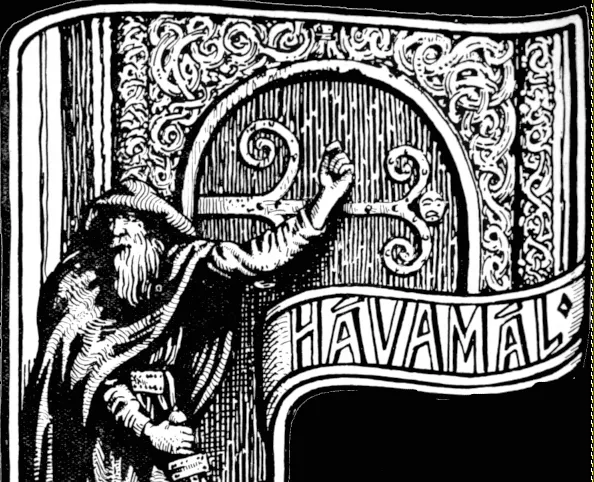
One of the reoccurring critiques and challenges I get from Christians and others regarding Paganism is the accusation that I don’t “Really” believe in the Pagan Gods … that I believe or “believe” only as some calculated political/philosophical expedient or aesthetic choice and that really my professed “belief” is some sort of white or darker shade of lie or “LARP”, and that I must plainly KNOW that the Greek, Roman, Nordic, Celtic and other pantheons and only legends, mere mythologies, and cute stories …
I wish I could find it … but there was actually a twitter thread about a group of Christians and Jews responding with OUTRAGE when a group of academics, quite detachedly and seemingly meaning nothing by it, referred to Behemoth, Leviathan, the Flood, the Destruction of Sodom and Gomorrah, David’s defeat of Goliath, Adam and Eve, the Nephilim, the Plagues of Egypt, and Abraham and Issac as stories and figures of “Hebrew Mythology”.
“Mythology” to their mind was not a neutral term referring merely to cultural stories of a supernatural or historically unverifiable nature whose historicity, origin, and attachment to actual events cannot be verified to the standard of primary history — Stories of cultural import which may or may not be true or fictionalized to some extent we can’t differentiate (Imagine if Gone with the Wind was the last American book to survive and then arguing the Battle of Atlanta was fictional and never happened), the way Homer’s account of the sloped walls of Troy turned out to be shockingly accurate when Troy was found, whereas his accounts of Chariot warfare seemed to be confused by the subsequent 300 years without Greeks employing chariot archers. Rather “Mythology” to their minds denotes FALSE STORIES. SUPERSTITIONS with no attachment to reality, and thus to refer to even the most fantastical and supernatural of biblical stories as events or aspects of “Hebrew Mythology” was to state the Bible was false.
Troy, Gilgamesh, the Arthurian Legends, the Buddha, the conquests of Mohammed, the war of the Three Kingdoms, the Battle of Goths and Huns, the Hiawatha, the Wendigo, Quetzalcoatl (the God and the hypothesized historical ruler), the various unconfirmed Pharaoh stories, the Mormon Corpus … THESE ARE MYTHOLOGY. Even the stuff that’s been archeologically confirmed. Our collection of of texts and books though … you can’t call that mythology. It’s the truth!
Ironically many of these same people within nearly the same breath that they accuse me of being a “LARPER” will also accuse me of making pacts with “Demons” and claim that the beings I believe in are in fact vastly more real than I can possibly comprehend and that I am playing with the most dangerous of hellfire … so pressingly REAL and dangerous are the Ancient “Gods” who are actually Satanic Demons in barely concealed disguise.
Somehow I am simultaneously a cringe 90s mall goth playing at witchcraft and also a Later-Day Faustus dealing in a damnable deadly game with the Devil himself.
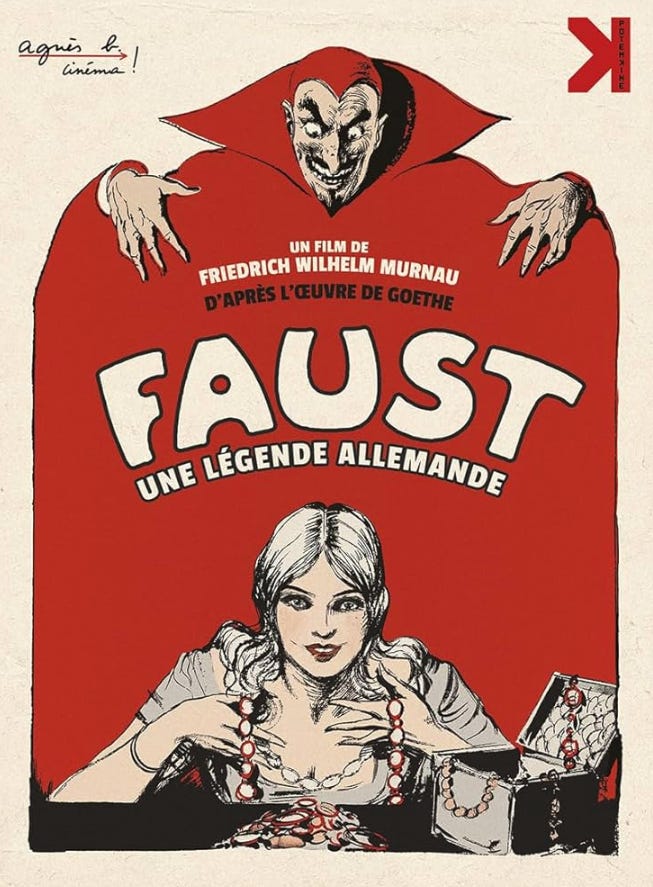
Amazing film BTW (Faust 1926)
“But do you actually believe in the Pagan Gods?”
Yes. Vastly more deeply and in more ways than the vast majority of Christian believe in their religion.
The Korean War Week 53 – Moscow Says ‘End the War!’ – June 24, 1951
The Korean War by Indy Neidell
Published 24 Jun 2025Soviet Ambassador Jacob Malik speaks to the world on UN radio, saying that the Soviet position on Korea is that ceasefire talks should begin among the belligerents. The Americans are thinking of how they can bring in more non-American UN units, even as South Korean President Syngman Rhee denounces the British and Commonwealth forces and says they should go home.
00:00 Intro
00:41 Recap
01:07 Jacob Malik Speaks
02:02 Chinese Change Plans
03:19 10th Corps Advances
05:37 More Non-American UN Units
07:52 Rhee Denounces his Allies
12:17 Summary
12:40 Conclusion
14:15 Call to action
(more…)
H.G. Wells’ Things To Come: Through The Eyes of its Time
Feral Historian
Published 10 Jan 2025H.G. Wells’ Things To Come played much differently in 1936 than it does today. So much so that it offers us an insight into the politics of the period if we can step back from our post-WWII understanding and look at it on its own terms.
Link to the Coupland essay.
http://digamoo.free.fr/coupland2000.pdf00:00 Intro
02:08 Revolution Envy
05:15 The Gulf of Time
06:32 Wells and the BUF
08:02 Empire and Establishment
12:11 The World State
15:18 To Understand the Past …
QotD: Marie Antoinette and the “Diamond Necklace” scandal
Today, the Diamond Necklace affair has been relegated to the status of sensational footnote in history books about the French Revolution. Throughout the 19th century, however, the scandal was widely believed to have been a major factor in the overthrow of the Bourbon monarchy. Decades after the French Revolution, Napoleon observed from the vantage point of his post-Waterloo exile: “The Queen’s death must be dated from the Diamond Necklace trial”. […] And here’s the irony: While the Diamond Necklace affair was the scandal that most tarnished Marie Antoinette’s reputation, it was one in which she was almost certainly guiltless.
The origins of the affair stretched back to Louis XV, who wished to lavish on his mistress, Madame du Barry, a splendid diamond necklace containing 647 stones and weighing 2,800 carats (worth roughly $15 million today). But Louis XV died before the sale of the necklace was concluded. And when young Louis XVI took the throne, the Paris jewelers Boehmer and Bassenge hoped the new king would purchase the same necklace for his own queen, Marie Antoinette. However, she refused to accept a piece of jewelry that had been created for the previous king’s mistress.
Meanwhile, a socially ambitious minor aristocrat named Jeanne de la Motte was plotting to get her hands on the necklace. Married to the Comte de la Motte, she was also the mistress of Cardinal de Rohan, former French ambassador to Marie Antoinette’s native Austria. Madame de la Motte managed to convince Cardinal de Rohan not only that Marie Antoinette wished to possess the necklace, but that she was acting on the Queen’s behalf. He could ingratiate himself at court, she insisted, by obtaining it. Cardinal Rohan foolishly purchased the necklace on credit, under the naive belief that he’d be repaid by Marie Antoinette. The scam concluded with Madame de la Motte stealing the necklace from the cardinal and, using her husband’s louche connections, selling it in pieces through fences in England.
This tawdry business was closer to comic opera than an affair of state. But when the fraud was discovered, the scandal gripped Parisian society. Louis XVI was so infuriated that he had Cardinal de Rohan arrested and imprisoned in the Bastille, which only heightened public interest. Marie Antoinette was already being caricatured in pamphlets as a depraved nymphomaniac. It was now open season.
In some caricatures, she appeared as a wild beast, a tiger feeding on the French nation. In others, she was depicted as an ostrich, a French wordplay with her home country Autriche, for Austria, which reads like autruche for ostrich. Even worse, she was depicted in pornographic postures, legs open and genitals gaping, cuckolding her obese husband with a succession of lovers, including lesbian trysts. Allusions to her sexual appetites suggested a carnal relationship with Satan. Robespierre’s publication Le Journal des hommes libres described her as “more bloodthirsty than Jezebel, more conniving than Agrippina”. The pamphlets blamed Marie Antoinette for all the nation’s misfortunes, including economic recession. She was so hated by the French public that there were serious concerns for her physical safety.
[…]
Cardinal de Rohan, meanwhile, was tried for his role in the Diamond Necklace affair. Astonishingly, he was acquitted. The scheming Madame de la Motte met a different fate. She was found guilty of theft and sentenced to be whipped and branded on the shoulder with the letter V for voleuse (thief). She was also incarcerated in the Salpêtrière prison in Paris, but escaped to London. In 1789, she published a book, Mémoires justificatifs, a scathing tell-all memoir about Marie Antoinette. It was a good year to attack the French monarchy, for the revolution was just getting going. Madame de la Motte was never returned to France to face justice. Exiled in London, she died in 1791 after falling from a window, apparently fleeing debt collectors. She was buried in St. Mary’s Churchyard in south London.
Matthew Fraser, “Marie Antoinette: Figure of Myth, Magnet for Lies”, Quillette, 2020-06-24.
June 24, 2025
Fandom Has Always Been UNHINGED
Jill Bearup
Published 23 Jun 2025Listen, nobody asked for a history of fanfiction but here we are regardless. From Helen of Troy fix-it fic to Holmes fans unsubscribing en masse when the detective was killed in The Final Problem, fandom has always been this chaotic, and fanfiction has always been with us. In one form or another.
00:00 Did you ask for this? Nah.
01:20 Ancient authors ripping off other ancient authors
03:06 Virgil was a Homer fanboy
04:10 Dante was a Virgil fanboy
05:18 Don Quixote and the Case of the Unauthorised Sequel
08:01 The Statute of Anne
12:35 Gulliver’s Travels NSFW fanart
14:40 Geniuses and Originality
16:51 The Berne Convention
17:20 Character Vibes are not Copyrightable
20:46 The First Modern Fandoms (were Genuinely Unhinged)Link to Der Spiegel article on copyright and innovation: https://www.spiegel.de/international/…
“Britain’s bill for Caribbean slavery comes to £19 trillion – fifteen times the current annual budget of the UK government”
The demands for reparations for historic wrongs will continue to grow, but the chances of any of the hustlers making the demands are remarkably slim, and thank goodness for that, because if the principle ever gets established we’ll be on a never-ending beggar-my-neighbour jag:
Britain’s bill for Caribbean slavery comes to £19 trillion — fifteen times the current annual budget of the UK government — according to the 2023 Brattle Report. And if the “Glasgow — City of Empire” display at the Kelvingrove Museum is anything to go by, Scotland owns a large share of that, since Glasgow was “one of the major port cities” involved in the slave-trade, whose profits played “a crucial role” in its economic development and prosperity.
The Tall Ship in Glasgow Harbour
The debt-collectors are already knocking at the door. In March 2023, Clive Lewis, MP and shadow Foreign Secretary under Jeremy Corbyn, called for the UK government to start “meaningful negotiations” over reparations with Caribbean countries. The following autumn, Lewis’s parliamentary office became the centre of a reparations-campaign, funded by Irish billionaire Denis O’Brien. And in April this year, Sir Keir Starmer received the Prime Minister of Barbados, Mia Mottley, into No. 10. “We’ve known each other many years as good colleagues and now as leaders who think alike”, said Starmer. Mottley has stated that Britain owes Barbados £3.9 trillion and it was she who pushed for reparations onto the agenda of the Commonwealth Heads of Government summit last year.
But the case for reparations doesn’t add up. Yes, some Britons were involved in inhumane slave-trading and slavery, mainly from about 1650 to the early 1800s, when they transported over 3.2 million slaves from Africa to the Americas. Yet, while campaigners portray British involvement as uniquely dreadful. It wasn’t.
Up until the end of the 18th century AD slavery and slave-trading were universal institutions, practised since the dawn of time on every continent by peoples of every skin colour. In North America, indigenous societies in the Pacific North-West were built on slave-labour, since subsistence required the rapid processing of salmon, and the quantity of work outstripped the supply of female labour. So, raiding for slaves was endemic. Thousands of miles to the south, the Comanche ran “the largest slave economy” in the 1700s — according to Oxford’s Pekka Hämäläinen. Meanwhile, on the other side of the Atlantic, Arabs had been busy slave-raiding and -trading since at least the 7th century AD. According to one authority, the Muslim trade transported 17 million slaves mainly from Africa, but also from Europe, to the southern and eastern coasts of the Mediterranean. This is one context out of which reparations-advocates like to abstract British slavery.
Another is African complicity. British slave-ships off the coast of West Africa didn’t have to raid inland to obtain their slaves. They just waited on the coast for them to be brought. Africans had been busy enslaving and trading other Africans for centuries, first to the Romans, then to the Arabs, and finally to the Europeans. As early as 1550 the Kingdom of the Kongo was exporting up to 8,000 African slaves annually to the Portuguese.
The final context that campaigners studiously ignore is the fact that Britain was among the first states in the history of the world to abolish slave-trading (in 1807) and slavery (in 1833) throughout its territories. It then used its dominant power to suppress both slave-trading and slavery from Brazil, across Africa and India, to New Zealand for the second half of the British Empire’s life. In the 1820s and ’30s, the Slave Trade Department was the Foreign Office’s largest unit. By mid-century the Royal Navy was devoting over 13 per cent of its total manpower to stopping transatlantic slave-trading. The cost of this alone to British taxpayers was at least the equivalent of up to £1.74 billion today or 12.7 per cent of the UK’s current expenditure on development aid — for half a century. According to the eminent historian, David Eltis, the nineteenth-century costs of slavery-suppression exceeded the eighteenth-century benefits.
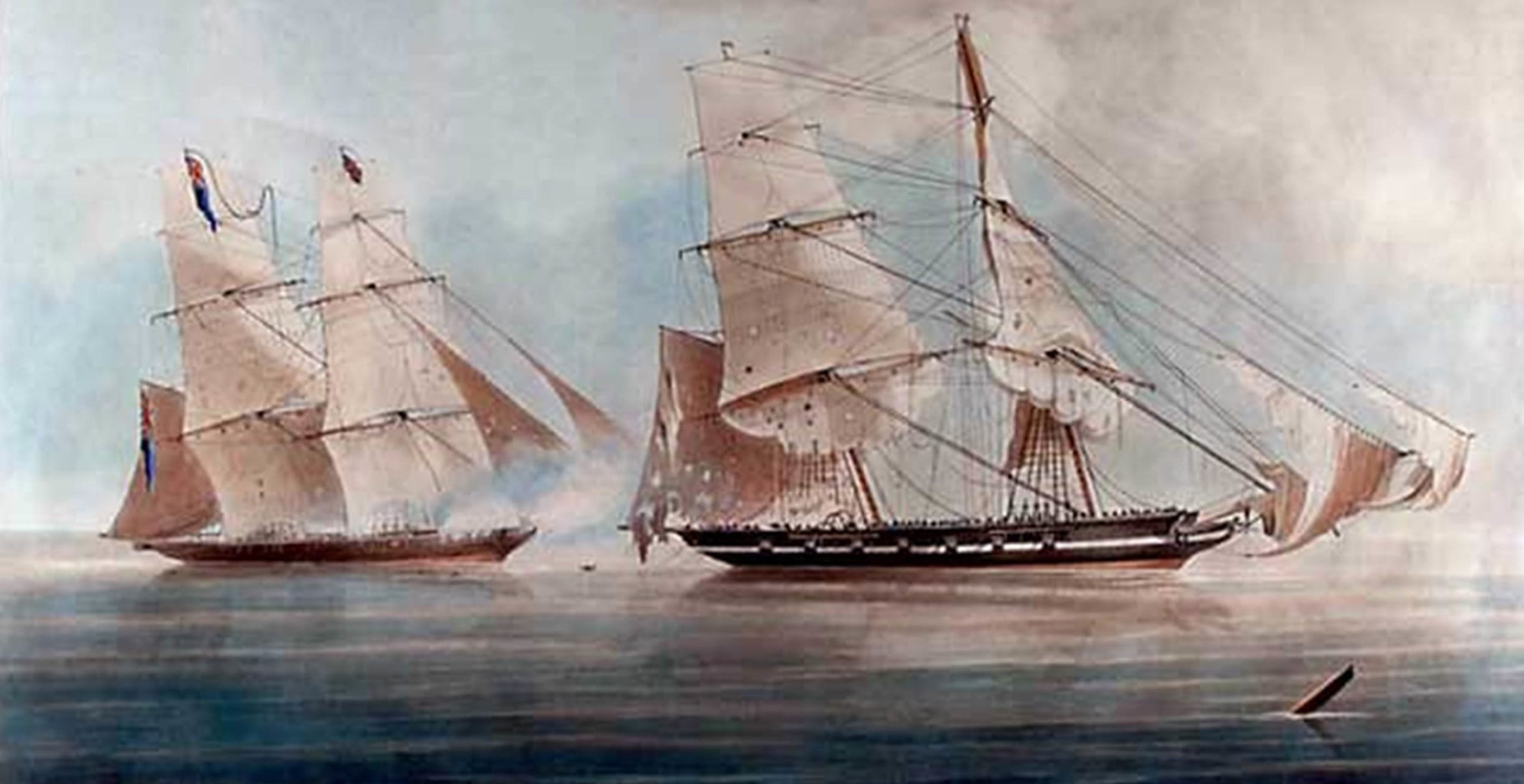
The West Africa Squadron, which freed 150,000 African slaves.

Praga I-23: Prototype Belt-Fed Predecessor of the ZB26
Forgotten Weapons
Published 3 Feb 2025Vaclav Holek’s first machine gun design for the Czech military was the Praga I, built in 1922 and based heavily on the Vickers/Maxim system. However, it became clear that the military wanted something lighter and more portable, and so the next year he heavily updated the design to this, the Praga I-23 (for 1923). It remains a belt-fed weapon chambered for the 8mm Mauser cartridge, but the locking system has been much simplified into a tilting bolt arrangement. The recoil operation from the earlier model is also gone, now replaced by a long stroke gas piston. Some elements of the Maxim remain in the belt feeding elements, but the overall gun is much more a light machine gun than the mounted heavy machine gun that was his first design.
A total of 40 of the Praga I-23 were ordered by the Czechoslovak military, and they were tested in 1924 (only 20 examples were actually delivered of the 40). The I-23 performed well, but it was again clear that it wasn’t quite what the military really wanted. Holek revised the design again to the model 1924, using a box magazine instead of a belt feed — and that is the gun that continued the path to the ZB-26.
Video on the Praga I machine gun that came immediately before this model: Praga I: A Blow-Forward Bullpup Semi-…
Many thanks to the VHU — the Czech Military History Institute — for giving me access to this fantastic prototype to film for you. The Army Museum Žižkov is a part of the Institute, and they have a three-story museum full of cool exhibits open to the public in Prague. If you have a chance to visit, it’s definitely worth the time! You can find all of their details (including their aviation and armor museums) here:
June 23, 2025
How Sex in War Breeds Boys – W2W 33
TimeGhost History
Published 22 Jun 2025That prolonged war triggers an increase in male baby births had been ordered since at least 250 years. This “returning soldier effect” happens again during WW2 and right after. How this happens is a mystery, but research in the past decades might provide some answers.
(more…)
Augustus and the empire – The Conquered and the Proud 14
Adrian Goldsworthy. Historian and Novelist
Published 15 Jan 2025This time we look at Augustus, the empire and the army. The man who built the Altar of Augustan Peace in Rome was also the last of the great conquerors, who added more territory to the Roman Empire than any other individual leader. How he did this, and how he kept the army under control, is the theme of this video.
QotD: Recruiting and organization under the “Marian reforms”
Sallust reports that Marius, “after he saw that the spirits of the plebs were aroused, he swiftly loaded ships with supplies, pay, weapons and other requirements; with them he ordered Aulus Manlius, his legate, to set out. Meanwhile himself he enrolled soldiers, not according to the mos maiorum [‘the customs of the ancestors’] from the census classes, but making use of whoever wished to go, mostly the capite censi [‘those counted by heads’ = the propertyless poor or proletarii]” (Sall. Iug. 86.1-2, trans mine). Plutarch repeats this report, that Marius violated custom by enrolling men who didn’t meet the property qualification for military service (Plut. Mar. 9.1).
There are a few oddities here to start, though. First, Sallust quickly notes that this resulted in Marius having an army rather larger than what the Senate had actually authorized (Sall. Iug. 86.4) and that’s actually quite a neat detail that may explain part of what’s going on here because this has, in a way, happened before. In 134, Scipio Aemilianus was elected consul for the second time (illegally, again) with a mandate to end the frustrating Roman war against the Celtiberian stronghold of Numantia in Spain. The Senate, however, denied Scipio authorization to raise fresh troops, to which Scipio responded by enlisting some 4,000 volunteers to replenish his legion; Appian says this was done with the consent of the Senate, but Plutarch’s brief note on it sure implies Scipio Aemilianus is end-running around Senatorial efforts to stifle him (App. Hisp. 84; Plut. Mor. 201A-B). And this too was hardly the first time for this sort of end-run; Scipio Africanus (what is it with Scipiones!?) back in 205 agitated for his invasion of Africa to end the Second Punic War and was given the province of Sicily with authorization to go to Africa if he thought it necessary, but the Senate registered its displeasure by refusing to let him levy troops, at which point – wait for it – Scipio took volunteers, equipping and financing his force through the socii and even building a fleet that way (Liv. 28.45.9-12).
In short, the Senate sometimes tried to trim the sails of generals it was displeased with – and Marius reportedly had gotten elected on a campaign platform of “to hell with the Senate” (Sall. Iug. 84.1) – by limiting the size of their armies or refusing to allow them to conduct a levy. And since 205 (a century before Marius), popular generals had occasionally juked this effort by the Senate by instead calling for volunteers, which the Senate could not stop. Marius is not doing something new in taking volunteers to supplement an army through the levy.
He also doesn’t keep doing it. After Marius wins in Africa with his volunteer-supplemented army (the bulk of which of course were still recruited through the dilectus under Metellus), he returns to Italy to take over the war against the Cimbri and Teutones but he doesn’t keep up the volunteer force, instead taking command of his predecessor Rutilius Rufus’ normally levied army (Front. Strat. 4.2.2). In practice, Marius probably took volunteers in part for that first army because the Senate was diverting available levy manpower towards the early phases of the Cimbric War (or at least that was a convenient excuse to kneecap him) – a series of costly military disasters for Rome which likely soaked up much of the manpower the Senate was willing to raise. Once Marius has access to that “primary” stream of manpower generated through the dilectus, he uses it and seems to stop using volunteers.
But what of recruiting the capite censi? Well, that isn’t quite new either, although it surely wasn’t typical. For one, it wasn’t that the poor absolutely never served; Polybius notes that the capite censi served in the fleet (Polyb. 6.19.2). But we also see non-assidui (assidui being the term for those wealthy enough to be liable for normal conscription) in a range of other emergencies. Livy reports in 329 a “crowd of sellularii [men who work sedentary trades, literally, ‘stoolsmen’], a type least suited for military service, were called into the army” (Livy 8.20.4), though the historicity of this report is questionable given the early date. In 296, Etruscan entrance into the Third Samnite War causes a draft of “not only the freeborn or the iuniores took the oath, but cohorts were made of seniores and centuries of freedmen” (Livy 10.21.4). Gellius (16.10.1) quotes Ennius reporting the proletarii were pulled into the armies in 280, presumably in response to Pyrrhus’ victory at Heraclea. And during the Second Punic War the Romans pulled out all of the stops, recruiting debtors and men convicted of capital crimes (Livy 23.14.3), enrolling slaves into the army (called the volones; you free them first and then draft them, Livy 27.38 and 28.10, Val. Max. 7.6.1) and as noted above, taking volunteers more generally.
As an aside, if you are wondering why the Romans seem in some of these to skip recruiting freeborn capite censi and go straight to freedmen and enslaved people, I think there are two answers here for this period. First, many of the available freeborn poor are probably already in service in the fleet. Second, there probably aren’t that many of them. Recall our chart of Roman social classes – the capite censi in the third century is quite small, almost certainly outnumbered by enslaved persons in Italy. But the population of Italy was rising over the third and especially second century and without adding new farmland, those new freeborn Romans may have swelled the ranks of the capite censi, leading to a much larger propertyless class by the late second century or the first century.1 Consequently, there may have been a lot more capite censi worth recruiting by Marius’ day, when Rome no longer needed to keep a large navy at sea (not facing any naval powers in its wars) and the number of capite censi having risen.
Finally, Marius does not mark the end of the Roman dilectus! Evidently Roman conscription persisted at least to the end of the Roman civil wars, as Suetonius reports Augustus (perhaps when he was still Octavian) inflicting the traditional penalty of being sold into slavery for draft-dodging on a Roman eques who cut the fingers off of his two sons to make them ineligible for military service (Suet. Aug. 24.1). Indeed we have attestations of the dilectus in 55, 52, 50, 49, AD 6 and AD 9.2 Even once the army is fairly clearly primarily a volunteer force, at least notionally the ability to hold a levy when necessary to fill the ranks remained “on the books” and Trajan (r. 98-117 AD) holds at least one levy because he punishes a father for the same reason Augustus had done (Dig. 49.16.4.12). So the traditional dilectus remained a thing Roman leaders could do well into the empire. In practice it seems safe to assume the system by the mid-first century is substantially ad hoc, as the census straight up doesn’t happen from 69 BC to 28 BC, which would make it hard to actually enforce the property requirements. But the process doesn’t stop in 107 and there’s no reason to suppose from 107 to 69, with the census being regularly conducted, that most annual levies were not conducted along traditional property lines.3
So the most we might say is that a one-time crisis expedient in earlier periods slowly becomes a standard way to supplement legions and then the standard way to recruit them, with the old normal method of the dilectus instead becoming the unusual way to supplement in a crisis. It’s unclear exactly when that shift-over point happens, but it sure isn’t in the career of Gaius Marius, who sits clearly in the “volunteers as a crisis response” side of the issue.
And what of the notion that Gaius Marius introduced both citizenship as a reward for service as a regular bonus and also that he instituted the paying of soldiers at the completion of a campaign to render them loyal? Well on the latter point, the Romans had been distributing spoils to the soldiers at the end of a campaign as a lump-sum payment since the beginning. This is exceedingly well reflected in Livy’s accounting of the years from 201 to 167 (where we have a nice continuous burst of Livy), see for instance Livy ::deep breath:: 30.45, 31.20, 33.23, 33.37, 34.46, 34.52, 36.40, 37.59, 39.5, 39.7, 40.34, 40.43, 40.59, 41.7, 41.13, 45.40, 45.43.4 And the idea that Roman victories might seize land which would then be settled as Roman coloniae, creating new land for Roman settlers was also not new (Wikipedia has a convenient list of Roman coloniae). So Marius is simply promising to do a thing Roman commanders regularly did, essentially saying, “serve with me, because I’m going to win and victory will make us rich”. Which is exactly the reason volunteers rushed to serve with Scipio Africanus and Scipio Aemilianus: they anticipated a lucrative victory for such well-regarded commanders.
And by now you may well be asking, “but wait, then when does the system change?” Because after all, I said that by the early empire, we can pretty clearly see an army primarily composed of professional, long-service volunteers who receive substantial retirement bonuses and are permanently stationed on the frontiers. Who is responsible for that? And in response, I give you, this guy.
It’s Augustus. It was always Augustus. Or at least I should say that is my view, given the evidence. Older scholarship – I think here of Keppie (1984) in particular – tended to assume that because most of the big changes happened with Marius (but we’ve seen they don’t) that Octavian/Augustus probably made only minimal changes to the military system he inherited from Julius Caesar. I don’t think that’s correct. I think if we look at the evidence in more detail it becomes clear that Augustus is the “break” (though not a clean break by any means) and that in fact we need to start regarding Augustus as a military reformer of some significant scale rather than merely the codifier of a Caesarian military system (though he probably does that too).
Augustus, after all, institutes regular bonuses for discharge, establishing a treasury funded by a regular tax to meet the expense rather than simply promising that he would win a lot and so soldiers would get rich off of their share of the booty (Res Gestae 17). And it’s not hard to see the problem he’s responding to – the massive military buildup of the Roman civil wars had left Octavian, as the victor, with the red-hot potato of hundreds of thousands of soldiers who were promised the spoils of victory, including large numbers of men who didn’t win but who, if not settled down somehow would disrupt the state (RG 3). Earlier in the civil wars, Octavian had used proscriptions and land confiscations to solve this problem but as emperor, he needed a permanent solution, thus the establishment of the aerarium militare and its discharge bonuses (praemia). Before that, you simply had generals promising to feast their soldiers off of the property of the vanquished; the civil wars had only changed that in that the vanquished were now Romans. It also establishes a standard length of service, creating that professional, long-service army.
There’s a related issue which is the fate of the citizen equites and the velites. Caesar’s armies in Gaul seem to have neither, so the assumption was that the shift to recruiting proletarii meant that these wealth-based distinctions (the richest Romans serve as equites, the poorest as velites) dropped away, leaving a uniform heavy infantry legion. And in a schematic it makes sense: both roles are absorbed by the auxilia and indeed Caesar makes use of a lot of Gallic cavalry auxiliaries. But as François Gauthier recently pointed out,5 it’s not all clear that the velites really did vanish in the late-second/early-first century. Cicero still refers to to them writing in the 40s (Cic. Fam. 9.20; Brut., 271) and their apparent absence in Caesar’s writing may well just be an accident of Caesar’s avoidance of technical language. Caesar doesn’t generally talk about hastati or triarii much either; he prefers milites (“soldiers”). Likewise, it’s clear the citizen cavalry – the equites – survived Marius; as Jeremiah McCall notes, we have good evidence for citizen equites at least as late as the 90s BC and suggests the citizen cavalry probably vanished in the 80s as a result of the Social War and Sulla‘s Civil War.6 It surely did not happen in 107 or 104.
Meanwhile the auxilia as a mature part of the Roman army really only emerge under Augustus, and not even right at the beginning of his reign either. Roman armies needed cavalry and light infantry to function, so once again we may not be looking at a clean break but rather a period of transition as a result of some generals preference for (non-Italian) allied or auxiliary cavalry and light infantry and the formalization of that system not in 107 with Marius but again in 27 with Augustus.
Marius is also sometimes credited with the idea of extending citizenship to non-citizens who served, which is a catastrophic misreading of one episode in his career. For one, this gets read as meaning that Marius extended citizenship to all of the Italians in his army or that he made it standard to do so. Note for instance this line pulled from Wikipedia:
Finally, Marius granted citizens of the Italian allies (Etruria, Picenum, etc.) full Roman citizenship if they fought for Rome and completed a period of service in the Roman army.
[Dated] 6/25/2023, specified in the hope this page changes to be less wrong.
And that’s very much not right either. We have evidence for only a handful of citizenship extensions by Marius. In particular, of his army he extended citizenship to just two cohorts (c. 1,000 men) from Camerinum (Plut. Mor. 202D, Cic. Pro Balbo 46.). I can only assume this gets misunderstood because some writers don’t know their unit sizes, but Marius had 32,000 men in his army at Vercellae (101 BC), probably something like half of which were socii. These two cohorts were a comparatively tiny fraction. Marius also seems to have selected a very small number of his other socii veterans for citizenship (Cic. Pro Balbo 48), but there was no blanket grant of citizenship. Of course there wasn’t, this issue remained substantially unsolved until the Social War (91-87BC); if Roman levies had been calmly minting new citizens out of thousands of Italians through the 90s, there would hardly have been a cause for the Social War.
Instead, citizenship as a reward for service is an artifact of the imperial period and the auxilia. The Roman use of non-Roman, non-socii troops to supplement their armies was not new, but it emerged as a formalized, permanent part of the Roman army not during the civil wars – where such units where both ad hoc but also not nearly so numerous – but under the reign of Augustus, coming to form about half of the army by the end of his reign (Tac. Ann. 4.5; on the emergence of the auxilia, see I. Haynes, Blood of the Provinces (2013)). Indeed, as Haynes notes (op. cit. 49), it is actually only under Tiberius (r. 14-37) that we get direct evidence of citizenship grants to auxilia and the practice even then seems at least somewhat irregular (though it comes to be regularized).
In short that, the notion that Gaius Marius instituted the pattern of granting citizenship to serving non-citizens on discharge is simply wrong; that’s not in our sources. That doesn’t become consistent until Tiberius well over a century later. Gaius Marius did recruit volunteer capite censi into his army once but didn’t make a habit of it and as such isn’t a major reformer so much as a key step in a slow process of change which reaches its decisive point probably under Augustus, more than half a century after Gaius Marius died. He wasn’t the first to do either thing, whatever our sources say.
Bret Devereaux, “Collections: The Marian Reforms Weren’t a Thing”, A Collection of Unmitigated Pedantry, 2023-06-30.
1. For more on the dynamics of this, see N. Rosenstein, Rome at War (2004), as this is part of his central argument.
2. For textual references, see Brunt, Italian Manpower (1971), 636-7.
3. We do not know how that process would have accounted for the massive expansion of the Roman citizen class due to the Social War. But evidently it did!
4. These were happily already compiled by Brunt, op. cit., 394.
5. “Did velites Really Disappear in the Late Roman Republic?” Historia 70 (2021).
6. J.B. McCall, The Cavalry of the Roman Republic (2002), 100-113..
June 22, 2025
Day Four – The Meuse Must Hold! – Ten Days in Sedan
World War Two
Published 21 Jun 2025May 13, 1940: In today’s episode of our WW2 documentary, Ten Days in Sedan, the German Blitzkrieg reaches its climax. Guderian’s Panzers launch a daring river assault as the Luftwaffe pounds French lines into chaos. Away from Sedan itself, Rommel and Reinhardt strike further north, opening new fronts. France scrambles to counterattack, but the German bridgeheads are growing fast.
00:00 Intro
00:48 French Defences, German Air Assault
04:13 Guderian Crosses The Meuse
08:25 Hartlieb’s Houx Crossing
11:28 Rommel Crosses At Dinant
16:04 Einhardt Crosses At Monthermé
19:15 Summary & Conclusion
(more…)
Ljungman Updates: the AG-42 vs AG-42B
Forgotten Weapons
Published 31 Jan 2025In 1953, the Swedish military launched a program to refurbish and refit all of the Ag m/42 rifles in inventory. Aside from replacing broken parts and worn barrels, the program also made a number of improvements to the rifles:
- Auxiliary front magazine catch added
- Large gripping lugs added to bolt cover
- Rubber case deflector added
- Single-piece cleaning rod to replace the two-part original
- Rear sight geometry modified
- Rear sight range dial modified
- Dual-wire recoil spring in place of the original single wire type
These updates were made to virtually all rifles then in existence, and it is very rare to find original pattern Ag m/42 rifles today.
(more…)


