
Quotulatiousness

July 10, 2013

How Avro salvaged a bad design to create the Lancaster bomber

Filed under: Britain, History, Technology, WW2 — Tags: , — Nicholas @ 00:01

In Samizdata, Brian Micklethwait goes back to his Airfix modelling days to rediscover his admiration for Avro’s Lancaster bomber. In the process, he discovers just how strange the evolution of that aircraft actually was:

In the late 1930s, believing that bombers would always get through and that they therefore had to have lots of bombers or lose the war, British Air Officialdom had two ideas about how to build a bomber. They accordingly announced two specifications, which different potential bomber-makers were invited to meet with their designs. They wanted a two engined bomber, like those that the Germans bombed Britain with in 1940 but better, or like the Wellington but better. And they wanted a much bigger four engined bomber, such as the Germans never got around to building, and like … well, like the Avro Lancaster.

So, the Lancaster was Avro’s answer to the second requirement? Actually, no. Or, not at first. Britain ended up with three four-engine heavy bombers, the Short Stirling, the Handley Page Halifax, and the Lancaster. But strangely, by far the worst of these three, the Short Stirling, was the only one of the three that was all along intended to be a four-engine bomber. Both the Halifax and the Lancaster started out as answers to the two-engine specification rather than the four-engine one.

[. . .]

In particular, all the work that Avro had done improving, as they had hoped, the fuselage of the Manchester, which had done nothing to improve the Manchester, suddenly came into its own in the new configuration. Ever since I built my Airfix Lancaster as a child, I have wondered about the oddity of that Lancaster fuselage. Simply, this fuselage seemed too small for the airplane as whole. And the wings seemed too big. Not ugly exactly, in fact not ugly at all, but nevertheless a bit like the arms of one of those misshapen body builders with excessive biceps. My Lancaster photo (above) even shows how the wings between the fuselage and the inner two engines go straight out rather than tapering, as if these wings were only widened late on in the design process. Now, all that makes sense. The Lancaster’s fuselage began life as the fuselage of a smaller airplane. No wonder it looked to me too small. It was too small. The Lancaster’s wings look stretched because they were stretched. It is only now, after half a century and more of gazing at the Lancaster, that one looks at the Manchester, and sees its fuselage as too big and its wings as too small.

The birth of the Lancaster illustrates a general point about making airplanes, which explains why successful airplanes often fly on for so long. Consider the airborne WW2 mega-hit, the DC-3 (aka the Dakota), and then later the big Boeings, the B-52 and the 747. The Lancaster didn’t last as long as those hardy perennials, because propeller driven heavy bombers were soon replaced by jet bombers (like the B-52) and by intercontinental ballistic missiles. But even the Lancaster flew on for many decades, in the only slightly altered form of its close cousin, the Avro Shackleton, which only went out of service in 1991!
July 8, 2013

Canadian Army to return to historical designations and rank insignia

Filed under: Cancon, History, Military — Tags: , — Nicholas @ 14:40

Oh, good: now nobody in the journalistic world will ever be able to figure out what the assemblage of items on a Canadian Army officer’s shoulder strap actually translates to in spoken English.

Traditional Insignia for Officers

In line with the formalization of historical rank names for non-commissioned members, the traditional army officer rank insignia – with the stars, or “pips,” and crowns – are being restored. This ranking system is more than a hundred years old and continues to be used by armies the world over. Historically, the variations of the stars and crown were used to delineate rank so that officers could recognize each other on the battlefield. Canadian Army colonels and general officers will also wear the traditional gorget patches.

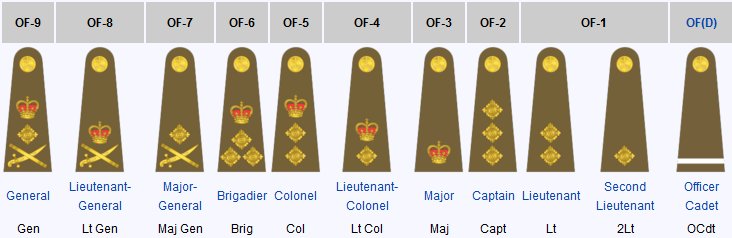
A quick search didn’t turn up any new graphics showing the rank insignia, but it’s similar to what the British army uses:

British army officer insignia

Divisional Nomenclature and Patches

Land Force Areas will be renamed as divisions and Canadian Army personnel will wear appropriate division patches. Formations will be renamed as follows:

  • Land Force Quebec Area will be referred to as “2nd Canadian Division”;
  • Land Force Western Area will be referred to as “3rd Canadian Division”;
  • Land Force Central Area will be referred to as “4th Canadian Division”;
  • Land Force Atlantic Area will be referred to as “5th Canadian Division”; and
  • Land Force Doctrine and Training System will be referred to as “Canadian Army Doctrine and Training Centre”.

There will be no change to 1st Canadian Division Headquarters.

Update 24 July: No wonder the official website didn’t have any updated graphics for the re-instated rank insignia … “The CA was not apprised of this announcement until days before the MND made it. It was announced less than 2 weeks ago so we can only offer preliminary information.

It is not generally understood how our Army came to wear the current Navy rank. This SITREP will hopefully allow you to dispel wrong information.

Key Talking Points

a. ‘Stars and Crowns’ is not British. The officers of almost 100% of the armies on every continent of the world including China, Russia, Finland, Colombia, and including the Salvation Army and RCMP wear a system of two identifiers: (i) a star, and (ii) a national symbol…it is an international convention and customary practice so an officer from any country can negotiate on the battlefield or work in coalitions like the UN or NATO and with civilian agencies. Canada’s Army used this international customary practice from 1885, officially recognized it in 1903, but lost it in 1968.

b. The CA lost stars and crowns as rank insignia in 1968 when the CA and RCAF plus the RCN were directed to put-up Merchant Navy rank. The RCN successfully got their ‘fighting-Navy’ executive curl back for their 100th anniversary. Now, the CA will return to Army vice Navy rank in time for the 100th anniversary of WWI and the 75th anniversary of WWII.

c. Cheaper. It costs $33.00 to tailor an officer’s DEU sleeve rank every time they get a new jacket or are promoted. It costs $5-6.00s for a pair of crowns or stars. The CA will save 80% of the costs and pay-off the initial project in just over 4 years. ‘Stars and crowns’ is going to save money for the CA not cost money.

This is what we can share now and will continue to share more in next Friday’s SITREP.

• Date of Implementation. Stars and Crowns cannot be implemented until a meeting off the National Defence Clothing and Dress Committee endorses the design for wear on DEU uniform. The CA will likely announce two dates: (i) the date that crowns and stars are available from each officer’s Logistik Unicorp account, and (ii) the date they need to be put-up.
• The full implementation may take considerable time to fully introduce because we were unaware of the change and there is no current stock of crowns or stars in the supply system.
• The CA will introduce the traditional rank system of WW II as found in Figure 14 of the 1953 CA Dress Regulations. We have already met with DHH and DSSPM for purchase discussions.
• DEU. The CA will buy and issue one pattern of star and crown at public expense based on one national CA/DHH approved pattern. The crowns and stars will be push pin like the NCM rank badges so the uniform is not damaged.
• Rifle and Guards Regiments. The CA will respect the traditional prerogative of rifle regiments and Regiments of Guards to purchase their alternate colours and patterns of stars and crowns respectively on DEU, patrol, ceremonial, and mess dress. For DEU, the CA HQ has requested public funding but the outcome is not known. For DEU, rifle regiments must still apply to the chain of command and submit their alternative designs for approval by the CCA and DHH. Rifle regiments may contact the G1 Heritage Pat Bryden at 613 415 7707 for additional guidance.
• CADPAT. There is a new high visibility CADPAT rank slip on/velcro project running as we speak. The project will change all CADPAT rank to higher visibility thread. This project will introduce stars and crowns for officers prior to mass production. Thanks to this project, there will be no new cost to put crowns and stars onto CADPAT slip-ons.
• DEU Slip-ons. The CA with DHH will also approve patterns for the officers’ slip-on for the CA. Decisions are now being made on the extent of patterns and the extent of public funding support. Vendors are already offering rank badges and insignia to units. Some units might lean forward and we suggest Divisions advise units to not proceed until key decisions are made on (a) permissible public and non-public purchasing, (b) the extent to which units will be permitted to deviate from the CA patterns, and (c) the CA date to implement new DEU rank is announced in a CANARMYGEN. All regiments can trust that our CA HQ is working in the interest of regimental identity and speed to meet the MND intent.
• Mess Dress. It is recognized that a substantial number of our CA units still informally use stars and crowns on their mess dress. The current CA recommendation will be that officers with Navy bars on their mess dress will only be required to put-up stars and crowns voluntarily (grandfathered) but it will be mandatory if/when the officer is promoted. This will be further developed.

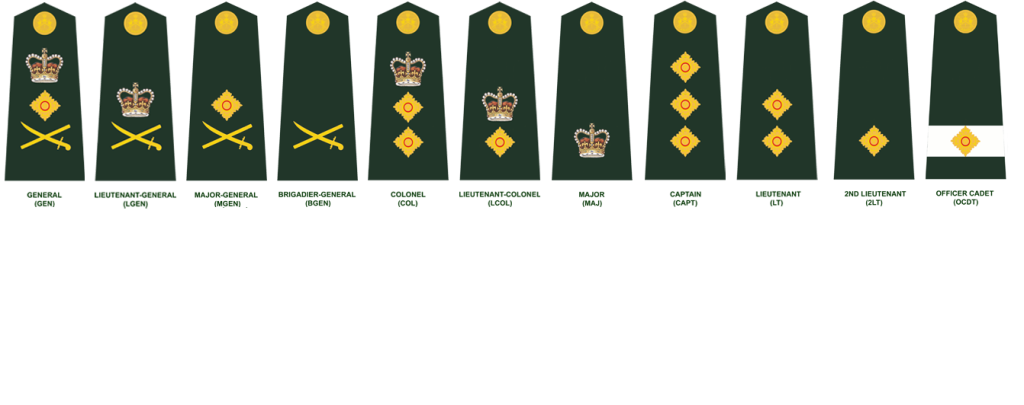
Update, 11 June, 2014. While I wasn’t paying attention, the Canadian Army Insignia page was updated with the current rank insignia. For your inconvenience, I’ve bodged the officer shoulder insignia into one image:

Canadian Army Officer Rank Insignia 2014

July 6, 2013

Orwell’s rules of tea

Filed under: Britain, Food, History, Randomness — Tags: — Nicholas @ 09:02

When he wasn’t writing books for the ages, George Orwell sometimes turned his hand to less world-shaking tasks such as making a proper cup of tea:

First of all, one should use Indian or Ceylonese tea. [. . .]

Secondly, tea should be made in small quantities — that is, in a teapot. [. . .]

Thirdly, the pot should be warmed beforehand. [. . .]

Fourthly, the tea should be strong. [. . .]

Fifthly, the tea should be put straight into the pot. [. . .]

Sixthly, one should take the teapot to the kettle and not the other way about. [. . .]

Seventhly, after making the tea, one should stir it, or better, give the pot a good shake, afterwards allowing the leaves to settle.

Eighthly, one should drink out of a good breakfast cup — that is, the cylindrical type of cup, not the flat, shallow type. [. . .]

Ninthly, one should pour the cream off the milk before using it for tea. [. . .]

Tenthly, one should pour tea into the cup first. [. . .]

Lastly, tea — unless one is drinking it in the Russian style — should be drunk without sugar.

Dateline 1972 – Nixon tries to “fix” NFL blackout policies

Filed under: Football, History, Media — Tags: , , , , , , — Nicholas @ 08:52

The St. Paul Pioneer Press raided the National Archives to find this clip of President Nixon talking to his attorney general about the outrageous NFL TV blackout policy:

Football populist Richard Nixon was furious at the NFL and wanted to flex his political muscle to end television blackouts.

At 2:06 p.m. on Dec. 18, 1972, Nixon met with Attorney General Richard Kleindienst at the Executive Office Building and railed against the league’s policy that prevented fans from watching their team’s home playoff games on TV.

The 37th president of the United States wanted to intervene because the Washington Redskins-Green Bay Packers postseason game at RFK Stadium on Christmas Eve was going to be blacked out in Washington, D.C., even though it already was sold out.

In a conversation secretly recorded by the White House bugging system that helped doom his presidency, Nixon threatened to sue the league if it did not lift blackouts for the playoffs. The devout Redskins fan ordered Kleindienst to “get busy with your lawyers” and take the fight to NFL Commissioner Pete Rozelle and Redskins owner Edward Bennett Williams.

July 5, 2013

The secret army of monitors who fed Enigma signals to Bletchley Park

Filed under: Britain, Germany, History, Italy, Military, WW2 — Tags: — Nicholas @ 08:20

The BBC remembers the volunteer radio tinkerers who helped win the intelligence war in Europe:

One day, towards the start of World War II, a captain wearing the Royal Signals uniform knocked on a British teenager’s door.

The 16-year-old was called Bob King. When he went to greet the visitor, he had no idea that soon he would become one of Britain’s so-called “voluntary interceptors” — some 1,500 radio amateurs recruited to intercept secret codes broadcast by the Nazis and their allies during the war.

“The captain asked me if I would be willing to help out with some secret work for the government,” remembers Mr King, now 89. “He wouldn’t tell me any more than that.

“He knew that I could read Morse code – that was the essential thing.”

[. . .]

By mid-1941, the new base, Arkley View, was receiving about 10,000 message sheets a day from its recruits.

“I worked for five years scrutinising the logs that came in from the other amateurs — thousands of log sheets with the signals which we knew were wanted, and you could only know it from experience,” remembers Mr King.

“We knew it wasn’t Allied army air force, we knew it was German or Italian — various things gave that away, but it was disguised in such a form that it looked a bit like a radio amateur transmission.

“We knew it was highly important, everything was marked ‘top secret,’ but only many years later we discovered that it was German secret service we were listening to.

“Of course you didn’t ask questions in those days, otherwise you’d be in real trouble.”

Encoded messages were transmitted to Bletchley Park in Buckinghamshire, the UK’s former top-secret code-cracking centre.

Once decoded, the data was sent to the Allied Commanders and the UK Prime Minister, Winston Churchill.

July 1, 2013

The rise and fall of economic powers

Filed under: China, Economics, History, Japan — Tags: , , , , , — Nicholas @ 10:30

Charles Hugh Smith has a guest post at Zero Hedge, talking about the theme of economic decline of great powers:

Our collective interest in the rise and fall of empires is not academic. The meteoric rise of China and the financialization rotting out global capitalism are just two developments that suggest we are entering an era where some great powers will collapse, others will remake themselves and others will gain ascendancy.

[. . .]

In 1987, pundits were predicting that Japan’s “5th generation” computing would soon dominate what was left of America’s technological edge. They were spectacularly wrong, as the 5th generation fizzled and Japan became an also-ran in web technology, a position it still holds despite its many global electronic corporations and vast university research system.

Japan’s modern economy was set up in the late 1940s and early 1950s to exploit the world of that time. Sixty years later, Japan is still a wealthy nation, but its relative wealth and power have declined for 20 years, as its political-financial power structure clings to a model that worked splendidly for 40 years but has not worked effectively for 20 years.

The decline is not just the result of debt and political sclerosis; Japan’s vaunted electronics industry has been superseded by rivals in the U.S. and Korea. It is astonishing that there are virtually no Japanese brand smart phones with global sales, and only marginal Japanese-brand sales in the PC/notebook/tablet markets.

The key dynamic here is once the low-hanging fruit have all been plucked, it becomes much more difficult to achieve high growth rates. That cycle is speeding up, it seems; western nations took 100 years to rapidly industrialize and then slip into failed models of stagnation; Japan took only 40 years to cycle through to stagnation, and now China has picked the low-hanging fruit and reverted to financialization, diminishing returns and rapidly rising debt after a mere 30 years of rapid growth.

There is certainly evidence that China’s leadership knows deep reform is necessary but the incentives to take that risk are low. Perhaps that is a key dynamic in this cycle of rapid growth leading to stagnation: the leadership, like everyone else, cannot quite believe the model no longer works. There are huge risks to reform, while staying the course seems to offer the hope of a renewal of past growth rates. But alas, the low hanging fruit have all been picked long ago, and as a result the leadership pursues the apparently lower-risk strategy that I call “doing more of what has failed spectacularly.”

Though none of the historians listed above mention it, there is another dangerous dynamic in any systemic reform: the very attempt to reform an unstable, diminishing-return system often precipitates its collapse. The leadership recognizes the need for systemic reform, but changing anything causes the house of cards to collapse in a heap. This seems to describe the endgame in the USSR, where Gorbachev’s relatively modest reforms unraveled the entire empire.

June 29, 2013

1948 and the “Black Friday” of cryptanalysis

Filed under: Books, History, Technology, USA — Tags: , , , — Nicholas @ 09:05

In Salon, Andrew Leonard looks at the early years of the NSA:

On Oct. 29, 1948, the Soviet Union suddenly changed all its ciphers and codes. What later became known as “Black Friday” delivered a huge shock to the two U.S. intelligence agencies that had conducted the bulk of American code-breaking efforts during World War II and its immediate aftermath. Before Black Friday, the Army’s SIS and the Navy’s OP-20-G complacently assumed that they had acquired the keys to most of the world’s encrypted communications. But with a flip of the switch the U.S. was once again in the dark — just as the Cold War was heating up.

“One of the gravest crises in the history of American cryptanalysis,” writes historian Colin Burke, led directly to the 1949 merging of the SIS and OP-20-G into the Armed Forces Security Agency. Three years later, another bureaucratic shuffle transformed the AFSA into the National Security Agency. A sense of panic induced by the “Soviets’ A-Bomb, the Berlin Blockade, the forming of the satellite bloc in Eastern Europe, the fall of China, and the Korean War” — all of which “were not predicted” by the intelligence agencies — encouraged the U.S. government to authorize the NSA to spend tens of millions of dollars on computer research, in the hope that technological advances would help crack the new Soviet codes.

Colin Burke is the author of It Wasn’t All Magic: The Early Struggle to Automate Cryptanalysis, 1930s-1960s. Burke completed his history in 1994, but until last week, his volume of crypto-geekery had only a handful of readers. Part of a series produced by the NSA’s Center for Cryptological History, It Wasn’t All Magic was considered classified material until May 2013, and was only made available online on June 24.

Nice timing! With the NSA currently occupying its highest public profile in living memory, a look back at its early history is quite instructive. It is useful to be reminded that the mandate to spy and surveil and break codes was absolutely critical to the early growth and evolution of computer technology. Some things never change: The immense effort required to crack German and Japanese codes during World War II are an early example of the intimidating challenges posed by what we now call “big data.”

It’s actually quite surprising that it took the Soviets until 1948 to change their codes: from 1942 or so, Britain and the US were sharing their Enigma decryptions of top-secret German messages with the Soviet Union. Even if the information was provided without the original text, the Soviets were fully aware that this was the fruit of decryption, not human spy reports. At the end of World War 2, that Anglo-American expertise would obviously have been redeployed to other ends … and reading Soviet message traffic clearly would be one of the more interesting sources of data.

QotD: Orwell on nationalism and the world state

Filed under: Germany, History, Military, Quotations, Russia, WW2 — Tags: , , , , — Nicholas @ 00:01

What is the use of pointing out that a World State is desirable? What matters is that not one of the five great military powers would think of submitting to such a thing. All sensible men for decades past have been substantially in agreement with what Mr. Wells says; but the sensible men have no power and, in too many cases, no disposition to sacrifice themselves. Hitler is a criminal lunatic, and Hitler has an army of millions of men, aeroplanes in thousands, tanks in tens of thousands. For his sake a great nation has been willing to overwork itself for six years and then to fight for two years more, whereas for the common-sense, essentially hedonistic world-view which Mr. Wells puts forward, hardly a human creature is willing to shed a pint of blood. Before you can even talk of world reconstruction, or even of peace, you have got to eliminate Hitler, which means bringing into being a dynamic not necessarily the same as that of the Nazis, but probably quite as unacceptable to ‘enlightened’ and hedonistic people. What has kept England on its feet during the past year? In part, no doubt, some vague idea about a better future, but chiefly the atavistic emotion of patriotism, the ingrained feeling of the English-speaking peoples that they are superior to foreigners. For the last twenty years the main object of English left-wing intellectuals has been to break this feeling down, and if they had succeeded, we might be watching the S.S. men patrolling the London streets at this moment. Similarly, why are the Russians fighting like tigers against the German invasion? In part, perhaps, for some half-remembered ideal of Utopian Socialism, but chiefly in defence of Holy Russia (the ‘sacred soil of the Fatherland’, etc. etc.), which Stalin has revived in an only slightly altered from. The energy that actually shapes the world springs from emotions — racial pride, leader-worship, religious belief, love of war — which liberal intellectuals mechanically write off as anachronisms, and which they have usually destroyed so completely in themselves as to have lost all power of action.

[. . .]

Mr. Wells, like Dickens, belongs to the non-military middle class. The thunder of guns, the jingle of spurs, the catch in the throat when the old flag goes by, leave him manifestly cold. He has an invincible hatred of the fighting, hunting, swashbuckling side of life, symbolised in all his early books by a violent propaganda against horses. The principal villain of his Outline of History is the military adventurer, Napoleon. If one looks through nearly any book that he has written in the last forty years one finds the same idea constantly recurring: the supposed antithesis between the man of science who is working towards a planned World State and the reactionary who is trying to restore a disorderly past. In novels, Utopias, essays, films, pamphlets, the antithesis crops up, always more or less the same. On the one side science, order, progress, internationalism, aeroplanes, steel, concrete, hygiene: on the other side war, nationalism, religion, monarchy, peasants, Greek professors, poets, horses. History as he sees it is a series of victories won by the scientific man over the romantic man. Now, he is probably right in assuming that a ‘reasonable,’ planned form of society, with scientists rather than witch-doctors in control, will prevail sooner or later, but that is a different matter from assuming that it is just round the corner. There survives somewhere or other an interesting controversy which took place between Wells and Churchill at the time of the Russian Revolution. Wells accuses Churchill of not really believing his own propaganda about the Bolsheviks being monsters dripping with blood, etc., but of merely fearing that they were going to introduce an era of common sense and scientific control, in which flag-wavers like Churchill himself would have no place. Churchill’s estimate of the Bolsheviks, however, was nearer the mark than Wells’s. The early Bolsheviks may have been angels or demons, according as one chooses to regard them, but at any rate they were not sensible men. They were not introducing a Wellsian Utopia but a Rule of the Saints, which like the English Rule of the Saints, was a military despotism enlivened by witchcraft trials. The same misconception reappears in an inverted form in Wells’s attitude to the Nazis. Hitler is all the war-lords and witch-doctors in history rolled into one. Therefore, argues Wells, he is an absurdity, a ghost from the past, a creature doomed to disappear almost immediately. But unfortunately the equation of science with common sense does not really hold good. The aeroplane, which was looked forward to as a civilising influence but in practice has hardly been used except for dropping bombs, is the symbol of that fact. Modern Germany is far more scientific than England, and far more barbarous. Much of what Wells has imagined and worked for is physically there in Nazi Germany. The order, the planning, the State encouragement of science, the steel, the concrete, the aeroplanes, are all there, but all in the service of ideas appropriate to the Stone Age. Science is fighting on the side of superstition. But obviously it is impossible for Wells to accept this. It would contradict the world-view on which his own works are based. The war-lords and the witch-doctors must fail, the common-sense World State, as seen by a nineteenth-century Liberal whose heart does not leap at the sound of bugles, must triumph. Treachery and defeatism apart, Hitler cannot be a danger. That he should finally win would be an impossible reversal of history, like a Jacobite restoration.

George Orwell, “Wells, Hitler and the World State”, Horizon, 1941.

June 28, 2013

The real reasons for problems with Canada’s submarine fleet

Filed under: Cancon, History, Military — Tags: , , , — Nicholas @ 11:01

An interesting post at the Laurier Centre for Military, Strategic, and Disarmament Studies looks at the real reasons the Royal Canadian Navy has had such a rough time with the current class of submarines:

Submarines are perhaps the most misunderstood weapon system in the Canadian Forces. Few Canadians, even those well-versed in military matters, understand their role in Canada’s defence. Worse, the technical issues that have afflicted the Victoria class submarines have dominated the media narrative for a decade, convincing many that they really are a set of lemons put upon us by the crafty British. In actuality, the navy had relatively few options to replace its aging Oberons in the 1990s. It was the decisions made then, rather than any inherent technical shortcomings, which created many of the problems experienced after these vessels entered active service. Yet, the choices for the navy were stark. Faced with a government that was essentially hostile to the idea of submarines, and limited in what it could spend, the used, but highly modern Upholders were the only option open to the RCN: it was either that or the end of the Submarine Service.

[. . .]

However, submarines were politically unpopular within the Chretien government. The former foreign minister called them “un-Canadian” in nature, and Chretien himself dithered on the decision. Sensing that the window was about to slam shut, the navy lobbied hard for their acquisition in what was called the deal of a century – four slightly used subs for $750 million. The old supply vessel HMCS Provider would be paid off early and planned refits for the O-boats foregone.

But the navy had to live within the tight limits that had been established by that $750 million figure. As such, much of the spare parts the RN had warehoused for the submarines were not purchased, nor was some of the technical information concerning the engineering of the submarine’ systems acquired from VSEL (later BAE Systems). In addition, a series of technical problems were discovered in the submarines as they began to be reactivated by the Royal Navy. Many of these were fixed before the boats were delivered to Canada, but several expensive fixes remained after they were acquired. The heavy demands made on the navy at the beginning of the War on Terror in 2003, just as the submarines were arriving in Halifax, also limited the ability to move quickly in resolving these issues.

In many ways, the problems experienced by the subs represent an “own goal” on the part of the navy. The decisions that were made at the time in order to get the boat were to come back to haunt the navy years later. The failure to acquire sufficient spares or establish supplier relationships resulted in many of the significant delays in making the subs operational as the navy worked to create its own network of industrial relationships to manufacture the specialized equipment found on no other naval system. It is this fallout from the procurement process, rather than the frequent argument that the subs were poorly constructed, that is responsible for the delays and technical setbacks in the programme. Given the constraints under which the navy had to operate in the mid-1990s there really were no other alternatives if the service was to be preserved. Despite the problems that came with the boats, it really was the deal of the century!

June 27, 2013

Progress and regress in the pursuit of care for the mentally ill

Filed under: Government, Health, History, USA — Tags: , , — Nicholas @ 13:32

In City Journal, James Panero looks at the history of treatment of the mentally ill in America:

If it’s true that “men moralise among ruins,” as Benjamin Disraeli wrote, the ruins of America’s nineteenth-century mental institutions should invite some serious reflection. Built between 1850 and 1900, these crumbling edifices speak to our onetime dedication to caring for the mentally ill. Almost all were designed on the Kirkbride Plan, named for Pennsylvania physician Thomas Story Kirkbride, author of an influential treatise on the role of architecture and landscape in treating mental disorders. Even in their dilapidated state, it’s possible to see how the buildings, which followed a method of care called the “moral treatment,” gave the mentally ill a calming refuge from the gutters, jails, and almshouses that had been the default custodians of society’s “lunatics.”

Unfortunately, in the middle of the twentieth century, as asylums became grossly overcrowded and invasive treatments aroused public concern, the moral treatment came to seem immoral. The eventual result was the process known as deinstitutionalization, which steadily ejected patients from the asylums. Instead of liberating the mentally ill, however, deinstitutionalization left them — like the asylums that once sheltered them — in ruins. Many of today’s mentally ill have returned to pre-Kirkbride conditions and live on society’s margins, either sleeping on the streets or drifting among prisons, jails, welfare hotels, and outpatient facilities. As their diseases go untreated, they do significant harm to themselves and their families. Some go further, terrorizing communities with disorder and violence. Our failure to care for them recalls the inhumane era that preceded the rise of the state institutions. The time has come for new facilities and a new moral treatment.

[. . .]

At a time when the medical science of mental illness was in its infancy, the Kirkbride Plan created alternative, protected worlds for patients. It echoed many of today’s more holistic approaches to treatment by encouraging patients to participate in social activities, games, and crafts. Kirkbride institutions often sported their own baseball diamonds, golf courses, bakeries, bowling alleys, ice cream shops, dairy farms, gardens, and stages for plays and other performances.

But in the twentieth century, a shadow fell over the Kirkbride asylums, as doctors there began using more invasive procedures. The Austrian psychiatrist Manfred Sakel introduced insulin shock therapy, now known as insulin coma therapy, in the 1930s. Electroshock therapy arrived from Italy soon after. Both treatments induced seizures to alter brain chemistry in patients with depression and schizophrenia. In 1949, the Portuguese neuropsychiatrist Egas Moniz won a Nobel Prize for developing the frontal lobotomy, which he had invented in 1935. Walter Freeman, a clinical neurologist in Washington, D.C., further popularized the treatment through his own outpatient procedure, which came to be known as the transorbital, or “ice-pick,” lobotomy.

June 24, 2013

Finally, a semi-rational explanation for the slow adoption of deodorant in Britain

Filed under: Britain, Health, History, Media — Tags: , , — Nicholas @ 11:57

Richard Smith talks about the British Medical Association’s “official” stance on heterosexual and homosexual “indulgences” from the 1950s on, and also explains why British use of deodorant always lagged the rest of the western world:

I was once responsible for Family Doctor Publications, which were a series of booklets owned by the BMA, had titles like You and Your Bowels, and sold in huge numbers in the 1950s because they were almost the only information on health available to the public. I was much amused that in the 50s the BMA agreed that the booklets could include advertising for cigarettes and alcohol, but under no circumstances could they advertise contraceptives. And at about the same time thousands of copies of one booklet had to be pulped because it seemed to accept the possibility of sex before marriage. Now I’ve learnt more about the prudishness and “severe, restrictive morality” of the BMA.

[. . .]

The BMA was also happy to ignore science and evidence when it launched into explanations of what at the time was perceived as “an epidemic of homosexuality.” “Many men see in homosexual practices as a way of satisfying their sexual desires without running the risks of sequelae of heterosexual intercourse. They believe, for example, that there is no danger of contracting venereal disease in homosexual activity. Other men adopt homosexual practices as a substitute for extramarital heterosexual intercourse because there is no fear of causing pregnancy or emotional complications as in the life of a woman.” The idea that “women” equals “emotional complications” was a very 50s idea.

It was unsurprising, thought the BMA, that the public would be hostile to homosexuals because of the propensity of its practitioners in “positions of authority to give preferential treatment to homosexuals or to require homosexual subjection as an expedient for promotion. The existence of practising homosexuals in the Church, Parliament, Civil Service, Armed Forces, Press, radio, stage and other institutions constitutes a special problem.” Medicine is conspicuously absent from that list. God (heterosexual, of course, even though capable of insemination without intercourse) forbid that the BMA would have homosexuals in its membership.

The BMA found sexual acts between men “repulsive” and that “homosexuals congregating blatantly in public houses, streets, and restaurants are an outrage to public decency. Effeminate men wearing make-up and using scent are objectionable to everybody.” Born in 1952 I was infused with this kind of thinking and didn’t use a deodorant until I was 45 for fear of what people might think. My father, born in 1922, didn’t like me to buy half a pint rather than a pint of beer in case I be thought homosexual.

Having made its position clear, the BMA concluded that “if degenerate sodomists” persist then “it would be in the public interest to deal with them in the same way as mentally deranged offenders.” In other words, commit them to state lunatic asylums.

June 19, 2013

Examining Vermouth’s claim to being the “oldest wine in the world”

Filed under: Greece, Health, History, Italy, Middle East, Wine — Tags: , — Nicholas @ 08:13

History Today linked to an article in their archives from 1975 from Pamela Vandyke Price discussing the ancient provenance of Vermouth:

When the great vermouth establishments refer to their product as ‘the oldest form of wine in the world’, they are not exaggerating. If we could travel in time, we might find many of the wines praised in antiquity to be harsh, sour and coarse to our palates, but the ‘aromatized wine’ that we know as vermouth would then have existed and, even if we drank it for medicinal or preventive reasons rather than for enjoyment, we could recognise it and relate it to the vermouths of today.

Vermouth can be, and often is, made wherever wine is made. The ancient Egyptians used both wine and beer, plus juniper, frankincense, celery, lotus leaves and honey, in the treatment of certain ailments; and it is by a method of infusion, maceration, distillation, or two or all three of these processes that, essentially, vermouth is made today. In Book IV of the Odyssey, Helen throws a drug given to her by an Egyptian lady into the bowl in which the wine is to be mixed and diluted before dinner; this ‘had the power of robbing grief and anger of their sting and banishing all painful memories’ — an efficacious aperitif, assuring good digestion. At the end of the third millennium B.C. what is perhaps the first written doctor’s prescription is recorded in cuneiform script on a tablet from the Sumerian city of Nippur — a physician notes that certain powders should be infused with a type of wine.

[. . .]

Other families in the drink business were quick to see the possibilities for vermouth, setting up in Turin, Marseilles and Sete (again in proximity to mountain herbs and a quantity of wine), and in Chambray. Many of them are still family concerns, even though they are great empires of the drink business. Martini & Rossi, who were founded about 1840, replaced a much older concern making vermouths and liqueurs at Pessione, near Turin (the head of that firm was the grandfather of Giovanni Angelli, founder of Fiat); the superb museum now established alongside the Pessione installations is a necessary detour for anyone interested in the history of wine from the earliest times.

The Cinzano family began in the drink business in the sixteenth century, and in 1757 the brothers Carlo Stefano and Giovanni Giacomo were invested as Master Distillers in Turin; today their business is gigantic, including, among other things, the Florio concern at Marsala, (itself including the former cantinas of Ingham and Woodhouse). Louis Noilly, in business at the beginning of the nineteenth century in Lyons, set up in the vermouth trade with his son-in-law, Claudius Prat and they enjoyed so much success that by 1843 they moved their headquarters to Marseilles. Madame Josephine Prat, who ran the business after the deaths of the two founders, was succeeded by her two children; and her granddaughter, Vicomtesse Vigier, who entered the firm before 1939, directed it until 1970 when she died, over a hundred years old.

It seems a little odd that, with so many modifications of wine-making and changes in the tastes of drinkers, aromatized wine should still be in demand. But, in fact, it is increasingly so. Whenever people order a straight vermouth they are ordering the oldest wine in the world.

June 18, 2013

A brief history of Habeas Corpus

Filed under: History, Law, Liberty, USA — Tags: , , , , — Nicholas @ 10:09

In Reason, Jonathan Hafetz reviews a new book by Anthony Gregory called The Power of Habeas Corpus in America: From the King’s Prerogative to the War on Terror:

This tension between the ideal and the reality of habeas corpus is central to Anthony Gregory’s excellent new book, The Power of Habeas Corpus in America. Gregory, a research fellow at the Independent Institute, provides a valuable contribution to the literature on habeas corpus, one with broader implications for civil liberties, state power, and justice in a liberal democracy. The book does not attempt to capture all of the complex doctrinal shifts in habeas over the centuries. Instead, it synthesizes these developments to underscore a paradox: the way habeas serves as “both as an engine and a curb on state power.” In the process, Gregory charts how power dynamics have historically shaped struggles over habeas and its role in American society.

Gregory situates this paradox early in habeas‘ history. During the 15th and 16th centuries, habeas served mainly as a mechanism for England’s central courts to assert control over ecclesiastical courts and other rival tribunals. By demanding that reason be given why any of the king’s subjects was imprisoned, habeas helped increase the crown’s authority and legitimacy.

By the late 17th century, on the other hand, habeas had become a means of challenging royal authority itself, eventually taking on its modern incarnation as the Great Writ of Liberty. Yet even here, the story is more complex. Building on the pioneering work of historian Paul Halliday, Gregory points out that, contrary to popular interpretations, habeas‘ potential as a judicial constraint on state power was threatened by legislation. Gregory notes, for instance, how the famous Habeas Corpus Act of 1679, labeled by William Blackstone as a “second Magna Carta and stable bulwark of our liberties,” ultimately diluted the writ’s potency and flexibility by tying it down to statute. Increasingly, habeas‘ efficacy would be seen to depend on legislative action — an understanding perhaps best illustrated by U.S. Supreme Court Chief Justice John Marshall’s statement that a federal court’s power to award the writ “must be given by written law.”

[. . .]

The contradictions within habeas were manifested during antebellum America, where the writ was used both to bolster slavery and to undermine it. Slave owners employed habeas to apprehend runaways — for example, by petitioning state courts in the North to assist in apprehending their “property.” Other state courts in the North, by contrast, sometimes used habeas to free slaves or block their return to the South. Ultimately, the ability of state courts to wield habeas in defense of individual liberty was limited by Supreme Court rulings barring state interference with the enforcement of federal fugitive slave laws and, eventually, with federal detentions generally — an example of what Gregory describes as the dangers of centralization.

A significant counter to Gregory’s thesis is the role federal habeas corpus played during the 20th century in helping enforce civil rights in the South and in advancing the criminal procedure revolution undertaken by the Supreme Court to protect the rights of defendants. Gregory’s account here runs against the traditional narrative in which habeas‘ centralization was critical to its continuing role in protecting liberty. In response, Gregory cites the declining utility of federal habeas corpus following several decades of Supreme Court decisions and congressional restrictions that have made it more difficult for prisoners not merely to obtain relief but even to have their claims heard by a judge. Federal habeas, Gregory writes, has become a “shell of what it promised to be.”

June 14, 2013

“The only truly new political idea in the last couple thousand years is this libertarian idea”

Filed under: Government, History, Liberty — Tags: , — Nicholas @ 08:46

In National Review Online, Jonah Goldberg responds to a recent Salon hit piece on libertarianism:

In a much-discussed essay for Salon, Michael Lind asks: “If libertarians are correct in claiming that they understand how best to organize a modern society, how is it that not a single country in the world in the early twenty-first century is organized along libertarian lines?”

Such is the philosophical poverty of liberalism today that this stands as a profound question.

[. . .]

That phrase, “the wave of the future,” became famous thanks to a 1940 essay by Anne Morrow Lindbergh. She argued that the time of liberal democratic capitalism was drawing to a close and the smart money was on statism of one flavor or another — fascism, Communism, socialism, etc. What was lost on her, and millions of others, was that this wasn’t progress toward the new, but regression to the past. These “waves of the future” were simply gussied-up tribalisms, anachronisms made gaudy with the trappings of modernity, like a gibbon in a spacesuit.

The only truly new political idea in the last couple thousand years is this libertarian idea, broadly understood. The revolution wrought by John Locke, Edmund Burke, Adam Smith, and the Founding Fathers is the only real revolution going. And it’s still unfolding.

Indeed, what’s remarkable about all of the states Lind identifies as proof that libertarianism doesn’t work is that they are in fact proof that it does. What made the American experiment new were its libertarian innovations, broadly speaking. Moreover, those innovations made us prosper. Even Sweden — the liberal Best in Show — owes its successes to its libertarian concessions.

I’m actually not a full-blown libertarian myself, but it’s an ideal I’d like America to move closer to, not further away from as we’ve been doing of late — bizarrely in the name of “progress,” of all things.

Nostalgia for a far-distant imperial era

Filed under: Britain, History, Military — Tags: — Nicholas @ 00:01

At the Thin Pinstriped Line, Sir Humphrey pours cold water on the calls to re-establish the Royal Navy’s former fleet and base organizations overseas:

Humphrey has a certain pet hate on some internet sites, and this is the trend to ‘fantasy fleet’ creation. While the merits of discussing possible courses of action are interesting, in recent years these sort of threads have routinely become an excuse to wishlist large numbers of ships, aircraft and vessels in an almost fantasian order of battle which bears no resemblance to any current reality. Almost without exception these threads prove immensely dull to read, and rarely achieve more than listing different types of impressive ships in arbitrary ‘fleets’.

The concept of these so-called ‘fleets’ has often puzzled the author — it is something to which many posters cling to — the notion that the Royal Navy should somehow hark back to its imagined glory days and establish a ‘Far East Fleet’, a Med Fleet and south Atlantic squadrons, along with the supporting bases and dockyards. These impressive sounding titles are bandied around without really thinking what this means. Ironically, those who most loudly advocate the creation of these fleets are the ones who also demand that the MOD cuts the numbers of officials and Admirals to pay for it — as if adding an additional layer of command is going to somehow reduce officialdom.

For this post, Humphrey wants to consider why foreign dockyards and the concept of ‘Fleets’ is perhaps less relevant than ever to the Royal Navy of today, and considers that what may have worked in the past is not necessarily the model of the future fleet structure.

[. . .]

The other point which often crops up in Fantasy Fleet discussions is the keen desire for the RN to establish a network of overseas dockyards which will house whole squadrons of warships (presumably under the command of a newly re-established Fleet HQ). While it is wonderful to look back in history and see where the RN used to have permanent bases, it is hugely misleading to do so.

The author has a very personal view that the RN is in the business of sending warships to sea, and not the business of managing an unnecessarily large property portfolio. Every penny spent on building and sustaining shore infrastructure is a penny not being spent on a warship. While there is a very clear case for a well maintained and modern infrastructure, this does come at a cost. The RN already probably has a surplus of real estate relative to its fleet size, and much of this is buildings that are decades (and in some cases centuries) old, which require updating, refurbishment and refitting.

Historically overseas dockyards made perfect sense — in the early 20th century when communications were slow, it made immense sense to ensure that local dockyards could repair vessels on station, ensuring they were available in short order, rather than waiting weeks or months for spare parts to be sent out. The presence of coal or oil in the days before the RFA was a strategic necessity, while ammunition depots could easily store shells for use. Similarly, the reliance on troopships rather than trooping flights meant that long drafts for overseas personnel made sense — it wasn’t feasible to keep moving people around unless there was good reason to do so. Hence maintaining a strategic network of dockyards and accommodation facilities made enormous sense.

« Newer PostsOlder Posts »

Powered by WordPress


