
Much has been written about Rachel Jeantel, routinely described as the prosecution’s “star witness” in the George Zimmerman trial, almost as if she were some sort of new-generation civil-rights icon. Jeantel has been variously praised by liberals for her street smarts, and lamented by conservatives as emblematic of the tragic detours of the Great Society. Both agree that in some sense she is a victim of the social forces that for decades now have been forging an underclass.
Perhaps — but from her testimony and her post-trial interviews for hire, we learned that Ms. Jeantel was confident and savvy about using electronic media while at the same time apparently illiterate, given that she could not read “cursive.” Yet whose fault is it that she preferred to post obscenities rather than scroll over to a book? Jeantel’s worldview appears anti-liberal to the core. She admitted that her original testimony under oath was not fully accurate: Trayvon Martin, we now learn, wanted to “whoop ass” and so threw the first blow against Zimmerman. Yet Jeantel did not say that at the trial; she was quite willing to see the defendant convicted on false testimony.
Jeantel was unapologetic about her use of “retarded” as a putdown, her preposterous homophobic accusations that George Zimmerman could have been some sort of crazed gay rapist, and her casual use of slurs like “bitch,” “nigga,” and “crazy ass cracker.” True, Jeantel is impoverished and no doubt “underserved” by a host of government agencies entrusted with providing support to the less well off. Yet by both past American and present global standards, she is not victimized in the sense of suffering hunger, unaddressed health problems, or lack of access to technology.
In today’s topsy-turvy world, we are to emphasize the untruth that Ms. Jeantel is poor in the Dickensian sense, while ignoring the truth that her matter-of-fact worldview is by contemporary liberal benchmarks homophobic, racist, and misogynistic — and entirely contrary to the race-blind meritocracy that a much poorer, much more heroic generation of civil-rights leaders once sacrificed for.
From 1619 to 1865, African-Americans in a large region of North America were enslaved. For the century following the Civil War, they were deprived in the South of civil rights that were supposed to be accorded citizens of the United States, and elsewhere were often subjected to insidious racism. In the last half-century, a vast private effort has sought to change the American psyche while a vast public one has used government resources to attempt to redress racist legacies. These are elemental issues of good and evil that are at the heart of the human experience and must continue to be addressed — but not in the manner of our era of psychodramatic trivialization.
Victor Davis Hanson, “Our Postmodern Angst”, National Review, 2013-08-13
August 14, 2013
QotD: Our Postmodern Angst
August 7, 2013
Infrastructure does not lead development – it lags
In the Wall Street Journal, Larry Schweikart and Burton Folsom correct the misunderstanding that development and growth will follow infrastructure:
History says it doesn’t work like that. Henry Ford and dozens of other auto makers put a car in almost every garage decades before the National Interstate and Defense Highways Act in 1956. The success of the car created a demand for roads. The government didn’t build highways, and then Ford decided to create the Model T. Instead, the highways came as a byproduct of the entrepreneurial genius of Ford and others.
Moreover, the makers of autos, tires and headlights began building roads privately long before any state or the federal government got involved. The Lincoln Highway, the first transcontinental highway for cars, pieced together from new and existing roads in 1913, was conceived and partly built by entrepreneurs — Henry Joy of Packard Motor Car Co., Frank Seiberling of Goodyear and Carl Fisher, a maker of headlights and founder of the Indy 500.
Railroads are another example of the infrastructure-follows-entrepreneurship rule. Before the 1860s, almost all railroads were privately financed and built. One exception was in Michigan, where the state tried to build two railroads but lost money doing so, and thus happily sold both to private owners in 1846. When the federal government decided to do infrastructure in the 1860s, and build the transcontinental railroads (or “intercontinental railroad,” as Mr. Obama called it in 2011), the laying of track followed the huge and successful private investments in railroads.
In fact, when the government built the transcontinentals, they were politically corrupt and often — especially in the case of the Union Pacific and the Northern Pacific — went broke. One cause of the failure: Track was laid ahead of settlements. Mr. Obama wants to do something similar with high-speed rail. The Great Northern Railroad, privately built by Canadian immigrant James J. Hill, was the only transcontinental to be consistently profitable. It was also the only transcontinental to receive no federal aid. In railroads, then, infrastructure not only followed the major capital investment, it was done better privately than by government.
August 5, 2013
A morbid bit of railway history
I read about the London Necropolis Railway in The Fuller Memorandum by Charles Stross. I foolishly assumed he’d made it up for the purposes of the story. Not at all:
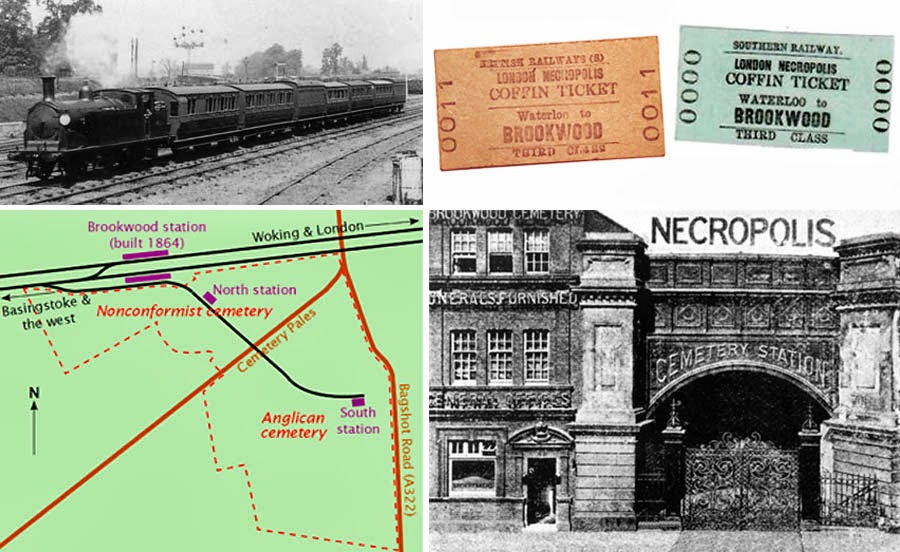
[Sir Richard] Broun was fascinated by the recently-emerged technology of steam trains. In 1848, Waterloo Station had only just been opened, and the railways themselves were still considered something of a novelty. Broun, along with his partner Richard Sprye, concocted a plan to ease the overcrowding issue with the help of this new invention. Buying up a 1,500 acre site outside Woking, they proposed the creation of a dedicated railway of the dead: a line (serviced by London & Southwest Rail) used for the sole purpose of transporting the deceased from London to ‘Brookwood Cemetery’ for burial.
[…]
The railway was inaugurated on 13th November 1854, with its own dedicated platform at Waterloo Station. A timetabled service would transport coffins down at night and mourners by day, delivering them to one of two stations: the Conformist station on Brookwood’s sunny side; or the non-conformist station on its dark north face. To prevent upsetting any delicate Victorian sensibilities, each ‘coffin train’ was divided into classes to separate the dead from their poorer neighbours. Even in death, it seemed, the idea of sharing a carriage with a pauper was anathema.
[…]
Until the 1940s it remained a weird London institution, a ghoulish Victorian hangover that resisted time, social change and falling demand. Ultimately, it took the Luftwaffe to close it down: during the heavy bombing raid of 16th April 1941 the Waterloo terminus was obliterated. The LNR had shipped its last cadaver.
H/T to Dave Slater for the link.
August 4, 2013
Ben Klass responds to Bell Canada CEO’s open letter
You begin the “unusual step of writing to all Canadians” (Strange, isn’t it, that “Canada’s Top Communication Company” should find it unusual to communicate with its customers?) with a history lesson, ostensibly in the interest of helping us “understand a critical situation” now facing the wireless industry: the potential entrance of an American company into the Canadian market.
You inform us that, since Parliament granted Bell its charter in 1880, Bell has spent 133 years “investing in delivering world-class communications services to Canadians.” An impressive track record!
You must, however, be aware that Bell’s permission to operate in Canada was initially obtained by agents acting in the interest of the (American) National Bell Telephone Company and that, after securing a favourable charter, three top-level executives from National Bell were appointed to Bell Canada’s board of directors (Babe, 1990, pg 68-69). Or how about how American Bell initially owned 50% of your company, only fully divesting its interest 43 years ago, in 1970 (Winseck, 1998, pg 119)?
Bell began its life in Canada as a branch plant of an American company. (In a strange twist of fate, it’s now a descendant of National Bell Telephone — Verizon — which is contemplating (re)entering the Canadian market.) And they leveraged this relationship to get an early leg up on the competition — using patents owned by its American parent, Bell quickly monopolized the market for Canadian telephone services, a monopoly it used to funnel profits back to the States. (Smythe, 1981, pg 141)
You suggest that “US giants don’t need special help from the Canadian government,” but that’s exactly how Bell got to where it is today!
That’s all ancient history, however, and in the here and now, BCE is a Canadian company who “welcomes any competitor,” so long as they “compete on a level playing field.” Right?
You’re calling on the Federal government to close “loopholes” that are intended to promote competition in your industry — rules that your company has forced the government to create.
Read the whole thing.
The Day The Universe Changed – “The Way We Are”
Episode 1 of James Burke’s ground-breaking series “The Day The Universe Changed” which explores the evolution of Western Scientific thought starting from the fall of Rome.
August 3, 2013
Energy efficiency does not equate to lower energy usage
Tim Harford talks about an obscure 19th century prognosticator and the implications of one of his predictions:
Despite Keynes’s admiration, Jevons might now be forgotten, save for one famous prediction and one intriguing argument. The famous prediction — that the UK’s economic prosperity was at risk because the country would run out of viable reserves of coal — was contained in The Coal Question (1865), a book that made Jevons a celebrated pundit at the age of 29. The coal industry did fall into decline. Production peaked exactly a century ago, when there were 1.1 million coal miners — four times as many as when Margaret Thatcher was elected in 1979. Whether this had much to do with the fall of the Empire is a fascinating question.
Jevons remains notable in some circles for an argument he made in The Coal Question, rebutting critics who claimed that a coal shortage was no problem because steam engines would become dramatically more efficient. Jevons replied: “It is wholly a confusion of ideas to suppose that the economical use of fuel is equivalent to a diminished consumption. The very contrary is the truth.” This idea became known as the Jevons paradox: that energy efficiency does not reduce energy consumption. When light was hugely expensive, a person might read by the fickle flame of a single candle; now it’s so cheap we flood our cities with it. Double glazing could mean lower heating bills but in practice it means warmer houses.
So was Jevons right? That’s a hotly contested topic. On a microeconomic level, he was not: a 50 per cent increase in the energy efficiency of a device will lead to increased use, but rarely to the doubling in usage that would be necessary for Jevons to be correct. Aha, reply Jevons’s defenders: even if a fuel-sipping car does not induce me to drive much further, I may still spend my cash savings on some other energy-guzzling device. True. But energy is a small enough part of the economy — about 6 to 10 per cent — that the actual cash savings available to spend elsewhere will usually be modest.
August 2, 2013
The self-inflicted wounds of Britain’s post-war auto industry
Dominic Sandbrook contrasts the rise of the German auto industry from the literal rubble of the post-war world with the slow decline of Britain’s once-mighty car makers:
If you want to know why Angela Merkel calls the shots in Europe, Germany’s car factories are a pretty good place to start.
By contrast, Britain’s car industry is a shadow of its former self. We do still make almost one and a half million cars a year, which is good news for thousands of British engineers. But these days, we make them for other people.
The iconic Mini plant at Cowley, for example, is celebrating its centenary this year. It was founded in 1913 by the entrepreneur William Morris as the home for his legendary Morris Oxford.
Today it still makes thousands of cars — but it makes them for BMW.
It’s a similar story at Crewe, the home of another great British icon, Bentley – which actually belongs to Volkswagen.
Half a century ago, let alone when Morris was at his peak, this would have seemed unimaginable. But the sad truth is that Britain’s car firms only have themselves to blame.
Seventy years ago, at the end of World War II, Germany was on its knees. After the fall of Hitler’s empire, its car industry lay in ruins.
In August 1945 the British Army sent a major called Ivan Hirst to take control of the giant Volkswagen plant in Wolfsburg, which had been built under the Nazis to produce ‘people’s cars’ for the German masses.
Ignoring his sceptical superiors, Hirst could see the potential amid the shattered debris of the Wolfsburg factory.
Rebuilding Volkswagen, he thought, would be a step towards rehabilitating Germany as a prosperous, peaceful European ally. And of course he was right.
In the next few years, Hirst restarted production of a car we know today as the Beetle. And from then on, VW was flying.
July 30, 2013
Was Caligula the victim of a historical smear campaign?
I confess, my views on Emperor Caligula (formally Gaius Julius Caesar Augustus Germanicus) were almost completely informed by the character in the novels I, Claudius and Claudius the God by Robert Graves. BBC News Magazine‘s Mary Beard thinks Caligula got a fearful load of bad press:
Of course, there had been some very nasty monarchs and despots before Caligula. But, so far as we know, none of his predecessors had ever ticked all the boxes of a fully fledged tyrant, in the modern sense.
There was his (Imelda Marcos-style) passion for shoes, his megalomania, sadism and sexual perversion (including incest, it was said, with all three of his sisters), to a decidedly odd relationship with his pets. One of his bright ideas was supposed to have been to make his favourite horse a consul — the chief magistrate of Rome.
Roman writers went on and on about his appalling behaviour, and he became so much the touchstone of tyranny for them that one unpopular emperor, half a century later, was nicknamed “the bald Caligula”.
But how many of their lurid stories are true is very hard to know. Did he really force men to watch the execution of their sons, then invite them to a jolly dinner, where they were expected to laugh and joke? Did he actually go into the Temple of the gods Castor and Pollux in the Roman Forum and wait for people to turn up and worship him?
It is probably too sceptical to mistrust everything that we are told. Against all expectations, one Cambridge archaeologist thinks he may have found traces of the vast bridge that Caligula was supposed to have built between his own palace and the Temple of Jupiter — so it was easier for him to go and have a chat with the god, when he wanted.
So the idea that Caligula was a nice young man who has simply had a very bad press doesn’t sound very plausible.
All the same, the evidence for Caligula’s monstrosity isn’t quite as clear-cut as it looks at first sight. There are a few eyewitness accounts of parts of his reign, and none of them mention any of the worst stories.
No revisionist slant on Caligula is complete without a few nasty cracks directed towards kindly old Uncle Claudius:
More topical though is the question of what, or who, came next. Caligula was assassinated in the name of freedom. And for a few hours the ancient Romans do seem to have flirted with overthrowing one-man rule entirely, and reinstating democracy.
But then the palace guard found Caligula’s uncle Claudius hiding behind a curtain and hailed him emperor instead. Thanks to Robert Graves, Claudius has had a good press, as a rather sympathetic, slightly bumbling, bookish ruler.
But the ancient writers tell a different story — of an autocrat who was just as bad as the man he had replaced. The Romans thought they were getting freedom, but got more of the same.
Considering what happened then, it’s hard not to think of the excitements and disappointments of the Arab Spring.
July 25, 2013
Misappropriation of William Lyon Mackenzie
Richard Anderson on a recent attempt to “re-imagine” the real William Lyon Mackenzie:
It seems unlikely that William Lyon Mackenzie was the chillin’ sort of dude. In fact he was a notorious hot-head. Nor was he fond of big government. During his brief and ill-starred rebellion Mackenzie actually had a flag made up with the word LIBERTY written on it. He was a libertarian avant la lettre and would likely be utterly horrified at the size and scope of modern municipal government. For a public sector union to appropriate him as a sort of mascot for “public service” is chutzpah at its finest.
One of the many things that rankled Mackenzie, he was inclined to react strongly to injustice, was tightly knit oligarchies who use government power to fleece the ordinary citizen. In his day they called it the Family Compact. Today we might call it the Liberal-NDP-Government Union Axis. Not as catchy, but again I’m not WLM. I’m omitting the provincial Tories as their haplessness renders them more amusing than contemptible at the moment.
[…]
I haven’t the slightest clue as to Mackenzie’s views on diversity, the Upper Canada of his day was as white as a lily. From the records that have come down to us he seems to have been a fairly enlightened man. What he would have made of Toronto’s demographics we can only guess at. We are on more certain ground as to government providing “assistance to its elderly, infirm and financially disadvantaged.” Mackenzie would almost certainly have opposed government involving itself in such essentially private matters. Those incapable of fending for themselves were the responsibility of the churches, private charities and of last resort the municipal government. Relief for the poor was remarkably stingy both from necessity and principle.
The solution to “poverty” in early Victorian Canada was typically an axe and a few acres of land. There is little indication in the historical record that the rebel of 1837 was some kind of proto-socialist. That CUPE is implying as much is disgraceful.

July 20, 2013
UK government inches closer to giving posthumous pardon to Alan Turing
In the Guardian, Nicholas Watt updates the news on a private member’s bill that would give Alan Turing a pardon:
Alan Turing, the Enigma codebreaker who took his own life after being convicted of gross indecency under anti-homosexuality legislation, is to be given a posthumous pardon.
The government signalled on Friday that it is prepared to support a backbench bill that would pardon Turing, who died from cyanide poisoning at the age of 41 in 1954 after he was subjected to “chemical castration”.
Lord Ahmad of Wimbledon, a government whip, told peers that the government would table the third reading of the Alan Turing (statutory pardon) bill at the end of October if no amendments are made. “If nobody tables an amendment to this bill, its supporters can be assured that it will have speedy passage to the House of Commons,” Ahmad said.
The announcement marks a change of heart by the government, which declined last year to grant pardons to the 49,000 gay men, now dead, who were convicted under the 1885 Criminal Law Amendment Act. They include Oscar Wilde.
Update: On the other hand, Matt Ridley thinks that there’s a major problem with this approach.
That Turing deserved an apology in his lifetime for this appalling treatment is not in doubt. What will be debated tomorrow is whether a posthumous pardon from today’s Government is right, or may be a further insult to his memory. After all, the word pardon implies that his crime is still a crime, which it is not, and it will do nothing for the victim (especially since he was an atheist), and do nothing to untarnish his reputation, which history has already fully untarnished. Also it could be unfair to other, less famous convicted gay men and may even seem to rewrite history rather than leaving it starkly to reproach us. By rights, Turing should be pardoning the Government, but that’s not possible.
So it is not easy to judge if a pardon is the right thing. For my part, I think a greater matter is at issue — whether we have done enough to recognise Turing’s scientific reputation and how we put that right. It becomes clearer by the day that, irrespective of his tragic end and even of his secret war service, he ranks for the momentous nature of his achievements with the likes of Francis Crick and Albert Einstein in the 20th-century scientific pantheon. This was not just a moderately good scientist made famous by persecution; this was the author of a really big idea.
[…]
When the war broke out, Turing’s genius proved as practical as it had been ethereal in the 1930s. His crucial contributions to three successive computing innovations at Bletchley Park — the “bombe” machines for replicating the settings of the German Enigma encryption machine, the later cracking of the naval Enigma machine enabling U-boat traffic to be read, and finally the Colossus computer that broke the Germans’ “tunny” cipher machine — provided Churchill with the famous “ultra” decrypts that almost certainly shortened the war and saved millions of lives in battlefields, ships and camps.
For this he was appointed OBE, but secrecy shrouded his work until long after his death, so he wasn’t known to be a hero, let alone the man who saved so many lives. He moved to what would become GCHQ, but in the paranoid days after Burgess and Maclean fled east, his homosexuality conviction categorised him as a security risk.
July 18, 2013
Chinese museum woes – “80 of the museum’s 40,000 objects had been confirmed as authentic”
Tom Phillips on the sudden closure of the Jibaozhai Museum:
The museum’s public humiliation began earlier this month when Ma Boyong, a Chinese writer, noticed a series of inexplicable discrepancies during a visit and posted his findings online.
Among the most striking errors were artifacts engraved with writing purportedly showing that they dated back more than 4,000 years to the times of China’s Yellow Emperor. However, according to a report in the Shanghai Daily the writing appeared in simplified Chinese characters, which only came into widespread use in the 20th century.
The collection also contained a “Tang Dynasty” five-colour porcelain vase despite the fact that this technique was only invented hundreds of years later, during the Ming Dynasty.
Museum staff tried to play down the scandal.
Wei Yingjun, the museum’s chief consultant, conceded the museum did not have the proper provincial authorizations to operate but said he was “quite positive” that at least 80 of the museum’s 40,000 objects had been confirmed as authentic.
“I’m positive that we do have authentic items in the museum. There might be fake items too but we would need [to carry out] identification and verification [to confirm that],” he told The Daily Telegraph.
Mr Wei said that objects of “dubious” origin had been “marked very clearly” so as not to mislead visitors and vowed to sue Mr Ma, the whistle-blowing writer, for blackening the museum’s name.
July 15, 2013
If you’re bored with the Stratfordians versus Oxfordians, here’s a new debate
In the Guardian, Saul Frampton looks at the First Folio edition of Shakespeare’s works:
Sometime in 1623, seven years after Shakespeare’s death, the actors John Heminges and Henry Condell published Mr William Shakespeares Comedies, Histories, & Tragedies — what we now know as the First Folio. It was the literary event of the century, recording for all time the sound of Shakespeare’s English and the sweep of his imagination: Elsinore, Egypt and the Forest of Arden; a balcony, a spotted handkerchief and a skull.
Yet despite this shrine to Shakespeare’s memory, erected by those who knew him, sceptics have continued to doubt his authorship of the plays. He was, they insist, inadequately educated, insufficiently travelled, and didn’t know how to spell his own name. A range of alternative candidates have come and gone over the centuries, including Anne Hathaway, the Jesuits, and more recently Edward de Vere, the 17th Earl of Oxford, the subject of Roland Emmerich’s film Anonymous. As always, conspiracy is more fun than consensus, and the doubters have the internet on their side. Shakespeare has thus become the focus of a global conspiracy industry, joining company with reptilian elites, self-destructing lightbulbs and skeletons on the moon.
Scholars have recently fought back against this scepticism, however. Books such as James Shapiro’s Contested Will and Paul Edmondson and Stanley Wells’s Shakespeare Beyond Doubt marshal facts, allusions and funeral monuments to prove that Shakespeare did indeed write the plays and poems attributed to him. Or as Iago says at the end of Othello: “what you know, you know.”
So Shakespeare wrote “Shakespeare”. The printing of the First Folio, however, raises another, ultimately more interesting, question. Without the Folio, Shakespeare’s plays — scattered around in playscripts or in smaller quarto editions — might have been lost to posterity. But did Heminges and Condell edit the text?
H/T to Tim O’Reilly for the link.
July 14, 2013
Calcio Storico – historical Florentine ball game
BBC News Magazine looks at a historical relic of Florentine history:
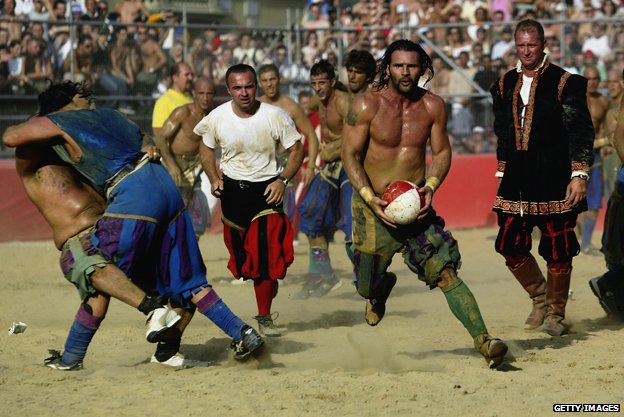
No one knows exactly when “Calcio Storico” — historic football — was first played here, but its pitch, the piazza of Santa Croce, dates from the 14th Century and the rules of the game — in so far as there are any — were written down in the late 1500s. The four quarters of the city — Santa Spiritu, San Giovanni, Santa Maria Novella and Santa Croce, named for their great local churches — each put up a team of 27 men.
The aim, over two heats and a final, is for players to get the ball over the 4ft (1.2m) fence at either end of the pitch. To achieve this, players can use both hands and feet, as well as every other part of the body when it comes to wrestling, punching and generally immobilising their opponents on the way. In other words — sport as muted warfare.
A 15th Century Florentine would still recognise much of the event. Each game is preceded by trumpet fanfares and marching drums as costumed dignitaries and flag-throwers in the rich hot renaissance colours of their teams march from their various quarters to the piazza. The only concession to sartorial modernity — the players’ coloured t-shirts with sponsors’ logos — are off within minutes of getting onto the pitch, so that all one can see is naked upper torsos, caked with sand and sweat, hurling themselves at each other, as the crowd roars its approval and each goal, or caccia, is greeted by cannon fire.
The addition of tourism has done little to blunt the edge of civic competition and not-so-benign thuggery that comes with it. Time travel works both ways, and watching from my window as the teams arrive (in the Renaissance most respectable women wouldn’t have been allowed out anyway), you get a distinct whiff of a darker, more physical past, where the streets were often full of excess testosterone looking for action.
July 11, 2013
Inane new “measurement” claims 1978 was the “best year ever”
An editorial in New Scientist (which I can’t quote from due to copyright concerns) claims that using a new “measurement” called the Genuine Progress Indicator (GPI), human progress peaked in 1978 and it’s all been downhill since then. Anyone who actually lived through 1978 might struggle to recall just what — if anything — was better about 1978 than following years, but the NS editors do point out that the GDP measurement generally used to compare national economies doesn’t capture all the relevant details, while GPI includes what they refer to as social factors and economic costs, making it a better measuring tool for certain comparisons.
I can only assume that most of the economists who believe that 1978 was a peak year for the environment hadn’t been born at that time: pollution was a much more visible issue in North America and western Europe than at almost any time afterwards (and eastern Europe was far worse). Industry and government were taking steps to cut back some of the worst pollutants, but that process was really only just in its early stages: it took several years for the effects to start to show.
In the late 1970s, the world was a much dirtier, poorer, less egalitarian place than even a decade later: China and India were both much more authoritarian and had still not mastered the art of ensuring that there was enough food to feed everyone. Behind the Iron Curtain, Soviets and citizens of their client states in Europe were falling further and further behind the material well-being of westerners (and becoming much more aware of the deficit).
No matter how much emphasis you put on nebulous “social factors”, the fact that the world poverty rate — regardless of how you measure it — has been cut in half over the last twenty years, lifting literally billions of people out of near-starvation makes an incredibly strong case that the world is doing better now than at any time since 1978. You can prattle on all you like about “rising inequality”, but for my money it’s a better world where the risk of people literally starving to death is that much closer to being eliminated. Give me an “unequal” world where even the poorest have enough food and clean water over an egalitarian world where billions starve, thanks very much.
July 10, 2013
Operation Husky, 1943
Was the invasion of Sicily by the allies in 1943 a strategic error?
Seventy years ago this week, U.S. and British Commonwealth troops began Operation Husky, the invasion of Sicily. Foreshadowing D-Day 1944, Gen. Dwight Eisenhower served as overall Allied commander. Like D-Day, Allied airborne soldiers led the Husky assault by parachuting (on the night of July 9, 1943) into olive groves and rock-strewn fields along the island’s southeastern shores. On July 10, seven divisions — three U.S., three British and the 1st Canadian Infantry Division — launched an amphibious attack on a 100-mile long front. Despite several successful Axis air attacks on ships and a brazen Italian tank attack on U.S. positions near Gela, by midnight July 10 all seven divisions were ashore.
Putting seven divisions ashore so swiftly was an extraordinary coup. Oh, grievous errors occurred as the buildup proceeded, the most notorious being the July 11 downing of 23 U.S. transports by Allied anti-aircraft fire. The planes were ferrying paratroop reinforcements. Yet in its initial phases Husky demonstrated that the Anglo-American team had learned a great deal since the Operation Torch landings in November 1942. Planning and coordination had improved. North African combat had honed the skills of American forces.
[. . .]
The Sicily campaign placed Allied troops less than 10 miles (the strait’s width) from mainland Italy.
The oh-so-close proximity of large Allied forces to Italy was enticing. And that enticement leads to the biggest historical question tagging Operation Husky: Was taking Sicily the best strategic choice, since it made an invasion of Italy inevitable? From south of Naples to the Po Valley, Italy’s rugged and rocky terrain is a defender’s delight and attacker’s sorrow.
Winston Churchill had sold Sicily as the next logical step. Sicily was the classical route to Rome from North Africa, and knocking fascist Italy out of the war would deal Adolf Hitler’s Axis a heavy political loss.
Sicily geographically dominates the central Mediterranean. Husky’s advocates noted that for three millennia the island served as the stepping stone of to-and-fro commerce and war between North Africa and Europe.
American military leaders were not convinced. The decisive route to Berlin goes through France — make the all-out effort there. Churchill also claimed Europe had a “soft underbelly.” Italian and Balkan terrain is not soft. Several senior U.S. planners thought Churchill was really trying to defend British imperial interests.
Axis-controlled Sicily had served as a big aircraft carrier for attacking Allied shipping. Under Allied control, those bases would extend air cover to northern Italy and Sardinia. U.S. planners agreed that Husky made operational sense if the goal was securing air bases. But can we stop there, at the strait? Sicily’s hard slog was costly. A strategic thrust up Italy’s mountainous spine will be as just slow and deadly.
And indeed it was.


