Quotulatiousness

May 1, 2014

Stephen Harper moves to 9th on the longest-serving PM list

Filed under: Cancon, History — Tags: , — Nicholas @ 06:42

It hasn’t been a banner year so far for Prime Minister Stephen Harper. David Akin notes that it’s Harper’s birthday today and that he’s now our 9th longest-serving PM:

Today is Prime Minister Stephen Harper’s 55th birthday. It is also is his 3,005th day in office. (The Library of Parliament counts his first day as Feb. 6, 2006, the day he and his first cabinet were sworn in.)

At 3,005 days in office, the country’s 22nd prime minister is its 9th longest-serving prime minister.

Here’s the top 14 as of today:

  1. William Lyon Mackenzie King: 7,824 days in office
  2. John A. Macdonald: 6,934 days
  3. Pierre Elliott Trudeau: 5,620 days
  4. Wilfrid Laurier: 5,565 days
  5. Jean Chrétien: 3,689 days
  6. Brian Mulroney: 3,202 days
  7. Robert Borden: 3,195 days
  8. Louis St. Laurent: 3,139 days
  9. Stephen Harper: 3,005 days
  10. John Diefenbaker: 2,130 days
  11. R.B. Bennett: 1,902 days
  12. Lester Pearson: 1,824 days
  13. Alexander Mackenzie: 1,796 days
  14. Paul Martin: 786 days

April 25, 2014

England’s mixed-up, renamed, lost, and forgotten counties

Filed under: Britain, Government, History — Tags: , , — Nicholas @ 08:16

I was born in Yorkshire. If anyone ever asked, that’s what I’d say. But there’s Yorkshire and then there’s “Yorkshire”. At some point shortly after my family emigrated to Canada, they moved my hometown out of Yorkshire and into a new county-like entity. Then they moved the boundaries again. And again. And again. I’ve long since lost track of which county Middlesbrough is officially located in … I think it was now part of Durham (which is nice, because I currently live in a different county-like entity also called Durham). As this BBC News Magazine post illustrates, the counties of England are very confusing and in some cases bear almost no relationship to the historical counties most of us still think of as being “the real counties”:

Middlesex dates back to the 8th Century but Middlesex County Council was abolished in 1965. Middlesex County Cricket Club and Middlesex University live on. So too does the historic county of Middlesex even though most of its inhabitants now live in the ceremonial county of Greater London.

Still following?

England’s counties are the source of much regional pride, not least on cricket pavilions. To identify as a Yorkshirewoman or a Devonian or a Northumbrian is to invite certain expectations about the forthrightness of one’s views or one’s tolerance for cider and clog-dancing.

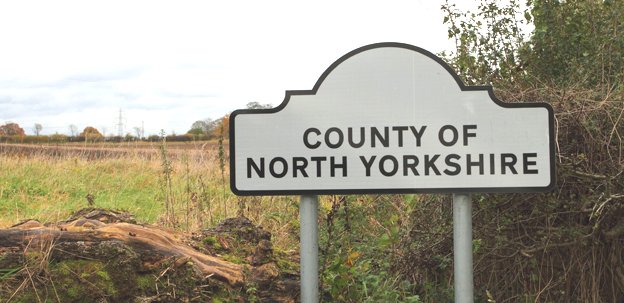
County boundary sign for North Yorkshire

But successive waves of local government reform have left many people deeply unclear as to which county they live in – the answer to which depends on exactly what you mean by the word “county”.

Now, in an effort to support the “tapestry” of ancient place names, the government has changed its rules allowing councils to put up boundary signs marking traditional English counties – including the likes of Cumberland and Huntingdonshire, names which no longer have any connection to local authorities.

If you’re attempting to keep score at home, here are the different kinds of “county” you need to track for historical purposes:

First there are the historic counties, which date as far back as the mid-Saxon period. Some, like Westmorland, no longer exist in an administrative sense. But especially in places like Yorkshire, Durham and Cornwall, they are important expressions of geographic and cultural identity.

Then there are administrative counties and unitary authority areas created by the 1972 Local Government Act. These include non-metropolitan county councils like Oxfordshire and Surrey (where some services are also provided by districts). Others, like Northumberland, are single-tier unitary councils. Some areas like Berkshire have no county council and the districts are the sole local authorities.

And finally there are the ceremonial counties, established by the 1997 Lieutenancies Act, each of which has a Lord Lieutenant. Bedfordshire and Cheshire, for instance, do not exist as councils but do as ceremonial counties. In metropolitan counties like Merseyside, Tyne and Wear and Greater Manchester, county councils were scrapped in the 1980s, but some services including transport and the police are run jointly by groups of councillors within the old boundaries.

If you’ve followed that, well done. Catherine Staite, director of the Institute of Local Government at Birmingham University, says there was no consistency to the way these overlapping boundaries were drawn. “We’ve ended up with a patchwork of arrangements for which there is no logic.”

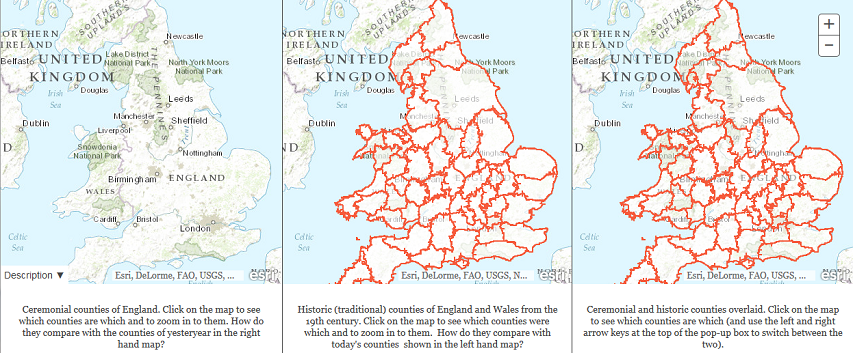
There is a new website to attempt to resolve the confusion, but I’m not sure it will do much:

English county maps

April 23, 2014

Desegregation

Filed under: Education, History, USA — Tags: , , — Nicholas @ 08:04

An interesting article in the New Yorker by Jelani Cobb discusses some of the aspects of the struggle to desegregate American schools that I hadn’t heard of:

The architects of Jim Crow were fixated by notions of white racial purity, but black people subjected to that dictatorship of pigment were concerned with a different question: In a hostile society, is it better to be isolated from those who view you with contempt or in close proximity to them? In retrospect, it is easy to see segregation as a moral evil unanimously despised by black people, but even its fiercest critics betrayed ambivalence about what its end would mean. In the thirties, W. E. B. Du Bois inspired rancorous debates within the N.A.A.C.P. by arguing, in his writing, that there were important economic benefits — the built-in market for black businesses, for instance — that came with segregation. James Nabrit, Jr., an attorney who handled a school-desegregation suit in Washington, D.C., that became one of the cases grouped with Brown, went on to become president of Howard University, a job that entailed the seemingly paradoxical task of preserving and furthering an all-black educational institution. Three of the other attorneys who worked on Brown, including Thurgood Marshall, had, in fact, met as students at Howard’s law school, and they began their desegregation work under the tutelage of Charles Hamilton Houston, the school’s dean. Black teachers in South Carolina, where another of the desegregation suits had been filed, worried, with some cause, that integration would end a state of affairs in which black children, though deprived of equal resources, at least benefitted from teachers who did not calibrate their expectations according to the color of their students’ skin.

The Supreme Court decision on Brown, in 1954, marked a moral high point in American history, but the practice that it dispatched to the graveyard had already begun to mutate into something less tangible and far more durable. What would, in the end, preserve the principle of “separate inequality” was not protests like the one staged by Orval Faubus, the governor of Arkansas, who deployed the National Guard to Little Rock’s Central High School, in 1957, in order to keep black students out. Instead, it was policies like the Interstate Highway Act, whose passage one year earlier helped spawn American suburbia. In the wake of Brown, private schools, whose implicit mission was to educate white children, cropped up throughout the South. The persistent legacies of redlining, housing discrimination, and wage disparity conspired to produce segregation without Jim Crow — maintaining all the familiar elements of the past in an updated operating system.

To the extent that the word “desegregation” remains in our vocabulary, it describes an antique principle, not a current priority. Today, we are more likely to talk of diversity — but diversification and desegregation are not the same undertaking. To speak of diversity, in light of this country’s history of racial recidivism, is to focus on bringing ethnic variety to largely white institutions, rather than dismantling the structures that made them so white to begin with.

And so, sixty years after Brown, it is clear that the notion of segregation as a discrete phenomenon, an evil that could be flipped, like a switch, from on to off, by judicial edict, was deeply naïve. The intervening decades have shown, in large measure, the limits of what political efforts directed at desegregation alone could achieve, and the crumbling of both elements of “separate but equal” has left us at an ambivalent juncture. To the extent that desegregation becomes, once again, a pressing concern — and even that may be too grand a hope — it will have to involve the tax code, the minimum wage, and other efforts to redress income inequality. For the tragedy of this moment is not that black students still go to overwhelmingly black schools, long after segregation was banished by law, but that they do so for so many of the same reasons as in the days before Brown.

H/T to ESR for the link.

April 21, 2014

QotD: Vikings!

Filed under: History, Humour, Politics, Quotations — Tags: , — Nicholas @ 10:41

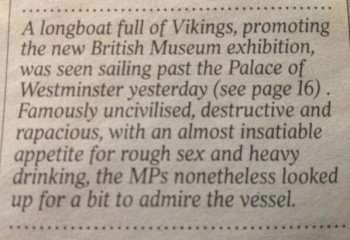
VikingTimesQuote-350x240

– Spotted yesterday in the Times (which is behind a paywall) of the day before yesterday by 6k. “Very good” says he. Indeed.

Brian Micklethwait, Samizdata quote of the day”, Samizdata, 2014-04-19.

April 20, 2014

If Scotland chooses separation, should it take Northern Ireland too?

Filed under: Britain, History — Tags: , , , — Nicholas @ 00:01

Patrick West believes that Scotland should include Northern Ireland in its new country if the separation vote succeeds:

[A union] between England and Wales could, possibly [succeed]. Despite the wishes of Welsh (and indeed English) nationalists, the two countries are physically and economically linked – just have a look at the commercial relationship between Bristol and Cardiff or Liverpool and north Wales. But Northern Ireland would resemble a very odd third partner in this hypothetical, slimmed-down UK, cut off by the sea and by culture (there are no peace walls in England and only Southport has annual Orange Order parades).

So, I have a better suggestion: if Scotland declares independence, shouldn’t Northern Ireland go with it? No, let me rephrase that: if Scotland becomes independent, it has a moral obligation to take Northern Ireland with it. Ulster is, after all, far more of a Scottish colony than an English one, demographically speaking. From the reign of King James VI of Scotland (who also became James I of England in 1603), Ulster was disproportionately colonised by Scots (many of whom later left for America to become ‘Scotch-Irish’), which explains why Presbyterianism was always a more popular denomination in Ulster than the Church of Ireland. The Scottish legacy is also reflected in efforts in recent decades among Protestants to cement an ‘Ulster-Scots’ culture and language. While you will see the Scottish saltire at Orange Order marches, you won’t see an empty-handed Cross of St George.

The two lands are united in their love of and hatred of Glasgow’s two football teams and by simmering sectarianism. The Scottish National Party (SNP) was very keen to jump on the Braveheart bandwagon. Why not go even further back in time? Parts of Ulster and Scotland were once united in the sixth and seventh century in the kingdom of Dalriada. The revival of this ancient kingdom, should Scotland vote ‘Yes’, would make much more sense than Northern Ireland’s continued bondage to England. After all, most English people are notoriously ignorant about Ulster. During the Troubles, the English regarded the province with a mixture of irritation and indifference, which is why the IRA in the 1970s knew that England would only take notice if there were bombs on the mainland. ‘They’re both as bad as each other’ and ‘fancy fighting about religion’ were the two common reactions. To the English, the Northern Irish are a foreign people, which is why they found the grating, mangled accents of John Cole and Ian Paisley so amusing – so otherish, so strange.

There has been little love in the opposite direction. To Irish republicans, England was always the occupier, and most Ulster Catholics had good reason to come to dislike the English after 1969. It was with English accents that they heard their houses raided, their husbands and brothers interned and shot. Meanwhile, Ulster Protestants have always – with fair reason – suspected that London wanted to rid itself of the Six Counties, hence the actions of 1974 and 1985 (even 1912), when ‘loyalists’ rebelled against a perceived perfidious London government.

April 19, 2014

Orwell and equality

Filed under: Books, Britain, History, Liberty, Media — Tags: , , , — Nicholas @ 11:28

Bruno Waterfield reviews a recent “intellectual biography” by Robert Colls, George Orwell: English Rebel:

Orwell, or rather Blair, was of the British upper class, but he could clearly see that human equality was a fact. It transcended class and nationality, and was palpable even in the briefest of encounters between people. It was the ‘crystal spirit’ that had bought a young Italian, and Orwell, to fight for democracy in Spain, just as it was the same human quality that made life in a slum unbearable. Equality for Orwell was not a merely a measure or a statistic; it was a quality that all living humans have, a resistance to fate even at its most blind.

These two encounters also reveal a man with a deep belief in the character and qualities of living humans, something that Robert Colls understands in his excellent ‘intellectual biography’ of Orwell. No book about Orwell can be perfect; the man was too contradictory, too contrarian and too bloody minded to be an easy study. But Colls (with some limitations) really gets it. Orwell refused ideology in a century defined by it, and that was his strength and brilliance. Setting out his stall, Colls, a professor of Cultural History at De Montfort University, puts his finger on why Orwell despised ideology as a ‘form of abstract knowledge which, in order to support a particular tendency or regime, has to distort the world and usually does so by drawing off, or separating out, ideas from experience. Ideology, in Orwell’s eyes, could never afford to get too close to the lives of the people. The more abstract the idea and the language that that expressed it, the more ideological the work and vice versa’, he writes at the book’s beginning.

‘[Orwell] knew that if he was saying something so abstract that it could not be understood or falsified, then he was not saying anything that mattered’, Colls continues. ‘He staked his reputation on being true to the world as it was, and his great fear of intellectuals stemmed from what he saw as their propensity for abstraction and deracination – abstraction in their thinking and deracination in their lives. Orwell’s politics, therefore, were no more and no less than intense encounters turned into writings he hoped would be truthful and important. Like Gramsci, he believed that telling the truth was a revolutionary act. But without the encounters he had no politics and without the politics he felt he had nothing to say.’

Orwell was on a collision course with the intelligentsia to which he, as a rebel and a modernist radical, instinctively belonged, but which, due to its embrace of social engineering, the state and Stalinism, he was starting to oppose. His dissidence appears early in The Road to Wigan Pier where, as Colls wisely remarks, ‘Socialism emerges not as the solution but the problem, and the unemployed and exploited emerge not as a problem but the solution’. Colls paraphrases Orwell: ‘The battle of the classes… will not be won in the abstract, or in some future state, but in the present, in how people actually are and what they actually think of each other.’ Orwell despised the ‘Europeanised’ intellectual British Left because they had become wilfully displaced and removed, uprooted from the lived life of their country. Even worse, the deracinated intellectuals, divorced from the majority, wanted to refashion the people in their image. In the world of Beatrice and Sidney Webb and Fabian socialism, gaining political power also meant using the state to engineer the people, through eugenics and public health.

[…]

Orwell returned to Britain in time for the beginning of the Second World War. Apart from taking up the cudgels on behalf of the truth in Spain, without which the historical record would have been badly damaged by the falsifiers, he was not immune to much of the confusion that plagued the left in the run up to hostilities. Should socialists refuse to take sides in a conflict between imperialist powers? Should socialists sabotage the war efforts and oppose rearmament in the face of the threat from Nazi Germany? George Orwell was as confused as anyone else and his writings of 1939 and early 1940 are full of the turmoil and contradictions of the day.

But then in 1940, Orwell took another one of his leaps away from the lines and orthodoxies of leftish ideology which had led many intellectuals into pacifism or the defeatism of toeing the Stalinist line on the Soviet Union’s 1939 pact with the Nazis. In a way, Orwell’s experiences in Wigan and Barcelona, prepared the ground. In the Second World War, he would side with the British people, and an imperfect British state, because Britain’s political and wider culture reflected a way of living better than the fascism or Stalinist communism preferred by many of the intelligentsia. He reserved and exercised his right to criticise British imperialism, which he continued to attack throughout the war and his life. Again, his instincts were right or, at the very least, less wrong than most on the left. Instead of abstract ideology, distorted and twisted to suit either a Marxism that was synonymous with Stalinist tyranny, or the elitist social engineering of the Fabians, Orwell advocated a patriotic defence of a way of life that could not be trusted to intellectuals or, by implication, the state.

The Doolittle Raid, 18 April 1942

Filed under: History, Japan, Military, Pacific, USA, WW2 — Tags: , , , , — Nicholas @ 09:35

I was busy with away-from-the-computer stuff yesterday, so I didn’t see this post until today:

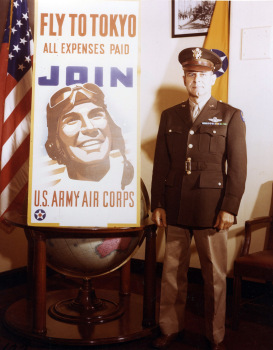
Brig. Gen. James Doolittle poses beside an Air Corps recruiting poster that alludes to his bombing raid on Japan in April 1942. (c) 1943

Brig. Gen. James Doolittle poses beside an Air Corps recruiting poster that alludes to his bombing raid on Japan in April 1942. (c) 1943

Less than 19 weeks after the U.S. Navy was attacked at Pearl Harbor on Dec. 7, 1941, the American military struck back. On April 18, 1942 – 72 years ago today – sixteen Army Air Force bombers launched from a Navy aircraft carrier to attack the enemy’s homeland.

Led by Lt. Col. James H. Doolittle, the raid was launched from USS Hornet, commanded by Capt. Marc Mitscher and escorted by ships under the command of Vice Adm. “Bull” Halsey aboard his flagship, USS Enterprise.

The extraordinary joint Doolittle Raid showed Imperial Japan’s military leaders their vulnerability and America’s resolve.

The raid also demonstrated innovation, courage and resilience.

The five-man B-25 crews trained relentlessly prior to their mission, with specialized training led by Navy flight instructor Lt. Henry F. Miller. The Army Air Force made ingenious modifications so the bombers could have extra fuel but less weight.

Pilots, all volunteers, needed to be extremely fearless, taking off in their huge planes from a short flight deck. On rough seas they launched in bitter cold, 75-knot winds and foam-flecked spray, as Sailors aboard recalled.

Doolittle, as his team’s leader, took off first. His success inspired the other pilots just as their entire mission would inspire the nation – putting action to the nationwide words of resolve heard throughout the world: “Remember Pearl Harbor!”

[…]

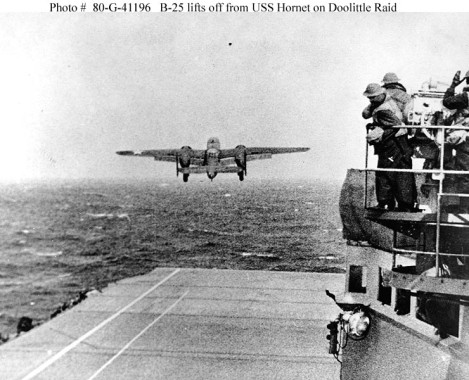
An Army Air Force B-25B bomber takes off from USS Hornet (CV 8) at the start of the raid, April 18, 1942. Note men watching from the signal lamp platform at right. (Official U.S. Navy Photograph, now in the collections of the U.S. National Archives – Courtesy of the NHHC Photo archives)

An Army Air Force B-25B bomber takes off from USS Hornet (CV 8) at the start of the raid, April 18, 1942. Note men watching from the signal lamp platform at right. (Official U.S. Navy Photograph, now in the collections of the U.S. National Archives – Courtesy of the NHHC Photo archives)

Seven Doolittle Raiders were killed in the mission: Two drowned and a third was killed by the fall after bailing out; eight were captured by the Japanese. Three of the eight POWs were executed Oct. 15, 1942, and another died of malnutrition Dec. 1, 1943. The surviving four POWs were released in August 1945.

The Raiders who landed in China were assisted by American missionary Rev. John M. Birch, whose contacts within Japanese-occupied China helped the Raiders to escape. Afterward, Birch was commissioned a lieutenant in the Army Air Force, continuing his work as a missionary while gathering intelligence on the Japanese. He was killed Aug. 25, 1945, at the age of 27, during a confrontation with Chinese Communists. The John Birch Society honors Birch, a recipient of both the Legion of Merit and the Distinguished Service Medal.

Even though the Doolittle Raiders bombed Tokyo, it was the Chinese who suffered the most from the raid. Furious the Chinese nationalists were protecting the Americans, the Japanese retaliated against several coastal cities suspected of harboring the Americans, killing an estimated 250,000 Chinese citizens.

Doolittle was so convinced his mission had been a failure, he was convinced he would face a court-martial upon his return to the United States. Instead, he was promoted to general, skipping the rank of colonel. He and all of his Raiders were awarded the Distinguished Flying Cross.

Mitscher served in a variety of command leadership positions for the rest of World War II, earning the rank of admiral and title as Commander in Chief, U.S. Atlantic Fleet.

April 16, 2014

Russia’s long and brutal relationship with Crimea

Filed under: History, Russia, WW2 — Tags: , , , — Nicholas @ 10:39

In History Today, Alexander Lee talks about the historical attitude of Russia toward the Crimean peninsula and some of the terrible things it has done to gain and retain control over the region:

… Russia’s claim to Crimea is based on its desire for territorial aggrandizement and – more importantly – on history. As Putin and Akysonov are keenly aware, Crimea’s ties to Russia stretch back well back into the early modern period. After a series of inconclusive incursions in the seventeenth century, Russia succeeded in breaking the Ottoman Empire’s hold over Crimea with the Treaty of Küçük Kaynarca (1774), before formally annexing the peninsula in 1784. It immediately became a key factor in Russia’s emergence as a world power. Offering a number of natural warm-water harbours, it gave access to Black Sea trade routes, and a tremendous advantage in the struggle for the Caucasus. Once gained, it was not a prize to be willingly surrendered, and the ‘Russianness’ of Crimea quickly became a cornerstone of the tsars’ political imagination. When a spurious dispute over custody of Christian sites in the Holy Land escalated into a battle for the crumbling remnants of the Ottoman Empire in 1853, Russia fought hard to retain its hold over a territory that allowed it to threaten both Constantinople and the Franco-British position in the Mediterranean. Almost a century later, Crimea was the site of some of the bitterest fighting of the Second World War. Recognising its military and economic importance, the Nazis launched a brutal attempt to capture the peninsula as a site for German resettlement and as a bridge into southern Russia. And when it was eventually retaken in 1944, the reconstruction of Sevastopol – which had been almost completely destroyed during a long and bloody siege – acquired tremendous symbolic value precisely because of the political and historical importance of the region. Even after being integrated into the Ukrainian Soviet Socialist Republic and – later – acknowledged as part of an independent Ukraine after the fall of the USSR, Crimea’s allure was so powerful that the new Ukrainian President, Leonid Kraychuk, claimed that Russia’s attempts to assert indirect control of the peninsula betrayed the lingering force of an ‘imperial disease’.

[…]

The non-Russian population of Crimea was to suffer further even worse under the Soviet Union, and between 1921 and 1945, two broad phases of persecution devastated their position in the peninsula. The first was dominated by the fearsome effects of Stalinist economic policy. In keeping with the centralised aims of the First Five-Year Plan (1928-32), Crimean agricultural production was collectivised, and reoriented away from traditional crops such as grain. On top of this, bungling administrators imposed impossibly high requisition quotas. The result was catastrophic. In 1932, a man-made famine swept through the peninsula. Although agronomists had warned their political masters of the danger from the very beginning, the Moscow leadership did nothing to relieve the situation. Indeed, quite the reverse. As starvation began to take hold, Stalin not only prosecuted those who attempted to collect left-over grain from the few remaining collectivised farms producing grain, but also hermetically sealed regions afflicted by shortages. He was using the famine to cleanse an ethnically diverse population. A true genocide, the Holodmor (‘extermination by hunger’) – as this artificial famine is known – killed as many as 7.5 million Ukrainians, including tens of thousands of Crimeans. And when it finally abated, Stalin took the opportunity to fill the peninsula with Russians, such that by 1937, they accounted for 47.7% of the population, compared to the Tatars’ 20.7%.

The second phase – covering the period between 1941 and 1945 – compounded the terrible effects of the Holodmor. On its own, the appalling casualties caused by the savage battle for Crimea would have decimated the peninsula. Some 170,000 Red Army troops were lost in the struggle, and the civilian population suffered in equal proportion. But after the Soviet Union regained control, the region was subjected to a fresh wave of horror. Accusing the Tatars of having collaborated with the Nazis during the occupation, Stalin had the entire population deported to Central Asia on 18 May 1944. The following month, the same fate was meted out to other minorities, including Greeks and Armenians. Almost half of those subject to deportation died en route to their destination, and even after they were rehabilitated under Leonid Brezhnev, the Tatars were prohibited from returning to Crimea. Their place was taken mostly by ethnic Russians, who by 1959 accounted for 71.4% of the population, and – to a lesser extent – Ukrainians.

Handel’s Messiah – the Live Aid of 1750

Filed under: Britain, History, Media, Religion — Tags: , , , — Nicholas @ 08:08

In the Telegraph, Michael White explains why Handel’s Messiah really was the 18th century equivalent of Live Aid:

Every year, his masterpiece reliably comes round, filling musicians’ diaries with unending renditions of the Hallelujah Chorus and “Surely he hath borne our griefs” (or “worn our briefs” as choirboys have it), like a tonic for the flagging bank balance. And it will be the same this week, with a performance of some kind or other guaranteed to come your way, unless you’re living in the Outer Hebrides without a choir in sight or sound.

But for good measure, there’s also a BBC TV programme on Saturday in which the historian Amanda Vickery is looking at Messiah’s back story. And it seems her interest isn’t in the piece as a gift to musicians but as a gift to the poor — focusing on a London performance in 1750 that was, as she says, an 18th-century precedent for Live Aid.

This performance took place at the Foundling Hospital in London, which these days is a museum but was then a children’s home attracting the support of celebrated figures in the arts world. Painters including Hogarth gave it canvases to exhibit; composers such as Handel gave it music to perform. And the funds raised helped keep it going — in something like the manner of that other famous children’s home, the Ospedale della Pietà, Venice, where Vivaldi gave his services.

[…]

The only problem was that Handel depended for commercial success on operatic ventures that proved disastrously expensive and went sour when public tastes changed (as they always do). Hence his interest in writing English oratorios: they were cheaper to produce than opera, avoided over-priced Italian singers and attracted decent audiences.

Hence Messiah, which was written not for London but for Dublin, where it was premiered in April 1742. A large crowd was clearly expected because notices published in advance begged gentlemen to leave their swords at home and ladies to attend “without Hoops”. The critical information on those notices, though, was that making room for more people would “greatly increase the Charity”; because even this initial Dublin try-out was a fundraiser, designed for the relief of prisoners and an infirmary.

So it was good causes that helped swell the turnout. And from what we know of how it went, the audience was high-minded, entering into the spirit of an entertainment that was happening in a concert hall but none the less used sacred texts.

Jonathan Swift, the Dean of Dublin’s Anglican Cathedral, had initially tried to stop his choir being involved, on the grounds that a concert hall wasn’t the right place for such things, and that one of the soloists, Susannah Cibber, was a woman of loose morals. But when she sang “He was despised” she did so with such beauty that another clergyman in the audience stood up and shouted “Woman, thy sins be forgiven”: the kind of engagement you might wish of modern audiences, if only they could be distracted from their iPhones.

April 14, 2014

Canada’s potential influence in East Asia

Filed under: Cancon, China, History — Tags: , , — Nicholas @ 00:01

In The Diplomat, Anthony V. Rinna looks at Canada’s rather history of diplomatic and cultural exchanges with China:

Canadian Prime Minister Stephen Harper has noticeably changed his stance toward China. Previously, the Conservative prime minister maintained a hard line against the PRC based on what he perceived as a poor human rights record. That position has softened over recent years. This seems to be part of a broader strategy aimed at transforming Canada, traditionally Atlanticist in its political leanings, into a leading actor in the Asia-Pacific. Specifically there is ample opportunity for Canada and China to enter into a symbiotic energy relationship. China of course desperately needs energy, and wants a diverse base of suppliers. Canada, in turn, is a major energy producer and exporter and would find a very willing customer in China.

Among the Western democracies, Canada has something of a history as a catalyst vis-à-vis the West’s relations with China. Canadian Prime Minister Pierre Trudeau was the first Western leader to open up to China, starting in 1970 when Canada officially recognized the government in Beijing as the legitimate government of the land (and the stage had been set for this by Trudeau’s predecessor, John Diefenbaker). Although Hugh Stevens of TransPacific Connections attributes Canada’s renewed interest in strengthening ties with China in part to following the lead of the U.S. “pivot” toward Asia, Canada has the potential to again be a leader and innovator in its own right. Canada’s own unthreatening position can only help.

While Canada’s relationship with China is largely based on trade and investment, military relations between Canada and China continue to develop apace, well beyond the conventional placement of military attachés at each country’s respective embassies in Beijing and Ottawa. In March 2012, then-Canadian Chief of Staff General Walter Natyncyk participated in a high-level visit to China and met with top brass from the People’s Liberation Army. In August 2013, Robert Nicholson, who had become Canada’s Minister of Defence only a month earlier, held talks with his Chinese counterpart Chang Wanquan on deepening Sino-Canadian military cooperation.

[…]

Canada has used its position to ease Asia-Pacific tensions in the past, for instance during the South China Sea Dialogues in the mid-1990s. James Manicom of the Centre for International Governance Innovation argues that the Track II-style of Canadian involvement in the 1990s may no longer be appropriate or effective given the rise in regional tensions. Nevertheless, as Canada’s military engagement with China increases, this still leaves the possibility of Canada playing a role in soothing regional tensions on an official level.

Ottawa has positive relations with the other states with territorial interests and disputes in the South China Sea. For instance, 49 percent of Indonesians say they have a positive view of Canada (and only 16 percent express a negative view). In line with its progressive stance toward China in the 1970s, Canada also recognized Vietnam diplomatically toward the end of the U.S.-led Vietnam War (whereas the U.S. only normalized relations with that country late in the administration of President Bill Clinton). Thus, Canada may be in a position to assist not only as a third node in a Canada-China-U.S. strategic triangle, but also to use its own diplomatic clout hand-in-hand with its growing military ties to China to work between China, the U.S. and U.S. partners in the region, many of whom have called for American assistance in counterbalancing China.

April 13, 2014

Japan does not understand how it is perceived overseas

Filed under: Government, History, Japan — Tags: , , — Nicholas @ 11:02

In The Diplomat, Robert Dujarric explains some of the odd behaviour of some Japanese politicians in dealing with and talking about other nations:

… why are outsiders so worried about Japanese militarism?

First, there is the “sheep in wolf’s clothing” posture of the Abe Cabinet. In barely more than a year it has engaged in an endless stream of symbolic or verbal provocations: pilgrimages to Yasukuni, participation at Takeshima Day rites, Abe-appointed NHK governors denying wartime sexual slavery and the Nanjing Massacre, discussions about revisiting the Kono Statement, and a convoluted speech by Deputy Premier Taro Aso on learning from the Fuehrer.

Second, many Japanese politicians don’t know how the rest of the world thinks. A telling example was the prime minister giving a thumbs up from the cockpit of Japanese Air Self Defense jet with tail number 731. That prompted memories of Imperial Japanese Army Unit 731, which performed gruesome experiments on Chinese, other Asians, Russians and some Westerners (and whose leaders received a “get out of jail card” courtesy of the United States). Yet the premier either didn’t notice the markings or didn’t realize what the impact would be, and then failed to fire his entire advance team afterwards. The “731 photo-op” was not unique. Aso’s trip to Yasukuni just after attending the inauguration of President Park Geun-hye of South Korea was another.

Third, Japan has an excellent but minute corps of diplomats and bureaucrats who excel at interaction with foreigners. Beyond this, though, most of its officialdom, including many in the Foreign Ministry, have not received the necessary training to, as the American expression goes, “make friends and influence people” overseas. The root causes lie in the inward-looking education system. Unfortunately, the government is blind to the requirement to provide extensive multi-year “remedial education” to the graduates it hires to ensure they are capable of functioning in a non-Japanese setting.

Also, Japan’s is a “closed shop.” Most Japanese who grew up overseas or have a parent from another country end up working for foreign companies or governments. Those best suited for interacting between Japan and the world are lost to the Japanese state.

Fourth, most Japanese officials view outsiders who criticize the LDP as hostile to Japan as a nation, which is generally not true. During a recent session with a Japanese diplomat, I mentioned a Western journalist in Tokyo. This reporter, whom I would describe as an open-minded left-winger, is neither a supporter of historical revisionism nor of Koizumi-Takenaka economics. Anyone who cares to read his prose will also notice a deep empathy for the Japanese people, an outstanding knowledge of the country, and a passion for Japanese culture. My Japanese interlocutor, however, saw him as a foe.

April 11, 2014

Dungeons and Dragons versus BADD

Filed under: Gaming, History, Media, USA — Tags: , , , , , , — Nicholas @ 08:05

BBC News Magazine looks back at the moral panic about Dungeons & Dragons in the early 1980s:

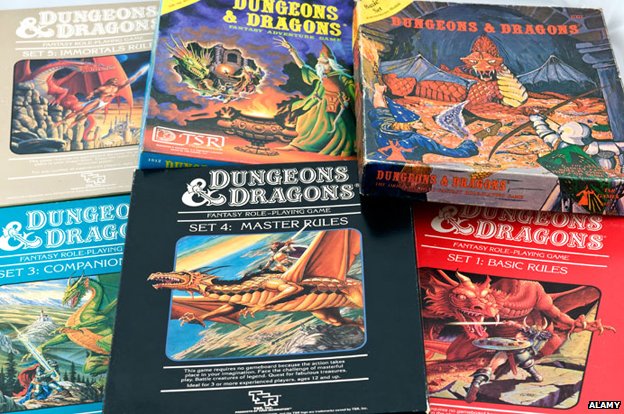
Dungeons and Dragons rulebooks

In 1982, high school student Irving Lee Pulling died after shooting himself in the chest. Despite an article in the Washington Post at the time commenting “how [Pulling] had trouble ‘fitting in'”, mother Patricia Pulling believed her son’s suicide was caused by him playing D&D.

Again, it was clear that more complex psychological factors were at play. Victoria Rockecharlie, a classmate of Irving Pulling, commented that “he had a lot of problems anyway that weren’t associated with the game”.

At first, Patricia Pulling attempted to sue her son’s high school principal, claiming the curse placed upon her son’s character during a game run by the principal was real. She also sued TSR Inc, the publishers of D&D. Despite the court dismissing these cases, Pulling continued her campaign by forming Bothered About Dungeons and Dragons (BADD) in 1983.

Pulling described D&D as “a fantasy role-playing game which uses demonology, witchcraft, voodoo, murder, rape, blasphemy, suicide, assassination, insanity, sex perversion, homosexuality, prostitution, satanic type rituals, gambling, barbarism, cannibalism, sadism, desecration, demon summoning, necromantics, divination and other teachings”.

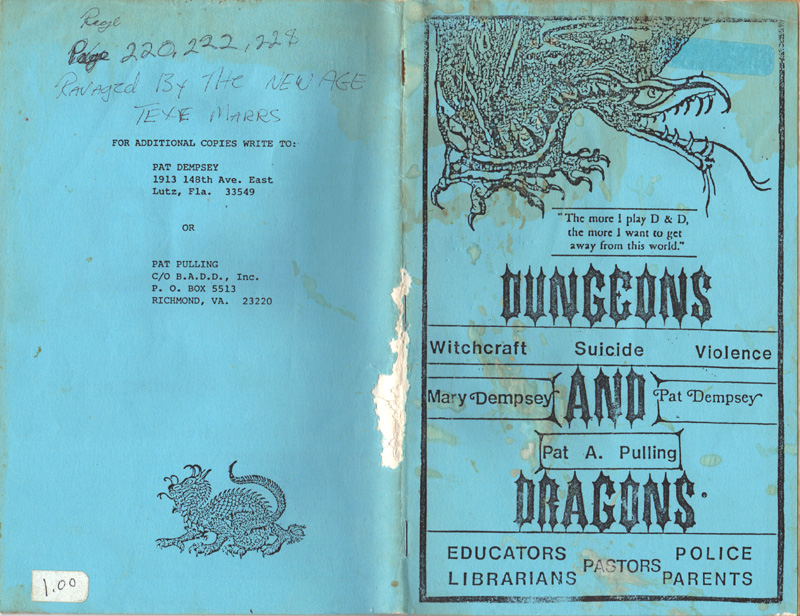
Pulling’s pamphlet on the dangers of D&D:

Dungeons and Dragons moral panic

In 1985, Jon Quigley, of the Lakeview Full Gospel Fellowship, spoke for many opponents when he claimed: “The game is an occult tool that opens up young people to influence or possession by demons.”

These fears also found their way into the UK. Fantasy author KT Davies recalls “showing a vicar a gaming figure – he likened D&D to demon worship because there were ‘gods’ in the game”.

Veteran roleplayer Andy Smith found himself in the unusual position of being both a roleplayer and a Christian. “While working for a Christian organisation I was told to remove my roleplaying books from the shared accommodation as they were offensive to some of the other workers and contained references to demon-worship.”

Looking back now, it’s possible to see the tendrils of a classic moral panic, and some elements of the slightly esoteric world of roleplaying did stir the imaginations of panicked outsiders.

QotD: Romantic views of death in battle

Filed under: History, Humour, Quotations, WW1 — Tags: , , , — Nicholas @ 07:48

And we ourselves? Let us not have too much hope. The chances are that, if we go to war, eager to leap superbly at the cannon’s mouth, we’ll be finished on the way by an ingrowing toenail or by being run over by an army truck driven by a former Greek bus-boy and loaded with imitation Swiss cheeses made in Oneida, N. Y. And that if we die in our beds, it will be of measles or albuminuria.

The aforesaid Crile, in one of his smaller books, A Mechanistic View of War and Peace, has a good deal to say about death in war, and in particular, about the disparity between the glorious and inspiring passing imagined by the young soldier and the messy finish that is normally in store for him. He shows two pictures of war, the one ideal and the other real. The former is the familiar print, “The Spirit of ’76,” with the three patriots springing grandly to the attack, one of them with a neat and romantic bandage around his head apparently, to judge by his liveliness, to cover a wound no worse than an average bee-sting. The latter picture is what the movie folks call a close-up of a French soldier who was struck just below the mouth by a German one-pounder shell a soldier suddenly converted into the hideous simulacrum of a cruller. What one notices especially is the curious expression upon what remains of his face an expression of the utmost surprise and indignation. No doubt he marched off to the front firmly convinced that, if he died at all, it would be at the climax of some heroic charge, up to his knees in blood and with his bayonet run clear through a Bavarian at least four feet in diameter. He imagined the clean bullet through the heart, the stately last gesture, the final words: “Therese! Sophie! Olympe! Marie! Suzette! Odette! Denise! Julie! … France!” Go to the book and see what he got … Dr. Crile, whose experience of war has soured him against it, argues that the best way to abolish it would be to prohibit such romantic prints as “The Spirit of ’76” and substitute therefore a series of actual photographs of dead and wounded men. The plan is plainly of merit. But it would be expensive. Imagine a war getting on its legs before the conversion of the populace had become complete. Think of the huge herds of spy-chasers, letter-openers, pacifist-hounds, burlesons and other such operators that it would take to track down and confiscate all those pictures!

H.L. Mencken, “Exeunt Omnes”, Prejudices: Second Series, 1920.

April 10, 2014

Chiles, peppers, and world trade before globalization

Filed under: Americas, Economics, Food, History, India — Tags: , , , — Nicholas @ 07:53

ESR linked to an interesting discussion of the spread of chile peppers and other exotic spices from the Roman empire onwards:

Can you imagine a world without salsa? Or Tabasco sauce, harissa, sriracha, paprika or chili powder?

I asked myself that question after I found a 700-year-old recipe for one of my favorite foods, merguez — North Africa’s beloved lamb sausage that is positively crimson with chiles. The medieval version was softly seasoned with such warm spices as black pepper, coriander and cinnamon instead of the brash heat of capsicum chile peppers — the signature flavor of the dish today.

The cuisines of China, Indonesia, India, Bhutan, Korea, Hungary and much of Africa and the Middle East would be radically different from what they are today if chiles hadn’t returned across the ocean with Columbus. Barely 50 years after the discovery of the New World, chiles were warming much of the Old World. How did they spread so far, so fast? The answers may surprise you — they did me!

I learned that Mamluk and Ottoman Muslims were nearly as responsible for the discovery of New World peppers as Columbus — but I’m getting ahead of myself.

The global pepper saga begins in the first millennium bce with the combustible career of another pepper — black pepper (Piper nigrum) and its cousins, Indian long pepper and Javanese cubeb. Although Piper nigrum was first grown on the Malabar Coast in India, the taste for it enflamed the ancient world: No matter what the cost — and it was very high — people were mad for pepper. The Romans, for example, first tasted it in Egypt, and the demand for it drove them to sail to India to buy it. In the first century, Pliny complained about the cost: “There is no year in which India does not drain the Roman Empire of fifty million sesterces.”

In one sense, the whole global system of trade — the sea and land routes throughout the known world that spread culture and cuisine through commerce — was engaged with the appetite for pepper, in its growth, distribution and consumption.

Dried chiles shipped well worldwide. From top-left: New World Capsicum annuum varieties include guajillo, ancho and New Mexico; a smaller Capsicum frutescens variety called “birdseye” chiles spread wild in Africa after birds spread their seeds from early gardens, and they are now common also in Southeast Asia; “Indian” chiles are among the most common varieties in India, which today grows and exports more chiles than any other nation. Bottom-left: Three popular capsicum peppers that took root in the Middle East—Maraş, Urfa and Aleppo, shown below in their flaked form—are used in dishes throughout the region. Bottom-right: Fresh serrano, poblano and ripe jalapeño peppers.

Dried chiles shipped well worldwide. From top-left: New World Capsicum annuum varieties include guajillo, ancho and New Mexico; a smaller Capsicum frutescens variety called “birdseye” chiles spread wild in Africa after birds spread their seeds from early gardens, and they are now common also in Southeast Asia; “Indian” chiles are among the most common varieties in India, which today grows and exports more chiles than any other nation. Bottom-left: Three popular capsicum peppers that took root in the Middle East — Maraş, Urfa and Aleppo, shown below in their flaked form — are used in dishes throughout the region. Bottom-right: Fresh serrano, poblano and ripe jalapeño peppers.

ESR said in his brief G+ posting:

More about the early and very rapid spread of capsicum peppers in the Old World than I’ve ever seen in one place before.

I also didn’t know they were such a nutritional boon. It appears one reason they became so entrenched is they’re a good source of Vitamin C in peasant cuisines centered around a starch like rice. My thought is that moderns may tend to miss this point because we have so much better access to citrus fruits and other very high-quality C sources.

The bit about paprika having been introduced to Hungary by the Ottomans was also particularly interesting to me. This was less than 30 years after they had reached the Old World.

April 5, 2014

“They, and they alone, will decide who the Racists are”

Ace on racism and the unofficial deciders on who is a racist and who is not:

Karl Lueger was the mayor of Vienna at the turn of the century, whose populist politics were often riven with anti-semtism — so much so that he was cited as an inspiration by none other than Adolf Hitler in Mein Kampf.

However, there’s a debate about how anti-semitic he actually was, and how much of an anti-semite he pretended to be for the sake of political positioning.

Lueger is famous for an answer he once gave on this issue. He was asked how he squared that fact that many of his policies were anti-semitic, while he counted many Jews among his close friends.

I decide who is a Jew,” he said, apparently creating his own definition of Judaism.

This flexible opinion on “who is a Jew” permitted him to both debase himself (and Vienna) with populist politics of hatred while simultaneously carving out a space for himself to consort with the Hated Other, as he might choose.

Similarly, today, White “liberals” have decided to sell out liberalism to the leftist, totalitarian goons of the Progressive Speech Police. They’ll join the Progressives’ hate campaigns against free speech and free thought — but only when those campaigns are directed towards non-liberals.

Playing to the Progressive mobs just like Luegar played to the Vienna ones, White Liberals reserve themselves the power to both traffic in hateful intolerance, and except themselves and their friends from the claims they otherwise inflict on others.

They, and they alone, will decide who the Racists are.

In the case of the campaign to get Dan Snyder to rename the Washington Redskins (because it’s an offensive, racist epithet), Ace points out that some racist terms are more equal than others:

Obviously no one names a sports club after something they think is substandard, or shoddy, or weak, or useless. People always object to the Redskins name by using the same example — “Well, what would you say if someone named his baseball team the New York N*****s, huh?”

But that’s stupid. No one does that. No one would do that. Because “N****r” is inherently a demeaning term, and a hateful one, and no one — no one — names their sports clubs after things they hate.

They name them after things they respect, or wish to emulate, or wish to associate themselves with. Thus the large number of teams named after great cats, and bears, and stallions, and even the gee-whiz technology of the 50s (jets, rockets).

And as for clubs named after types of people, all those people have a positive association; in football, especially, a martial-themed sport if there ever was one, those positive associations all have to do with virility and deadliness in battle:

Vikings.

Raiders.

Buccaneers.

Warriors.

Fighting Irish.

Spartans.

You do not see “The San Francisco Coolie Laborers” in the lists of any sports teams, nor the “Boston Drunken Irish Wife-Batterers.” All team names are tributes to the group in the nickname.

Some team names implicitly specify a race/ethnicity — Vikings, Fighting Irish. There is no commotion over this — people understand that when someone names a team the “Vikings,” they mean it a positive way. They are speaking of the fury of the Northmen — and not, for example, their propensity to rape and reduce much of Europe to a constant Twilight in which civilization could never advance too far before being pillaged and raped into rubble.

Nor does anyone seriously think “the Fighting Irish” is really about the Irish’s well-known tendency to over-indulge in alcohol and then get their Irish up. (Oh, what a giveaway.) And that one really does actually step right on up to the line of being a slur against the Irish — but we understand the intent behind it is playful, and positive. (Mostly.)

In fact, White Liberals currently on their jihad against the name “Redskins” make an exception for other teams with Indian nicknames — Braves, Chiefs, Indians, all okay. Not racist, the White Liberals have decided, although it’s unclear how they’ve come to this conclusion.

All three names, after all, do reference a specific race — Native Americans — just as surely as “Redskins” does, and for the exact same reasons.

But White Liberals know the difference. White Liberals can tell you who the Racists are.

« Newer PostsOlder Posts »

Powered by WordPress