Quotulatiousness

May 19, 2014

“Parallel construction” and Godwinizing the NSA

Filed under: Government, History, USA, WW2 — Tags: , , , — Nicholas @ 09:33

At Popehat, Clark uses an excerpt from a Bruce Schneier post to make a larger point. Here’s what Bruce wrote last year:

This dynamic was vitally important during World War II. During the war, the British were able to break the German Enigma encryption machine and eavesdrop on German military communications. But while the Allies knew a lot, they would only act on information they learned when there was another plausible way they could have learned it. They even occasionally manufactured plausible explanations. It was just too risky to tip the Germans off that their encryption machines’ code had been broken.

And this is Clark’s take:

We know that the NSA collects all sorts of information on American citizens. We know that the FBI and the CIA have full access to this information. We know that the DEA also has full access to that data. And we know that when the DEA busts someone using information gleaned by the electronic panopticon of our internal spy organization, they take pains to hide the source of the information via the subterfuge of parallel construction.

The insight is this: our government is now dealing with the citizenry the same way that the British dealt with the Nazis: treating them as an external existential threat, spying on them, and taking pains to obfuscate the source of the information that they use to target their attacks.

Yeah, Godwin’s law, whatever, whatever. My point is NOT that the NSA is the same as the Nazi party (in fact, my argument has the NSA on the opposite side). My point is that the government now treats ordinary civilians as worthy of the same sort of tactics that they once used against the Nazis.

H/T to Bernard King for the link.

May 18, 2014

The Past at Work Railway Mania (1980)

Filed under: Britain, History, Railways — Tags: , , — Nicholas @ 12:33

Uploaded on 25 Oct 2011

Part 8 of the 8-part series “The Past at Work”
Written & Presented by Anthony Burton
First broadcast 13th May 1980 (BBC 2)
See also: http://www.bbc.co.uk/archive/steamtrains/7309.shtml and http://www.imdb.com/title/tt1718607/episodes

H/T to Eric Kirkland for the link.

May 17, 2014

The genesis of George MacDonald Fraser’s Flashman

Filed under: Books, Britain, History, Media — Tags: — Nicholas @ 08:59

In the Telegraph, Harry Mount has the story of how George MacDonald Fraser came to create his most memorable fictional character, Harry Flashman:

“I had written what might be called an introductory chapter about this boozy old veteran pouring out his soul on Mafeking Night to some anonymous listener; I think, but I’m not sure, that I called the veteran Flashman, having in mind Thomas Hughes’s character. Anyway, I discarded the introduction, which wasn’t good, and it has probably been destroyed, unless it’s in a trunk somewhere,” MacDonald Fraser wrote in the unpublished account.

“‘How did you get the idea?’ is a question I have been asked ad nauseam, and the answer is that I don’t know. I read Tom Brown’s Schooldays as a child, and possibly on later occasions; I found Flashman the most striking character in the book, and suspect that Hughes did, too — and probably wrote Flashman out of the story because he realised that, if he didn’t, the deplorable lout would take over the book.”

“Possibly it was simply boyhood recollection that prompted it. I certainly don’t remember thinking, ‘Flashman – eureka!’ Anyway, somewhere around April ’66, when I was 41 years old, I sat down to write Flashman, working in the kitchen after I came home from work in the small hours.”

“I began where Hughes had left off, in the style of a memoir; since I knew from internal evidence in Tom Brown the date of Flashman’s expulsion from Rugby, and, since I had determined that he was the kind of rotter whose career was bound to lie in the army, various plot points suggested themselves at once — Lord Cardigan, the First Afghan War, etc. But I had no idea, when I started, of any coherent storyline: Flashman would be a cad and a coward, but I would just plunge ahead and see where my imagination took me.”

Fraser’s Flashman and the following books will tell you more about British history in the Victorian era than you’d learn in a proper history undergrad program, but no university course could be as entertaining as Flashman’s recounting of episodes in his own career. One of the books (and in my opinion the weakest) was turned into a movie, but it didn’t do well enough at the box office, so no more were made. I doubt that a modern movie could be made, as Flashman has all the vices of “his” era, most of which are now so politically incorrect that no studio would dare touch them.

QotD: Modern echoes of 1914

Filed under: Europe, History, WW1 — Tags: , , , , — Nicholas @ 00:01

Though the debate on this subject is now nearly a century old, there is no reason to believe that it has run its course.

But if the debate is old, the subject is still fresh — in fact it is fresher and more relevant now than it was twenty or thirty years ago. The changes in our own world have altered our perspective on the events of 1914. In the 1960s-80s, a kind of period charm accumulated in popular awareness around the events of 1914. It was easy to imagine the disaster of Europe’s ‘last summer’ as an Edwardian costume drama. The effete rituals and gaudy uniforms, the ‘ornamentalism’ of a world still largely organized around hereditary monarchy had a distancing effect on present-day recollection. They seemed to signal that the protagonists were people from another, vanished world. The presumption stealthily asserted itself that if the actors’ hats had gaudy green ostrich feathers on them, then their thoughts and motivations probably did too.

And yet what must strike any twenty-first-century reader who follows the course of the summer crisis of 1914 is its raw modernity. It began with a squad of suicide bombers and a cavalcade of automobiles. Behind the outrage at Sarajevo was an avowedly terrorist organization with a cult of sacrifice, death and revenge; but this organization was extra-territorial, without a clear geographical or political location; it was scattered in cells across political borders, it was unaccountable, its links to any sovereign government were oblique, hidden and certainly very difficult to discern from outside the organization. Indeed, one could even say that July 1914 is less remove from us — less illegible — now than it was in the 1980s. Since the end of the Cold War, a system of global bipolar stability has made way for a more complex and unpredictable array of forces, including declining empires and rising powers — a state of affairs that invites comparison with the Europe of 1914. These shifts in perspective prompt us to rethink the story of how war came to Europe. Accepting this challenge does not mean embracing a vulgar presentism that remakes the past to meet the needs of the present but rather acknowledging those features of the past of which our changed vantage point can afford us a clearer view.

Among these is the Balkan context of the war’s inception. Serbia is one of the blind spots in the historiography of the July Crisis. The assassination at Sarajevo is treated in many accounts as a mere pretext, an event with little bearing on the real forces whose interaction brought about the conflict. In an excellent recent account of the outbreak of war in 1914, the authors declare that ‘the killings [at Sarajevo] by themselves caused nothing. It was the use made of this event that brought the nations to war.’ The marginalization of the Serbian and thereby of the larger Balkan dimension of the story began during the July Crisis itself, which opened as a response to the murders at Sarajevo, but later changed gear, entering a geopolitical phase in which Serbia and its actions occupied a subordinate place.

Our moral compass has shifted, too. The fact that Serbian-dominated Yugoslavia emerged as one of the victor states of the war seemed implicitly to vindicate the act of the man who pulled the trigger on 28 June — certainly that was the view of the Yugoslav authorities, who marked the spot where he did so with bronze footprints and a plaque celebrating the assassin’s ‘first steps into Yugoslav freedom’. In an era when the national idea was still full of promise, there was an intuitive sympathy with South Slav nationalism and little affection for the ponderous multinational commonwealth of the Habsburg Empire. The Yugoslav wars of the 1990s have reminded us of the lethality of Balkan nationalism. Since Srebrenica and the siege of Sarajevo, it has become harder to think of Serbia as the mere object or victim of great power politics and easier to conceive of Serbian nationalism as an historical force in its own right. From the perspective of today’s European Union we are inclined to look more sympathetically — or at least less contemptuously — than we used to on the vanished imperial patchwork of Habsburg Austria-Hungary.

Christopher Clark, The Sleepwalkers: How Europe Went To War In 1914, 2012.

May 16, 2014

The built-in confusion about net neutrality

While I’ve been following the net neutrality debate, I was still unconvinced that either side had the answers. In a post from 2008, ESR helps to explain why I was confused:

Let it be clear from the outset that the telcos are putting their case for being allowed to do these things with breathtaking hypocrisy. They honk about how awful it is that regulation keeps them from setting their own terms, blithely ignoring the fact that their last-mile monopoly is entirely a creature of regulation. In effect, Theodore Vail and the old Bell System bribed the Feds to steal the last mile out from under the public’s nose between 1878 and 1920; the wireline telcos have been squatting on that unnatural monopoly ever since as if they actually had some legitimate property right to it.

But the telcos’ crimes aren’t merely historical. They have repeatedly bargained for the right to exclude competitors from their networks on the grounds that if the regulators would let them do that, they’d be able to generate enough capital to deploy broadband everywhere. That promise has been repeatedly, egregiously broken. Instead, they’ve creamed off that monopoly rent as profit or used it to cross-subsidize competition in businesses with higher rates of return. (Oh, and of course, to bribe legislators and buy regulators.)

Mistake #1 for libertarians to avoid is falling for the telcos’ “we’re pro-free market” bullshit. They’re anything but; what they really want is a politically sheltered monopoly in which they have captured the regulators and created business conditions that fetter everyone but them.

OK, so if the telcos are such villainous scum, the pro-network-neutrality activists must be the heroes of this story, right?

Unfortunately, no.

Your typical network-neutrality activist is a good-government left-liberal who is instinctively hostile to market-based approaches. These people think, rather, that if they can somehow come up with the right regulatory formula, they can jawbone the government into making the telcos play nice. They’re ideologically incapable of questioning the assumption that bandwidth is a scarce “public good” that has to be regulated. They don’t get it that complicated regulations favor the incumbent who can afford to darken the sky with lawyers, and they really don’t get it about outright regulatory capture, a game at which the telcos are past masters.

[…]

In short, the “network neutrality” crowd is mainly composed of well-meaning fools blinded by their own statism, and consequently serving mainly as useful idiots for the telcos’ program of ever-more labyrinthine and manipulable regulation. If I were a telco executive, I’d be on my knees every night thanking my god(s) for this “opposition”. Mistake #2 for any libertarian to avoid is backing these clowns.

In the comments, he summarizes “the history of the Bell System’s theft of the last mile”.

May 15, 2014

The real Havana, outside “Cuba’s Elysium”

Filed under: Americas, History — Tags: , , , — Nicholas @ 00:01

Michael Totten lied to Cuban immigration officials to get into Cuba. Then he went outside the area of Havana that the foreign tourists see. The movie Elysium is supposed to be about a dystopian LA in the future, where the plutocrats live in vast luxury aboard a satellite, looking down on the squalor of those left behind. Totten says this is a pretty accurate description of Cuba today:

Outside its small tourist sector, the rest of [Havana] looks as though it suffered a catastrophe on the scale of Hurricane Katrina or the Indonesian tsunami. Roofs have collapsed. Walls are splitting apart. Window glass is missing. Paint has long vanished. It’s eerily dark at night, almost entirely free of automobile traffic. I walked for miles through an enormous swath of destruction without seeing a single tourist. Most foreigners don’t know that this other Havana exists, though it makes up most of the city — tourist buses avoid it, as do taxis arriving from the airport. It is filled with people struggling to eke out a life in the ruins.

Marxists have ruled Cuba for more than a half-century now. Fidel Castro, Argentine guerrilla Che Guevara, and their 26th of July Movement forced Fulgencio Batista from power in 1959 and replaced his standard-issue authoritarian regime with a Communist one. The revolutionaries promised liberal democracy, but Castro secured absolute power and flattened the country with a Marxist-Leninist battering ram. The objectives were total equality and the abolition of money; the methods were total surveillance and political prisons. The state slogan, then and now, is “socialism or death.”

Cuba was one of the world’s richest countries before Castro destroyed it — and the wealth wasn’t just in the hands of a tiny elite. “Contrary to the myth spread by the revolution,” wrote Alfred Cuzan, a professor of political science at the University of West Florida, “Cuba’s wealth before 1959 was not the purview of a privileged few … Cuban society was as much of a middle-class society as Argentina and Chile.” In 1958, Cuba had a higher per-capita income than much of Europe. “More Americans lived in Cuba prior to Castro than Cubans lived in the United States,” Cuban exile Humberto Fontova, author of a series of books about Castro and Guevara, tells me. “This was at a time when Cubans were perfectly free to leave the country with all their property. In the 1940s and 1950s, my parents could get a visa for the United States just by asking. They visited the United States and voluntarily returned to Cuba. More Cubans vacationed in the U.S. in 1955 than Americans vacationed in Cuba. Americans considered Cuba a tourist playground, but even more Cubans considered the U.S. a tourist playground.” Havana was home to a lot of that prosperity, as is evident in the extraordinary classical European architecture that still fills the city. Poor nations do not — cannot — build such grand or elegant cities.

[…]

Cubans in the hotel industry see how foreigners live. The government can’t hide it without shutting the hotels down entirely, and it can’t do that because it needs the money. I changed a few hundred American dollars into convertible pesos at the front desk. The woman at the counter didn’t blink when I handed over my cash — she does this all day — but when she first got the job, it must have been shattering to make such an exchange. That’s why the regime wants to keep foreigners and locals apart.

Tourists tip waiters, taxi drivers, tour guides, and chambermaids in hard currency, and to stave off a revolt from these people, the government lets them keep the additional money, so they’re “rich” compared with everyone else. In fact, they’re an elite class enjoying privileges — enough income to afford a cell phone, go out to restaurants and bars, log on to the Internet once in a while — that ordinary Cubans can’t even dream of. I asked a few people how much chambermaids earn in tips, partly so that I would know how much to leave on my dresser and also to get an idea of just how crazy Cuban economics are. Supposedly, the maids get about $1 per day for each room. If they clean an average of 30 rooms a day and work five days a week, they’ll bring in $600 a month — 30 times what everyone else gets. “All animals are equal,” George Orwell wrote in Animal Farm, his allegory of Stalinism, “but some animals are more equal than others.” Only in the funhouse of a Communist country is the cleaning lady rich compared with the lawyer. Yet elite Cubans are impoverished compared with the middle class and even the poor outside Cuba.

May 12, 2014

Thumbnail sketch of Russian history

Filed under: Europe, History, Humour, Russia — Tags: , — Nicholas @ 14:10

P.J. O’Rourke says we need to take the long view in regard to Vladimir Putin, and provides a rough history of Russia to back up his contention:

In the sixth century A.D. Russia was the middle of nowhere in the great Eurasian flat spot bounded by fuck-all on the north and east, barbarian hordes and the remains of the Byzantine Empire on the south, and the Dark Ages on the west.

Wandering around in here, up and down the watershed of the Dnieper River from Novgorod (which hadn’t been built yet) to Kiev (ditto) were disorganized tribes of Slavic pastoral herdsmen herding whatever was available, pastorally. They were harried by Goths, Huns, Khazars, and other people who had the name and nature of outlaw motorcycle gangs long before the motorcycle was invented.

The original Russian state, “Old Russia,” was established at Novgorod in A.D. 862 by marauding Vikings. They’d set off to discover Iceland, Greenland, and America, took a wrong turn, and wound up with their dragon boat stuck on a mud bar in the Dnieper. (Historians have their own theories, involving trade and colonization, but this sounds more likely.)

The first ruler of Old Russia was the Viking Prince Ryurik. Imagine being so disorganized that you need marauding Vikings to found your nation — them with their battle axes, crazed pillaging, riotous Meade Hall feasts, and horns on their helmets. (Actually, Vikings didn’t wear horns on their helmets — but they would have if they’d thought of it, just like they would have worn meade helmets if they’d thought of it.) Some government it must have been.

Viking Prince Ryurik: “Yah, let’s build Novgorod!”

Viking Chieftain Sven: “Yah, so we can burn it down and loot!”

May 10, 2014

What did King Solomon and David Lee Roth have in common?

Filed under: Business, Economics, History, Media — Tags: , , — Nicholas @ 12:59

Actually, more than a few things, as the Freakonomics team of Dubner and Levitt explain:

King Solomon built the First Temple in Jerusalem and was known throughout the land for his wisdom.

David Lee Roth fronted the rock band Van Halen and was known throughout the land for his prima-donna excess.

What could these two men possibly have had in common? Well, both were Jewish; both got a lot of girls; and both wrote the lyrics to a No. 1 pop song (“Jump” in Mr. Roth’s case and, in Solomon’s, several verses from Ecclesiastes that appeared in the Byrds’ 1965 hit “Turn! Turn! Turn”). But most improbably, they both dabbled in game theory, as seen in classic stories about their clever strategic thinking.

[…]

And so it was that David Lee Roth and King Solomon both engaged in a fruitful bit of game theory — which, narrowly defined, is the art of beating your opponent by anticipating his next move.

Both men faced a similar problem: How to sift the guilty from the innocent when no one is stepping forward to profess their guilt? A person who is lying or cheating will often respond to an incentive differently than an honest person. Wouldn’t it be nice if this fact could be exploited to ferret out the bad guys?

We believe it can — by tricking the guilty parties into unwittingly revealing their guilt through their own behavior. What should this trick be called? In honor of King Solomon, we’ll name it as if it is a lost proverb: Teach Your Garden to Weed Itself.

May 9, 2014

Shakespeare: Original pronunciation

Filed under: Britain, History, Media — Tags: , , , — Nicholas @ 13:04

Jon, my former virtual landlord sent along an interesting link:

An introduction by David and Ben Crystal to the ‘Original Pronunciation’ production of Shakespeare and what they reveal about the history of the English language.

QotD: Real history and economic modelling

Filed under: Economics, History, Media, Quotations — Tags: , , — Nicholas @ 08:23

I am not an economist. I am an economic historian. The economist seeks to simplify the world into mathematical models — in Krugman’s case models erected upon the intellectual foundations laid by John Maynard Keynes. But to the historian, who is trained to study the world “as it actually is”, the economist’s model, with its smooth curves on two axes, looks like an oversimplification. The historian’s world is a complex system, full of non-linear relationships, feedback loops and tipping points. There is more chaos than simple causation. There is more uncertainty than calculable risk. For that reason, there is simply no way that anyone — even Paul Krugman — can consistently make accurate predictions about the future. There is, indeed, no such thing as the future, just plausible futures, to which we can only attach rough probabilities. This is a caveat I would like ideally to attach to all forward-looking conjectural statements that I make. It is the reason I do not expect always to be right. Indeed, I expect often to be wrong. Success is about having the judgment and luck to be right more often than you are wrong.

Niall Ferguson, “Why Paul Krugman should never be taken seriously again”, The Spectator, 2013-10-13

The 1964 trial of Jack Ruby

Filed under: History, Law, USA — Tags: , , , , — Nicholas @ 00:01

The Toronto Sun shares a portion of Peter Worthington’s Looking for Trouble (now available as an e-book) dealing with the trial of Jack Ruby. Worthington had been in the room when Ruby gunned down Lee Harvey Oswald.

The Ruby trial was pure showbiz. While the witnesses and characters who surfaced during the trial were Damon Runyon, the judge and lawyers seemed straight out of Al Capp and Dogpatch. Judge Joe B. Brown’s legal education before he was elected to the bench consisted of three years of night school 35 years earlier. In Dallas he was known as Necessity – “because Necessity knows no law.”

[…]

One day as a stripper who worked at Ruby’s nightclub called Little Lynn (who was over nine months pregnant at the time), was waiting to testify, seven prisoners in the connecting county jail grabbed a woman hostage and fled. They had fashioned a pistol of soap, pencils and shoe polish, persuaded guards that it was real, and made their break, witnessed by some 100 million viewers.

Little Lynn fainted and Belli prepared to play midwife. A BBC reporter on the phone to his office was describing the action and repeatedly swore to his editors that he was neither kidding, nor had he been drinking. “Listen, you bloody fools, this is America, this is Texas … any bloody insane thing is possible here!”

The next day, the New York Daily News ran an eloquent black headline: “Oh, Dallas!”

The jury returned in 140 minutes with a guilty verdict. In Texas, where the juries set the penalty, they opted for the electric chair.

Belli returned to San Francisco in disgust. “I shall never return here; it’s an evil, bigoted, rotten, stinking town.”

As it happened, Ruby died three years later and won a form of immortality and a place in criminal and political legend.

And as for conspiracy theories, the flaw is that Oswald was an ideologue, a semi-literate left-wing extremist, while Ruby wouldn’t know what an ideologue was unless he did a strip-tease for him.

To choose two such perfect foils on which to base a presidential murder plot challenges credulity. There has been so much official deceit, perjury, rationalization and cover-up that the deeds seem […] more sinister than they actually have been.

We will probably never know the truth.

May 8, 2014

George Orwell was a socialist, despite what many right-wingers piously believe

Filed under: Books, History, Media, Politics — Tags: , , — Nicholas @ 08:09

I’m not sure how you could characterize the great George Orwell as anything other than a socialist, unless you’ve never actually read any of his works:

Orwell's press card portrait, 1943

Orwell’s press card portrait, 1943

One wonders whether the confusion stems from what [Krystal Ball] thinks she knows about Orwell’s politics? Contrary to the devout wishes of many conservatives, it remains an indisputable fact that George Orwell was a socialist. He was not “confused” about his politics. He was not a “capitalist in waiting.” He was not merely “living in another time.” He was a socialist, and he believed that, “wholeheartedly applied as a world system,” socialism could solve humanity’s problem. By contrast, he was wholly appalled by capitalism, which he described as a “racket” and which he believed led inexorably to “dole queues, the scramble for markets and war.” Abandoning a comfortable upbringing that had included an education at Eton and a stint as an imperial policeman in Burma, Orwell not only went out into the streets to discover how the other half lived but went so far as to risk his life for the cause, fighting for the Workers’ Party of Marxist Unification against Franco in the Spanish Civil War. (He was shot by a sniper, but survived.)

When the Right seized upon 1984 (which his publisher quipped to his irritation might be worth “a cool million votes to the Conservative party”), Orwell reacted with controlled anger, explaining in a letter that was published in Life magazine that,

    my novel Nineteen Eighty-Four is not intended as an attack on socialism, or on the British Labor party, but as a show-up of the perversions to which a centralized economy is liable, and which have already been partly realized in Communism and fascism.

So far, so clear.

And yet, admirably, he never lost his independence of mind, writing in the very next line of his explanation that,

    I do not believe that the kind of society I describe necessarily will arrive, but I believe (allowing of course for the fact that the book is a satire) that something resembling it could arrive. I believe also that totalitarian ideas have taken root in the minds of intellectuals everywhere, and I have tried to draw these ideas out to their logical consequences.

This fear came to preoccupy him — and to the exclusion of almost everything else. “Every line of serious work that I have written since 1936,” he explained in Why I Write, “has been written, directly or indirectly, against totalitarianism and for democratic Socialism, as I understand it.”

How he understood it was changing by the day. “Collectivism,” he warned in a 1944 book review, “leads to concentration camps, leader worship and war.” More important, perhaps, he admitted that this might always be so, suggesting that “there is no way out of this unless a planned economy can somehow be combined with the freedom of the intellect, which can only happen if the concept of right and wrong is restored to politics.” Like Wilde before him, he held that freedom of the intellect to be indispensable. The question: Could socialism accommodate it?

It is de rigeur these days to cast Orwell as being merely an anti-totalitarian socialist — a “democratic socialist,” if you will — and, in doing so to parrot the graduate student’s favorite assurance that, because Marxism has never been tried in any sufficiently developed country, its critics are condemning merely its “excesses.” Certainly, Orwell did not believe that the Soviet Union was in any meaningful way a “socialist” state: “Nothing,” he charged, “has contributed so much to the corruption of the original idea of socialism as the belief that Russia is a socialist country and that every act of its rulers must be excused, if not imitated.” But, dearly as he hoped it could be realized, he also never quite managed to convince himself that his form of socialism was possible either — let alone that it could coexist with the English liberties he so sharply championed. For Orwell, it was not simply a matter of distinguishing between the “good” and “bad” Left, but worrying whether the former would lead always to the latter — a concern that the British literary classes, which indulged Stalin’s horrors to an unimaginable degree, did little to assuage.

May 7, 2014

Peak inequality in England – about 200 years ago

Filed under: Books, Britain, Economics, History — Tags: , , , — Nicholas @ 10:18

An interesting article that starts and ends talking about Thomas Piketty’s new book, but in the middle goes a long way to explain what happened to English aristocracy over the last few hundred years:

Extravagances like the stately homes of England made economic sense before the 19th century because the relative wages of servants and construction workers mostly fell from 1500 to 1800 as the supply of English workers slowly recovered in size from the Black Death of the 1340s.

But, outside of economic theory, the rich have often tended to get poorer, especially when they spend more than they make. It’s a common theme in English literature (Evelyn Waugh’s A Handful of Dust) and television (Downton Abbey). For instance, by the time of Winston Churchill’s birth in 1874, the English ultra-rich weren’t getting richer.

[…]

The long agricultural depression of 1873-1896 meant the great houses of England began falling apart. Wings had to be shut as servants found higher paying jobs in factories. Repairs could not be paid for.

The usual solutions were to first auction off the art collection, then marry American heiresses, as in Downton Abbey, where Countess Cora, played by Elizabeth McGovern, is from the Chicago Levinsons. Winston’s mother Jenny was from the Jeromes of Wall Street.

[…]

Servants had steadily become more expensive in England. One reason was the increase in jobs elsewhere in a modernizing economy. On Downton Abbey, to illustrate, a maid applies for a job in town as a secretary, which is a much better post.

A forgotten reason, though, was that the massive emigration from the British Isles reduced the supply of workers and thus raised their wages. While Tony Blair’s Labor Government liked to claim that Britain had always been a nation of immigrants, it was in truth a nation of emigrants. Today, there are perhaps two or even three times as many people descended from the British Isles living in the United States, Canada, Australia, New Zealand, South Africa, and Argentina as there are in Britain and Ireland. Without all that outflow, wages in Britain would be lower and land prices astronomical.

H/T to Kathy Shaidle for the link.

May 5, 2014

Dien Bien Phu and the end of French Indochina

Filed under: Asia, France, History, Military — Tags: , , , — Nicholas @ 07:16

BBC News Magazine looks back 60 years to the end of French colonial government and the military defeat at Dien Bien Phu which made it inevitable:

Sixty years ago this week, French troops were defeated by Vietnamese forces at Dien Bien Phu. As historian Julian Jackson explains, it was a turning point in the history of both nations, and in the Cold War — and a battle where some in the US appear to have contemplated the use of nuclear weapons.

“Would you like two atomic bombs?” These are the words that a senior French diplomat remembered US Secretary of State John Foster Dulles asking the French Foreign Minister, Georges Bidault, in April 1954. The context of this extraordinary offer was the critical plight of the French army fighting the nationalist forces of Ho Chi Minh at Dien Bien Phu in the highlands of north-west Vietnam.

The battle of Dien Bien Phu is today overshadowed by the later involvement of the Americans in Vietnam in the 1960s. But for eight years between 1946 and 1954 the French had fought their own bloody war to hold on to their Empire in the Far East. After the seizure of power by the Communists in China in 1949, this colonial conflict had become a key battleground of the Cold War. The Chinese provided the Vietnamese with arms and supplies while most of the costs of the French war effort were borne by America. But it was French soldiers who were fighting and dying. By 1954, French forces in Indochina totalled over 55,000.

[…]

Saturday 3 April 1954 has gone down in American history as “the day we didn’t go to war”. On that day Dulles met Congressional leaders who were adamant they would not support any military intervention unless Britain was also involved. Eisenhower sent a letter to the British Prime Minister Winston Churchill warning of the consequences for the West if Dien Bien Phu fell. It was around this time, at a meeting in Paris, that Dulles supposedly made his astonishing offer to the French of tactical nuclear weapons.

In fact, Dulles was never authorised to make such an offer and there is no hard evidence that he did so. It seems possible that in the febrile atmosphere of those days the panic-stricken French may simply have misunderstood him. Or his words may have got lost in translation.

Dien Bien Phu map

“He didn’t really offer. He made a suggestion and asked a question. He uttered the two fatal words ‘nuclear bomb’,” Maurice Schumann, a former foreign minister, said before his death in 1998. “Bidault immediately reacted as if he didn’t take this offer seriously.”

According to Professor Fred Logevall of Cornell University, Dulles “at least talked in very general terms about the possibility, what did the French think about potentially using two or three tactical nuclear weapons against these enemy positions”.

Bidault declined, he says, “because he knew… that if this killed a lot of Viet Minh troops then it would also basically destroy the garrison itself”.

In the end, there was no American intervention of any kind, as the British refused to go along with it.

May 4, 2014

The Battle of the Atlantic

Filed under: Cancon, Germany, History, Military, WW2 — Tags: , , , — Nicholas @ 00:01

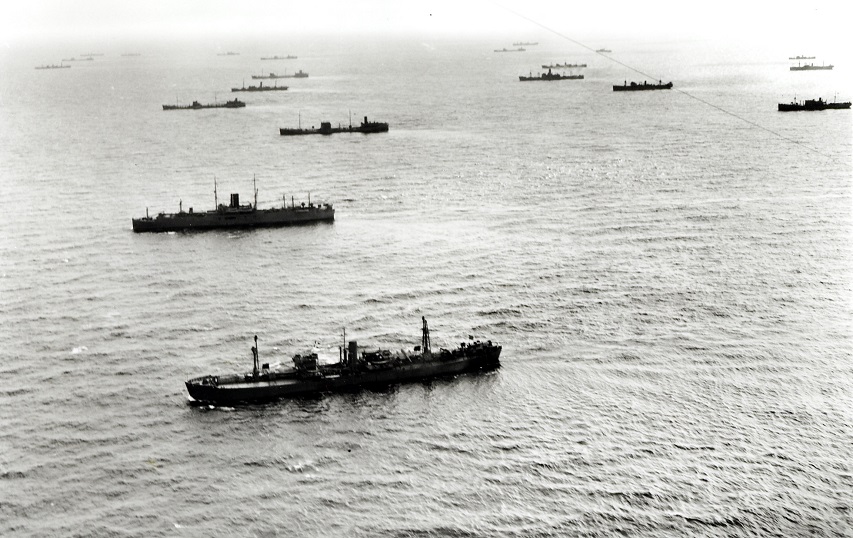
On the first Sunday in May every year, we remember the Battle of the Atlantic, one of the major contributions to allied victory in World War 2, and the Canadian part in that multi-year battle:

The Battle of the Atlantic campaign was fought at sea from 1939 to 1945 with the strategic outcome being sea-control of the North Atlantic Ocean. It was the longest, largest, and arguably the most complex campaign of the Second World War. Over the course of 2,075 days, Allied naval and air forces fought more than 100 convoy battles and perhaps 1,000 single ship actions against the submarines and warships of the German and Italian navies. Enemy vessels targeted mainly the convoys of merchant ships transporting material and troops vital to safeguarding the freedom of the peoples of North America and Europe.

On any given day, up to 125 merchant vessels were sailing in convoy across the North Atlantic. It was during these treacherous, stormy crossings that Canada’s navy matured and won the mantle of a professional service. Our navy escorted more than 25,000 merchant vessels across the Atlantic. These ships carried some 182,000,000 tonnes of cargo to Europe — the equivalent of eleven lines of freight cars, each stretching from Vancouver to Halifax. Without these supplies, the war effort would have collapsed.

Thousands of Canadian men and women – members of the Royal Canadian Navy (RCN), the Merchant Navy (MN) and the Royal Canadian Air Force (RCAF), mostly volunteers from small town Canada – had to face situations so perilous they are difficult for us to imagine. As Canadians, we should be proud of their courage.

Although largely unprepared for war in 1939, Canada’s navy grew at an unparalleled rate eventually providing 47 percent of all convoy escorts. Rear Admiral Leonard Murray, who as Commander-in-Chief Northwest Atlantic from March 1943, would become the only Canadian to hold an Allied theatre command during the war and direct the convoy battles out of his headquarters in Halifax.

During the Second World War the RCN grew from 13 vessels to a strength of nearly 100,000 uniformed men and women and nearly 400 vessels, the fourth largest navy in the world. It had suffered 2,210 fatalities, including six women, and had lost 33 vessels. It had destroyed or shared in the destruction of 33 U-Boats and 42 enemy surface craft. In partnership with Canada’s maritime air forces and merchant navy, it had played a pivotal and successful role in the contest for seaward supremacy.

Merchant ships of Convoy HX188 en route to Britain. Photo: Library and Archives Canada PA-115006

Merchant ships of Convoy HX188 en route to Britain.
Photo: Library and Archives Canada PA-115006

« Newer PostsOlder Posts »

Powered by WordPress