
The central problem of relations with de Gaulle stemmed from President Roosevelt’s distrust. Roosevelt saw him as a potential dictator. This view had been encouraged by Admiral Leahy, formerly his ambassador to Marshal Petain in Vichy, as well as several influential Frenchmen in Washington, including Jean Monnet, later seen as the founding father of European unity.
Roosevelt had become so repelled by French politics that in February he suggested changing the plans for the post-war Allied occupation zones in Germany. He wanted the United States to take the northern half of the country, so that it could be resupplied through Hamburg rather than through France. “As I understand it,” Churchill wrote in reply, “your proposal arises from an aversion to undertaking police work in France and a fear that this might involve the stationing of US Forces in France over a long period.”
Roosevelt, and to a lesser extent Churchill, refused to recognize the problems of what de Gaulle himself described as “an insurrectional government”. De Gaulle was not merely trying to assure his own position. He needed to keep the rival factions together to save France from chaos after the liberation, perhaps even civil war. But the lofty and awkward de Gaulle, often to the despair of his own supporters, seemed almost to take a perverse pleasure in biting the American and British hands which fed him. De Gaulle had a totally Franco-centric view of everything. This included a supreme disdain for inconvenient facts, especially anything which might undermine the glory of France. Only de Gaulle could have written a history of the French army and manage to make no mention of the Battle of Waterloo.
Anthony Beevor, D-Day: The Battle for Normandy, 2009.
June 5, 2014
QotD: Churchill, Roosevelt and de Gaulle
Conspiracy theorist’s festival day
Matt Welch on the last few decades that paved the way for a re-expansionist Russia:
On September 10, 1990, U.S. President George Bush and Soviet President Mikhail Gorbachev issued a simple and remarkable joint statement. “We are united in the belief that Iraq’s aggression must not be tolerated,” the former Cold War opponents declared after a seven-hour meeting in Helsinki to discuss Saddam Hussein’s annexation of Kuwait. “No peaceful international order is possible if larger states can devour their smaller neighbors.”
Observers understood immediately the historical significance of two previously antagonistic superpowers agreeing on the principle that countries cannot swallow one another. What was less obvious at the time is that the moment would look like science fiction from the perspective of the future as well.
President Bush — we did not need to differentiate him as “H.W.” back then — was so giddy about the prospects of rules-based global cooperation that on the not-yet-portentous date of September 11, 1990, he gave an unfortunate name to the concept during an address to a joint session of Congress: new world order.
“Most countries share our concern for principle,” he asserted. “A new partnership of nations has begun, and we stand today at a unique and extraordinary moment. The crisis in the Persian Gulf, as grave as it is, also offers a rare opportunity to move toward an historic period of cooperation. Out of these troubled times, our fifth objective — a new world order — can emerge: a new era-freer from the threat of terror, stronger in the pursuit of justice and more secure in the quest for peace. An era in which the nations of the world, east and west, north and south, can prosper and live in harmony. […] A world where the rule of law supplants the rule of the jungle. A world in which nations recognize the shared responsibility for freedom and justice. A world where the strong respect the rights of the weak.”
Because “new world order” sounded creepy and was already a phrase used by conspiracists worried about one-world government, Bush’s larger point got washed away in the ensuing brouhaha. But terminology aside, the creation of an international taboo against subsuming weaker countries was a worthwhile endeavor.
Mother Jones on the Rothbard-Koch feud
I met Murray Rothbard a few years before he died, sharing a panel with him at a Libertarian event in Toronto. He was a fascinating, but uncomfortable man to talk with (at least on my brief acquaintance). He was an ideological fundamentalist and had no time for those who wanted to “water down” the libertarian message to make it more acceptable to the general public. In Mother Jones, Daniel Schulman reports on the bitter break between Charles Koch and Rothbard not long after the founding of the Cato Institute over exactly that kind of issue:
Long before Charles Koch became the left’s public enemy number one (or two, depending on where David Koch falls in the rankings), some of his most vocal detractors were not liberals but fellow libertarians. None of his erstwhile allies would come to loathe him more fiercely than Murray Rothbard, one of the movement’s intellectual forefathers, with whom Charles had worked closely to elevate libertarianism from a fringy cadre of radical thinkers to a genuine and growing mass movement.
In the 1970s, Charles helped fund Rothbard’s work, as the economist churned out treatise after treatise denouncing the tyranny of government. Rothbard was a man with a plan when it came to movement-building. Where some libertarians had bickered over whether to advance the cause through an academic or an activist approach, Rothbard argued that the solution wasn’t to choose one path, but both. Charles was taken with his strategic vision.
Rothbard dreamt of creating a libertarian think tank to bolster the movement’s intellectual capacity. Charles Koch made this a reality in 1977, when he co-founded the Cato Institute with Rothbard and Ed Crane, then the chairman of the national Libertarian Party. This was a high point for libertarianism, when a busy hive of libertarian organizing buzzed on San Francisco’s Montgomery Street, home to Cato and a handful of other ideological operations bankrolled by Charles Koch.
But the relationship between Cato’s co-founders soon soured.
Rothbard, who was feisty by nature, chafed under the regime of Crane and Koch — the libertarian movement’s primary financier at that time. His breaking point came during the 1980 election, when David Koch ran as the Libertarian Party’s vice presidential nominee. Rothbard and his supporters felt that, in a bid for national legitimacy, David Koch and his running mate, Ed Clark, had watered down the core tenets of libertarianism to make their philosophy more palatable to the masses. Americans today would consider their platform — which called for abolishing Social Security, Medicare, and Medicaid and eliminating federal agencies including the EPA and the Department of Energy — a radical one. But to Rothbard and his circle, it wasn’t radical enough. For instance, the Clark-Koch ticket stopped short of calling for the outright repeal of the income tax. And Clark, to Rothbard’s horror, had even defined libertarianism as “low-tax liberalism” in a TV interview.
Following the 1980 election, in which the Clark-Koch campaign claimed a little over one percent of the popular vote, Rothbard did not hold back. He penned a scathing polemic titled “The Clark Campaign: Never Again,” in which he wrote that Ed Clark and David Koch had “sold their souls — ours, unfortunately, along with it — for a mess of pottage, and they didn’t even get the pottage.” Thanks in part to Rothbard’s rabble-rousing, factional feuds and recriminations splintered the libertarian movement just as it was gaining momentum. A few months after Rothbard’s diatribe, Charles Koch and Ed Crane tossed him out of the Cato Institute and voided his shares in the think tank (which was set up, under Kansas law, as a nonprofit corporation with stockholders), a rebuke that turned their libertarian brother-in-arms into a lifelong adversary.
The Rothbard-Koch split was only the biggest of a lot of factional in-fighting in the movement in those days. Even in the outermost fringes of the movement (in Canada, for example), we had lots of splinters-of-splinters micro-movements going on (which is why the Monty Python skit about the People’s Front of Judea, the Judean People’s Front and the Judean Popular People’s Front “Splitters!” rings so true for me). Some days, we made the Communists/Marxist-Leninists look like sane, sensible co-operative folks.
A visual history of pin-up magazines

A review of a new three-volume history of the girly magazine:
Taschen delivers as only Taschen can with Dian Hanson’s History of Pin-Up Magazines, a comprehensive three-volume boxed set chronicling seven decades in over 832 munificently illustrated pages, tipping the scales at nearly seven hardbound pounds. Although each volume is ram-packed with a bevy of sepia sweethearts, hand-tinted honeys, and Kodachrome cuties squeezed between dozens of lurid full-page vintage magazine covers, the accompanying text is so compelling that you’re apt to actually read these books too. And there’s a lot to learn about the history of pin-up magazines, more than you’d ever imagine, and this set leaves no stone unturned and no skirt unlifted. From the suggestive early illustrations of the post-Victorian era to the first bare breasts, the intriguing sources that fueled the fires of popular fetish trends, and the many ways in which publishers tried to legitimize the viewing of nude women while gingerly dancing around obscenity laws, we watch this breed of pulp morph and reinvent with fiction or humor, and later the marriage of crime and flesh. We see the influence on pin-up culture in the wake of the First World War and with the advent of World War II and the rise of patriotica. We follow the path of the bifurcated girl, to eugenics, the role of burlesque, and the legalization of pubic hair. We venture under-the-counter, witness the death of the digest and the pairing of highbrow literature and airbrushed beauties. Hanson even treats us to a peek into the lesser-known black men’s magazine genre, and the contributions made by erotic fiction and Hollywood movie studios.
June 2, 2014
The naval revolution and HMS Dreadnought
BBC News Magazine looks back on the launch of the first modern all-big-gun battleship, HMS Dreadnought, in 1906.

HMS Dreadnought underway, circa 1906-07
[HMS Dreadnought] “really transformed naval warfare rather like the tank did on land warfare. In fact Dreadnought was described at the time as ‘the most deadly fighting machine ever launched in the history of the world'”.
Dreadnought brought together for the first time a series of technologies which had been developing over several years. Most important was her firepower. She was the first all big-gun battleship — with ten 12-inch guns. Each gun fired half-ton shells over 4ft tall and packed with high explosive. They weighed as much as a small car. Standing next to one today, it is easy to see how a single broadside could destroy an opponent — and do so at 10 miles’ distance.
These great distances caused problems of their own — in controlling and directing the fire — and Dreadnought was one of the first ships fitted with new equipment to electrically transmit information to the gun turrets.
For potential enemies on the receiving end this was a terrifying prospect. Admiral Lord West, a former head of the Royal Navy, calls Dreadnought “a most devastating weapon of war, the most powerful thing in the world”.
Potential adversaries would also have trouble outrunning her. New steam turbine engines gave her a maximum speed of about 25mph. They made her more reliable than previous ships, and able to sustain a higher speed for much longer.
But there was something else, too. Dreadnought had been built in just one year — a demonstration of British military-industrial might at a time when major battleships generally took several years to build. This, says Roberts, was an “enormous achievement which made the Germans sit up because their shipbuilding capability just could not match that”.

Despite the Royal Navy’s reputation for being tradition-bound and stodgy, they had quite an interesting history of experimentation and innovation in ship design. The launch of HMS Dreadnought was a good example of the navy being willing to take risks — specifically the risk of making the rest of the battlefleet obsolete overnight.
Update, 18 February, 2018: A recent post at Naval Gazing provides more information on the evolution of the Dreadnought design.
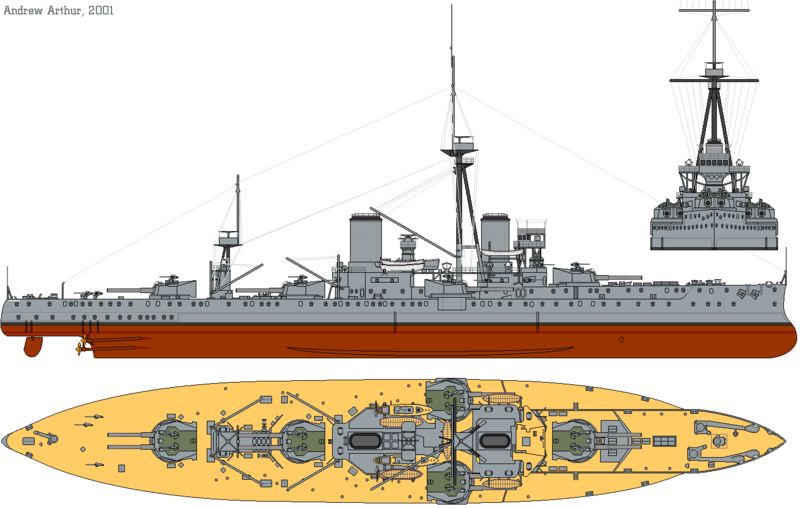
HMS Dreadnought in 1911
[Admiral Sir John “Jackie”] Fisher established a committee, including John Jellicoe and Reginald Bacon, who settled on the characteristics that would define Dreadnought. Bacon, later Dreadnought’s first captain – regarded by Fisher as “the cleverest officer in the Navy” – was the man who convinced Fisher to switch from all-10″ to all-12″. Reports of the effectiveness of the 12″ gun during the Russo-Japanese war helped confirmed this decision.
The second major change that Dreadnought brought is less obvious but in many ways more important. Dreadnought was the first large warship to use steam turbines instead of reciprocating engines. This increased her speed from the previous standard of 18 kts to 21 kts, saved 1000 tons, and most importantly allowed her to maintain high speed for much longer without the risk of mechanical failure. This was a vital component of Fisher’s other innovation, what we now call net-centric warfare. The high sustained speed of the new ships allowed them to cover greater areas, based on the improved information gathering and dissemination system that Fisher set up.
Dreadnought broke new ground in other areas, too. Her hull was about 18% lighter by volume than that of the proceeding Lord Nelson class, and she set a new standard for watertight integrity, removing most doors below the waterline. The only area without major improvement was armor, which was actually slightly less than in the Lord Nelson.
The design process began in November of 1905, initially with plans for 6 turrets. The first set of designs included the obvious (a hexagonal layout), the slightly less obvious (three superfiring turrets on each end) and the weird (a triangle at each end, with two turrets abreast and a superfiring turret above them). Eventually, it was decided that muzzle blast made the later two designs infeasible. Blast interference between the wing turrets meant that the aft pair was replaced by a single centerline turret, producing the arrangement used in Dreadnought.
The final result was a ship of 18,000 tons and 527 ft. With an 8-gun broadside, she matched the long-range firepower of almost any two ship afloat, and she set a new standard for speed in battleships. She was laid down on October 2nd, 1905, and launched only 5 months later, on February 10th, 1905. The 14 months exactly from laying down to commissioning set a record that has never been broken for capital ships, and was intended by Fisher to send a message to the world.
He also references the Dreadnought Hoax, which I’d never heard of … I’m surprised Cole wasn’t prosecuted as a spy, given the popular anxieties about foreign espionage and worries about an invasion.
The fall and rise of racism
Frank Furedi says that what “everyone knows” about the rising tide of racism not only isn’t true, but it’s actually the reverse: racism has been largely defeated in the West. What we now call “racism” isn’t the same thing at all, as our definitions have changed dramatically.
It is astounding just how thoroughly the ideology of racism has been crushed. We should recall that until the outbreak of the Second World War, racial thinking was rarely questioned in any part of the world. Even in academic circles, critics of racism were very much in a minority in the 1930s. Back then, the term ‘racist’ was used neutrally and sometimes even positively in Western societies. It was only in the 1930s that the word ‘racism’ started to acquire negative connotations. It was in that decade that the use of the word racism in a derogatory way was first recorded in the English language. But even then, the idea of racial equality had few defenders – including within the intellectual community.
Since the 1930s, racism, with its oppressive claim that some people are superior to other, ‘subhuman’ people, has been systematically discredited. The idealisation of the racial superiority of whites and the dehumanisation of people from Africa and Asia has been culturally marginalised. Even the most extreme xenophobic cults and parties now find it difficult explicitly to use the language of racial ideology. The notion of racial superiority is conspicuous by its absence in public discussion in the twenty-first century.
People may still have their prejudices, but very few individuals now define themselves as racist. Indeed, the term racist is looked upon negatively even by people who do feel some form of prejudice against a foreign ethnic or religious group. The fact that such people feel obliged to say ‘I’m not a racist, but…’ indicates that racism enjoys very little cultural validation in modern Western societies.
[…]
Paradoxically, the sharp decline in expression of racial pride has been paralleled by a huge increase in public accusations of racism. One reason why such accusations are on the rise is because the definition of racism has changed to the point where it has almost nothing in common with the original meaning of the word. These days, any heated dispute between people of different cultural or ethnic backgrounds has the potential to be branded a racist incident. In his disturbing study, The Myth of Racist Kids, Adrian Hart reported that new anti-racist policies in British schools have led to the rebranding of everyday playground insults as ‘racist behaviour’. Following the lead of other institutions, schools have adopted an expansive definition of racism that includes name-calling and excluding a child from games.
June 1, 2014
In the Progressive Era, “big business led the struggle for the federal regulation of the economy”
Timothy Carney says we should know much more about socialist historian Gabriel Kolko and his careful debunking of the “Teddy Roosevelt as trust-buster” myth:
Every American knows the fable of the Progressive Era and that “trust buster” Teddy Roosevelt wielding the big stick of federal power to battle the greedy corporations. We would be better off if more people knew the work of the man who dismantled this myth: historian Gabriel Kolko, who died this month at age 81.
Kolko was a self-described socialist and a Harvard-educated historian, but he had little use for the liberal political establishment’s pious regard for the Progressive Era of 1900 to 1916. And he was never credulous enough to believe that government intervention in the economy was generally in the public interest.
For today’s politics, Kolko’s most important book was The Triumph of Conservatism, published in 1967. His thesis: “The dominant fact of American political life” in the Progressive Period “was that big business led the struggle for the federal regulation of the economy.”
The standard history of the Progressive Period — which painted Teddy and the Feds as the scourge of Big Business — relied too much on the public rhetoric of TR and his cohorts. Kolko dug deeper to show how Big Business truly felt about Big Government, and how the Progressives truly felt about Big Business.
Many corporate titans in the early 20th Century, buying into the pervasive hubris of the day, believed that a state-managed economy was the inevitable end of a rational society — the conclusion of what Standard Oil’s top lobbyist Samuel Dodd called the “march of civilization.” Competition, in their eyes, was destructive redundancy.
[…]
Liberal scholar William Galston at the Brookings Institution explains the economics at play. “Corporations have sizeable cash flows and access to credit markets, which gives them a cushion against adversity and added costs,” he wrote in 2013, explaining why the big guys often welcome regulation. “[S]mall businesses often operate much closer to the margin and are acutely sensitive to policies that threaten to drive up costs.” Also, “CEOs can hire experts to help them cope with added regulatory burdens and can spread the costs over a large workforce.”
Kolko’s research smashed the favorite tales of the Progressive myth. When Upton Sinclair wrote The Jungle, which included descriptions of rancid meat-packing plants, Roosevelt saw Sinclair as personally despicable, but a useful asset in his quest to impose federal meat inspection. Sinclair opposed Roosevelt’s regulation, and Kolko relates that “the big packers were warm friends of regulation, especially when it primarily affected their innumerable small competitors.”
By “conservatism,” Kolko meant “stability,” and preservation of the status quo. This is often the aim of corporate giants. It is consistently the consequence of federal action. And it is reliably the enemy of entrepreneurship, economic growth and free choice.
May 31, 2014
Amusing Telex exchange as Falkland Islands were invaded by Argentina
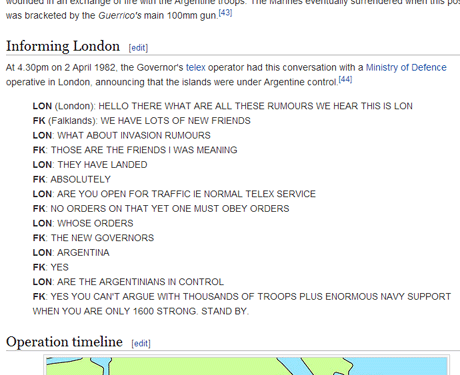
H/T to Jonathan Liew for the image.
May 30, 2014
“Historical” High Court judgment that ignores history
Last week, the High Court decided that the remains of King Richard III will be re-buried in Leicester, not in York. As you might expect, that leaves a lot of people unhappy.
When Richard III was hacked to death in rural Leicestershire in 1485, the royal House of York fell, bringing an end to the Plantagenet line that had lasted for 16 kings and 331 years. Many people see his death as the end of the English middle ages.
Despite this country’s ancient legal system, the courts do not often get to deal with real history, although they make many historic decisions. Yet the ruling of the High Court last Friday truly made history, as three judges decided that Richard III should be buried at the scene of his violent defeat, and not in York.
One side is always unhappy after a court hearing. And in this case those who sponsored York Minster may have more to be sore about than most.
The High Court acknowledged the case has “unprecedented” and “unique and exceptional features,” but nevertheless went on to give a rather bland ruling supporting Chris Grayling’s decision to leave the matter of reburial in the hands of the University of Leicester team running the excavation. In doing so, the court treated the hearing as a straightforward matter of public law, and affirmed that the government had been under no duty to consult widely before handing the responsibility over to the University of Leicester.
[…]
History and legacy mattered to medieval monarchs. Their actions, even the less obvious ones, were intended to make statements to reinforce their dynastic power. York Minster is an ancient foundation, home to the throne of the second most senior churchman in England. There has been an Archbishop of York since at least the seventh century. For Richard, a scion of the house of York, the Minster was an obvious place to fuse the sacred and secular, binding royal and church power together in one of England’s most venerable religious buildings. By contrast, Leicester Cathedral, although a lovely building with a long tradition of worship on the site, was a parish church until 1927 when it became the city’s cathedral. Although there was a church there in Richard’s day, it does not have the dynastic associations that Richard was clearly building with York.
And there’s always the religious aspect to consider (which would have been true regardless of the High Court’s decision):
And finally, the question of the liturgy is also set to run. As the old joke goes: Q. What is the difference between a terrorist and a liturgist? A. You can reason with a terrorist. Leicester cathedral has diligently teamed up with an expert medieval musicologist, who has painstakingly uncovered and proposed the finer details of prayers and music appropriate to a 15th-century reburial. However, strong feelings which go beyond the musical arrangements have been expressed in many quarters, including in an online petition, and by Dr John Ashdown-Hill, the historian who led the excavations. These views reflect a conviction that Richard should have a Roman Catholic ceremony that respects the faith in which he grew up and died, and which is honest to what his wishes would have been. Leicester Cathedral will certainly have their hands full trying to reconcile Richard’s pre-Reformation religious beliefs with the Church of England ceremonies they are permitted to conduct.
QotD: Pursuit of a beaten foe
All commanders must have been aware of the advantages of vigorous pursuit; hence the mere fact that they did not succeed in achieving it shows that there must be some big predisposing cause militating against its attainment. This cause may be defined as lassitudo certamine (to coin an expression), that moral and physical fatigue and reaction that usually supervenes toward the close of a hard-fought struggle as the daylight departs and the pursuit should just be starting. At the battle of Orthez Wellington thoroughly defeated Soult but omitted to pursue him. Why? Almost certainly because he was himself wounded just at the close of the action, and his physical and mental powers at that critical moment no doubt suffered temporary eclipse. In the same way Marlborough after his brilliant exploit in forcing the Lines of the Geet in 1705 made no attempt to pursue. He had just taken part himself in a fierce cavalry charge, and was physically bouleversé. It is doubtful whether in any army this potential weakness is sufficiently recognized and systematically combatted.
Lt. Colonel Alfred H. Burne, The Art of War on Land, 1947.
May 28, 2014
The oddly neglected Battle of Amiens, 1918
In History Today, Nick Lloyd wonders why the allied victory at the Battle of Amiens does not have the same degree of recognition that the British disaster at the Battle of the Somme does:
For the historian John Terraine, who fought a long and lonely battle to rescue the reputation of Field Marshal Sir Douglas Haig – commonly caricatured as a ‘butcher and bungler’ – the Battle of Amiens was his vindication. In his article for History Today, written in 1958, Terraine revisited the scene of the infamous ‘black day’ of the German army on August 8th, 1918. As Terraine reminds us, this battle was a far cry from the barren, bloody results of the first day on the Somme, July 1st, 1916, when the British army suffered its worst day. According to Terraine, Amiens was a triumph of ‘planning and method … of co-ordination and cunning; of the valour and efficiency of the British artillery and tanks; and of the courage, initiative and dash of the infantry’.
Much of what Terraine wrote still stands. Amiens was a decisive moment, kicking off Marshal Ferdinand Foch’s ‘series of movements’ that would end with the German government appealing for peace negotiations on October 3rd (an essential prelude to the Armistice on November 11th). Amiens was a perfect demonstration of not only how effective British and Commonwealth forces had become by 1918 – developing an embryonic blitzkrieg – but also how the German army had no answer to this kind of combined, all-arms approach to warfare.
Purists will be offended by Terraine’s failure to explain the role of the French army at Amiens (which extended the attack to the south), but more intriguing is the sidelining of Sir Arthur Currie’s Canadian Corps. Indeed, Terraine’s focus on generals Rawlinson and Monash (although not incorrect in itself) seems to miss how important the Canadians were to the battle; it would be true to say that they made the Battle of Amiens. Their four divisions in line, deployed in the centre along the Amiens-Roye Road, formed the spearhead of the assault. At the end of the day they had driven eight miles into the position of the German Second Army.
The “servant problem” of post-Victorian England
Before the widespread availability of electricity, no middle class household in England could get by without at least one servant. Even as modern labour-saving appliances (along with proper plumbing) started to take their place in the home, servants were still deemed an essential part of being middle- or upper-class. It may account for some of the fascination with TV shows like Downton Abbey or the earlier Upstairs, Downstairs to modern audiences — they give at least a bit of a glimpse into a very different domestic world. At Bookforum, Daphne Merkin reviews a books that look at the “servant problem”:
Servants is chockablock with incredulous-making details about the exploitative conditions in which household help lived and worked (these included cramped, chilly, and spartan sleeping quarters, endless hours, and the overriding assumption of inferiority), as well as anecdotes of supreme helplessness on the part of the coddled rich, such as the following: “Lord Curzon, whose intellect was regarded as one of the glories of the Empire, was so baffled by the challenge of opening a window in the bedroom of the country house in which he was staying (no servants being available so late at night), that he simply picked up a log from the grate and smashed the glass.” Even after World War II, when homes had begun to be wired for electricity despite the gentry’s insistence on the vulgarity of such improvements and the ideal of the 1950s self-contained (and servantless) housewife was hoving into view, so otherwise gifted a chap as Winston Churchill was unable, according to his valet John Gibson, to dress himself without assistance: “He was social gentry … He sat there like a dummy and you dressed him.” As easy as it is to snicker at such colossal ineptitude on the part of the cultural elite, it is also intriguing to consider how this kind of infantilizing treatment might have facilitated their performance in demanding grown-up roles — like someone playing with rubber ducks in the bath before going out to lead men in a military campaign.
Servants takes the reader from the days of Welbeck Abbey, the home of the eccentric and reclusive Duke of Portland, where upper servants had their own underservants to wait on them, to the gradual erosion of the older forms of domestic service and on up through the new world of do-it-yourself home comforts as devised by technology and a greater show of equality between employer and servant. This world, ushered in with the 1950s, shunned the “badge of servitude” that was conveyed by uniforms, surreal daily routines (whether it meant Ladyships who couldn’t sleep with creases on a pillowcase or Ladyships who insisted on cutting their boiled eggs with a letter opener), and a feudal attitude that took no more cognizance of domestics than it did of the furniture. “It was in the best houses considered quite unnecessary (in fact poor form),” Lethbridge notes, “for servants to knock before entering a room. This was partly because they lived in such everyday familiarity with the family that there was nothing to hide from them and partly because … their presence made no difference whatsoever to whatever was being said or going on.”
[…]
There’s much to think about in both these books — not least the particularly British style of treating domestics, both less casually sadistic and less casually amorous than, say, white Americans’ attitude toward black slaves. Indeed, I suspect that one of the reasons American audiences delight in the travails and triumphs of the gaggle of domestics on Downton Abbey is out of a sense of superiority that the “servant problem” in such acute, institutionalized form isn’t ours. Much as we may envy them all that pampering, we also like to look down our noses at it as going against the democratic and independent Yankee ethos. To this point it’s worth noting that Betty Friedan in The Feminine Mystique referred precisely to “the servant problem” as one of the besetting woes of the upper-middle-class housewives she was looking to liberate, and that our habit of befriending those who clean our kitchens and bathrooms and look after our children can’t disguise the fact that we value their hourly labor less than we value a twenty-minute haircut and that we live largely in ignorance of their thoughts and feelings.
May 26, 2014
QotD: The “inevitability” of Austro-Hungarian collapse
These spectacular symptoms of dysfunctionality might appear to support the view that the Austro-Hungarian Empire was a moribund polity whose disappearance from the political map was merely a matter of time: an argument deployed by hostile contemporaries to suggest that the empire’s efforts to defend its integrity during the last years before the outbreak of war were in some sense illegitimate. In reality, the roots of Austria-Hungary’s political turbulence went less deep than appearances suggested. […]
The Habsburg lands passed during the last pre-war decade through a phase of strong economic growth with a corresponding rise in general prosperity — an important point of contrast with the contemporary Ottoman Empire, but also with another classic collapsing polity, the Soviet Union of the 1980s. Free markets and competition across the empire’s vast customs union stimulated technical progress and the introduction of new products. The sheer size and diversity of the double monarchy meant that new industrial plants benefited from sophisticated networks of cooperating industries underpinned by an effective transport infrastructure and a high-quality service and support sector. The salutary economic effects were particularly evident in the Kingdom of Hungary. In the 1840s. Hungary really had been the larder of the Austrian Empire — 90 per cent of its exports to Austria consisted of agricultural products. But by the years 1909-13, Hungarian industrial exports had risen to 44 per cent, while the constantly growing demand for cheap foodstuffs of the Austro-Bohemian industrial region ensured the Hungarian agricultural sector survived in the best of health, protected by the Habsburg common market from Romanian, Russian and American competition. For the monarchy as a whole, most economic historians agree that the period 1887-1913 saw an ‘industrial revolution’, or a take-off into self-sustaining growth, with the usual indices of expansion: pig-iron consumption increased fourfold between 1881 and 1911, railroad coverage did the same between 1870 and 1900 and infant mortality decreased, while elementary schooling figures surpassed those in Germany, France, Italy and Russia. In the last years before the war, Austria-Hungary and Hungary in particular (with an average annual growth of 4.8 per cent) was one of the fastest growing economies in Europe.
Christopher Clark, The Sleepwalkers: How Europe Went To War In 1914, 2012.
May 25, 2014
The case for reparations
Another discussion that seems to have taken centre stage recently (at least in some US publications) is the argument that reparations are owed to the descendents of African American slaves:
Ta-Nehisi Coates has an excellent essay about the historical treatment of African Americans over the centuries, the legacy of slavery and Jim Crow and all that. And more specifically he addresses the problem of what African Americans have had stolen from them over that period of time. All of which leads various economist types to try to put a value on the theft of that labour. Tyler Cowen thinks that non-slaves have lost as much (or, given their greater number, cumulatively) or more thus there is no amount of reparations possible. For slavery itself means that current society is poorer than it would have been without slavery. If we leave that argument aside there’s another way of calculating what reparations might or should be. And it has been done rather cleverly here. However, I think we still end up in roughly the same sort of place. Which is that even if reparations for slavery are logically or morally due, the actual amount is still going to end up being pretty much nothing.
[…]
Thus today’s value of what was stolen from the slaves is that $1.75 trillion. Which is, when you look at it, a formidable sum of money. Except, actually, it isn’t. The net wealth of the entire country is around $80 trillion or so. So it’s a trivial percentage of the national wealth. Or we could look at it another way. There’s 42 million or so African Americans (defined as having some possibly slave and black antebellum ancestry) so the capital sum would be some $40,000 for each of them. Which, while a nice enough sum to receive isn’t the sort of life changing sum some might think might be due in reparations.
And we can also break it down another way. Think of that as the capital sum and then apply that 4% return to it. That would be an extra $1,600 in income per year to each and every descendant of slaves. Or, in total, something like $70 billion a year. Which, in the context of a $15 trillion economy is pretty much next to nothing. About, in fact, the size of the food stamp or SNAP program.
Even if slavery reparations are righteously due they would amount to around and about the current cost of food stamps. Which is, as I say, around and about nothing given the size of the entire economy. And, I would also wager, not an amount that anyone at all thinks is going to fix the problems that beset parts of American society today.
May 20, 2014
India Pale Ale – the first “global” beer
The Economist looks back at the history of India Pale Ale, the first truly global beer:
INDIA pale ale (IPA) had a good claim to be the first global beer, before lager took a grip on the world’s tipplers. Now IPA, an amber, hop-laden brew, high in alcohol, is regaining its global footprint. Arguments rage about the origins and history of IPA. Britain’s territories on the Indian subcontinent were generally too hot for brewing. So a couple of hundred years ago, to keep army officers and officials of the East India Company away from the fearsome local firewater, beer was exported from Britain to take its place. Whether a beer already existed that had the characteristics of IPA or whether it was developed for the purpose is a matter of heated debate among beer historians. What is clear is that hops, which act as a preservative as well as a flavouring, combined with a hefty dose of alcohol for added robustness, ensured that the beer survived the long sea journey to India. Indeed, the months jiggling in a barrel onboard seemed only to improve the flavour. The style caught on at home, as the brew seeped onto the domestic market.
IPA’s popularity waned as the brewing industry changed. After the second world war, big brewers in Britain and America bought smaller competitors and flooded the market with bland, mass-market beers as old styles were abandoned in favour of a pint that would not offend anyone. In the 1980s brewing began to change again.
A minor quibble: in the snobby world of the British Raj, it wasn’t company concern for army officers and officials — it was those men being concerned that the troops in company army service or the lower-ranking clerks and functionaries not get too fuddled on local firewater. The officers and officials had their regimental officers’ messes and clubs which catered nearly as well as fancy gentlemens’ clubs in London. No beer for those chaps! Wine, whisky, and gin certainly (and in great supply) but beer was for the sweaty lads in the lower orders.
The beer that craft brewers like making the most is IPA. Artisan beermakers in America adopted old recipes from Britain for their IPAs but gradually began to adapt the brews to their own tastes. The heavy use of hops allows them to show off their skills in blending different flavours. Some parts of America, like Britain, have an excellent climate for growing top-quality hops. The bold flavours and high alcohol content create a beer that has a distinct style and bold taste, yet can come in many shades. The passion for hops in American craft beers has taken on the characteristics of an arms race, as brewers try to outdo each other in hoppiness.
The hop-addiction among craft brewers is well known. In fact, the demand for high quality aromatic hops is threatening to create shortages of the “good stuff” in the immediate future, as more craft brewers enter the market and try to out-hop the Joneses.


