Quotulatiousness

June 20, 2014

The Black Death, the peasants’ revolt, and … tax increases

Filed under: Britain, France, History — Tags: , , , , , — Nicholas @ 07:47

Put yourself in the position of an advisor to the 10-year old King Richard II shortly after his coronation in 1377. You’ve just witnessed one of the greatest population disasters in European history — the Black Death — where one third of the people of all classes died. The crown is at war with France (the Hundred Years’ War), and there’s little or no money in the treasury. You could probably come up with better policy ideas in your sleep than what Richard’s advisors did:

Fixated with outright victory in the One Hundred Years War, started by his grandfather Edward III, Richard’s government introduced hugely unpopular poll taxes in 1377 and 1379. A further tax introduced in 1381 was to be the straw that broke the camel’s back. Irrespective of wealth, the tax was fixed at a rate of 12 pence per person, meaning that it was a huge burden on the poor, but a minor inconvenience to the wealthy. In addition, rumours spread of widespread corruption in the government. The peasants were ripe for revolt.

Following the expulsion of a tax collector from the town Brentwood, 30 kilometres north-east of London, a band of rebels swept through Kent and Essex, swelling their numbers with volunteers as they went. They advanced upon London in a pincer movement from the south and east. The two leaders of the rebellion emerged as Wat Tyler, of whom little was previously known, and John Ball, a radical priest who had been broken out of prison by Kentish rebels, where he had been held for his beliefs in social equality and a fair distribution of wealth within the church. Indeed, as he preached to the crowd of thousands of rebels at Blackheath, then just outside London, he cried: ‘When Adam delved and Eve span, Who was then the gentleman? From the beginning all men by nature were created alike, and our bondage or servitude came in by the unjust oppression of naughty men.’

Londoners willingly opened the gates of their city to the rebels who set about their task with fervour. They sacked Savoy Palace, the home of the key adviser to the now 14-year-old Richard. Guards in the Tower of London opened the gates to the rebels, who freed the inmates and executed Simon Sudbury, the Archbishop of Canterbury and Lord Treasurer of England, who had been hiding inside. There were also several incidents of misplaced rage among the rebels, like when the crowd set their sights upon Flemish immigrants, many of whom were wealthy wool merchants, and murdered them in the streets.

Faced with a grave situation, the young king rode out to meet the rebel leaders at Blackheath. Their demands were an end to poll taxes, an immediate end to serfdom, the introduction of a more democratic form of government with local representation based on the Provisions of Oxford in 1258, and a fair distribution of wealth and power from the nobility. Richard initially gave into their demands as well as issuing pardons for all involved.

It got worse (for the peasants) after that brief high point…

QotD: Whiskey and bourbon

Filed under: Business, History, Humour, Quotations, USA — Tags: , , , — Nicholas @ 00:02

Whiskey in the USA has a long, colourful history. (Note that it is indeed spelt with an “e”, along with Irish whiskey — the Scotch and Canadian varieties are both plain whisky.)

One of the most illustrious early American distillers was George Washington, who manufactured the stuff commercially at his place near Mount Vernon in Virginia, and was very proud of the high reputation of his merchandise. I’m sure it was great for its time, but then and for long afterwards the general run of whiskey must have been pretty rough. I’ve often thought that the really amazing achievement of the Western hero wasn’t his ability to shoot a pip out of a playing card at fifty paces, nor even his knack of dropping crotch first into his saddle from an upstairs window, but the way he could stride into the saloon, call for whiskey, knock it back neat and warm in one and not so much as blink, let alone burst into paroxysms of uncontrollable coughing.

All that, of course, is changed now. American whiskeys are second to none in smoothness, blandness, everything that goes to make a fine spirit. Some of them, like Washington’s product and many since, are based on rye, but nearly all the brands we see in the UK belong in the bourbon category. Bourbon (rhymes with turban) gets its name from Bourbon County, Kentucky, where the first stills of this type were set up, though it’s long been regularly made in several other states besides. Federal law requires bourbon whiskey to be derived from a cereal mash of at least 51 per cent corn, which is to say Indian corn, often called maize over here, though it’s the identical vegetable that makes you, or me, so tremendously fat eaten off the cob.

The manufacturing process is carried out by means of large stills that operate on exactly the same principle as the patent or Coffey stills used in the production of grain whisky in Scotland. The young spirit is then drawn off to mature in specially charred oak barrels. Until recently, these were required to be new, but it seems that nowadays used casks are permitted. This is bad news for some distillers in Scotland, who formerly imported the secondhand casks to age their own whisky in.

Prominent brands of bourbon available in the UK include Jim Beam, Old Grandad, Wild Turkey, and Jack Daniel’s. Wild Turkey is a newcomer, to this country at any rate, and increasingly tipped as the best. Jack Daniel’s is the established quality leader. Strictly it isn’t a bourbon at all, but a Tennessee whiskey made at Lynchburg in Moore County, no less.

Don’t go there, as I once did. Moore County turned out to be dry and all I got to drink all day was a glass of cold tea at Madame Bobo’s Boarding House. I doubt if things have changed much.

Kingsley Amis, Everyday Drinking: The Distilled Kingsley Amis, 2008.

British steam locomotives

Filed under: Britain, History, Railways — Tags: — Nicholas @ 00:01

H/T to Jon, my former virtual landlord, for the link.

June 19, 2014

QotD: You (probably) drive on the wrong side of the road

Filed under: History, Humour, Quotations — Tags: , , — Nicholas @ 08:29

The heart is (or to be exact, appears to be) on the left side of the body. In the more primitive form of warfare some form of shield is therefore used to protect the left side, leaving the offensive weapon to be held in the right hand. The normal offensive weapon was the sword, worn in a scabbard or sheath. If the sword was to be wielded in the right hand, the scabbard would have to be worn on the left side. With a scabbard worn on the left, it became physically impossible to mount a horse on the off side unless intending to face the tail — which was not the normal practice. But if you mount on the near side, you will want to have your horse on the left of the road, so that you are clear of the traffic while mounting. It therefore becomes natural and proper to keep to the left, the contrary practice (as adopted in some backward countries) being totally opposed to all the deepest historical instincts. Free of arbitrary traffic rules the normal human being swings to the left.

C. Northcote Parkinson, “Personality Screen, Or The Cocktail Formula”, Parkinson’s Law (and other studies in administration), 1957.

June 18, 2014

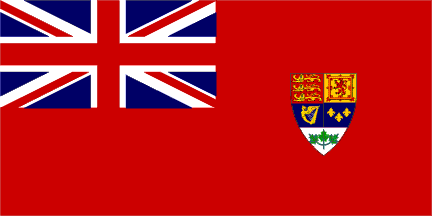
The Red Ensign campaign

Filed under: Cancon, History — Tags: — Nicholas @ 07:21

Canadian Red Ensign 1921-1957

Canadian Red Ensign 1921-1957

Back in the blogging dark ages, I belonged to a group of libertarian/conservative bloggers called the Red Ensign Brigade. As time marched on, blogrolls and blog rings faded from the scene: several still exist, but few bloggers get much traffic directly from them. The Red Ensign list went quiet a few years ago, and sometime in the last year the aggregation site disappeared. I still show the Red Ensign in my sidebar, but it no longer links to the brigade.

The other day, I got an email from Brian Bicknell, who runs the Canadian Red Ensign Campaign page on FaceBook, asking if I’d be willing to assist his efforts. As a fan of the Red Ensign, I’ve added a link to his http://www.flytheredensign.com/ page, so if you click on the small Red Ensign in my sidebar, it will take you to that web page now.

June 17, 2014

Game of Thrones lessons learned by ISIS

Filed under: History, Media, Middle East — Tags: , , , , — Nicholas @ 07:56

I haven’t been watching Game of Thrones, but I’ve seen enough of it that James Delingpole‘s observations seem rather accurate:

Consider some of the Isis footage now doing the rounds on the internet. One video is filmed from the point of view of some young men in car, driving along a highway outside a town somewhere in northern Iraq, looking for cars to shoot up with their AK-47s. The innocent drivers clearly aren’t expecting this. By the time they’re aware what’s going on, it’s too late: soon, their bullet-riddled cars are veering off the roads, their dead or wounded drivers slumped at the wheel. Next, eager as puppies, out pop the jihadis to inspect the damage, gleefully filming their dying victims and then finishing them off. It’s like an episode of Grand Theft Auto Mosul, only acted out for real.

What kind of mindset do you need to carry out this kind of barbaric violence? Well I hesitate to say a “Medieval” one because then the Medievalists get all upset. But let’s agree shall we that it is a mindset almost completely alien to Western Judeo-Christian culture. Yes, there are exceptions to every rule: the obvious one being Germany in World War II. At the risk of crudely generalising though, I’d say that however much society breaks down in the West I can’t ever see any of us reaching the point where we start machine gunning road users just for the sheer hell of it, any more than I can ever imagine us beheading or crucifying prisoners. We got all that stuff out of our system, over the centuries, in a succession of savage conflicts like the Thirty Years War and the Wars of The Roses.

It’s from the Wars of the Roses, of course, that George RR Martin gets a lot of his gory detail, including the kill-or-be-killed mindset of his protagonists. They don’t think like us because they don’t enjoy the luxury of living in a society as advanced as ours. What to us might seem like basic human decency would strike the Game of Thrones protagonists as fatal weakness. Hence, for example, the House Bolton’s practice of flaying its prisoners: a) a dead enemy is never going to kill you and b) it so terrifies your foes that — as Isis have found in Iraq — they would rather flee for their lives than face you in battle.

This kind of insight is, I’m sure, one of the main reasons why Game of Thrones has grown to achieve its status as unmissable, landmark television. Yes, of course, the fine acting, great locations, pert breasts and CGI dragons are a big draw too. But what really makes it stick out is that, unlike almost any other fiction set in the past, it chooses not to imbue its characters with the liberal values of the present. This brutal honesty is at once exhilaratingly novel but also deeply unsettling, for it opens a window onto a world where people may look like us and apparently share the same hopes, dreams and fears as us, but where the progressive pieties to which we’ve become accustomed in the post-war years simply don’t apply. Not only do they not apply but they actually look foolish, counterproductive, suicidal.

June 16, 2014

The tomb for Richard III

Filed under: Britain, History — Tags: , — Nicholas @ 09:16

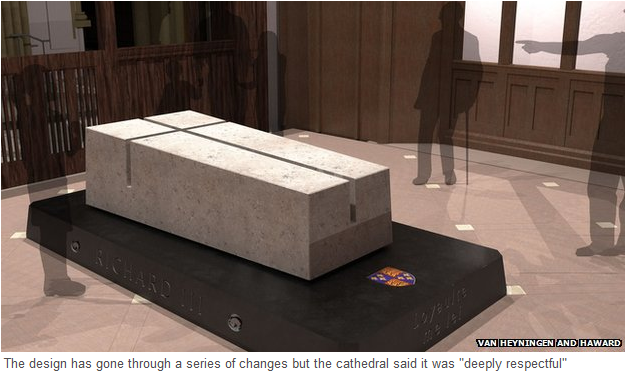
BBC News has images of the tomb designed for the re-burial of Richard III at Leicester Cathedral:

Design of Leicester tomb for Richard III

The design of the tomb King Richard III will be reburied in at Leicester Cathedral, has been unveiled.

The wooden coffin will be made by Michael Ibsen, a descendent of Richard III, while the tomb will be made of Swaledale fossil stone, quarried in North Yorkshire.

The total cost of reburial is £2.5m and work will start in the summer.

The Very Reverend David Monteith, Dean of Leicester, said the design “evokes memory and is deeply respectful”.

Judges ruled his remains, found under a Leicester car park in 2012, would be reinterred in Leicester, following a judicial review involving distant relatives of the king who wanted him buried in York.

A new visitor centre is set to open in July, which will tell the story of the king’s life, his brutal death in Battle in 1485 and rediscovery of his remains.

Magna Carta

Filed under: Britain, History, Liberty — Tags: , , , — Nicholas @ 08:35

Allan Massie says there was “nothing revolutionary” about the signing of the Magna Carta on June 15, 1215:

The document was presented to the king and his signature, by seal, extracted. He had violated so many customs of the realm and infringed long-established liberties, which we might rather call privileges, that his rule in its present form had become intolerable to the barons and landholders, to the Church, and to the merchants of boroughs protected by their own charters.

The Magna Carta rehearsed these customs and liberties. It was a reproof to the king, to compel him to mend his ways. Far from being an abstract statement of rights, it was a practical document: calling the king to order, reminding him of the limits on his power, and insisting that he was not above the law, but subject to it.

This was not unusual. Kings had been brought to a similar point before. Medieval monarchy was limited monarchy, in theory and of necessity. Kings had to govern in collaboration with “the Community of the Realm” (essentially the propertied classes) and with their consent. Ultimately, having neither a standing army nor a police force, they had little choice. Moreover, the society of the Middle Ages was intensely legalistic – and the purpose of Magna Carta was to remind the king of what the laws were and of his duty to observe them if he himself was to receive loyalty and obedience.

If Shakespeare makes no mention of the document it is because in the years of the Tudor despotism the balance between government and governed shifted in favour of the former. The Tudors made use of what were called the Prerogative Courts to bypass the common law of England. Torture, practised on “subversive” Roman Catholics by the Elizabethan government, was illegal under the common law (and indeed under Magna Carta), but inflicted by the judgment of the Prerogative Courts (the Star Chamber and High Commission).

It was the parliamentary and judicial opposition to the less effective (and less oppressive) despotism of the early Stuarts which revived interest in Magna Carta, now presented as the safeguard or guarantee of English liberty. Though it had been drawn up by Anglo-Norman bishops and presented to the king by Anglo-Norman barons, the theory was developed that it represented a statement of the rights and liberties enjoyed in Anglo-Saxon England by the “free-born” Englishmen before they were subjugated to the “Norman Yoke”.

This, doubtless, offered an unhistorical and rather-too-rosy view of Anglo-Saxon England before the Norman Conquest, but it had this to be said for it: that the Norman and Plantagenet kings had regularly promised to abide by the “laws of King Edward” – the saintly “Confessor” and second-last Saxon king.

June 12, 2014

Step aside, Andrew Jackson

Filed under: History, Liberty, USA — Tags: , , , , — Nicholas @ 07:21

In The Atlantic, Conor Friedersdorf makes an argument that it’s time the United States put Martin Luther King on the $20 bill:

During the 2008 election, Thomas Chatterton Williams wrote an article for Culture11 about the significance of a Barack Obama victory. “On television screens from Bedford Stuyvesant to South Central Los Angeles, images will be broadcast of a black family — a father, a mother, and two little girls — moving into the White House,” he wrote. “Whatever you think of policy, the mere fact of electing a black man president, sending him to live in the nation’s most iconic, so far whites only house, would puncture holes through the myth of black inferiority, violating America’s racial narrative so fundamentally as to forever change the way this country thinks of blacks, and the way blacks think of this country — and themselves.”

I still think Williams had a point. Today’s six, seven, and eight-year-olds have no memory of an America with anything other than a black president. What seemed improbable to us as recently as 2007 is, for them, a reality so normal that they don’t even think about it. Yet these same kids are still growing up in a country where the faces celebrated on the paper currency are all white. I don’t want to overstate the importance of that. There is a long list of suboptimal policies that are vastly more urgent to remedy. Still, the lack of diversity in this highly symbolic realm is objectionable, and improving matters would seem to be very easy.

Martin Luther King, Jr. is a universally beloved icon who led one of the most important struggles for justice in American history. When Gallup asked what figure from the 20th Century was most admired, MLK beat out every single American, and was second overall in the rankings, placing behind only Mother Theresa. Putting him on money would not be a case of elevating a man simply for the sake of diversity. Yet it would address the fact that, but for racism, our money would’ve long been more diverse. The only loser here would be the historic figure kicked off of a bill.

[…]

MLK is the best symbol of the civil rights movement, but many preceded him in that long struggle. They ought to be featured on $20’s flip side. Perhaps it could include a timeline stretching from Harriet Tubman to Rosa Parks, putting them in the company of Susan B. Anthony and Sacajawea, the women featured on U.S. coins. I suppose Jackson might be upset at my judgment that he is less deserving of our esteem than those figures. Then again, he might well support my plan. After all, few men in American history were as adamant about their hatred of paper money.

June 8, 2014

QotD: Understanding the Koran

Filed under: History, Middle East, Quotations, Religion — Tags: , , — Nicholas @ 00:01

The Koran is pretty contradictory. That’s because it was written by Muhammad at different stages in his career as a would-be world conqueror. In the initial stages of his inventing Islam, he presented it as a moral system and a warning. The first chapters of the Koran read a lot like parts of the Bible, especially Jesus’ sermons: repent for judgment is at hand. It condemns immoral behavior and calls for repentence. Then, as Muhammad gained followers and began his series of military campaigns to conquer all surrounding areas in the name of his new religion, the themes shifted.

Now it was all about defeating and subjugating the wicked. About how Muslim warriors are the hand of Allah on earth and fighting against the evil unbeliever who will be punished. Here instead of a call for personal repentance there are calls for conquest and destruction, slaughtering the wicked and cutting the heads off of those who will not submit or convert.

Then, having beaten almost everyone and in power, the tone shifts again. The last parts of the Koran are about how to govern, how to live, what to do in minute detail down to what hand to eat with, and information on how to live with the wicked Jew and Christian who are so close to Islam. The calls for death and conquest are subdued and fade away in this last bit, but complaints about women and how to keep them under control are pretty much the exclusive content of the last few chapters.

Now, Muslims say that there is a principle where older parts of the Koran are understood or replaced by the newer; so if there’s a conflict between part A and part C, the part C bits are the ones you follow.

But then it gets complicated. Because the Hadith is a collection of stories allegedly about Muhammad from his life, collected anecdotes, quotes, information, and tales of his life that are then used to interpret the Koran and create Islamic law with. And these can wildly differ, conflict with, and even completely contradict each other.

To make matters worse, for a thousand years or so, different Sharia Courts and Imams have been making official proclamations about Islam that are not just suggestions but absolute total voice-of-Allah law of Islam and the countries that it controls.

And these, too, can be totally at odds. So its a horrible contradictory mess of conflicting absolutes all claiming to be the total voice of Allah. And, as Muhammad himself allegedly said, Allah changes his mind sometimes, that’s why the conflicts in his writings.

The end result is that Islam can be honestly portrayed as both peaceful and opposing horrible violence against people … and violent conquerors out to behead anyone who disagrees. Because both are true.

Christopher Taylor, “I’M THE GOOD GUY HERE”, Word Around the Net, 2014-05-23.

June 7, 2014

Historic WW2 aircraft fly over Juno Beach

Filed under: Cancon, Europe, France, History, WW2 — Tags: , — Nicholas @ 10:53

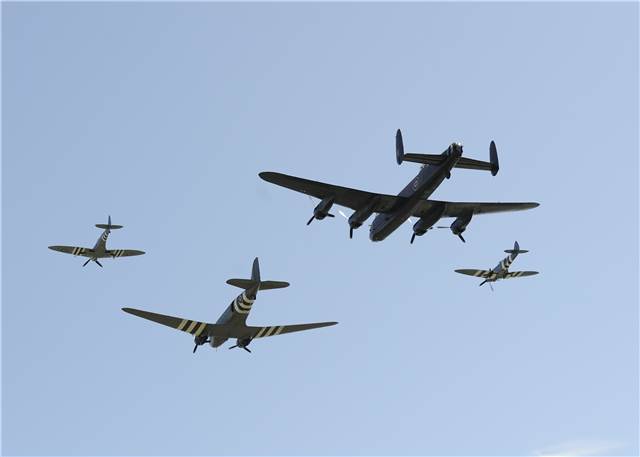
Two Spitfires, a Dakota DC-3, and a Lancaster Bomber conduct a flypast over Juno Beach, France, during commemorative ceremonies of the 70th Anniversary of D-Day on June 6, 2014. Photo by Sgt Bern LeBlanc Canadian Army Public Affairs AS2014-0027-002

Two Spitfires, a Dakota DC-3, and a Lancaster Bomber conduct a flypast over Juno Beach, France, during commemorative ceremonies of the 70th Anniversary of D-Day on June 6, 2014. Photo by Sgt Bern LeBlanc Canadian Army Public Affairs AS2014-0027-002

June 6, 2014

1st Canadian Parachute Battalion War Diary

Filed under: Cancon, Europe, History, Military — Tags: , , , — Nicholas @ 08:38

Excerpt from 6 June, 1944:

6th June 1944

Place: Carter Bks, Bulford

The initial stages of operation OVERLORD insofar as the 1st. Cdn. Parachute Battalion was concerned, were divided into three tasks. The protection of the left flank of the 9th Para Battalion in its approach march and attack on the MERVILLE battery 1577 was assigned to “A” Company. The blowing of two bridges over the RIVER DIVES at 1872 and 1972 and the holding of feature ROBEHOMME 1873 was assigned to “B” Company with under command one section of 3 Para Sqdn Engineers. The destruction of a German Signal Exchange 1675 and the destruction of bridge 186759 plus neutralization of enemy positions at VARRAVILLE 1875 was assigned to “C” Company.

The Battalion was to drop on a DZ 1775 in the early hours of D Day, “C” Company dropping thirty minutes before the remainder of the Battalion to neutralize any opposition on the DZ. The Battalion emplaned at Down Ampney Airfield at 2250 hours on the 5th June, 1944. “C” Company travelled in Albemarles and the remainder of the Battalion in Dakotas (C-47). The flight was uneventful until reaching the French coast when a certain amount of A.A. fire was encountered. Upon crossing the coast-line numerous fires could be seen which had been started by the R.A.F. bombers. Unfortunately the Battalion was dropped over a wide area, some sticks landing several miles from their appointed R.V.. This factor complicated matters but did not deter the Battalion from securing its first objectives.

Protection of Left Flank of 9 Para Bn – A Company

“A” Company was dropped at approximately 0100 hours on the morning of 6th June, 1944. Lieut. Clancy, upon reaching the Company R.V. found only two or three men of the Company present. After waiting for further members, unsuccessfully, of the Company to appear, he decided to recce the village of GONNEVILLE SUR-MERVILLE 1676. Taking two men he proceeded and penetrated the village but could find no sign of the enemy. He then returned to the Company R.V. which he reached at approximately 0600 hours and found one other Officer and twenty Other Ranks of the Battalion and several men from other Brigade Units waiting. The entire body then moved off along the pre-arranged route to the MERVILLE battery. Encountering no other opposition enroute other than heavy R.A.F. Bombardment at GONNEVILLE SUR-MERVILLE. Upon completion of the 9th Battalion task the Canadian party acted first as a recce patrol to clear a chateau 1576 from which a German M.G. had been firing and then acted as a rear guard for the 9th Battalion withdrawal toward LE PLEIN 1375. The party left the battalion area (9th Battalion) at LE PLEIN at 0900 hours and reached the 1st Cdn. Para. Bn. position at LE MESNIL BAVENT cross roads 139729 at 1530 hours on the 6th June, 1944.

ROBEHOMME – “B Company

Two platoons of “B” Company were dropped in the marshy ground south and west of ROBEHOMME. Elements of these platoons under Sgt. OUTHWAITE then proceeded toward the Company objective. Enroute they encountered Lieut. TOSELAND with other members of “B” Company making a total of thirty All Ranks. They were guided through the marshes and enemy minefields to the ROBEHOMME bridge by a French Woman. On arriving at the bridge they met Capt. D. GRIFFIN and a further thirty men from various sub-units of the Battalion, including mortars and vickers Platoons. MAJOR FULLER who had been there for some time left in an attempt to locate Battalion Headquarters. Capt. GRIFFIN waited until 0630 hours for the R.E.’s who were to blow the bridge. As they failed to arrive explosives were collected from the men and the bridge successfully demolished.

A guard was left on the bridge and the main body withdrawn to the ROBEHOMME hill. Although there were no enemy in the village there were several skirmishes with enemy patrols who were attempting to infiltrate through the village and some casualties were suffered by the Company. An O.P. was set up in the church spire. An excellent view was obtained of the road from PONT DE VACAVILLE 2276 to VARRAVILLE. Artillery and infantry could be seen moving for many hours along this road from the East. It was particularly unfortunate that wireless communication could not be made with Bn. H.Q. as the subsequent fighting of the Battalion was carried out in such close country that observation of enemy movement was almost impossible.

At 1200 hours on the 7th June, 1944, it was decided to recce the route to Bn. H.Q.. Upon the route being reported clear orders were issued for the party to prepare to join Bn. H.Q. Lieut. I. WILSON, Bn. I.O. came from LE MESNIL to guide the party back. The move was made at 2330 hours, the strength of the party by this time being 150 All Ranks, the addition having been made by stragglers of various units who had reported in. The wounded were carried in a civilian car given by the cure, and a horse and cart given by a farmer. The route was BRIQUEVILLE 1872 to BAVENT road 169729, through the BOIS DE BAVENT and on to LE MESNIL cross roads. Near BRIQUEVILLE the lead platoon was challenged by enemy sentries. The platoon opened fire killing seven and taking one prisoner. Shortly afterwards this same platoon was fortunate enough to ambush a German car which was proceeding along the road from BAVENT. Four German Officers were killed. Bn. Headquarters was reached at 0330 hours on the 8th June, 1944.

VARRAVILLE – “C” Company

The majority of “C” Company was dropped west of the RIVER DIVES, although some sticks were dropped a considerable distance away including one which landed west of the RIVER ORNE. Due to this confusion the company did not meet at the R.V. as pre-arranged but went into the assault on the Chateau and VARRAVILLE in separate parties. MAJOR McLEOD collected a Sgt. and seven O.R.’s and proceeded towards VARAVILLE. En route they were joined by a party under Lieut. WALKER. One of the Sgts. was ordered to take his platoon to take up defensive positions around the bridge that the R.E. sections were preparing to blow. This was done and the bridge was successfully demolished.

MAJOR McLEOD and Lieut. WALKER with the balance of the party then cleared the chateau and at the same time other personnel of “C” Company arrived from the DZ and cleared the gatehouse of the chateau. The gatehouse then came under heavy M.G. and mortar fire from the pill box situated in the grounds of the chateau. The pill-box also had a 75 mm A/Tk. Gun. The whole position was surrounded by wire, mines and weapon pits. MAJOR McLEOD, Lieut. WALKER and five O.R.’s went to the top floor of the gatehouse to fire on the pillbox with a P.I.A.T. the enemy 75mm A/Tk. Gun returned fire and the shot detonated the P.I.A.T. ammunition. Lieut. WALKER, CPL. OIKLE, PTES. JOWETT and NUFIELD were killed and MAJOR McLEOD and PTE. BISMUKA fatally wounded. PTES. DOCKER and SYLVESTER evacuated these casualties under heavy fire. CAPT. HANSON, 2 i/c of “C” Company was slightly wounded and his batman killed while proceeding to report to the Brigade Commander who had arrived in the village from the area in which he dropped. “C” Company, together with elements of Brigade H.Q. and the R.E.’s took up defensive positions around the village and a further party encircled the pill-box in order to contain the enemy. A further party of “C” Company under Lieut. McGOWAN who had been dropped some distance from the DZ arrived in VARAVILLE in time to catch two German Infantry Sections who were attempting to enter the town. Lieut. McGOWAN’s platoon opened fire causing casualties and the remainder of the enemy surrendered. This platoon took up firing positions firing on the enemy pill-box. “C” Company H.Q. which was located in the church yard pinned an enemy section attempting to advance in a bomb crater killing at least three. The chateau was evacuated by our troops and left as a dressing station. An enemy patrol re-entered the chateau and captured the wounded including Capt. BREBNER, the Unit M.O., and C.S.M. Blair of “B” Company. This patrol although attacked by our own troops managed to escape with their prisoners.

Heavy enemy Mortar Fire and sniping was brought to bear on our positions from the woods surrounding VARAVILLE. During this time the local inhabitants were of great assistance, the women dressing wounds and the men offering assistance in any way. One Frenchman in particular distinguished himself. Upon being given a red beret and a rifle he killed three German Snipers. This man subsequently guided the Brigade Commander and his party towards LE MESNIL. Although it is believed he was a casualty of the bombing attack that caught this party enroute to LE MESNIL.

At approximately 1030 hours the enemy pill-box surrendered. Forty-two (42) prisoners were taken and four of our own men who had been captured were released. From 1230 hours on artillery fire was brought to bear on VARAVILLE from the high ground east of the RIVER DIVES. At 1500 hours cycle troops of the 6th Commando arrived and at 1730 hours on 6 June, 1944, “C” Company proceeded to the Bn. area at LE MESNIL. The german prisoners giving evident satisfaction to the French population enroute.

VICKERS PLATOON – Initial Stages

The Vickers platoon was dropped in four sticks of ten or eleven each being a total of forty-one (41) All Ranks. For the first time their M.G.’s were carried in Kit Bags, a number of which tore away and were lost.

The Platoon was dropped over a wide area, a part of them joining “C” Company’s attack on VARAVILLE, part joining “B” Company at ROBEHOMME and part joining Bn. H.Q.. Casualties on the drop totalled twelve missing and three wounded. One of the missing, PTE. PHIPPS, was identified in a photo in a German newspaper found on a P.W. After the initial Company tasks had been accomplished the platoon was deployed to the Companies as single gun detachments or as Sections.

MORTAR PLATOON – Initial Stages

The Mortar Platoon was dropped over a wide area and suffered very heavy loss in equipment due to kit bags breaking away and a great majority of the men landing in marshy ground. As the platoon dropped they attached themselves to the nearest company they could find and assisted in the capture of the objectives. One detachment commander landed on top of the German pill-box at VARAVILLE. He was made prisoner and spent the rest of the time in the pill-box until the Germans surrendered to “C” Company. A point of interest was that the P.I.A.T. Bombs did definite damage to the interior of the pill-box and had a very towering effect upon the morale of the defenders.

Some of the Mortar Platoon which joined “B” Company at ROBEHOMME were detailed to guard the approaches to the destroyed bridge. Three enemy lorries full of infantry appeared on the other side of the bridge. The guard opened fire knocking out one truck killing most of its occupants. The other two lorries were able to withdraw. One of our own men who was a prisoner in the lorry was able to make good his escape.

Upon the detachments arriving at LE MESNIL they were re-grouped as a platoon and given three mortars which had arrived by sea. These mortars were set up in position in the brickworks where they engaged the enemy.

BATTALION HEADQUARTERS – Initial Stages

The Commanding Officer, 2 i/c, Signals Officer and the Intelligence Officer and a small portion of the Battalion Headquarters together with elements of 224 Para Fd. Ambulance and other Brigade Units met at the Battalion R.V. in the early hours of the morning of 6th June, 1944. The Signals Officer was detailed to look after the Enemy Signal Exchange near the R.V.. He went into the house and found a certain amount of Signals equipment which he destroyed but he found no Germans. The Intelligence Officer set out with two men to recce VARAVILLE and bring back a report on the situation. In the Battalion Headquarters meantime the party moved off to LE MESNIL taking with them many scattered elements including a 6 Pdr. A/Tk. Gun and crew. Upon reaching the Chateau 1574 they encountered part of the Brigade Headquarters. The party there upon split up into unit parties and continued until they reached the orchards 141729 where they came under heavy sniping fire from nearby houses. This fire caused several casualties including one Officer. The enemy were forced to withdraw from the buildings after an attack by the party. The party reached the Battalion area at approximately 1100 hours on 6th June, 1944.

H/T to @LCMSDS for the link.

Update: War diaries for units in the 3rd Canadian Division in Normandy can be read here.

“Fizzy dishwater” instead of Champagne for the “wine Fuhrer”

Filed under: Europe, France, Germany, History, Wine, WW2 — Tags: — Nicholas @ 06:45

Chris Mercer on the various ways the French Champagne producers tried to keep their best wine from being diverted to the use of the Nazis:

By the time the French city of Reims was liberated in August 1944, many Champagne houses and growers had spent four years playing a game of high stakes cat-and-mouse with the local Nazi ‘wine fuhrer’, Otto Klaebisch.

As Julian Hitner writes in a feature published in the July issue of Decanter magazine, it was Klaebisch’s job to keep the Nazi empire topped up with France’s finest Champagnes. At its peak, Klaebisch was demanding 400,000 bottles per week.

In response, many Champenois resorted to subterfuge to try to protect their most precious vintages and cuvees.

As noted in the book Wine & War by Don & Petrie Kladstrup, some built fake walls in their cellar to hide their best stocks, while others intentionally mislabelled bottles.

On more than one occasion, Klaebisch suspected he was being duped. ‘How dare you send us fizzy dishwater?’ he asked 20-year-old Francois Taittinger.

‘Who cares? It’s not as if it’s going to be drunk by anyone who knows anything about Champagne,’ replied the young Taittinger, who was subsequently thrown in prison for several days.

H/T to Brendan for the link.

Mulberries, PLUTO and Hobart’s Funnies

Filed under: Britain, Europe, France, Germany, History, Military, USA — Tags: , , , — Nicholas @ 00:02

Seventy years ago today, the Allies launched Operation Overlord, the invasion of Normandy by the combined British, American, and Canadian armies. A huge fleet of combat and transport vessels, supported by a large proportion of the United States Army Air Force and the Royal Air Force bomber and fighter aircraft were all deeply involved in making the invasion a success. In addition, perhaps the world’s largest disinformation campaign was being run to keep the German high command unsure of the real time and location of the invasion: the Pas de Calais and the Norwegian coast were also potential invasion targets, forcing the defenders to spread their forces thinner and to keep as many as possible out of reach of the real beaches.

In addition to the operational uncertainty of where to expect the blow, the Germans were also split about how best to conduct the defence: Field Marshal Rommel wanted to rush units to the beach as soon as possible, to defeat the Allies before they got inland. General Geyr von Schweppenburg, commander of Panzer Group West (and Field Marshal von Rundstedt, overall commander in the West), on the other hand, preferred to meet the Allies further inland (not taking the full impact of Allied air superiority into account). On 6 June, the defenders fell between the two philosophies, not being able to mass enough force to stop the invaders in their tracks, but suffering higher casualties in the attempt to move units toward the coast in the teeth of RAF/USAAF attacks.
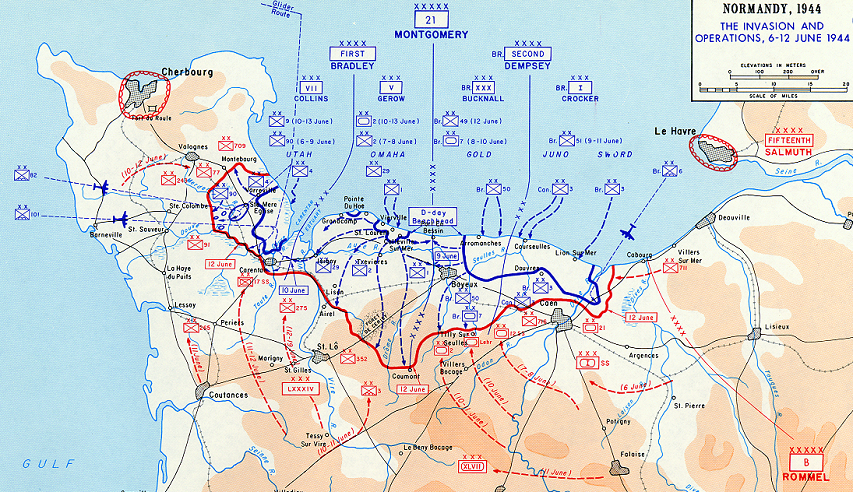
Operation Overlord (detail) Click to see full-sized image at wwii-info.net

Operation Overlord (detail) Click to see full-sized image at wwii-info.net

The invasion beaches were code-named Utah (4th US Division), Omaha (1st and 29th US divisions), Gold (50th British Division), Juno (3rd Canadian Division), and Sword (3rd British Division). Before the amphibious forces landed, three paratroop divisions were dropped behind the beaches to slow down German response (US 82nd and 101st Airborne Divisions to the West and Southwest of Utah beach, and the 6th British Airborne to the East of Sword beach).

One thing to note from the map is that there wasn’t a significant port within the invasion zone: the Allies had learned the bitter lessons of attacking a port in August of 1942 and the 2nd Canadian Division had paid in blood for the tuition. This meant a way had to be found to keep getting supplies to the troops after they moved off the beaches, until a functioning port could be secured. The Allied answer was to bring a port with them from England — two of them, actually — one to support the US forces in the West and one to support the British and Canadian forces in the East. These were the Mulberry harbours:
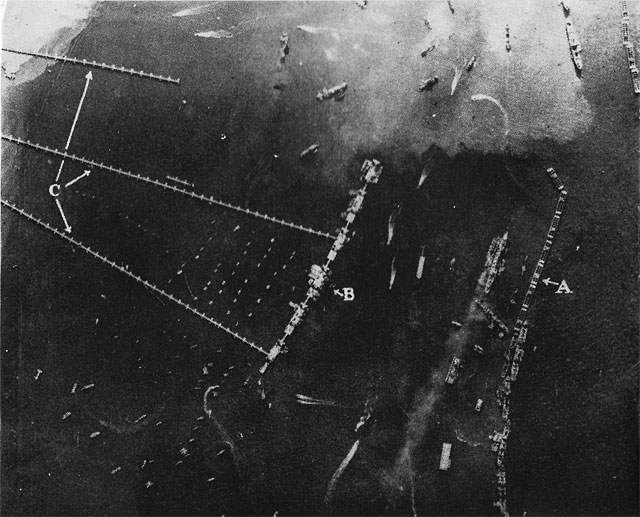
Mulberry harbour aerial view

Think Defence explains how the Mulberry harbour worked:

In the image above these three components are shown.

A; Breakwater to attenuate waves

B; Pier heads at which to load and unload

C; Causeways that connected the pier heads to the beach

Each of the components was given a code word but fundamentally, they were concerned with either providing sheltered water or connecting ships and the beach.

There have been a number of different theories about how the Mulberry name was chosen, the more fanciful ones being completely incorrect.

Brigadier White recalls the moment he received a memo, unclassified, with the heading ‘Artificial Harbours’ and after recovering from the shock of such poor security immediately consulted with the Head of Security at the War Office. The next code, from the big book of code words, was Mulberry, it was that simple.

[…]

There were two complete Mulberry harbours, A for American and B for British, each the size of Dover harbour. Once the task of constructed and assembling the components on the South coast of England was complete they were ordered to Normandy on the 6th of June 1944, D-Day, departing on the 7th

Assembling the components was an effort in itself, requiring 600 tugs drawn from all parts of the UK and USA, all under the supervision of the Admiralty Towing Section commanded by Rear Admiral Brind.

Operational security was paramount, the captains of the block ships were told they were going to the Bay of Biscay and a model of the Mulberry harbour and invasion beaches in the headquarters of the Automobile Association at Fanum House was made by toymakers who were confined to the building until well after the invasion.

Unfortunately, the Western harbour was severely damaged in a storm a few weeks after coming into service, so the Eastern Mulberry had to do double duty after that.

Aside from the need to get reinforcements, rations, ammunition and other supplies forward, the Allied armies were highly motorized, and required vast amounts of fuel. Without a port’s specialized unloading facilities, it was assumed that it would be somewhere between difficult and impossible to keep the armies mobile. To address this, PLUTO was developed: Pipe Line Under The Ocean.

A great solution, although as Think Defence points out, it didn’t actually go into service until a few months after D-Day, and was not quite the war-winner the newsreel portrayed:

Second in daring only to the artificial harbors project and provided our main supplies of fuel during the Winter and Spring campaigns.

What also PLUTO did was allow vital tanker tonnage to be deployed to the Far East theatre.

Despite the understandable over exaggeration of the success of PLUTO it should be noted that fuel did not start flowing until September 1944, well after the invasion and on the 4th of October, BAMBI was closed down and operations concentrated on DUMBO after it had delivered a measly 3,300 tonnes, hardly war winning.

Cherbourg was by then receiving tanker supplies direct from the USA.
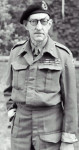
Major General Sir Percy HobartGetting across the channel was a major undertaking, but getting the troops ashore with enough firepower to break out of the beach defences required more innovation. The British army established a specialized unit to develop and operate vehicles and weapon systems specifically designed for that purpose. Major General Sir Percy Hobart was the commander of the 79th Armoured Division, and he was exactly the right man for the job (being related by marriage to Montgomery may have helped, too, but before taking command he was acting as a corporal in the Home Guard).

Hobart’s unit developed some of the most interesting armoured vehicles (not all of which were brilliant successes) and it’s safe to say that the Allies would have suffered much higher casualties without Hobart’s “Funnies”. In fact, General Eisenhower said as much himself: “Apart from the factor of tactical surprise, the comparatively light casualties which we sustained on all beaches, except OMAHA, were in large measure due to the success of the novel mechanical contrivances which we employed, and to the staggering moral and material effect of the mass of armor landed in the leading waves of the assault. It is doubtful if the assault forces could have firmly established themselves without the assistance of these weapons.” Think Defence has a good summary of many of these odd and interesting vehicles:
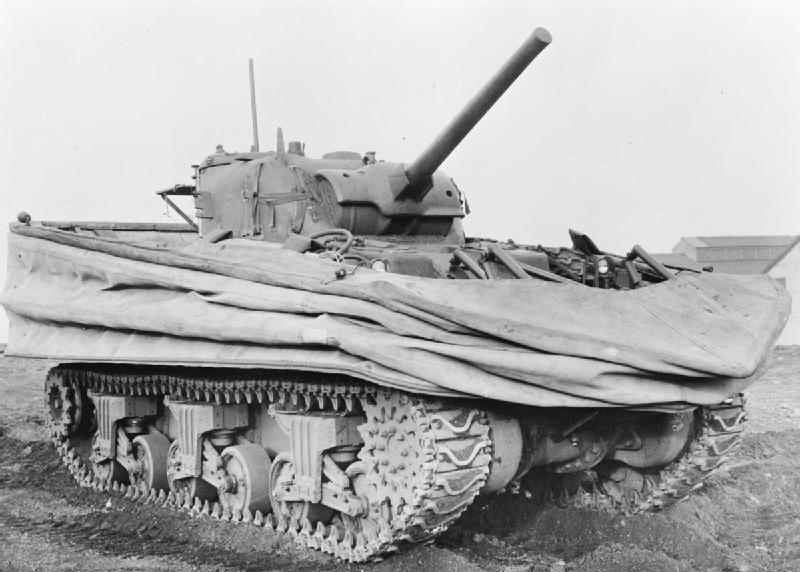
Sherman Duplex-Drive tank

Sherman tanks were also converted into amphibious vehicles by the addition of a canvas skirt, propellers and other modifications. These provided vital armoured fire support in the opening phase of the beach assault although a number were lost to the heavy seas when they were launched too far from the beach. It is widely thought that as these losses were particularly heavy on Omaha beach it was this that contributed to the very high losses in that area.
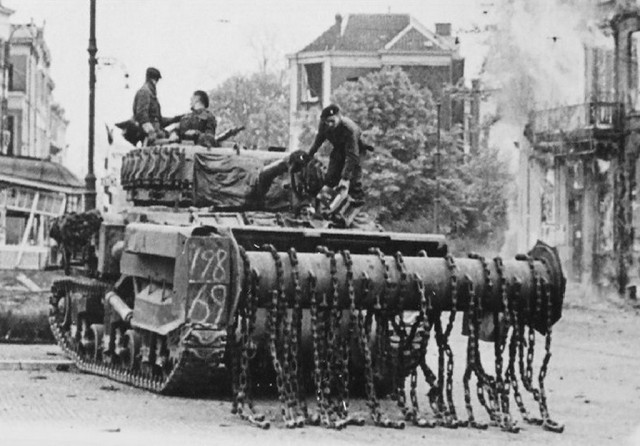
Sherman AVRE Flail tank

Mine clearance was carried out by a number of means but the preferred method was to use rotating chain flails to detonate the mines thus clearing a path the width of the tank. The flails were mounted on the front of the tank and were called Sherman Crabs. A number of Churchill based designs using rollers and ploughs were also employed, although this image shows one mounted on a Sherman.
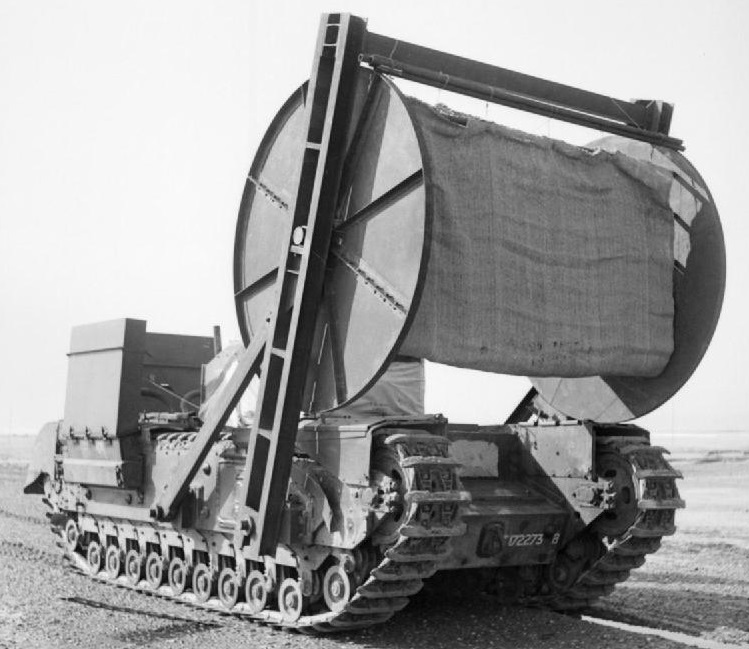
Churchill AVRE Bobbin tank

The beach surveys had revealed the existence of large patches of clay that would not bear the weight of heavy vehicles and artillery. To overcome this the ‘bobbin’ tanks were used that laid a continuous reinforced canvas mat over the soft ground, thus spreading the load over a wider area.

Canadian paratroopers on D-Day – “he thought we were battle hardened and we were as green as green could be”

Filed under: Cancon, France, Germany, History, Military, WW2 — Tags: , , , — Nicholas @ 00:01

Lance Corporal John Ross tells the Ottawa Citizen about his D-Day experiences with the 1st Canadian Parachute Battalion:

“We attacked the strong point; there was an all-night fire fight. We had casualties and the Germans did too. At about 10 o’clock in the morning they surrendered. There were about 30 of us there, 42 Germans surrendered to us. They outnumbered us and they out gunned us,” describes Capt (Ret) John Ross, now 93 years-old recalling his time as a paratrooper who dropped several kilometers inland of Normandy on D-Day.

“We took off on the 5th of June, one day before D-Day. C Company was given the job to go in 30 minutes ahead to clear the drop zone of any enemy and attack the German complex.”

Capt (Ret) Ross served as a Lance Corporal in C Company, 1st Canadian Parachute Battalion, 3rd Airborne Brigade, 6th British Airborne Division. He was dropped from an Armstrong Whitworth Albemarle, a small two engine paratroop transport aircraft.

[…]

When thinking back to his time in Normandy Capt (ret) Ross remembers how Canadian soldiers were thought of as, seasoned warriors.

“I read an excerpt written by a German General after the war. He was in that area that we dropped in and he said that the reason they were overcome was because they faced battle hardened Canadians. I’d like to write a letter to him and say none of those Canadians had ever heard a shot fired in anger; he thought we were battle hardened and we were as green as green could be.”

« Newer PostsOlder Posts »

Powered by WordPress