Quotulatiousness

July 6, 2014

Henry II – “from the Devil he came, and to the Devil he will surely go”

Filed under: Britain, Europe, France, History — Tags: , , , — Nicholas @ 09:40

Nicholas Vincent looks at the reign of King Henry II, the founder of the Plantagenet dynasty who died on this day in 1189:

Although in December 1154, Henry was generally recognised as the legitimate claimant to the throne, most notably by the English Church, his accession was fraught with perils. Among the Anglo-Norman aristocracy there were many who saw Henry as an outsider: an Angevin princeling, descended via his father, Count Geoffrey Plantagenet of Anjou, from a dynasty that had long been regarded as the principal rival on Normandy’s southern frontier. King Stephen had left a legitimate son, William Earl Warenne, still living in 1154, and Henry himself had two younger brothers who might well have disputed his claims to succeed to all his family’s lands and titles. Asked some years before to judge Henry’s chances of success, St Bernard of Clairvaux is said to have predicted of Henry that ‘from the Devil he came, and to the Devil he will surely go’.

Yet, from what contemporaries termed ‘the shipwreck’, and modern historians have described as ‘the anarchy’ of Stephen’s reign, Henry II was to emerge as one of England’s, indeed as one of Europe’s, greatest kings. The Plantagenet dynasty that he founded was to occupy the throne of England through to 1399 and the eighth successive generation. Henry himself came to rule over the most extensive collection of lands that had ever been gathered together under an English king – an empire in all but name, that stretched from the Cheviots to the Pyrenees, and from Dublin in the west to the frontiers of Flanders and Burgundy in the east.

In part this empire was the product of dynastic accident. From his mother, Matilda, daughter and sole surviving legitimate child of the last Anglo-Norman King, Henry inherited his claim to rule as king in England and as duke in Normandy. From his father, Geoffrey, he succeeded to rule over Anjou, Maine and the Touraine: the counties of the Loire valley that had previously blocked Anglo-Norman ambitions in the South. Rather than share these inherited spoils with his brothers, Henry seized everything for himself. William, his younger brother, was granted a rich but by no means royal estate. Geoffrey, the third brother, threatened rebellion but was bought off with a shortlived grant of the county of Nantes.

Henry, however, was far more than just a fortunate or crafty elder son. Through his own exertions he greatly expanded his family’s territorial claims. In 1152, two years before obtaining the throne of England, he had married Eleanor, heiress to the duchy of Aquitaine and only a few weeks earlier divorced from her previous husband, the Capetian King Louis VII. As effective ruler of Eleanor’s lands, Henry found himself in possession of a vast estate in south-western France, stretching from the Loire southwards through Poitou and Gascony to the frontiers of Spain. Henry’s marriage to Eleanor was regarded as scandalous even by his own courtiers. She was eleven years older than him and was rumoured to have enjoyed extra-marital affairs not only with her own uncle but with Henry’s father, Geoffrey Plantagenet. By temperament she was as fiery as Henry, and as determined to stake her own claims to rule. As a result, Henry’s domestic life was far from tranquil. From 1173 onwards, Eleanor was to be held under house arrest in England, whilst Henry, to judge by the bastard children that he fathered, had long enjoyed the favours of a series of mistresses. Even so, by his marriage, Henry laid the basis of the later claims made by England’s kings to rule over southern France: claims that were to unite Gascony to the English crown as late as the fifteenth century and which were to play a vital role in the history of Anglo-French relations throughout the Middle Ages and beyond.
July 5, 2014

The Tsilhqot’in Nation and British Columbia, now with legal standing and everything

Filed under: Britain, Cancon, History, Law — Tags: , , — Nicholas @ 10:32

When I saw the initial reports on the Supreme Court’s decision in Tsilhqot’in Nation versus British Columbia it sounded like the Supremes were ordering the province to pack up and move out … that most (all?) of the land previously known as British Columbia was now to be handed back to the First Nations bands. I guess it’s not quite so apocalyptic, although it will complicate things. Colby Cosh talks about the historical record that informed the decision:

Like everyone else who has studied the Supreme Court’s dramatic decision in the case of Tsilhqot’in Nation v. British Columbia, my response largely amounts to “Well, sure.” “Tsilhqot’in” is the new accepted name of the small confederacy of B.C. Indian bands long called the Chilcotin in English. They live in a scarcely accessible part of the province, and one reason it is scarcely accessible is that the Chilcotin prefer it that way. In 1864, they fought a brief  “war” against white road builders, killing a dozen or so. The leaders of the uprising were inveigled into surrendering and appearing before the “Hanging Judge,” Matthew Begbie. True to his nickname, he executed five of the rebels. But that road never got finished.

In most of Canada, occupancy by “settlers” whose ancestors arrived after Columbus has been formally arranged under explicit treaties. There is a lot of arguing going on about the interpretation of these treaties. But, broadly speaking, most of us white folks outside B.C. have permission to be here. Our arrival, our multiplication and the supremacy of our legal system were all explicitly foreseen and consented to by representatives of the land’s Aboriginal occupants. The European signatories of those treaties recognized that First Nations had some sort of property right whose extinction needed to be negotiated.

Oddly, this concept was clearer to imperial authorities in the 18th and early 19th centuries than to those who came later. The Royal Proclamation of 1763, for instance, recognized the right of Indians to dispose of their own lands only when they saw fit. By the time mass colonization was under way in British Columbia, the men in charge on the scene had absorbed different ideas. Concepts of racial struggle were in vogue, and so were straitlaced, monolithic models of human progress.

And the problems going forward?

The biggest problem for large infrastructure projects in the B.C. Interior may not be the collective nature of “Aboriginal title” alone, but the fact that it is restricted in a way ordinary property ownership isn’t. “It is collective title,” writes the chief justice, “held not only for the present generation but for all succeeding generations. This means it cannot be alienated except to the Crown, or encumbered in ways that would prevent future generations of the group from using and enjoying it.” The special category of legal title devised for First Nations turns out to have a downside: Even completely unanimous approval of some land use by a band or nation may not suffice if people who do not yet exist are imagined disagreeing with it. Would you care to own a car or a house on such terms?

Update, 11 July: Perhaps I spoke too soon that this ruling didn’t mean the non-First Nation inhabitants need to move out of the province.

British Columbia First Nations are wasting no time in enforcing their claim on traditional lands in light of a landmark Supreme Court of Canada decision recognizing aboriginal land title.

The hereditary chiefs of the Gitxsan First Nations served notice Thursday to CN Rail, logging companies and sport fishermen to leave their territory along the Skeena River in a dispute with the federal and provincial governments over treaty talks.

And the Gitxaala First Nation, with territory on islands off the North Coast, announced plan to file a lawsuit in the Federal Court of Appeal on Friday challenging Ottawa’s recent approval of the Northern Gateway pipeline from Alberta.

The Kwikwetlem First Nation also added its voice to the growing list, claiming title to all lands associated with now-closed Riverview Hospital in Metro Vancouver along with other areas of its traditional territory.

They cite the recent high court ruling in Tsilhqot’in v. British Columbia.

[…]

In the short term, the ruling will impact treaty negotiations and development in the westernmost province, where there are few historic or modern treaties and where 200 plus aboriginal bands have overlapping claims accounting for every square metre of land and then some.

“Over the longer term, it will result in an environment of uncertainty for all current and future economic development projects that may end up being recognized as on aboriginal title lands,” wrote analyst Ravina Bains.

Harry Turtledove’s “revolutionary” alternative history

Filed under: Books, Britain, Cancon, History, Media, USA — Tags: , , , — Nicholas @ 10:15

In The Atlantic, Uri Friedman talks to Harry Turtledove about other futures that could have occurred if the American Revolution hadn’t gone quite as it did historically:

Turtledove told me that it was Richard Dreyfuss, the actor, who first gave him the idea of the American Revolution as a subject for alternate history. The two collaborated on a novel, The Two Georges, that is set in the 1990s and based on the premise that the Revolutionary War never happened. Instead, George Washington and King George III struck an agreement in which the United States and Canada (the “North American Union”) remained part of the British Empire. The artist Thomas Gainsborough commemorated the deal in a painting, The Two Georges, that is emblazoned on money and made ubiquitous as a symbol of the felicitous “union between Great Britain and her American dominions.”

[…]

Turtledove told me by email that he had an “epiphany” when he traveled with his family to the World Science Fiction Convention in Winnipeg, Canada in 1994, shortly before he published The Two Georges.

As he read a book from the Little House on the Prairie series to his daughter at the hotel, he came upon a section about a Fourth of July celebration “on the plains in the late nineteenth century, with fireworks and with tub-thumping speakers talking about how the United States had broken away from British tyranny and was the freest country in the world as a result. And there I was reading this in the country next door to mine, a country as similar to mine as any two nations on earth, a country just as free as mine — and a country that had never broken away from Britain at all. It was a thought-provoking experience.” Canada, of course, merely shares a queen with the United Kingdom at this point, but its relationship with Britain has certainly evolved differently than America’s has.

You could think of 1776 as a British political experiment, with Canada as the control (“British” here meaning both the British government and the colonists/revolutionaries). At this point in history, the control appears to actually be more free than the experimental subject.

H/T to Colby Cosh for the link.

QotD: Collaborators and their accusers, France 1944

Filed under: Europe, France, Germany, History, Military, WW2 — Tags: , , , — Nicholas @ 00:01

The task of filtering the tens of thousands of Frenchmen and women arrested for collaboration in the summer of 1944 proved overwhelming for the nascent administration of de Gaulle’s provisional government. That autumn, there were over 300,000 dossiers still outstanding. In Normandy, prisoners were brought to the camp at Sully near Bayeux by the sécurité militaire, the gendarmerie and sometimes by US military police. There were also large numbers of displaced foreigners, Russians, Italians and Spaniards, who were trying to survive by looting from farms.

The range of charges against French citizens was wide and often vague. They included “supplying the enemy”, “relations with the Germans”, denunciation of members of the Resistance or Allied paratroopers, “an anti-national attitude during the Occupation”, “pro-German activity”, “providing civilian clothes to a German soldier”, “pillaging”, even just “suspicion from a national point of view”. Almost anybody who had encountered the Germans at any stage could be denounced and arrested.

Anthony Beevor, D-Day: The Battle for Normandy, 2009.

July 4, 2014

Reason.tv – Presidential Power and the Rise of American Monarchy

Filed under: Government, History, Liberty, USA — Tags: , , , — Nicholas @ 08:37

Published on 3 Jul 2014

“America is dropping like a stone in rankings of freedom. As power accumulates in one person, expect that to continue,” says Frank Buckley, George Mason University law professor and author of the new book, The Once and Future King: The Rise of Crown Government in America.

Buckley sat down with Reason TV‘s Tracy Oppenheimer to discuss how the U.S. presidency has evolved into what he calls “something like an elective monarch.” He says that this is not what the framers of the Constitution had intended, nor did they conceive of the modern version of the separation of powers.

“A parliamentary regime was more or less what the framers wanted…as far as the separation of powers is concerned,” says Buckley “instead of a device to constrain a president, it’s one which immunizes him from criticism by Congress.”

QotD: The English Civil War of 1776

Filed under: Britain, History, Quotations, USA — Tags: , , , — Nicholas @ 00:01

It is fashionable today to view the Revolution as one might a traditional war between foreign powers, but, in truth, the break of 1776 was the latest in a series of fallings out between brothers — a civil war fought by men who were separated by an ocean but not by a history. Reading through the extraordinary profusion of pamphlets and gripes that the crisis produced, one cannot help but be impressed by how keenly the revolutionaries hewed to existing principle. Thomas Paine, perhaps the most radical of the agitators, may have believed that he could start the world all over again, but the colonists who marched with him mostly definitely did not. Instead, they sought a restoration of their inheritance, the Constitutional Congress asserting in 1774 that British subjects in America were “entitled to all the rights, liberties, and immunities of free and natural-born subjects, within the realm of England.” In the same year, William Henry Drayton, a lawyer from South Carolina who later served as a delegate to the Congress, fleshed out the claim, establishing in a tract of his own that he and his countrymen were “entitled to the common law of England formed by their common ancestors; and to all and singular the benefits, rights, liberties and claims specified in Magna Charta, in the petition of Rights, in the Bill of Rights, and in the Act of Settlement.” With this popular sentiment, Drayton and his acolytes set themselves up as the Roundheads of the New World, linking spiritual arms with the parliamentarians of the English civil war, with the seditious architects of the Glorious Revolution, and with all who had established colonial outposts in the name of English freedom.

[…]

Fear of potentates ran deep within the Anglo-American tradition. When the mutinous Immortal Seven ushered in the Glorious Revolution of 1688, their invitation to William of Orange related that the people were “generally dissatisfied with the present conduct of the government, in relation to their religion, liberties and properties (all which have been greatly invaded).” As Daniel Hannan observes in Inventing Freedom, these three objects were philosophically inextricable. Protestantism, Hannan notes, was seen by the architects of English liberty in “political rather than theological terms, as guarantor of free speech, free conscience, and free parliament”; Catholicism, by contrast, was held to consume those virtues and to lead, inexorably, to monarchy. The fear of “popery” that helped to usher in the Glorious Revolution was certainly more pronounced in England that it was in America. But the concerns that motivated it were not, being instead inseparable from the fundamental political question, which was, “are we to rule ourselves or are we to be ruled by Kings and by Popes?” It stood to reason then that those who had become accustomed to expecting to enjoy a relationship with God that was not refereed by a host of spiritual bureaucrats would be able to more easily imagine governing their own worldly affairs, as it made sense that a culture in which the laity was encouraged to read Scripture for itself would be one in which subjects would more quickly rush to the defense of parliaments against the King. As ever, the instinct was toward the fragmentation of power.

Charles C.W. Cooke, “The Civil War of 1776”, National Review, 2014-07-03.

July 3, 2014

Jeremy Bentham’s “secret” writings

Filed under: Britain, History, Liberty, Media, Quotations — Tags: , , , — Nicholas @ 10:43

In the Guardian, Faramerz Dabhoiwala reviews a recent “discovery” that Jeremy Bentham, far from being an innocent about sexual matters (as portrayed by his disciple John Stuart Mill among others), had thought deeply on the topic and had written much. After his death, these writings were ignored for fear that they would discredit his wider body of work.

Bodily passion was not just a part of Bentham’s life: it was fundamental to his thought. After all, the maximisation of pleasure was the central aim of utilitarian ethics. In place of the traditional Christian stress on bodily restraint and discipline, Bentham sought, like many other 18th-century philosophers, to promote the benefits of economic consumption, the enjoyment of worldly appetites and the liberty of natural passions. This modern, enlightened view of the purpose of life spawned a revolution in sexual attitudes, and no European scholar of the time pursued its implications as thoroughly as Bentham. To think about sex, he noted in 1785, was to consider “the greatest, and perhaps the only real pleasures of mankind”: it must therefore be “the subject of greatest interest to mortal men”. Throughout his adult life, from the 1770s to the 1820s, he returned again and again to the topic. Over many hundreds of pages of private notes and treatises, he tried to strip away all the irrational and religious prohibitions that surrounded sexual activity.

Of all enjoyments, Bentham reasoned, sex was the most universal, the most easily accessible, the most intense, and the most copious — nothing was more conducive to happiness. An “all-comprehensive liberty for all modes of sexual gratification” would therefore be a huge, permanent benefit to humankind: if consenting adults were freed to do whatever they liked with their own bodies, “what calculation shall compute the aggregate mass of pleasure that may be brought into existence?”

The main impetus for Bentham’s obsession with sexual freedom was his society’s harsh persecution of homosexual men. Since about 1700, the increasing permissiveness towards what was seen as “natural” sex had led to a sharpened abhorrence across the western world of supposedly “unnatural” acts. Throughout Bentham’s lifetime, homosexuals were regularly executed in England, or had their lives ruined by the pillory, exile or public disgrace. He was appalled at this horrible prejudice. Sodomy, he argued, was not just harmless but evidently pleasurable to its participants. The mere fact that the custom was abhorrent to the majority of the community no more justified the persecution of sodomites than it did the killing of Jews, heretics, smokers, or people who ate oysters — “to destroy a man there should certainly be some better reason than mere dislike to his Taste, let that dislike be ever so strong”.

Though ultimately he never published his detailed arguments for sexual liberty for fear of the odium they would bring on his general philosophy, Bentham felt compelled to think them through in detail, to write about them repeatedly and to discuss them with his acquaintances. In one surviving letter to a friend, he joked that his rereading of the Bible had finally revealed that the sin for which God had punished the inhabitants of Sodom and Gomorrah was not in fact buggery, but the taking of snuff. He and his secretary had consequently taken a solemn oath to hide their snuff-pouches and nevermore to indulge “that anti-Christian and really unnatural practice” in front of one another. Meanwhile, they were now both happily free to enjoy “the liberty of taking in the churchyard or in the market place, or in any more or less public or retired spot with Man, Woman or Beast, the amusement till now supposed to be so unrighteous, but now discovered to be a matter of indifference”. Among those with whom Bentham discussed his arguments for sexual toleration were such influential thinkers and activists as William Godwin, Francis Place and James Mill (John Stuart Mill’s father). Bentham’s ultimate hope, “for the sake of the interests of humanity”, was that his private elaboration and advocacy of these views might contribute to their eventual free discussion and general acceptance. “At any rate,” he once explained, even if his writings could not be published in his own lifetime, “when I am dead mankind will be the better for it”.

July 1, 2014

QotD: Patriotism

Filed under: History, Quotations — Tags: , , — Nicholas @ 00:01

Patriotic effusions, whosever they may be, seldom please citizens of other nations, because they are generally so self-congratulatory; and self-congratulation, which is no doubt an inescapable part of the human condition, is best kept to oneself even when justified. Occasional outbursts may be acceptable, as after a triumph in a just war — but just wars are themselves infrequent events in human history. Ignorance of and disdain for others are often the corollaries of noisy patriotism; it was with good reason that Doctor Johnson said that patriotism is the last refuge of a scoundrel. Quite often it is the first refuge as well.

On the other hand, some kind of collective self-belief is necessary, for otherwise effort would be in vain and achievement impossible. A country completely without patriotism, even if this state remained implicit rather than explicit, would be an unhappy place. As in most things human, a balance must be struck.

Theodore Dalrymple, “A More Sinister Equality”, Taki’s Magazine, 2014-04-06

June 26, 2014

The second volume of Patterson’s biography of Robert Heinlein

Filed under: Books, History, Liberty, Media, USA — Tags: , , , , , — Nicholas @ 16:43

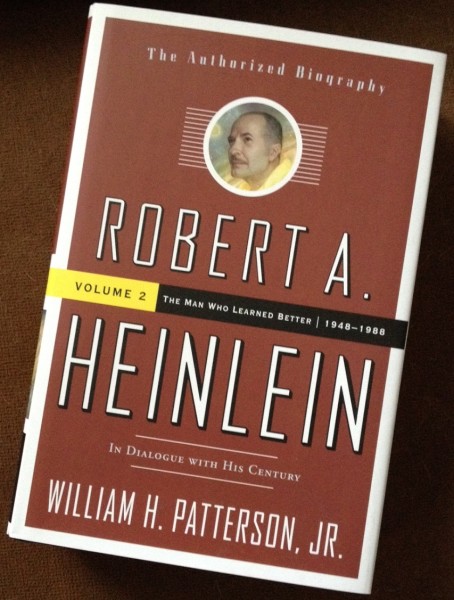
RAH by Patterson Volume 2In the Washington Post, Michael Dirda reviews the second (and final) volume of William Patterson’s Robert A. Heinlein: In Dialogue With His Century.

Robert Anson Heinlein (1907-1988) possessed an astonishing gift for fast-paced narrative, an exceptionally engaging voice and a willingness to boldly go where no writer had gone before. In “— All You Zombies—” a transgendered time traveler impregnates his younger self and thus becomes his own father and mother. The protagonist of Tunnel in the Sky is black, and the action contains hints of interracial sex, not the usual thing in a 1955 young adult book. While Starship Troopers (1959) championed the military virtues of service and sacrifice, Stranger in a Strange Land (1961) became a bible for the flower generation, blurring sex and religion and launching the vogue word “grok.”

Heinlein’s finest work in the short story was produced in the late 1930s and early ’40s, mainly for the legendary editor of Astounding, John W. Campbell. But by 1948, when this volume opens, “The Roads Must Roll,” “By His Bootstraps, “Gulf” and “Requiem” are behind him. The onetime pulp writer has broken into the Saturday Evening Post and Boy’s Life, married his third (and last) wife, Virginia, and settled in Colorado Springs, where he designs and builds a state-of-the-art automated house. Apart from his occasional involvement with Hollywood, as in scripting Destination Moon, he will devote the rest of his career mainly to novels.

[…]

Like his fascinating but long-winded first volume, the second half of Patterson’s biography is difficult to judge fairly. Packed with facts both trivial and significant, relying heavily on the possibly skewed memories of the author’s widow, and utterly reverent throughout, volume two emphasizes Heinlein the husband, traveler, independent businessman and political activist. Above all, the book celebrates the intense civilization of two that Heinlein and his wife created. There is almost nothing in the way of literary comment or criticism.

Though Heinlein can do no wrong in his biographer’s eyes, if you use yours to look in Patterson’s voluminous endnotes, you will occasionally find confirmation that the writer could be casually cruel as well as admirably generous, at once true to his beliefs and unpleasantly narrow-minded and inflexible about them. Today we would call Heinlein’s convictions libertarian, his personal philosophy grounded in absolute freedom, individual responsibility and an almost religiously inflected patriotism. Heinlein could thus be a confirmed nudist and member of several Sunshine Clubs as well as a grass-roots Barry Goldwater Republican.

For the record, I loved this volume even more than I loved the first one. But Dirda’s comments are fair: Patterson worked hard to present Heinlein in as positive a light as possible, so it’s not unreasonable to suspect that the great man’s character quirks could make him difficult and awkward to deal with at times (to be kind). In the last post, I talked about the adolescent Heinlein as being “probably a pretty toxic individual” and that aspect of his character can still be discerned in the recounting of his later years.

June 25, 2014

QotD: The difference between money and wealth

Filed under: Economics, History, Quotations, USA — Tags: , , — Nicholas @ 00:01

… it is a mistake to use “money” and “wealth” as synonyms. Money is not wealth (though it is often a signifier of wealth). Wealth is a concept far greater, deeper, and more complex than mere money can encompass. Money is a tool; wealth is a state of being, an environment, a continuum in which we conduct our lives. When the left speaks of inequality in purely monetary terms, they are engaging in a puerile and futile kind of reductionism.

Consider a man with a wife and three teenage daughters, who lives in a house with only one bathroom. This man wouldn’t need a million dollars to feel wealthier; he’d just need a second bathroom. A chance to have a hot shower in the morning and have a clean space on the sink for his shaving gear. Wealth to this man is not the money it would take to build the extra bathroom; wealth is the time and comfort the new bathroom brings. Wealth is comfort he gains, his improved state of mind, the increased peace in his household, his improved quality of life. The marginal utility of the additional bathroom is great indeed (the utility of additional bathrooms would be less). The wealth of that additional bathroom is much greater, proportionally, than if this man and his family lived in a huge mansion with fifteen bathrooms. (In fact, the huge house might decrease his happiness due to the expense of upkeep and maintenance. Who knows?)

You don’t make a poor person wealthy by giving them money; history is full of lottery winners who ended up just as poor as when they started, and many’s the dissipated scion of a rich family who frittered away the family fortune. Wealthy people tend to have a lot of money because money is correlated with wealth (but does not cause it). Income, investments, assets — all can generate money for a wealthy person.

But wealth is more than just stuff. A loving spouse and healthy, happy children are treasures. Running a successful business can mean more than just the profits it generates; there is deep satisfaction in conducting a successful enterprise. A deep love of art or music can enhance and enrich a life. The company of good friends is truly priceless, and something that wise people learn to value more as time goes by.

Money gives access to some of those things, but all the money in the world can’t buy an appreciation of those things.

But to speak of wealth even in this broadened sense is misleading, for in America even “poor” people are wealthy beyond the dreams of people in many places in the world. And compared to people in most ages of the earth prior to the 20th century, there are no poor Americans. It’s amazing to consider how much better life for an average person is now compared to past times. We have food in amazing abundance and variety. Every house has a big-screen television, central heating and air-conditioning, and a refrigerator and range. Everybody has at least one car. Everybody has a cellular phone, and most people have a computer. Few of us work more than eight hours a day to afford all these things, leaving plenty of free time to relax. Medical technology has extended our lifespans, and made our tour upon the earth far more pleasant than in former times. We live healthier, more active, more stimulating lives than at any point in our history — wealthier lives.

Monty, “Wealth as an end and wealth as means to an end”, Ace of Spades HQ, 2014-06-24.

June 24, 2014

QotD: Back in the boozy USSR

Filed under: History, Quotations, Russia — Tags: , , — Nicholas @ 00:01

The Soviet government recently issued one of its condemnations of public drunkenness and the usual warning about stern countermeasures. This is partly routine, like official attacks on rock music, jeans and other signs of decadence, but it’s also an indication that the legal booze supply is improving after a setback. Like every other industry in the USSR, the state liquor monopoly, Prodintorg, is appallingly inefficient, the constant victim of breakdowns and shortages. At such times the authorities’ attitude to illicit distilling, normally harsh in the extreme, mellows wonderfully. The bootleg stills spring up in their tens of thousands and the police look the other way until Prodintorg recovers.

Because, come what may, Soviet man has got to be given his drink. Some say the Russian Revolution of 1917 happened because the Czar had banned alcohol three years before as a wartime measure, or at least that was why it was so bloody. Certainly Russian attitude to drink is different from ours in the West, probably always has been. Centuries ago, travellers recorded that a typical Russian meal was one where everybody got speechlessly drunk, all classes, all ages, both sexes, seven days a week, that people were always falling down dead in public through over-use, that “drinke is their whole desire,” as an English diplomat wrote of his visit in 1568.

Drinking to get drunk is probably known in every country, and there are alcoholics in most places, but even the ordinary Russian drinks to be drunk with the minimum of delay — hence the down-in-one ritual, which of course also shortens the agony of getting down the local hooch. And once drunk he acts drunk. It’s expected of him; indeed the regard and sympathy shown drunks in public is something almost unknown in the West outside Ireland — a suggestive comparison. From time immemorial a Russian needing to buy a bottle has gone to the head of any queue in a grocery or market, not by law but by natural right.

Kingsley Amis, Everyday Drinking: The Distilled Kingsley Amis, 2008.

June 23, 2014

Censoring WW1 art

Filed under: Britain, History, Military, WW1 — Tags: , , — Nicholas @ 07:29

In BBC News Magazine, Alan Little looks at some early WW1 art that fell afoul of the censors for being too accurate:

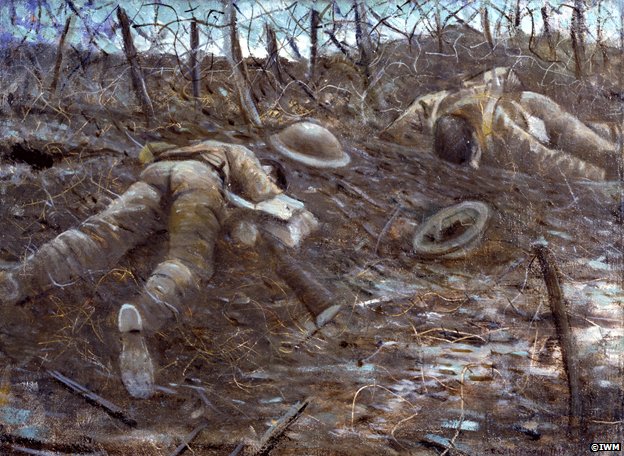
Paths of Glory by Christopher Nevinson

What you notice first about the two figures in Christopher Nevinson’s painting Paths of Glory is the banality of their deaths. Their commonplace, mundane fate. They lie face down in the blasted earth, two men in British military fatigues, their helmets and rifles lying in the mud beside them.

They are indistinguishable from each other, stripped of individual identity. Nothing marks them out as the unique human beings they must once have been with names, and families, and remembered childhoods, and desire and love and hope and ambition.

From the bottom left of the composition, where the corpse in the foreground lies with the soles of his boots facing you, your eye moves diagonally upwards and to the right, to the second dead man, who has fallen forwards towards you, and you see the top of his dark head but Nevinson denies you a glimpse of his face. He has no face, no personality, no story of his own. In colour, texture and even contour, the lifeless bodies are almost indistinguishable from the land on which they lie, and which will now swallow them.

In my time as a war reporter for the BBC I have come across scenes like this. You cannot mistake the recently dead for the sleeping, for there is something bloodless, something shockingly, arrestingly lifeless about them. I have found myself transfixed by odd detail — a bootlace tied just a few hours ago, by fingers that will now never move again. What talents lie locked into the muscle memory of those fingers? Could they, as recently as this morning, have picked out a melody on a piano? With the death of each individual, an entire universe vanishes.

[…]

I think of those two young men whose names I never learned when I look at Nevinson’s Paths of Glory. Its title is taken from Thomas Gray’s Elegy Written in a Country Church-Yard. “The boast of heraldry, the pomp of pow’r, / And all that beauty, all that wealth e’er gave / Awaits alike th’inevitable hour. / The paths of glory lead but to the grave.”

Government censors did not like Paths of Glory. They judged it bad for morale and refused to pay Nevinson for it. But he included it anyway in the first exhibition of his war paintings in London early in 1918, with a brown paper strip across the canvas carrying the word “censored”. He was reprimanded both for exhibiting a censored painting and, bizarrely, for unauthorised use of the word “censored” in a public place. But the painting was bought, during that exhibition, by the Imperial War Museum, where it remains.

June 21, 2014

The science of booze

Filed under: History, Science, Technology, Wine — Tags: , , — Nicholas @ 09:18

Mankind has been making alcoholic beverages for thousands of years, yet there are still some pretty basic things we don’t know about alcohol:

Consider the number of things we still don’t know: Yeast, the single-celled fungus responsible for fermentation (the conversion of sugar into alcohol), seems to have been domesticated about 12,000 years ago, but we don’t know for sure where it came from, why it makes ethanol, or why some strains do it better than others.

The physics of distillation are well established, but nobody knows who invented it — an alchemist in ancient Alexandria called Maria the Jewess? — and getting a consistent taste from the finicky process is more an art than a science.

Aging in toasted barrels clearly does hooch good, as the wood breaks down and the liquid penetrates its pores to mix with tannins and other molecules. But the final flavor of a spirit depends on everything from the temperature in the warehouse where it is aged to the climate where the trees are grown, and attempts to create synthetic processes to season liquor quicker (read: more profitably) have come mostly to naught.

Even at the most basic level, scientists don’t yet understand why booze makes us feel the way it does. Alcohol’s mode of action in the brain is much more complicated and elusive than that of a drug such as heroin, which locks into specific, identified receptors meant for natural neurotransmitters. “The truth is, we don’t know at the molecular level what alcohol is binding to,” Rogers quotes the director of the National Institute on Alcohol Abuse and Alcoholism as saying. “It’s never been resolved.”

QotD: The bureaucratic revolution

Filed under: Bureaucracy, Education, Government, History, Quotations — Tags: , , — Nicholas @ 00:01

In 1939, Bruno Rizzi, a largely forgotten Communist intellectual, wrote a hugely controversial book, The Bureaucratization of the World. Rizzi argued that the Soviet Union wasn’t Communist. Rather, it represented a new kind of system, what Rizzi called “bureaucratic collectivism.” What the Soviets had done was get rid of the capitalist and aristocratic ruling classes and replace them with a new, equally self-interested ruling class: bureaucrats.

The book wasn’t widely read, but it did reach Bolshevik theoretician Leon Trotsky, who attacked it passionately. Trotsky’s response, in turn, inspired James Burnham, who used many of Rizzi’s ideas in his own 1941 book The Managerial Revolution, in which Burnham argued that something similar was happening in the West. A new class of bureaucrats, educators, technicians, regulators, social workers, and corporate directors who worked in tandem with government were reengineering society for their own benefit. The Managerial Revolution was a major influence on George Orwell’s 1984.

Now, I don’t believe we are becoming anything like 1930s Russia, never mind a real-life 1984. But this idea that bureaucrats — very broadly defined — can become their own class bent on protecting their interests at the expense of the public seems not only plausible but obviously true.

The evidence is everywhere. Every day it seems there’s another story about teachers’ unions using their stranglehold on public schools to reward themselves at the expense of children. School-choice programs and even public charter schools are under vicious attack, not because they are bad at educating children but because they’re good at it. Specifically, they are good at it because they don’t have to abide by rules aimed at protecting government workers at the expense of students.

[…]

Working for the federal government simply isn’t like working for the private sector. Government employees are essentially unfireable. In the private sector, people lose their jobs for incompetence, redundancy, or obsolescence all the time. In government, these concepts are virtually meaningless. From a 2011 USA Today article: “Death — rather than poor performance, misconduct or layoffs — is the primary threat to job security at the Environmental Protection Agency, the Small Business Administration, the Department of Housing and Urban Development, the Office of Management and Budget and a dozen other federal operations.”

Jonah Goldberg, “Of the Bureaucrats, by the Bureaucrats, for the Bureaucrats: The naked self-interest of the government-worker class”, National Review, 2014-06-20.

June 20, 2014

The Black Death, the peasants’ revolt, and … tax increases

Filed under: Britain, France, History — Tags: , , , , , — Nicholas @ 07:47

Put yourself in the position of an advisor to the 10-year old King Richard II shortly after his coronation in 1377. You’ve just witnessed one of the greatest population disasters in European history — the Black Death — where one third of the people of all classes died. The crown is at war with France (the Hundred Years’ War), and there’s little or no money in the treasury. You could probably come up with better policy ideas in your sleep than what Richard’s advisors did:

Fixated with outright victory in the One Hundred Years War, started by his grandfather Edward III, Richard’s government introduced hugely unpopular poll taxes in 1377 and 1379. A further tax introduced in 1381 was to be the straw that broke the camel’s back. Irrespective of wealth, the tax was fixed at a rate of 12 pence per person, meaning that it was a huge burden on the poor, but a minor inconvenience to the wealthy. In addition, rumours spread of widespread corruption in the government. The peasants were ripe for revolt.

Following the expulsion of a tax collector from the town Brentwood, 30 kilometres north-east of London, a band of rebels swept through Kent and Essex, swelling their numbers with volunteers as they went. They advanced upon London in a pincer movement from the south and east. The two leaders of the rebellion emerged as Wat Tyler, of whom little was previously known, and John Ball, a radical priest who had been broken out of prison by Kentish rebels, where he had been held for his beliefs in social equality and a fair distribution of wealth within the church. Indeed, as he preached to the crowd of thousands of rebels at Blackheath, then just outside London, he cried: ‘When Adam delved and Eve span, Who was then the gentleman? From the beginning all men by nature were created alike, and our bondage or servitude came in by the unjust oppression of naughty men.’

Londoners willingly opened the gates of their city to the rebels who set about their task with fervour. They sacked Savoy Palace, the home of the key adviser to the now 14-year-old Richard. Guards in the Tower of London opened the gates to the rebels, who freed the inmates and executed Simon Sudbury, the Archbishop of Canterbury and Lord Treasurer of England, who had been hiding inside. There were also several incidents of misplaced rage among the rebels, like when the crowd set their sights upon Flemish immigrants, many of whom were wealthy wool merchants, and murdered them in the streets.

Faced with a grave situation, the young king rode out to meet the rebel leaders at Blackheath. Their demands were an end to poll taxes, an immediate end to serfdom, the introduction of a more democratic form of government with local representation based on the Provisions of Oxford in 1258, and a fair distribution of wealth and power from the nobility. Richard initially gave into their demands as well as issuing pardons for all involved.

It got worse (for the peasants) after that brief high point…

« Newer PostsOlder Posts »

Powered by WordPress