
Adrian Goldsworthy. Historian and Novelist
Published 10 Sept 2025Today we think about attitudes to Roman rule and discuss how frequent rebellions were in the Roman empire’s provinces and what were their causes. In particular we think about Judaea, and the Jewish population of the empire more generally, in the first and second centuries AD. Why was there a big rebellion in AD 66 against Nero’s rule, another of the Jewish population in Egypt, North Africa and Cyprus but NOT Judaea against Trajan, and then the final major rebellion in Judaea under Hadrian.
April 4, 2026
RESISTANCE and REBELLION – The Conquered and the Proud 19
Comments Off on RESISTANCE and REBELLION – The Conquered and the Proud 19
April 3, 2026
QotD: The Great Purge
In July 1936, Grigory Zinoviev and Lev Kamenev were brought to Moscow to be interrogated for being part of Trotsky-led conspiracy. The pair had been part of the ruling triumvirate, along with Stalin, after Lenin was incapacitated with a stroke, but they had sided with Trotsky in the power struggle that followed Lenin’s death. As a result. their status had declined in the party. In 1932, they were found to be complicit in the Ryutin Affair and were expelled from the Communist Party.
Stalin ordered Nikolai Yezhov, who later was head of the NKVD during the purges, to interrogate the two as part of a larger conspiracy involving Trotsky loyalists. Yezhov appealed to their devotion to the Soviet Union. They were, of course, subjected to physical and psychological pressure. Yezhov told Kamenev he had evidence against his son, which could result in his execution. Inevitably, they agreed to participate in what would be the first of many show trials against Stalin’s enemies.
The bargain Zinoviev and Kamenev struck with the Politburo was that they would testify against their comrades in exchange for their lives and their family’s lives. Stalin himself agreed to the deal in person, on behalf of the Politburo. They were tried with fourteen other defendants in the House of the Unions, which still stands today. All sixteen were found guilty of plotting to kill Stalin and other Soviet officials. They were promptly executed in the basement of Lubyanka Prison.
This would be the pattern throughout the Great Purge. Political enemies would be turned against one another through a combination of terror, torture and the promise of forgiveness if they cooperated. The real purpose of forcing friends to denounce friends and family members to denounce other family members was to create an atmosphere in which no one could trust anyone. As Montesquieu noted, the motor that powers every despotic regime is a general fear of the ruler.
The Z Man, “What Comes Next”, The Z Blog, 2020-08-03.
Comments Off on QotD: The Great Purge
April 2, 2026
m/27PH aka m/37: Finland’s First Standard Sniper Rifle (and it’s really bad)
Forgotten Weapons
Published 14 Nov 2025The m27PH, aka the m/37, was the first standardized Finnish sniper rifle. It was developed as part of the plan to make a whole family of m/27 rifles for the Finnish Army, including cavalry, trainer, and sniper models. The sniper model was delayed because of the structural problems with the m/27 base rifle, and it was not formally adopted until 1937. The rifle used a 2.2x prismatic scope made by Finnish company Physica Oy. The scope was heavy, fragile, and had a very short eye relief.
When first adopted, the rifles had short, slightly bent bolt handled and standard stocks. Once they began to see use in the Winter War (for which they were Finland’s only standardized sniper rifle), experience showed these features to be problems. The bolt handles were largely replaced with much longer Soviet-style sniper bolts, and wooden cheek rests were added to the stocks.
During the Continuation War, m/27PH rifles were still in service, but as they were damaged their scopes were generally used to build new m/39PH sniper rifles instead. Today they are extremely rare rifles.
(more…)
Comments Off on m/27PH aka m/37: Finland’s First Standard Sniper Rifle (and it’s really bad)
QotD: Growing up behind the Iron Curtain
Which makes sense if you think about it. When everybody’s snitching on everybody else, shameless is the only way to live. Everybody’s guilty of something, so own it — being, of course, perpetually prepared to snitch anyone and everyone else at a moment’s notice if someone drops the dime on you. Also, if you have to stand in line six hours to maybe get a few potatoes, damn it, you’re gonna get those potatoes. It doesn’t matter if you like potatoes, or have any possible use for potatoes at the present time. You’re going to take every single spud you can get your hands on, plus steal anything that isn’t nailed down, because you never know when you’ll get another chance.
As it turns out, overabundance creates the same conditions. When you’ve been standing in line for six hours with 1,000 of your new best friends just to get some tampons — and you’re a guy, you don’t need tampons, but you can always barter them for something — you’re not going to scruple to do anything and everything to get them. Indeed you want people to know Ivan’s got some tampons, because that’s how the black market works …
… anyway, as I say, we’re not in line for six hours, but we are perpetually at least under the threat of surveillance. And not from the Feds — just as Ivan’s not worried about the KGB, but rather his neighbors, so we don’t have to worry about the Feebs monitoring us. Instead, it’s that Basic College Girl with the iPhone. She’s not filming you, of course, she’s filming herself, but there you are anyway, in the background, doing whatever. Under those conditions — and when everyone’s volunteering the most intimate details of their lives on Fakebook and Twatter — shameless is the only way to live.
In other words, thanks to constant social media “surveillance”, it has gone in the blink of an eye from “It didn’t happen unless someone caught it on film” to “It’s all on film anyway, so fuck it, I’m gonna get mine”. I used to see this all the time in class. Basic College Girls will lie straight to your face, for any reason or no reason. They’ll do it on spec, just to see if you bite. More importantly, they’ll tell you such obvious, easily disproven whoppers that you start wondering if they’re having a schizoid break. You have to know I know you’re lying, right? That Dead Grandma Story is very sad, but you have pictures of yourself all over Twitter drunk at the sorority formal, when you told me you were at Nana’s funeral.
It’s not that they don’t know. It’s that they don’t care. Because somehow I’m the asshole for not believing them, despite the evidence of my own lying eyes.
Severian, “Friday Male Bag”, Founding Questions, 2022-06-03.
Comments Off on QotD: Growing up behind the Iron Curtain
April 1, 2026
The Korean War Week 93: Who Wants To Be President? – March 31, 1952
The Korean War by Indy Neidell
Published 31 Mar 2026A surprise announcement this week leaves the US wondering just who is going to run for President — the election is this fall. Whoever does run and win, it can’t help but have an impact on this war. As for what’s going on in the war, Operation Mixmaster winds up, having moved the US 1st Marine Division far to the west along the front lines. The operation was a success, but there are a host of new dangers to deal with in the new defenses. Operation Saturate goes into action- this is another aerial interdiction campaign against Communist logistics, but early results are disappointing, and the future composition of the South Korean armed forces because more and more an issue of contention.
00:00 Intro
00:46 Recap
01:14 Truman Won’t Run
07:04 Operation Mixmaster
11:04 Operation Saturate
13:17 Increase the ROK
16:32 Summary
16:46 Conclusion
(more…)
Comments Off on The Korean War Week 93: Who Wants To Be President? – March 31, 1952
The fall of Rome and the rise of Islam
Gustavo Jalife points out that a work from nearly a century ago identified the rise of Islam as being far more disruptive to western civilization than the fall of the western Roman Empire (and the surge of Islamic power destroyed the Persian Empire and nearly toppled Constantinople as well):
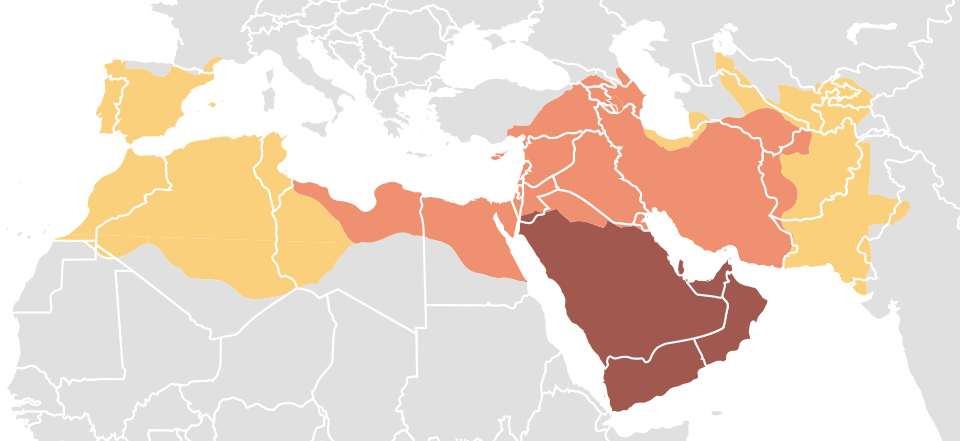
Expansion of the Caliphate: Mohammed, 622-632 (red), Rashidun Caliphate, 632-661 (orange), and the Umayyad Caliphate, 661-750 (yellow).
Wikimedia Commons.
In Mohammed and Charlemagne – posthumously published in 1937 – renowned historian Henri Pirenne (1862-1935) advanced a thesis at once simple and much contested: that the true rupture between Late Antiquity and the beginning of the Middle Ages was not the fall of Rome in the fifth century, as traditionally held, but the expansion of Islam in the seventh. The Germanic kingdoms, he argued, had preserved much of the Roman economic and cultural architecture. Trade across the Mediterranean continued; cities, though diminished, remained nodes in a wider network sustained by the circulation of goods and by administration. For the Romans, the mare nostrum was a highway rather than a barrier.
If a good article starts after it ends, one might say that a civilisation reveals itself most clearly not in its proclamations, but in the modification of its habits – when what was once assumed becomes contested. In such subtle alterations, Pirenne discerned the end of the ancient world.
With the Islamic expansion the greater part of the Mediterranean’s southern and eastern shores fell under Muslim control, from the Levant and Egypt to North Africa and the Iberian Peninsula. The sea was no longer a unified Roman basin, but a divided one. Authority and function shifted: the Mediterranean ceased to operate as a shared commercial zone. Long-distance trade dwindled, the flow of goods between East and West was disrupted and with it the urban and monetary life that depended upon it. Only then did Western Europe withdraw inward, shrinking into the medieval world as it is recognised today.
The argument has been debated, qualified, and revised. Yet its inner core endures: civilisations are sustained not merely by armies or laws, but by the invisible fibres of exchange – commercial, intellectual and cultural – that bind their parts together. Sever those threads and, without even the cut of a sword, a whole order may vanish into a rumour.
To draw a parallel with present-day Europe is to tread on disputed ground. The language of “invasion” is often employed with more heat than light; yet to deny that significant demographic and cultural changes are under way would be equally unhelpful. The question, then, is whether Pirenne’s model can illuminate what many believe is a tragedy without reducing it to a farce.
The spread of Islam in the seventh and eighth centuries was a series of military conquests. The Arab fleets that took North Africa and Spain, the armies that crossed into Gaul, and the long struggle for control of the Mediterranean were enterprises of war and empire. Contemporary migration into Europe, by contrast, occurs largely through civilian movement, legal and illegal. However, both historical processes demonstrate that massive migratory movements, whatever their specific nature, do not merely add numbers to a population; they introduce new networks, new loyalties, new values and new norms that eventually fracture the existing state of affairs.
Before the eighth century, the Mediterranean economy continues to function, vibrant and connected. After the eighth century, that system is shattered. The sea is closed. Trade disappears. Europe faces an empire whose only wealth is the land, where the movement of goods is reduced to a bare minimum. Far from advancing, society regresses.
Pirenne’s thesis gains thrust and edge in presenting the Islamic expansion as embodying a fundamental alteration in coexistence.
Comments Off on The fall of Rome and the rise of Islam
Generation Jones and the Temple of Boom(ers)
Wee Nips
Published 19 Sept 2025Generation Jones and the Temple of Boom(ers) explores the fascinating differences — and surprising overlaps — between Baby Boomers, Generation X, and the often-overlooked Generation Jones.
Were you too young for Woodstock but too old for grunge? Stuck between disco and Nirvana? You might just be a Joneser.
In this video, we’ll compare:
🎵 The cultural touchstones of Boomers, Gen X, and Jonesers
📉 The low points in history that shaped each generation’s outlook
💰 The economic conditions that defined their opportunities
🧠 The attitudes and stereotypes that still stick today
Generation Jones isn’t just a footnote — they’re the missing link between the optimism of the Boomers and the skepticism of Gen X.
0:00 Introduction
1:38 Definitions
2:42 Cultural Touchstones
3:38 Low Points in History
4:53 Economic Conditions
5:42 Social and Attitude Differences
6:38 Humorous Stereotypes
7:09 Overlaps and Connections
8:02 Closing
(more…)
Comments Off on Generation Jones and the Temple of Boom(ers)
QotD: “Colour-blind” casting
As a regular reader of this column, I have no doubt that you want to remain on the right side of history, and I imagine your instincts are to applaud anything that is annoying for conservatives, like diverse casting in historical dramas. Sometimes being an anti-racist can be hard work, but we don’t tell people to “do the work” for nothing.
First, we need to dispense with the “historical accuracy” argument. There are two ways to do this and the first is to say accuracy should play second fiddle to representation. This is apparently the Hilary Mantel argument. The Times says the Wolf Hall author blessed colour-blind casting before she died, saying that although it was difficult: “you’re in the realm of representation. I think we have to take on board the new thinking.” Everything in 21st Century Britain should reflect 21st Century Britain. We’re in year zero, and hence not employing non-white actors in a production made today, even though there were very few non-white people in sixteenth century England, is simply racist.
The second option is to straightforwardly argue that there were lots of Black and Brown people pottering around the court of Henry VIII, so the production is historically accurate. This is the BBC Horrible History approach. Were you there? Can you prove that it wasn’t full of People of Colour? And is it worth losing your job to do so?
I prefer to hold both of these arguments in my head at the same time. Too much consistency seems a bit right-wing.
Next we need to look at specifically who is being played. Thankfully, the “colour-blind casting” didn’t select any PoGMSTs (People of Global Majority Skin Tones) to play bad guys. This was both on purpose, because oppressed people cannot be bad, and it was also not on purpose, because otherwise it wouldn’t be colour-blind casting. Whichever one it was — and it was both — without PoGMSTs actors playing historic fictionalised evil people, we can avoid the completely random casting process being labelled as racist.
David Scullion, “People of Colour television”, The Critic, 2024-11-12.
Comments Off on QotD: “Colour-blind” casting
March 31, 2026
This Recipe Took 3 Years … Ninja Kikatsugan
Tasting History with Max Miller
Published 23 Sept 2025Very bitter, very sake-flavored balls that include ginseng, coix seeds, and licorice
City/Region: Japan
Time Period: 1676Much like cowboys, pirates, and knights, ninja have been fictionalized to be a far cry from the intelligence gathering and sabotage experts of history. The term “ninja” didn’t even become popular until the mid-20th century.
Even the historical text I’m using here, the Bansenshukai, has been called into question. Because it was written over the period of several centuries, often by people who weren’t even alive during the period when ninja, or shinobi, were active, who knows if it’s an accurate portrayal of their tools and methods.
If this recipe is accurate, I feel bad for the people who had to eat them. They’re really bitter with an overwhelming sake flavor that isn’t pleasant. Really, I wouldn’t recommend making these; they’re not worth the 3 year time investment, and hyōrōgan are a much tastier ninja survival food.
Kikatsugan
10 ryō Asiatic ginseng
20 ryō Buckweat flour
20 ryō Millet Flour
20 ryō Yam
1 ryō Liquorice
10 ryō Coix seed
20 ryō Rice flour
Grind this into a powder, soak it in three shō of sake for three years until it has dried. Afterward, roll it into balls the size of peach pits.
Eating three of these daily will keep you healthy even when you have nothing else to eat.
Eating three will prevent both mental and physical fatigue.— Bansenshukai, 1676
Comments Off on This Recipe Took 3 Years … Ninja Kikatsugan
QotD: Slavery
It is impolite to say of one’s spouse or one’s debtor that they are part of one’s property. With slaves, politeness is unnecessary. (Slavery and Social Death, P.22)
What makes a slave different from a wife, professional player or even a serf is that a slave is in a state of social death: they have no claims of social connection that their master (or anyone else) need pay attention to beyond that to the master.
This is not to say slaves have no legal personality — all slave systems are very well aware that slaves are people. Rather, the relationship of exclusive domination was such that they had no connections that anyone had any obligation to respect other than to their master.
Other individuals might be in relationships of servitude under a master but still retained connections with others subject to presumptive respect. This was true even of serfs and is what distinguishes various forms of serfdom from slavery. Even under Russian serfdom, a serf marriage was a legally recognised marriage; a serf father had legally recognised authority over his family; a serf could legally own property. Once somebody had suffered the social death of slavery, they were utterly bereft of any such connections.
Both serf and slave lacked any choice of master or about the nature and content of that mastery: that is what makes both forms of labour bondage. Nevertheless, a serf had legally recognised relationships, and choices about them, that a slave simply did not.
Slaves are violently dominated: the whip or equivalent has been a control device in every known system of slavery. They are natally alienated: both from from any (positive) standing from their ancestors or claims over their descendants. They are culturally degraded: whether in naming, clothing, hair style, marks on the body or required acts.
All this serves to establish, mark and reinforce the relationship of domination. For that level of domination is required to turn one human into the possession, and so the property, of another. (Karl Marx’s talk of “wage slave” is not only rhetorical excess, it is contemptible rhetorical excess: a manifestation of his comprehensive mischaracterisation of commerce.)
None of these key features of domination require the acknowledgement of the wider society. There are likely slaves in every major city in the world, even in economically highly developed democracies with the rule of law.
While it can be helpful to have your relationship of domination over a slave recognised by others, the crucial thing is the acknowledgment by the slave. Slavery is a relationship between people about an owned thing, where the slave acknowledges that they are the owned thing. This is a key element in the humiliation of slavery.
The mechanisms of domination are, however, obviously much more powerful if they are embedded in wider institutional acceptance of slavery. Where there is no such wider acknowledgement, then even greater isolation from the wider society is required to establish and maintain the relationship of domination.
In social systems that openly incorporate slaveholding, a slave’s state of domination, of the social nullity of no independent connection, normally meant that they could not be a formally recognised owner of property: that they could not be a legal owner of property, not a person who could have property. They lacked the sort of legal standing that could legally own things.
To do so would require the slave to have social and legal connections, beyond the claims and decisions of their master, that others are bound to accept or respect, and that is precisely what slavery, as a structure of domination of one by other, denies. The Ahaggar Tuaregs express this feature of slavery very directly, holding that:
without the master the slave does not exist, and he is only socializable through his master. (Slavery and Social Death, P.4.)
Slavery is, always and everywhere, a created relationship of dominion. As the Kel Gress group of the Tuareg say:
All persons are created by God, the slave is created by the Tuareg. (Slavery and Social Death, P.4)
In a society that accepts slavery, the conventions of acknowledged possession will operate for the master about the slave in a far more complete way than any other claim of property in another human. If other mechanisms of delegated control were sufficiently absent or attenuated, then slaves became preferred agents. The use of slaves as commercial agents was surprisingly common.
In societies dominated by kin-groups, slaves could make preferred warriors or officials precisely because they had no other connection entitled to presumptive respect than that to their master — hence the slave warriors of Greater Middle Eastern (Morocco to Pakistan) Islam.
The danger of kin-groups is that they readily colonise social institutions — rulers come and go, the kin-group is forever. Slave warriors and officials were a solution to that problem in societies where suppression of kin-groups was not a practicable option.
Imperial China found kin-groups useful for economising on administrative costs and Emperors used distance — officials could not be assigned to their home counties — and rotation of officials to inhibit kin-group colonisation of their administrations. Even so, much of the appeal of eunuchs to Emperors was precisely the presumed severing of kin-group ties. (They also had the advantage of being the only males, other than the Emperor, permitted overnight residence in the imperial palace.)
Nevertheless, slavery can exist without such wider acknowledgement by laws. For turning someone into a slave requires forcing them to acknowledge the relationship of domination to the point of being a possession of another.
So, slavery is not, at its core, a matter of property but of domination. Domination to the extent that the conventions of acknowledged possession can apply to slaves entire. Slaves can be turned into property without any other connections with presumptive respect or standing. Yet, even a slave could be a beneficial participant in the conventions of acknowledged possession.
For, so powerfully useful are the conventions of acknowledged possession, that masters have, surprisingly often, allowed slaves to also be accepted beneficiaries of the conventions of acknowledged possession. To be owners of property in practice, if not in law. This was done to lessen the burdens of control, the cost of subsistence or to enable the slave to buy their freedom. The Romans acknowledged this through the concept of peculium.
The Romans, being relentlessly logical in such matters, held a slave to be an owned animal. That is, a human on which such a comprehensive social death has been imposed that they are the legal equivalent of a domesticated animal. (Yet, somewhat awkwardly, still people.)
Just as you can geld an animal, you can castrate a slave. Despite the Islamic slave trade being on a comparable scale to, and lasting centuries longer than, the Transatlantic slave trade, there is no ex-slave diaspora within Islam, unlike the Americas. All children of a Muslim father are members of the Muslim community while so many of the male slaves were castrated.
The Roman concept of property as dominium, as absolute ownership of a thing, may have transferred the domination of slavery into a more general conception of property so as to absolutely separate slave (who suffers dominium) from citizen (who possesses it). Rome ran one of the most open slave systems in human history, such that a freed slave could become a citizen. This necessitated particularly sharp legal delineation of the difference between slave and citizen.
Such dominion is not a relationship between a person and thing (despite claims to the contrary) for it is still setting up a relationship with others regarding what is owned, remembering that the crucial thing in property is not mine! but yours!: the acknowledgement by others of possession and so the right-to-decide. Hence the importance of the signals of possession for slavery.
The Greeks also had citizenship and — particularly in the case of Athens — mass slavery. Greek citizenship was, however, far more exclusive than Roman citizenship and the existence of metis, resident non-citizens, further separated citizen from slave. The Greek city-states also operated much more convention-based, and distinctly less developed, laws than did Rome. If law is a matter of such abstraction as is needed to establish functional differences, and no more, the Romans perhaps felt more need to establish that a citizen could possess dominion.
Conversely, as Romans were not moral universalists, they felt no need to generate some justificatory abstraction about slavery: a slave was simply a loser. If a slave later became a Roman citizen, then, congratulations to them, they had become a winner (and few cultures have worshipped success quite as relentlessly as did the Romans). Hence freedmen would put their status as freedman on their tombstones.
Aristotle — as his moral theory did tend towards moral universalism — came up with a clumsy justificatory abstraction (natural slaves) as to why slaves could be morally degraded. Indeed, the combination of moral universalism and slavery invariably led to justifications that held some essential flaw in the slave justified their domination by others. A process much easier to manage if slaves were from a different continental region, so with distinguishing physical markers of their continental origin.
The Romans had no need of such Just-So stories to justify slavery and did not generate them. Muslims and Christians are moral universalists and so did manifest the need to tell such Just-So stories about enslaved groups: why children of God were being enslaved. (Because that is what they were fit for, clearly.)
Islamic writers generated the first major discourses of skin-colour racism, applying them to the populations they enslaved. In their case, generating both anti-black and anti-white racism, as they systematically enslaved both Sub-Saharan Africans and Europeans, particularly Eastern Europeans. It also led to some awkward rationalisations as to why the inhabitants of South Asia could have dark skins but not suffer from any deemed inherent inferiority.
Just as slavery continues, modern totalitarian Party-States have used forced labour — labour bondage — on massive scales, starting with the Soviet Union and then wartime Nazi Germany. Such continues to the present day in CCP China — infamously of the Uyghurs — and the Kim Family Regime of North Korea. From 1940 to 1956, the Soviet Union banned workers moving jobs without the permission of their existing workforce, the key element of serfdom.
Lorenzo Warby, “Owning people, owning animals, controlling attributes”, Lorenzo from Oz, 2025-12-25.
Comments Off on QotD: Slavery
March 30, 2026
UOTCAF – EP 001 – The Royal Canadian Regiment – SWG
Stormwalker Group
Published 24 Oct 2025Dive into the rich legacy of the Royal Canadian Regiment (RCR) in the premiere episode of “Units of the CAF”, hosted by ex-reservist Mario Gaudet.
This 15-minute narration explores the RCR’s origins in 1883 as Canada’s first permanent infantry unit, the symbolism of their iconic “VRI” cap badge, unique uniform features, and their heroic battles from the North-West Rebellion to Afghanistan. We also spotlight some of the regiment’s most decorated soldiers.
Whether you’re a history buff, military enthusiast, or proud Canadian, this series honors the sacrifices and traditions of the Canadian Armed Forces.
(more…)
QotD: The Revenge of the Archaeologists
It is thus relevant that over the past half-century or so, it has so happened that effectively all ancient historians have had to develop a strong grasp of archaeological data; we don’t all necessarily learn to do the excavation work, of course (that’s what archaeologists do), but pretty much all ancient historians at this point are going to have to be able to read a site or artifact report as well as have a good theoretical grasp of what kinds of questions archaeology can be used to answer and how it can be used to answer those questions. This happened in ancient history in particular for two reasons: first, archaeology was a field effectively invented to better understand the classical past (which is now of course also used to understand the past in other periods and places) so it has been at work the longest there, but also because the sources for ancient history are so few. As I like to say, the problem for the modern historian is taking a sip of meaning from the fire-hose of evidence they have; but the challenge of an ancient historian is finding water in the desert. Archaeological data was a sudden, working well in that desert and much of the last two decades of ancient history has been built around it. Other fields of history are still processing their much larger quantity of texts; why dig so deep a well when you live next to a running river?
The result, in ancient history, has been what I tend to refer to as “the revenge of the archaeologists”. Not, mind you, revenge on medievalists, but in fact revenge on a very specific ancient historian and classicist, Moses Finley. Moses Finley was, from the 1950s to the 1980s, one of the most prominent classicists and his work touched on many fields, including the study of the ancient economy. Finley, writing in the 1960s was generally skeptical of the ability of archaeology to provide useful answers about the ancient economy (he preferred to understand the question by probing the mentalities of the Greek and Roman elite). Archaeology, Finley thought, was frequently over-interpreted and could never give a representative sample anyway; as he quipped in his 1965 article “Technical Innovation and Economic Progress in the Ancient World”, “we are too often victims of that great curse of archaeology, the indestructibility of pots”, a line for which, as far as I can tell, he is still quite unforgiven by some archaeologists.
As if in response, the archaeologists have spent the subsequent almost-six-decades proving again and again the tremendous value of their discipline by, among other things, utterly burying Finley’s The Ancient Economy (1973) under a mountain of archaeological data. It turns out the mentalités of aristocrats who largely hated merchants were not a good barometer of the activities of those merchants.
But you may now guess how this is going to play out in the discussion of Late Antiquity. The ancient historians come to the question ready to think in archaeological terms and ask what archaeological data can do to clear up these questions. Scholars of Late Antiquity trained as medievalists on the other hand, may or may not be well versed in archaeological methods or data (to be clear, some medievalists very much are versed, including prominent voices on the “change and continuity” side of this debate! But it is also very possible to be a “pure text” medievalist in a way that I don’t think I know a “pure text” ancient historian younger than sixty) because their field has not been forced, by dint of the paucity of sources, to revolve so heavily around archaeological data and because the archaeological data on the Middle Ages is not yet as voluminous as that on Classical Antiquity.
As I noted in the first post, beginning in the 1970s, what James O’Donnell calls the “reformation in Late Antique studies” launched a long overdue reassessment of Late Antiquity and the impact of the Fall of Rome – what we’ve called the “change and continuity” argument. I bring up all of this to note that the “counter-reformation” – what we’re calling the “decline and fall” argument – that really emerges beginning in the 90s is in many ways an extension of the “revenge of the archaeologists” in Classical studies (and especially the ancient economy) into the field of Late Antiquity. Indeed some of the scholars are the same (e.g. Willem Jongman) and many of them enter the debate on Late Antiquity as an extension of the debate about the Roman economy (in part demanding that “change and continuity” Late Antique scholars acknowledge things now generally considered “proved” by ancient historians about the earlier Roman economy).
In my own experience, particularly in more informal conversations, the methodological difference that interaction creates between ancient historians – for whom it has long been almost entirely settled that in a “fight” between archaeological evidence and effectively any other kind, the archaeological evidence “wins” – and medievalists for whom archaeology is a much less central part of their method (in part because their textual sources are more extensive) can lead to situations where the two sides of the debate talk past each other.
But when it comes to questions of demographics, economics and the conditions of life for the sort of people who rarely figure in our sources, archaeological evidence – although it is often incomplete and hard to interpret – offers the possibility of decisive answers to questions that otherwise would have to live entirely within the realm of speculation.
Bret Devereaux, “Collections: Rome: Decline and Fall? Part III: Things”, A Collection of Unmitigated Pedantry, 2022-02-11.
Comments Off on QotD: The Revenge of the Archaeologists
March 29, 2026
The collapse of the Afghan National Army in 2021 was inevitable
On the social media site formerly known as Twitter, InfantryDort explains why the way that soldiers were required to cover up ANA shortcomings or even blatantly lie about the ANA’s military capabilities show that collapse was inevitable once western forces began to pull out:
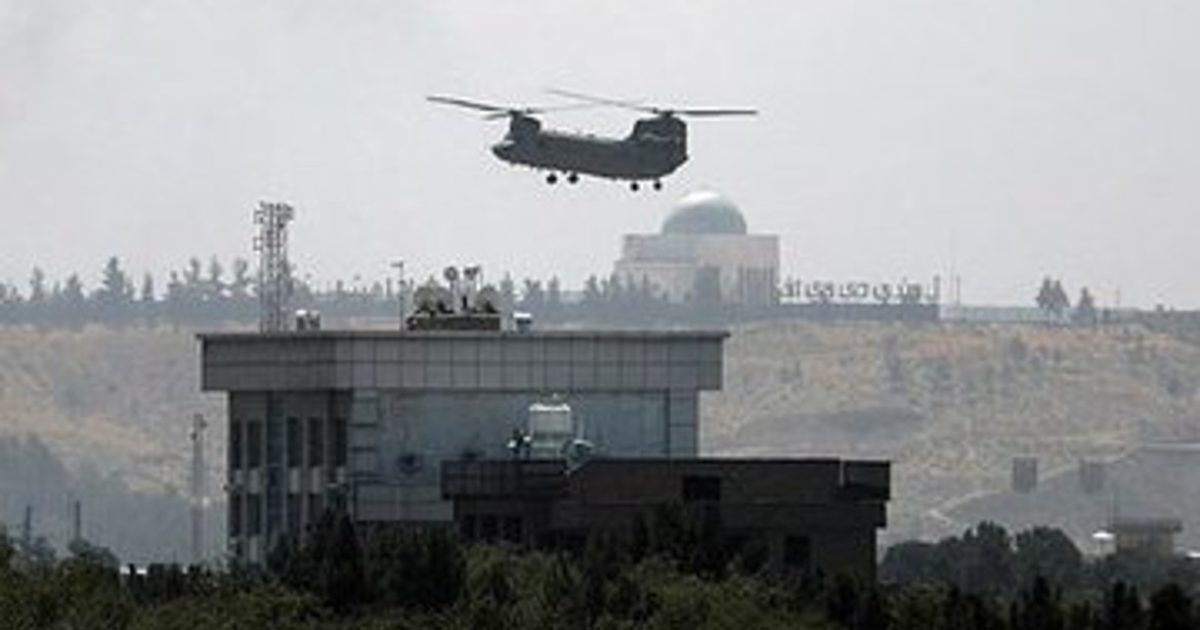
A Boeing CH-47 Chinook transport helicopter appears over the U.S. embassy compound in Kabul, 15 Aug 2021. Image from Twitter via libertyunyielding.com
I always get confused when I hear people say they never saw the collapse of the Afghan military coming.
Anyone who’s been on the ground with them knew this.
I saw an entire ANA battalion with modern American equipment get pinned down by 3 Taliban with AKs. Begging me for air support.
How was this a surprise?
And further:
When it came to partnering with Afghans, I was actually convinced for awhile that their failure was my fault. Why? Because that’s what our superiors told us.
I remember giving honest assessments in formal reports about the capabilities of Afghans. It led to many confrontations with superiors across different tours.
“You can’t write that they don’t do X, Y, or Z in this SITREP. Don’t you know every failure is yours and every success is theirs?”
That was the mantra. Every failure was ours and every success theirs. And I believed it.
The military intellectual crowd was in charge at the time. The ones who hate us now for noticing their inadequacies.
The ones who made us think that we could succeed if we made just one more measure of performance and measure of effectiveness to implement.
Maybe we could make that barbarian culture better by just doing one more intellectual thing.
No. And it’s those same people who punished us for telling the truth. And they should be shamed for it in perpetuity.
Senior leaders in 2021 acted stunned at how the Afghans fell so fast. Nobody could believe it.
Maybe they were stunned because the truth had been filtered for decades. Laundered. And for what?
Lies. All lies. And they were peddled by the most “intelligent” military leaders among us.
So if you’re part of that crowd and are now uncomfortable with the current backlash from “idiots” like me. I simply ask, why?
You earned it.
Forcing subordinates to lie doesn’t change the reality they’re trying to inform you about, it just makes the point where reality asserts itself that much more surprising and painful. True in business, especially true in the military.
Update, 31 March: Welcome, Instapundit readers! Have a look around at some of my other posts you may find of interest. I send out a daily summary of posts here through my Substack – https://substack.com/@nicholasrusson that you can subscribe to if you’d like to be informed of new posts in the future.
How Radio Killed Democracy – Death of Democracy 09 – Q1 1935
World War Two and Spartacus Olsson
Published 28 Mar 2026Radio did not just spread Nazi propaganda — it helped make dictatorship feel normal.
In How Radio Killed Democracy, we examine how Adolf Hitler and Joseph Goebbels used mass broadcasting to manipulate public opinion in Germany in early 1935. As the Saar plebiscite returned the Saarland to the Reich, the regime turned radio into a political weapon: shaping emotion, manufacturing consent, and helping millions of Germans embrace rearmament, conscription, and the destruction of democracy.
This episode of Death of Democracy follows the decisive first quarter of 1935: the Saar vote, Göring’s admission of [the existence of] the Luftwaffe, Hitler’s open defiance of Versailles, and the growing power of the Gestapo. While Nazi propaganda promised pride, unity, and national revival, civil liberties were collapsing, Jews were being isolated, and Germany was being prepared for war.
How did propaganda become so effective? How did radio help turn fear, resentment, and nationalism into obedience? And how did so many people support a regime that was already dismantling the rule of law?
This is the story of how radio helped kill democracy in Nazi Germany.Never Forget
(more…)
Comments Off on How Radio Killed Democracy – Death of Democracy 09 – Q1 1935
Adventures in Surplus! Finnish M28 “Ski Trooper”
Forgotten Weapons
Published 10 Nov 2025Today we are going to take a look at just how much historical [information can] be read from the features and markings of an individual rifle. This is an early production Finnish M28 “ski trooper” Mosin Nagant that can be traced from Russian manufacture to WW1 Russian use, Austro-Hungarian capture, rechambering to 8x50mm Mannlicher, concession to Italy as war reparations, sale to Finland, rebuilding as a Civil Guard M28, use in the Winter War and Continuation War, transfer to the Finnish Army, and finally importation into the United States.
(more…)
Comments Off on Adventures in Surplus! Finnish M28 “Ski Trooper”


