
Medieval kingdoms and Early Modern states were both built around the personal holdings of individual rulers. For instance, to talk of “Austria” or “Burgundy” in the 1400s as states/countries/governments is to engage in a degree of anachronism. There was no Austrian state, merely the collection of lands either owned or controlled by whoever the reigning Habsburg was at the time. Likewise, Burgundy in, say, 1440 was not a coherent entity, it was simply the collection of lands that Philip the Good (Duke of Burgundy, but also Duke of Brabant, Limburg, Luxemburg and Lothier, Count of Artois, Flanders, Charolais, Haniaut, Holland and Zeeland, and the Margrave of Namur). The “kingdom” was thus not a permanent, durable entity so much as a collection of possessions the same way my personal “library” is not permanent building but just a term for “books I happen to own right now”.
It is thus a bit odd that the regions of Westeros are seen by its inhabitants as being clear and unchanging. For instance, the Reach has borders, those borders do not move and everyone in those borders is loyal to House Tyrell. This is not how medieval rule works. The borders of, say, France, shifted over time (some places we consider “obviously” part of France were added only quite late, like French Flanders or Provence) as the ability of the French king to control those regions changed. For long periods of the Middle Ages, large parts of France were effectively controlled by the Kings of England (because they were also Dukes of this or that French duchy).
The idea that France, or Germany or Italy was a distinct, permanent entity with its own existence apart from a given royal family – more than just a space on a map – which comprised a people, their language and the government of those people, this is a modern phenomenon. Indeed, one may argue, it – that is, the nation-state – is the modern phenomenon.
Bret Devereaux, “New Acquisitions: How It Wasn’t: Game of Thrones and the Middle Ages, Part III”, A Collection of Unmitigated Pedantry, 2019-06-12.
April 11, 2026
QotD: Kingdoms were not “nations” in the Middle Ages
April 10, 2026
A Brief History of GRAVY
Tweedy Misc
Published 2 Dec 2025For the next instalment of the series of classic British sauces we take a look at the history of gravy.
In this video I look into some of the earliest historical references to gravy, then some 18th Century recipes. I investigate whether gravy might be a derivative of a classic French sauce, and look in some detail into one important component of traditional gravy recipes: the roux, used for thickening.
I also investigate some products which have emerged since the 19th Century to help with the process of making gravy, from gravy salt and gravy browning, through Bisto’s original gravy powder of 1908, and their fully instant product in the form of “gravy granules”, launched in the 1970s.
Also, have you ever wondered why Bisto is called Bisto? We’ll get into that too.
0:00 Introduction
0:32 What is gravy?
1:27 Early history of gravy
2:01 18th Century gravy recipe
2:25 The importance of the roux
3:37 More 18th Century gravy recipes
4:07 Is gravy actually…. French?!?!
5:29 Gravy salt
6:47 Gravy browning
7:31 History of Bisto
9:19 Modern Bisto
10:25 Conclusion
QotD: William Cobbett
Cobbett was a scrapper on the same majestic scale as our Henry V and our Horatio, except he dished it out to Vested Interest rather than Jean-Pierre Foreigner. He is the faded star of the British Awkward Squad (Capt. Jon. Swift; Vice Capt. Geo. Orwell) and he needs a boost. He needs a blue plaque on every place he ever visited. In his long life — he was born in 1763 and died in 1835 — Cobbett was a farmer, Tory, soldier, Radical, MP, agony uncle (his books include Advice to Young Men), and the founder of Hansard.
His obituary in The Times, after categorising him as a “self-taught peasant”, declared Cobbett “by far the most voluminous writer that has ever lived for centuries”. The funniest, too: when some town council somewhere banned his anti-Malthusian play Surplus Population, he riposted with a drama entitled Bastards in High Places.
Above all, though, Cobbett was the champion of the rural poor, the village labourer and the small farmer. He was their one true tribune. He spoke at The King’s Head in 1820 because country folk were suffering a triple wham from agricultural depression, enclosure and the rise of agri-business. Or, to precis, “Hodge” (his name for the generic farm worker) was low-waged or unwaged and deprived of the bits of land he had once enjoyed under commoner’s rights.
Cobbett railed against “The Thing” (the capitalist, manufactory system) and the centrifugal, corrupting force of smoky London (“The Wen”, in Cobbettian). But he was no bloviator: he was a farm boy, and hence entirely empirical and properly pragmatic. He spent a decade travelling around the English sticks to discover the true state of affairs. His descriptions of his horseback journeys were published in 1830 as Rural Rides, the first sociological study of the English countryside.
No dry-as-dust tome by the way, the Rides: it brims with pinned-to-the-specimen-board descriptions of people and places, nature, wit. Cobbett knew beauty and, the proper Englishman that he was, he loved horses:
The finest sight in England is a stage coach ready to start. A great sheep or cattle fair is a beautiful sight; but in the stage coach you see more of what man is capable of performing. The vehicle itself, the harness, all so complete and so neatly arranged; so strong and clean and good. The beautiful horses, impatient to be off. The inside full and the outside covered, in every part with men, women, children, boxes, bags, bundles. The coachman taking his reins in hand and his whip in the other, gives a signal with his foot, and away go, at the rate of seven miles an hour.
One of these coaches coming in, after a long journey is a sight not less interesting. The horses are now all sweat and foam, the reek from their bodies ascending like a cloud. The whole equipage is covered perhaps with dust and dirt. But still, on it comes as steady as the hands on a clock.
Speaking at The King’s Head coaching inn in Monmouth must have been the dream gig for Cobbett the horseman.
John Lewis-Stempel, “Why Britain needs a peasants’ revolt”, UnHerd, 2020-08-06.
April 9, 2026
QotD: Diffuse versus concentrated state power
Ivor Thomas, The Socialist Tragedy, 1951.
April 8, 2026
“Queering the Past”
It sometimes seems as though modern historians are spending all their time postulating that pretty much every prominent figure in western history was gay or lesbian or trans*. The latest attempt to present someone from British history as being trans is Queen Elizabeth I (admittedly in a drama rather than a documentary):
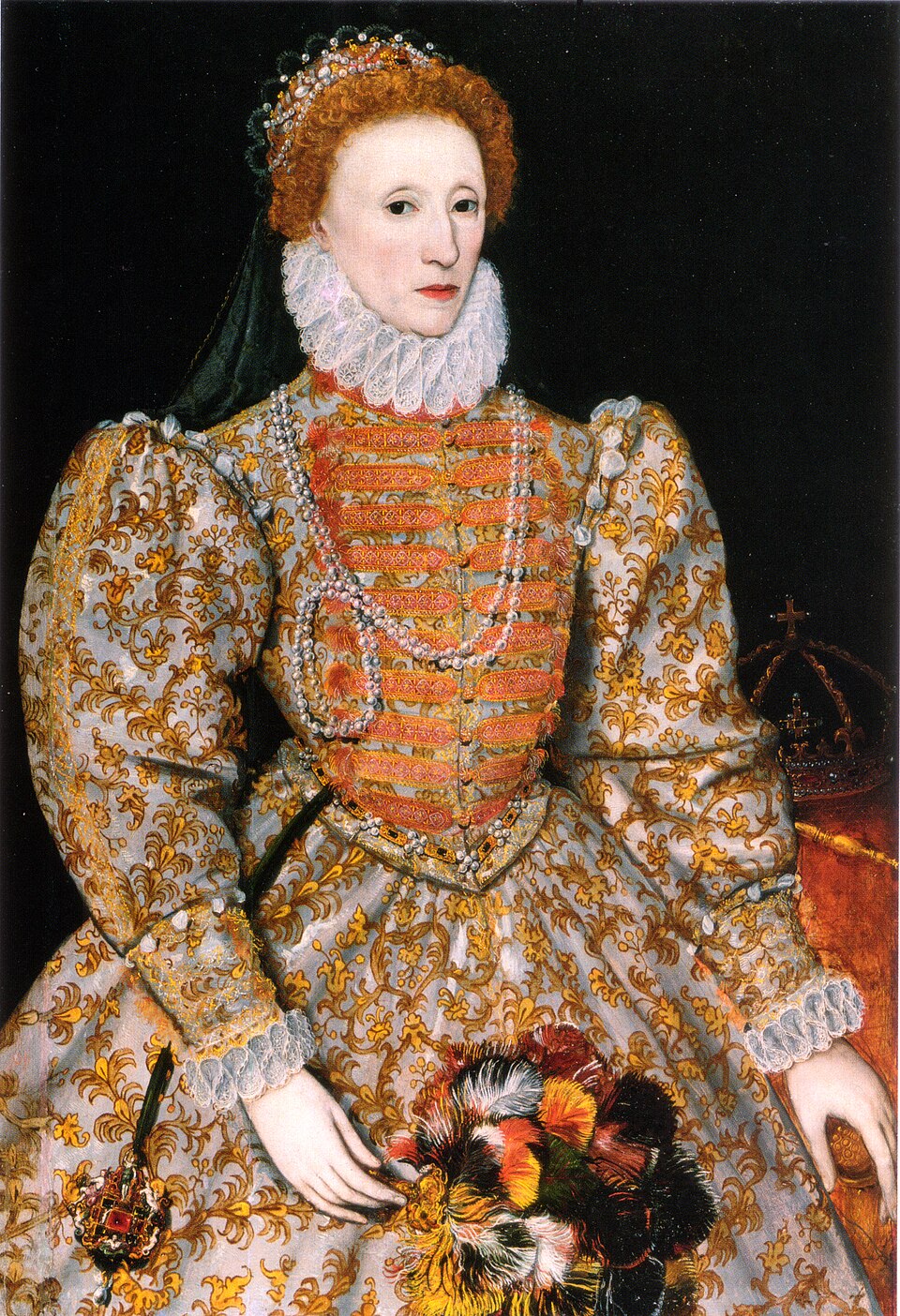
The “Darnley Portrait” of Elizabeth I of England (circa 1575).
National Portrait Gallery via Wikimedia Commons.
Appropriately, it was April Fool’s Day when I read that Queen Elizabeth I is to be portrayed as a cross-dressing man in a forthcoming television show. But we live in times when the more silly and outlandish a rumoured cultural or political plan, the more likely it is to be true. Majesty – an oddly “heritage” title for a project that clearly considers itself “transgressive” – is set to film this summer, and is seeking “trans actresses” (what we used to call cross-dressers, before they got really cross) to play the monarch.
The Sun, which first reported it, seemed drearily inclined to go along with the usual sexist claims of the trans lobby. “She is known for having traits associated with a male monarch”, it mouthed in a mealy manner in an article last week. What would those be – not getting her tits out for, if not the cameras, then the portrait painters of the era? “Some have speculated she had male pseudo-hermaphroditism, known as testicular feminisation”, the Sun continued, also noting that “others are obsessed with the Bisley Boy myth”. Yes, “obsessed” isn’t too extreme a word here – I often hear people at bus stops discussing the Bisley Boy myth. This is the claim that Princess Elizabeth died in her youth and was replaced by a local boy with red hair. It was popularised by Bram Stoker in his 1910 book, Famous Imposters – because Bram “Dracula” Stoker never made up far-fetched stories based extremely loosely on real people, did he?
The Sun quoted a “TV insider” who insists: “Most historians dismiss the claims as misogyny motivated by the idea no woman could be as strong or capable without actually being a man. But it’s a theory which captures the imagination and appears to answer a lot of other questions around the unique queen.”
What would these questions be? That Elizabeth never married and had no children? Must be a bloke, then – what real woman would forego such unqualified pleasures? It’s a sign that trans thought is so woefully conventional, so gender straitjacketed, that it just doesn’t seem able to grasp, in this case, why a woman would refuse to hand over her hard-won power to a man by marrying a stranger who didn’t even speak her language. Or that she said on the eve of the Spanish Armada invasion: “I know I have the body of a weak and feeble woman, but I have the heart and stomach of a king”? It’s called wordplay, I believe, and was extremely common until people with Tin Ear Syndrome – a disease affecting the “trans community” and their inordinate number of “allies” – became so prevalent among those in the arts and media.
This, of course, is our old mate “Queering the Past” (or “lying” as those not educated beyond all common sense and honesty know it) beloved of universities, museums and other beclowned institutions. There have been some truly rib-tickling examples of it, such as the claim that “trans Vikings” existed, which sounds like a Monty Python sketch; sometimes the whole circus gets too much even for the most proudly gay public figure. In 2023, the museum dedicated to conserving the Mary Rose hosted a blog, promising to understand the collection of everyday objects found on the 16th-century ship “through a queer lens”. This prompted the great Philip Hensher to post on X: “I am as keen as anyone on gay sex, but I have to say to these curators – you’re fucking mental”.
The Korean War Week 94: Mines, Marines, and Mayhem – April 7, 1952
The Korean War by Indy Neidell
Published 7 Apr 2026In order to try and make some progress on the thorny issue of POW repatriation, the UN offers to screen all the POWs they hold to get an exact number of who refuses to be sent back. The Communists agree and the plans are put in motion. Plans in the field are finishing up, with the US 1st Marine Division having moved to new positions in the west, but they now have to deal with the unforeseen issue of thousands of landmines. They did not see that coming.
00:00 Intro
00:47 Recap
01:27 POW Issues
05:58 New Operations
07:18 Marine Defenses
10:53 Landmines
14:18 Summary
15:01 Conclusion
Architectural nostalgia in our hyper-bland modern world
Freddie deBoer considers the all-too-frequent social media wave of real or performative nostalgia for the more appealing styles of older buildings followed by the inevitable anti-nostalgic backlash:
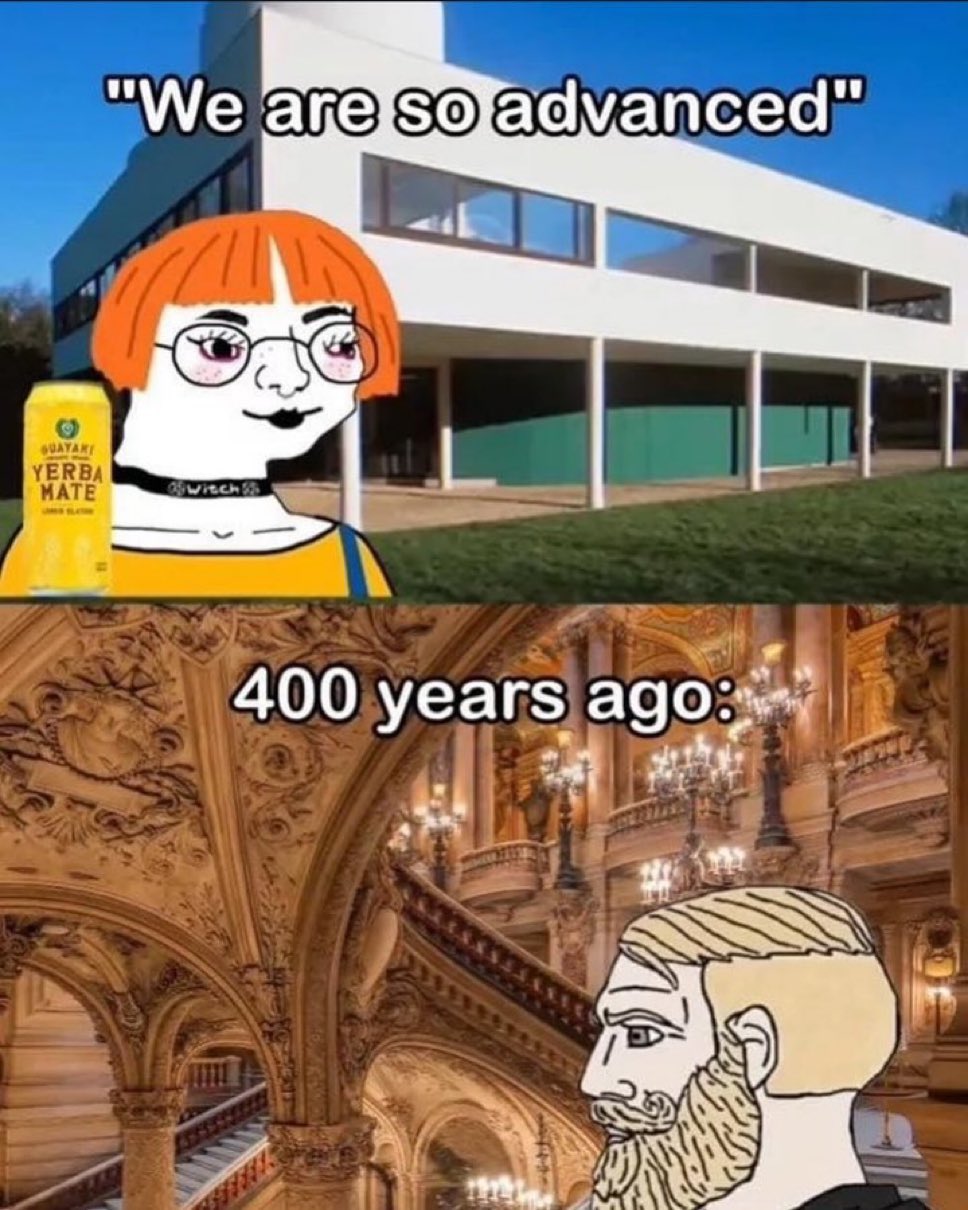
There’s a meme, of sorts, that pops up on Twitter from time to time: why don’t we build beautiful buildings anymore? The sentiment is associated with a more general yearning for the past, the kind that asserts that America or Western civilization or human culture are in decline. There certainly must be a lot of people who harbor similar concerns, as evidenced by how these tweets tend to rack up thousands of “likes”. They’ll share a picture of some beautiful old building — Art Deco classics like the Chrysler Building are common, but also Gothic buildings, and neoclassical, and others — and ask why we don’t, or can’t, or won’t make beautiful buildings anymore. They’ll point to the aesthetic qualities of older buildings, remind us that we have vastly more advanced technology and are far richer today than when those beautiful buildings were built, and wonder why we don’t build for beauty these days.
Why are so many new fancy buildings generic and forgettable works of brushed steel and glass? Why so many new ordinary buildings cookie-cutter rectilinear jobs, almost entirely free of embellishment or decoration, all flat roofs and sharp edges, and neutral in both color and effect? Why do they all look like … that? You know what I mean by “that”. Sometimes the style is referred to as Late International or The Glass Box Style, but perhaps the term Value-Engineered Modernism is more apt. Whatever you call it, this kind of building is the architectural equivalent of a default font, a soul-crushing assembly line of sterile glass monoliths that erases local identity in favor of the numbing, cookie-cutter uniformity of global bureaucracy. It’s the corporation in building form.
As is true with all social media phenomena, there is a counter-chorus, and it expresses itself in condescending, sighing, superior tones. Part of this is related to the fact that the accounts lamenting the death of public aesthetics are often right-coded; certainly a lot of the complaints are coming from Twitter users with Greek statues for profile pictures. And really, any sentiment that’s repeated often enough on social media will attract mockery in time. But a good deal of the derision comes from the online side of the YIMBY movement, which in the last decade or so has become something like the caricature mainstream Dems made of the Bernie Sanders online army back in 2016 — that is, snarky, self-righteous, and fundamentally concerned with achieving in-group status through the mechanism of arguing about politics. YIMBYs are an imperfect but important force in a country that desperately needs to build more housing and which has all manner of stupid and sclerotic zoning rules. It’s generically true, though, that the more online you get the less useful any given political movement becomes, and Twitter YIMBYs seem absolutely attached to representing all of the worst elements of that group — they’re incurious, rude, reductive, averse to basic best practices of messaging, and above all else, tribal. (Politics gets stupid when politics becomes a way to belong rather than a way to to do things.) And they’ll have you know that lamenting the death of beautiful buildings is dumb, lol lol lol lol.
The Twitter YIMBYs tend to treat concern for aesthetics as a decadent demand in a world where we need to JUST BUILD. And their particular tactic is to insist that we don’t build attractive buildings anymore because doing so is just too expensive, and really, what’s more important, the unconquerable human desire to live surrounded by beauty, or our need to put people in homes??? Case closed! But not really. It turns out that it’s simply not true that building stylish and ornamented buildings is relatively more expensive today than it was in eras past. Read all about it. Yes, Baumol’s cost disease is real, and construction is a manpower-intensive industry, but almost a century after the Empire State Building was erected, we’ve got the benefit of modern logistics and supply chains and automated production of essential parts and so on. The cost of labor cannot explain the death of decoration in modern building design. And increasingly, there seems to be an acknowledgment that it’s easier to move the public to accept new construction when said new construction is inspiring. King YIMBY Matt Yglesias had a good post on this recently; as he says, we can look at the premium people will pay to live in townhouse neighborhoods where most of the construction happened 100+ years ago as a clue to what people actually like. Housing is expensive in both Park Slope and Hudson Yards, but there’s no question that the former is an aspirational bourgie vision that has stood the test of time while the latter is barely tolerated. And aesthetics plays a large role in that.
We’re wired to pursue beauty. We are not, however, wired to pursue authenticity.
Ian McCollum’s Perfect Car: Driving His Citroen 2CV
Jimports
Published 22 Nov 2025This isn’t Forgotten Weapons, this is James Reeves here for Jimports with my close personal friend Ian McCollum, and today we are looking at what might be the most on-brand car on all of YouTube, Ian’s Citroen 2CV. This is a late production 1988 car, but it traces its roots back to the 1930s as a French farmer’s replacement for a horse and cart, and Ian walks us through how it survived World War II, why it shares DNA with cars like the VW Beetle and Fiat 500, and how a two cylinder, 26 horsepower French tin can can still cruise at 60 miles per hour and somehow feel great. We talk about the bizarre but clever suspension, inboard front disc brakes, the “French bolt action” shifter, the fold up windows, roll back roof, and all of the little details that make the 2CV weird, practical, and weirdly desirable. If you know Ian from Forgotten Weapons you already know how deep he goes on history and engineering, and this is that same energy pointed at one of the coolest European classics ever made. Check out Forgotten Weapons and Deep Dive With Ian if you have not already, and if you are new here, subscribe to Jimports so I can justify buying more dumb cars like this.
April 7, 2026
“The Eight Hundred Years of Oppression”
On Substack, Upper Canadian Cavalier examines “The Irish Question”:
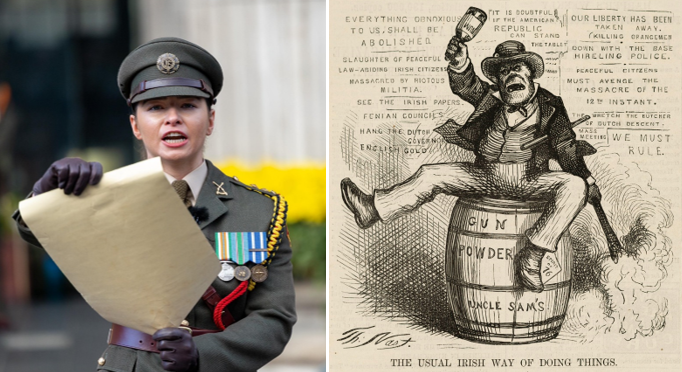
Every confidence scheme requires three things. A mark who is sympathetic. A grievance real enough to be credible. And an operator whose entire livelihood depends on ensuring the grievance is never actually resolved. Resolution ends the game. The operator does not want justice. He wants the next fundraising dinner.
Irish nationalism, in its mature institutional form, is one of the longest-running confidence schemes in the history of democratic politics. This is not to say the underlying grievances were invented. English rule in Ireland produced genuine catastrophes, and anyone who tells you otherwise has not read much history. The point is not that the wounds were fake. The point is that a very specific class of people discovered, sometime in the nineteenth century, that a bleeding wound is worth considerably more than a healed one, and they have been salting it professionally ever since.
The operators of this scheme are not a conspiracy in any tidy sense. They do not meet in a room. They are, rather, an ecosystem: the Sinn Féin political class, the Irish-American fundraising establishment, the Gaelic cultural bureaucracy with its language boards and arts councils and grant committees, and undergirding all of it for most of its history, the Catholic Church, which managed the remarkable trick of positioning itself as the spiritual soul of Irish resistance while simultaneously running the country’s schools, hospitals, orphanages, and laundries with the administrative efficiency of a medium-sized colonial power. They share no common mailing list. They share something considerably more durable: a common interest in a people who define themselves entirely by what was done to them, because such a people will always need someone to explain what it means.
That someone, naturally, has a salary. Sometimes several.
Part One: The Invoice That Never Clears
The foundational text of Irish identity is not a poem or a legal document or a philosophical treatise. It is an invoice. The Eight Hundred Years of Oppression, presented at every available occasion, never stamped paid, accruing interest at a rate that defies actuarial calculation. It is invoked at pub tables and university seminars and Boston fundraisers and Sinn Féin press conferences with the solemn regularity of a liturgical response, which is appropriate, since it has become one.
Eight hundred years. Let us sit with that number for a moment, because it deserves scrutiny rather than reverence.
The Poles were partitioned entirely out of existence for a hundred and twenty-three years, absorbed simultaneously by three empires, had their language banned, their nobility liquidated, their clergy persecuted, and their country removed from the map of Europe with a finality that the Irish situation never approached. They rebuilt it. They were then invaded again from both sides at once within living memory, occupied by The Nazis and Soviets losing somewhere between five and six million citizens in six years. They do not, as a general rule, organize their entire national identity around the experience. They built things instead.
The Armenians experienced something so total it required the coinage of an entirely new word to describe it. The Acadians were physically deported. The Welsh had their language suppressed for centuries by a state apparatus that regarded Welsh-speaking children as candidates for corrective intervention, which is considerably more systematic than anything the Penal Laws produced. The Greeks spent nearly four centuries under actual Ottoman administration, not the notional suzerainty that characterized much of the Anglo-Irish relationship, and emerged and got on with being Greeks.
None of them made Eight Hundred Years into a brand.
What distinguishes the Irish accounting of oppression is not the severity of the oppression, which was real but not historically singular, but the extraordinary care with which it has been packaged, maintained, and exported. The Famine, which ended in the 1850s, is still discussed in certain Irish-American circles as a recent bereavement requiring ongoing condolences and, more usefully, ongoing donations. The emotional statute of limitations has never been permitted to run. Each generation receives the invoice freshly printed, as though the debt were personally owed to them and personally owed by someone who can still be made to feel bad about it.
The Myth of Mooncakes: Did they topple a Chinese Dynasty?
Tasting History with Max Miller
Published 30 Sept 2025Mooncakes made with flaky pastry and a seed and nut filling, decorated with a red stamp
City/Region: China
Time Period: 1792There are many different kinds of mooncakes made all over East Asia around this time of year for the Mid-Autumn Festival. Some are savory, some are sweet, and they can have chewy, crumbly, or flaky doughs.
The flaky dough that we’re making here can be made with either lard or melted butter. Lard would have been more traditional for 1792, and it makes a more flavorful pastry, but melted butter will make a smoother dough that’s easier to work with and comes out less crumbly and more flaky.
The filling is delicious and not too sweet, with a rich unctuousness from lard, nuts, and seeds.
Imperial Scholar Liu’s Mooncake
Use flying flour from Shandong to make a flaky pastry for the crust, with pine nuts, walnuts, and melon seeds ground into a fine powder for the filling. A little rock sugar and lard are added. When eaten, it does not taste overly sweet, but instead is fragrant, flaky yet tender, and rich; a truly unique experience.
— Suiyuan Shidan by Yuan Mei, 1792
April 6, 2026
Coolidge “does not deserve credit for winning the 1924 election … it just happened to him”
While I wouldn’t agree with the statement in the title of this post, it has been a common enough reading of the US 1924 presidential election — that it wasn’t an endorsement of Coolidge and his policies but merely a reflection of voters’ overall satisfaction with the economy. The editors of the Coolidge Review would beg to differ:
From the distance of more than a century, a political scientist has taken a fresh look at the 1924 presidential election.
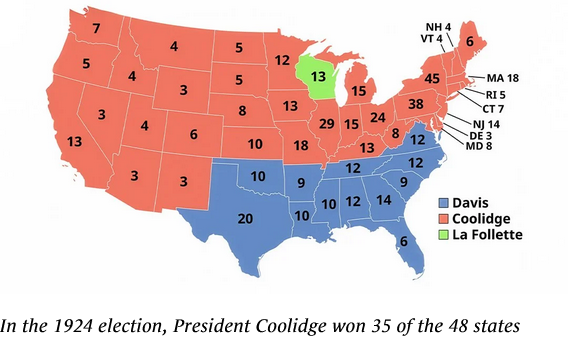
In an article published last year in Presidential Studies Quarterly, Christopher Devine questions the conventional wisdom about how and why the incumbent, Calvin Coolidge, won that election in a landslide. Coolidge had assumed the presidency little more than a year earlier, after the unexpected death of Warren Harding. In 1924’s three-way race, he received more votes than the other two candidates combined and carried thirty-five of the forty-eight states.
As Devine points out, most historians say that a robust economy was by far the biggest reason Coolidge won. Strong economic conditions did work in the president’s favor. But Devine notes that many historians adopt a form of economic “determinism”. In this very common view, Coolidge “does not deserve credit for winning the 1924 election”. Rather, “thanks mostly to the economy, it just happened to him”.
That argument is too simplistic, Devine suggests. He presents both qualitative and quantitative evidence to challenge the standard narrative of the 1924 campaign.
Old Assumptions, New Data
For his empirical analysis, Devine examines “county-level political, economic, and demographic data” alongside county-by-county voting results. Using these data, he tests three common explanations for the election’s outcome:
Did Coolidge win primarily because of the economy? Scraping the data, Devine concludes that the answer is largely yes. And he shows it’s misleading to claim that — as one history textbook put it — Coolidge merely rode “the crest of a wave of economic prosperity for which he was given undeserved credit”. Devine demonstrates that from behind the scenes, Coolidge “took an active role in coordinating campaign messaging” that showcased the administration’s and Republicans’ achievements. For example, Coolidge worked closely with his running mate, Charles Dawes, to keep the famously free-range vice-presidential candidate focused on the economic message. “In the matter of economy and tax reduction”, Dawes declared, “the Federal Government is headed in the right direction”. Moreover, as Devine reports, Dawes argued that the administration’s work to stabilize Europe via the Dawes Plan spared America from “the depths of an inevitable and great depression” while also ensuring that “the whole world enters upon a period of peace and prosperity”.
Did third-party candidate Robert M. La Follette hurt Democratic nominee John W. Davis more than Coolidge? Devine concludes that this effect appeared only in the Great Plains and the Mountain West. It probably wasn’t large enough to change the election’s outcome.
Did internal divisions cost the Democratic Party votes in 1924? The Democrats were so fractured that they needed 103 ballots to choose a nominee at their convention. Devine says it would be hard to imagine that such disarray did not hurt Democrats in the election. Yet he notes that quantitative evidence on the reasons for Democratic losses in 1924 is hard to find because “scientific polling did not exist in the 1920s”.
Seeking an alternative approach, Devine looks at patterns of defection from the Democratic Party by state. He finds that northern states that voted to defeat the anti-Ku-Klux-Klan plank at that year’s Democratic National Convention — in other words, states whose delegations supported the Klan — saw heavier defections in the general election. From that, Devine extrapolates to suggest that Coolidge “benefited from the resurgence of the Ku Klux Klan — or, perhaps one might say, Democrats lost ground because of it”.
T20 Family: Springfield Makes the Garand a Grenade Launching Sniper Machine Gun
Forgotten Weapons
Published 17 Nov 2025Late in 1944 the Ordnance Committee recommended adoption of a magazine-fed, select-fire version of the M1 Garand as a new standard US infantry rifle. Both Springfield and Remington developed rifles to meet the requirement, with Springfield’s being the T20 and Remington’s the T22.
The Springfield design went through several iterations from the original T20 to the T20E1 and T20E2, with the capability to launch rifle grenades, mount optical sights, and fire in either semiautomatic or full auto. The first examples of the final T20E2 design were ready in June 1945, but the program lost momentum in August when Japan surrendered. It did continue slowly until 1949, providing some of the basis for the eventual M14 rifle.
(more…)
April 5, 2026
How To Let the People Pay For War – Death of Democracy 10 – Q2 1935
World War Two and Spartacus Olsson
Published 4 Apr 2026June 1935: Adolf Hitler reassures the world with promises of peace — while secretly accelerating Germany’s path to war. In this episode of Death of Democracy, we examine how Hitler manipulated international diplomacy and domestic opinion in the second quarter of 1935. From the collapse of the Stresa Front to the signing of the Anglo-German Naval Agreement, foreign leaders were drawn into a dangerous illusion. Meanwhile, inside Germany, antisemitic violence escalated, press censorship intensified under Joseph Goebbels, and economic realities worsened under Hjalmar Schacht’s policies.
Drawing on firsthand accounts from William L. Shirer and Victor Klemperer, this episode reveals a society caught between fear, propaganda, and growing dictatorship.
How did Hitler convince both his people and world leaders that he wanted peace – while preparing for war?
Watch to understand how democracies can be misled – and what happens when we fail to act.
(more…)
How to Make Marbled Eggs for Easter – The Victorian Way
English Heritage
Published 23 Mar 2018If you’d like to try this recipe at home, make sure to be very careful when handling/blowing the eggs. In some countries chickens are not vaccinated against salmonella so we suggest giving the eggs a good wash in boiling water and take care not to get any raw egg in your mouth.
This recipe for Marbled Eggs would have been served as a sweet “entremets” — small dishes served before dessert. This particular version uses a sweetened cream filling with chocolate and vanilla, but you could use any flavour you like or experiment with different colour jellies.
(more…)
QotD: The structure of a typical polis government
Because this week we’re interested in the politeia of a polis, that’s going to mean we’re mostly focused on the politai, the citizens, who we discussed last time as one of the key building blocks of the polis. Now, as we noted last time, it’s important to keep in mind that the politai are not all of the people in the polis or indeed even very many of them: women, children, resident foreigners, native members of non-citizen free underclasses and slaves were all set outside the politai and often had no means of gaining entrance. We’re going to talk about all of those folks in more depth in the third part, where we’ll look at the status layer-cake of polis society. But for now I just want to note that all of those people are there, even if they won’t figure very prominently in this discussion of the structures of polis government.
Now we’ll explore this question of how a polis was governed: first laying out the standard elements of a polis constitution, which as we’ll discuss were surprisingly similar from one polis to the next. Then we’ll deal with variations in how those elements are structured, which the Greeks understood to define the differences in the three kinds of constitution that a polis might normally have: oligarchy, democracy and tyranny. Then […] we’ll look at what sort of magistrates a polis might have and what their jobs might be as well as the structure of the legal system a polis might have.
THis is going to mean that we’re discussing the “constitutions” of poleis, but I want to be really clear here at the start that these are almost never written constitutions. So when I say “constitution”, understand that we mean this in the broad sense of “the actual makeup of the state’s institutions” rather than in the narrow sense of “a formal set of instructions for the running of the state”. Some poleis did actually have the latter (the oldest we have that I know of is a constitution established by Ptolemy I Soter for Kyrene in 322; the fact that this is a constitution dictated by a king to a subordinated polis should signal how odd it is), but they seem to have been very rare.
Bret Devereaux, “Collections: How to Polis, 101, Part IIa: Politeia in the Polis”, A Collection of Unmitigated Pedantry, 2023-03-17.


