
“Everyone wants to get old; and everyone complains once they have,” wrote Cicero in his De Senectute (On Old Age). “So great is the inconstancy and perversity of foolishness.” The De Senectute was one of the most commonly assigned books in American high schools a century ago; you can still find the old textbooks moldering in second-hand bookshops. It is one of the most thoroughly relevant books ever written, as we invariably get old if we do not die young: Why not consider what makes old age a worthwhile stage of our lives? It is a book we could wish more Americans would read, as this year’s election cycle only seems to confirm that America is an old country. The book’s message is easily conveyed: Nature is not your enemy. “In this we are wise,” Cicero writes, “we follow nature, as our best guide, almost as our god.” Cicero uses a theatrical metaphor: “Old age is the final scene in life’s drama.” The drama is penned by Nature herself: “The rest of the play is well designed; do you believe Nature neglected to consider how it all would end?”
John Byron Kuhner, “Marlene Dietrich’s War on Nature”, First Things, 2024-02-05.
May 7, 2024
QotD: Cicero’s De Senectute
May 6, 2024
Germans and Americans fighting side by side! – WW2 – Week 297B – May 5, 1945
World War Two
Published 5 May 2024I don’t want to give too much away about this extra regular episode here in the description, but it’s true- German and American soldiers fought side by side in the waning days of the European part of WW2, and not just once! And the second time is an all-time great tale of adventure.
(more…)
Kulak on banned fantasy novels hated by Feminists
There are books that get banned for all sorts of reasons — histories that tell the “wrong” facts, books beloved by terrorists, political tracts by wild-eyed fanatics, etc. — but they’re not the ones Kulak is talking about here:
… the fiction books that are banned are usually fictionalized versions of those, works like Camp of the Saints, or The Turner Diaries, despite their ability to move people emotionally are not banned for their emotional content but for their political content (and in the case of The Turner Diaries its accurate instructions on bomb making)
HOWEVER! There is one series that was driven from bookstores, and by the late 90s was almost totally disappeared based purely on the … “feelings” … it generated in its readers. A fantasy series set entirely on another world with more or less nothing to say about politics back on earth, awakened … stirrings … in its readers so disturbing to the powers that be it had to be stopped.
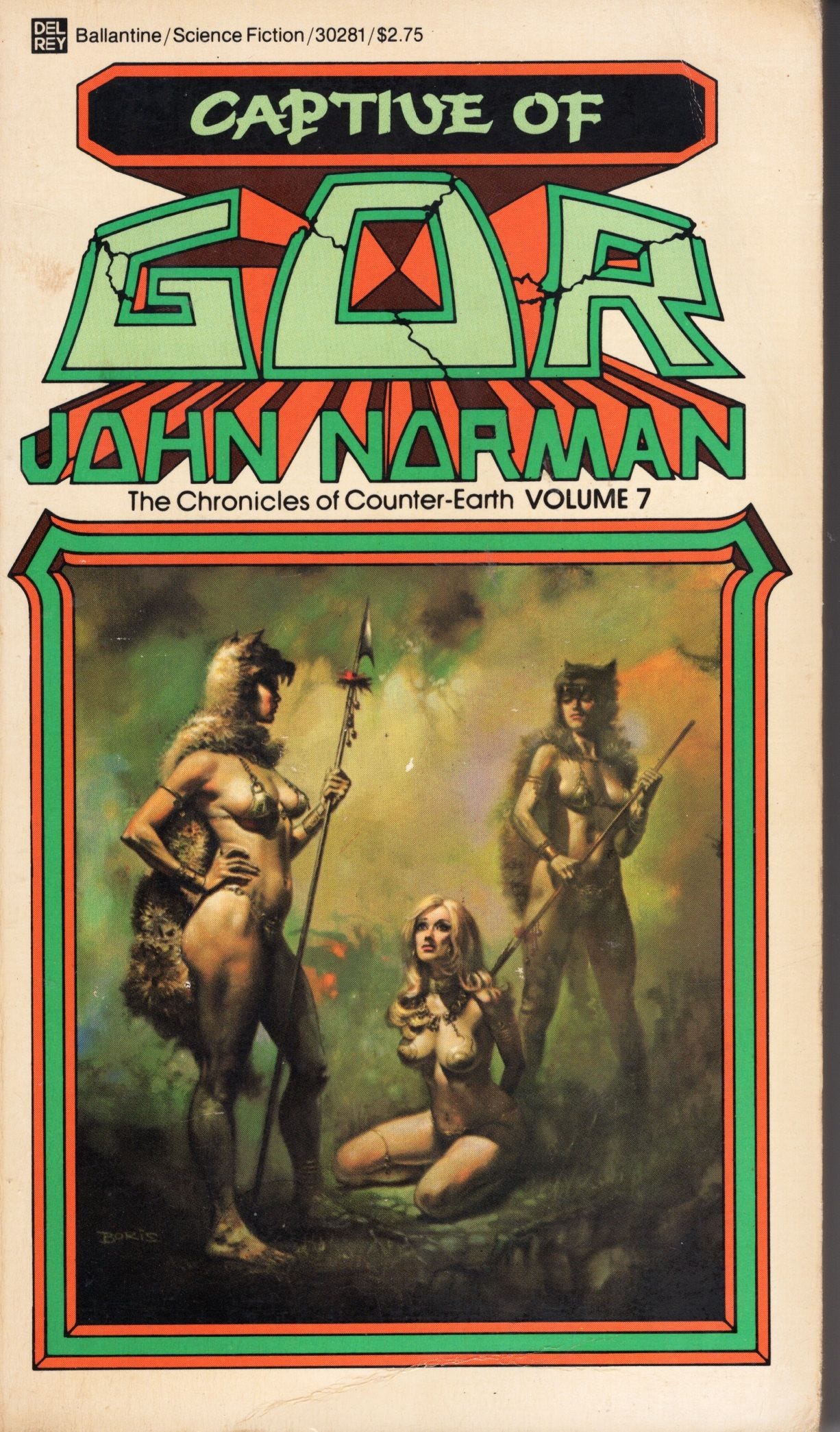
The Chronicles of GOR by John Norman (Pen-name of Philosophy Professor John Lange)
Begun in 1966 and continuing to … today (he’s 92), the 38 book series is a Pulp Science Fantasy series in the vein of Edgar Rice Burroughs’ “Barsoom” series (shout out to John Carter of Postcards From Barsoom)
It has a lot of neat fantasy/historical/military hypotheticals to get the young male mind going “what if Vikings raided Japanese samurai cities with flying monsters?” but the thing that outraged the feminists and what they’d never admit enraged them, was its effect on female readers.
Norman has a lot of theories about sex … theories which his millions of books sold suggest are very true. Theories which recent DNA discoveries have confirmed.
At SEVERAL points in the genetic record you and nearly everyone on earth, have approximately 17 female ancestors for every 1 male ancestor.
This was of course the result of patriarchal warfare, polygamy, and sexual slavery … The kind familiar to any readers of the Iliad.
Indeed Norman cites Homer, Freud, and Nietzsche as the primary influences on his philosophy.
But whereas this produced the ancient and then modern warfighting man boys and young men idolize from the Iliad, through Rome, to the Mongols, to the adventures and conquests of early modern Europe. And whose feuds and daring consume half the plot of Norman’s stories …
The real controversy is what it produced of the women.
Women are natural slaves Norman tells and in the later books shows (the books greatly improved over time: don’t read them in order)
While these periods of slaving warfare between peoples and tribes produced modern technical, competent, highly coordinated and cooperative man … In women it produced natural slaves. Women who’d long for the chain, women who’d desire nothing so much as to be owned and to submit to a powerful violent man not of their choosing … women who’d never feel so “””empowered””” as when they obey, and surrender the spirits, bodies, and wombs which they cannot defend. Who’d never feel so loved and wanted as when they are abused and disdained.
This is the world and theory of mind Norman paints with a philosopher’s attention to completeness … 38 books deconstructing and undoing not only modern feminist ideas of equality, but Christian ideas of the equality of the soul and nobility of the feminine spirit. By any standard maybe the most sexist misogynistic books ever written, not out of ignorance or resentment but a philosopher’s indifference to any social or ethical preening that might impede the truth …
And women freaking loved it.
I encountered Captive of Gor at a mainstream book store in Mississauga in about 1975, and I was amazed that it was available for sale in still-pretty-conservative Ontario. I read several of the other books in the series, but I had no idea the author was still adding new volumes down to the present day. I can’t remember the last time I saw one for sale, but I guess the fans can still get their hands on them even if ordinary book stores no longer carry them.
James Holland | Top 5 Tanks | The Tank Museum
The Tank Museum
Published Oct 4, 2019WW2 Historian James Holland came to The Tank Museum to choose his Top 5 Tanks. Unsurprisingly they are all from the Second World War!
(more…)
QotD: Confident cultures … unlike our modern one
Only in the modern period do we feel we need black-letter law for everything. And once we’ve got formal law, of course, the very next thing we do is start carving out penumbras and emanations, because we are so far from a self-confident culture that we must constantly prove to ourselves what clever, clever boys we are …
Severian, “Barely Legal”, Rotten Chestnuts, 2021-06-21.
May 5, 2024
Allied Victory in Berlin, Italy, and Burma! – WW2 – Week 297 – May 4, 1945
World War Two
Published 4 May 2024So much goes on this week, and this is the longest episode of the war by like 15 minutes. But there’s so much to cover! The Battle of Berlin ends; the war in Italy ends; the war in Burma ends- well, it ends officially, though there are still tens of thousands of Japanese soldiers scattered around Burma. And there’s a whole lot more to these stores and a whole lot more stories this week in the war. You can’t miss this one.
01:27 The End of the War in Italy
03:40 Western Allied Advances
07:02 Relief Operations in the Netherlands
15:45 Hitler’s Death and the Surrender of Berlin
24:20 Walther Wenck’s Retreat
28:00 The Polish Situation
31:09 What About Prague?
32:44 The End of the Burma Campaign
36:04 THE FIGHT FOR TARAKAN ISLAND BEGINS
37:24 Okinawa
40:11 Other Notes
41:04 Summary
41:43 Conclusion
(more…)
Trudeau’s shameful role in promoting “the blood libel against Canada”
Conrad Black believes that Justin Trudeau owes Canadians an apology for his role in pushing the most extreme version of the Residential Schools propaganda:

A very well-informed friend of many years, a contemporary of mine, wrote me the other day that “The blood libel against Canada of this monstrous fiction of thousands of secretly buried Indigenous victims of residential schools may be the single worst injustice this country has suffered in our lifetimes. It is now a conspiracy of silence involving both federal and provincial governments, the RCMP (shameless and useless as ever), and the media, and ‘let’s be frank’, (quoting a Soviet diplomat many years ago whom we both always found rather entertaining in the utter nonsense he used to recite at international meetings), a large section of the public, which knows this to be a falsehood but chooses to side with the silent forces”.
Almost all readers will be aware of the tidal wave of self-mutilating hysteria that inundated this country when, on the basis of apparent anomalies detected by underground radar close to a former Indian Residential School site at Kamloops, British Columbia, a couple of years ago. Immediately, the theory took hold that thousands of native children in those schools had died because of negligence or outright homicide, were buried secretly in unmarked graves, their deaths never recorded and no account given to their families. There is no evidence to support this, yet the prime minister led the nation in an almost medieval circular mass pilgrimage of self-flagellation. In order to impress upon ourselves and the entire world the profundity of our self-humiliation, all official Canadian flags everywhere were lowered to half-mast and maintained in that condition for an unheard-of period of six months.
Parliament voted to spend $27 million to conduct the excavations necessary to verify or otherwise the existence and extent of these graves. This work could have been accomplished by a small group for a few thousand dollars, but the suggestion of actually establishing what happened set up the customary cacophony of complaints about the sacred untouchability of burial grounds, even though it was not clear that there was burial ground at the Kamloops site, and if it was it was rank speculation about who might be buried there if it was. It is not conceivable to me that the country could dress itself out in sackcloth and ashes and flay the flesh off its own back before the bemused or astonished eyes of the entire world and then produce no evidence whatever of the unspeakable outrages that allegedly occurred and gave rise to this conduct, and then simply lapse into Sphinx-like incommunicability: a pristine silence of perfect ambiguity followed a near-terminal St. Vitus dance of window-rattling ululations of national guilt, shame, and self-hate.
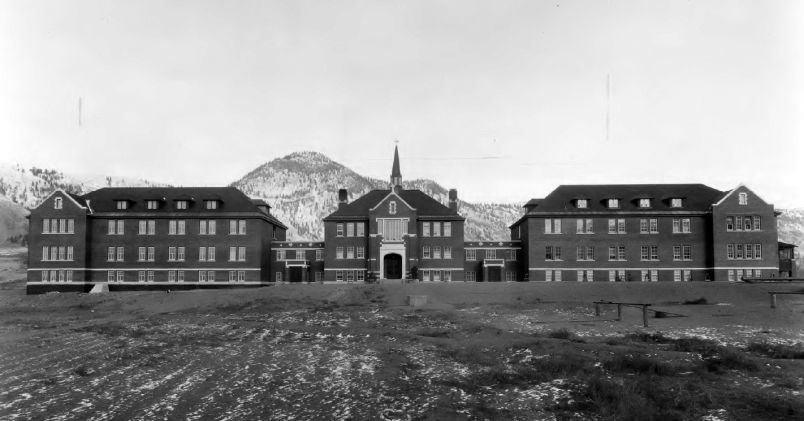
Kamloops Indian Residential School, 1930.
Photo from Archives Deschâtelets-NDC, Richelieu via Wikimedia Commons.Various parts of this macabre fable have been precisely and publicly put to rest: children in residential schools were not buried secretly and records were not destroyed; residential school students were accounted for and if they died while at the schools the reason was typically provided and it was almost invariably as a result of illnesses that were not as well treated in those times, and particularly tuberculosis. Beyond that, there has been silence: the febrile allegations of hideous wrongdoing vituperatively hurled at Canadian history and society – at the ancestors of English and French Canadians, at the main Christian churches, at the principal founder of our country whose distinguished name (John A. Macdonald) has been taken down from public buildings, statues of him overturned or removed, and effigies of him burned at festivities of confected righteous anger from coast to coast; all just mysteriously stopped. It is a sonic version of the celebrated poem by Shelley about the fallen monument of a once great King: “Round the decay of that colossal wreck, boundless and bare, the loan and level sands stretch far away.”
M98kF1 ZF41: Norway Recycles Germany’s Worst Sniper Rifle
Forgotten Weapons
Published Jan 29, 2024When Germany capitulated at the end of World War Two, several hundred thousand German soldiers were stuck in Norway (thanks to the efforts of the Norwegian Resistance preventing them from moving south to reinforce against Allied landings in Normandy). These solders’ arms were surrendered to the Norwegians, and they formed the basis of Norwegian Army and Home Guard armaments for many years. With hundreds of thousands of K98k rifles to choose from, the Norwegians were able to pick out plenty in good condition. This included 400 ZF41 DMR/sniper rifles that were kept intact and taken into Norwegian service. Three different branches used the rifles, and they are marked on the chamber with either HAER (Army), FLY (Air Force), or K.ART (Naval Artillery).
In 1950, Norway began to get US military aid in .30-06, and they decided to rebarrel these Mausers to that cartridge. The process began in 1952 and they were all converted by the end of 1956. The new barrels are marked “KAL 7.62”, for 7.62x63mm. There was only a small amount of experimental further conversion to 7.62mm NATO. The ZF-41 models like this one were also given a new serial number tag riveted onto the scope mount with the rifle’s serial number (150001 through 150400).
Converted Mausers served in the Home Guard until the early 1970s, when they were replaced by the AG3 (HK91).
(more…)
May 4, 2024
Shakespeare Summarized: Antony and Cleopatra
Overly Sarcastic Productions
Published Dec 2, 2016Hey, remember almost exactly three years ago when I summarized Julius Caesar? Published on December 1st, even? A coincidence I totally planned when I spontaneously decided to do this video today?
May 3, 2024
The History of Half-tracks, by the Chieftain
World War Two
Published 2 May 2024Is it a tank? Is it a truck? No, it’s a half-track! Nicholas Moran aka “The Chieftain” stops by to cover this Frankenstein of a vehicle. He looks at their origins at the turn of the twentieth century, their heyday as troop transporting, artillery towing, flak gunning, jacks-of-all-trades during the war, and their sudden decline after the war.
(more…)
Art Deco vs Streamline Moderne
Michael Pacitti
Published Dec 24, 2022Differentiating between Art Deco and Streamline Moderne can be difficult if you don’t know their history. They are two very different periods of design. Here is a look at those differences, characteristics, colors, transportation, influences, and more.
QotD: Colonialism in the ancient Mediterranean
Greek settlement in the late Bronze Age (c. 1500-1100) was focused on the Greek mainland, though we have Greek (“Mycenean”) settlements on the Aegean islands (and Crete) and footholds on the west coast of Asia Minor (modern Turkey). Over the Dark Age – a period where our evidence is very poor indeed, so we cannot see very clearly – the area of Greek-speaking settlement in the Aegean expands and Greek settlements along that West coast of Asia Minor expand dramatically. Our ancient sources preserve legends about how these Greeks (particularly the Ionians, inhabiting the central part of that coastal strip) got there, having been supposedly expelled from Achaia on the northern side of the Peloponnese, but it’s unclear how seriously we should take those legends. But the key point here is that the outward motion of Greeks from mainland Greece proper begins quite early (c. 1100) and is initially local and probably not as organized as the subsequent second phase beginning in the 8th century, which is going to be our focus here.
Our other group are the Phoenicians. They did not call themselves that either; it derives from the Greeks who called them Phoinices (φοίνικες), which like the Roman Poeni may have had its roots in Egyptian fnḫw or perhaps Israelite Ponim.1 In any case, the word is old, as it appears in Linear B tablets dating to the Mycenean period (that 1500-1100 period). The Phoenicians themselves, if asked to call themselves something, would more likely have said Canaans, Kn’nm, though much like the Greeks tended to be Athenians, Spartans, Thebans and so on first, the Phoenicians tended to be Sidonians, Tyrians and so on first. They spoke a Semitic language which we call Phoenician (closely related to Biblical Hebrew) and they invented the alphabet to represent it; this alphabet was copied by the Greeks to represent their language, who were in turn copied by the Romans to represent their language, whose alphabet in turn was adopted by subsequent Europeans to represent their languages – which is the alphabet which I am writing with to you now.
Since at least the late bronze age, they lived in a series of city states on the eastern edge of the Mediterranean in Phoenicia in the Levant in what today would mostly be Lebanon. During the late bronze age, this was the great field of contested influence between the Hittite, (Middle) Assyrian and (New Kingdom) Egyptian Empires. The Late Bronze Age Collapse removed those external influences, leading to a quick recovery from the collapse and then efflorescence in the region. They had many cities, but the most important by this point are Sidon and Tyre; by the 9th century, Tyre emerged as chief over Sidon and may at times have controlled it directly, but this was short lived as the whole region came under the control of the (Neo)Assyrian Empire in 858. The Assyrians demanded heavy tribute (which may contribute to colonization, discussed below) but only vassalized rather than annexed Tyre, Byblos and Sidon, the three largest Phoenician cities.
Both the Greeks and the Phoenicians have one thing in common at the start, which is that these are societies oriented towards the sea. Their initial area of settlement is coastal and both groups were significant sea-faring societies even during the late Bronze Age and remained so by the Archaic period. Both regions, while not resource poor (Phoenicia was famous for its timber, Lebanese cedar), are not resource rich either, particularly in agricultural resources. Compared to the fertility of Mesopotamia, Egypt or even Italy, these were drier, more marginal places, which may go some distance to explaining why both societies ended up oriented towards the sea: it was there and they could use the opportunities.
Bret Devereaux, “Collections: Ancient Greek and Phoenician Colonization”, A Collection of Unmitigated Pedantry, 2023-10-13.
1. The former is what I’ve found in dictionary entries for etymologies, the latter is what Dexter Hoyos suggests, Carthaginians (2010), 1. I am not an expert on Semitic languages, linguistics or etymologies, so don’t ask me to decide between them.
May 2, 2024
When Malcolm Muggeridge investigated P.G. Wodehouse for MI6
Alan Ashworth explains the circumstances under which the great P.G. Wodehouse became the subject of an MI6 (Britain’s Secret Intelligence Service) treason investigation near the end of the Second World War:
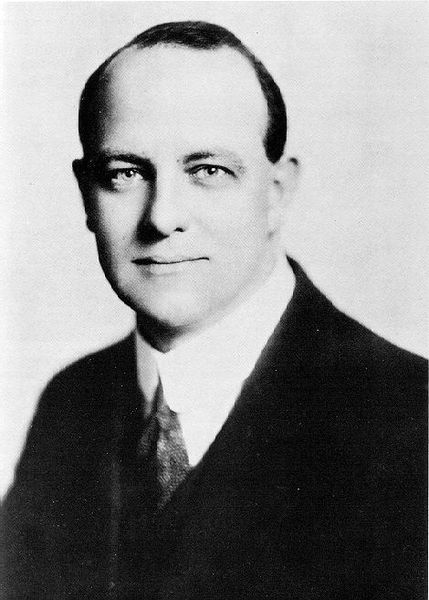
P.G. Wodehouse, circa 1904.
The American Legion Weekly, 24 October, 1919 via Wikimedia Commons.
[Malcolm Muggeridge:] “I first made Wodehouse’s acquaintance in circumstances which might have been expected to shake even his equanimity. This was in Paris just after the withdrawal of the German occupation forces. As Wodehouse well understood, the matter of his five broadcasts from Berlin would now have to be explained; and in the atmosphere of hysteria that war inevitably generates, the consequences might be very serious indeed. It would have been natural for him to be shaken, pale, nervous; on the contrary I found him calm and cheerful. I thought then, and think now more forcibly than ever, that this was due not so much to a clear conscience as to a state of innocence which mysteriously has survived in him.”
Muggeridge explains that he was attached to an MI6 contingent and a colleague “mentioned to me casually that he had received a short list of so-called traitors who cases needed to be investigated, one of the names being PG Wodehouse”. Muggeridge readily agreed to take on the case, “partly out of curiosity and partly from a feeling that no one who had made as elegant and original a contribution to the general gaiety of living should be allowed to get caught up in the larger buffooneries of war”. He duly visited Wodehouse at his hotel that same evening and the author described what had happened to him from the collapse in 1940 of France, where he was living with his wife Ethel, to his internment at a former lunatic asylum in Tost, Poland.
“The normal wartime procedure is to release civilian internees when they are sixty. Wodehouse was released some months before his sixtieth birthday as a result of well-meant representations by American friends – some resident in Berlin, America not being then at war with Germany. He made for Berlin, where his wife was awaiting him. The Berlin representative of the Columbia Broadcasting System asked him if he would like to broadcast to his American readers about his internment and foolishly he agreed, not realising the broadcasts would have to go over the German network and were bound to be exploited in the interest of Nazi propaganda.” [Here are German transcripts of the offending items.]
Muggeridge goes on: “It has been alleged that there was a bargain whereby Wodehouse agreed to broadcast in return for being released from Tost. This has frequently been denied and is, in fact, quite untrue but nonetheless still widely believed.”
Wodehouse came under virulent attack, particularly from Cassandra, the Daily Mirror columnist William Connor, who denounced him as a traitor to his country. Public libraries banned his books. Wodehouse wrote to the Home Secretary admitting he had been “criminally foolish” but said the broadcasts were “purely comic” and designed to show Americans a group of interned Englishmen keeping up their spirits. But the damage was done and the stigma stuck. After the war he spent the rest of his life in America.
In words that resonate half a century after their publication, Muggeridge says: “Lies, particularly in an age of mass communication, have much greater staying power than the truth.
“In the broadcasts there is not one phrase or word which can possibly be regarded as treasonable. Ironically enough, they were subsequently used at an American political warfare school as an example of how anti-German propaganda could subtly be put across by a skilful writer in the form of seemingly innocuous, light-hearted descriptive material. The fact is that Wodehouse is ill-fitted to live in an age of ideological conflict. He just does not react to human beings in that sort of way and never seems to hate anyone – not even old friends who turned on him. Of the various indignities heaped upon him at the time of his disgrace, the only one he really grieved over was being expunged from some alleged roll of honour at his old school, Dulwich.”
[…]
Muggeridge records that, when the war ended, the Wodehouses left France for America. “Ethel has been back to England several times but Wodehouse never, though he is always theoretically planning to come. I doubt if he ever will [he didn’t, dying in 1975 at the age of 93]. His attitude is like that of a man who has parted, in painful circumstances, from someone he loves and whom he both longs for and dreads to see again.”
Rome’s Biggest Construction Projects
toldinstone
Published Jan 26, 2024Chapters:
0:00 Introduction
3:06 Domitian’s Temple of Jupiter
4:45 Aura
5:48 The Forum of Trajan
7:16 Nero’s Golden HouseMy new book, Insane Emperors, Sunken Cities, and Earthquake Machines is now available! Check it out here: https://www.amazon.com/Insane-Emperor…
May 1, 2024
The Death of Adolf Hitler – WW2 – Week 296B – April 30, 1945
World War Two
Published 30 Apr 2024Europe is broken, its cities in ruins, and millions have died in war and genocide. The world has risen against the Nazi threat, and now the Nazi leader cowers in his bunker under Berlin — this is how Adolf Hitler’s last 15 weeks unfold, and why he ultimately chooses suicide to escape responsibility for his actions.
Watch the Führerbunker special here:


