
World War Two
Published 11 May 2024Germany signs not one, but two unconditional surrenders and the war in Europe is officially over … although that does not mean that all the fighting in Europe is, for there is fighting and surrenders all over Europe all week. The Japanese launch a counteroffensive on Okinawa; the Chinese launch one in Western Hunan; the Australians advance on Borneo and New Guinea; and the fight continues on Luzon in the Philippines, so there is still an awful lot of the world war to come, even with the end of the war in Europe.
00:00 Intro
00:40 The German Surrender
03:23 Fighting And Surrenders In The East
06:53 The Prague Uprising
15:50 The Last Surrenders In Europe
18:42 The Polish Situation
20:25 The War In China And The South Seas
23:17 Summary
24:44 Conclusion
(more…)
May 12, 2024
Germany Surrenders! – WW2 – Week 298 – May 11, 1945
Javier Milei and the “Malvinas” question
Colby Cosh on how Argentine President Javier Milei handled British press inquiries about the Malvinas Falkland Islands like a boss:

I’ve been relishing a classic feast of British press overreaction to a BBC interview with the colourful libertarian president of Argentina, Javier Milei. The Beeb’s Ione Wells visited Milei at the Casa Rosada last week in Buenos Aires for a chat, and nothing like this could possibly happen without some talk about those damned islands — the Falklands or las Malvinas, depending on which country you believe to be their rightful sovereign.
Argentine leaders have to be careful how they talk about the Falklands (and about their uninhabited dependencies elsewhere in the South Atlantic). For decades regimes of left and right in Argentina have opportunistically kept the disputed islands at the forefront of the public imagination, fostering a spirit of delayed revenge. Sometimes this leads to daft verbal outbursts about “colonialism”, alongside game-playing with supplies and access to the islands. The constitution of Argentina contains language asserting “legitimate and imprescriptible sovereignty” over the rocks.
So anything a current Argentine leader says about the Falklands is bound to be scrutinized closely at home and in the United Kingdom. Milei is naturally impulsive, and has the particular problem that he is a political admirer of the late Margaret Thatcher. Wells tried to provoke him by bringing up the 1982 sinking of the General Belgrano and the consequent deaths of 323 Argentine sailors, which is still a slightly controversial episode of the Falklands War among the most self-hating shades of U.K. political opinion.
Milei, who had arranged a little display of Thatcher memorabilia in the room where the interview was held, sliced right through Wells’s Gordian knot. “Criticizing someone because of their nationality or race is very intellectually precarious,” he told Wells. “I have heard lots of speeches by Margaret Thatcher. She was brilliant. So what’s the problem?”
Even if you venerate Thatcher, who ordered the sinking of the Belgrano in very cold blood, you can perceive that this is a non sequitur. Milei is under no obligation to like a fellow neoliberal who was a military enemy of his own country. But one does remember that British statesmen have often been willing to express admiration for Napoleon I, Washington, Rommel and other killers of large numbers of British soldiers.
Whitneyville Rolling Block for the Montreal Riot Squad
Forgotten Weapons
Published Feb 2, 2024In 1875 the Montreal City Police decided that they wanted to equip a riot squad in case of public disturbance. They initially requested funds for 50 revolvers, but this changed to 60 carbines instead, and these were purchased via broker in 1876 from the Whitneyville Armory. Whitneyville was a factory that made a variety of independently patented designs, and their rolling block design was actually protected by a different patent (the Whitney-Laidley) than Remington’s, despite the very similar appearances of the two guns.
The Montreal Rolling Blocks were carbines, fitted with long bayonets and chambered for a .43 caliber black powder cartridge. They were engraved “Montreal Police” on the barrels, and were actually never fired in anger, nor even deployed. They remained in government possession until the 1960s, when they were finally sold off. This example is here for me to film courtesy of Mike Carrick of Arms Heritage Magazine.
(more…)
QotD: What is Putin’s endgame in Ukraine?
It would appear that Putin, Xi, etc. are coming to see themselves as the leaders in a worldwide battle against Juggalisme. That might be wishcasting — they are practical men, after all, and let me state, unequivocally and for the record, that I do NOT want to be ruled by Russians or Chinese. They are not my people. Nonetheless, it does seem clear they understand that the source of their problems is beyond what we think of as geopolitics. The United States is “agreement incapable”, as I guess the term d’art is, because it’s not rational, or even predictably irrational.
That was the monarchist critique of representative government that hit closest to home: Foreign policy needs to be supple and responsive; it must be able to move quickly, to make big changes in narrow time windows. In a real crisis, you simply don’t have time to convene a Parliament to debate stuff. N.b. they were saying this in the late 18th century; it’s so much worse now. And another observation from that time that is even truer today: A “democratic” foreign policy can never be consistent. You simply can’t plan long-term when there’s partial to complete governmental overhaul every few years.
That the US managed to muddle through for as long as it did was really a combo of two things: time (as a function of distance), and a near-peer enemy.
Neither of those is integral to the system, and neither is within the system’s control. Until recently, American foreign policy had to take into account the fact that on-the-spot commanders would have to make decisions on their own recognizance. Even with phone communications, the man on the ground in the Fulda Gap has to make decisions basically without reference to Washington. It forced him to be conservative — in other words, it discouraged adventurism.
Same way with the near-peer enemy. The looming shadow of the USSR forced regular reality checks inside the US Apparat. A whole bunch of possibilities were foreclosed by default — our response to any given situation had to take the likely Soviet reaction into account. As with the time/distance factor, this forced a kind of conservatism that looked a lot like sclerosis, but at least it deterred adventurism.
The history of the later 20th century is the history of those constraints being removed. In Vietnam, for instance, you had LBJ and McNamara sitting in a room in the White House, personally directing airstrikes in near-realtime. If “news” reports are to be believed, Obama was on the horn with that SEAL team going after Bin Laden right up to the very moment the chopper landed. Knowing these things are technically possible is catnip to politicians — they already assume they’re omnicompetent, and so now they want to be “advising” the commanding general even as the battle rages.
And if that’s catnip, then the end of the USSR was catnip on steroids. Why not play fuck-fuck games everywhere, all at once? Who’s gonna stop us? China? They chose to pass. They saw what happened to the USSR when it locked itself into an ideological death spiral vis-a-vis the Struggle Against International Capitalism. American policymakers only understand Soviet-style bluff and bluster. The Chinese play the long game.
NOT because they’re Inscrutable Orientals, I hasten to add — they’re as Juggalicious as our Clowns, in their way — but because the generation currently in power came up hard, and so they are adults. That’s all. They are not spoiled, petulant children. The next generation of Chinese leadership — assuming we live to see it — will really be something, and not in a good way.
So, what does Putin want? I dunno, and I’m not sure he knows, because I’m not sure he can know. I’m sure his broadest goal is “to stop getting fucked with by idiots”, but how can that be achieved? There shall be no durable peace in this world until there is Regime Change in [Washington, DC], and I’m not talking about the other half of the Uniparty winning an election or two. I think Putin knows that, but what can he really do about it? I think he’s going to be forced to annex a fair amount of territory and set up a totally demilitarized buffer zone. It won’t work, but it’s the least-worst practical option.
Severian, “Friday Mailbag”, Founding Questions, 2024-02-09.
May 11, 2024
The second time as farce – “we’re living through a performative version of the seventies”
Sarah Hoyt posted this a few days back, but I only noticed it now:
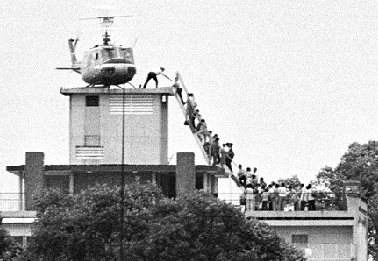
A member of the CIA helps evacuees up a ladder onto an Air America helicopter on the roof of 22 Gia Long Street April 29, 1975, shortly before Saigon fell to advancing North Vietnamese troops.
Hubert van Es photo via Wikimedia Commons.
Yesterday talking to a friend, he said that it seems like we’re living through a shoddy version of the seventies.
But that’s not QUITE it. It’s more complicated. It’s more like we’re living through a performative version of the seventies.
It’s like all the recasting and re-doing of classic movies and series, at this point even those that weren’t particularly successful: it feels like Hollywood is just redoing these things out of some sort of dinosaur brain memory that they were successful. However, the people in charge no longer have any idea why these things were successful or why they resonated or achieved the results they did.
So the re-casts/re-dos sound hollow and strange, and would even if they didn’t use them to push their weird personal current obsessions. (All heroes must be women and black and increasingly of some odd sexual identity! Only villains can be white!) Because the car is there, but the engine is gone metaphorically speaking.
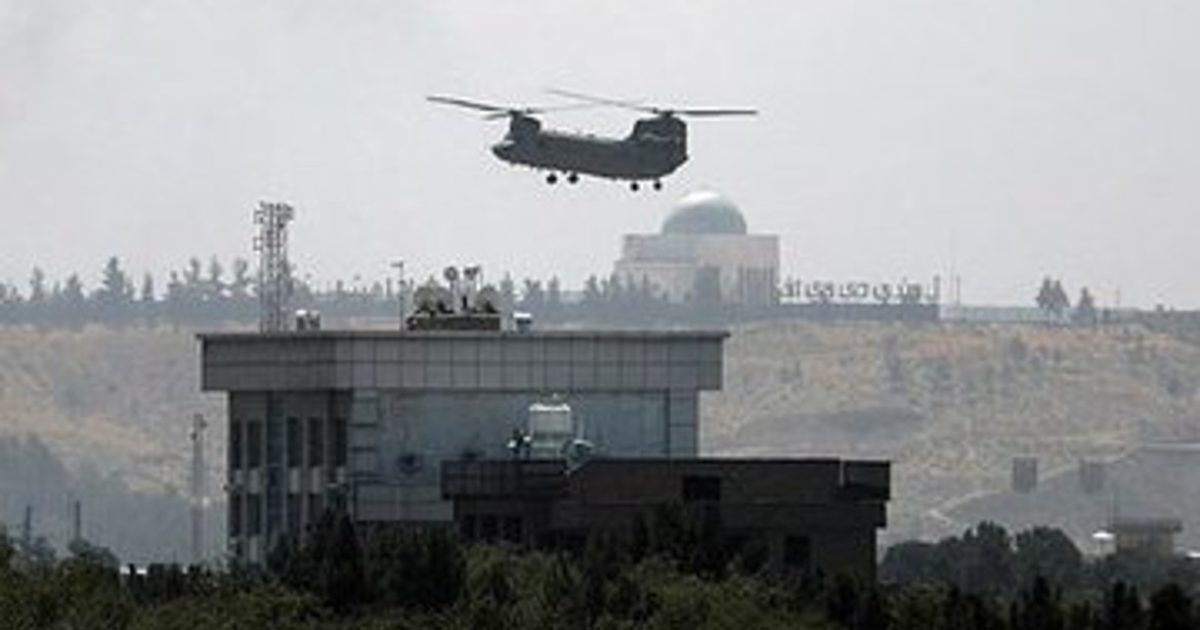
A Boeing CH-47 Chinook transport helicopter appears over the U.S. embassy compound in Kabul, 15 Aug 2021. Image from Twitter via libertyunyielding.com
All these redos and recastings and all are just shells of what the original was. And imbuing them with current wokeness doesn’t make them massively popular, because it doesn’t have that kind of purchase amid the public.
The left and current “Cultural gatekeeping elite” doesn’t seem to be aware of this, or aware of why they fail. In fact, each failure baffles them.
I could be snide, here, and say that it’s because this entire administration, and in fact, the entire upper-crust/controlling layer of our institutions are profoundly untalented theater kiddies, who have no creativity but love the style, and so are trying to do performance of what they think should be there, in the hopes it will work. And are forever baffled it doesn’t.
The truth is not quite that mean, but it rhymes. They are people of a certain frame of mind. In most places and most times, this would make them profoundly “conservative.” Frankly they are, because 100 years into the “progressive” project, those who support it are conservatives. But it’s a weird sort of “conservatism” because what they’re conserving is the cult that tells them if they tear Western civ apart paradise ensues. The whole just-so cult of Marx as filtered through their parents, grandparents and great grandparents.
Part of the whole Marxian philosophy is that it’s a self-contained system, congruent within itself, and with no basis in reality. This makes a certain type of mind susceptible to it. In other centuries they’d be religious fanatics, missionaries to the heathens and zeal-burned puritans.
That type of mind tends to think of things in terms of pre-ordained and fixed narrative, not wildly creative and innovative. That THEY think of themselves as creatives is the insanity of the current system and the Marxian corruption of institutions. They are not actually capable of creativity, only of passing on the received word.
And so we get to the other side of the rerun of the seventies: These kids, by and large, grew up with everything from schools, to TV to even their parents (for the children and grandchildren of boomers) being sold a version of the sixties and seventies in which protesting on the street, behaving badly and destroying property was being passionate and fighting for the voiceless and by itself meant IMPROVING SOCIETY and MAKING THE WORLD A BETTER PLACE.
So the most gullible of this generation are rebels without a clue. They must perform the hit the streets and protest, but they lack the immediacy of the draft to make it personal, and they lack anything like civil rights to make it righteous.
Instead they attach to any stupid cause they can find or which is handed to them by manipulative SOBs. So, you know, it might be saving the endangered Prebles Jumping Mouse, or perhaps saving old buildings, or even well … Lately Occupy Wall Street, BLM, antifidiots and of course pro-Hamass.
May 10, 2024
A different take on the Russo-Ukrainian War
Kulak suggests that far from being a model for future wars, the ongoing conflict in Ukraine may not prefigure anything at all about future wars:

Few weeks go by where I don’t read a piece on how Ukraine is the Future of warfare and armies and thinkers need to adjust to the reality that the warfare of the future will involve massive unaccountable amounts of artillery, trenches, conscription and grinding warfare.
While sometimes they point to relevant lessons: Yes the inability of the US to quickly reindustrialize and produce artillery shells at a rate comparable to Russia does speak to a profound rot in American governance, the military industrial complex, and American business regulation more generally,
Often times the conclusions drawn are dangerously delusional: A draft would be more likely to break the American nation than save it. As indeed conscription has resulted in Ukraine’s population collapsing with somewhere between 6 and 10 million Ukrainians (out of a pre-war 36 million) having fled the country, not to escape the mostly static war, but to escape the Totalitarian conditions the Zelensky regime has imposed in response to the war. (1.1 million of whom escaped INTO Russia, for any who deny this [is] largely an ethnic conflict between Western and Russian Ukrainians, as it has been since 2014).
And the thing is all of these discussions rest on a assumption that seems ludicrous the second you stop and think about it: Ukraine is not the future of Warfare, these conditions will be almost impossible to ever create again.
Ukraine had a pre-war Nominal GDP of 199 billion USD. Officially this only declined to 160 billion in 2022 as a result of the war, but there’s good reason to think its actual internal private sector economy collapsed far further [given] it had collapsed from 177 billion in 2013 to 90 billion in 2015 as a result of the US backed Coup/Revolution.
Indeed given the population flight, conscription, and impositions on the populace, it is very likely a SUPER-MAJORITY of that 160 billion GDP in 2022, was actually the result of US and NATO pouring hundreds of billions into the country. Where it was either used or siphoned off as corruption.
Simply put Ukraine has received military, financial and other aid most like in excess of what its entire internal economy produced in the same period, and as of writing it’s still losing territory.
When commentators say this is a war between NATO and Russia they are almost entirely correct. If you combine all the economies that are funding, arming, or fighting on one side or the other of this war you get a majority of the entire global economy.
And they have used all that money to pay off the Ukrainian regime to refuse any peace agreement, even ones their own negotiators had agreed to, and that were clearly in the best interest of the country … you know if you value hundreds of thousands of young men and not having your population collapse more than narrow stretches of land being bought up by Blackrock.
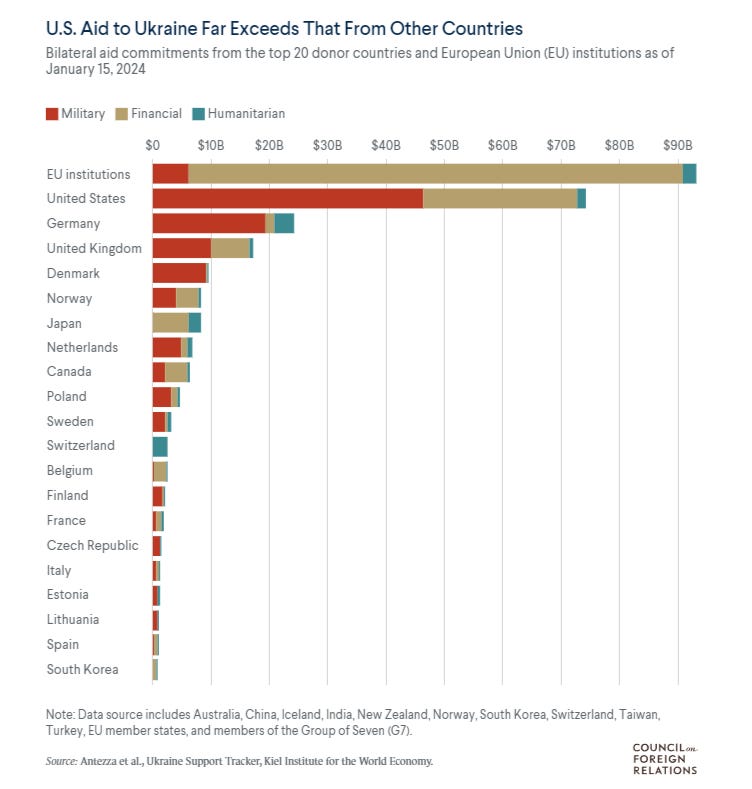
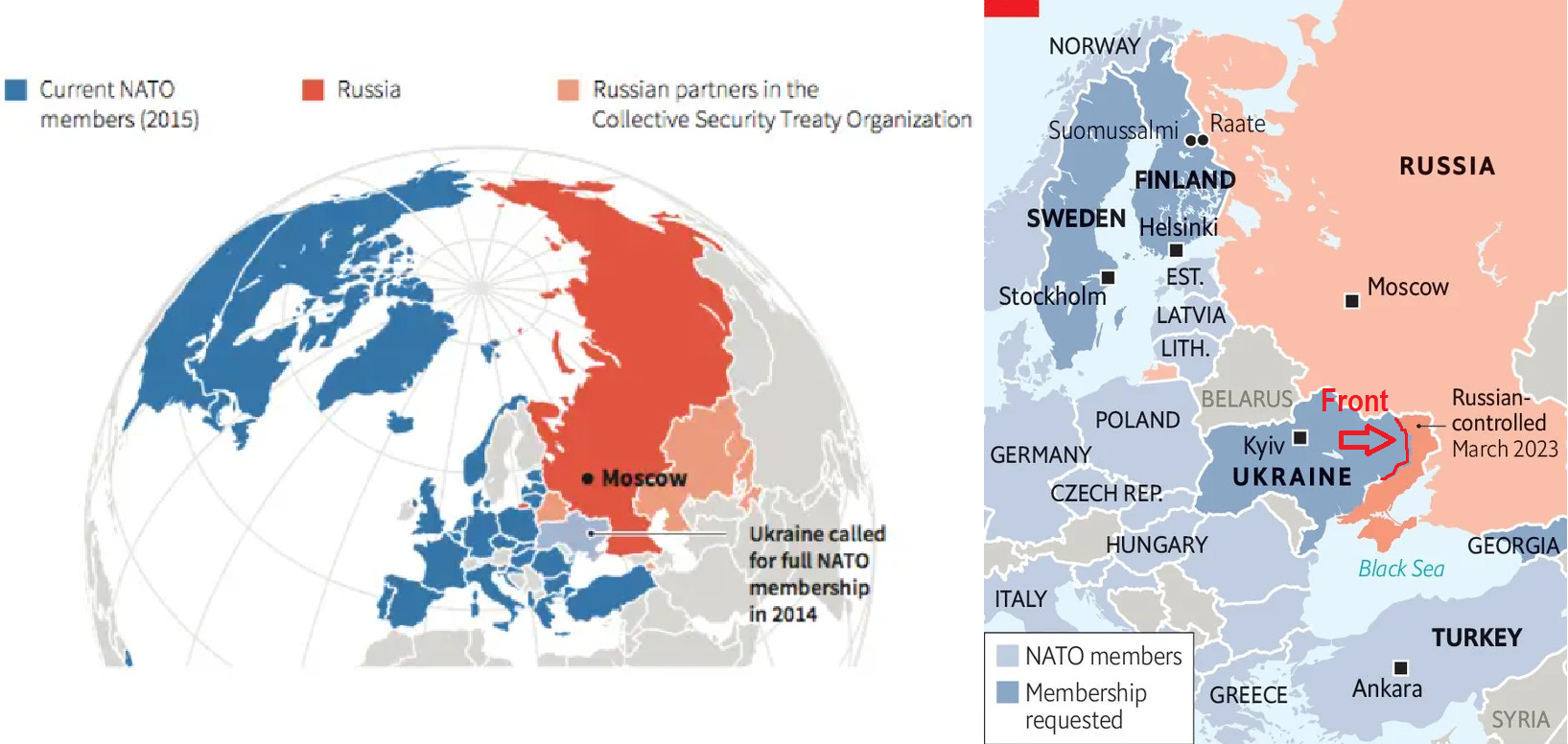
Table Manners in the Ottoman Empire – Acem Pilaf
Text from https://www.tastinghistory.com/recipes/ottomanpilaf:
At an Ottoman banquet, you were only ever meant to eat a few bites of each dish that was brought out (having more was seen as being greedy). But there was no danger of leaving the table hungry, as there could be upwards of dozens of dishes. To European visitors, the order that the dishes were brought out in made no sense. Cakes could be brought out between meat courses, a rich pastry brought out after fish, and fowl after chocolate cake. Amidst this seeming chaos, pilaf was always the last dish served.
Let’s address the elephant in the room and state that yes, the pilaf is supposed to come out layered and all in one piece, but mine did not. Ottoman dishes were meant to be not only flavorful, but beautiful as well. That being said, even if you mold yours in a separate container like I did, it is still delicious (and quite nice looking). The warm spices are a wonderful and unusual combination with the lamb (at least to my palate), and there is a fantastic array of textures.
“Chop a piece of good mutton into small pieces, place them in a pot … add one or two spoonfuls of fresh butter and after frying, take the cooked meat from the pot with a hand strainer. Finely chop three or four onions and fry them, then put the roasted meat on top. Then add plenty of pistachios, currants, cinnamon, cloves, and cardamom on top. After that, according to the old method, one measure of washed Egyptian rice. Add two measures of cold water without disturbing the rice, add sufficient salt, then close the lid of the pot and cover it thoroughly with dough. Boil it slowly on coals and when the water is absorbed, take the cover off, and turn the contents out of the pan onto a dish so it comes out intact. This makes a Pilaw that is very pleasing to the sight, and exceedingly pleasant to the taste.”
— Melceü’t-Tabbâhîn, 1844
May 9, 2024
The Liri Valley: Canada’s Breakthrough to Rome
WW2TV
Published 8 May 2024The Liri Valley: Canada’s Breakthrough to Rome
With Mark Zuehlke
Part of our “Italy 1944 – Monte Cassino and Beyond” series
• Monte Cassino and BeyondFor the Allied armies fighting their way up the Italian boot in early 1944. Rome was the prize that could only be won through one of the greatest offensives of the war. The Liri Valley was a long, flat corridor through miles of rugged mountains. At one end stood the formidable Monte Cassino, at the other, Rome. In May 1944, I Canadian Corps drops up this valley toward the Italian capital, facing the infamous Hitler Line — a bastion of concrete bunkers fronted by wide swaths of tangled barbed wire, minefields, and “Tobruk” weapon pits. The ensuing battle resulted in Canada’s single bloodiest day of the Italian campaign. But the sacrifice of young Canadians during the twenty-four days of relentless combat it took to clear the valley paved the way for the Allies to take Rome.
Mark Zuehlke is an award-winning author generally considered to be Canada’s foremost popular military historian. His Canadian Battle Series is the most exhaustive recounting of the battles and campaigns fought by any nation during World War II to have been written by a single author.
(more…)
“[B]ad music does seem to disappear – you just need to wait 70 or 80 years, more or less”
I’m far from a modern music fan, so I find Ted Gioia’s analysis of the genre to be hopeful for the future … there’s so much objectively bad music being released these days, but the vast majority of it will sink without a trace:

Handwritten score by Bach
“No stupid literature, art or music lasts.”
That’s a quote from literary critic George Steiner (1929-2020) — in his highly recommended book Real Presences from 1986.
I was shocked when I read that sentence. But pleasantly shocked.
Could it really be true that all the sonic detritus circulating in our culture will just magically disappear? It seems too good to be true.
And Steiner wrote that before the rise of the Internet and AI. If he thought we were drowning in crappy art back in the 1980s, what would he think now?
Around 100,000 songs are uploaded online every day. I can’t listen to more than a fraction of them, but almost every day I check out random new tracks on Bandcamp — and sometimes the process is painful.
Nobody can say that I’ve shirked my responsibilities as a music critic. In recent months, I’ve listened to death metal bands from Croatia who sounded like they were ready to bludgeon the entire population of Zagreb; incoherent Christian drone pop that only delivers the Good News when it’s finally over; entire albums of static, buzzes, burps, or toots; people singing to backup tracks, but apparently unaware that they are in different keys; and various home recordings that should never have left the basement.
It’s an ugly job, but somebody has to do it. I occasionally find that rare gem, a self-produced needle of rare pointedness in the otherwise dismal haystack. That makes it all worthwhile.
But Steiner may be on to something. Most of the bad stuff disappears without anyone worrying about it. In fact, it disappears for that very reason — because nobody worries about it.
And the deeper I peer into the past, the more I see the same Darwinian trend. He called it survival of the fittest.
My considered judgment is that almost every musical work from the 17th and 18th centuries that survives in the standard repertoire possesses some merit. An interesting case is Bach, who is the presiding genius among the known composers from that era. Bach was unfairly forgotten in the years following his death — in fact, his sons got more acclaim than their dad.
Bach had been dead for more than 75 years before his reputation started rising again. The neglect was unfair, almost horrendously so. But with the passage of time, he gained preeminence, almost as if an invisible hand — much like those the economists describe — was setting things right. You could tell similar stories about other composers, from Antonio Vivaldi to Scott Joplin. It’s almost magical the way things work.
I must say that this is a judgment that takes a long time to make. Back at age twenty, I couldn’t have told you if Bach wrote better fugues than other composers, or Joplin composed better rags. Yet after decades seeking lost masterpieces from the past, and picking through the works of secondary and tertiary figures, I’ve concluded that the legendary figures from the past definitely earned their preeminence.
As a result, I worry more about the artists whose work has disappeared completely. Those are wrongs that can’t be rectified.
How the First World War Created the Middle East Conflicts
The Great War
Published Dec 8, 2023The modern Middle East is a region troubled by war, terrorism, weak and failed states, and civil unrest. But how did it get this way? The map of today’s Middle East was mostly drawn after the First World War, and the war that planted many of the seeds of conflict that still plague Israel, Palestine, Iraq, Syria and even Iran today.
(more…)
QotD: Rome’s socii system
In any case, the Romans win the war and impose a peace treaty the terms of which, according to Dionysius of Halicarnassus went thusly:1
Let there be peace between the Romans and all the Latin cities as long as the heavens and the earth shall remain where they are. Let them neither make war upon another themselves nor bring in foreign enemies nor grant a safe passage to those who shall make war upon either. Let them assist one another, when warred upon, with all their forces, and let each have an equal share of the spoils and booty taken in their common wars. Let suits relating to private contracts be determined within ten days, and in the nation where the contract was made. And let it not be permitted to add anything to, or take anything away from these treaties except by the consent both of the Romans and of all the Latins.
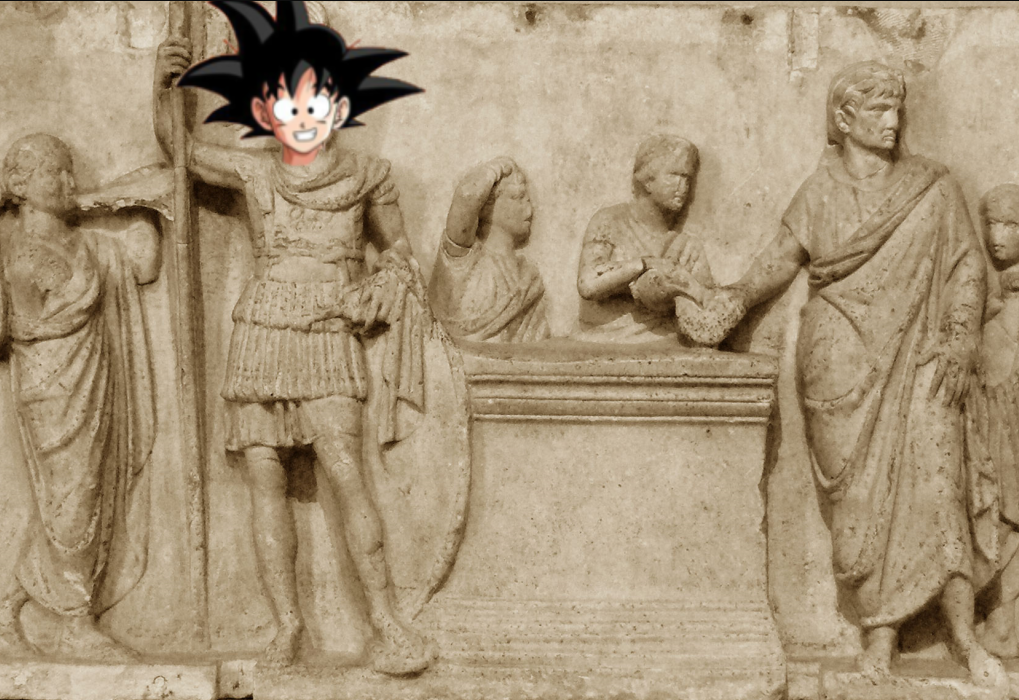
This is the origin point for Rome’s use of what I’ve termed the “Goku Model of Imperialism” – “I beat you, therefore we are friends”. Having soundly defeated – at least according to our sources – the Latins, Rome doesn’t annex or destroy them, nor does it impose tribute, but rather imposes a treaty of alliance on them (in practice I suspect we might want to understand that Rome’s position was not so dominant as our sources suggest, thus the relatively good terms the Latins get). The treaty sounds like an equal relationship, until one remembers that it is the entire Latin league – thirty or more communities – as one party and then just Rome as the other party.
I will still make no apologies for this visual gag.
Image modified by Bret Devereaux.Rome proceeds, in the century or so that follows, to use this alliance to defeat their other neighbors, both the nearest major Etruscan centers as well as the Aequi and Sabines who lived in the hills to the north-east of Rome and the Volsci who lived to the south of Latium. Roman relations with the Latins seem to fray in the early 300s, presumably because the greatest threat to their communities was increasingly not the Volsci, but Rome’s emerging regional power. That leads to a collapse of the Foedus Cassianum in 341 and another war between Rome and the Latin League. Once again our sources are much later, so we might be somewhat skeptical of the details they provide, but the upshot is that at the end the Romans won by 338.
Rome’s expansion into most areas follows a familiar pattern: Rome enters a region by concluding an alliance with some weaker power in a region and then rushing to the aid of that weaker power; in some cases this was a long-term relationship that had been around for some time (like the long Roman friendship with Etruscan Caere) and in some cases it was a very new and opportunistic friendship (as with Capua’s appeal to the Romans for aid in 343). In either case, Rome formed a treaty with the community it was “protecting” and then moved against its local enemies. Once defeated, it imposed treaties on them, too. Rome might also seize land in these wars from the defeated party (before it imposed that treaty); if these were far away, Rome might settle a colony on that land rather than annexing it into Rome’s core territory (the ager Romanus). These new communities – the Latin colonies – were created with treaty obligations towards Rome.
Note the change: what was initially an alliance between one party (Rome) and another party (the Latin League) has instead become an alliance system, a series of bilateral treaties between Rome and a slew of smaller communities. And they were smaller, because Rome often took land in these wars, so that by the third century, the Roman citizen body represented roughly 40% of the total, making Rome much bigger than any other allied community. This shift was probably gradual, rather than there being some dramatic policy change at any point. Rome accrued its Italian empire the same way it would accrue its Mediterranean one: as a result of a series of localized, ad hoc decisions which collectively added up to the result without ever being intended to constitute a single, unified policy.
The Romans called all of these allied communities and their people socii, “allies” – a bit of a euphemism, because these were no longer equal alliances. We’ll get into the terms in a moment, but it seems clear that by 338 that these “allies” are promising to have no foreign policy save for their alliance with Rome and to contribute soldiers to Roman armies. So Rome is in the driver’s seat determining where the alliance will go; Rome does not have to consult the allies when it goes to war and indeed does not do so. The socii cannot take Rome to war (but Rome will go to war immediately if a community of socii is attacked). This is no longer an equal arrangement, but it is useful for the Romans to pretend it is.
The next major series of Roman conflicts are with the Samnites. Rome is, according to Livy, at least, drawn into fighting the Samnites because of its suddenly concluded alliance with Capua and the Campanians (though Rome had been more loosely allied to the Samnites shortly before). In practice, the first two Samnite Wars (343-341, 326-304) were fought to determine control over Campania and the Bay of Naples, with Rome fighting to expand its influence there (by making those communities allies or protecting those who were) while the Samnites pushed back.
The Third Samnite War (298-290) becomes something rather different: a containment war. Rome’s growing power – through its “alliance” system – was clearly on a course to dominate the peninsula, so a large coalition of opponents, essentially every meaningful Italian power not already in Rome’s alliance system, banded together in a coalition to try to stop it (except for the Greeks). What started as another war between Rome and the Samnites soon pulled in the remaining independent Etruscan powers and then even a Gallic tribe (the Senones) in an effort to contain Rome. The Romans manage to pull out a victory (though it was a close run thing) and in the process managed to pull yet more communities into the growing alliance system. It seems – the sources here are confused – that the decade that followed, the Romans lock down much of Etruria as well.
The Greek cities in southern Italy now at last recognize their peril and call in Pyrrhus of Epirus to try to beat back Rome, leading to the Pyrrhic War (280-275). Pyrrhus wins some initial battles but – famously – at such cost that he is unable to win the war. Pyrrhus withdraws in 275 and Rome is then able over the next few years to mop up the Greek cities in Southern Italy, with the ringleader, Tarentum, falling to Rome in 272. Rome imposed treaties on them, too, pulling them into the alliance system. Thus, by 264 Rome’s alliance system covered essentially the whole of Italy South of the Po River. It had emerged as an ad hoc system and admittedly our sources don’t give us a good sense of how and when the terms of the alliance change; in many cases it seems our sources, writing much later, may not know. They have the foedus Cassianum, with its rather more equal terms, and knowledge of the system as it seems to have existed in the late third century and the dates and wars by which this or that community was voluntarily or forcibly integrated, but not the details of by what terms and so on.
Bret Devereaux, “Collections: How to Roman Republic 101, Addenda: The Socii“, A Collection of Unmitigated Pedantry, 2023-10-20.
1. trans. Earnest Clay (1940).
May 8, 2024
The nonsensical “right of return” debate
George Monastiriakos explains why he should have the right of return to his ancestral homeland:
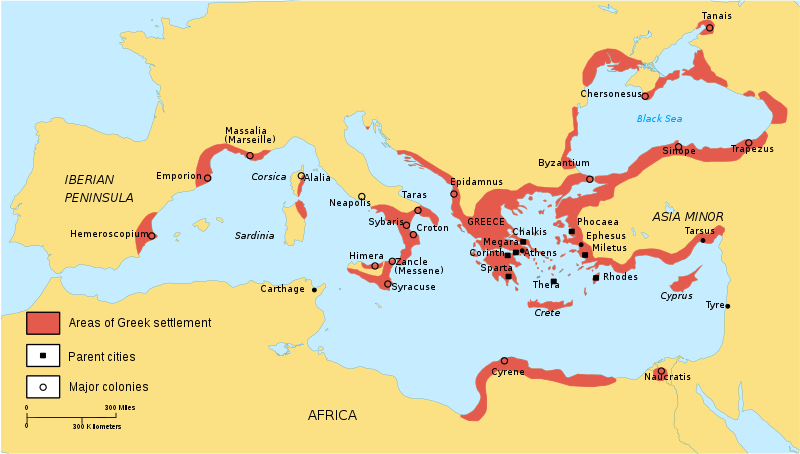
Greek colonization in the Archaic period.
Map by Dipa1965 via Wikimedia Commons.
My family hails from a small Greek village in Anatolia, in modern day Turkey, but I have unfortunately never been to my ancestral homeland because I was born a “refugee” in Montreal. Living in the “liberated zone” of Chomedey, Que., one of the biggest Greek communities in Canada, is the closest I’ve ever felt to my beloved Anatolia.
The Republic of Turkey does not have a legal right to exist. It is an illegitimate and temporary colonial project built by and for Turkish settlers from Central Asia. My ancestors resided on the Aegean coast of Asia Minor for thousands of years before the first Turks arrived on horseback from the barren plains of Mongolia. I will never relinquish my right to return to my ancestral homeland.
If you think these assertions are ridiculous, it’s because they are. I copied them from the shallow, even childish, anti-Israel discourse that’s prevalent on campuses in the United States and Canada, including the University of Ottawa, where I studied and now teach. I am a proud Canadian citizen, with no legal or personal connection to Anatolia. I have no intention, or right, to return to my so-called ancestral homeland. Except, perhaps, for a much-needed vacation. Even then, my stay would be limited to the extent permitted by Turkish law.
The Second Greco-Turkish War concluded with the Treaty of Lausanne in 1923. Among other things, this agreement finalized the forced displacement of nearly one-million Ottoman Greeks to the Kingdom of Greece, and roughly 500,000 Greek Muslims to the newly formed Republic of Turkey. This ended the over 3,000 years of Greek history in Anatolia, and served as a model for the partition of British India, which saw the emergence of a Hindu majority state and a Muslim majority state some two decades later.
With their keys and property deeds in hand, my paternal grandmother’s family fled to the Greek island of Samos, on the opposite side of the Mycale Strait at a nearly swimmable distance from the Turkish coast. While they practised the Greek Orthodox religion and spoke a dialect of the Greek language, they were strangers in a foreign land with no legal or personal connection to the Kingdom of Greece.
The Great War channel produced an overview of the Greco-Turkish War of 1919-1923 that resulted in the vast human tragedy of the expulsion of ethnic Greek civilians from Anatolia and ethnic Turkish civilians from mainland Greece here.
Walther Volkspistole
Forgotten Weapons
Published Mar 11, 2015As the Second World War started to really take a toll on German industrial production, several companies started to work on alternatives to the P38 handgun in an effort to reduce production cost and time. This is one such example made by Walther, with a normal type of milled slide and an experimental frame made from stamped sheet steel. It uses a rotating barrel mechanism taken from Nickl (and the Steyr-Hahn before him), and uses standard P38 magazines. None of these designs actually made it into production before the end of the war.
(more…)
QotD: Imperial Spain’s “House of Trade”
And it was something that the English tried, for decades, to emulate. Before they embarked on their first explorations of the icy seas around Russia in the 1550s, they first poached the Casa‘s principal navigator, the Pilot Major, Sebastian Cabot. And later, during the few years that England and Spain were united in matrimony, under Mary I, one English navigator, Stephen Borough, had the chance to visit and glean some of its secrets. He was instrumental in having Spain’s key navigational manual translated in English, and he petitioned Elizabeth I to create an English version of the Casa. That dream never materialised, but the quest to emulate the Casa informed many of the smaller-scale projects — lectures, manuals, globes, and maps — which meant that the English did not sail completely into the unknown.
Anton Howes, “The House of Trade”, Age of Invention, 2019-11-13.
May 7, 2024
Charles Holden and the Ministry of Truth
Jago Hazzard
Published Jan 28, 2024The strange connection between George Orwell and the London Underground.


