
World War Two
Published 30 Apr 2024Europe is broken, its cities in ruins, and millions have died in war and genocide. The world has risen against the Nazi threat, and now the Nazi leader cowers in his bunker under Berlin — this is how Adolf Hitler’s last 15 weeks unfold, and why he ultimately chooses suicide to escape responsibility for his actions.
Watch the Führerbunker special here:
May 1, 2024
The Death of Adolf Hitler – WW2 – Week 296B – April 30, 1945
Comments Off on The Death of Adolf Hitler – WW2 – Week 296B – April 30, 1945
Lobscouse, Hardtack & Navy Sea Cooks
Tasting History with Max Miller
Published Jan 23, 2024Hearty meat and potato stew thickened with crushed hardtack (clack clack)
Comments Off on Lobscouse, Hardtack & Navy Sea Cooks
April 30, 2024
DNA and India’s caste system
Earlier this month, Palladium published Razib Khan‘s look at the genetic components of India’s Caste System:
Though the caste system dominates much of Indian life, it does not dominate Indian American life. At slightly over 1% of the U.S. population, only about half of Indian Americans identify as Hindu, the religion from which the broader categories of caste, or varna, emerge. While caste endogamy — marrying within one’s caste — in India remains in the range of 90%, in the U.S. only 65% of American-born Indians even marry other people of subcontinental heritage, and of these, a quick inspection of The New York Times weddings pages shows that inter-caste marriages are the norm. While tensions between the upper-caste minority and middle and lower castes dominate Indian social and political life, 85% of Indian Americans are upper-caste, broadly defined, and only about 1% are truly lower-caste. Ultimately, the minor moral panic over caste discrimination among a small minority of Americans is more a function of our nation’s current neuroses than the reality of caste in the United States.
But this does not mean that caste is not an important phenomenon to understand. In various ways, caste impacts the lives of the more than 1.4 billion citizens of India — 18% of humans alive today — whatever their religion. While the American system of racial slavery is four centuries old at most, India’s caste system was recorded by the Greek diplomat Megasthenes in 300 BC, and is likely far more ancient, perhaps as old as the Indus Valley Civilization more than 4,000 years ago. Indian caste has a deep pedigree as a social technology, and it illustrates the outer boundary of our species’ ability to organize itself into interconnected but discrete subcultures. And unlike many social institutions, caste is imprinted in the very genes of Indians today.
Of Memes and Genes
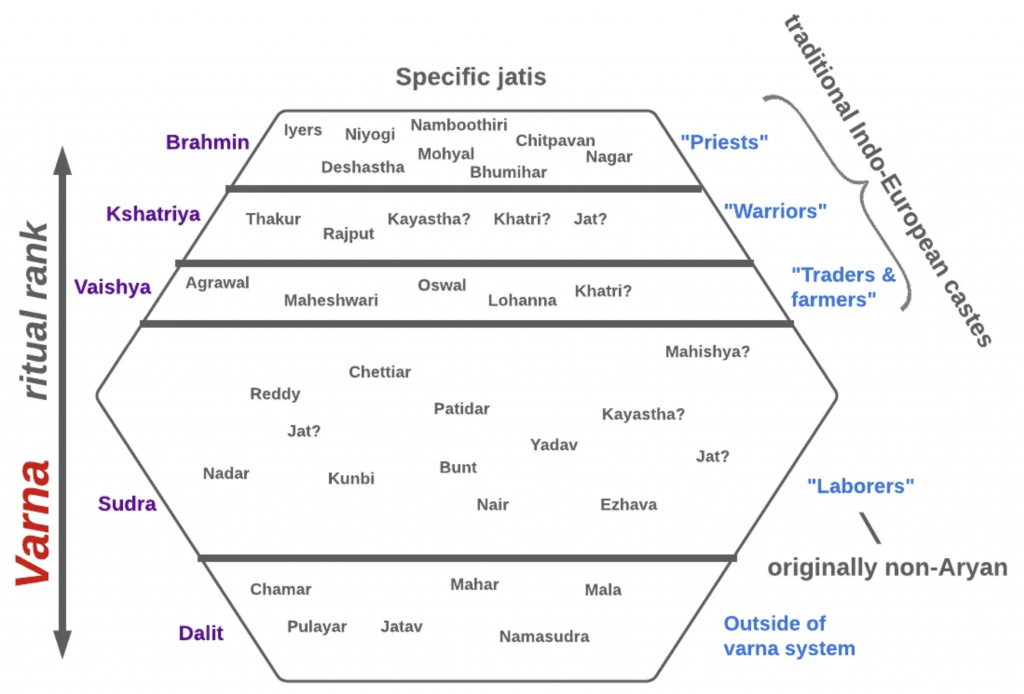
Beginning about twenty-five years ago, geneticists finally began to look at the variation within the Indian subcontinent, and were shocked by what they found. In small villages in India, Dalits, formerly called “outcastes,” were as genetically distinct from their Brahmin neighbors as Swedes were from Sicilians. In fact, a Brahmin from the far southern state of Tamil Nadu was genetically closer to a Brahmin from the northern state of Punjab then they were to their fellow non-Brahmin Tamils. Dalits from the north were similar to Dalits from the south, while the three upper castes, Brahmins, Kshatriyas and Vaishyas, tended to cluster together against the Sudras.
Some scholars, like Nicholas Dirks, the former chancellor of UC Berkeley, argued for the mobility and dynamism of the caste system in their scholarship. But the genetic evidence seemed to indicate a level of social stratification that echoes through millennia. Across the subcontinent, Dalit castes engaged in menial and unsanitary labor and therefore were considered ritually impure. Meanwhile, Brahmins were the custodians of the Hindu Vedic tradition that ultimately bound the Indic cultures together with other Indo-European traditions, like that of the ancient Iranians or Greeks. Other castes also had their occupations: Kshatriyas were the warriors, while Vaishyas were merchants and other economically productive occupations.
Brahmins, Kshatriyas, and Vaishyas were traditionally the three “twice-born” castes, allowing them to study the Hindu scriptures after an initiatory ritual. The majority of the population were Sudras (or Shudras), India’s peasant and laboring majority. Shudras could not study the scriptures, and might be excluded from some temples and festivals, but they were integrated into the Hindu fold, and served by Brahmin priests. A traditional ethnohistory posits that elite Brahmin priests and Kshatriya rulers combined with Vaishya commoners formed the core of the early Aryan society in the subcontinent, with Shudras integrated into their tribes as indigenous subalterns. Outcastes were tribes and other assorted latecomers who were assimilated at the very bottom of the social system, performing the most degrading and impure tasks.
The caste system as a layered varna system with five classes and numerous integrated jati communities.
Razib KhanThis was the theory. Reality is always more complex. In India, the caste system combines two different social categories: varna and jati. Varna derives from the tripartite Indo-European system, in India represented by Brahmins, Kshatriyas, and Vaishyas. It literally translates as “color”, white for Brahmin purity, red for Kshatriya power, and yellow for Vaishya fertility. But India also has Shudras, black for labor. In contrast to the simplicity of varna, with its four classes, jati is fractured into thousands of localized communities. If varna is connected to the deep history of Indo-Aryans and is freighted with religious significance, jati is the concrete expression of Indian communitarianism in local places and times.
Comments Off on DNA and India’s caste system
QotD: The ambitious Roman’s path to glory and riches
The Romans, for one, admitted all the time that they screwed up … to themselves, in private (what passed for “private” in the ancient world, anyway). A big reason an ambitious man (a redundancy in ancient Rome) wanted to climb the cursus honorum was because that was the easiest way to get a field command, which was the easiest way to start a war with someone, which was the easiest route to riches and glory … provided you didn’t fuck it up. But if you did, the best thing to do was to go down fighting with your legions, because the minute you got back to Rome, there’d be ambitious men (again: redundant in context) lined up from here to Sicily waiting to prosecute your ass for something, anything — “losing a war” wasn’t a crime in itself, but whatever the official charge (usually “corruption” or “misuse of public funds” or something), everyone knew you were really getting punished for losing.
At no point, however, did the putative justification for war come into play. Picking a war with the Parthians wasn’t bad in itself. Nor was “picking a war with the Parthians because you gots to get paid”. Certainly picking a war with, say, the Gauls wasn’t bad in itself, and “picking a war with the Gauls because I need to capture and sell a few thousand slaves to cover my debts” was so far from being bad, guys like Caesar, if I recall my Gallic Wars correctly, openly declared it from jump street. And though Caesar surely would’ve been prosecuted if he’d lost, and Crassus if he’d lived, suggesting that anyone owed an apology to the Gauls or Parthians would’ve gotten you locked up as a dangerous lunatic.
A confident, manly power might lose a war or two. Hell, they might lose a bunch — the Romans got beat all the time, and so did the British. But no matter how bad the loss, or how embarrassing the peace treaty, they shrugged it off. You win some, you lose some, and when it’s clear you’re going to lose — or when it becomes clear that there’s no possible way “victory” will ever be worth the cost — you cut your losses and came home. HM forces, for instance, lost no less than three wars in Afghanistan. And so what? Great Britain was still the world’s preeminent power. They never even dreamed of apologizing — that’s the Great Game, old sock.
Severian, “Friday Mailbag / Grab Bag”, Rotten Chestnuts, 2021-07-23.
Comments Off on QotD: The ambitious Roman’s path to glory and riches
April 29, 2024
“The disaster at Imphal was perhaps the worst of its kind yet chronicled in the annals of war”
Dr. Robert Lyman makes the case for the Japanese defeat at the battles of Imphal and Kohima being one of the four great turning points in the Second World War:
It is clear to me that the great twin battle of Imphal & Kohima, which raged from March through to late July 1944, was one of four great turning-point battles in the Second World War, when the tide of war changed irreversibly and dramatically against those who initially held the upper hand.
The first great turning point was arguably at Midway in June 1942 when the US Navy successfully challenged Japanese dominance in the Pacific. The second was at Stalingrad between August 1942 and January 1943 when the seemingly unstoppable German juggernaut in the Soviet Union was finally halted in the winter bloodbath of that city, where only 94,000 of the original 300,000 German, Rumanian and Hungarian troops survived. The third was at El Alamein in October 1942 when the British Commonwealth triumphed against Rommel’s Afrika Korps in North Africa and began the process that led to the German surrender in Tunisia in May 1943. The fourth was this battle, that at Kohima and Imphal between March and July 1944 when the Japanese “March on Delhi” was brought to nothing at a huge cost in human life, and the start of their retreat from Asia began. Adjectives such as “climactic” and “titanic”, struggle to give proper impact to the reality and extent of the terrible war that raged across the jungle-clad hills during these fearsome months.
That the Japanese were contemplating an offensive against India in early 1944 was a surprise to Allied planners, who had given no thought to its possibility. By this time Japan had reached the apogee of its power, having extended the violent reach of its Empire across much of Asia since it launched its first surprise attacks in late 1941. Its initial surge in 1942 into what was briefly to be Japan’s “Greater East Asia Co-Prosperity Sphere” was as dramatic as it was rapid and two years further on several millions of peoples across Asia laboured under its heavy yoke. But by early 1944 the tide had turned decisively in the Pacific, the American island-hopping advance reaching steadily but surely towards Japan itself, its humiliated enemies fighting back with desperation, and with every ounce of energy they could muster. They were beginning to prevail in the fight although the struggle on the landmass of Asia was a strategic sideshow in the context of a global conflict: at this time the British and American High Commands were totally occupied with Europe and the Pacific. The British and Americans were preparing for D Day. The Soviets were advancing in Ukraine. There was a stalemate in Italy at Monte Cassino. The Americans were preparing to land in the Philippines. Germany and Japan were both in retreat, but not defeated. In this global context India and Burma appeared strategically peripheral, even inconsequential. Yet in this month, at a time when on every other front the Japanese were on the strategic defensive, Japan launched a vast, audacious offensive deep into India in an attack designed to destroy for ever Britain’s ability to challenge Japan’s hegemony in Burma.
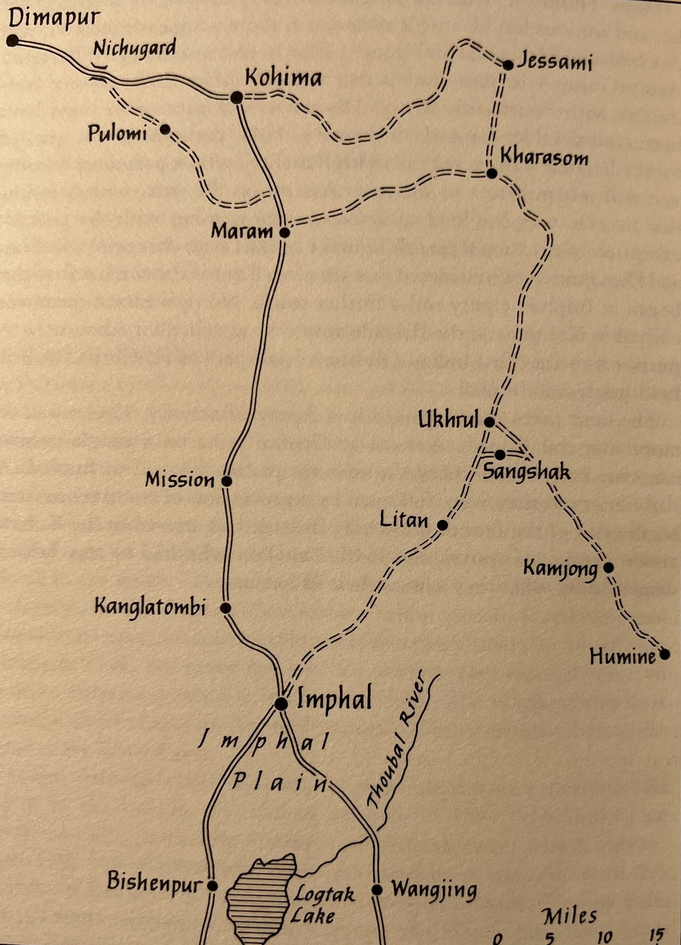
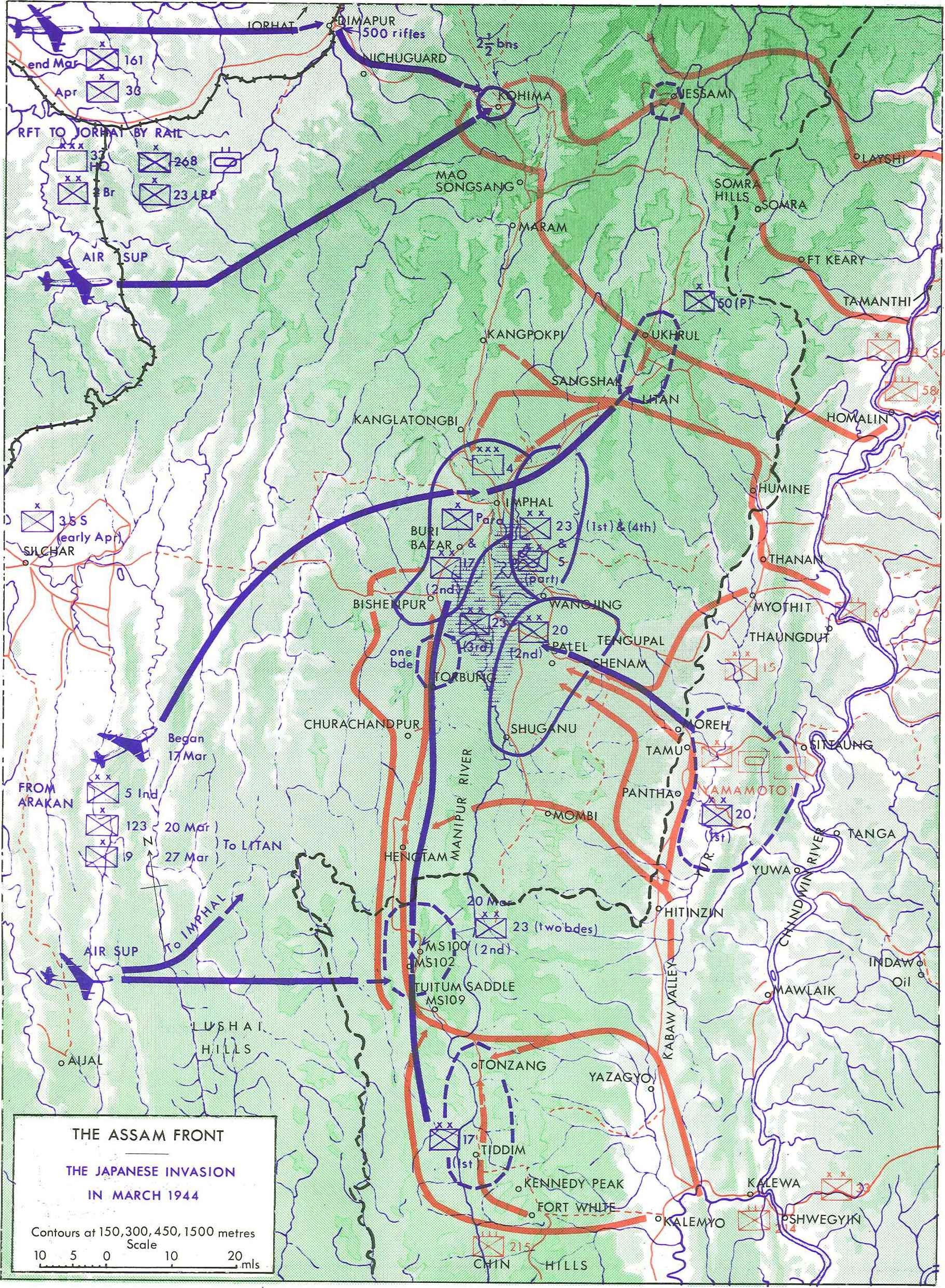
The Japanese commander was General Mutaguchi Renya, a gutsy go-getter who had played a significant role in the collapse of Singapore in February 1942. His evaluation of the British position in northeast India revealed that the three key strategic targets in Assam and Manipur were Imphal; the mountain town of Kohima, and the huge supply base further back on the edge of the Brahmaputra Valley at Dimapur. If Kohima were captured, Imphal would be cut off from the rest of India by land. From the outset Mutaguchi believed that with a good wind Dimapur, in addition to Kohima, could and should be secured. He reasoned that capturing this massive depot would be a devastating, possibly terminal blow to the British ability to defend Imphal, supply the Americans in Northern Burma under Vinegar Joe Stilwell, support the Hump airlift into China and mount an offensive into Burma. It would also enable him to feed his own, conquering army, which would advance across the mountains from the Chindwin on the tightest imaginable supply chain. With Dimapur captured, the Japanese-led Indian National Army under the Bengali nationalist Subhas Chandra Bose could pour into Bengal, initiating the long-awaited anti-British uprising.
(Click to enlarge)
The essence of the battle for India in 1944 can be quickly told. Mutaguchi’s 15th Army advanced in four separate columns into Manipur. The Japanese made determined, even desperate, efforts to seize their objectives: in the north Kohima, with a scratch British and Indian garrison of 1,200 trained fighting soldiers – about two thirds of them Indian – was attacked by an entire division of about 15,000 men in early April. Surrounded and slowly forced back onto a single hill they were supplied by air until relief came on 20 April, although the battle to dislodge the Japanese from Kohima continued bloodily, in appalling weather and battlefield conditions – the annual monsoon was in full spate – through to early June. Further south the Japanese plan entailed attacking Imphal from north, east and south. The plan of the commander of the 14th Army, Lieutenant General Bill Slim, was to withdraw his forces into the hills and there to allow the Japanese to expend themselves fruitlessly against well-supplied and aggressive British bastions, equipped with tanks, artillery and supported by air. The battle for Imphal in Manipur and for Kohima to the north-west in the neighbouring Naga Hills settled down to a bloody hand-to-hand struggle as the Japanese tried to gain the foothold necessary for their survival. They travelled lightly, and reserves soon exhausted themselves and further supplies were almost non-existent. Just as the air situation was becoming critical for Slim through poor weather and shortages of aircraft the relieving division from Kohima – the British 2nd Infantry Division that had last seen action at Dunkirk – began fighting its way towards Imphal, and the four beleaguered divisions began to push out from the Imphal pocket. By 22 June the 2nd Division and the 5th Indian Division met north of Imphal and the road to the plain was open. Four weeks later the Japanese withdrawal to Burma began.
Of all the invading armies of history, it is hard to think of one that was repulsed more decisively, or more ignominiously, than the Japanese 15th Army launched against India in March 1944. Its defeat was not the fault of the Japanese soldiers, who fought courageously, tenaciously and fiercely, but of their commanders, who sacrificed the lives of their troops on the altar of their own hubris. The battle had provided the largest, most prolonged and most intense engagement with a Japanese army yet seen in the war. “It is the most important defeat the Japs have ever suffered in their military career” wrote Mountbatten exultantly to his wife on 22nd June 1944, “because the numbers involved are so much greater than any Pacific Island operation.” The extent of the disaster that befell the 15th Army is captured by a comment by Kase Toshikazu, a member of the wartime Japanese Foreign Office, who lamented: “Most of this force perished in battle or later of starvation. The disaster at Imphal was perhaps the worst of its kind yet chronicled in the annals of war.” The latter might better have included the caveat “Japanese” to avoid charges of exaggeration, but his comment captures something of the enormity of the human disaster that overwhelmed the 15th Army. It might more fairly be described as the greatest Japanese military disaster of all time. The Indian, Gurkha, African and British troops of this remarkably homogeneous organisation had also decisively removed any remaining notions of Japanese superiority on the battlefield.
The importance of this victory was overshadowed at the time, and downplayed for decades afterwards, by the massive victories in 1945 which brought World War II to an end in Europe and the Pacific. But this lack of publicity and of awareness does not remove the fact that, objectively speaking, the battles in India in 1944, epitomized in the fulcrum battle at Kohima, were an epic comparable with Thermopylae, Gallipoli, Stalingrad, and other better known confrontational battles where the arrogant invader became, in time, the ignominious loser.
Comments Off on “The disaster at Imphal was perhaps the worst of its kind yet chronicled in the annals of war”
Greek History and Civilization, Part 7 – Alexander
seangabb
Published Apr 28, 2024This seventh lecture in the course covers the career of Alexander the Great and its consequences for the world.
(more…)
Comments Off on Greek History and Civilization, Part 7 – Alexander
“The Earth goes around the Sun, or so they would have you believe …”
Colby Cosh on a recent “grand theory” from Andrea Matranga, an Italian economist who outlined his thoughts in a paper accepted by the Quarterly Journal of Economics, summarized in the sub-hed “Hunter-gatherers were better off than Neolithic farmers, diet-wise — until Earth was hit by seasonal extremes caused by Jupiter’s gravity”:
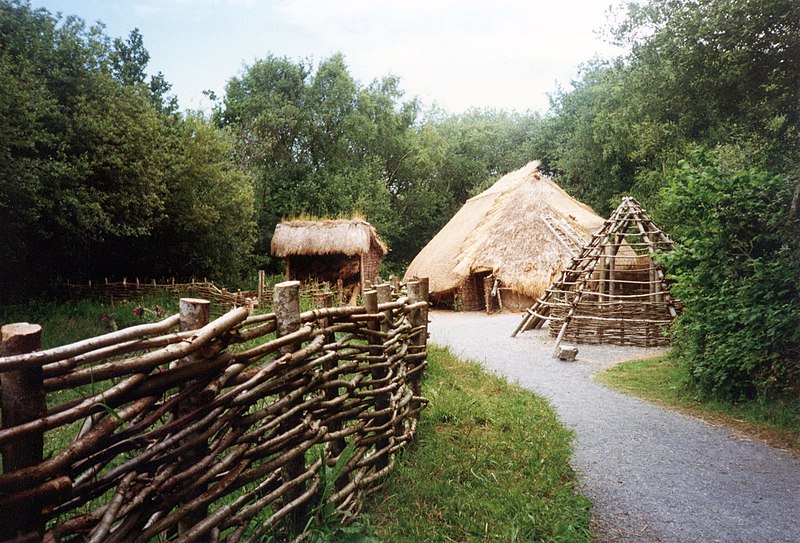
Reconstruction of a neolithic farmstead at the Irish National Heritage Park in Ferrycarrig.
Photo by Jo Turner via Wikimedia Commons.
Matranga’s own explanation for the invention of agriculture is: “Believe it or not, it is down to extraterrestrial forces”. Yes, that’s an actual quote from a cheeky Twitter thread in which Matranga summarizes his hypothesis colourfully. The real idea is that the period of the Neolithic Revolutions coincided with a time when seasonal temperature and rainfall differences were maximized by coinciding features of Earth’s orbit — features attributable mostly to Jupiter’s gravitational tug on us.
The Earth goes around the Sun, or so they would have you believe, and Earth’s rotational axis is tilted relative to the Sun, which creates the seasons. But the Earth’s motion has other subtle wobbles and shimmies caused by Jupiter: the eccentricity of its elliptical orbit grows and shrinks, and the rotational axis “precesses”, or wobbles, meaning that the face of the Earth pointing toward the Sun at our closest approach to it changes over time.
The implication of this is that over a period of millennia, and particularly in what we think of as the “temperate” zones, the magnitude of climate seasonality will itself change in a somewhat chaotic way. For some periods much longer than a human lifetime, seasonal changes might be almost beneath notice; a few millennia later, they become a dominant feature of human experience. And one hemisphere of the planet — say, the northern one — might end up with a lingering developmental advantage because it was favoured at the right moment by the precession of Earth’s axis.
Matranga pulls together a lot of math, astronomy and geography to show that the local Neolithic Revolutions coincide with maximum local seasonality, and then he builds some economic models of primitive society to suggest what effect this might have had on social organization and population evolution. Alfred Marshall would have told him to burn this part of his paper, but perhaps the equations are necessary for appearances. The crucial point is that Matranga has found a strong possible explanation for the Neolithic paradox — why, and when, humans in many places adopted a form of social organization that seems to have left most of them worse off on average.
For it’s not just the average that matters. In a world that was more or less the same year-round, hunter-gatherers didn’t have to worry about food storage: they could migrate cyclically within a small range, following wild game, to keep up with modest seasonal effects. But if the seasons then got more intense, food storage would become more important to the long-term survival of the group: one winter could now finish everyone off.
Comments Off on “The Earth goes around the Sun, or so they would have you believe …”
Battle Rifles of World War Two: Overview
Forgotten Weapons
Published Jan 26, 2024Today we are going to take a look at the three main battle rifles of World War Two — the M1 Garand, the SVT-40, and the Gewehr 43. We will also consider the SVT-38, Gewehr 41(W), and Gewehr 41(M). The United States, Soviet Union, and Germany were the three countries that fielded large numbers of semiautomatic full-power rifles in combat in WW2; how did they differ in their approaches to infantry firepower?
(more…)
Comments Off on Battle Rifles of World War Two: Overview
QotD: The draft
P.J. O’Rourke, interviewed by Scott Walter, “The 60’s Return”, American Enterprise, May/June 1997.
Comments Off on QotD: The draft
April 28, 2024
The Battle of Berlin! – WW2 – Week 296 – April 27, 1945
World War Two
Published 27 Apr 2024The battle for the German capital rages on all week, as the Soviets get ever closer to the Reich Chancellery, under which lies Hitler’s bunker. Berlin is surrounded, but can it be relieved? There are also Allied advances in East Prussia, Czechoslovakia, and in Western Germany, but beyond that, it looks like the Axis lines have completely collapsed in Italy. The Allies are also advancing — and quickly — in Burma toward Rangoon, though not much at all on Okinawa, and it is the Japanese who are on the move in Western Hunan. It’s a real rollercoaster of a week.
Chapters
01:10 Recap
01:43 Soviets fight their way into Berlin
07:45 Berlin surrounded
10:28 Rokossovsky advances
12:48 Göring and Himmler betray Hitler
13:57 Fighting on the Eastern Front
15:23 Allied advance in the West
15:51 German collapse in Italy
17:31 4th Corps racing through Burma
19:36 The Battle of Western Hunan
21:40 Okinawa and the Philippines
22:59 Notes
23:59 Conclusion
(more…)
Comments Off on The Battle of Berlin! – WW2 – Week 296 – April 27, 1945
How Britain got out of the Great Depression (and no, it wasn’t WW2)
Tim Worstall, in refuting something being pushed by Willie Hutton, explains how the British government escaped from the Great Depression and set off a nice little boom in the mid- to late-1930s:
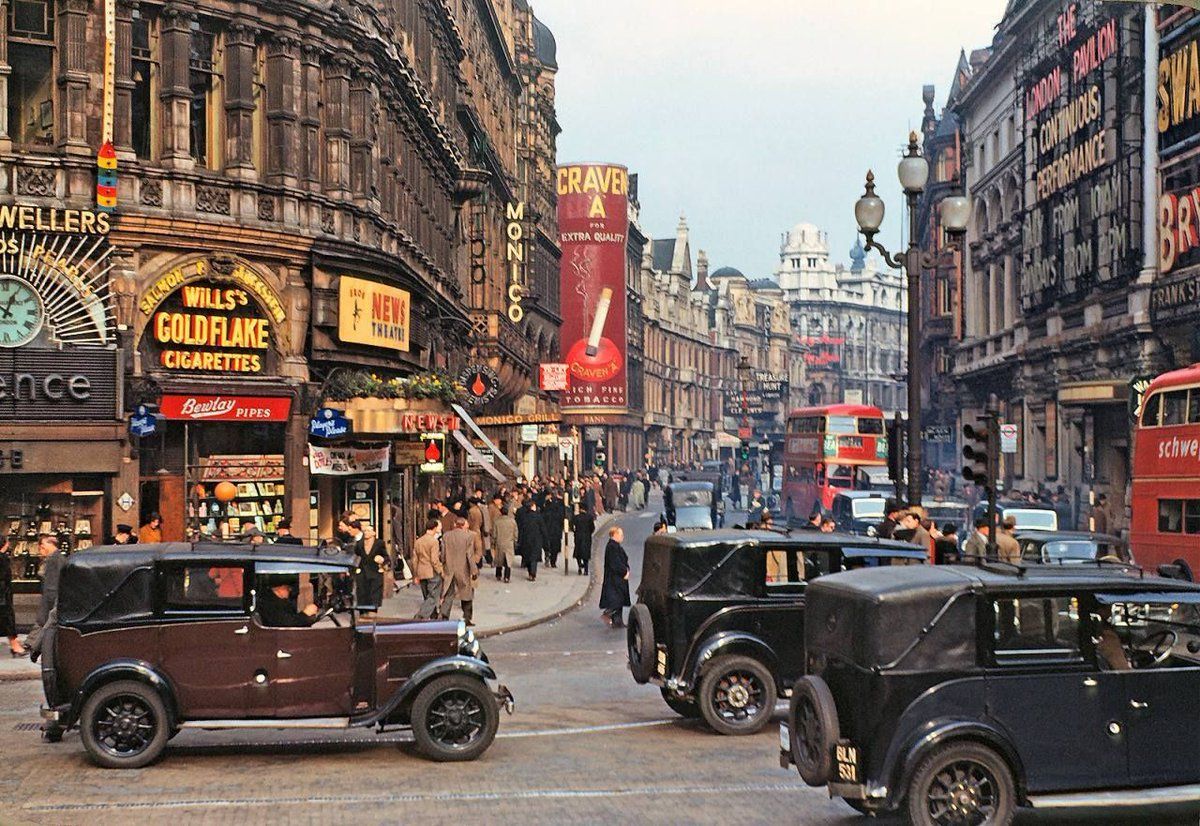
Piccadilly Circus in London, mid-1930s.
Colourized photo via Reddit.
Well, yes. Except that’s not actually what did drag Britain out of the Depression. What did was expansionary fiscal austerity. You know, that thing the Tories talked of in 2010 and which everyone laughed at? Somewhat annoyingly I was one of the very few (it’s annoying because I was clearly right in what I was saying) who pointed this out back then.
When we boil this right down it’s an argument about the effectiveness of monetary policy. Absolutely no one thinks that it has no effect. But there’s many who think that it has no effect at the zero lower bound: when interest rates are zero. That’s really the argument that leads to fiscal policy, that idea that government might tax less, or spend more, blow out that deficit and get the economy moving again. We’ve done all we could with monetary policy and we’ve still got to do something so here’s fiscal policy.
To put it as simply as possible. We’ve two major macroeconomic tools, monetary policy and fiscal. The first is interest rates, exchange rates and money printing and so on. The second is the difference between taxes collected and money spent by government — the government deficit or surplus (note, please, for purists, this is being very simple).
OK, either lever or tool can be used to loosen conditions — gee stuff up — or tighten them. Which we use when is somewhere between a matter of taste and necessarily correct given the circumstances. But clearly the total amount of geeing up out of a recession — or tightening to prevent inflation — or depression is the combination of the two sets of policies, applications of levers and tools.
It’s thus theoretically possible to tighten with one, loosen with the other and gain, overall, either tightening or loosening. Depends upon how much of each you do.
Britain in the 30s tightened fiscal policy. The opposite of what the Keynesians said, the opposite of what the US did and so on. Cut — no, really cut, not just slowed the increase in — government spending and thereby cut the government deficit (might, actually, have gone into surplus, not sure). This is, according to the Keynesian line, something that should make the recession/depression worse.
But at the same time they came off the gold standard — Churchill had taken us back in in 1925 at far too high a rate — and lowered interest rates. That’s a loosening of monetary policy.
As it happens, on balance, the monetary was loosened more than the fiscal was tightened and so we have expansionary fiscal austerity. Which set off a very nice little boom in fact. The mid- to late- 30s in Britain were economic good times. Driven, nicely driven, by a housebuilding boom — the last time the private sector built 300 k houses a year in fact (this is before the Town and Country Planning Act stopped all that). Mixed in was that the motor car was becoming a fairly standard bourgeois item and so housing spread out along the roads.
Comments Off on How Britain got out of the Great Depression (and no, it wasn’t WW2)
Look at Life – The Car Has Wings (1963)
Classic Vehicle Channel
Published Apr 19, 2020Transporting cars by sea, air and rail. This film features wonderful traffic archives.
Comments Off on Look at Life – The Car Has Wings (1963)
April 27, 2024
Floating Fun: The History of the Amphibious Boat Car
Ed’s Auto Reviews
Published Aug 9, 2023A classic car connoisseur dives into the general history of amphibious cars and vehicles. When did people start to build boat-car crossovers? What made Hans Trippel’s Amphicar 770 and the Gibbs Aquada so special? And why don’t you see a lot of amphibious automobiles out on the road and water these days?
(more…)
Comments Off on Floating Fun: The History of the Amphibious Boat Car
QotD: Roman magistrates during the middle Republican period
Similar to the magistrates in the Greek polis, Roman magistrates should not be thought of as bureaucrats within a unitary governing institution. Rather each magistrate is an independent actor, granted certain powers to oversee the public interest in a specific field. This is perhaps even more true of Roman magistrates, who rarely function as “boards” the way Greek magistrates often do (none of the senior magistrates in Rome function as a board, they are all individual actors). Instead of having an chief executive (like a president or prime minister) to coordinate the different actions of government, the Romans in the Middle Republic instead rely on the Senate, which will be our topic for next week, though the Senate’s guidance is going to show up a fair bit here as well.
Each of these offices has a range of functions and some interesting powers and prerogatives, so it is worth discussing each one in turn.
Bret Devereaux, “Collections: How to Roman Republic 101, Part IIIa: Starting Down the Path of Honors”, A Collection of Unmitigated Pedantry, 2023-08-11.
Comments Off on QotD: Roman magistrates during the middle Republican period
April 26, 2024
The British Army from the start of the Cold War
Dr. Robert Lyman discusses the state of the British Army through the Cold War years down to today, with emphasis on the defence budget tracking against perceived threats to the UK and allies over that period:
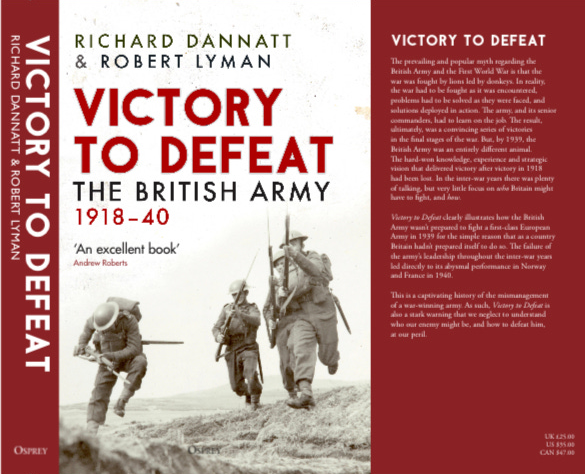
Last year General Lord Dannatt and I published an account of the British Army between 1918 — when it achieved a great victory — and 1940, when it did not. The book was written in part to challenge the UK to think seriously about what happens when our country neglects the requirement for an army able to fight at a high-intensity for a prolonged period against a peer adversary.
Part of our argument was to look at the amount of money the country spends on its defence as a barometer of the seriousness or otherwise of our political masters towards spending money on the primary duty of government, namely the security of its citizens. Our fear is that in the rampant feel-goodery that has plagued the West since 1991 the harsh realities of our unstable world have become forgotten. It has taken Putin’s invasion of Ukraine, and Russia’s subsequent bludgeoning of that benighted country for politicians to gradually wake up to the scale of the threat that this sort of instability offers to the world, not merely Europe or the West.
My fear, like that of many others, is that the wake-up call is taking too long and our country’s defences remain in a parlous state. We haven’t had an army able to deploy at divisional level or above in sustained all-arms manoeuvre for perhaps ten years or more. In other words, our ability to provide what our forefathers would have described as a robust “continental commitment” is almost non-existent.
In the book we trace the origins of the failure to think seriously about the need to have a deployable, expeditionary army, able to fight and operate alongside its allies in NATO on an all-arms battlefield. The reality is that the Cold War forced Britain to retain the ability to fight a general war in Europe, all the while finding the resources to undertake its other commitments across the world. Although worldwide events were dynamic from 1945 to 1989 with further conflicts for the United Kingdom in Malaya, Dhofar, Cyprus, Kenya, Borneo, the Falklands, and the long-running Troubles in Northern Ireland, it was the Cold War in Europe that principally drove the defence agenda and kept the budget at around 5 per cent of GDP. As the major bridge between the United States and Europe, the Royal Navy was heavily committed above and below the surface of the Atlantic Ocean to keep open the sea lines of communication to NATO’s dominant partner, while the British Army retained some 55,000 troops in four armoured divisions as part of NATO’s Northern Army Group and the Royal Air Force was also largely forward-based in West Germany as part of the Second Allied Tactical Air Force. These conventional deployments were all conducted under the nuclear umbrella of Mutual Assured Destruction. By the 1980s, with the West under the leadership of US President Ronald Reagan and British Prime Minister Margaret Thatcher and with increased spending on both conventional armaments and the highly experimental Inter-Continental Ballistic Missile Defence system, the strain of strategic military competition began to show on the political and economic stability of the Soviet Union. Despite the perestroika political movement for reform within the Communist Party of the Soviet Union and the associated openness of glasnost under General Secretary Mikhail Gorbachev, the cracks in the Berlin Wall that opened on 9 November 1989 led inexorably to the collapse of the Soviet Union two years later and the old flag of Russia being raised over the Kremlin on 26 December 1991. The Cold War was over, and an apparent New World Order had begun. The historian Francis Fukuyama declared – somewhat ambitiously – the end of history.
It was at this point that international leaders and their finance ministers in the West began to overlook the cautionary tale that the history of the 20th century might have taught them. With the Soviet Union gone and rump Russia apparently enfeebled, Western states eagerly embarked on military reduction and a peace dividend. In the United Kingdom, the “Options for Change” exercise saw a major slashing of defence capability, beneficially coincidental to help ameliorate a significant economic downturn. The British Army was reduced from 155,000 to 116,000 soldiers, notwithstanding the first Gulf War of 1990–91 which many wishful thinkers regarded as something of an aberration. However, despite that war and the subsequent deployment of large parts of the armed forces to Bosnia from 1992 and then to Kosovo in 1999, the new Labour government of Prime Minister Tony Blair continued with the implementation of its Strategic Defence Review of 1997–98. As a piece of policy work, this was considered an honest review of the United Kingdom’s defence policy and a progressive blueprint for future defence planning and expenditure. Endorsed by Tony Blair and the Chiefs of Staff, this review might have stood the nation in good stead for the future had the Chancellor of the Exchequer, Gordon Brown, fully funded its outcome. For his own reasons, he chose not to do so. The underfunding of the United Kingdom’s defence capability began to show its deficiencies a year after with the second Gulf War of 2003, and the situation was then exacerbated by a protracted campaign in Iraq for the British Army lasting until 2009 and an even more intense one in Afghanistan lasting until 2014.
Comments Off on The British Army from the start of the Cold War


