
The Commies weren’t big on consumer goods for obvious reasons, but even the proles need shoes. If you’re a Communist (or a teenager), it seems simple enough: send your flunkies out into a region, have them write down everyone’s shoe sizes, and then make those. Which would work, I guess, if not for the fact that industry doesn’t operate that way. Industries are only efficient through economies of scale. “A shoe factory” only beats “a cordwainer” because the factory can crank out 10,000 pairs of shoes in the time it takes the cordwainer to produce one pair. Worse, factories are massive resource sinks if they’re not running at full blast at all times …
After trying several workarounds, GOSPLAN, the state production ministry, decided to use “Gross Output Targets” to produce goods. Which probably worked ok for stuff like rebar, if you don’t care about quality (see Mao’s DIY backyard blast furnaces), but is terrible for stuff like shoes. So let’s say GOSPLAN decides that 100,000 lucky proles of Irkutsk Oblast shall receive one pair of shoes apiece. Since all materials had to be requisitioned in advance from GOSSNAB (I confess: I love Soviet acronyms), and since the production line would need to be re-tooled for each individual size and style of shoe, the factory managers — who had to hit the Gross Output Target, or go tour Siberia — did the only logical thing: They cranked out 100,000 baby shoes, all left feet. (Baby shoes use less leather; the excess can be sold or traded, see below).
Again, Commies couldn’t care less about consumer complaints, but eventually some up and comer in the Party will notice that everyone is wandering barefoot around a big pile of baby shoes. That might make him look bad, so he sends a report, and, after a long and convoluted bureaucratic process, GOSPLAN revises their order: 100,000 pairs of shoes, but in different sizes and styles, for men and women. In response to which, the factory manager does the only logical thing: 99,999 pairs of baby shoes, all left feet, plus one pump and one wingtip.
Lather, rinse, repeat. The factory manager isn’t a bad guy — in fact, let’s say he’s Wyatt. He’s just operating on an entirely different incentive structure than even his immediate boss, to say nothing of the faceless apparatchiks at GOSPLAN. Hitting any Gross Output Target is a real task, given that his workforce is a bunch of illiterate peasants who hate him and are constantly drunk. What probably seems like spectacularly inventive cruelty to the proles of Irkutsk Oblast is just Wyatt doing everything he can to keep his family out of the Gulag. And since Wyatt’s a smart guy, he can get around any target GOSPLAN sets. If they tell him to produce 100,000 pounds of shoes, his factory cranks out one enormous pair of concrete sneakers.
That’s one of Wyatt’s two overriding priorities: Staying out of the Gulag. The other one is: Using whatever he can scrimp, save, or scrounge from GOSSNAB as trade goods in the black market.
Here again, Wyatt’s not a bad guy. He’s not doing this to feather his own nest (though of course he lives a little better than others; he’s only human). In the words of the immortal Mike Tyson, everyone has a plan until he gets punched in the mouth, and even the most meticulously “scientific” management gets punched in the mouth all the time. As we’ve seen, GOSPLAN can’t even get it right with something as low-tech, as easy to mass-produce as shoes, so imagine how they do with more complex bits of equipment. The factory managers, who have to hit the Gross Output Targets, no matter what, quickly figure out that they’ll be waiting until doomsday if they try requisitioning what they need from GOSSNAB, so they form a kind of black market between themselves. Indeed there’s an entire class of quasi-criminals, whose name I forget, that exists only to facilitate such transactions.
Extend that paradigm to everything, and you’ve got life in the USSR. There’s the “official” economy, which is pure fantasy. There’s the black market economy at the factory level, where bulk materials change hands (since the official economy is pure fantasy, nobody blinks an eye when, say, 100,000 metric tons of concrete disappears off a manifest somewhere and reappears, un-manifested (as it were), somewhere else). There’s the black market at the consumer level, since of course the poor proles of Irkutsk Oblast have to have shoes and there’s no way they’re getting them from Wyatt’s factory. And finally, there’s the black market at the service level — those go-betweens arranging for 100,000 metric tons of concrete to fall off a truck in Vladivostok and appear, like magic, in Kiev (and their consumer-level equivalents — think pimps, but for everything).
Severian, “Darker Shade of Black IV: Black Market”, Rotten Chestnuts, 2021-04-02.
November 7, 2021
QotD: Shoe manufacturing in the Soviet Union
November 6, 2021
Canadian flag shenanigans still not resolved, kinda
For non-Canadian readers (which last time I bothered to check were the absolute majority of readers), it’s perhaps not clear why flying of the Canadian national flag is an ongoing issue here in the dysfunctional Dominion. In short, Prime Minister Trudeau ordered the flag to be flown at half-staff at federal government and military sites after the publicization of unmarked graves of First Nations children who died during their stay at various residential schools across the country. (I must note that this wasn’t actually unknown beforehand … it just got enough media attention that PM Look-at-my-socks Photo-op decided it was a good idea to ostentatiously pretend that this was previously unknown and (to some) provided further evidence of the “ongoing genocide” of Canada’s problematic relations with First Nations people. The flag-lowering was ordered in May and no end date was specified to the observance. Like ritualistic “land acknowledgements” this did absolutely nothing to actually improve the living conditions of any members of First Nations bands, but was balm to the soul of virtue-signallers across the country. In Friday’s NP Platformed newsletter, Colby Cosh updates us on the state of play:

This morning the Assembly of First Nations (AFN) made its much-anticipated move in the chess game that has developed over the display of the Canadian flag on federal government buildings. As you will recall, the flags on all these buildings, including those abroad, were lowered to half-mast in May, when unmarked graves were discovered on the site of a former residential school in Kamloops, B.C., and have stayed there ever since. The prime minister said then that, although the lowering of the flags is his exclusive responsibility, he wouldn’t allow them to be flown normally again until “Indigenous communities and leadership” agreed that they could go back up.
Was this elliptical, confounding phrase intended to refer to the AFN? We wondered at the time who was capable of giving the necessary permission, if not the AFN: it appears, quite naturally, to have accepted the position, which is bound to be controversial if made explicit, that it is the exclusive political instrument for Indigenous communities.
In any case the AFN announced its solution to the stalemate this morning. Its executive committee, after consulting with elders, suggests raising the Maple Leaf on Sunday alongside an orange “Every Child Matters” banner. Both flags would go to half-mast on Monday, Nov. 8, this being Indigenous Veterans Day. The flags then go back up, and the Canadian one comes down again on Nov. 11, according to the usual tradition. From then on, both flags fly until “all of our children are recovered, named and symbolically or physically returned to their homelands with proper ceremony.”
There are Canadians who have no use for a national flag; some, no doubt, dream of carrying national self-abnegation to the point of having a fully transparent flag. But even these progressives would have to admit that it is hard to imagine a sequence of events allowing some future prime minister and some future AFN executive to get together and say, “Great job, everybody, the orange one can come down now.” This is a proposed permanent adoption of two national flags (and who is to say it won’t catch on among private citizens?). Yet it could still be argued that the AFN is letting the prime minister off the hook lightly, in exchange for a symbolic political victory of its own.
With the approach of Remembrance Day, the flag flying at half-mast was becoming a symbol, not of Canadian remorse, but of one politician’s daft impulsiveness and inability to act with even the immediate future in mind. As much as some approved of the original gesture, the prime minister should never have been allowed to treat the flag as personal property or as a subject for political negotiation.
In what other country would this be contemplated? Where else could a head of government do something like this without being warned or grimaced at or, outside the pages of the National Post, castigated very much? Indeed, how was this particular power of jerking the flag up and down on government buildings ever assigned to a prime minister in the first place? It is a little anomalous that this file doesn’t belong to the Governor General, who wrangles other flag-like symbols like medals and heraldry.
November 4, 2021
QotD: The “Righteousness Fallacy”, California style
The Righteousness Fallacy (also known as the fallacy of good intentions) is described by author Dr. Bo Bennett as the idea that one is correct because their intentions are pure.
It recently occurred to me that California is a perfect example of this fallacy. Consider these three facts about the Golden State:
- California spends about $98.5 billion annually on welfare — the most in the US — but has the highest poverty rate in America.
- California has the highest income tax rate in the US, at 13.3 percent, but the fourth greatest income inequality of the 50 states.
- California has one of the most regulated housing markets in America, yet it has the highest homeless population in American and ranks 49th (per capita) in housing supply.
That politicians would persist with harmful policies should come as little surprise. The Nobel Prize-winning economist Milton Friedman once observed the uncanny proclivity of politicians “to judge policies and programs by their intentions rather than their results”.
In his book Capitalism and Freedom, Friedman described the danger of such thinking.
[The threat comes] from men of good intentions and good will who wish to reform us. Impatient with the slowness of persuasion and example to achieve the great social changes they envision, they’re anxious to use the power of the state to achieve their ends and confident in their ability to do so. Yet … Concentrated power is not rendered harmless by the good intentions of those who create it.
Jon Miltimore, “Data Show California Is a Living Example of the Good Intentions Fallacy”, Foundation for Economic Education, 2019-01-09.
November 2, 2021
Election day in Virginia
Mark Steyn writing about the Tuesday state elections being held in Virginia, which certainly seemed to become much more competitive as larger concerns about the school system energized a lot of parents, and a Republican-in-name-only group plays dirty tricks on the Republican candidate for governor:
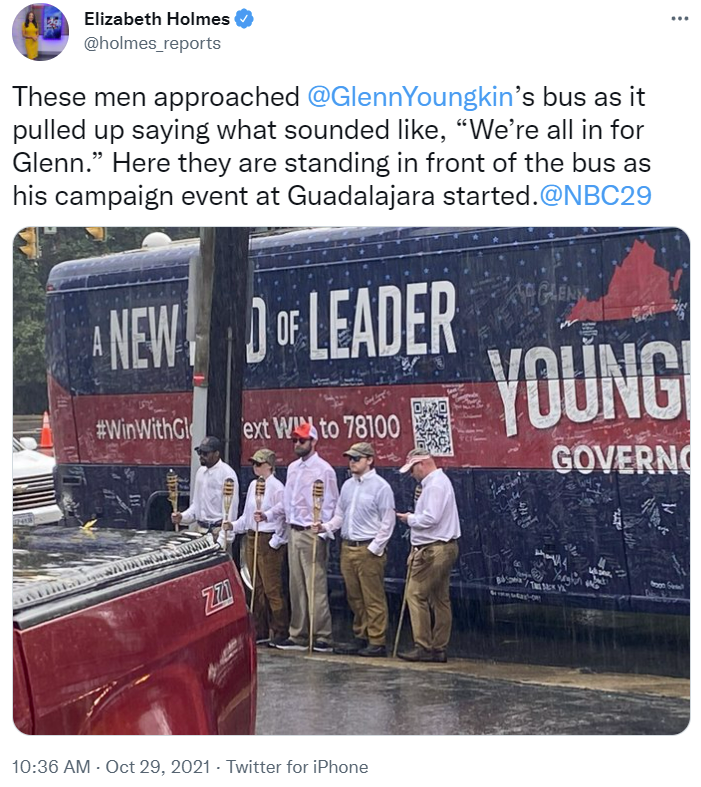
“Republican” group trolls Republican candidate in the Virginia election campaign, October 2021.
Tuesday is what less evolved societies than Virginia still quaintly call “Election Day”. The Democrat candidate, the unlovely Clinton bagman Terry McAuliffe, claims that “we are substantially leading on the early vote”. In the fullness of time he will also be substantially leading on the late vote, if he isn’t already.
That leaves the votes on Voting Day up for grabs. The Republican candidate, Mr Youngkin, is a squish of no fixed beliefs who will govern as Mitt did in Massachusetts or Pataki did in New York. But he has been handed a winning issue that he would probably not have chosen save for public outrage — the state of Virginia schools in an age of “critical race theory” and trans-mania. It’s bigger even than an education issue: The left is so boundlessly ambitious that it is abolishing biological sex, and if it gets away with it will leave an awful mountain of human wreckage in its wake, bigger even than its other innovations.
Every Virginian should vote on Tuesday — because Youngkin’s campaign is a classic example of Milton Friedman’s dictum: in politics you don’t wait for the right people to do the right thing, you create the conditions whereby the wrong people are forced to do the right thing. That is what parents at school-board meetings have been doing, and they deserve to be rewarded for it.
Virginia is a state where a rapist gets transferred to another school because he/she belongs to a protected class, rapes again, and, when you protest the anal rape of your daughter by a known rapist, you’re the guy who gets thrown to the ground and arrested. Whether one finds the foregoing objectionable shouldn’t really be a Republican/Democrat thing, but such is the moral depravity of the cultural heights that Dems are all in on the convicted sodomizer and only squaresville low-status GOP candidates can muster even pro forma objections. So in 21st-century Virginia insouciance about schoolgirl anal rape is now a partisan thing.
Of course, it remains to be seen whether the state’s election system is sufficiently honest to reflect fairly that public outrage. If at, say, 10pm on Tuesday night Youngkin is narrowly ahead but you wake up on Wednesday morn to find McAuliffe has been the beneficiary of all the 3am votes, well, Republicans will be forgiven for suspecting that “fortifying” the “two-party system” into something rather more streamlined is here to stay.
I say that as an immigrant who never feels more foreign than on America’s hideously chaotic yet oddly purposeful election nights. But then in Northern Virginia a quarter of the population is now foreign-born, and half of those arrived in the last twenty years. That’s a remarkable statistic for a so-called “Old Dominion”. Demography is destiny, and in an ever more tightly circumscribed public discourse there are decreasing opportunities even to raise the topic.
October 30, 2021
“Pretendians” … members of the Wannabe tribe … people who fake First Nations ancestry for personal gain
I missed Thursday’s NP Platformed newsletter when it first came out, where Colby Cosh praised a CBC “longread” which dug into the oft-trumpeted heritage of a prominent Saskatchewan university official and did a thorough job of demolishing her claims to First Nations ancestry. This might have seemed unwarranted cruelty, except that those false claims had materially aided her rise to her current position with the university and the federal government:

Carrie Bourassa with media.
Lead photo in Geoff Leo’s article for the CBC – https://www.cbc.ca/newsinteractives/features/carrie-bourassa-indigenous
The result is not only astonishingly well-written and funny — it’s unanswerable. Bourassa has been caught telling utterly insupportable stories about her own past, making lurid claims of racial abuse and colonial trauma in a fanciful Indigenous household bearing no resemblance to the wealthy white one in which she actually grew up. When she got wind that the CBC was working on a story, Bourassa used the resources of the institute to organize a PR defence and arrange for an “open letter”, whose signatories are surprised and offended to find their names attached.
And if the story’s soundness is doubted, one need only refer to the rebuttal that Bourassa published yesterday. Read it and hear the scratching of ticked-off boxes. “I refuse to be victimized by this man who calls himself a journalist. This entire smear campaign stems from lateral violence … nothing less than tabloid journalism … it is apparent that I must adhere to western ideologies.”
But Bourassa’s response, while slinging the jargon generously, does nothing to refute Leo’s reporting. The Saskatchewan scholar lashes herself to the mast of a late-life Métis adoption, which does nothing to explain her tales of making mukluks and beadwork with her “half-breed” “gramps” at age seven.
No prior news item about Aboriginal stolen identity has ever been as strong and complete as this one — and that is why it is worthy of our attention, and of the resources dedicated to it. Bourassa has earned fantastic sums as a researcher and administrator of public funds. Most of this would have been utterly unavailable to her as an ordinary white social worker from the vodka-drinking parts of Saskatchewan. She is in a paramount position of importance in a national bureaucracy dedicated to Indigenous well-being and cultural preservation: her endless nose-stretchers about Aboriginal identity make her position completely untenable.
So will anything be done about it? If the federal government and the University of Saskatchewan are willing to overlook the case made here by the CBC, they will overlook absolutely anything. Falsely claiming Aboriginal descent is one sinful thing; lying floridly and repeatedly to audiences about your personal history of suffering racist treatment is another. (Can one “adopt” experiences? We suppose one can, with a little imagination!) Bourassa seems determined to fight, and to exploit her position to do it. So the institutions to which she has attached herself may have to act — or suffer a disastrous blow to their credibility among First Nations and settlers alike.
October 27, 2021
QotD: China’s single child policy
Another effect is legions of older people with not enough of a younger population to support them, a social security problem that dwarfs any such in the West.
The Chinese solution is likely to be simplicity itself: shoot the punks and let the geezers starve. Either way, it means social upheaval.
J.R. Dunn, “The Myth of China as Superpower”, American Thinker, 2019-01-09.
October 26, 2021
The Constitution of Athens
Historia Civilis
Published 15 Dec 2017Patreon | http://historiacivilis.com/patreon
Donate | http://historiacivilis.com/donate
Merch | http://historiacivilis.com/merch
Mailing List | http://historiacivilis.com/mailinglist
Twitter | http://historiacivilis.com/twitter
Website | http://historiacivilis.comSources:
The Athenian Constitution by Aristotle: http://amzn.to/2C1mHLv
Politics by Aristotle: http://amzn.to/2AB6KPV
Parallel Lives: The Life of Solon by Plutarch: http://amzn.to/2AT5Viv
The Constitution of the Athenians by Pseudo-Xenophon: http://amzn.to/2z9rE6l
The Rise of Athens by Anthony Everitt: http://amzn.to/2C2ryMu
The Athenian Democracy in the Age of Demosthenes by Mogens Herman Hansen: http://amzn.to/2AEAtYj
Persian Fire by Tom Holland: http://amzn.to/2AjLB8WMusic:
“Direct to Video,” by Chris Zabriskie
“It’s Always Too Late to Start Over,” by Chris Zabriskie
“Mario Bava Sleeps In a Little Later Than He Expected To,” by Chris Zabriskie
“Hallon,” by Christian BjoerklundWe are a participant in the Amazon Services LLC Associates Program, an affiliate advertising program designed to provide a means for us to earn fees by linking to Amazon.com and affiliated sites.
“…watching The Media spin for Brandon; it’s just so Pravda-licious”
Severian manages to find entertainment in the full-blown propagandization of “The Media”, especially during the course of the Wuhan Coronavirus pandemic:

Wuhan Institute of Virology.
Wikimedia Commons.
Back when the Kung Flu nonsense first started, I took it quasi-seriously. Let me clarify: Like America’s greatest philosopher, I assume that everything in the newspaper is 90% bullshit, and I read it because it entertains me. Nonetheless, the bullshit operates on several levels, and it’s important to distinguish between them if you want to extract more than entertainment from it. In the case of Covid, back in the earliest days, I assumed that the bullshit was more top tier — that is, that it was mostly ignorance.
Media people are stupid. We all know that, but unless you’ve been around them (or their inbred, banjo-picking cousins, academics) recently, you probably don’t realize just how stupid they actually are. Remember Michael Crichton’s bit about “Gell-Mann Amnesia“? He said that The Media are so dumb, they routinely get important things not just wrong, but completely backwards: The headline would read the equivalent of “Wet Streets Cause Rain”.
And to be fair to The Media — I know, I know, but again, if you want anything more than a chuckle from the propaganda, you must try — it really did seem to be more ignorance than anything. I’m the kind of guy who needs to pull off a sock every time he has to count past ten, but compared to everyone in The Media I’m Euclid himself. I could see right away that the numbers they were spouting would make Kung Flu exponentially more lethal than even the Black Plague, which would, you know, tend to show up on satellite reconnaissance. And since there’s this thing called “Google Earth” …
But even though I knew right away you’d need to scale back their projections by a factor of about eleventy billion, that wasn’t the end of it, because even doing the necessary mental math to scale it down by eleventy billion — take the cosine, carry the one, divide by zero — it still looked pretty bad. But not “pretty bad” in a factual way. Rather, pretty bad in a second-level bullshit way, the mere propaganda way.
Those were the days, you might recall, when — out of the blue, on a dime — the Official Story changed from “China categorically denies there’s any such thing as germs, much less this particular strain of flu” to “OMG, the Chinese are welding apartment doors shut as people keel over in the streets.” Accompanied, in some cases — and good luck finding those video clips now — with grainy little movies of obvious actors keeling over so hammily, Al Pacino himself would tell them to tone it down. Pravda et al would never have been so crude, but those guys were pros, and as bad as the USSR was, affront-to-basic-intelligence-wise, this is Clown World.
Sure enough, the stories soon came out that China had cornered the market on PPE gear. It was an obvious short con, but remember: Clown World.
This — the CCP cornering the PPE market — soon prompted the third level of Media bullshit, the ideological level. Not content to merely take orders from their Chinese paymasters, the Media, being ideology-addled prize graduates of American “higher” “education”, started taking it upon themselves to lecture us for our own good. Masks, which were once bad, were now good, and if one mask was good, then two were even better! Thus the flood of stories like the one covered at the old RC, where the woman went on about swabbing her eyelids with disinfectant and whatnot. They got their chance to hector us for our own good, and they will never turn that down.
October 21, 2021
If Quebec is the model for universal childcare services, then voters will be waiting a long, long time for that promise to be fulfilled
In The Line, Andrea Mrozek talks about the promises (mostly still unfulfilled) of Quebec’s “universal” childcare service model:

Since last month’s election, many have been asking which promises the Liberals made will prove the most difficult to keep. Put child care at the top of the list: The federal government’s five-year, $30 billion Canada-wide child-care plan is rife with complicating factors. When government officials point to Quebec as the model for the rest of Canada, what that means is a system plagued by lack of access, inequality and poor quality.
When Quebec introduced its low-user fee “universal” system in 1997, the goal was to create a centre-based, publicly-funded system for all children. Fees started at $5 a day, briefly shifting to a fee structure based on income, before settling in at the current daily rate of $8.50.
The rapid reduction in fees in only one part of the child-care sector disrupted the care options parents were using in Quebec. Private providers, who were not to be included in Quebec’s system, “understandably crumbled” after the system began. Unfortunately, the public system never picked up the slack. So the Quebec government then coaxed them back into the business of child-care provision through a system of tax credits.
Consider this: We are told publicly funded child care offered at a fixed low price for parents is the way to go across Canada. Consider further that we are told Quebec is the model for said child-care system. Then consider that between 2003 and 2021, in Quebec, public (“Centres de la petite enfance” or CPE spaces) increased by about 55 per cent, or 35,000 spaces. In the same time period, private, unsubsidized spaces increased by about 4,200 per cent or 68,500 spaces. This growth in private provision is not at all what architects of public child-care provision desire. It has, however, proved unavoidable in Quebec, precisely because provision of public spaces has been so slow. Whether it’s lack of funds, political will or some other combination of factors, Quebec has been unable over two decades to build the system of CPE’s envisioned in the mid 1990s.
None of this is a secret: The Quebec auditor general reported last fall there are “not enough spaces available in subsidized child care to meet the needs of families in Quebec.” There are 98,014 spaces in CPEs but 46,000 on a waiting list for a CPE space, as per the auditor general. Does this sound like a policy success?
Further, the waitlists are now themselves a source of inequity. The same auditor-general report highlights that in Montreal in particular, “the children of low-income families are underrepresented in (CPEs).” Previous studies showed this to be a problem across Quebec. Sociologist Rod Beaujot wrote this in a 2013 paper: “In Quebec, day care is used less by children in vulnerable environments, and the services they use are of lower quality (Giguère and Desrosiers 2011). In contrast, the higher the mother’s education, and the higher the family income, the greater the usage of child-care in the Quebec program (Audet and Gingras 2011.) While the program has provisions for disadvantaged families, it would appear that other provinces are more successful in tailoring programs to families with lower incomes.”
So, it’s another “universal” program that disproportionally benefits the wealthy and well-connected (who tend to be Liberal Party supporters and voters)? Tabarnak! Who could ever have possibly seen this coming? Oh, and the Quebec model the rest of the country is supposedly eager to adopt has literally the worst ratios of adult caregivers to children, and 81% of Quebec parents say “Finding quality child care is a way bigger hassle than it should be for parents today”, which is a higher percentage than it is in any other province.
October 20, 2021
Alberta and Quebec, the dark twins of Confederation
In The Line, Jen Gerson explains why the Alberta government is consciously taking some of its strategies for dealing with the feds and other provinces from the generations-long success that has been Quebec’s planbook:
Quebec — as the single largest recipient of equalization cash — is often a target of anger in these parts, but I’d encourage any readers from thereabouts not to read too much into this fact. Both Alberta and Quebec suffer from a culture of political grievance that feed off one another. Alberta resents the fiscal balances, often casting Quebec as an ungrateful recipient of the very oil wealth that the latter regards with contempt. And I can only imagine how Quebec must read this; as a signal of its own isolation from Anglo culture more broadly. On both sides, I see politicians who have made a generational art of milking these respective grievances.
So sometimes it’s worthwhile to point this out.
Alberta doesn’t hate Quebec.
The provinces exist on flip sides of the very same coin; they are each others’ dark twins, and Alberta seeks mostly to emulate its French sibling.
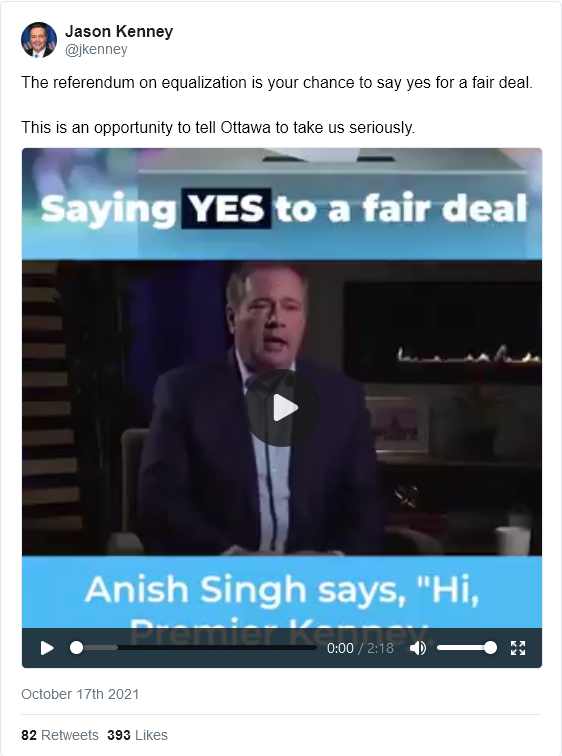
Kenney made this point entirely explicitly in the days leading up to the referendum.
“We’re using this to get leverage to basically take a page out of Quebec’s playbook in having successfully dominated the political attention of the federation for the last 40 or 50 years.”
What playbook was he referencing, here?
The answer is obvious; the separation referenda of 1980 and 1995. In fact, the whole logic of Alberta’s referenda last night was predicated on a novel reading of the Quebec Secession Reference, in which a clear majority on a clear question must force the federal government to the negotiating table in good faith. The fact that this reference spoke to a secession question — and not a longstanding quibble over an item within the constitution — is a material difference from a legal point of view, but not a psychological one.
The hope is that this referenda will give us somethin akin to the “leverage” Quebec has enjoyed vs. Ottawa since its failed separation referenda; and the disproportionate financial and cultural incentives that followed in the following decades. Essentially, Alberta is asking for the leverage of a true separatist movement without suffering the risk of actually separating. We are play-acting a little Potemkin secession referendum, here. If it falls to me to point out the show is a little childish and even a touch pathetic, well, so be it.
October 19, 2021
Sarah Hoyt on getting #teamheadsonpikes to trend
In the latest Libertarian Enterprise, Sarah Hoyt considers the people who are still desperately hoping that if they just vote harder, the next election will fix everything:
Normalcy bias is YUGE in America. It is a testament to the founders’ vision that after a century of attempts to wrench us away from a constitutional republic, after a massive, in the open election steal, people are still counting on elections to right this mess.
They’re right and wrong.
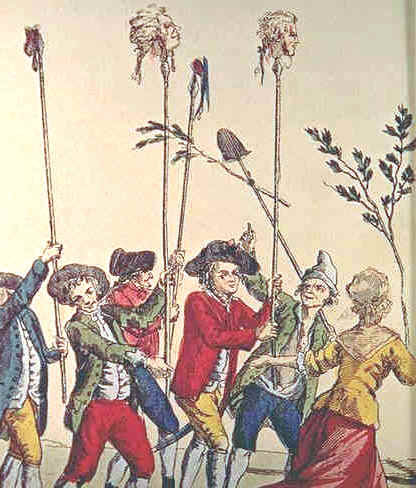
Look, I’m holding up my lighter with tears in my eyes, and whispering hopefully “Team heads on pikes”. Because I think a brief, brutal convulsion is our best hope to come back to ourselves as ourselves.
In the end we win, they lose, but the gradual road is in the end more costly. Perhaps the butcher’s bill will be hidden. You won’t see heads on pikes and bodies on overpasses. But the squid farms on Mars, the unborn babies, the uninvented conveniences, the–more costly. Because socialism kills, either fast or slow, and the longer we play footsy with it, the more lives will be lost. In that case, probably lives that don’t exist.
And frankly, though #teamheadsonpikes might not eventuate, I still see a brief and violent convulsion in our future. Understand “violent” here does not refer to the butcher’s bill. I mean, I wouldn’t want to be the Junta and their toadies, as I think there will be a few Romanian Christmas Gift events, but MOSTLY? MOSTLY there will be a lot of retirements, if we’re lucky a few prison sentences, almost for sure a lot of people taking themselves overseas for retirement (I’m hoping the Obama posse and their cronies are dumb enough to run to China. (Looks heavenward. Lord, if I’m a very good girl for the rest of my life …) our institutions will turn over so fast you’d think they were on wheels. They might retain the name but that will be the last resemblance. People will lose all faith in government (we’re mostly there) and this bizarre idea of scientific governance will be finally put to bed with a shovel. About 100 years after it should have been, but hey.
Why do I think that? Why do I expect an uprising at all? Americans are supine and taking it and reeeeeeeee.
Will someone PLEASE get me my eyes? The cats aren’t here, but the floor is covered in dust and paint chips. That can’t be good.
Two things: Normalcy bias. As I said, most people who aren’t political animals (Party like it’s 1776, yo) are still waiting for the elections to fix everything. Hell, I’ve seen people who are political animals waiting for it. And the left is lying to itself very hard and half believes their wins are legitimate. (AH!)
And: IF there is a rebellion and the news doesn’t report it, would you know about it?
Hell, the world has been in more or less open rebellion for 5 years, and our news sits on it, like it’s their favorite thumb. And most people don’t see it, except for things like Brexit, or Trump’s election. Ask them about German farmers driving their tractors to city hall and they’ll look at you like you’re nuts.
So now?
October 17, 2021
QotD: Like Justin Trudeau, too many western politicians admire China’s “basic dictatorship”
Then there is the Chinese government’s ability to surveil and control their people – for their own good, of course. How many over here would love a Social Credit System, where they can reward and punish people according to government’s priorities, from environmentally-conscious behaviour to public health considerations. In democracies, the people rate their leaders; in China the leaders rate their people. Just imagine how much more effectively our governments and health authorities would be able to to deal with all of us during the current pandemic if they could “see” and “nudge” every individual at every moment and in every situation. The most dangerous virus to come from China recently is not COVID, it’s “socialism with Chinese characteristics” with its siren call of unrestrained power for large sections of our political and economic elites.
Arthur Chrenkoff, “World hearts commies”, The Daily Chrenk, 2021-07-01.
October 16, 2021
Alberta’s Equalization referendum is “political theatre, and it’s poorly timed political theatre at that”
The province of Alberta is unhappy with the current federal-provincial equalization arrangement. This is not new … it’s been the case off-and-on for most of my life, but this year the province is undertaking a formal referendum on the issue, as Jen Gerson explains in The Line:

Let’s start with all the usual but necessary rigmarole about the Alberta referendum on equalization: a “yes” vote won’t peel equalization from the constitution; even a resounding victory may not actually force the federal government to sit with the province of Alberta to discuss the matter. I mean, it might: this was Ted Morton’s idea, and his argument. That Alberta can force Ottawa and the provinces to engage in some kind of open-hearted exchange by piggybacking on the Quebec Secession Reference is not totally impossible, I guess.
As this Fraser Institute bulletin by Rainer Knopff points out, that reference is specific to questions of, well, secession and probably can’t be re-applied willy nilly to any old provincial grievance. However, Knopff goes on to note that the referendum is necessary to create a provincial legislative resolution on the matter, which would allegedly trigger some kind of duty to negotiate — although certainly no duty to come to an agreement that Alberta would find acceptable.
Most credible individuals begin to handwave furiously when asked to nail the technical legal details about how we’re going to make Ottawa cede a damn thing. Even Morton had to point out that the referendum’s greatest power lies in granting Alberta “moral force” on the question.
In other words, it’s political theatre, and it’s poorly timed political theatre at that.
Equalization is a perennial complaint in Alberta, and not one totally without merit. Although the province doesn’t cut Ottawa some kind of novelty-sized equalization cheque at tax time, we are a comparatively wealthy province, which means the province traditionally sends more money to the federal government through its income and business tax remittances than it receives in rebates and services. There is a sense of injustice, here, which notes that equalization-receiving provinces offer services like cheap daycare, and are now racking up rainy day funds as Alberta falls ever deeper into debt. Meanwhile, we can’t seem to get a pipeline built to transport the very product that provides so much of this national bounty and wealth because other provinces oppose them.
QotD: Social security
Julian Sanchez, “Social Security’s Progressive Paradox: Retirement ‘insurance’ as a Rube Goldberg machine”, Reason, 2005-05-02.
October 13, 2021
Elitist scorn for “dollar” stores
Laura Williams uses the often-debunked tale of Marie Antoinette telling the poor of Paris to eat cake to illustrate a very real present-day issue of local governments trying to limit or even eliminate low-cost retail options in poor areas of their municipalities:

“Family Dollar Store” by JeepersMedia is licensed under CC BY 2.0

Sixty-two percent of adults surveyed by brand intelligence firm Morning Consult say Dollar Tree “has a positive effect on my community” (compared to 51 percent for Starbucks and 59 percent for Target).
People who can afford more choices — driving out to a big-box store, buying in bulk, ordering online, patronizing a farmer’s market — simply can’t see the perspective of someone for whom the dollar store is the most practical option.
[…]
Opponents of dollar stores often contradict each other or even themselves.
Critics objected when suburban growth sent stores running for whiter, more affluent suburbs. But dollar stores’ explicit attempts to reverse this trend — to set up affordable retail options in poorer, underserved neighborhoods — are somehow also the target of scorn.
You’ll also hear critics claim dollar stores engage in “predatory” behavior by offering prices that are simultaneously too low (undercutting potential competitors) and also too high (as compared to a per-unit cost at the Costco 15 miles away).
Haters complain retail jobs offered by dollar stores are “low quality and low-wage” but also that dollar stores don’t create enough of these low-quality, undesirable jobs. One is reminded of the Woody Allen line complaining about a restaurant’s “terrible food … and such small portions!”
A Tulsa councilwoman begrudgingly confirmed that dollar retailers offer essentials like toothpaste and school supplies, bread and eggs, in areas where supermarkets “have consistently failed”. Why this is condemnable, rather than laudable, she does not explain.
With backward economic thinking, CNN claimed dollar stores “limit poor communities’ access to healthy food,” blaming low-cost retailers for the gaps they try to fill.
Bans on walkable, ultra-affordable stores do nothing to increase the availability of fresh food; they merely stamp out the only existing option.


