
Count up the victims of World War I, and American tourists will be pretty far down the list. But victims they were. When the conflict broke out, thousands of Americans were overseas visiting the cathedrals of Florence or the museums of London. They woke up one morning to find the ships that were supposed to take them back had been conscripted into the war effort, or refused to sail for fear of enemy fire. The banks that were supposed to cash their travelers’ checks were panicking, or devoting all their funds to the war effort, or dealing with a million other things. The hotels that were supposed to house them were closed indefinitely, their employees rushing to enlist out of patriotic fervor. And so thousands of frantic Americans, stuck in a foreign continent with no money and nowhere to stay, showed up at the door of the US Embassy in London and said – help!
The US Consulate in London didn’t know how to solve these problems either. But Herbert Hoover, still high on his decision to pivot to philanthropy and public service, calls them up and asks if he can help. They say yes, definitely. Hoover gets in touch with his rich friends, passes around the collection plate, and organizes a Committee For The Assistance Of American Travelers. Then he gets to work, the way only he can:
Within 24 hours, Hoover’s committee had its own stationery, and within forty-eight it was operating a booth in the ballroom of the Savoy Hotel as well as three other London locations. Through his business connections, Hoover managed to bypass restrictions on telegraph service and open a transatlantic line to allow Americans to wire money to stranded friends and relatives. In a city suddenly flooded with refugees, he reserved for American travelers some two thousand rooms in hotels or boardinghouses. He issued a press release proclaiming that his Residents’ Committee was assuming charge of all American relief work in the city, and that in doing so it had the blessings of its honorary chairman, Walter Hines Page, the US ambassador to London.
… which is totally false. Hoover is starting to display a pattern that will stick with him his whole life – that of crushing competing charities. He begins a lobbying effort to get the US Embassy to ban all non-Hoover relief work, focusing on the inefficiency of having multiple groups working on the same problem. When the US Assistant Secretary Of War arrives in London to coordinate a response, he is met on the dock by Hoover employees, who demand he consult with Hoover before interfering in the US tourist issue. Eventually the Embassy, equally exasperated by Hoover’s pestering and impressed with his results, agrees to give him official control of the relief effort.
After two months of work, Hoover and his Committee have repatriated all 120,000 US tourists, supporting them in style until it could find them boat tickets. All of its loans and operating costs have been repaid by grateful tourists, and its budget is in the black. The rescued travelers are universal in their praise for Hoover, partly because Hoover has threatened to ruin any of them who get too critical:
Other complainants were received with less patience, including a hotheaded professor of history from the University of Michigan, who wrote to accuse the Residents’ Committee of mistreatment. Hoover refuted his charges indignantly and comprehensively, copying his response to the president of the university and its board of regents. After a meeting with his employer, the professor returned Hoover an abject retraction and apology.
Scott Alexander, “Book Review: Hoover”, Slate Star Codex, 2020-03-17.
August 23, 2020
August 22, 2020
John Cabot’s patent monopoly grant and the rise of the modern corporation
In the latest Age of Invention newsletter, Anton Howes traces the line of descent of modern corporate structures from the patent granted to John Cabot to explore (and exploit) a trade route to China:
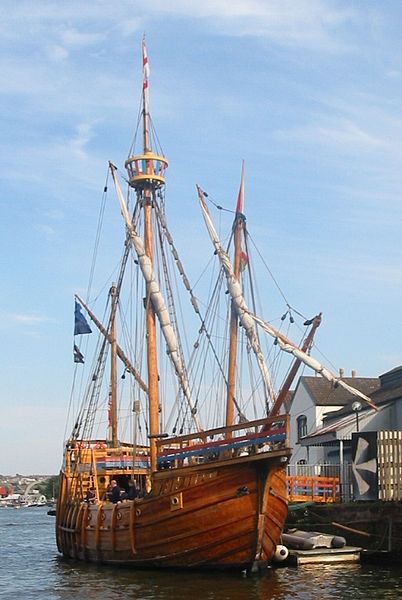
The replica of John Cabot’s ship Matthew in Bristol harbour, adjacent to the SS Great Britain.
Photo by Chris McKenna via Wikimedia Commons.
I discussed last time [linked here] how the use of patent monopolies came to England in the sixteenth century. Since then, however, I’ve developed a strong hunch that the introduction of patent monopolies may also have played a crucial role in the birth of the business corporation. I happened to be reading Ron Harris’s new book, Going the Distance, in which he stresses the unprecedented constitutions of the Dutch and English East India Companies — both of which began to emerge in the closing years of the sixteenth century. Yet the first joint-stock corporation, albeit experimental, was actually founded decades earlier, in the 1550s. Harris mentions it as a sort of obscure precursor, and it wasn’t terribly successful, but it stood out to me because its founder and first governor was also one of the key introducers of patent monopolies to England: the explorer Sebastian Cabot.
As I mentioned last time, Cabot was named on one of England’s very first patents for invention — though we’d now say it was for “discovery” — in 1496. An Italian who spent much of his career serving Spain, he was coaxed back to England in the late 1540s to pursue new voyages of exploration. Indeed, he reappeared in England at the exact time that patent monopolies for invention began to re-emerge, after a hiatus of about half a century. In 1550, Cabot obtained a certified copy of his original 1496 patent and within a couple of years English policymakers began regularly granting other patents for invention. It started as just a trickle, with one 1552 patent granted to to some enterprising merchant for introducing Norman glass-making techniques, and a 1554 patent to the German alchemist Burchard Kranich, and in the 1560s had developed into a steady stream.
Yet Cabot’s re-certification of his patent is never included in this narrative. It’s a scarcely-noted detail, perhaps because he appears not to have exploited it. Or did he? I think the fact of his re-certification — a bit of trivia that’s usually overlooked — helps explain the origins of the world’s first joint-stock corporation.
Corporations themselves, of course, were nothing new. Corporate organisations had existed for centuries in England, and indeed throughout Europe and the rest of the world: officially-recognised legal “persons” that might outlive each and any member, and which might act as a unit in terms of buying, selling, owning, and contracting. Cities, guilds, charities, universities, and various religious organisations were usually corporations. But they were not joint-stock business corporations, in the sense of their members purchasing shares and delegating commercial decision-making to a centralised management to conduct trade on their behalves. Instead, the vast majority of trade and industry was conducted by partnerships of individuals who pooled their capital without forming any legally distinct corporation. Shares might be bought in a physical ship, or even in particular trading voyages, but not in a legal entity that was both ongoing and intangible. There were many joint-stock associations, but they were not corporations.
And to the extent that some corporations in England were related to trade, such as the Company of Merchant Adventurers of London, or the Company of Merchants of the Staple, they were not joint-stock businesses at all. They were instead regulatory bodies. These corporations were granted monopolies over the trade with certain areas, or in certain commodities, to which their members then bought licenses to trade on their own account. Membership fees went towards supporting regulatory or charitable functions — resolving disputes between members, perhaps supporting members who had fallen on hard times, and representing the interests of members as a lobby group both at home and abroad — but not towards pooling capital for commercial ventures. The regulated companies were thus more akin to guilds, or to modern trade unions or professional associations, rather than firms. Members were not shareholders, but licensees who used their own capital and were subject to their own profits and losses.
Before the 1550s, then, there had been plenty of unincorporated business associations that were joint-stock, and even more unincorporated associations that were not joint-stock. There had also been a few trade-related corporations that were not joint-stock. Sebastian Cabot’s innovation was thus to fill the last quadrant of that matrix: he created a corporation that would be joint-stock, in which a wide range of shareholders could invest, entrusting their capital to managers who would conduct repeated voyages of exploration and trade on their behalves.
August 20, 2020
QotD: Manipulating minimum wage laws to harm your competitors
The logic of such rent-creating legislation is plain: producer group A competes for many of the same customers against producer group B. Producer group A, however, uses for its production a mix of inputs (most importantly, capital and labor) that differs from the mix used by producer group B. Also, producer group B might compete most effectively against producer group A not by producing outputs as nearly identical as possible to that of A but, instead, by producing “substitute” goods or services that sell at prices lower than those charged by producer group A.
For example, producer group A might consist of locally owned restaurants with tablecloths and serving food freshly prepared by skilled chefs, while producer group B consists of chain restaurants serving food less exquisite but priced much lower. Members of producer group A are upset that producer group B is competing successfully for some diners who would likely otherwise eat more frequently at the restaurants of producer group A. What are the members of producer group A to do?
They could accept the fact that competition is not tortious — indeed, that economic competition is healthy for the economy at large — and do nothing other than compete harder to win more consumer patronage. That’d be the honest and honorable path to take. But government is in the picture, standing ready to escort those with little interest in honesty and honor down the rent-seeking path.
“So just pass legislation outlawing chain restaurants in our state,” suggests the leader of producer group A.
“Wish I could,” responds Sen. Slimey, “but that’s too blatant. Plus, it might not pass muster with the courts. But I’ve got an alternative plan that’s just as good.”
“Do tell!” exclaims the leader of producer group A.
“Well, I understand,” replies Sen. Slimey, “that the restaurants run by producer group B use many more low-skilled workers in their kitchens than your restaurants use.”
“That’s correct. We serve only fine food, so we hire experienced, high-skilled chefs, whose market wages are high.”
“So,” observes Sen. Slimey, “let’s enact a statute that raises the minimum wage above the average wage now paid to the average worker in producer group B’s restaurants, but lower than the average wage paid to workers in your — producer group A’s — restaurants.”
“Brilliant!” declares the leader of producer group A, who sees immediately that, while the minimum-wage legislation will on its face — de jure — apply to all restaurants, it will in fact have a differentially harsh effect on the restaurants in producer group B. The minimum wage will artificially raise producer group B’s costs of operation, causing them to reduce their outputs. One consequence of producer group B’s reduced outputs will be artificially increased demand for meals served at producer group A’s restaurants.
Sen. Slimey smiles, knowing that the news media, as well as most of the intellectuals in town, will applaud him for his apparent humanity and “Progressive” values. It’s a win-win for Sen. Slimey and for members of producer group A. And too few people will pay close-enough attention to the members, workers, and customers of producer group B to suspect that Sen. Slimey is anything other than a socially conscious public servant.
Don Boudreaux, “Doing Bad By Pretending to Do Good”, Café Hayek, 2018-05-13.
August 19, 2020
He calls it “unintended consequences”. I disagree … these consequences are very much intended
Brad Polumbo is being far too generous to Californian politicians by saying the impending collapse of the state’s entire gig economy was not the intended result of passing “worker protection” laws that penalized success:

UBER 4U by afagen is licensed under CC BY-NC-SA 2.0


This Friday, Uber and Lyft are set to entirely shut down ride-sharing operations in California. The businesses’ exit from the Golden State will leave hundreds of thousands of drivers unemployed and millions of Californians chasing an expensive cab. Sadly, this was preventable.
Here’s how we got to this point.
In September of 2019, the California state legislature passed AB 5, a now-infamous bill harshly restricting independent contracting and freelancing across many industries. By requiring ride-sharing apps such as Uber and Lyft to reclassify their drivers as full employees, the law mandated that the companies provide healthcare and benefits to all the drivers in their system and pay additional taxes.
Legislators didn’t realize the drastic implications their legislation would have; they were simply hoping to improve working conditions in the gig economy. The unintended consequences may end up destroying it instead.
Here’s why.
AB 5 went into effect in January, and now, a judge has ordered Uber and Lyft to comply with the regulation and make the drastic transformation by August 20. Since compliance is simply unaffordable, the companies are going to have to shut down operations in California.
Their entire business model was based upon independent contracting, so providing full employee benefits is prohibitively expensive. Neither Uber nor Lyft actually make a profit, and converting their workforce to full-time employees would cost approximately $3,625 per driver in California. As reported by Quartz, “that’s enough to boost Uber’s annual operating loss by more than $500 million and Lyft’s by $290 million.”
Essentially, California legislators put these companies in an impossible position. It makes perfect sense that they’d leave the state in response. It’s clear that despite the good intentions behind the ride-sharing regulation, this outcome will leave all Californians worse off.
QotD: The Canadian Broadcasting Corporation
But it is an infestation of leftist biases, and is often grossly unprofessional. For decades, despite being almost entirely funded by Canadian taxpayers, it was the principal house organ of the Quebec separatist movement, to the point that former prime minister Pierre Trudeau, shortly before the 1980 Quebec independence referendum, threatened to shut the French network down; when asked what he would replace it with, he responded with his customary vivacity of wit: “Still pictures of Chinese and Japanese vases, at least they have some cultural value.” It is compulsively misanthropic and nasty, and almost always takes a snide leftist view of everything, including foreign affairs. Brexiters were cavemen, U.S. President Donald Trump is a racist, sexist crook and moron, and it is racism and xenophobia to assert that the coronavirus originated in China. Can’t we have better and more original insights than this?
Conrad Black, “Canada needs a much better CBC”, New English Review, 2020-05-02.
August 18, 2020
Don’t worry your pretty little heads, normies, the enlightened ones are planning “The Great Reset” for 2021
Mark Steyn on how the great and the good of the world are figuring out the road ahead of us:
… most of the chaps who matter in this world are people you’ve never heard of — by which I mean they are other than the omnipresent pygmies of the political scene: In a settled democratic society such as Canada, for example, if you wind up with an electoral contest between a woke mammy singer with a banana in his pants and a hollow husk less lifelike than his CBC election-night hologram whose only core belief is that he has no core beliefs other than that party donations should pay for his kids’ schooling, you can take it as read that the real action must be elsewhere.
A lot of those chaps you’ve never heard of turn up in this video from the “World Economic Forum” — ie, the Davos set. After five months of Covid lockdown, you’ll be happy to hear that all the experts have decided that 2021 will be the year of “The Great Reset”:
I see my chums at the Heartland Institute headline this the “World Leaders’ ‘Great Reset’ Plan“. But, if by “leader” you mean an elected head of government accountable to the people, there is a total dearth. Indeed, it’s a melancholy reflection on the state of “world leadership” that the nearest to anyone accountable to the people in this video is HRH The Prince of Wales, in whom one day in the hopefully extremely far distant future the executive authority of the United Kingdom, Canada, Australia, etc will be nominally vested but which cannot be exercised without the consent of the people’s representatives. Yet even that token accountability is, as noted, in the future. So right now he’s just another guy who’s a “world leader” because he gets invited to Davos and you don’t — and, even if you were minded to show up anyway, you’d need a private jet because all the scheduled flights have been Covid-canceled and the world’s airports are ghost towns.
As is the custom among our big thinkers, the blather is very generalized. “Now is the time to think about what history would say about this crisis,” says the head of the IMF. If you say so. Personally, I was thinking that now is the time to eat a meal in a restaurant, if they weren’t closed.
But, why is it history’s job to say something about this crisis? Why, don’t you “world leaders” of the here and now say anything about it? “It is imperative that we reimagine, rebuild, redesign, re-invigorate and re-balance our world,” declares the UN Secretary-General.
That’s almost a full set, but he forgot “redefined”. “Possibilities are being redefined each and every day,” says the chief exec of British Petroleum, who as is his wont sounds like he’s in any business other than petroleum.
There is, of course, an inscrutable Oriental, who is chairman of something called the “China Green Finance Committee”. He’s there as a not so subtle reminder not even to bring up the subject of China, whose lies amplified by their sock puppet at the WHO are the sole cause of the present crisis – and whose death-grip on our future is the thing that most urgently needs to be reimagined, rebuilt, re-balanced and redefined. As I’ve mentioned many times over the spring and summer, twenty years ago we were told to forget about manufacturing — from widgets to “These Colors Don’t Run” T-shirts, that’s never coming back; from now on, we’re going to be “the knowledge economy”. Yet mysteriously, with the 5G and the Huawei and all the rest, China seems to have snaffled all that, too.

August 16, 2020
QotD: Labour is now the “party of government” even when they’re not in power
Anyone official and highly educated sounding who challenges whatever happens to be the prevailing supposed wisdom of this governing class, on Coronavirus or on anything else, must be scolded into irrelevance and preferably silenced. The governors must be obeyed, even if they’re wrong. In fact especially if they’re wrong, just as the soldiers of the past were expected to obey their orders, no matter what they thought of the orders or of the aristocratic asses who often gave them. Whether they were good orders was an argument that those giving orders could have amongst themselves, but that orders must be obeyed was a given. “Capitalism” isn’t worth dying for, but this new dispensation is, right or wrong.
Our new class of entitled asses, together with all those who have placed their bets for life on carrying out their orders or trying to profit from them, seems now to be the limit of the Labour Party’s electoral ambition. And who knows? The awful thing is that this class and its hangers-on could be enough, in the not too distant future, to get them back into direct command of the governmental process that they so adore.
Brian Micklethwait, “Mick Hartley on the politics of the Lockdown”, Samizdata, 2020-05-15.
August 10, 2020
Russia in Asia (for now)
Ted Campbell looks at some long-frozen geopolitical forces that may become more active in coming years:
The Jamestown Foundation, which some experts describe as mainly non-partisan and relatively unbiased, has published an interesting article by Paul Goble in which he reminds us that “Russia east of the Urals comprises more than two-thirds of the Russian Federation but has only about one-fifth of that country’s population. It is where most of Russia’s natural resources are to be found, though the earnings from their extraction largely go to Moscow and not to local people. The region is located three to ten time zones east of Moscow and is linked to the center by few roads or rail lines. Its people are far closer to China and other Pacific rim countries — including the United States — than to the core of the Russian Federation. Because of their roots in explorers, those fleeing oppression, and those sent there by the state for punishment, eastern Russians have always been more independent minded and entrepreneurial than Russians in central and western Russia. Perhaps the most important measure of this cultural divide is that Protestant faiths dominate the religious scene there, not the Russian Orthodox Church of the Moscow Patriarchate.”
It is related to something I have been saying for a long time: Siberia (essentially everything East of the Yenisei River (some say everything East of the Urals) is Asia …
… while Russia, per se, is an Eastern European country.
[…]
A few years ago a couple of middle-ranked Chinese officials suggested to me that one of China’s long-term strategic plans was (and I’m guessing still is) to encourage separatist movements in Siberia which, they hoped, will succeed in creating three or four (maybe even five or six) “autonomous” states in Siberia which will, like Mongolia, look, primarily to China for trade and support.
China
covetsneeds the resources, including water, that Siberia has. I have, in the past, forecast a Sino-Russian “Water War” in Siberia. But, speaking broadly and generally, the Chinese don’t like wars: they are expensive and unpredictable. They would much rather play a modest, behind the scenes role in creating a handful of weak, independent Siberian states with which they can trade to their advantage. They do not, I was told, wish to annex Siberia ~ some Chinese feel that the Qing Dynasty (1644 to 1912) went too far when it annexed what is now the Xinjiang Uyghur Autonomous Region (新疆维吾尔自治区) in 18th century.(Tibet is a different matter and most of the Chinese people I know who might wish that Xinjiang was a more autonomous place, more like Kyrgyzstan, for example, believe that Tibetans are Chinese (and Uighurs are not) and Tibet is a “natural” part of China.)
I said a couple of days ago, that “Russia is a pariah state that is flailing about as it withers and dies.” But Putin is flailing about in the wrong directions. The Chinese are, I believe, cultivating and fertilizing Siberian separatist movements with a view to dismembering Russia and “liberating” Siberia. When that happens, and I’m confident that it is NOT an IF, the world will be a much different place.

Donald MacLean: The First of the Cambridge Five
The Cold War
Published 22 Jun 2020Our historical documentary series on the history of the Cold War continues with a video on the famous Cambridge Five and Donald Maclean in particular — a real Cold War-era spy story
Support us on Patreon: https://www.patreon.com/thecoldwar or Paypal: http://paypal.me/TheColdWar
✔ Merch store ► https://teespring.com/stores/thecoldwar
✔ Instagram ► http://www.instagram.com/thecoldwartv#ColdWar #Maclean #CambridgeFive

FDR’s “New Deal” and the Great Depression
The Great Depression began with the collapse of the stock market in 1929 and was made worse by the frantic attempts of President Hoover to fix the problem. Despite the commonly asserted gibe that Hoover tried laissez faire methods to address the economic crisis, he was a dyed-in-the-wool progressive and a life-long control freak (the Smoot-Hawley Tariff Act which devasted world trade was passed in 1930). Franklin D. Roosevelt won the 1932 election by promising to undo Hoover’s economic interventions, yet once in office he turned out to be even more of a control freak than Hoover. His economic and political plans made Hoover’s efforts seem merely a pale shadow.
For newcomers to this issue, “New Deal” is the term used to describe the various policies to expand the size and scope of the federal government adopted by President Franklin Delano Roosevelt (a.k.a., FDR) during the 1930s.
And I’ve previously cited many experts to show that his policies undermined prosperity. Indeed, one of my main complaints is that he doubled down on many of the bad policies adopted by his predecessor, Herbert Hoover.
Let’s revisit the issue today by seeing what some other scholars have written about the New Deal. Let’s start with some analysis from Robert Higgs, a highly regarded economic historian.
… as many observers claimed at the time, the New Deal did prolong the depression. … FDR and Congress, especially during the congressional sessions of 1933 and 1935, embraced interventionist policies on a wide front. With its bewildering, incoherent mass of new expenditures, taxes, subsidies, regulations, and direct government participation in productive activities, the New Deal created so much confusion, fear, uncertainty, and hostility among businessmen and investors that private investment, and hence overall private economic activity, never recovered enough to restore the high levels of production and employment enjoyed in the 1920s. … the American economy between 1930 and 1940 failed to add anything to its capital stock: net private investment for that eleven-year period totaled minus $3.1 billion. Without capital accumulation, no economy can grow. … If demagoguery were a powerful means of creating prosperity, then FDR might have lifted the country out of the depression in short order. But in 1939, ten years after its onset and six years after the commencement of the New Deal, 9.5 million persons, or 17.2 percent of the labor force, remained officially unemployed.
Writing for the American Institute for Economic Research, Professor Vincent Geloso also finds that FDR’s New Deal hurt rather than helped.
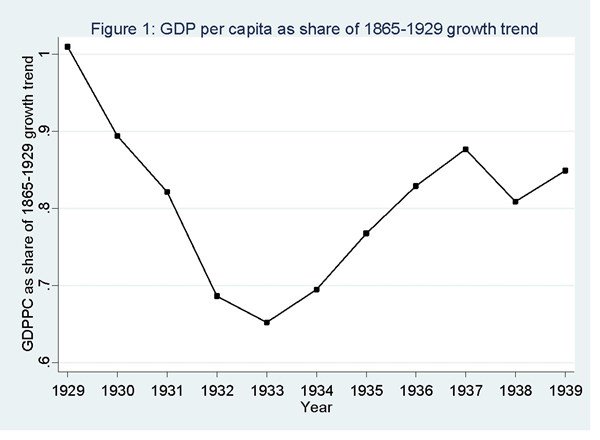
… let us state clearly what is at stake: did the New Deal halt the slump or did it prolong the Great Depression? … The issue that macroeconomists tend to consider is whether the rebound was fast enough to return to the trendline. … The … figure below shows the observed GDP per capita between 1929 and 1939 expressed as the ratio of what GDP per capita would have been like had it continued at the trend of growth between 1865 and 1929. On that graph, a ratio of 1 implies that actual GDP is equal to what the trend line predicts. … As can be seen, by 1939, the United States was nowhere near the trendline. … Most of the economic historians who have written on the topic agree that the recovery was weak by all standards and paled in comparison with what was observed elsewhere. … there is also a wide level of agreement that other policies lengthened the depression. The one to receive the most flak from economic historians is the National Industrial Recovery Act (NIRA). … In essence, it constituted a piece of legislation that encouraged cartelization. By definition, this would reduce output and increase prices. As such, it is often accused of having delayed recovery. … other sets of policies (such as the Agricultural Adjustment Act, the National Labor Relations Act and the National Industrial Recovery Act) … were very probably counterproductive.
Here’s one of the charts from his article, which shows that the economy never recovered lost output during the 1930s.
August 9, 2020
QotD: The economic concept of “revealed preferences”
Now, you can’t help but notice that there is a disparity between those who say that taxes should be higher and those who act as if they should be. Clearly, an individual who really believes that the Government is more effective at spending his money would voluntarily offer up more than the legal minimum of taxation. That we have fewer people acting in this manner than are to be found writing columns and making speeches calling for higher taxation shows a certain gap, does it not, between public utterances and private actions? Why, we could make such donations a litmus test for those believers in higher taxation and state spending who want to compel all of us to pay more. Only those who show their commitment by sending a cheque to the Treasury should be treated seriously.
Cheques, by the way, should be made out to “The Accountant, HM Treasury”, and sent to 1 Horse Guards Road, London SW1A 2HQ. A 2nd-class stamp is sufficient and you are encouraged to add a covering note so that your donation is spent in the way you like.
Tim Worstall, “Show us your cheques”, Times of London, quoted in Continental Telegraph, 2020-05-07.
August 6, 2020
Congress legislating on high tech is like your Grampa telling you how to play your favourite online game
Brad Polumbo on the notion that the politicians in Washington (or Ottawa, or London, or Canberra, …) are in any way capable of sensibly regulating the high tech sector:

While many principled small-government conservatives, such as Sen. Rand Paul, still back a free-market approach to tech policy issues, Hawley is not an outlier by any means.
Indeed, President Trump has also backed the regulation of social media companies to combat perceived anti-conservative bias. And the most popular conservative media personality in the country, Fox News host Tucker Carlson, regularly rails against Big Tech — even agreeing with progressive proposals to use the heavy hand of government antitrust regulation to break up companies such as Facebook and Google.
So, if major figures from both parties can agree on regulating Big Tech, it must be a good idea, right? Not so fast.
From left to right, the intentions behind these regulatory proposals are often good. After all, most reasonable people would likely share Democrats’ desire to see Big Tech better handle misinformation, “fake news,” and foreign election interference, while conservative Republicans’ calls for political neutrality online are no doubt appealing in the abstract.
Unfortunately, in their haphazard rush to score political points through government action, would-be regulators from both parties are forgetting the inevitable “knowledge problem” that plagues any central planners who try to dictate the minutiae of complicated industries from the halls of Washington, DC.
Economic philosopher Friedrich A. Hayek diagnosed this fatal flaw of government control in his seminal work “The Use of Knowledge in Society.”
“If we can agree that the economic problem of society is mainly one of rapid adaptation to changes in the particular circumstances of time and place,” Hayek wrote. “It would seem to follow that the ultimate decisions must be left to the people who are familiar with these circumstances, who know directly of the relevant changes and of the resources immediately available to meet them.”
“We cannot expect that this problem will be solved by first communicating all this knowledge to a central board which, after integrating all knowledge, issues its orders,” he continued. “We must solve it by some form of decentralization. But this answers only part of our problem. We need decentralization because only thus can we insure that the knowledge of the particular circumstances of time and place will be promptly used.“
August 5, 2020
Red Toryism, limited government and other Canadian political sinkholes
In his latest article in The Dominion, Ben Woodfinden talks about the political void where most Canadian conservatives keep their notions about what “conservatism” actually means in the Canadian context:
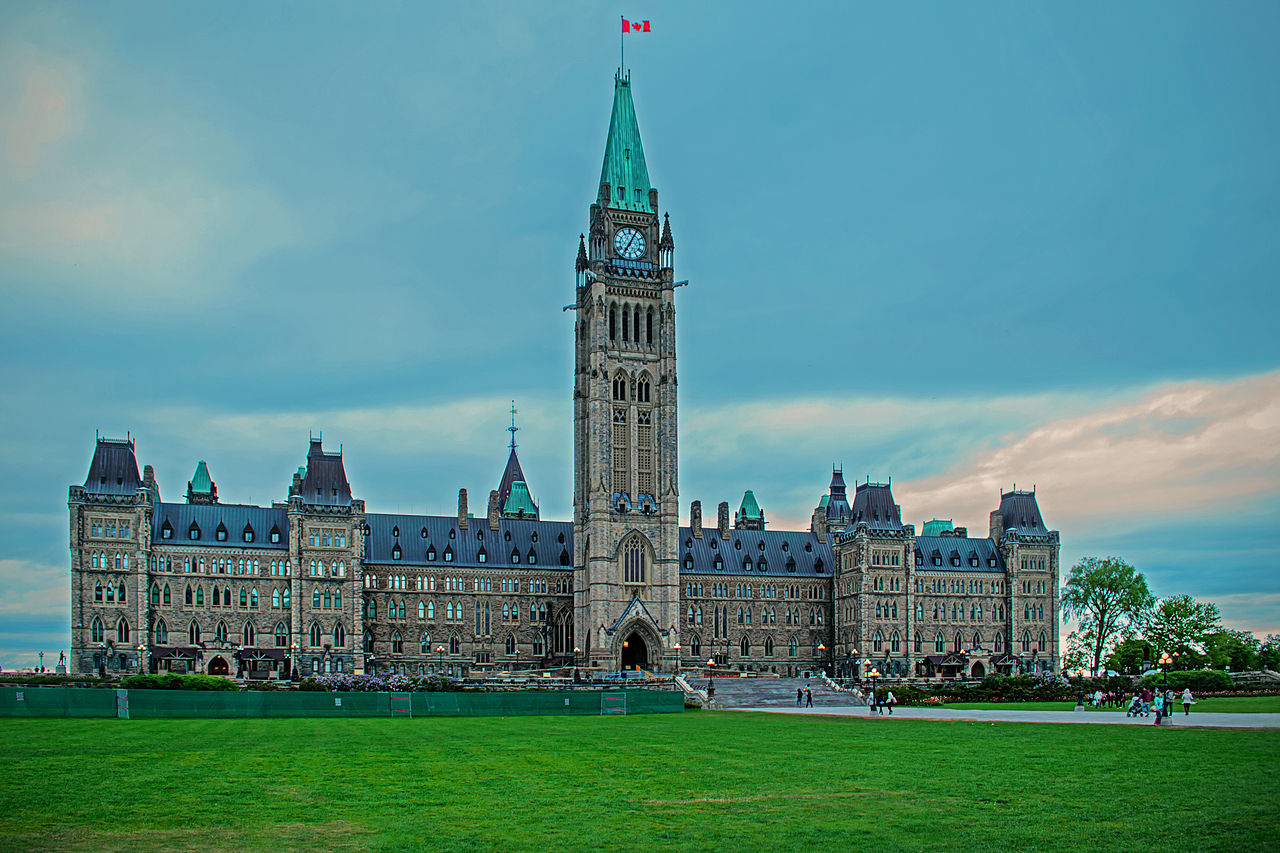
Parliament Hill in Ottawa.
Photo by S Nameirakpam via Wikimedia Commons.
This passage is from the Red Toryism essay:
Modern Canadian conservatism champions “small government”, seemingly without having any theory of what the state is actually for. Absent such a framework, it is difficult to identify governing priorities let alone to develop a philosophically coherent blueprint for action. When Conservatives get elected, they often have no idea of how to achieve the “fiscal responsibility” they preach. A series of ad hoc actions and policies follow, and the predictable result is failure to roll back the state in any significant or lasting way.
This, predictably, did not please everyone, and in a political landscape where we often still think that the divides between left and right are really about “big” versus “small” government, this was to be expected. But a conservative theory of government needs to escape this paradigm.
While conservatism is a broad tent, one unifying feature should be a commitment to limited government. But limited government is a term that often gets conflated with ideological “small government” that sees most of the modern state as illegitimate, and would eliminate most of it and leave the state to provide just the most minimal night-watchman functions. But small government, while a valid view to hold, is not limited government, and conservative government cannot just be about small government.
Limited government means constitutional government that is accountable and constrained by the rule of law, and while there are aspects of the modern state that need to be reformed, tamed, and limited, conservative government cannot just be about trying (and failing) to shrink the state. Conservatives have too often, I think, adopted the rhetoric of small government, without actually being true believers, and in the process they find it very difficult to actually reform and shape the state because they have put little thought into what government actually ought to be about.
Let me give you an example. Recently my friend Asher Honickman and I wrote a column for the National Post calling for a “parliamentary revival.” One specific and important reform we want to see is an expanded House of Commons to 500 MPs. More MPs would make for better party, and parliamentary government. But multiple people, including well connected conservatives, privately told us that while they think this is a good idea, one reason it won’t happen is because conservatives will just look at it through the lens of more spending of tax dollars on politicians. Instead the conservative impulse is to just try and shrink the size of legislatures to save a little bit of money.
In this case small government ideology actually gets in the way of reforms that would help make government more accountable, and limited. MPs should be held accountable and have their spending and salaries heavily scrutinized, but the cost of 150 more MPs would be nothing in the grand scheme of things.
This misses the point. More MPs would make for more accountable and better parliamentary government, and allow parliament, instead of both the bureaucracy and judiciary to increasingly take over more and more of lawmaking and governing that should be done by elected officials. The choice isn’t between more government or less government, in this case it’s a choice between who you’d rather be governed by; MPs who can scrutinize the government more, legislate with more freedom, and who you can hold to account, versus unelected bureaucrats with minimal oversight and limited accountability to elected officials.
In short, a conservative theory of governance should prioritize limited government, but in some cases this might require an attempt to strengthen (and more spending) on certain parts of government to constrain other parts.
It’s a rare Canadian conservative who’s willing to be quoted as saying that any part of human life is not automatically part of the remit of the federal government … how do you carve a “limited” government philosphy out of that?
August 4, 2020
Ontario’s COVID Alert app
Michael Geist explains why he has installed the Canadian government’s COVID App on his phone, despite the privacy concerns such government tracking apps present:

The Canadian COVID Alert app is ultimately as notable for what it doesn’t do as for what it does. The voluntary app does not collect personal information nor provide the government (or anyone else) with location information. The app merely runs in the background on an Apple or Android phone using bluetooth technology to identify other devices that come within 2 metres for a period of 15 minutes or more. Obviously, the distance and timing are viewed as the minimum for a potential transmission risk. If this occurs, a unique, random identifier is stored on each person’s device for a period of 14 days. After the 14 day period, the identifier is deleted from the device.
The identifier does not identify a specific person or location information, and is not sent to any centralized database. If a person tests positive for the virus, they are given a key code to input into the app. Once the key code is inputted, anyone that was identified as being potentially exposed over the prior 14 days receives a notification that this has occurred and they should consider testing and/or self-isolating.
From a privacy perspective, this is very low risk. Indeed, the government’s position – confirmed in the Privacy Commissioner of Canada’s analysis – is that there is no collection of any personal information and therefore the Privacy Act does not apply. The Privacy Commissioner rightly points out this raises some concerns about the state of the law (arguing it should be sufficiently robust to allow for reviews of this kind), however, the use of random identifiers ensures that identification of individual is very unlikely. Moreover, the Privacy Commissioner’s review concludes that “there are very strong safeguards in place” with security of the data, commitments limiting use, independent oversight, and a pledge to de-commission the app (including deletion of all data) within 30 days of the Chief Public Health Officer of Canada declaring the pandemic over.
The Ontario Information and Privacy Commissioner was also engaged in the review process. Her recommendation letter points to commitments for potential ongoing issues, including ensuring that the app is effective, that there is monitoring of third party components such as the Google-Apple Exposure Notification System, and public transparency associated with the app and its use.
While the app passes legal muster, its introduction reinforces the problems with social inequities that COVID-19 has laid clear. Much like the connection between socio-economic status and infection risk, the app itself is only accessible to those who can afford newer Apple and Android devices. That obviously means that those with older phones or no wireless access at all are unable to use it. While I don’t think that is reason to abandon the initiative, the government should be exploring alternatives to allow all citizens to implement these safeguards.
August 1, 2020
Masking stupidity
In The Critic, Patrick Fagan talks about the dehumanizing aspect of mandatory facemask orders:

“Utrecht: Facemask Store” by harry_nl is licensed under CC BY-NC-SA 2.0
In Joost Meerloo’s analysis of false confessions and totalitarian regimes, The Rape of the Mind, he coins a phrase for the “dumbing down” of critical resistance – menticide. “In the totalitarian regime,” he wrote, “the doubting, inquisitive, and imaginative mind has to be suppressed. The totalitarian slave is only allowed to memorise, to salivate when the bell rings.”
[…]
Face masks can now be added to the list of mandates that make you stupid. As if Piers Morgan feverishly promoting them weren’t evidence enough, here are the facts on why you absolutely, categorically should not wear a face mask. They make you suggestible; they make you more likely to follow someone else’s direction and do things you wouldn’t otherwise do. In short, they switch off your executive function – your conscience.
A great example comes from a study by Mathes and Guest (1976), who asked participants how willing they would be, and how much they would have to be paid, to carry a sign around the university cafeteria reading “masturbation is fun” (this being 1976, doing such a thing would be considered embarrassing; these days it will probably earn you a course credit!). The results showed that when people wore a mask, they were more likely to carry the sign and required less money to do so ($30 compared to $48, on average).
Meanwhile, Miller and Rowold (1979) presented Halloween trick-or-treaters with a bowl of chocolates and told them they were allowed to take only two each. When the children thought they weren’t being watched, they helped themselves. Children without a mask broke the rule, taking more chocolates, 37% of the time, compared to 62% for masked children. The authors concluded that masks “lead to lower restraints on behaviour”.
The effect has similarly been found online: the online disinhibition effect refers to the tendency for people to act antisocially when anonymous online (Suler, 2004). There is even an infamous trolling movement calling itself Anonymous and using a mask as its symbol.
The disinhibiting effects of wearing a mask are described by psychologists in terms of a suspension of the superego’s control mechanisms, allowing subconscious impulses to take over. Saigre (1989) wrote that masks “short-cut” conscious defence systems and encourage “massive regression” to a more primitive state; Castle (1986) wrote that eighteenth century masquerades allowed mask-wearers to release their repressed hedonistic and sexual impulses; and Caillois (1962) similarly wrote about European masked carnivals involving libidinal activities including “indecencies, jostling, provocative laughter, exposed breasts, mimicking buffoonery, a permanent incitement to riot, feasting and excessive talk, noise and movement”. In the 12th Century, Pope Innocent III banned masks as part of his fight against immorality; and in 1845, New York State made it illegal for more than two people to wear masks in public, after farmers wore masks to attack their landlords.
From a neuroimaging perspective, masks are known to inhibit identity and impulse control – both associated with executive function in the prefrontal cortex (e.g., Glannon, 2005; Tacikowski, Berger & Ehrsson, 2017). In other words, masks silence the Jiminy Cricket in the brain.


