
Quotulatiousness

April 30, 2013

Another incident of hypersentimentality

Filed under: Books, Britain, Media — Tags: , , , , — Nicholas @ 09:45

In sp!ked, Brendan O’Neill discusses the latest opportunity for people to ostentatiously display their sentimentality:

I wish Scottish author Iain Banks had kept his cancer to himself. For in making it public, through a statement about being ‘Very Poorly’, he has unwittingly mobilised one of the ugliest mobs of modern times: the death-watchers, the ostentatious grievers, those who like nothing more than to read about another’s physical demise and advertise how moved they are by it.

Almost as soon as Banks announced earlier this month, through the publisher of his entertaining novels, that he was suffering from terminal gall bladder cancer, these professional proxy weepers were doing their thing. Premature mourning was rife. Twitter became a vast virtual pre-death condolences book, as everyone stopped what they were doing for 45 seconds to tweet about how torn apart they were by the news of Banks’ sickness. People seemed keen to out-lament each other. One said Banks’ cancer revelation hit her like ‘a chill blast of sorrow and grief’, which makes you wonder how she’ll cope when he dies.

Friends and fans of Banks set up a website where lovers of his novels can get updates on his condition and sign a ‘guest book’ that is really just another offensively early condolences book. Thousands of messages have been posted. It’s remarkable how many of the message writers admit they ‘don’t know what to say’ yet proceed to say it anyway, at length, clearly feeling weirdly compelled to sign up to the speedily constructed community of online mourners.

We’ve also had pre-death obituaries, articles assessing Banks’ life and work before either has come to an end: his next novel, The Quarry, will be published shortly. Even those who know nothing about Banks felt an urge to write about him, or rather about how they personally felt upon hearing he was sick. Simon Kelner at the Independent admitted ‘I haven’t read any of his books’, before producing a whole column on Banks’ cancer news. The macabre sense of anticipatory mourning is summed up in the way Banks’ wife is referred to on the tribute website: as his ‘chief widow-in-waiting’.

April 29, 2013

Boris: Don’t panic about UKIP eating our lunches … there’ll be plenty of time for that later

Filed under: Britain, Media, Politics — Tags: , , , , — Nicholas @ 08:08

London mayor Boris Johnson tries to find the positive side of the rise of UKIP and the resulting uncertain election fortunes of his Conservative brethren:

We Tories look at [UKIP leader Nigel Farage] — with his pint and cigar and sense of humour — and we instinctively recognise someone who is fundamentally indistinguishable from us. He’s a blooming Conservative, for heaven’s sake; and yet he’s in our constituencies, wooing our audiences, nicking our votes, and threatening to put our councillors out of office. We feel the panic of a man confronted by his Doppelgänger. Omigaaaad, we say to ourselves: they’re stealing our schtick! And we are tempted to do a Nicolas Cage — to overreact, to freak out, to denounce them all as frauds or worse. I think there may have been a few ill-advised insults flying around in the past couple of days.

Well, I would humbly submit that there are better ways of tackling the Ukip problem, if indeed it is really a problem at all. The rise of Farage and Ukip tells us some interesting and important things about what the electorate wants — and it is by no means bad news for the Conservatives. It tells us that the voters are fed up with over-regulation of all kinds, and especially from Brussels. Well, who is going to offer a referendum on the EU? Only the Conservatives — and the trouble with voting Ukip is that it is likely to produce the exact opposite: another Labour government and another five years of spineless and unexamined servitude to the EU.

[. . .]

Rather than bashing Ukip, I reckon Tories should be comforted by their rise — because the real story is surely that these voters are not turning to the one party that is meant to be providing the official opposition. The rise of Ukip confirms a) that a Tory approach is broadly popular and b) that in the middle of a parliament, after long years of recession, and with growth more or less flat, the Labour Party is going precisely nowhere.

You’ve got to admire the quality of his whistling, don’t you?

April 28, 2013

Denmark re-thinks their generous social support system

Filed under: Economics, Europe, Government — Tags: , , — Nicholas @ 11:52

Denmark has a very liberal approach to welfare and social services … perhaps too liberal:

It began as a stunt intended to prove that hardship and poverty still existed in this small, wealthy country, but it backfired badly. Visit a single mother of two on welfare, a liberal member of Parliament goaded a skeptical political opponent, see for yourself how hard it is.

It turned out, however, that life on welfare was not so hard. The 36-year-old single mother, given the pseudonym “Carina” in the news media, had more money to spend than many of the country’s full-time workers. All told, she was getting about $2,700 a month, and she had been on welfare since she was 16.

In past years, Danes might have shrugged off the case, finding Carina more pitiable than anything else. But even before her story was in the headlines 16 months ago, they were deeply engaged in a debate about whether their beloved welfare state, perhaps Europe’s most generous, had become too rich, undermining the country’s work ethic. Carina helped tip the scales.

[. . .]

Students are next up for cutbacks, most intended to get them in the work force faster. Currently, students are entitled to six years of stipends, about $990 a month, to complete a five-year degree which, of course, is free. Many of them take even longer to finish, taking breaks to travel and for internships before and during their studies.

In trying to reduce the welfare rolls, the government is concentrating on making sure that people like Carina do not exist in the future. It is proposing cuts to welfare grants for those under 30 and stricter reviews to make sure that such recipients are steered into jobs or educational programs before they get comfortable on government benefits.

Officials have also begun to question the large number of people who are receiving lifetime disability checks. About 240,000 people — roughly 9 percent of the potential work force — have lifetime disability status; about 33,500 of them are under 40. The government has proposed ending that status for those under 40, unless they have a mental or physical condition that is so severe that it keeps them from working.

April 27, 2013

“Nazi” is a word that leads to intellectual laziness and misunderstanding

Filed under: Germany, History, Media, WW2 — Tags: , , — Nicholas @ 09:00

In History Today, Richard Overy explains why the word “Nazi” has been over-used and has become an obstacle to historical understanding:

Few words in regular use in historical writing can have been abused as much as the word ‘Nazi’. At the very least it has proved a persistent grammatical challenge for generations of students who fall into the trap of writing ‘Nazi’s’ or ‘Nazis’ ‘ as the plural of Nazi and ‘Nazis’ as the possessive without an apostrophe, when it should be the other way around. This has become so widespread a practice that the mistake profits from a growing linguistic inertia. Soon it will be designated as an anomaly we can all live with, like the misuse of ‘impact’ as if it were a verb — as in ‘the Nazi’s impacted the German political system’.

In truth this is the least of the problems. The real issue is the indiscriminate use of the term ‘Nazi’ to describe anything to do with German institutions or behaviour in the years of the dictatorship between 1933 and 1945. It is common practice to talk of the ‘Nazi Army’, or the ‘Nazi Air Forces’, or ‘Nazi atrocities’, or ‘the Nazi economy’ as if everything in Germany under Hitler was uniquely and unambiguously National Socialist. The result is a complete lack of historical precision. ‘Nazi’ becomes a shorthand term that obscures more than it explains. Historians who write about the Soviet Union under Stalin do not usually describe its features as ‘Commie this’ or ‘Commie that’, any more than historians of British party politics in the interwar years talk about ‘Tories’ and ‘lefties’ rather than the Conservative Party and the Labour Party.

The term originated in the 1920s when contemporaries searched for some way of getting round the long-winded title of the party — the National Socialist German Workers Party (NSDAP). It was used chiefly by the enemies of the party and never by the regime itself. The term ‘Nazi’ or ‘the Nazis’ had strongly negative associations; it was employed as a quick way of describing a movement popularly associated in the mind of left-wing critics outside Germany with authoritarian rule, state terror, concentration camps and an assault on the cultural values of the West. Psychologists even suggested that there was such a thing as a ‘Nazi mind’ to explain why members of the party were so brutal, aggressive and mendacious. The term then, and now, was loaded.

The last Beguine

Filed under: Europe, History, Religion — Tags: , , , — Nicholas @ 08:53

An obituary (and short history lesson) in The Economist:

AT THE heart of several cities in Belgium lies an unexpected treasure. A gate in a high brick wall creaks open, to reveal a cluster of small, whitewashed, steep-roofed houses round a church. Cobbled alleyways run between them and tiny lawns, thickly planted with flowers, grow in front of them. The cosiness, the neatness and the quiet suggest a hortus conclusus, a medieval metaphor both for virginal women and the walled garden of paradise.

Any veiled women seen there now, however, processing to Mass or tying up hollyhocks in their dark habits and white wimples, are ghosts. Marcella Pattyn was the last of them, ending a way of life that had endured for 800 years.

These places were not convents, but beguinages, and the women in them were not nuns, but Beguines. In these communities, which sprang up spontaneously in and around the cities of the Low Countries from the early 13th century, women led lives of prayer, chastity and service, but were not bound by vows. They could leave; they made their own rules, without male guidance; they were encouraged to study and read, and they were expected to earn their keep by working, especially in the booming cloth trade. They existed somewhere between the world and the cloister, in a state of autonomy which was highly unusual for medieval women and highly disturbing to medieval men.

Nor, to be honest, was it the first thing Juffrouw Marcella thought of when, as a girl, she realised that her dearest wish was to serve her Lord. But she was blind, or almost so, and no other community would accept her. She wanted to work, too, and was not sure she could in an ordinary convent. The beguinages had originally been famous for taking the “spare” or “surplus” women who crowded into 13th-century cities in search of jobs. Even so, the first community she tried sent her back after a week, unable to find a use for her. (In old age she still wept at the thought of all the rejections, dabbing with a handkerchief at her blue unseeing eyes.) A rich aunt intervened with a donation to keep her there, and from the age of 21 she was a Beguine.

The Caspian Sea as a potential trouble zone

Filed under: Asia, Military, Russia — Tags: , , , , — Nicholas @ 08:46

Strategy Page provides some background on the possibility of conflict on the Caspian in the post-Soviet era:

The Caspian Sea, long a Russian lake, is now witnessing a naval arms race. Before the Soviet Union broke up in 1991, the only nations bordering the Caspian were Russia (with most of the coastline) and Iran. But now those two nations have been joined by parts of the Soviet Union that have become independent states (Kazakhstan, Azerbaijan and Turkmenistan). It goes downhill from there.

Iran shares a land border with Azerbaijan and has a historical claim on Azerbaijan. In the 19th century Azerbaijan (as in the area occupied the Azeris, a Turkic people) was divided by Russia and Iran. Currently about a quarter of the Iranian population is Azeri, but the Azeris of Azerbaijan believe all Azeris should be part of an independent Azerbaijan. This was how it was for centuries before Turkey, Russia and Iran began seeking to conquer Azerbaijan. Some Iranian Azeris like this idea and Iran is always looking for ways to make Azerbaijan back off. So Iran is building up its Caspian naval forces, which is annoying Russia more than Azerbaijan.

The Iranian buildup includes a new corvette, an Iranian built 1,400 ton ship. Azerbaijan responded by buying $1.6 billion worth of weapons from Israel (which angered Iran a great deal.) Among the items ordered were Gabriel anti-ship missiles. These are 522 kg (1,150 pound) weapons with a range of 36 kilometers. Azerbaijan will use these to protect its Caspian Sea coast from the growing number of Iranian warships being introduced in the area. Most of the Iranian Caspian “fleet” consists of small patrol boats. Some are armed with anti-ship missiles but they are basically coast guard type craft.

What really controls the Caspian is aircraft and Russia has the most of those. Russia also has the only water link to the ocean and thus the ability to bring in more warships on short notice. These, plus Russia’s larger air force gives Russia the edge.

The misplaced outrage over Amazon’s tiny tax bill in the UK

Filed under: Books, Britain, Business, Economics, Europe, Media — Tags: , , , , — Nicholas @ 08:40

Tim Worstall explains that the current efforts by various campaigners including Stephen Fry are not only a waste of time and effort, but betray a fundamental misunderstanding of how the EU is set up:

There are several points that could be made. One being that selling to Brits from Luxembourg is not tax dodging, it’s exactly what the EU intends the Single Market should be. A, umm, single market across 27 countries. A second might be that even if we start to whine about UK warehouses, tax is still not due here. Our double taxation treaty with Luxembourg means that such warehouses do not lead to tax being due. And that’s from 1968 or so when Wilson ruled: it’s also a standard part of all double taxation treaties and for good reason.

(For example, the metals trade uses warehouses in Rotterdam as the point at which a contract is concluded. The cut flowers business warehouses in a small village near Schipol. Should Holland get all the tax from the world’s metals and flower businesses? Or should everyone be taxed where they really are, not the warehouses?)

But there’s much worse than this. We’ve had the Margaret Hodges screeching that we’re talking about immoral, not illegal. The TJN and other fools similarly scream about how awful it is that people can do business without paying tax. And it is precisely all of this activism that leads these gentle booksellers to spend their year collecting signatures. To absolutely no avail whatsoever.

For in the year they are complaining about, last year, 2012, Amazon did not make a profit. A $39 million loss in fact according to their accounts. It’s simply not true that “tax dodging” by Amazon is leading to the crucifixtion of the independent book shop. That’s a lie that’s been foisted upon people by the obfuscations of the campaigners.

April 24, 2013

More on the currency choices facing an independent Scotland

Filed under: Britain, Economics, Europe — Tags: , , , , , — Nicholas @ 10:49

John Kay works through the short list of options about money that a newly independent Scotland would need to decide about:

Speculation about Scotland’s currency future would begin on the day Scotland voted for independence — or the day on which a poll showed that this result was likely. Scotland would have three main options — the euro, the pound sterling, or its own distinct money.

The euro is the official currency of the EU, and Scotland would in principle be committed to its adoption. But there would be little enthusiasm for that course in either Edinburgh or Brussels, and Scotland — like the UK — would not meet the criteria on debt and deficits for joining the euro. A vague Scottish aspiration to join the single currency at some distant date would probably satisfy everyone.

The sensible outcome would be continued currency union with England — or with the entity that, in deference to Wales and Northern Ireland, participants in the Scottish debate call rUK — rest of UK. Scotland might ask for — and get — a Scottish economist on the Bank of England’s Monetary Policy Committee (not a representative of Scotland — the rules of the committee preclude representative roles). But that would be the extent of Scottish influence on monetary policy.

[. . .]

If I represented the Scottish government in the extensive negotiations required by the creation of an independent state, I would try to secure a monetary union with England, and expect to fail. Given experience in the eurozone, today’s conventional wisdom is that monetary union is feasible only as part of a move towards eventual fiscal union. But desire to break up fiscal union was always a major — perhaps the principal — motive for independence in the first place.

Scotland could continue to use the pound unilaterally, whether the Bank of England liked it or not — as Ecuador uses the dollar and Montenegro the euro. But this is not really an attractive course, and the only countries that have adopted it are those — such as Ecuador and Montenegro — whose monetary histories are so dire that they prefer to entrust their policies to foreigners.

April 23, 2013

Seller of fake bomb detectors found guilty of fraud

Filed under: Britain, Law, Middle East, Technology — Tags: , , , , — Nicholas @ 11:01

Back in 2010, I said “There should be a special hell for this scam artist” who mocked up bomb detector kits and sold them for thousands of dollars in Iraq and other areas with a real need for protection against IEDs. It’s taken more than three years, but he’s finally been found guilty:

A Somerset-based businessman has been convicted of three counts of fraud over the sale of bogus bomb detectors after his operation was exposed in a BBC Newsnight investigation in 2010.

This was a scam of global dimensions. James McCormick marketed his fake bomb detectors around the world, selling them in Georgia, Romania, Niger, Thailand, Saudi Arabia and beyond.

But his main market was Iraq, where lives depended on bomb detection and where the bogus devices were, and still are, used at virtually every checkpoint in the capital.

Between 2008 and 2009 alone, more than 1,000 Iraqis were killed in explosions in Baghdad.

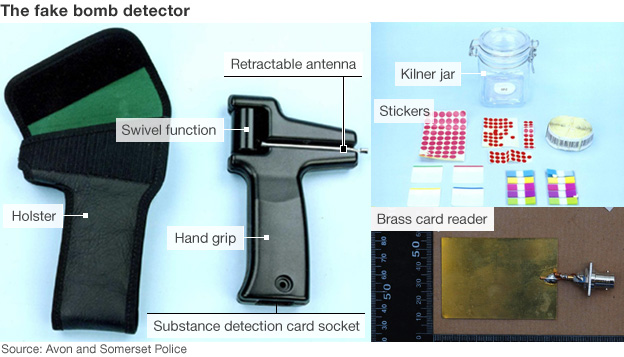
ADE-651 fake bomb detector

How the device was meant to work:

  1. A small amount of the substance the user wished to detect — such as explosives — was put in a Kilner jar along with a sticker that was intended to absorb the “vapours” of the substance
  2. The sticker was then placed on a credit-card sized card, which was read by a card reader and inserted into the device
  3. The user would then hold the device, which had no working electronics, and the swivelling antenna was meant to indicate the location of the sought substance

In other words, a magical dowsing stick that depended on the user to “detect” whatever the device was supposedly seeking. This wasn’t a case of a device that didn’t do what it was designed to do: it was a deliberate fraud with just enough “technological” mumbo-jumbo to appear to be a solution to a real problem:

The court heard that McCormick began his business by buying a batch of novelty “golf ball detectors” from the USA for less than $20 each. In fact they were simply radio aerials, attached by a hinge to a handle. He put the labels of his company, ATSC, on them and sold them as bomb detectors for $5,000 each.

He then made a more advanced-looking version which he was to sell for up to $55,000. The ADE-651 came with cards which he claimed were “programmed” to detect everything from explosives to ivory and even $100 bills. Police say the only genuine part of the kit — and the most expensive — was the carrying case.

To their credit, the police moved to investigate the same day the BBC’s original story broke. Strategy Page explained why the scam had been so easy to sell. Later it was reported that British civil servants and military personnel had been implicated in the fraud.

Independent Scotland would not be in currency union with the UK

Filed under: Britain, Economics — Tags: , , , — Nicholas @ 09:08

In the Guardian, Patrick Wintour and Severin Carrell cover the latest provocative notion coming out of London, directed at the Scottish separatists:

An independent Scotland would be forced to adopt new currency arrangements that would be a “very deep dive into uncharted waters”, George Osborne has warned. The chancellor said an independent Scotland would be unable to operate with a currency linked to sterling, let alone be able to form a currency union with it.

“The best arrangement is if they stay in the UK,” he said.

Osborne said he thought it “unlikely” the rest of UK would agree to a currency union with Scotland, noticeably hardening his rhetoric against Alex Salmond’s proposal.

Speaking on BBC Radio Scotland, the chancellor said: “Why would it want to risk a currency union? We’ve got a currency union in Europe and it’s called the euro, and look at all the problems that has had trying to co-ordinate the economic policies of different countries.”

Setting out the options, the chancellor said: “I think Scotland could either join the euro, and Alex Salmond is very nervous of saying that, or Scotland can set up its own currency. That is what lots of countries do, but Alex Salmond is again nervous of saying that.

“They can use the pound without our consent, like Panama uses the American dollar, or they can negotiate with the rest of the UK to form a currency zone. But Britain has had poor experience with things like the ERM [exchange rate mechanism], when it has tried to lock or peg its currency together with other currencies. So it is not clear that it would be in the rest of the UK’s interest to enter into a euro-style currency zone with the rest of Scotland.”

April 22, 2013

India’s submarine program hits (even more) delays

Filed under: Bureaucracy, France, India, Military — Tags: , , , — Nicholas @ 08:17

Strategy Page reports on the latest set of delays to hit the Indian navy’s submarine building program:

India’s effort to build six submarines (French Scorpenes), under license, has been delayed once again. The problem is mainly poor management. An example of this occurred quite recently with the departure of ten Spanish technical advisors for the Scorpenes. Their contract expired at the end of March and, despite the expiration date being well known Indian bureaucrats were unable to get a new contract in place on time. Similar avoidable delays have occurred several times already and the price has gone up with each delay. Last year it was announced that the first Scorpene sub would not be ready until 2015. The new delays push that to 2017.

Building the subs in India will leave India with thousands of workers and specialists experienced in building modern submarines. All that will be wasted because the defense procurement bureaucrats seem to have learned nothing. These officials already caused numerous delays and cost overruns during negotiations to build these diesel-electric submarines. The bureaucrats mismanaged this deal to the extent that it is now five years behind schedule. But it is even more behind schedule if you count the several years the Indian bureaucrats delayed it even getting started. The delays and mismanagement have so far increased the cost of the $4 billion project by 25 percent (to $834 million per sub).

[. . .]

All this ineffective urgency is in play because India’s submarine fleet is dying of old age and new boats are not going to arrive in time. It’s not like this was a surprise, but the Indian defense procurement bureaucracy has long been noted as slow, sloppy, and stubborn, especially in the face of demands that it speed up. The twisted tale of the tardy submarines is particularly painful.

The plan was to have a dozen new subs in service by the end of the decade. At present, there will be (with a bit of luck) three or four of them in service by then. The procurement bureaucracy is still seeking a supplier for the second batch of six diesel-electric subs. This second six probably won’t even begin arriving by the end of the decade. It’s hard to say, although the defense procurement nabobs speak of “fast tracking” this project, but long-time observers not expecting speed.

There’s some urgency to all this because this year five of India’s 16 diesel-electric subs (10 Kilo and two Foxtrot class Russian built boats and four German Type 209s) were to be retired (some are already semi-retired because of age and infirmity). Because of the Scorpene delays, the Type 209s are being kept in service (but not allowed out to sea much) for several more years. That leaves India with 14 subs. But in the next year or so several of the older Kilos will reach retirement age. Thus, by the time the first Scorpene arrives in 2017, India will only have five or six working subs. India believes it needs at least 18 non-nuclear subs in service to deal with Pakistan and China.

April 21, 2013

EU banking governance as situational comedy

Filed under: Bureaucracy, Economics, Europe — Tags: , , , — Nicholas @ 09:14

In the Telegraph, Jeremy Warner pokes a bit of fun at the EU’s self-inflicted media pratfalls over the Cypriot banking “bailout”:

For the last time, I never used the word “template”. Thus said Jeroen Dijsselbloem, President of the Eurogroup, at his IMF press conference on Saturday. This is about whether the troika’s disastrous mishandling of the Cypriot bailout should be used as a model for future banking insolvencies in the eurozone. The row shows no sign of abating. OK, so Mr Dijsselbloem never did use the word “template” in originally welcoming the Cypriot defenestration, but that’s what he meant, forcing him quickly to backtrack when it was pointed out to him that his remarks might prompt a run on banks elsewhere in the eurozone.

But hold on a moment. Wolfgang Schauble, the German finance minister, said on Friday that Cyprus did provide a model in terms of bailing in depositors, so who’s right? Well it is sort of a model, Mr Dijsselbloem said at his IMF press conference, in the sense that common principles would in future be applied to banking resolution, but each case would no doubt be different and have its own defining characteristics. All clear now?

April 16, 2013

The anti-libertarian legacy of Margaret Thatcher

Filed under: Britain, Government, Law, Liberty — Tags: , , , , , , — Nicholas @ 09:31

Sean Gabb explains why Thatcher should not be considered in any way “libertarian”:

She started the transformation of this country into a politically correct police state. Her Government behaved with an almost gloating disregard for constitutional norms. She brought in money laundering laws that have now been extended to a general supervision over our financial dealings. She relaxed the conditions for searches and seizure by the police. She increased the numbers and powers of the police. She weakened trial by jury. She weakened the due process protections of the accused. She gave executive agencies the power to fine and punish without due process. She began the first steps towards total criminalisation of gun possession.

She did not cut government spending. Instead, she allowed the conversion of local government and the lower administration into a system of sinecures for the Enemy Class. She allowed political correctness to take hold in local government. When she did oppose this, it involved giving central government powers of supervision and control useful to a future politically correct government. She extended and tightened the laws constraining free speech about race and immigration.

Her encouragement of enterprise never amounted to more than a liking for big business corporatism. Genuine enterprise was progressively heaped with taxes and regulations that made it hard to do business. Big business, on the other hand, was showered with praise and legal indulgences. Indeed, her privatisation policies were less about introducing competition and choice into public services than in turning public monopolies into corporate monsters pampered by the State with subsidies and favourable regulations — corporate monsters that were expected in return to lavish financial rewards on the political class.

April 15, 2013

Why UKIP has been drawing support away from the Conservatives

Filed under: Britain, Politics — Tags: , , , , — Nicholas @ 09:59

In the Telegraph, Ed West explains some of the reasons for UKIP’s rise in support at the expense of David Cameron’s Tories:

Across the North of England, Ukip is able to appeal to a wide range of socially conservative people who hate the Tories as the people who destroyed their towns and yet are voting for Thatcher’s heir.

The key to David Cameron’s failure, in 2010 and since, has been the pursuit of the centre ground. The key to Ukip’s success is their understanding that there’s no such thing, and that on a range of issues — health, transport and jobs — the public are more Left-wing than the powers that be, and on several others — crime, Europe and immigration — they’re considerably more Right-wing. Whether Ukip’s economic policies would help working-class people is open to debate, although restricting unskilled immigration would help.

The cornerstone of Ukip’s support is the subject of mass immigration, which is not only an unpopular process in itself, but tends to create a code of dishonesty and cant in the political class, further driving them apart from the public. It is an issue inescapably tied up with the European Union, and Ukip has successfully (so far) negotiated a middle course close to the centre of public opinion; most people do not share the political elites’ talk about “Britain’s diversity is its strength”, but neither do they dislike immigrants or wish to support the politics of hate. They just don’t want their country changed beyond recognition, and don’t see why they should be condemned for this.

None of this would matter, of course, if people had particular confidence that one of the major parties knew what they were doing with the economy. As it is, Labour got us into this mess, while having George Osborne in charge rather feels like being on an aeroplane where the company owner’s 12-year-old son has insisted on being the pilot. I hope he knows what he’s doing, but I’m prepared to let someone else have a go.

April 14, 2013

Differing national philosophies on child-raising

Filed under: Europe, Health, USA — Tags: , , , — Nicholas @ 10:56

In The Atlantic, Olga Khazan compares the way American parents interact with their children to the rather more relaxed parenting styles of other nations:

The biggest difference between American parents and their counterparts in Europe might be that they are far more relaxed about enrichment than we are, according to a study released this week by Sara Harkness and Charles M. Super at the School of Family Studies at the University of Connecticut.

Not only are Americans far more likely to focus on their children’s intelligence and cognitive skills, they are also far less likely to describe them as “happy” or “easy” children to parent.

“The U.S.’s almost obsession with cognitive development in the early years overlooks so much else,” Harkness told Slate.

For part of their research, the authors focused just on parents in the United States and the Netherlands. The differences are stark: American parents emphasized setting aside “special time” with each of their children, while Dutch parents spent a few hours each day together with their kids as an entire family.

American parents said they struggled to manage the sleep schedules of their babies and young children, explaining that they try to entertain or distract them when they wake up in the middle of the night.

« Newer PostsOlder Posts »

Powered by WordPress

