
Quotulatiousness

April 14, 2013

An alternative Britain would be “Cuba without the sunshine”

Filed under: Britain, History, Media — Tags: , , , — Nicholas @ 10:06

Dominic Sandbrook recounts the history of a slightly different Britain: one where Margaret Thatcher lost to Jim Callaghan in 1978:

As historians now agree, Mrs Thatcher never really stood a chance: Britain was not ready for a woman prime minister. As she herself had remarked only eight years earlier: ‘There will not be a woman prime minister in my lifetime — the male population is too prejudiced.’

In her place, the Tories turned to the bumbling figure of Willie Whitelaw, an old-fashioned patrician Wet whom they decided would connect better with the British electorate.

In the meantime, the country was reeling from crisis to crisis. Scarcely had Callaghan returned to No 10 than his premiership was consumed in the notorious Winter of Discontent. As one group of workers after another — lorry drivers, railwaymen, bus drivers, ambulance drivers, caretakers, cleaners, even grave-diggers — walked out on strike for higher wages, the country ground to a halt.

Buoyed by his election victory, Callaghan was in no mood to compromise. Rather than break his declared 5 per cent national pay limit and risk higher inflation, he declared a State of Emergency and summoned the Army to drive Britain’s petrol tankers.

It was a catastrophic mistake. On February 12, 1979, a date that has gone down in history as Black Monday, fighting broke out between pickets and soldiers at one depot outside Hull.

In the chaos, one soldier — carrying live rounds, in contravention of orders — opened fire and killed five people. It was one of the most shocking moments in modern British history.

Callaghan resigned the next day, the last honourable act of a decent man overwhelmed by events. But contrary to his expectations, the Labour Party did not turn to his Chancellor, the bushy-browed Denis Healey.

Instead, they lurched to the Left and elected as their new Prime Minister Michael Foot, with his flowing white locks, walking stick and impassioned socialist rhetoric. The real power in the land, however, was Foot’s colleague Tony Benn, who replaced the disgruntled Healey as Chancellor. And in the next few years, it was Benn who presided over the most sweeping socialist measures any Western country had seen in living memory.

To the horror of many in industry, Benn insisted that Britain’s declining economy needed a dose of shock therapy. The top rate of income tax went up to 98 per cent, and the government announced a one-off 5 per cent ‘equality levy’ on households with income over £50,000 a year.

As frightened investors began to withdraw their money from the City of London, Benn introduced sweeping exchange controls. He also, in an attempt to shore up Britain’s crumbling manufacturing base, introduced the most stringent import tariffs in the Western world.

The reaction was pandemonium. As inflation shot over 25 per cent and unemployment went above two million, horrified European leaders insisted that Britain’s new policies were incompatible with membership of the Common Market.

But Benn was adamant. ‘You turn if you want to,’ he told his party conference in 1980. ‘Labour’s not for turning.’

The following year, as the economic picture continued to worsen, the Government introduced controls to stop people taking sterling out of the country. As a result, the foreign package holiday market collapsed — although landladies in Blackpool said they had never seen more business.

There were rumours that Foot was planning to move his turbulent Chancellor, but they were blown away when, in April 1982, Argentine forces landed in the Falklands.

H/T to Roger Henry for the link.
April 13, 2013

This from the country that invented hypersentimentality?

Filed under: Britain, USA — Tags: , , — Nicholas @ 09:12

BBC America has what they call a list of 10 things about America that Brits will never understand. A few of them seem likely to be true, but this one is just not right:

6. Compulsive sentimentality
Gushing public displays are usually meant well but give Brits the creeps. For instance, my husband and I recently checked out of a B&B after a two-night stay. Instead of bidding us farewell with a firm handshake and a receipt, the owner — a man in his 50s — latched on to me, then my man, for a prolonged hug. Just when we thought it was over, he announced, “I’ll miss you guys!” No, actually. You won’t.

I can refute the notion that Americans are more embarrassingly sentimental with two words: Princess Diana. Did any country ever show more ridiculous sentimentality than Britain in their “grief” over a former royal person? The old notion of British reserve may still be true in some parts of the country, but most Brits these days seem to take extreme joy in wallowing in sentimentality.

April 11, 2013

QotD: An underclass that’s too rich

Filed under: Britain, Economics, History, Quotations — Tags: , , , — Nicholas @ 10:05

I hear quite a bit of that these days — almost like a local version of East German “ostalgie“. Old British friends say to me, well, say what you like about the 1970s — nothing worked; if you wanted to buy a new car, it was as if post-war rationing was still in effect — but all the same life in the village seemed a lot more pleasant back then. There’s something to this: the benign side of oppressive statism is often a kind of public restraint. And more than a few folks seem to feel, with the benefit of hindsight, that it’s better to have unionised thugs nutting scabs on the picket line than freelance yobs in hideous leisurewear infesting ersatz-American high streets catering to their every frightful whim from one end to the other. For the modern liberal, this is a new dilemma: an underclass that’s too rich.

Mark Steyn, “The Unfinished Revolution”, Daily Telegraph, 2004-05-04 (link goes to Steyn’s own site)

April 10, 2013

In British political circles, the term “Thatcherism” conceals at least as much as it reveals

In sp!ked, Tim Black explains why the term “Thatcherism” is not actually a useful descriptor of Margaret Thatcher’s political ideology, but it helps hide the weaknesses of her political and ideological foes:

… for many of those who today preen themselves as left-wing, the idea of Thatcher is arguably even more important. And that’s because she can be blamed for everything that is wrong today. She may have left office nearly a quarter of a century ago, but so potent was the ideology she apparently promulgated — Thatcherism — that we as a nation continue to be in thrall to it. As one prominent left-wing columnist stated yesterday: ‘Thatcherism lives on. Nothing to celebrate.’ Ex-London mayor ‘Red’ Ken Livingstone agreed: ‘In actual fact, every real problem we face today is the legacy of the fact she was fundamentally wrong.’

Elsewhere, Johnathan Freedland at the liberalish-leftish Guardian joined the Thatcherism Lives chorus: ‘The country we live in remains Thatcher’s Britain. We still live in the land Margaret built.’ At the much-reported-upon, little-attended street parties in Brixton and Glasgow, staged in ironic honour of Thatcher’s passing, the belief that her ideas still walk among us was palpable. In the words of one 28-year-old student: ‘It is important to remember that Thatcherism isn’t dead and it is important that people get out on the street and not allow the government to whitewash what she did.’

[. . .]

And here is where reality stops and myth begins. Because that’s not what the left saw. They saw something more ideological than brutally pragmatic. They saw, in the words of Marxism Today editor Martin Jacques in 1985, ‘a novel and exceptional force’. They saw, in short, Thatcherism.

Given the fact that Thatcher herself never had an actual ideological project to which ‘Thatcherism’ might actually refer, it is unsurprising that a recent book on the subject admitted that ‘talk of “Thatcherism” obscures as much as it reveals’. Instead, the idea of Thatcherism always revealed far more about the left than it did about some perpetually elusive right-wing ideology. That is why the concept, first used by academic Stuart Hall in 1979, gained intellectual traction on the left in 1983, the year Labour, under the leadership of Michael Foot, suffered a devastating defeat at the General Election: it shifted the responsibility for failure from the Labour Party, and its complicity with so-called Thatcherite economics, to the working class, a social constituency supposedly seduced away from the Labour Party by Thatcher’s advocacy of social mobility and aspiration. The idea of ‘Thatcherism’ let Labour off the hook.

So the legacy of Thatcherism may indeed live on, as some sunk on the left insist. But not because of anything Thatcher herself did. It will live on because too many are more comfortable attacking a phantasm from the past than reckoning with political reality today.

April 9, 2013

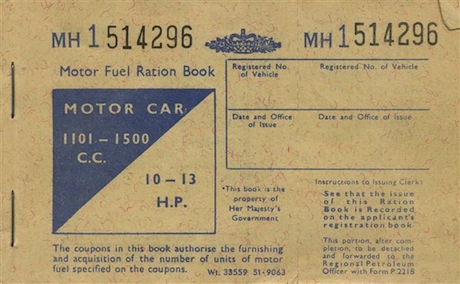
Britain’s wartime rationing was the actual start of the modern welfare state

Filed under: Britain, Bureaucracy, Food, Government, History, WW2 — Tags: , , , — Nicholas @ 08:31

In the Telegraph, Daniel Hannan shows that the wartime coalition government led by Winston Churchill actually laid the groundwork for the post-war “creation” of the welfare state:

British WW2 Fuel ration book cover

It wasn’t the 1945 Labour Government that created the welfare state, that Saturn which now devours its children. The real power-grab came in 1940.

With Britain’s manpower and economy commandeered for the war effort, it seemed only natural that ministers should extend their control over healthcare, education and social security. Hayek chronicled the process at first hand: his Road to Serfdom was published when Winston Churchill was still in Downing Street.

Churchill had become prime minister because he was the Conservative politician most acceptable to Labour. In essence, the wartime coalition involved a grand bargain. Churchill was allowed to prosecute the war with all the nation’s resources while Labour was given a free hand to run domestic policy.

The social-democratic dispensation which was to last, ruinously, for the next four decades — and chunks of which are rusting away even today — was created in an era of ration-books, conscription, expropriations and unprecedented spending. The state education system, the NHS, the Beveridge settlement — all were conceived at a time when it was thought unpatriotic to question an official, and when almost any complaint against the state bureaucracy could be answered with “Don’t you know there’s a war on?”

All quite true, and all quite necessary at the time. Without significant amounts of imported food, Britain could not feed its people. Even with imports, the amount of available food was subject to unpredictable fluctuations as losses at sea interrupted supply and left empty shelves in grocery stores. Although losses were relatively low early in the war (early U boats were unable to stay at sea for long periods, and German bases were a long way from most British trade routes), the writing was on the wall if the war continued for years.

To fight a totalitarian regime, Britain had to emulate some of its methods (ironically, full rationing wasn’t introduced in Germany until much later in the war). For the middle classes, this was an unwelcome intrusion of the state into private affairs, but generally accepted due to the war. For the working classes, in many cases it was actively welcomed. While the rations were small, there was the promise — and generally a fulfilled promise — that some would be made available even in the poorest areas of the country. My mother was nine when the war began, and she remembers seeing more food in the stores of Middlesbrough after rationing was introduced. After the deprivations of the Great Depression, many people in the north and in Scotland were better fed and clothed during the rationing period than they had been for nearly a decade.

Given that information, it should not be surprising that so many people voted for Labour in the 1945 elections: they’d had what they believed to be a live demonstration of the benefits of socialism for six years of war, and didn’t want to go back to the pre-1940 status quo.

April 8, 2013

The “Winter of Discontent” that brought Margaret Thatcher to power

Filed under: Britain, Economics, History — Tags: , , , , — Nicholas @ 14:42

Megan McArdle explains the temper of the late 1970s in Britain:

To understand the legacy of Margaret Thatcher, you need to understand Britain’s “Winter of Discontent,” in which striking public-sector workers nearly paralyzed the nation. Actually, you have to go back a bit further, to the inflations of the 1970s. Americans remember the “stagflation” of the 1970s as bad, but in Britain it was even worse — the inflation rate peaked in 1975 at over 25 percent.

Governments on both sides of the pond decided that the solution to inflation was to simply declare, by fiat, that prices would not rise so much. In America we got Nixon’s wage and price controls. In Britain, they got the government’s 1978 vow to hold public-sector wage increases to 5 percent — at a time when inflation was running to double digits.

The public-sector workers, as you might imagine, did not like that. And in Britain, the public-sector workers had immense power. Trash piled up in the streets. The truck drivers who ferried goods all over Britain went on strike — and the ones who didn’t, like oil tanker drivers, began feeding their destinations to “flying pickets” — mobile groups of strikers who would go from location to location, blockading them so that workers couldn’t get in and goods couldn’t get out. The BBC called them the “shock troops of industrial action” and that’s an accurate picture; effectively mobilized, flying pickets can grind the wheels of industry to a halt. Which is what they did in the winter of 1978-79.

In Liverpool, the gravediggers went out, leaving bodies unburied for weeks. By the end of January, half the hospitals in Britain were taking only emergency cases. Full of righteous fury, the unions flexed every muscle, demonstrating all the tremendous power that they had amassed by law and custom in the years since the Second World War. Unfortunately, they were pummeling the Labour Party, which had given them most of those powers. And the public, which was also suffering through high inflation and anemic GDP growth, had had enough. They elected Margaret Thatcher, a Conservative grocer’s daughter without roots in the working-class power structure of the labor movement, or the elite power structure of Britain’s famously rigid class system. She systematically went about dismantling the two main sources that gave labor the power to essentially shut down the United Kingdom: lenient strike laws and state ownership of key industrial sectors.

[. . .]

Her detractors should remember that as terrible as it was for the miners when the pits were closed, these mining operations were not sustainable — nor was it even desireable that they be sustained so that further generations could invest their lives in failing coal seams. The work was dreadful. The coal was too dirty for the environment, or the delicate pink tissue of the miners’ lungs. And even if Britain had wanted to keep mining the filthy stuff, it was getting too expensive to dig it out. The mines were playing out, not because Margaret Thatcher was mean, but because the cradle of the Industrial Revolution had burned through much of her coal.

In short, Margaret Thatcher destroyed an industrial system which had yes, provided workers with a secure livelihood, but yes, also done so at an unnacceptable cost. These two things are the same legacy. They cannot be parted.

Her achievement was not inevitable. But looking back at the Winter of Discontent, I’d argue that it was necessary. The alternate future for a United Kingdom where the labor unions hung on was another decade or two of failing state firms and economic decline. By the early 1980s, the UK’s per-capita GDP was lower than that of Italy. You can maybe argue that there was some alternative Social Democratic future, Sweden-style, or perhaps the discovery of an alternative path to capitalism. But it’s hard to look at the convulsions of 1970s Britain and argue that this was a happier past that the nation should pine after. And I find it hard to argue that Britain’s economy could have been modernized without taking on the unions; their veto power made even such obvious steps as shutting down failing mines effectively impossible.

As I wrote a few years back:

My family left Britain in 1967, which was a good time to go: the economy was still in post-war recovery, but opportunities abroad were still open to British workers. My first visit back was in [mid-winter] 1979, which was a terrible shock to my system. I’d left, as a child, before the strikes-every-day era began, and my memories of the place were still golden-hued and happy. Going back to grey, dismal, cold, smelly, strike-bound Britain left me with a case of depression that lasted a long time. It didn’t help that the occasion of the visit was to attend my grandfather’s funeral: it was rather like the land itself had died and the only remaining activity was a form of national decomposition.

French intelligence agency discovers the power of the “Streisand Effect”

Filed under: Europe, France, Government, Media — Tags: , , — Nicholas @ 10:04

The French Central Directorate of Interior Intelligence (DCRI) didn’t appreciate that Wikipedia had an article on one of their installations (link is to the English version of the page in question), so they asked to have it removed. However, because they wouldn’t specify what information in the article was sensitive (even though it was largely based on a French TV broadcast), the Wikipedia editors turned down the request. The DCRI then channelled their inner thug:

Wikipedia refused to delete it, and then things took a nasty turn, as a press release from the Wikimedia Foundation explains:

    Unhappy with the Foundation’s answer, the DCRI summoned a Wikipedia volunteer in their offices on April 4th. This volunteer, which was one of those having access to the tools that allow the deletion of pages, was forced to delete the article while in the DCRI offices, on the understanding that he would have been held in custody and prosecuted if he did not comply. Under pressure, he had no other choice than to delete the article, despite explaining to the DCRI this is not how Wikipedia works.

As the Wikimedia Foundation goes on to note:

    This volunteer had no link with that article, having never edited it and not even knowing of its existence before entering the DCRI offices. He was chosen and summoned because he was easily identifiable, given his regular promotional actions of Wikipedia and Wikimedia projects in France.

This is very similar to the situation discussed last week, where Benjamin Mako Hill seems to have been targeted because he, too, was easily identifiable. As we noted then, putting pressure on Wikipedia volunteers in this way is extremely problematic, since it naturally discourages others from helping out.

How did the DCRI learn about the Streisand Effect?

… the deleted article is, of course, back on line, in French and a dozen other languages. Moreover, the DCRI’s ham-fisted attempt to censor an extremely obscure Wikipedia page that hardly anyone ever visited, has achieved exactly the opposite effect: in the last few days, the page has been viewed over 45,000 times.

Margaret Thatcher, RIP

Filed under: Britain, History, Politics — Tags: , , — Nicholas @ 09:02

The Iron Lady is dead. Her place in 20th century British history as the first female PM and the victor in the 1982 Falklands War is counterbalanced for many people by her battling, confrontational style and her attempts to dismantle large parts of the postwar welfare state. Here is the initial BBC report:

Former Prime Minister Baroness Thatcher has died “peacefully” at the age of 87 after suffering a stroke, her family has announced.

David Cameron called her a “great Briton” and the Queen spoke of her sadness at the death.

Lady Thatcher was Conservative prime minister from 1979 to 1990. She was the first woman to hold the role.

She will not have a state funeral but will be accorded the same status as Princess Diana and the Queen Mother.

The ceremony, with full military honours, will take place at London’s St Paul’s Cathedral.

The union jack above Number 10 Downing Street has been lowered to half-mast.

[. . .]

Former Labour Prime Minister Tony Blair called her a “towering figure”, while his successor Gordon Brown praised her “determination and resilience”.

Labour leader Ed Miliband said Lady Thatcher had been a “unique figure” who “reshaped the politics of a whole generation”.

He added: “The Labour Party disagreed with much of what she did and she will always remain a controversial figure. But we can disagree and also greatly respect her political achievements and her personal strength.”

Deputy Prime Minister Nick Clegg described Lady Thatcher as one of the “defining figures in modern British politics”, adding: “She may have divided opinion during her time in politics but everyone will be united today in acknowledging the strength of her personality and the radicalism of her politics.”

London Mayor Boris Johnson tweeted: “Very sad to hear of death of Baroness Thatcher. Her memory will live long after the world has forgotten the grey suits of today’s politics.”

UK Independence Party leader Nigel Farage called Lady Thatcher a “great inspiration”, adding: “Whether you loved her or hated her nobody could deny that she was a great patriot, who believed passionately in this country and her people. A towering figure in recent British and political history has passed from the stage. Our thoughts and prayers are with her family.”

Lady Thatcher, who retired from public speaking in 2002, had suffered poor health for several years. Her husband Denis died in 2003.

(more…)

April 7, 2013

British police chiefs to conceal the names of arrested from the media

Filed under: Britain, Law, Liberty, Media — Tags: , , , , — Nicholas @ 09:45

Freedom of the press is taking another battering in Britain:

Britain’s police chiefs are drawing up draconian rules under which the identities of people they arrest will be kept secret from the public.

The move, which follows a recommendation by Lord Justice Leveson in his report into press standards, has been branded an attack on open justice and has led to comparisons with police states such as North Korea and Zimbabwe.

Under current arrangements, police release basic details of a person arrested and in many cases will confirm a name to journalists. But the practice varies from force to force.

Under the new guidance, to be circulated by the Association of Chief Police Officers (ACPO), forces will be banned from confirming the names of suspects, even when journalists know the identity of someone who has been arrested.

Without official police confirmation, the legal risks of incorrect identification will prevent the media from publishing the names of suspects.

The police plan for ‘secret arrests’ is being opposed by the Government’s own adviser on law reform, the Law Commission, which believes it is in the interests of justice that the police release the names of everyone who is arrested, except in very exceptional circumstances.

April 6, 2013

The old class system and the modern welfare state

Filed under: Britain, Bureaucracy, Government — Tags: , , , , , — Nicholas @ 09:34

A majority of Britons who are on state assistance now believe that the system is too generous and discourages recipients from seeking jobs:

In 2003, 40 per cent of benefits recipients agreed that ‘unemployment benefits are too high and discourage work’; in 2011, 59 per cent agreed. So a majority of actual benefits recipients now think the welfare state is too generous and fosters worklessness. Surely those well-off welfare cheerleaders, when shown these figures, would accept that perhaps they don’t know what they’re talking about. But no, they have simply come up with a theory for why the poor are anti-welfare: because they’re stupid.

Even more resented than those who abuse the system are those who run it:

Working-class mothers hated the way that signing up for welfare meant having to throw one’s home and life open to inspection by snooty officials, community health workers and even family budget advisers.

They didn’t want ‘middle-class strangers’, as they called welfare providers, ‘questioning them about their children’. They felt such intrusions ‘broke a cultural taboo’.

And the use of welfare as a way of allowing society’s ‘betters’ to govern the lives of the poor continues now. Indeed, today’s welfare state is even more annoyingly nannyish than it was 80 years ago.

As the writer Ferdinand Mount says, the post-war welfare state is like a form of ‘domestic imperialism’, through which the state treats the poor as ‘natives’ who must be fed and kept on the moral straight-and-narrow by their superiors.

Mount describes modern welfarism as ‘benign managerialism’, which ‘pacifies’ the lower orders.

Working-class communities feel this patronising welfarist control very acutely. They recognise that signing up for a lifetime of state charity means sacrificing your pride and your independence; it means being unproductive and also unfree.

An unusual hero for a modern TV show

Filed under: Britain, Business, History, Media — Tags: , , — Nicholas @ 07:41

Virginia Postrel briefly reviews a British show that just made its way across to North America:

When the British drama Mr. Selfridge debuted on PBS this week, American viewers saw two things rarely on display in contemporary popular culture: a businessman hero and, more remarkably, a version of commercial history that includes not just manufacturing but shopping.

The show, which is also streamed on PBS.org, stars Jeremy Piven as Harry Gordon Selfridge, the American-born founder of the London department store. In the first episode, he arrives in 1909, determined to shake up U.K. retailing with the techniques that made him a success as a partner at Chicago’s Marshall Field’s: showmanship, tons of advertising, and displays that let customers easily handle the merchandise. In the second, he puts perfumes and powder on display right by the store’s front door and introduces an affordable house fragrance concocted with new chemical processes.

Ambitions that an American drama might treat as self- centered greed become, in a British context, a bold strike against class privilege. “You show great potential,” Selfridge tells the talented shop girl Agnes Towler (played by Aisling Loftus), the show’s working-class heroine. “You remind me of myself when I started out — grasping for every chance, keen as mustard to learn. You love it, don’t you? The customers, the selling, the feeling of the merchandise under your hands …”

[. . .]

Yet like railroads and telegraphs, the department stores of the late 19th and early 20th century were socially and economically transformative institutions. They pioneered innovations ranging from inventory control and installment credit to ventilation systems, electric lighting and steel construction, along with new merchandising and advertising techniques. They brought together goods from all over the world and lit up city streets with their window displays. They significantly changed the role of women, giving them new career opportunities and respectable places to meet in public. They popularized bicycles, cosmetics, ready-to-wear clothing and electrical appliances. They even invented the ladies’ room.

April 5, 2013

Is the North Korean government crazy like a fox or just plain crazy?

Filed under: Asia, Military, Russia — Tags: , , , , — Nicholas @ 09:47

Tim Worstall has actually had dealings with North Korean military officials. On the basis of those experiences, he’s much more worried that things will go very, very wrong:

My experience comes from working in Russia. The Norks had a special deal on freight rates on the railways. So, if you had a metals deal that would only work if you got cheap rail freight (say, aluminium alloy from Chelyabinsk in the Urals to Japan) then you’d chat to the local Nork KGB guy and cut them in on the deal. Which is how one day I ended up wandering through the Nork embassy, past the mural of Kim Il Sung standing on the mountain top, to present $10,000 in fresh $100 bills to my freight rate fixer.

Do note this was a couple of decades ago when such shenanigans were indeed legal. Not necessarily moral, but legal. This then led to more contacts, including being asked to rewrite into real English the collected works of Il Sung (at $100 a volume, not me, matey) and a request to provide aluminium alloy into N Korea itself for “window frames”. That the purchasing commission for these “window frames” was to go to three generals made us think that perhaps the windows were going to be on the rockets that you can also make from aluminium alloy. Fortunately my lust for lucre was never really tested as this sovereign nation was unable to come up with a Letter of Credit for $250,000 as required. Their “western” bank simply didn’t think they were good for the cash so refused to issue it. Which is one interesting little fact about the place.

But it was that long-ago meeting with those generals that makes me worried about what the Norks might do now. For they were entirely, completely and totally unaware, ignorant, of how the wider world worked. Even my demand for an LoC surprised them. But surely I would just do what the State desired of me? And who could doubt that the State would indeed pay me if it was in my or the State’s interest to do so? Umm, yeah, right.

We’ve all heard of groupthink, even of brainwashing. And the problem is that the people at the top of this State really do seem to believe their own propaganda: that the world really is out to get them; that their army, were they to unleash it, would sweep all before them; and even that lobbing a nuclear bomb at wherever would make all quail before their mighty power. They seem not to have considered the option obvious to the rest of us: that doing so would turn Pyongyang into a shiny glass parking lot for the assembled armies of the world.

Update: Just a bit of context from Wikimedia:

North Korean missile ranges

April 3, 2013

They “held the kind of attitudes that make the Daily Mail‘s headlines look positively Left‑wing”

Filed under: Britain, Economics, Government, Media — Tags: , , , — Nicholas @ 09:47

Brendan O’Neill on the vast gulf between the bien pensant supporters of Britain’s current welfare system and those who actually depend on that system:

Comfortably off liberal campaigners are always bemused to discover that the working classes and poor do not share their love of the welfare state. Where radical middle-class students bravely spend bitterly cold evenings on pro‑NHS demos, and Left-leaning newspaper columnists write heartfelt articles about the importance of maintaining welfare payments, the less well-off seem totally unmoved by cuts to welfare.

[. . .]

Agreement that “unemployment benefits are too high and discourage work” has risen steadily among the less well-off. Only 40 per cent of benefits recipients agreed with it in 2003, while in 2011 59 per cent did. Thirty-eight per cent of working-class respondents agreed in 2003 that welfarism discouraged work; 58 per cent agreed in 2011.

The lack of love for the welfare state among its supposed beneficiaries drives liberal campaigners nuts. Why, they wail, are those on the breadline so down about the glorious postwar system of welfarism, even though it has saved their ungrateful rumps from destitution?

In Monday’s Guardian, columnist John Harris, who regularly travels around Britain to find out what the little people think, bemoaned the fact that anti-welfare “noise” always gets louder “as you head into the most disadvantaged parts of society”. This echoes a recent Guardian editorial which complained that ordinary Brits have become “more Scrooge-like” towards welfare claimants.

Or behold the bamboozled Joseph Rowntree researcher Fern Brady, who was horrified to discover that the less well-off are not remotely “pro-welfare”. Earlier this year, Ms Brady interviewed 150 families who will be affected by benefits cuts and was alarmed to find that “the majority held the kind of attitudes that make the Daily Mail‘s headlines look positively Left‑wing” — that is, they were anti-welfarism, and stingingly critical of those who claim welfare, even though they themselves claim it.

April 2, 2013

Reporting on “Maggie’s War”

Filed under: Americas, Britain, History, Military — Tags: , , , — Nicholas @ 09:02

In History Today, Patrick Bishop recounts his experiences as a war correspondent during the Falklands War, 31 years ago:

For me, a young reporter attached to 3 Commando Brigade aboard the requisitioned cruise ship Canberra, covering ‘Maggie’s war’ was a process of constant revelation. The soldiers, the sea and landscapes, the actuality of combat — everything was surprising and collided with expectations.

I arrived in the war, like Britain itself, bemused at the suddenness of events. One minute I was a home news hack on the Observer, the next I was an official war correspondent, with a red cloth-covered Second World War-issue booklet of regulations and the rank of honorary captain.

We left from Southampton on a drizzly Good Friday evening. Two or three hundred wives, girlfriends and children had gathered on the quayside to say goodbye and good luck to their menfolk, while onboard a band played ‘A Life On The Ocean Wave’ and ‘Land Of Hope And Glory’. The crowd was cheerfully patriotic. Some waved union flags. Two buxom girls, soon the object of close attention by the TV cameras, were wearing T-shirts with the legend ‘Give The Argies Some Bargie’.

Who were these people? To my metropolitan eyes they appeared somewhat alien. Indeed they were. The era of Callaghan’s Labour government, which was replaced by Margaret Thatcher’s Conservative administration in 1979, had forced patriotism underground. Mrs T. was untried and not yet confident enough to encourage its resurrection.

Revisiting the revisionist view of the “Satanic mills” of the British industrial revolution

Filed under: Britain, Economics, History — Tags: , , , , — Nicholas @ 08:55

Rather in keeping with the sentiments expressed in today’s Quote of the Day post, Emma Griffin explains why the workers generally thought of the industrial revolution as a very good thing indeed:

Writers and academics often show an interesting ambivalence about industrialization. Today, they regard it as a blessing, the single-most-effective way to lift people out of poverty. But in thinking about Britain’s Industrial Revolution, they have tended to reach the opposite conclusion: The rise of the factory, they argue, caused the end of more “natural” working hours, introduced more exploitative employment patterns and dehumanized the experience of labor. It robbed workers of their autonomy and dignity.

Yet if we turn to the writing of laborers themselves, we find that they didn’t share the historians’ gloomy assessment. Starting in the early 19th century, working people in Britain began to write autobiographies and memoirs in ever greater numbers. Men (and occasionally women) who worked in factories and mines, as shoemakers and carpenters, and on the land, penned their stories, and inevitably touched on the large part of their life devoted to labor. In the process, they produced a remarkable account of the Industrial Revolution from the perspective of those who felt its effects firsthand — one that looks very different from the standard historical narrative.

[. . .]

Higher levels of employment also helped change the balance of power between master and laborer. So long as jobs remained scarce, workers, by necessity, obeyed their employers. The price of dissent or disobedience was unemployment. With more jobs, such subservience became less and less necessary. In the booming new industrial towns, workers could, and did, walk out on employers over relatively minor matters, confident that finding more work wouldn’t be difficult. One autobiographer left his position simply because he “grew sick” of the work; another because he didn’t want to “beg pardon” after a falling out with his master; another objected to wasting his precious Sunday mornings at his master’s religious services; and another quit when his master refused to let him take his tea breaks off the premises. All working relationships are defined by a disparity in power between master and servant. But that inequality is rendered more palatable if we’re well remunerated for our services and can leave at will.

The way in which working people described the upheavals of this period provides us with a powerful reminder of the transformative effect of industrialization and of its capacity to improve living standards, even for the poor. Generations of historians have dwelled on the loss of old working patterns and presumed that the introduction of more intensive ones was detrimental to workers’ welfare. But these developments weren’t viewed in such a sinister light at the time. Industrialization promised full employment, and for those used to scraping together a living from the land, this was very good news indeed.

« Newer PostsOlder Posts »

Powered by WordPress


