
Quotulatiousness

April 2, 2013

Mistral in Russian is Vladivostok

Filed under: Europe, France, Military, Russia — Tags: , , , — Nicholas @ 08:44

Strategy Page on the largest purchase of Western military equipment by Russia since the end of the Second World War:

The Russian Navy intends to have its version of the French Mistral amphibious ships (the Vladivostok Class) carry 30 helicopters (compared to 16 on the French version) and have several other modifications to the ship itself. The Vladivostok Class ships will be armed with two AK-630 multibarrel 30mm autocannon for anti-missile defense. There will also be two quad-launchers of shoulder fired type anti-aircraft missiles (with a 5 kilometer range and good against helicopters) and two or more DP-65 55mm grenade launchers for defense against divers.

The Vladivostoks will also be winterized for use in arctic conditions. The hull with be strengthened to deal with ice and the well deck door will completely close. The flight deck will have a deicing system and the ship will be modified to operate for extended periods in arctic conditions. There is also different electronics and this means a different arrangement of radomes and antennae.

In the aircraft handling areas below the deck height will be higher for the taller Ka-52K and Ka-29 helicopters. The Ka-52K is a navalized version of the Ka-52 that went into production last year. In addition to being equipped with coatings to resist sea water corrosion, the K model will also have a lightweight version of the high-definition Zhuk-AE AESA radar used on jet fighters. This radar currently weighs 275 kg (605 pounds), but the helicopter version will weigh only 80 kg (176 pounds) and enables the Kh-52K to use the Kh-31 anti-ship missile. This weapon has a range of 110 kilometers and travels at high speed (about one kilometer a second.) The Kh-52K can also carry the sub-sonic Kh-31 missile, which has a range of 130 kilometers. Both of these missiles weigh about 600 kg (1,300 pounds) each.

[. . .]

Russia is buying two French Mistral class amphibious ships for $1.7 billion. This is the largest Russian purchase of Western weapons since World War II. The deal was delayed for a long time because the Russians demanded the transfer of shipbuilding and electronics technology (which is now agreed to).

The French navy received the first of the 21,500 ton Mistrals in 2006, with the second one arriving in 2007. Both were ordered in 2001. These two ships replaced two older amphibious landing ships. This gave France a force of four amphibious ships. The two Mistrals are also equipped to serve as command vessels for amphibious operations. The French have been very happy with how the Mistrals have performed.

The Mistrals are similar in design to the U.S. LPD 17 (San Antonio) class. Both classes are about 200 meters/620 feet long, but the LPD 17s displace 25,000 tons. The French ships are more highly automated, requiring a crew of only 180, versus 396 on the LPD 17. On long voyages on the open ocean, the Mistrals require as few as nine sailors and officers on duty (“standing watch”) to keep the ship going.

QotD: In praise of cheap, gimcrack, run-of-the-mill manufacturing

For the first time ever, labourers were able to purchase cheap goods for themselves. The first factories focused on mass production of cheap goods for the poor. Shoes, for example, were produced for the proletariat — the rich bought made-to-measure shoes. This was different from France, where the government’s mercantilist product standards, designed to uphold quality, ensured that nothing was produced for the poor at all. In France, mercantilism continued to be state policy for much longer than in England. This is the reason why industrialisation took fifty more years to arrive on France’s shores.

J.P. Floru, Heavens on Earth: How To Create Mass Prosperity, quoted by Brian Micklethwait at Samizdata, 2013-03-29.

April 1, 2013

QotD: The Social Democratic Moment

Filed under: Europe, Government, Quotations — Tags: , , , , — Nicholas @ 00:01

The 1960s saw the apogee of the European state. The relation of the citizen to the state in Western Europe in the course of the previous century had been a shifting compromise between military needs and political claims: the modern rights of newly enfranchised citizens offset by older obligations to defend the realm. But since 1945 that relationship had come increasingly to be characterised by a dense tissue of social benefits and economic strategies in which it was the state that served its subjects, rather than the other way around.

In later years the all-encompassing ambitions of the Western European welfare state would lose some of their appeal — not least because they could no longer fulfill their promise: unemployment, inflation, ageing populations and economic slowdown placed insuperable constraints upon the efforts of states to deliver their half of the bargain. Transformations in international capital markets and modern electronic communications hamstrung governments’ capacity to plan and enforce domestic economic policy. And, most important of all, the very legitimacy of the interventionist state itself was undermined: at home by the rigidities and inefficiencies of public-sector agencies and producers, abroad by the incontrovertible evidence of chronic economic dysfunction and political repression in the Socialist states of the Soviet bloc.

Tony Judt, “The Social Democratic Moment”, Postwar: A History of Europe Since 1945, 2005

March 31, 2013

The deep strangeness of the Cyprus bank haircuts

Filed under: Economics, Europe, Greece, Russia — Tags: , — Nicholas @ 11:36

At Forbes, Tim Worstall has some thoughts on the oddities now apparent in how the Cyprus banking crisis has played out so far:

Now that we’re seeing the real numbers coming out about who loses what in the Cyprus haircut/bank consolidations there’s something very strange about the numbers. Whiffy even, and that’s not with a good odour to it either. For, as far as I can tell at least, the haircuts are far larger than they need to be in order to make good the damage that we were told about. I’m therefore coming around to the idea that this wasn’t what we’ve been told it was, a story of Russian offshore deposits and tax avoidance. Rather, it’s two banks which invested regular domestic deposits into just terrible opportunities and then lost it all.

I don’t think I can make the case absolutely but I think it’s a case worth at least investigating.

[. . .]

But back to the point I’m trying to work through here. We’ve been told that the immediate cause was all about all that foreign money which flooded the country’s banking system. Yet when we look at the amount that is being raised by the haircuts it doesn’t look as if the two bankrupt banks had all that much of those foreign deposits. It looks very much like the banks which had the deposits didn’t invest badly and thus didn’t go bankrupt. So the problem isn’t therefore one of all that foreign money.

Rather, it’s a problem of where those two banks invested their deposits. And it looks as if this was largely in Greek Government and Cypriot Government bonds. Which is why they are bust.

March 30, 2013

All those manufacturing jobs are never coming back

Filed under: Britain, Business, China, Economics, USA — Tags: , — Nicholas @ 08:37

Tim Worstall explains why this is at the Adam Smith Institute blog:

I’m always rather puzzled by those who shout that we’ve got to bring manufacturing back to the UK. Apparently this will solve all our problems over what to do with dim Northern lads or something. Once they’re all hammering out whippet flanges then we just won’t have a problem with unemployment ever again. The problem with this idea is that modern manufacturing simply doesn’t provide many jobs. And if it were to provide mass employment it would be very badly paid employment too:

    Americans working to produce traded goods and services earn, roughly, according to their productivity. If low-skill workers in America aren’t much more productive in manufacture of traded goods and services than low-skill workers in China, then they can’t earn much more than workers in China while being employed in manufacture of traded goods and services. They can earn a rich-world wage in production of non-traded goods and services, like sandwiches and haircuts, so long as there is sufficient local demand. In other words, the only way to get less-skilled Americans a good wage in a manufacturing industry is to significantly raise their skill and productivity level. If that can’t be accomplished, they can only hope to find good wages in non-traded industries. At least, that is, until wages of less-skilled workers across the developing world come much closer to converging with those in America.

Of course, that’s all about America but the same logic pertains here as well. Chinese manufacturing wages are around $6,000 a year at present. Meaning that if we had mass employment in manufacturing, as they do, then wages would need to be around that level. Or, alternatively, UK based manufacturing would have to be much more productive to support higher wages. And “more productive” is the same as saying “uses less labour”. Thus you can have few well paid jobs (in the Rolls Royces etc of this world) or you can have many badly paid jobs (Shenzen). It isn’t actually possible to mix and match between the two.

The impact of a bayonet charge

Filed under: Britain, Middle East, Military, USA, Weapons — Tags: , , , — Nicholas @ 08:22

Strategy Page on one of the most antique weapons still regularly issued to infantry troops:

Although the U.S. Army dropped bayonet training three years ago, most ground troops world-wide still get some of it. Some army personnel want to bring it back. The U.S. Marine Corps still trains riflemen on how to use the bayonet, as does Britain. In fact, British troops were the last troops to actually use a bayonet charge in combat. This happened in 2004, when a patrol of 20 British troops in Basra, Iraq were ambushed by about a hundred Iraqi Shia militiamen. Help was still on the way when the commander of the British troops realized they were running out of ammo and the Iraqi gunmen were moving closer. So he ordered his troops to fix bayonets and charge. That thoroughly demoralized the Iraqis who after some close combat with the British (Scots, actually) left 35 of them dead, all ran away. Some of the British troops were wounded, but all survived. This, however, was one of the very few such incidents of bayonet use in the last decade. The problem is that Western troops tend to be well trained marksmen and Iraq or Afghan gunmen have learned not to get too close. So opportunities for launching a bayonet charge are increasingly rare.

While the U.S. Army eliminated bayonet drills from basic training, the U.S. Marine Corps has not. The marines did this not so much for developing weapons skills, but for mentally conditioning marines for combat. The bayonet drills are part of larger program emphasizing one-on-one combat. The army does this, to a lesser extent, and now without bayonet training.

The army attitude towards close combat is a bit different, and always has been. While the bayonet and the bayonet charge have a firm place in military history, the reality is rather different. This has had a heavy influence on the army bayonet training decision. Bayonets are often still carried, but rarely attached to the front of a rifle. Most modern bayonets are simply knives, which are handy for all sorts of things on the battlefield. Sticking them in the enemy is rarely one of them. Army leaders saw training new recruits in the battlefield use of the bayonet as misleading and a waste of time. The marines looked beyond the weapon, to the spirit and enthusiasm with which it, and many other implements of destruction, are used in close combat.

March 29, 2013

Cyprus has become the EU’s “lab rat”

Filed under: Bureaucracy, Economics, Europe — Tags: , , , — Nicholas @ 09:59

In sp!ked, Bruno Waterfield talks about the EU’s most recent involuntary experimental subject, Cyprus:

Every negative European political trend has deepened in the latest round of the Eurozone crisis, as Cyprus has been treated by the EU with a disdain for self-determination worthy of the high age of imperialism. It is this which is really troubling, not the haircuts for depositors or the bank closures. In effect, an entire island nation has been made a laboratory rat for a new Eurozone experiment in rebalancing economies in the EU single currency — whether the Cypriots like it or not.

Cyprus is the perfect fall guy for the EU and IMF experts who, despite the mess in Greece and elsewhere in southern Europe, still believe they know best how to run a nation’s affairs. That’s because, as well as being too small to count, especially for the markets, Cyprus is easily painted as a bad guy, a swarthy, even Levantine crook which launders dirty Russian money (nearly a third of Cypriot bank deposits) for ‘dodgy’ oligarchs. This whiff of corruption (nothing new to Cyprus, or other European banks for that matter) provides the perfect pretext for treating Cyprus as a case apart. This is meant to soothe the fears of senior northern European debt holders — it is corrupt Cyprus, and not failed private risk in general, that has been targeted.

So, because it is small, and in the eyes of the Eurozone social engineers, easily contained, Cyprus has been selected to be an experiment, potentially a model for Portugal or Spain. And if it all goes horribly wrong… well, Cyprus is small and a dodgy special case, so who cares? The EU doesn’t.

Demonizing smokers hasn’t forced them to quit … let’s start sending them to psychiatric care instead

Filed under: Britain, Health, Media — Tags: , , , , , — Nicholas @ 09:53

When the all the persuasion, “nudging”, shaming, harassment, and legal shenanigans haven’t worked, try taking a leaf out of the old Soviet Union playbook for dealing with dissidents:

Smoking may be a sign of psychiatric illness, experts say. Doctors should routinely consider referring people who smoke to mental health services, in case they need treatment, they add.

The controversial recommendation from the British Lung Foundation, a charity, comes in response to a major report, Smoking and Mental Health, published this week by the Royal College of Physicians and the Royal College of Psychiatrists with the Faculty of Public Health. It says that almost one in three cigarettes smoked in Britain today is smoked by someone with a mental disorder. When people with drug and alcohol problems are included the proportion is even higher.

The reason is that smoking rates have more than halved over the past 50 years, but the decline has not happened equally in all parts of society.

“Smoking is increasingly becoming the domain of the most disadvantaged: the poor, homeless, imprisoned and those with mental disorder. This is a damning indictment of UK public health policy and clinical service provision,” the report says.

March 28, 2013

British energy prices graphically explained

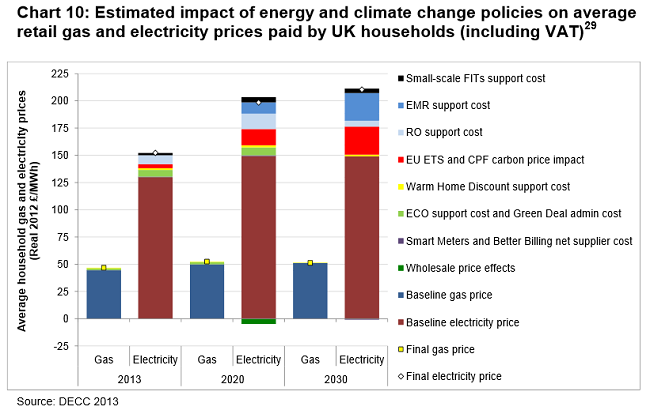
At The Register, Lewis Page debunks the propaganda from the government and shows the cost components of British energy prices from the government’s own published source:

The government’s Department of Energy and Climate Change, with the current minister as mouthpiece, has just pushed out a report claiming that its green policies are saving us money now and will save us even more in coming decades. Can it be true? We can save the planet — or anyway reduce carbon emissions — and it not only costs nothing, but puts money in our pockets?

In a word, no: of course not. If that was true there would be no need for government action, we’d be acting to reduce carbon emissions on our own. And indeed, once you skip the foolish tinned quotes and bogo-stats in the executive summary, the report itself makes it very clear that in fact green policies are already to blame for most of the sustained climb in electricity prices we’ve suffered over the past decade — and that it’s going to get a lot worse.

The blue and brown bars are what you would pay without green intervention. The rest is thanks to the greens.

The blue and brown bars are what you would pay without green intervention. The rest is thanks to the greens.

So there you are, plain as day. The various green interventions in the UK and EU energy markets which have come in since the turn of the century are already costing you a hefty sum — the government have already forced up the price you pay for electricity today by nearly 20 per cent over where it would have been if they’d left matters alone. If they carry on as planned, by the year 2030 they will have managed to drive it up by more than a third over where it would normally be.

March 27, 2013

The Beeching Report, 50 years on

Filed under: Britain, History, Railways — Tags: , , , , — Nicholas @ 09:36

In 1963, the British government published The Reshaping of British Railways, which became more commonly known as the Beeching Report. It was the trigger for the most substantive cuts in rail service and the focal point for a huge public outcry (and probably tipped the following national election to the Labour Party, too). The British railway system (which had been “rationalized” in 1923 and then fully nationalized in 1948) was bleeding money with little or no chance to pay back the debts it was running up. The operating deficit for British Railways ratcheted up from £16.5 million in 1956 to £104 million in 1962, with no likely end in sight. The Beeching Report was the government’s attempt to address the issue once and for all. History Today linked to this summary of the report and the public’s reaction by Charles Loft from 2003:

The lasting popular view of Beeching is of a cold-blooded accountant, concerned only with finance, whose report examined the railways in a vacuum when what was needed was a study of transport as a whole. One historian has called Beeching’s appointment ‘a tragedy for the nation’ and accuses him of ‘callously’ ignoring the social consequences of closures. Another, in a work entitled The Great Railway Conspiracy, suggests that the closure programme was at least partly motivated by a deliberate anti-rail bias on the part of the Conservative government of the day.

Such suspicions have been fuelled by a number of factors. Prior to 1962 closure proposals had (in effect, although not in law) to be approved by the relevant local Transport Users’ Consultative Committee. These committees rarely exercised a veto, but their hearings provided such an effective forum for critics of railway management, and took up so much time and effort, that they deterred railway managers from a vigorous pruning of the system. In 1956 the Ministry suggested that it might be better to publish a closure programme as part of a plan à la Beeching and have ‘one big row’ about it, than to fight a series of individual battles, but the British Transport Commission decided to experiment with diesel railbuses and other economies instead. Yet by 1959 it was clear that such measures were insufficient and therefore attempts were made to accelerate the rate of closures. [. . .]

Beeching’s apparent disregard for the social consequences of closure was merely a reflection of the fact that his report was a statement of what the railways should do as a business. What they should do as a social service was for ministers to decide, as only they could weigh the resulting costs against competing demands on the Exchequer. Because Beeching had little to say about social need and there was no legislative provision for subsidising loss-making services, the idea took root that the issue had simply been ignored. However, it was always accepted that many loss-making lines would have to be retained, particularly in urban areas where it was recognised that rail performed a vital role in reducing road congestion. Of course, the point at which hardship justified a loss was bound to be open to dispute; and in cases where losses were high and hardship affected relatively few, those few were unlikely to be consoled by the logic behind the process.

The Treasury’s concern over public spending levels also led it to initiate a series of studies of long-term demand in various sectors, in order to prioritise public investment. No such study of transport had been undertaken in Whitehall since the war and an initial attempt in 1957 revealed little more than officials’ lack of information or expertise on the subject. This problem proved difficult to solve. Such expertise could not be acquired overnight, and Whitehall was unable to establish a common measure for judging investment in road and rail. Instead, transport planning quickly crystallised around a choice between investing in rail and restricting road transport, or investing in roads and leaving the railways to perform only those tasks which they could accomplish profitably. As one Treasury under-secretary put it, the growth of road traffic in the 1950s meant that ‘Whitehall is … collectively fumbling after a new policy to meet new conditions which threaten to overwhelm us – indeed they may already have done so’.

[. . .]

In comparison to the lack of transport planning that typified the mid-1950s, the Beeching era represented a high point in transport policy-making. This is not to say that the resulting policy was unequivocally correct. Better roads were needed, but motorway-building did not offer a straightforward solution to congestion, and it is easy to point to regrettable rail closures. Some lines, such as Nottingham-Mansfield, have reopened, others, such as Oxford-Cambridge, may do so in the future; and the isolation of towns such as Hawick and Louth from the rail network was an act of dubious wisdom.

If these were errors, they were not Beeching’s, but politicians’. However, ministers of transport can never hope to satisfy our demand for unlimited road space and excellent public transport, as the availability of the former increases the latter’s cost. The lasting opprobrium heaped upon the memory of Dr Beeching is testimony to this fact — and to the gulf between the images conjured up by politicians’ talk of modernisation and the pains which, in reality, it all too often involves.

A collaboration that should have happened

Filed under: Britain, Media — Tags: , , , , — Nicholas @ 08:48

I missed this when it was posted last week:

Paul McCartney has revealed how he once asked electronic music pioneer Delia Derbyshire — creator of the Doctor Who theme music — to remake one of the Beatles’ most famous songs, Yesterday.

The former Beatle said that as a fan of experimental music he wanted the BBC Radiophonic Workshop composer to create a different version of the song.

[. . .]

Derbyshire is hailed as one of the most important figures in the history of electronic music in the UK. As part of the Radiophonic Workshop — the avant-garde wing of the BBC’s sound effects department — she created the distinctive signature tune for new TV series Doctor Who in 1963, using musique concrète techniques and sine- and square-wave oscillators to realise Ron Grainer’s score.

Derbyshire stopped making music in the 1970s, only rekindling her interest after working with Pete Kember (once of the group Spaceman 3) shortly before her death in 2001 at the age of 64.

Yesterday originally appeared on the Beatles’ 1965 album Help!. It is one of the most covered songs in the history of popular music, with more than 2,200 versions thought to exist.

MI5 and GCHQ will include assistance from the IT industry in the fight against online crime

Filed under: Britain, Government, Technology — Tags: , , , , — Nicholas @ 08:42

Two of the British government’s top intelligence agencies will team up with specialists from the IT field in a new initiative to counter online “cyber” crime:

Cyber-security experts from industry are to operate alongside the intelligence agencies for the first time in an attempt to combat the growing online threat to British firms.

The government is creating a so-called fusion cell where analysts from MI5 and GCHQ, the domestic eavesdropping agency, will work with private sector counterparts.

The cell is part of the Cyber Security Information Sharing Partnership (Cisp), launched on Wednesday, to provide industry with a forum to share details of techniques used by hackers as well as methods of countering them.

At any one time there will be about 12 to 15 analysts working at the cell, based at an undisclosed location in London.

“What the fusion cell will be doing is pulling together a single, richer intelligence picture of what is going on in cyberspace and the threats attacking the UK,” a senior official said.

John Leyden at The Register has more:

The programme, which follows a successful pilot scheme in 2011, is designed to support the wider aims of the UK’s cyber security strategy: such as making Britain the best country in the world to do e-business and protecting critical components of the national infrastructure (ie banks, utilities, telecoms and power grid).

Eighty companies from five key sectors of the economy — finance, defence, energy, telecommunications and pharmaceuticals — were encouraged to share information as part of the pilot scheme. The wider programme (involving a reported 160 organisations, at least initially) will allow access to a secure web-portal to gain access to shared threat intelligence information in real time, the BBC reports.

[. . .]

Terry Greer-King, UK MD for internet security firm Check Point, commented:

“This is a key step forward for both Governments and business in fighting web attacks, and reducing their impact. It’s essential that organisations collaborate and share intelligence with each other to track emerging threats, mitigate their severity or block them before they cause damage. Fighting threats together is much more effective than fighting alone.”

“In 2012, our research found that 63 per cent of organisations were infected with bots, and 54 per cent infected with malware that they didn’t know about. Any move which helps to reduce these figures is very welcome,” he added.

March 26, 2013

Irish municipal workers fear for their jobs after fixing a pothole … without getting Health & Safety approval first

Filed under: Bureaucracy, Europe, Government — Tags: , , — Nicholas @ 15:05

There are some stories which are just too silly for words:

THREE county council workers have been suspended from duty for attempting to fill in a pothole outside Carrigaline.

There has been outrage at the suspensions, which were imposed by the local authority after a health and safety inspector came across the workers carrying out unscheduled repairs to a road.

The outdoor crew were suspended on full pay pending an inquiry, and are now fearing for their jobs.
Council workers must pre-plan road works, fill in reports detailing the repairs to be carried out, and use the appropriate signage to alert the public.

It’s understood workers were on their way back to a council depot in Carrigaline when they spotted a large pothole on the road surface.

They decided to stop their vehicle to repair the pothole, even though it was not on their official list of jobs. They had earlier been carrying out scheduled repairs on the Carrigaline to Crosshaven road.

A health and safety inspector came across the workers carrying out the unofficial repairs and reported them to the local authority for a breach of health and safety guidelines.

March 25, 2013

The Cyprus “deal” decoded

Filed under: Economics, Europe, Russia — Tags: , , , — Nicholas @ 09:04

With a blog post entitled “THE CYPRUS HEIST GOES THROUGH: And it’s an Orwellian masterpiece“, you could say that this is an unfair summary of the situation:

Somewhere, George Orwell is spinning in his grave — although he wouldn’t be even remotely surprised by the 1984-style nonsense being hailed as a compromise by the Troikanauts and Nicosia’s embarrassed leaders.

This is the deal: the levy is called something else scrapped, and none of the deposits below €100,000 will be stolen included.

The new lunacy idea sees Laiki Bank closed. The entirety of its €4.2bn in deposits over €100,000 will be placed in a “bad bank”: why you would put healthy deposits in a bad bank eludes me, but we’re really just moving the stash around here: the bad bank’s resources will be confiscated. We’re talk a 100% haircut for all these savers.

And don’t be fooled by the Berlin propaganda about Russian money-laundering. First up, being a rich Russian doesn’t automatically make you a crook; and secondly, nowhere near all — possibly under half — are Russian anyway: UBS, several Israeli banks, a number of French banks will have depositor’s money taken out of them to pay for the ambitions of Brussels-am-Berlin.

There’s more: all the bondholders in Laiki also take a 100% haircut.

[. . .]

Entirely appropriate however was the choice of Wolfgang Schäuble to face the cameras and ‘explain’ why none of this would need the approval of the Cypriot Parliament. Just “approved by the 17 eurozone finance ministers comparatively quickly, after about two hours of further deliberations”. As to why it needed FinMin approval (but not that of the citizens’ representatives) get a load of this for jargonised bollocks:

“This plan will not require the approval of the Cypriot parliament because the losses on large depositors will be achieved through a restructuring of the island’s two largest banks and not a tax.”

Update: I think Tyler Cowen gets it exactly correct here:

The capital controls will have to be strict. What will the price of a Cypriot euro be, relative to a German euro? 50%? I call this Cyprus leaving the euro but keeping the word “euro” to save face. And yet they fail to reap most of the advantages of leaving the euro, such as having an independent monetary policy.

Still “a riddle, wrapped in a mystery, inside an enigma”

Filed under: History, Military, Politics, Russia, USA — Tags: , , — Nicholas @ 08:44

Strategy Page on the psychological state of Russia:

Westerners are puzzled at the way Russian politicians are growing increasingly hostile to foreigners in general and the West in particular. Then there is the feud going on within the Defense Ministry over whether to import more Western weapons or rely instead on what Russian defense firms produce.

Scrounging up details from Russian media, discussions on the Internet and statements by the many members of the Duma (parliament) with access to the inner circle reveals a rather bizarre (to Westerners, and some Russians) state of affairs. Put simply, most of those currently running Russia really believe that the United States has formed an anti-Russian coalition that is surrounding Russia in preparation for an invasion. The motive behind this plot is the Western need for Russia’s many natural resources. The U.S. has been using pro-democracy and reform minded NGOs (Non-Governmental Organizations) within Russia to cause turmoil and weaken the government and military.

[. . .]

Creating the idea that Russia is surrounded by enemies, led by the old Cold War arch foe America is something older Russians were exposed to most of their lives. It persuades Russians to keep electing Vladimir Putin and his cronies. But a growing number of Russians are noting that there’s no sign of this conspiracy in the West, only bewilderment over what the Russians are saying. Over time, the Putin paranoia program becomes less believable to more Russians. There is growing fear that, rather than face a majority of Russians who don’t believe in the conspiracy, the current rulers will try to turn Russian into a strict police state, without the trappings of Soviet–style communism or any other ism besides the greed of the small ruling class.

« Newer PostsOlder Posts »

Powered by WordPress

