
Published on 25 Aug 2016
NOTE: We are still on the road and won’t be able to answer many comments. Greetings from Lviv, Ukraine!
The Salonica Front was supposed to be a backdoor to the Austro-Hungarian Empire and for supporting the Serbian Army when the first Entente troops landed there. But their presence in Salonica was growing and bigger. With the return of the Serbian troops from Corfu and new support by the Russians and Italians, the Allies were now fielding a Five Nation Army here.
August 26, 2016
The Five Nation Army – The Salonica Front Erupts I THE GREAT WAR Week 109
Comments Off on The Five Nation Army – The Salonica Front Erupts I THE GREAT WAR Week 109
QotD: France’s “burkini” ban
France, like the rest of the liberal West, gets this exactly and lethally wrong. First we forbid individuals their natural right to set the rules within their own property, to exclude and admit who they choose, to demand the burkini or to ban it. Then we set the law on people for the crime of wearing too much cloth on the public beach. A photograph is reproduced worldwide showing three armed male policemen standing over a Muslim woman and making her remove the clothes she considers necessary for modesty. Whatever your opinion of Islam and its clothing taboos, does anyone in the world believe that this makes the next jihadist attack less likely? To call it “security theatre” would be a compliment. The popular entertainment it calls to mind is that of the mob stripping and parading une femme tondue.
Natalie Solent, “Security strip”, Samizdata, 2016-08-24.
August 25, 2016
RMS Queen Mary “was one of the epic government bailout boondoggles of the 20th century”
At Reason, Glenn Garvin looks at the role government subsidies had in the survival of the Cunard Line and the building of the RMS Queen Mary:
The most interesting thing about the Queen Mary, which for several decades was the largest passenger ship ever built, is not the 20-foot propellers so perfectly balanced that they could be spun with a flick of the wrist; or the 35,000 tons of metal that went into its construction; or the 10 million rivets that hold the whole thing together. It’s not even the still-mysterious question of how the ship became the springboard for the very first cheap-shot joke about Joan Collins. (Q. What’s the difference between Joan Collins and the Queen Mary? A. It takes a few tugs to get the Queen Mary out of her slip.)
No, the really special thing about the Queen Mary is that it was one of the epic government bailout boondoggles of the 20th century. In 1931, barely a year into the ship’s construction, the Cunard line went broke. The British dutifully forked over a loan of a staggering 9.5 million pounds — that’s $684 million in 2016 dollars — to keep the company afloat (dreadful pun not intended until I actually typed it). Which, as the documentary Mighty Ship at War: The Queen Mary notes, saved a whopping 2,000 jobs — at $342,000 a pop, I can only conclude that shipping lines employ a lot more neurosurgeons than I was aware — and, more importantly, England’s image: “Great Britain was at risk of losing its reputation as the world’s leading maritime nation.”
Its wide-eyed admiration of pork-slinging statecraft aside, Mighty Ship at War is a peppy and quite watchable little documentary about an oddball chapter in maritime history: the conversion of luxury liners into troop transports during World War II. When war broke out in Europe in 1939, unleashing German submarine wolfpacks on commercial shipping in the Atlantic, the cruise ships were drafted just like able-bodied men. They even got the maritime equivalent of a GI haircut, repainted a dull naval gray while their posh staterooms were ripped out to make way for towering stacks of bunks.
Even before its military makeover, Mighty Ship at War relates, the Queen Mary had found its business model remade by Europe’s gathering war clouds. Because the ship’s London-to-New York route included a stop in Cherbourg, France, it became the escape route of choice for many Jews fleeing Europe. Even families of modest means often traveled in plutocratic splendor, blowing their life savings on first-class tickets, because the Germans would confiscate any money or valuables the refugees tried to carry with them. “Give the money to the Brits, not the damn Nazis,” one refugee who made the crossing as a small child remembers his parents saying. By early 1939, every London departure of the Queen Mary was sold out.
Comments Off on RMS Queen Mary “was one of the epic government bailout boondoggles of the 20th century”
The Brothers Gracchi – I: How Republics Fall – Extra History
Published on 6 Aug 2016
Rome had doubled the size of its empire in a single generation, but such expansion came at great cost. The wars enriched the wealthy and impoverished the soldiers who fought in them. Into these turbulent times came a talented and well-connected young man named Tiberius Gracchus, who soon learned the power of appealing to the populace over the elite.
____________Rome had expanded rapidly during the 2nd century BCE. It now stretched from Spain to Greece, with holdings in Africa, and showed no signs of stopping. At home, this growth destabilized the entire economy. Slaves from captured lands became field workers for the wealthy. Common soldiers who used to own land could no longer tend it during the long campaigns, and returned to find themselves either bankrupt or forced to sell to the large slave-owning elites. Now these displaced landowners flooded Rome looking for work, but many of them remained unemployed or underemployed. In the midst of this, two boys named Tiberius and Gaius were born to the Gracchus family. They were plebeians, but of the most distinguished order. Their mother, Cornelia, was the daughter of Scipio Africanus. Their father was a two-time consul who’d celebrated two triumphs for winning great campaigns. But their father died early, so Cornelia raised her children alone and made sure they had a firm grounding in the liberal arts. As soon as he could, the elder boy, Tiberius, ran for office as a military tribune and joined the final campaign against Carthage. There he earned great honor for himself, and learned from the Scipio Aemilianus, his half-brother who also happened to be the leading general. Upon return to Rome, he ran for quaeastor and was sent to serve in the Numantian Wars in Spain. This time, the general he served under was struggling and suffered defeat after defeat. At the end, he tried to flee, only to be captured by the Numantians along with the entire army. The Numantians insisted on discussing surrender terms with Tiberius Gracchus, whose father had long ago earned their respect, and he successfully negotiated the release of 20,000 captured soldiers. In Rome, however, the elites looked on his treaty with scorn: they felt his surrender made Rome look weak. The families of the soldiers had a far different perspective: they celebrated Tiberius, and even saved him from punishment at the hands of the Senate. He had learned that power could be found in appealing to the people.
Comments Off on The Brothers Gracchi – I: How Republics Fall – Extra History
QotD: The rapid rise and equally rapid fall of the crime of Witchcraft
For the 19th century liberal and historian of ideas William Lecky, the most striking fact about England and France in the 17th century was the decline of belief in the supernatural. And the most striking instance of this fact was the collapse of belief in witchcraft.
At the beginning of that century, belief in witchcraft had been universal and unchallenged. James VI of Scotland (1567-1625) was one of the most learned men of his day. He believed without question in witches, and was a notable persecutor. When he became King of England as well in 1603, he brought his policies with him. It was to gain favour with him that Shakespeare introduced the witchcraft theme into Macbeth.
James procured a law that punished witchcraft with death on first conviction, even though no harm to others could be proven. This law was carried in a Parliament where Francis Bacon was a Member.
The law was carried into effect throughout England, and was especially used during the interregnum years of the 1650s. In 1664, under the restored Monarchy, Sir Matthew Hale — one of the greatest jurists and legal philosophers of the age — presided over the trial of two alleged witches in Suffolk. He told the jury that there could be no doubt in the reality of witchcraft. He said:
For first, the Scriptures had affirmed so much; and secondly, the wisdom of all nations had provided laws against such persons, which is an argument for their confidence of such a crime.
One of the witnesses called for the prosecution was Sir Thomas Browne, one of the most notable writers of the age. Appearing as a medical expert, he assured the jury “that he was clearly of opinion that the persons were bewitched.” They were convicted and hanged.
It was the same in France. In the town of St Claude, 600 persons were burnt in the early years of the century for alleged witchcraft and lycanthropy. In 1643, Cardinal Mazarin wrote to a bishop to congratulate him on his zeal for hunting out witches.
Yet, in 1667, Colbert, the chief minister of Louis XIV, directed all the magistrates in France to receive no more accusations of witchcraft. Those convictions still obtained he frequently commuted from death to banishment. By the end of the century, witchcraft trials had all but ceased.
In England, belief collapsed later, but even faster than in France. The last trial for witchcraft was in 1712. Jane Wenham, an old woman, was accused of the usual offences. The judge mocked the prosecution witnesses from the bench. When the jury convicted her against his directions, he made sure to obtain a royal pardon for the old woman and a pension.
Whatever the lowest reaches of the common people might still believe, belief in witchcraft had become a joke among the educated. And because of the tone they gave to the whole of society, disbelief spread rapidly beyond the educated. Anyone who tried to maintain its existence was simply laughed at. Laws that had condemned tens or hundreds of thousands to death, and usually to the most revolting tortures before death, were now sneered into abeyance.
We should expect that a change of opinion so immense had been accompanied by a long debate — something similar to the debates of the 19th century over Darwinism, or to the debates of the day over the toleration of nonconformity. Yet Lecky maintains that there was almost no debate worth mentioning. There were sceptics, like Montaigne, who disbelieved all accounts of the supernatural, or Hobbes, who was a materialist and atheist. But, while, book after book appeared in England during the late 17th century to defend the existence of witches and the need for laws against them, almost no one bothered to argue that witches did not exist. Lecky says:
Several… divines came forward…; and they made witchcraft, for a time, one of the chief subjects of controversy. On the other side, the discussion was extremely languid. No writer, comparable in ability to Glanvil, More, Cudworth, or even Casaubon, appeared to challenge the belief; nor did any of the writings on that side obtain any success at all equal to that of [Glanvil].
Belief in witchcraft perished with hardly a direct blow against it. What seems to have happened, Lecky argues, is a change of world view in which belief in witches ceased to have any explanatory value. We live in a world where, orthodox religion aside, belief in the supernatural is confined to the uneducated or the stupid or the insane. But if we step outside the consensus in which we live, we should see that there is nothing in itself irrational about belief in the supernatural, nor even in witches. The belief is perfectly rational granted certain assumptions.
Let us assume that the world is filled with invisible and very powerful beings, that some of these are good and some evil, that some human beings are capable of establishing contact with these evil beings, and that some compact can be made in which the power of the evil beings is transferred to human control. Granting these assumptions, it becomes reasonable to ascribe great or unusual events to magical intervention, and that it should be the purpose of the law to check such intervention.
Now, the Platonic philosophies do accept the existence of such beings. That is how Plato reconciled his One Creator with the many gods of the Greek pantheon. This belief was taken over by the Church Fathers, who simply announced that the ancient gods were demons. It then continued into the 17th century. It seemed to explain the world. Doubtless, cases came to light of false accusations and of people convicted because they were ill rather than possessed by demons. But our own awareness of corrupt policemen and false convictions does not lead us to believe that there are no murderers and that murder should not be punished. So it was with witchcraft.
During the 17th century, however, the educated classes came increasingly to believe that the world operated according to known, impersonal laws, and that God — assuming His Existence — seldom interfered with the working of these secondary laws. In such a view of the world, the supernatural had no place. Belief in witchcraft, therefore, did not need opposition. It perished as collateral damage to the system of which it was a part.
Sean Gabb, “Epicurus: Father of the Enlightenment”, speaking to the 6/20 Club in London, 2007-09-06.
Comments Off on QotD: The rapid rise and equally rapid fall of the crime of Witchcraft
August 23, 2016
Hey, EU! Two can play this silly medal total game!
If you’re on Twitter or Facebook, I’m sure you’ve seen at least one variant of this bit of EU self-puffery going around:
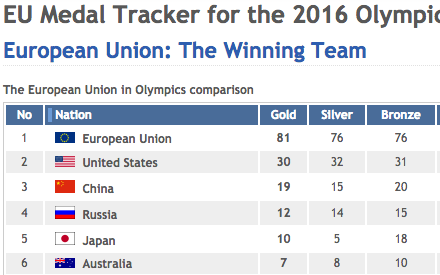
As Guido Fawkes points out, under those rules the British Empire completely eclipses the medal total of all the EU states:
The former countries of the British Empire won 396 medals – 138 more medals than a post-Brexit EU. While the European Parliament invents an EU state to “win” the Olympics, the medal tally of a one-time actual supra-state leaves Brussels for dust. Former member countries of the British Empire accrued 76 more medals than the rest of the world (24%). In all, the Empire’s score of 137 gold medals trounces the EU’s, which after removing Great Britain sits at just 79.
Looking at other alliances NATO countries took a stunning 443 out of the 974 medals on offer (45%), while Anglosphere countries grabbed a whopping 288 – 30% of the world total. This is compared to Francophone states’ measly 87 (9%), even with Canada’s 22 (2%) generously included. Hoisting the colours appears to have been good luck; countries with Union Jacks in their flags took a massive 115 medals, of which 40 were gold!
Comments Off on Hey, EU! Two can play this silly medal total game!
A Crucial Test For Unity – Greece in WW1 I THE GREAT WAR Special
Published on 22 Aug 2016
Greece was officially neutral in World War 1. Surrounded by warring nations and under the influence of the great powers, Greek unity was tested during the war in a time of National Schism.
Comments Off on A Crucial Test For Unity – Greece in WW1 I THE GREAT WAR Special
August 21, 2016
Kurds in WW1 – The Swagger Stick I OUT OF THE TRENCHES
Published on 20 Aug 2016
It’s Chair of Wisdom Time again and this week we talk about the Kurds in World War 1 and the iconic Swagger Stick.
Comments Off on Kurds in WW1 – The Swagger Stick I OUT OF THE TRENCHES
August 20, 2016
QotD: Violence in wartime – the great exception
War is the great exception, the great legitimizer of murder, the one arena in which ordinary humans routinely become killers. The special prevalence of the killer-ape myth in our time doubtless owes something to the horror and visibility of 20th-century war.
Campaigns of genocide and repressions such as the Nazi Holocaust, Stalin’s engineered famines, the Ankha massacres in Cambodia, and “ethnic cleansing” in Yugoslavia loom even larger in the popular mind than war as support for the myth of man the killer. But they should not; such atrocities are invariably conceived and planned by selected, tiny minorities far fewer than 0.5% of the population.
We have seen that in normal circumstances, human beings are not killers; and, in fact, most have instincts which make it extremely difficult for them to engage in lethal violence. How do we reconcile this with the continuing pattern of human violence in war? And, to restate to one of our original questions, what is belief in the myth of man the killer doing to us?
We shall soon see that the answers to these two questions are intimately related — because there is a crucial commonality between war and genocide, one not shared with the comparatively negligible lethalities of criminals and the individually insane. Both war and genocide depend, critically, on the habit of killing on orders. Pierson observes, tellingly, that atrocities “are generally initiated by overcontrolled personality types in second-in-command positions, not by undercontrolled personality types.” Terrorism, too, depends on the habit of obedience; it is not Osama bin Laden who died in the 9/11 attack but his minions.
This is part of what Hannah Arendt was describing when, after the Nuremberg trials, she penned her unforgettable phrase “the banality of evil”. The instinct that facilitated the atrocities at Belsen-Bergen and Treblinka and Dachau was not a red-handed delight in murder, but rather uncritical submission to the orders of alpha males — even when those orders were for horror and death.
Human beings are social primates with social instincts. One of those instincts is docility, a predisposition to obey the tribe leader and other dominant males. This was originally adaptive; fewer status fights meant more able bodies in the tribe or hunting band. It was especially important that bachelor males, unmarried 15-to-25 year-old men, obey orders even when those orders involved risk and killing. These bachelors were the tribe’s hunters, warriors, scouts, and risk-takers; a band would flourish best if they were both aggressive towards outsiders and amenable to social control.
Over most of human evolutionary history, the multiplier effect of docility was limited by the small size (250 or less, usually much less) of human social units. But when a single alpha male or cooperating group of alpha males could command the aggressive bachelor males of a large city or entire nation, the rules changed. Warfare and genocide became possible.
Actually, neither war nor genocide needs more than a comparative handful of murderers — not much larger a cohort than the half-percent to percent that commits lethal violence in peacetime. Both, however, require the obedience of a large supporting population. Factories must work overtime. Ammunition trucks must be driven where the bullets are needed. People must agree not to see, not to hear, not to notice certain things. Orders must be obeyed.
Eric S. Raymond, “The Myth of Man the Killer”, Armed and Dangerous, 2003-07-15.
Comments Off on QotD: Violence in wartime – the great exception
August 19, 2016
Cadorna Snatches Defeat From The Jaws of Victory I THE GREAT WAR Week 108
Published on 18 Aug 2016
The Italian offensive taking Gorizia last week surprised everyone. Including Italian Chief of Staff Luigi Cadorna who overlooks the huge strategical advantages now open in front of him. Instead he hesitates and “glorious” victory gets a few dents. At the same time, Romania is getting ready to join the war on the side of the Entente too and on the Western Front German morale is dwindling as the French and the British Army are getting more confident at the Somme and at Verdun.
Comments Off on Cadorna Snatches Defeat From The Jaws of Victory I THE GREAT WAR Week 108
Lindisfarne – An Age Borne in Fire – Extra History
Published on 30 Jul 2016
Bishops. Manuscripts. Pilgrimage. Wealth. In 793 CE, the island monastery of Lindisfarne thrived in a state of harmony. Then, everything changed when the Viking raiders attacked. Once they discovered Europe’s weakness, not even mighty kings like Charlemagne could stop them. They transformed their power at sea into an avenue for conquest and expansion: the Viking Age had begun.
____________Troubling omens were recorded in Lindisfarne prior to the Viking invasion on June 8, 793 CE. It was the seat of the bishop for much of Northeastern Britain. Monks in the scriptorium produced some of the most celebrated illustrated manuscripts, and abroad they helped convert the pagans of Britain. Lindisfarne had been the final resting place of St. Cuthbert, so pilgrims often came and enriched the priory and the town. It never occurred to anyone that when strange ships appeared on the horizon, that they might be hostile. The men who disembarked were fierce, unknown, and merciless. They cut down monks in the churches and looted the church… then left. Bishop Higbald survived, and sent the news across Europe. From there, the frequency of raids only increased and raged across all of Europe. The burgeoning flame of Lindisfarne was almost snuffed out. It was the first time in history that the reach of Christianity shrank, rather than expanded. But what about the other side of the story? These “barbarians,” who would become known as Vikings, were striking back at a culture that looked down on them, insulted their faith, and tried to swindle them at trade. They had realized how poorly defended these both the British Isles and mainland Europe were, and how rich they were in fertile land. They put their vast knowledge of shipcraft to work and turned trading routes into raiding routes, finding new lands for them to settle. The Viking Age had begun.
Comments Off on Lindisfarne – An Age Borne in Fire – Extra History
August 18, 2016
World of Warships – The Royal Navy
Published on 17 Aug 2016
Ahoy there, shipmates! Splice the mainbrace and shiver me timbers! British cruisers are coming and here’s our first look!
Comments Off on World of Warships – The Royal Navy
August 16, 2016
Austro-Hungarian Pistols of WW1 I THE GREAT WAR Special feat. C&Rsenal
Published on 15 Aug 2016
Check out Othais channel C&Rsenal to learn all about the history of WW1 firearms: https://www.youtube.com/c/candrsenal
We partnered with Othais again a few months ago for a livestream showing the Austro-Hungarian weapons of WW1. This is the 2nd episode about the surprising variety of pistols.
Comments Off on Austro-Hungarian Pistols of WW1 I THE GREAT WAR Special feat. C&Rsenal
Would Trump pull the US out of NATO?
Tom Kratman regretfully says no:
The last several months have seen repeated claims and variants on claims that presidential candidate Donald Trump wants to, and intends to, pull the United States out of NATO. Hillary Clinton made the claim on 28 March of this year, repeating a version of it on 8 May on Face The Nation.
Sad to say, Trump hasn’t said we need to pull out; would that he had. Instead, he’s made far weaker calls to “reconsider” our role in NATO, and to restructure or reform NATO to deal with modern threats, like terrorism, rather than Cold War threats, like the former Soviet Union and Warsaw Pact. These were couched in terms generally reasonable and factual; to paraphrase, NATO other than the US doesn’t pay its fair share.
I’m not so concerned with what politicians may say – and Trump’s become one now – who are vying for political office. See, for example, Hillary’s lies about what Trump actually said, cited above. I’m far more concerned with what they should do following election. In this particular case, though what Hillary has claimed of Trump is a lie, it’s a lie he should follow through on.
NATO has rarely pulled its weight in the past, nor is it pulling its weight in the present. Of twenty-eight NATO countries, only five meet their defense spending goal of two percent of GDP. Even that is begging the question, though; because none of them, not one, come near to our level of spending. Britain, for example, with a GDP of 2.679 trillion, spends about fifty-two billion, or just over two percent. France’s defense budget runs under two percent. Germany, Europe’s largest economy, disgracefully, spends a mere thirty-seven billion, or just over one percent. Some smaller NATO countries, the Netherlands, for example, spend about what Germany does.
We, conversely, spend about three times what Germany does, and even more than that if one tallies in a number of indirect expenditures, like the VA, on which we spend more than twice Germany’s entire defense budget.
Frankly, all of NATO is on a kind of moral defense welfare and has been pretty much since inception.
[…]
But the Truman Doctrine! The Truman Doctrine!
I know a lot of people must have missed it, but the Truman Doctrine wasn’t designed to contain Russia. Neither should one be taken in by flighty rhetoric presented to congress. The Truman Doctrine arose in the context of containing communism. That was done. Communism is no longer an international threat (and if we can keep the Hildebeast out of the White House we may be able to keep it from becoming a domestic threat, too).
But we need European troops!
Some of them have been, indeed, excellent. I am thinking especially of the UK’s, Canada’s, Australia’s, and Denmark’s. I am not thinking of Germany’s, the reports on whom, such as I have seen, are almost uniformly wretched, and I am not thinking of France’s, the reports on which are mixed. However, in accord with their defense budgets, those troop slices were objectively small, and they generally did not come with logistic self-sufficiency. In other words, in huge part, we had to provide the transportation and other support to keep them in the field in Afghanistan and Iraq, and that, especially in Afghanistan, where our own logistic capability was badly strained.
That was bad enough, but there is something much worse. There has grown up over the decades since the Second World War a regime of treaties, advancing what is often called “International Humanitarian Law” – IHL – and purporting to subordinate the law of war to it. Some of those claims are so preposterous as to be unbelievable, except that many, many of the world’s elites do believe in them and do force us to subordinate our own laws to them. A discussion of IHL is beyond the scope of this column. Note, however, two aspects of it that have arisen, the International Criminal Court, created by what is called “the Rome Statute,” and the Protocols Additional to Geneva Convention IV. The former subverts national sovereignty by placing it subordinate to unelected, partisan, largely left wing, jurists. The latter were specifically designed and pushed forward by the former Soviet Union to undermine the west.
We accept neither of these and, in fact, have a conditional declaration of war in place, the American Servicemembers Protection Act, should anyone try to grab our troops for trial before the ICC. Unfortunately, our “allies,” for the most part, have signed onto these obscenities. What that means is that we are constrained from acting with the full rigor of the law of armed conflict by the presence of allies, for whom, should we act in accordance with the law of war but against IHL, makes them complicit in what are, by their own domestic laws, war crimes. This constraint is intolerable, a rotten, stinking albatross tied around our necks. And this is what makes the presence of allied NATO troops not worth the bother, even when those troops are superb.
Comments Off on Would Trump pull the US out of NATO?
August 14, 2016
Captured Tanks – Bagpipers I OUT OF THE TRENCHES
Published on 13 Aug 2016
Indy sits in the chair of wisdom again to answer your questions about World War 1.
Comments Off on Captured Tanks – Bagpipers I OUT OF THE TRENCHES


