
The declared portion of the Spanish Civil War lasted from 1936 to 1939. It has passed into legend among Western leftists as a heroic struggle between the Communist-backed Republican government and Nazi-backed Franco, one that the good guys lost. The truth seems rather darker; the war was fought by two collections of squabbling, atrocity-prone factions, each backed by one of the two most evil totalitarianisms in human history. They intrigued, massacred, wrecked, and looted fairly indiscriminately until one side collapsed from exhaustion. Franco was the last man left standing.
Franco had no aspirations to conquer or reinvent the world, or to found a dynasty. His greatest achievements were the things that didn’t happen. He prevented the Stalinist coup that would certainly have followed a Republican victory. He then kept Spain out of World War II against heavy German pressure to join the Axis.
Domestically, Spain could have suffered worse. Spanish Fascism was quite brutal against its direct political enemies, but never developed the expansionism or racist doctrines of the Italian or German model. In fact it had almost no ideology beyond freezing the power relationships of pre-Republican Spain in place. Thus, there were no massacres even remotely comparable to Hussein’s nerve-gassing of Kurds and Shi’as, Hitler’s Final Solution or Stalin’s far bloodier though less-known liquidation of the kulaks.
Francisco Franco remained a monarchist all his life, and named the heir to the Spanish throne as his successor. The later `fascist’ regimes of South and Central America resembled the Francoite, conservative model more than they did the Italo/German/Baathist revolutionary variety.
One historian put it well. “Hitler was a fascist pretending to be a conservative. Franco was a conservative pretending to be a fascist.” (One might add that Hussein was not really pretending to be about anything but the raw will to power; perhaps this is progress, of a sort.) On those terms Franco was rather successful. If he had died shortly after WWII, rather than lingering for thirty years while presiding over an increasingly stultified and backward Spain, he might even have been remembered as a hero of his country.
As it is, the best that can be said is that (unlike the truly major tyrants of his day, or Saddam Hussein in ours) Franco was not a particularly evil man, and was probably less bad for his country than his opponents would have been.
Eric S. Raymond, “Fascism is not dead”, Armed and Dangerous, 2003-04-22.
August 13, 2016
QotD: The aftermath of the Spanish Civil War
August 12, 2016
Italy Breaks Through – Cadorna’s Triumph I THE GREAT WAR Week 107
Published on 11 Aug 2016
Italy’s war in the alps wasn’t very successful so far but this week they took Gorizia, a major triumph for the Duke of Aosta and Italian Chief of Staff Luigi Cadorna.
August 11, 2016
Urbino – The Light of Italy: Federico da Montefeltro – Extra History
Published on 16 Jul 2016
Federico da Montefeltro shone brightly as the “Light of Italy,” one of many torches that helped light the flame of Renaissance. He made his name as a wily yet honest mercenary captain, but he also ruled as prince of the small, remote town of Urbino. There, he and his wife built an illustrious court that celebrated creativity, knowledge, and justice.
____________Born an illegitimate son, Federico da Montefeltro became the heir of Urbino when his family got the Pope to legitimize him. As a child, he was sent to Venice to serve as a hostage for his family’s part in the wars of Lombardy, and by 15 he had turned his fate around to become knighted by the Holy Roman Emperor Sigismund. At 16, he became a condotierre, a mercenary. Although he was technically prince of Urbino, his land was isolated and poor, so mercenary service allowed him to make money. He excelled at it: he never lost and never broke a contract. Cities began paying him NOT to fight against them, and he channeled their riches into his hometown. He looked after his soldiers families in Urbino, walked the markets every day, and held court in his garden where all citizens were treated equally under the law. Since he loved history and philosophy, he built one of the greatest libraries in all of Italy, hiring scribes to find and copy classical works that might have been lost if not for him. He also built a palace where he fostered art of all kinds, and young people from noble houses across the continent flocked to his court. His wife, especially his second wife Battista Sforza, built Urbino alongside him. She’d received the same liberal education he had and often counseled him on politics When he was away, she held court in his stead. Sadly, she died of complications while bearing Federico’s only son, whom he named Guidobaldo. Guidobaldo was intelligent and well read, but he was sickly and could never be his father’s equal in war. After Federico died, the Borgia came and seized Urbino from Guidobaldo, but although his family lost its holdings, his legacy lived on as the ideas and attitudes he’d nurtured in his court survived and spread far enough to help spur the beginning of the Renaissance in Italy.
Debunking myths from the Muslim occupation of Al-Andalus
Recently returned from a trip to her native Portugal, Sarah Hoyt explains why the stories of Muslim-occupied Iberia being a wonderfully tolerant and humane place are not likely to have been true:
I’ve been reading a debunking of the myths of the “Convivencia” paradise that Al Andalus and generally Islamic Hispania is supposed to have been.
It’s not exactly a shock to me. First of all, my preferred reading, as soon as I could read, was history, most of it written in the early 20th century, and a lot of it local histories or histories of regions of Portugal and Spain. I won’t say that the authors universally rejected the myth of Islam as a civilizing/science-bearing force. I will say that when they applied it (in elementary school we were forced to memorize the improvements the Arabs brought to the peninsula — we did that with each invader, and boy did the area get invaded — almonds, pillows (al-mofadas), the sort of fountains that spout by themselves (you build them by making the water gravity fed from above where you want it to spout. I’m explaining very badly, but I am still not fully sleep recovered, and there’s a hole where the name for the fountains should be, orange trees. There might be something about the way oxen were yoked, but I doubt it. Oh, yeah, the way we write our numbers.) it left me curiously unconvinced.
It was little things, you see, having actually been born/grown up in one of the areas/near the area where this supposed paradise existed. Yeah, sure, the North of Portugal got off lightly. We were freed fairly early on (we were a crusade land and were freed mostly by French crusaders, one of whom, having married a daughter of the king of Castille became father to our first king.)
More specifically, though there are no specific histories of the village (duh) I heard more than once from people I trusted, that we were the sort of place that got by with one or two Berber supervisors, and local toadies… er, I mean functionaries.
But Portugal is a small place, and I went to other places. And there are things…
In a truly multicultural society, with REAL religious tolerance, the local church wouldn’t have been commandeered as a mosque (apparently this was a standard humiliation technique for captive populations.) It was returned to use as a church, and has been such for centuries now, the interior having been ALMOST completely scrubbed clean of arabesque decorations. ALMOST. Why almost, you ask? The wall near the door, around the door, where you can’t avoid seeing them as you leave, was left “decorated.” It was left so that people would never forget.
Then there are churches that were pulled down by the Muslim invaders, and into which people were buried through all the years of occupation. It was the only consecrated ground around, you see. The poor bastards weren’t allowed to have their own religious cemeteries/bury their dead in peace. Oh, and this was often in areas that were considered solid Muslim (this ties in to something else later on, so stay tuned.)
But there is more than that. I never BOUGHT the idea that Muslims were kind and gentle overlords for a more bone-deep reason.
Look, people with ancient cultures all in the same place REMEMBER. They remember in ways that no academic gaslighting, no professorial assurances to the contrary can erase. For instance, do you know how you can tell which Roman emperors were considered decent by the local people? They give their names to their kids. Still. Trajan, for instance. And then there are the bad ones, that are also still remembered, but whose names are given to dogs (Nero.) And then there are the unspeakable ones. Neither child nor dog is named Caligula.
Well, in the local area, you find some kids named Ibrahim (though that is a bit confusing since local custom does weird things to spelling) but NONE named Mohammed. (This might be different now, since the Conquista II — this time we pretend to be innofensive — is in progress.) But back then there were no Moes around.
And that is plain weird in a place that has forgotten nothing. (Seriously, there are still people around named after Roman gods, because the name runs in the family. And Greek Heroes. And Carthaginian heroes, too. My brother went to school with Hannibal, Hasdrubal, and a bunch of Roman historical names — I want to say Cipius, but I’m probably wrong.)
QotD: The Great Vowel Shift and “Canadian Raising”
Linguists do not generally attempt to answer questions of causality. “Why? I can’t answer that,” said Dailey-O’Cain when I asked. “You can look at ongoing changes sometimes if you have the right kind of data but it’s very, very hard.” But there are theories. One particularly fascinating explanation has to do with what’s called the Great Vowel Shift. If you’ve ever wondered why English is such a legendarily horrible language to learn, a lot of the problems can be traced back to the Great Vowel Shift.
There is no firm date on the beginning and end of the Great Vowel Shift, but at most, we can say it happened between the 1100s and the 1700s, with probably the most important and biggest changes happening in the 1400s and 1500s. This coincides with the shift from Middle English to Modern English, and also with the standardization of spelling. The shift itself? Every single “long vowel” — ”ey,” “ee,” “aye,” “oh,” “ooh” — changed. (Nobody knows why. Linguistics is turtles all the way down.)
Before the Great Vowel Shift, “bite” was pronounced more like “beet.” “Meat” was more like “mate.” Everything just kind of slipped one notch over. This happened in stages; that first word, “bite,” started out as “beet,” then became “bait,” then “beyt,” then “bite.” You can hear a nice spoken-aloud rundown of those here.
If you’re wondering what the difference between “bait” and “beyt” is, well, there you have one possible origin of Canadian Raising. “Beyt,” one of the later but not the final stage of the Great Vowel Shift, is extremely similar to the Canadian Raised sound spoken today. There is a theory — not necessarily accepted by all — that Canadian Raised vowels are actually a preserved remnant of the Great Vowel Shift, an in-between vowel sound that was somehow stuck in amber in the Great White North.
Maybe a certain population of Englishmen from that particular time period, around 1600, landed in Canada and due to its isolation failed to observe the further changes happening in England. Maybe.
But I like this explanation. Canadians aren’t weird; they’re respecting the past. One very specific past, that everyone else skipped on by. It’s an awfully nice-sounding diphthong.
Dan Nosowitz, “What’s Going On with the Way Canadians Say ‘About’? It’s not pronounced how you think it is”, Atlas Obscura, 2016-06-01.
August 10, 2016
The Year Of Battles I THE GREAT WAR Summary Part 6
Published on 9 Aug 2016
1916 is known as the year of battles and in the summer of that year this name was truly earned. The Battle of Verdun, the Brusilov Offensive and the Battle of the Somme were all fought simultaneously. On top of that, the Austrians launched a “punishment expedition” against the Italians, the Arab Revolt was declared and the slowly but steadily the Balkan front was built up once more.
Sir Humphrey Appleby explains the organization of the EU to his new minister
In the Guardian, Jonathan Lynn and Antony Jay provide a new minister with the wisdom of Sir Humphrey Appleby:
Sir Humphrey The first thing to understand is that there is a European Council and a Council of the European Union.
Minister They’re not the same thing?
Sir Humphrey No. The European Council, whose members are the 28 heads of state of the 28 member states, defines the general political direction and priorities of the European Union whereas the Council of the European Union, on the other hand, develops the EU’s common foreign policy, in so far as there is any, and security policy, concludes international agreements and adopts the EU budget.
Minister Who’s in charge?
Sir Humphrey That’s an interesting question. The president of the European Council is in office for 30 months and is in charge of preparing the agenda and chairing the meetings of the European Council, whereas the presidency of the Council of the European Union is held only for six months each, by rotating states, hardly enough time for a part-time president to get his feet under the desk. Which is probably the idea.
Minister So who really runs Europe?
Sir Humphrey Another interesting question. Well done, Minister! The European Union is run on an intricate and sophisticated system based on an hierarchical structure of interlocking and overlapping jurisdictions designed to separate the powers whilst reinforcing the authority of the departments, institutions and agencies who collectively and separately control and supervise the diverse activities of the Union and its associated organisations. So Europe is not run by the president of the European Council or the Council of the European Union but by the president of the European Commission, who is akin to prime minister of Europe because he is elected for five years and heads a cabinet government whereas the president of the Council, on the other hand, is not elected but appointed, and presides over the meetings of the Council, which is not the cabinet.
Minister Who are the members of the European Council?
Sir Humphrey The European Council’s membership consists of the heads of member states while the Council of the European Union, on the other hand – which is often still referred to as the Council of Ministers – is the real voice of EU member governments, adopting EU laws and coordinating EU policies. Sometimes it is just called “the Council” in the interests of clarity. And they’re not even trying to be funny.
Minister It’s called the Council.
Sir Humphrey Yes – but the Council of the European Union should not be confused with the European Council nor with the Council of Europe – nor the Council of Ministers, which is also sometimes just called “the Council”, although it is not the same Council as the other Council and is in fact not an EU body at all.
Populists and open borders
In City Journal, Victor Davis Hanson says the rise of Trump and other populist politicians is being powered by lower- and middle-class rejection of the elite preference for open borders:
Driving the growing populist outrage in Europe and North America is the ongoing elite push for a borderless world. Among elites, borderlessness has taken its place among the politically correct positions of our age — and, as with other such ideas, it has shaped the language we use. The descriptive term “illegal alien” has given way to the nebulous “unlawful immigrant.” This, in turn, has given way to “undocumented immigrant,” “immigrant,” or the entirely neutral “migrant” — a noun that obscures whether the individual in question is entering or leaving. Such linguistic gymnastics are unfortunately necessary. Since an enforceable southern border no longer exists, there can be no immigration law to break in the first place.
Today’s open-borders agenda has its roots not only in economic factors — the need for low-wage workers who will do the work that native-born Americans or Europeans supposedly will not — but also in several decades of intellectual ferment, in which Western academics have created a trendy field of “borders discourse.” What we might call post-borderism argues that boundaries even between distinct nations are mere artificial constructs, methods of marginalization designed by those in power, mostly to stigmatize and oppress the “other” — usually the poorer and less Western — who arbitrarily ended up on the wrong side of the divide. “Where borders are drawn, power is exercised,” as one European scholar put it. This view assumes that where borders are not drawn, power is not exercised — as if a million Middle Eastern immigrants pouring into Germany do not wield considerable power by their sheer numbers and adroit manipulation of Western notions of victimization and grievance politics. Indeed, Western leftists seek political empowerment by encouraging the arrival of millions of impoverished migrants.
QotD: “Pro-business” versus “Pro-consumer”
In popular discourse, America is said to be more “pro-business” than is France. When people use this term “pro-business” they typically have in mind some vague notion of a government policy made up of low-ish taxes and not a great deal of government regulation. That is, “pro-business” is commonly used to mean a free, or free-ish, market.
But such language is mistaken.
A true free market is at its core pro-consumer. In a genuinely free-market economy, businesses are valued only insofar as they serve consumers. The performance of a genuinely free-market economy is assessed by how well it satisfies, over time, the demands of consumers spending their own money and not by how well it satisfies the demands of business owners and managers.
Obviously, because businesses are a useful – indeed, practically indispensable – means of abundantly satisfying consumers’ demands, government policies that obstruct the smooth operation of these means are undesirable. But such policies that obstruct or discourage business operations are economically undesirable not because they harm businesses but, rather, because they harm consumers.
Anyway, for all of its faults, American culture and policy are actually much less pro-business than are the culture and policy of France. If you’re really looking for a government that is deeply pro-business – one that regards the protection of existing businesses as a worthy end in and of itself – one that forcibly transfers resources from taxpayers, consumers, and other non-businesses in order to promote the material interests of existing businesses – look at France. You’ll find there what you seek. In France you’ll find one of the most business-friendly policy regimes on the face of the earth. (HT Chris Meisenzahl)
Pity the French.
Don Boudreaux, “Pity the French Consumer and Worker”, Café Hayek, 2016-06-27.
August 9, 2016
The British Naval Blockade of Germany I THE GREAT WAR Special
Published on 8 Aug 2016
The big and decisive naval battle that the Royal Navy had hoped for did not happen during World War 1. But another naval strategy slowly but surely ground the German economy down.
August 8, 2016
The legacy of the Loeb Classical Library editions
While I sometimes feel old enough to have construed Latin in school, it departed the curriculum a few years before I reached high school. As a result, while I was vaguely aware of the Loeb Classical Library, I never had a need to obtain or depend on them for my academic career (thank goodness). Back in 2011, John Talbot described them as the “bright ghosts of antiquity” for New Criterion:
The gist of an old joke — it has a dozen local iterations — is that the Loeb Classical Library translations are so baffling that you have to consult the original Greek or Latin on the left-hand page to decipher the English translation on the right.
Funny or not, the wisecrack catches the condescension long directed at the Loebs, that venerable series of Greek and Latin classics in uniform volumes with facing English translations. Professors of classics in particular used to frown upon them. Until recently, merely to be seen on campus with a Loeb was to court scandal. There were gradations of disgrace. Those Loeb editions of Boethius, Bede, and Augustine I saw on the shelves of the professor who taught me Anglo-Saxon: those were permissible for an English scholar. But I, as a classics major, was to eschew the very same volumes. Even as an undergraduate, though I prized my Loeb edition of The Republic, edited and imaginatively annotated by Paul Shorey, I knew better than bring it to my seminar on Plato. That same tact — that same hypocrisy — accounts for the care I took, as a graduate student, to avoid detection as I sifted the used bookshops of Cambridge for second-hand Loebs. For many of us, the pleasure we took in the Loebs was tinged with guilt.
But attitudes are changing. Once treated as evidence of the decline of Western civilization, the Loeb Classical Library is now, in its centennial year, more often regarded as, if not quite a pillar of our culture, at least one of its more enduring and useful props. The centenary invites consideration of how the Loebs have both reflected and, increasingly, shaped our literary culture.
First, to deal with that joke: Are the Loeb translations really so convoluted? They are not. What is true, though not true enough to justify the slur, is that some of the translations, especially those of the Library’s first few decades, do make hard going for the reader, not because they are incomprehensible but because they are written in one of two different varieties of translationese. About the first kind, the Times Literary Supplement reviewer got it right when he complained that the 1913 Loeb Catullus was translated not into English exactly, but that other dialect, “the construing lingo beloved of schoolboys, but abhorred by man and gods.” He had in mind such clunking touches as “remains to be slept the sleep of one unbroken night” for Catullus’ suave nox est perpetua una dormienda, a solution which confirms, as though to satisfy a schoolteacher, the translator’s grasp of the future perfect passive, whatever the cost to English idiom.
H/T to Never Yet Melted for the link.
August 7, 2016
Flamethrowers – Anti Aircraft Guns I OUT OF THE TRENCHES
Published on 6 Aug 2016
In this week’s episode we answer your questions about flamethrowers, anti aircraft guns and the role of reserves.
QotD: “… there were no good guys in the Spanish Civil War”
Pio Moa’s thesis is that the Spanish Civil War was not a usurping revolt against a functioning government, but a belated attempt to restore order to a country that had already collapsed into violent chaos five years before the Fascists landed in 1936.
I’ve studied the history of the Spanish Civil War enough to know that Moa’s contrarian interpretation is not obviously crazy. I had an unusual angle; I’m an anarchist, and wanted to grasp the ideas and role of the Spanish anarchist communes. My conclusions were not pleasant. In short, there were no good guys in the Spanish Civil War.
First, the non-anarchist Left in Spain really was pretty completely Stalin’s creature. The volunteers of the International Brigade were (in Lenin’s timeless phrase) useful idiots, an exact analogue of the foreign Arabs who fought on in Baghdad after Iraqi resistance collapsed (and were despised for it by the Iraqis). They deserve neither our pity nor our respect. Insofar as Moa’s thesis is that most scholarship about the war is severely distorted by a desire to make heroes out of these idiots, he is correct.
Second, the Spanish anarchists were by and large an exceedingly nasty bunch, all resentment and nihilism with no idea how to rebuild after destroying. Wiping them out (via his Communist proxies) may have been one of Stalin’s few good deeds.
Third, the Fascists were a pretty nasty bunch too. But, on the whole, probably not as nasty as their opponents. Perceptions of them tend to be distorted by the casual equation of Fascist with Nazi — but this is not appropriate. Spanish Fascism was unlike Communism or Italian and German Fascism in that it was genuinely a conservative movement, rather than a attempt to reinvent society in the image of a revolutionary doctrine about the perfected State.
Historians and political scientists use the terms “fascist” and “fascism” quite precisely, for a group of political movements that were active between about 1890 and about 1975. The original and prototypical example was Italian fascism, the best-known and most virulent strain was Naziism, and the longest-lasting was the Spanish nationalist fascism of Francisco Franco. The militarist nationalism of Japan is often also described as “fascist” .
The shared label reflects the fact that these four ideologies influenced each other; Naziism began as a German imitation of Italian fascism, only to remake Italian (and to some extent Spanish) fascism in its own image during WWII. The militarist Japanese fascists took their cues from European fascists as well as an indigenous tradition of absolutism with very similar structural and psychological features
The shared label also reflects substantially similar theories of political economics, power, governance, and national purpose. Also similar histories and symbolisms. Here are some of the commonalities especially relevant to the all too common abuse of the term.
Fascist political economics is a corrupt form of Leninist socialism. In fascist theory (as in Communism) the State owns all; in practice, fascists are willing to co-opt and use big capitalists rather than immediately killing them.
Fascism mythologizes the professional military, but never trusts it. (And rightly so; consider the Von Stauffenberg plot…) One of the signatures of the fascist state is the formation of elite units (the SA and SS in Germany, the Guardia Civil in Spain, the Republican Guard and Fedayeen in Iraq) loyal to the fascist party and outside the military chain of command.
Fascism is not (as the example of Franco’s Spain shows) necessarily aggressive or expansionist per se. In all but one case, fascist wars were triggered not by ideologically-motivated aggression but by revanchist nationalism (that is, the nation’s claims on areas lost to the victors of previous wars, or inhabited by members of the nationality agitating for annexation). No, the one exception was not Nazi Germany; it was Japan (the rape of Manchuria). The Nazi wars of aggression and Hussein’s grab at Kuwait were both revanchist in origin.
Fascism is generally born by revolution out of the collapse of monarchism. Fascism’s theory of power is organized around the ‘Fuehrerprinzip‘, the absolute leader regarded as the incarnation of the national will.
But…and this is a big but…there were important difference between revolutionary Fascism (the Italo/German/Baathist variety) and the more reactionary sort native to Spain and Japan.
Eric S. Raymond, “Fascism is not dead”, Armed and Dangerous, 2003-04-22.
August 5, 2016
Germany’s Grandeur – Analyzing the War Effort I THE GREAT WAR Week 106
Published on 4 Aug 2016
It has been two years since the global escalation that lead to World War 1. Three of the biggest battles in history are fought simultaneously now and there is no end in sight. When asked about the state of the war, the nations are still determined but the German position is still full of grandiose exaggerations.
August 3, 2016
The scandal of the Chevalier d’Eon
In Atlas Obscura, Linda Rodriguez McRobbie tells the story of the French soldier, diplomat and spy, the Chevalier d’Eon (also known as Mademoiselle la Chevaliere d’Eon):
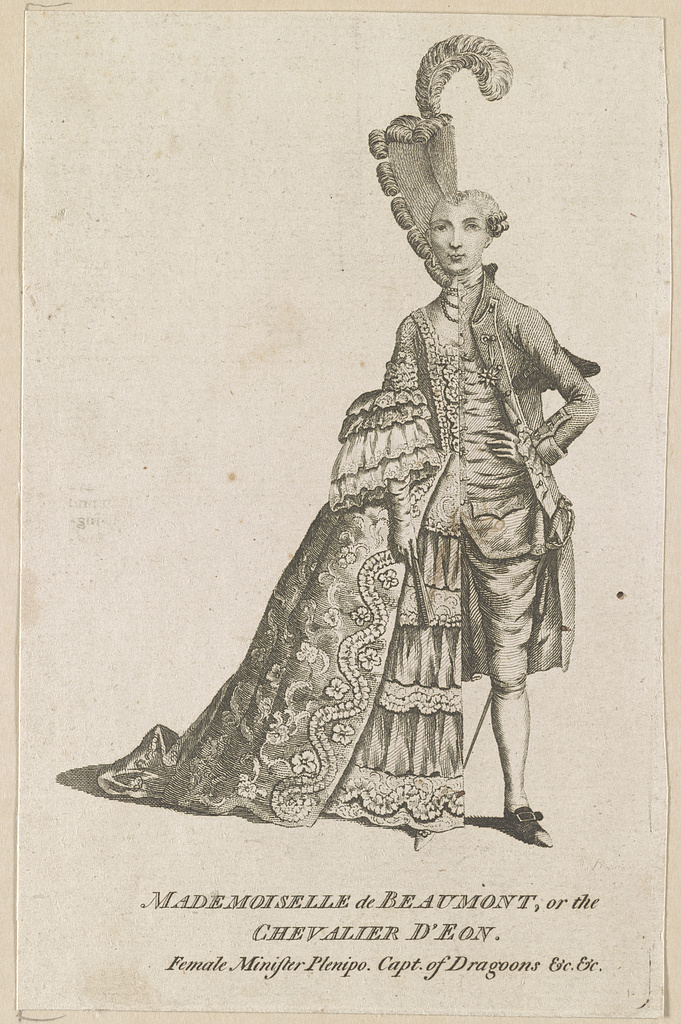
Mademoiselle de Beaumont or The Chevalier D’Eon. (Photo: Library of Congress/LC-DIG-ds-03347)
When the Chevalier d’Eon left France in 1762, it was as a diplomat, a spy in the French king’s service, a Dragoon captain, and a man. When he returned in July 1777, at the age of 49, it was as a celebrity, a writer, an intellectual, and a woman — according to a declaration by the government of France.
What happened? And why?
The answer to those questions is complex, obscured by layers of bad biography, speculation and rumor, and shifting gender and psychological politics in the years since, as well as d’Eon’s own attempts to reframe his story in a way that would make sense to his contemporary society. (Note: In consultation with d’Eon’s biographer, I have decided to use the male pronoun when talking about d’Eon before the gender shift and the female pronoun after.) Professor Gary Kates of Pomona College is one of the first modern academics to look closely at the life — or lives — of the Chevalier d’Eon, in his comprehensive biography Monsieur d’Eon Is a Woman. Kates had access to d’Eon’s personal papers, a treasure trove of manuscripts, diaries, financial records, documents, and letters housed at the University of Leeds, and his work is widely considered the best place to start when considering d’Eon.
The story Kates tells is a complex narrative, involving Ancien Regime intrigue, secret spy rings, political necessity, burgeoning celebrity culture, and nascent feminism. The meaning of d’Eon’s transformation has been dissected for centuries; feminist writer Mary Wollstonecraft praised d’Eon in their lifetime and contemporary trans groups have named themselves in d’Eon’s honor.
Even so, Kates cautions that the history of this fascinating figure is far from complete. “I don’t think I’ve written the definitive book on d’Eon,” he says. How could he? This is a person who lived enough for three lifetimes.


