
Quotulatiousness

February 13, 2019

The origins of the word “loot”

Filed under: Britain, History, India — Tags: , , , , , — Nicholas @ 03:00

William Dalrymple wrote about the Honourable East India Company for the Guardian a few years back, including the way the word “loot” entered common English usage:
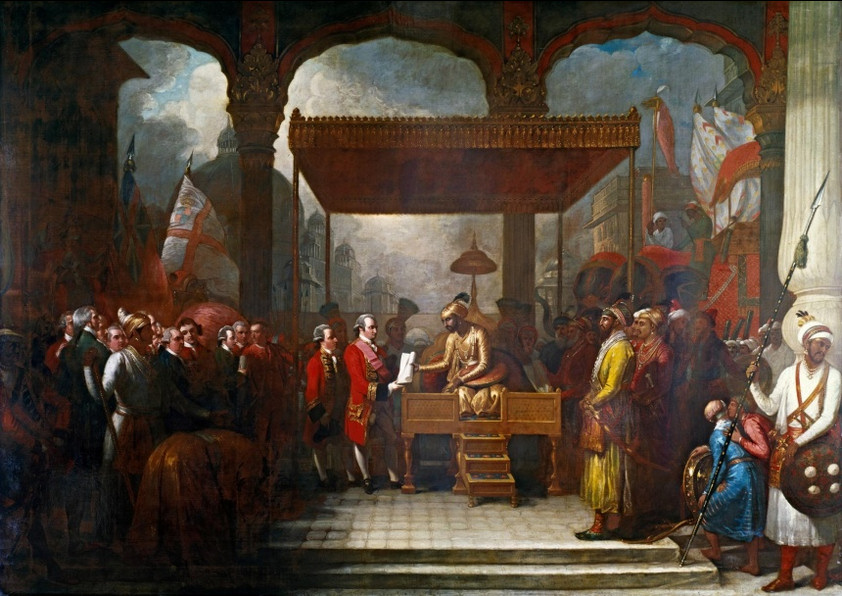
The Mughal emperor Shah Alam hands a scroll to Robert Clive, the governor of Bengal, which transferred tax collecting rights in Bengal, Bihar and Orissa to the East India Company, August 1765.
Oil painting by Benjamin West (1738-1820) via Wikimedia Commons.

One of the very first Indian words to enter the English language was the Hindustani slang for plunder: “loot”. According to the Oxford English Dictionary, this word was rarely heard outside the plains of north India until the late 18th century, when it suddenly became a common term across Britain. To understand how and why it took root and flourished in so distant a landscape, one need only visit Powis Castle.

The last hereditary Welsh prince, Owain Gruffydd ap Gwenwynwyn, built Powis castle as a craggy fort in the 13th century; the estate was his reward for abandoning Wales to the rule of the English monarchy. But its most spectacular treasures date from a much later period of English conquest and appropriation: Powis is simply awash with loot from India, room after room of imperial plunder, extracted by the East India Company in the 18th century.

There are more Mughal artefacts stacked in this private house in the Welsh countryside than are on display at any one place in India – even the National Museum in Delhi. The riches include hookahs of burnished gold inlaid with empurpled ebony; superbly inscribed spinels and jewelled daggers; gleaming rubies the colour of pigeon’s blood and scatterings of lizard-green emeralds. There are talwars set with yellow topaz, ornaments of jade and ivory; silken hangings, statues of Hindu gods and coats of elephant armour.

Such is the dazzle of these treasures that, as a visitor last summer, I nearly missed the huge framed canvas that explains how they came to be here. The picture hangs in the shadows at the top of a dark, oak-panelled staircase. It is not a masterpiece, but it does repay close study. An effete Indian prince, wearing cloth of gold, sits high on his throne under a silken canopy. On his left stand scimitar and spear carrying officers from his own army; to his right, a group of powdered and periwigged Georgian gentlemen. The prince is eagerly thrusting a scroll into the hands of a statesmanlike, slightly overweight Englishman in a red frock coat.

The painting shows a scene from August 1765, when the young Mughal emperor Shah Alam, exiled from Delhi and defeated by East India Company troops, was forced into what we would now call an act of involuntary privatisation. The scroll is an order to dismiss his own Mughal revenue officials in Bengal, Bihar and Orissa, and replace them with a set of English traders appointed by Robert Clive – the new governor of Bengal – and the directors of the EIC, who the document describes as “the high and mighty, the noblest of exalted nobles, the chief of illustrious warriors, our faithful servants and sincere well-wishers, worthy of our royal favours, the English Company”. The collecting of Mughal taxes was henceforth subcontracted to a powerful multinational corporation – whose revenue-collecting operations were protected by its own private army.

It was at this moment that the East India Company (EIC) ceased to be a conventional corporation, trading and silks and spices, and became something much more unusual. Within a few years, 250 company clerks backed by the military force of 20,000 locally recruited Indian soldiers had become the effective rulers of Bengal. An international corporation was transforming itself into an aggressive colonial power.

Using its rapidly growing security force – its army had grown to 260,000 men by 1803 – it swiftly subdued and seized an entire subcontinent. Astonishingly, this took less than half a century. The first serious territorial conquests began in Bengal in 1756; 47 years later, the company’s reach extended as far north as the Mughal capital of Delhi, and almost all of India south of that city was by then effectively ruled from a boardroom in the City of London. “What honour is left to us?” asked a Mughal official named Narayan Singh, shortly after 1765, “when we have to take orders from a handful of traders who have not yet learned to wash their bottoms?”

QotD: The goose-step

Filed under: Britain, Germany, History, Italy, Military, Quotations, WW2 — Tags: , — Nicholas @ 01:00

One rapid but fairly sure guide to the social atmosphere of a country is the parade-step of its army. A military parade is really a kind of ritual dance, something like a ballet, expressing a certain philosophy of life. The goose-step, for instance, is one of the most horrible sights in the world, far more terrifying than a dive-bomber. It is simply an affirmation of naked power; contained in it, quite consciously and intentionally, is the vision of a boot crashing down on a face. Its ugliness is part of its essence, for what it is saying is “Yes, I am ugly, and you daren’t laugh at me”, like the bully who makes faces at his victim. Why is the goose-step not used in England? There are, heaven knows, plenty of army officers who would be only too glad to introduce some such thing. It is not used because the people in the street would laugh. Beyond a certain point, military display is only possible in countries where the common people dare not laugh at the army. The Italians adopted the goose-step at about the time when Italy passed definitely under German control, and, as one would expect, they do it less well than the Germans. The Vichy government, if it survives, is bound to introduce a stiffer parade-ground discipline into what is left of the French army. In the British army the drill is rigid and complicated, full of memories of the eighteenth century, but without definite swagger; the march is merely a formalized walk. It belongs to a society which is ruled by the sword, no doubt, but a sword which must never be taken out of the scabbard.

George Orwell, “The Lion And The Unicorn: Socialism and the English Genius”, 1941-02-19.

February 12, 2019

History Summarized: Iroquois Native Americans

Overly Sarcastic Productions
Published on 7 Aug 2017

There’s a fascinating history from just northwest of American history that is too often ignored. But that’s a damn shame, because it’s a damn cool history, and I’m going to talk about it dammit!

No, I didn’t accidentally misspell the title of this video when I sleepily uploaded this after I woke up. That’s absurd.

EXTRA CREDITS: HIAWATHA: https://youtu.be/79RApCgwZFw

This video was produced with assistance from the Boston University Undergraduate Research Opportunities Program.

PATREON: http://www.patreon.com/OSP

February 10, 2019

Stalemate in China, Bombs over Finland – WW2 – 024 – February 9 1940

World War Two
Published on 9 Feb 2019

While the Winter War rages on in Finland, Japan is confronted with a dilemma. Keep fighting the Chinese and face huge problems feeding the populace in Japan and their newly conquered territories or withdraw and face your own populace to whom you’ve promised a glorious victory.

Follow WW2 day by day on Instagram @World_war_two_realtime https://www.instagram.com/world_war_t…

Join us on Patreon: https://www.patreon.com/TimeGhostHistory
Or join The TimeGhost Army directly at: https://timeghost.tv

Between 2 Wars: https://www.youtube.com/playlist?list…

Written and Hosted by: Indy Neidell
Produced and Directed by: Spartacus Olsson and Astrid Deinhard
Executive Producers: Bodo Rittenauer, Astrid Deinhard, Indy Neidell, Spartacus Olsson
Creative Producer: Joram Appel
Research by: Indy Neidell
Edited by: Iryna Dulka
Map animations: Eastory

Colorizations by Norman Stewart.
Thumbnail Colorization by Olga Shirnina aka Klimbim.

Photos of the Winter War are mostly from the Finnish Wartime Photograph Archive (SA-Kuva).

Eastory’s channel: https://www.youtube.com/channel/UCEly…
Archive by Screenocean/Reuters https://www.screenocean.com

A TimeGhost chronological documentary produced by OnLion Entertainment GmbH.

From the comments:

World War Two
2 days ago (edited)
New week, new video. A special one, since this one covers my birthday. Well, it would have if i were 54 years older… Anyhow, the Japanese are in trouble this week. At the same time, the Finnish are not as much in trouble as the Soviets would like them to be, but the pressure of the Soviet attacks is building up. Meanwhile, the Allied forces present a plan to actually intervene in the Winter War, in favour of Finland. A – for the Allies not at all unconvenient, side-effect would be an extra bonus. Talking about a convenient side-effect: If you support us on Patreon, we will be able to create ever more content. Right now, we’re working on the first biographies and more specials. We love to be able to bring those to you weekly, but we’re not there yet. Check out or Patreon page on https://www.patreon.com/TimeGhostHistory.

Cheers,
Joram

A debate on the impact of Brutalism on British cities

Filed under: Architecture, Britain, History — Tags: , , , , — Nicholas @ 03:00

In Prospect magazine, James Stevens Curl and Barnabas Calder disagree on how Brutalist architecture has influenced destroyed urban areas in so many British cities. This is Curl’s opening salvo:

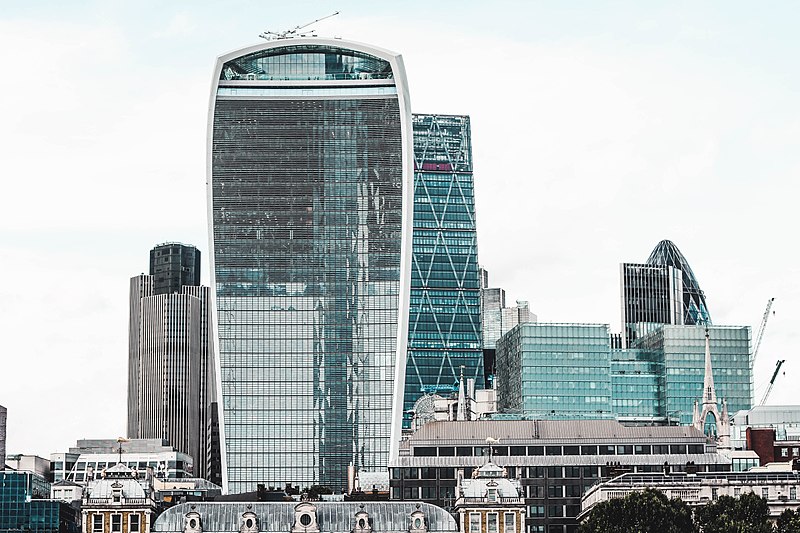
20 Fenchurch Street in London has been nicknamed the “Walkie-Talkie” due to its distinctive design.
Image by Toa Heftiba via Wikimedia Commons.

Visitors to these islands who have eyes to see will observe that there is hardly a town or city that has not had its streets — and skyline — wrecked by insensitive, crude, post-1945 additions which ignore established geometries, urban grain, scale, materials, and emphases.

Such structures were designed by persons indoctrinated in schools of architecture in ways that made them incapable of creating designs that did not cause immense damage and offend the eye, the sensibilities, and the spirit. Harmony with what already exists has never been a consideration for them, as it was not for their teacher: following the lead of “Le Corbusier” (as Swiss-French architect Charles-Édouard Jeanneret called himself), they have, on the contrary, done everything possible to create buildings incompatible with anything that came before. It seems that the ability to destroy a townscape or a skyline was the only way they have been able to make their marks. Can anyone point to a town in Britain that has been improved aesthetically by modern buildings?

Look at the more recent damage done to the City of London, with such crass interventions as the so-called “Walkie-Talkie” (which, through its reflectivity, has caused damage on the street below), or the repellent stuff inflicted on several cities by the infamous John Poulson and some of his bent cronies (from the 1950s until they were jailed in 1974). Quod erat demonstrandum.

How has this catastrophe been allowed to happen? A series of totalitarian doctrinaires reduced the infinitely adaptable languages of real architecture to an impoverished vocabulary of monosyllabic grunts. Those individuals rejected the past so that everyone had to start from scratch, reinventing the wheel and confining their design clichés to a few banalities. Today, form follows finance, when modern architecture is dominated by so-called “stars,” and becomes more bizarre, egotistical, unsettling, and expensive, ignoring contexts and proving stratospherically remote from the aspirations and needs of ordinary humanity. Their alienating works, inducing unease, are, without exception, inherently dehumanising and visually repulsive.

February 9, 2019

40:1 – The Battle of Wizna – Sabaton History 001

Filed under: Europe, Germany, History, Media, Military, WW2 — Tags: , , — Nicholas @ 04:00

Sabaton History
Published on 7 Feb 2019

Sabaton wrote a song about the Battle of Wizna, called 40:1. When the Germans invaded Poland in 1939, they met determined and fierce resistance. Multiple battles show the steadiness of the Polish defenders, in contrast to the common narrative about the Polish defence. One of these Battles is the Battle of Wizna, where a Polish defensive force managed to hold off a much larger German army for several days.

Watch the official music video for 40:1 in full here: https://www.youtube.com/watch?v=epeQw…

Support Sabaton History on Patreon: https://www.patreon.com/sabatonhistory

Hosted by: Indy Neidell
Written by: Markus Linke and Indy Neidell
Directed by: Astrid Deinhard and Wieke Kapteijns
Produced by: Pär Sundström, Astrid Deinhard and Spartacus Olsson
Creative Producer: Joram Appel
Executive Producers: Pär Sundström, Joakim Broden, Tomas Sunmo, Indy Neidell, Astrid Deinhard, and Spartacus Olsson
Maps by: Eastory
Edited by: Iryna Dulka
Sound Editing by: Marek Kaminski

Eastory YouTube Channel: https://www.youtube.com/channel/UCEly…
Archive by: Reuters/Screenocean https://www.screenocean.com

Music by Sabaton

An OnLion Entertainment GmbH and Raging Beaver Publishing AB co-Production
© Raging Beaver Publishing AB, 2019 – all rights reserved.

HMS Dreadnought – Guide 001

Filed under: Britain, History, Military, Technology — Tags: , , , — Nicholas @ 02:00

Drachinifel
Published on 12 Dec 2018

HMS Dreadnought, the first dreadnought battleship and game changer for the British Royal Navy, is today’s subject.

Want to support the channel? – https://www.patreon.com/Drachinifel

Want to talk about ships? https://discord.gg/TYu88mt

Music – https://www.youtube.com/c/NCMEpicMusic

February 8, 2019

Smashing China to Pieces, the Background | Between 2 Wars | 1925 Part 1 of 2

Filed under: Britain, China, History, Japan, Military — Tags: , , , , , — Nicholas @ 04:00

TimeGhost History
Published on 7 Feb 2019

The 19th century throws all kinds of terror and misfortune on China, which not long before was the most powerful nation in the world. While many other Western, Asian and even American nations seek to gain influence in China through politics, wars and trade, China itself tries to hold on to its glory days.

Join us on Patreon: https://www.patreon.com/TimeGhostHistory

Hosted by: Indy Neidell
Directed by: Spartacus Olsson
Written by: Spartacus Olsson
Produced by: Astrid Deinhard
Executive Producers: Bodo Rittenauer, Astrid Deinhard, Indy Neidell, Spartacus Olsson
Creative Producer: Joram Appel
Edited by: Wieke Kapteijns
Research by: Spartacus Olsson

Thumbnail depicts Ataturk colorised by Olga Shirnina aka Klimbim.

Colorized Pictures by Olga Shirnina and Norman Stewart

Olga’s pictures: https://klimbim2014.wordpress.com
Norman’s pictures https://oldtimesincolor.blogspot.com/

Video Archive by Screenocean/Reuters http://www.screenocean.com

A TimeGhost chronological documentary produced by OnLion Entertainment GmbH

From the comments:

TimeGhost History
1 day ago (edited)

Hey all!

After we decided to do Between Two Wars episodes on China in the 20’s, we quickly discovered that the historical context is necessary if you want to understand modern China. Therefore, we present to you a pre-war introduction of China. The end of the mighty empires is an exciting part of history that is often overlooked. That’s no longer the case.

Cheers,
Joram

History Summarized: The Portuguese Empire

Filed under: Americas, Europe, History, Humour, India — Tags: , , , , — Nicholas @ 02:00

Overly Sarcastic Productions
Published on 9 Nov 2018

Play World of Warships for free: http://bit.ly/2zyT191. New players will receive 1 MILLION free credits, the historical premium ship HMS Campbeltown and more by using my code PLAYWARSHIPS2018

What happens when you spend a few decades casually getting really good at seafaring, only to find that there’s suddenly a whole new world that’s only accessible to societies with exceptional sailing prowess? — You get fabulously rich, that’s what. Watch along and learn all about the surprising success of Portugal!

PATREON: http://www.patreon.com/OSP

From the comments:

BenficaHaze 1904
1 month ago
Portugal didn’t follow Spain. Portugal started the discoveries 60-70 years before Spain

Pietro SF
1 month ago
The video already starts badly by suggesting Portugal only entered the Discoveries as a response to the Spaniards, when in reality the Portuguese pioneered the Age of Discovery, starting it half a century before Columbus’ Voyage.

Daniel Ghan
1 month ago
Nice video, but 2 significant errors:
1) Columbus didn’t motivate Portugal’s exploration as the video implies; rather, it was the other way around. The Portuguese began searching for a way to India around Africa after the fall of Constantinople in 1453. Columbus, who was Italian, asked the Portuguese king to finance his expedition but was refused, and only then went to Spain.
2) Magellan (Magalhães) was Portuguese but his expedition was sponsored by Spain and he had a Spanish crew. So the expedition would not have returned to Lisbon.

Metriximor
1 month ago
Alright, Portuguese here, just wanna say overall you did a great job but I wanna clear a few misconceptions.

Portugal didn’t just spring up into action because of Columbus, in fact, he even asked the Portuguese Crown for funding before he asked the Spanish Crown. Portuguese discoveries began in 1418 with Madeira, 1427 we found Açores, then in 1434 Gil Eanes goes around Cape Bojador, 1472 we found Newfoundland, but most importantly, in 1487 Bartolomeu Dias goes around the Cape of Storms, and looking out at the huge possibilities of his accomplishment he declares it to be the Cape of Good Hope.

This was all before Columbus even thought of sailing the Atlantic(1488) or contacting the Spanish(1489), so saying Portugal just began exploring because of him is downplaying it a lot.

Otherwise, fantastic work, love your channel and content keep it up 😀
PORTUGAL CARALHO

QotD: Sex toys and sexbots

Filed under: Britain, Health, Quotations — Tags: , , , , — Nicholas @ 01:00

The global market in these abominations is currently valued at more than £12 billion, and that’s not counting the monstrous regiment of aforementioned sex dolls, the ‘high end’ of which began in Japan in the 1980s. Also coming soon will be sex robots, beginning with a robot ‘Fellatio Café’ in Paddington, due to open later this year. Even though I describe myself as a feminist, I can’t wait to mock the self-appointed spokeswomen for my gender slamming this set-up after years of bigging up broads bringing themselves off using battery-operated devices. As the rather rabid David Mills, an atheist activist and admirer of sex dolls, ranted to Vanity Fair: ‘Women have enjoyed sex toys for 50 years, probably 5,000 years, if the truth be known, but men are still stigmatised! We have to correct that! I want to be the Rosa Parks of sex dolls! Men are not going to sit in the back of the bus any more!’

Indeed, you could argue that a blowjob from a humanoid sexbot is far more indicative of a healthy desire to be connected to humanity than a quick once-over with a gilded pebble or a faceless phallus. But that won’t stop the lady columnists from penning predictable screeds about the woeful immaturity of men, and their willingness to risk having their tackle snagged in a faulty man-trap rather than ‘commit’ to a living, breathing female.

So can I (for once) put my head above the parapet and say that I totally get the appeal of sexbots in the current climate? Sex is, generally, a rather basic thing. Yet somewhere along the line some women have adopted the notion that it should be akin to a trip to Disneyland on gossamer wings for a playdate with Barbie and her pet unicorn. Some women seem to think sex should be about communicating, sharing, scented candles, two-hour massages, three-hour role play, kissing, cuddling and then… that other thing, if you must… whereas men generally tend to believe that sex is about having sex, the rotters. So can you blame them for wanting to keep it short and simple with a sexbot? And if it’s OK for women to pleasure themselves with friends electric, why not men?

Julie Burchill, “The other sexual double-standard: Why is self-love for women so cool and feminist? For men it’s seen as sad and sleazy”, The Spectator, 2017-03-23.

February 7, 2019

Dunkirk (2017) | Based on a True Story

Filed under: Britain, Europe, History, Media, Military, WW2 — Tags: , , , — Nicholas @ 02:00

The Cynical Historian
Published on 25 Jan 2018

Dunkirk is a 2017 war film written, directed, and produced by Christopher Nolan that depicts the Dunkirk evacuation of World War II. Its ensemble cast includes Fionn Whitehead, Tom Glynn-Carney, Jack Lowden, Harry Styles, Aneurin Barnard, James D’Arcy, Barry Keoghan, Kenneth Branagh, Cillian Murphy, Mark Rylance, and Tom Hardy. The film is a British, American, French, and Dutch co-production, and was distributed by Warner Bros.
————————————————————
Wiki:
Dunkirk portrays the evacuation from three perspectives: land, sea, and air. It has little dialogue, as Nolan sought instead to create suspense from cinematography and music. Filming began in May 2016 in Dunkirk and ended that September in Los Angeles, when post-production began. Cinematographer Hoyte van Hoytema shot the film on IMAX 65 mm and 65 mm large-format film stock. Dunkirk has extensive practical effects, and employed thousands of extras as well as historic boats from the evacuation, and period aeroplanes.
————————————————————
Hashtags: #History #Dunkirk #WWII #Review #BasedOnATrueStory #PhoneyWar

February 6, 2019

“The haggis croquette is the most London-thing ever done in London”

Filed under: Britain, Economics, Humour — Tags: , , , , — Nicholas @ 05:00

At the IEA, Andy Mayer reports on the first attempted Burns Night Supper in the City of London:

Haggis is a traditional Scottish dish made with sheep’s heart, liver and lungs, and stomach (or sausage casing); onion, oatmeal, suet, and spices. It’s either a local delicacy or an elaborate joke played on the English (take your pick).
Photo by “Lordvolom1” via Wikimedia Commons.

Last week the City of London held their first attempt at a Burns night supper, with the First Minister and representatives of the Scottish Government as guests of honour.

It is a difficult tradition to get wrong. Largely it requires steaming piles of Scotland’s revenge on the sausage, poetry that the English politely pretend to understand while feeling vaguely threatened, and bonhomie to overcome it, enabled through litres of distillate infused with the flavour of an entire peat bog.

The City served haggis croquettes, with wine.

There’s possibly a Glaswegian satirist somewhere who’s just given up. “Ach I canne compete. The sassenach dough-monkeys just served wee Nicola a haggis croquette, on Rabbie Burns night! I’m breaking-me pen.”

Meanwhile in Shoreditch two Millenials have just set up the Haggis Croquette Cafe, serving Organic Iron-Bru made from recycled plastic girders. The haggis croquette is the most London-thing ever done in London.

I spent much of the evening talking to trade officials. Their job is to sell Scottish opportunity around the world and open up its markets.

This was interesting – how would descendants of Adam Smith visiting the birthplace of trade economist David Ricardo define their comparative advantage? What can Scotland do better than anyone else? What might they do well enough that they can carve out positions, despite larger rivals, better off leaving such things to Scotland? Fundamentally, how are they going to compete?

There was an uneasy pause after these questions. And then to paraphrase, “Oh no, we don’t want to compete, we want to cooperate! With everyone! Not being threatening, that’s our advantage!”

I feel very sure that Smith, on hearing this, would have reached out, to extend the invisible hand of history across time, to give this official a mild slap. “Encouraging competition, with and from other places, and then getting out of the way, is the whole point”, he might say.

Yes, Minister – The North

Filed under: Britain, Government, Humour, Military — Tags: , , , — Nicholas @ 02:00

Greger Tomasson
Published on 9 Oct 2012

February 5, 2019

Mythology Matters – Extra Mythology – #1

Filed under: Europe, History — Tags: , , , — Nicholas @ 04:00

Extra Credits
Published on 4 Feb 2019

Join the Patreon community! http://bit.ly/EMPatreon

We’ll periodically, in-between series, do a Mythology Matters video, where we talk about some of the writing and research choices we made and topics we didn’t really get to cover in the full illustrated episodes. Let’s talk about plot holes and discrepancies in the myths we’ve covered so far, and the parallels we see between myths from completely different cultures!

Macron’s desperate efforts to keep the “European Project” on life-support

Filed under: Economics, Europe, France, Government, Politics — Tags: , , , , — Nicholas @ 03:00

Justin Raimondo on the plight French President Emmanuel Macron is facing:

The EU was a joint project of Euro-intellectuals who wanted a super-socialist State and were afraid Europeans might turn away from “Europe.” They sought to create an ersatz Euro-nationalism that has still only caught on among deracinated yuppies and oligarchs, if anyone at all. What they wanted and still want is what every true state has – an army. Which Macron has been agitating about for some time now. He doesn’t want to persuade Italy and Poland and Hungary to take more refugees – he wants to force them. Even more, he wants a reliable force to crush domestic protests, one that is unlikely to sympathize with the protesters.

Protests are everywhere: the media loves to cover them provided it’s the right cause – and one of the qualifying requirements of coverage should be drama. One would think therefore that the most recent and most violent would attract the media. Not so! We hear nothing about the twelve-week riots that have shaken the Macronist regime to its foundations.

But as the so-called Yellow Vests run roughshod in France – and all over the self-proclaimed “anti-nationalist” Macron – their origins, their ideology, their story remains untold.

French President Macron, a fanatic environmentalist, decided to revise the fuel tax code so that the small urban cars beloved by his circle had their tax reduced, while fuel for trucks and more industrial uses went up as much as 30%. It was a deliberate insult to the rural working poor who must drive long distances.

Macron went out of his way to convey his contempt for the rural voters who did not vote for him. The original reduction was actually intended for long-distance fuel, but Macron changed it around at the last minute to punish this use.

The French “Deplorables” reacted swiftly and not with the usual threat to strike: they simply started an insurrection. No preliminaries. They call themselves Yellow Vests referencing the safety vests required by French law of all motorists to signal emergency: yes, they declare: there IS an emergency going on!

« Newer PostsOlder Posts »

Powered by WordPress


