Back in the Cold War, prudent Kremlinologists had to take the marked decline in the Politburo’s collective intelligence very seriously indeed (the old adage “never attribute to malice what is adequately explained by stupidity” is terrifying when the potentially malicious dumbasses have nuclear missiles).
There were two main reasons for the decline, both structural. The first, of course, is Communism itself. A totally ideologized society is a society totally committed to make-believe. You could fill a good-sized book listing the catastrophes make-believe caused the USSR. Just to take the most obvious: Hitler did everything but send the Goodyear Blimp over Moscow, towing a banner announcing his invasion plans. But since everyone who accurately reported the goings-on in Poland ended up in the Gulag, the Wehrmacht walked right on in.
The second has to do with the nature of totalitarian leadership. Obviously sharing power is out of the question, so every Boss who finally claws his way to the top ruthlessly purges everyone who could conceivably challenge him. The purged are replaced by yes-men and toadies, who immediately enact mini-purges of their own inside their new departments. It doesn’t take more than a few rounds of this for smarter functionaries to learn to dig themselves in very, very deep, disguising themselves in a kind of protective stupidity. A few more rounds, and “protective stupidity” drops the modifier, as anyone with anything on the ball has decamped for the safer — and, not coincidentally, very soon much more profitable — havens of technical management.
It doesn’t take long before your “leadership” is nothing but ideology-addled dimbulbs. Sound familiar?
Severian, “How Dumb Are Liberals?”, Rotten Chestnuts, 2020-07-31.
November 29, 2020
QotD: The succession problem of totalitarian leadership
November 28, 2020
Miscellaneous Myths: The Zodiac
Overly Sarcastic Productions
Published 27 Nov 2020Thanks to longtime patron Volt for requesting this topic!
We know their names! We know their symbols! We know there’s a truly staggering number of websites dedicated to their stereotypical personality traits! But what do we know about their stories? Let’s discuss!
FUN FACT I GLOSSED OVER IN THE VIDEO: like I said, it’s REALLY hard to determine when these constellations entered Greece. Most people set the date at 300ish, when Eudoxus codified the Greek calendar based on the Babylonian one — but that clashes with the fact that Heracles’s labors predate that by at least three centuries, and they’ve had those zodiacal themes since that lost epic poem was initially written. We know, therefore, that the Babylonian zodiac entered greece between Homer’s time (when he conspicuously didn’t mention them — and neither did Hesiod in his Astronomia) and Peisander’s time (author of the lost Heracleia), basically the interval between 800 and 600 CE. The phoenician traders carrying that info is a reasonable assumption, especially considering how important the stars are to sailors navigating at night. But it is WILD to me how hard this is to research and how nobody seems to have really explored the timeline here!
Two Zodiac merch designs are available on our redbubble!
The modern constellations-only zodiac: https://www.redbubble.com/shop/ap/634…
The MUL*APIN Babylonian zodiac: https://www.redbubble.com/shop/ap/634…Our content is intended for teenage audiences and up.
PATREON: https://www.Patreon.com/OSP
MERCH LINKS: http://rdbl.co/osp
OUR WEBSITE: https://www.OverlySarcasticProductions.com
Find us on Twitter https://www.Twitter.com/OSPYouTube
Find us on Reddit https://www.Reddit.com/r/OSP/

FN Model D: The Last and Best BAR
Forgotten Weapons
Published 21 Aug 2020http://www.patreon.com/ForgottenWeapons
https://www.floatplane.com/channel/Fo…
Cool Forgotten Weapons merch! http://shop.bbtv.com/collections/forg…
Contact:
Forgotten Weapons
6281 N. Oracle #36270
Tucson, AZ 85740

QotD: Army recruit training
Ian Hay (Major John Hay Beith), The First Hundred Thousand: Being the Unofficial Chronicle of a Unit of “K(1)”, 1916.
November 27, 2020
Japanese Plague Bombs – War Against Humanity 023 – November 1941, Pt. 2
World War Two
Published 26 Nov 2020Japanse deploys biological weapons in China, leading to un unspecified number of deaths. Meanwhile, European Jews from Germany and their occupied territories are deported to Eastern Europe, where Jews are already being killed by the thousands.
Join us on Patreon: https://www.patreon.com/TimeGhostHistory
Or join The TimeGhost Army directly at: https://timeghost.tvFollow WW2 day by day on Instagram @ww2_day_by_day – https://www.instagram.com/ww2_day_by_day
Between 2 Wars: https://www.youtube.com/playlist?list…
Source list: http://bit.ly/WW2sourcesHosted by: Spartacus Olsson
Written by: Joram Appel and Spartacus Olsson
Director: Astrid Deinhard
Producers: Astrid Deinhard and Spartacus Olsson
Executive Producers: Astrid Deinhard, Indy Neidell, Spartacus Olsson, Bodo Rittenauer
Creative Producer: Maria Kyhle
Post-Production Director: Wieke Kapteijns
Research by: Joram Appel and Spartacus Olsson
Edited by: Miki Cackowski
Sound design: Marek Kamiński
Map animations: Eastory (https://www.youtube.com/c/eastory)Colorizations by:
Mikołaj Uchman
Spartacus Olsson
Jaris Almazani (Artistic Man), https://instagram.com/artistic.man?ig…Sources:
Bundesarchiv
Visuotinė-lietuvių-enciklopedija
Yad Vashem 2725/5, 4613/360, 85DO1, 142BO7, 4613/1055, 4147/32, 8747/3, 4360/99, 4613/525, 4572/3, 4572/2, 4572/4
USHMM
Picture of Jezdimir Dangic, courtesy of pogledi.rs
from the Noun Project: Skull by Muhamad UlumSoundtracks from the Epidemic Sound:
Farrell Wooten – “Blunt Object”
Yi Nantiro – “A Single Grain Of Rice”
Philip Ayers – “Trapped in a Maze”
Gavin Luke – “Drifting Emotions 3”
Gunnar Johnsen – “Not Safe Yet”
Cobby Costa – “From the Past”Archive by Screenocean/Reuters https://www.screenocean.com.
A TimeGhost chronological documentary produced by OnLion Entertainment GmbH.
From the comments:
World War Two
3 hours ago
We often get the question how we cope with researching, editing and hosting a series which is almost exclusively about human suffering. Indeed, for every episode that we make, Miki, Spartacus and I spend hours researching, reading accounts and scrolling through gruesome pictures. It is hard or stressful at times, and of course it impacts us emotionally.There’s a couple of things that help us get through this. The purpose with which we’re doing this, which is to learn, share and contribute to awareness so that this may never be forgotten definitely adds to our resilience. We have set up a small-scale support system between us, and we try to talk and share our emotions whenever we need to.
We recognise that some of you watching this may deal with similar questions. Talking about it, wether digitally or in person, helps us understand and process. We believe that exploring the motivations and fears of perpetrators and victims also helps to stay in touch with the human dimension behind staggering statistics. We try our best to keep this series down to earth with a close eye on the humane aspect – both in content and our community.
Thank you all for your support and kind comments,
Cheers,
Joram

“The Attack of the Dead Men” Pt.2 – Gas! Gas! Gas! – Sabaton History 095 [Official]
Sabaton History
Published 26 Nov 2020On 22. April 1915, a wall of greenish-yellow fog, up to 2m high, was slowly creeping towards the Allied lines on the Ypres salient. A sweetish-chloric smell preceded the horrific effects of the deadly gas. Coughing, spitting, and retching, men were abandoning their trenches, hurrying to the rear, or falling to the ground, clutching their throats. It was the same desperate, gruesome scenery, the Russian soldiers at Osowiec Fortress had to fight through. From then on, a scientific race to counter and protect against those deadly chemicals began.
Support Sabaton History on Patreon: https://www.patreon.com/sabatonhistory
Listen to “Attack of the Dead Men” on the album The Great War: https://music.sabaton.net/TheGreatWar
Watch the Official Lyric Video of “Attack of the Dead Men” here: https://www.youtube.com/watch?v=-AFdw…
Listen to Sabaton on Spotify: http://smarturl.it/SabatonSpotify
Official Sabaton Merchandise Shop: http://bit.ly/SabatonOfficialShopHosted by: Indy Neidell
Written by: Markus Linke and Indy Neidell
Directed by: Astrid Deinhard and Wieke Kapteijns
Produced by: Pär Sundström, Astrid Deinhard and Spartacus Olsson
Creative Producer: Maria Kyhle
Executive Producers: Pär Sundström, Joakim Brodén, Tomas Sunmo, Indy Neidell, Astrid Deinhard, and Spartacus Olsson
Community Manager: Maria Kyhle
Post-Production Director: Wieke Kapteijns
Editor: Karolina Dołęga
Sound Editor: Marek Kamiński
Maps by: Eastory – https://www.youtube.com/c/eastory
Archive: Reuters/Screenocean – https://www.screenocean.comColorizations by:
Adrien Fillon – https://www.instagram.com/adrien.colo…Sources:
– National Archives NARA
– Library of Congress
– Bundesarchiv
– Imperial War Museums: IWM Q 56546, HU67224, Q 60344
– Canadian War Museum
– Auckland Museum
– Wellcome Images
– Icons form The Noun Project: Arrow by 4B Icons, gas bomb by Mete Eraydın, Gas by Andrejs Kirma, Skull by Muhamad Ulum, smoke grenade by 1516All music by: Sabaton
An OnLion Entertainment GmbH and Raging Beaver Publishing AB co-Production.
© Raging Beaver Publishing AB, 2019 – all rights reserved.
Horse Lords: A Brief History of the Scythians
History Time
Published 30 Jan 2018This video is about the Scythians. One of the first horse cultures on Earth.
Are you a budding artist, illustrator, cartographer, or music producer? Send me a message! No matter how professional you are or even if you’re just starting out, I can always use new music and images in my videos. Get in touch! I’d love to hear from you.
If you liked this video and have a spare dollar you can help support the channel here:-
http://www.patreon.com/historytimeUKI’ve compiled a reading list of my favourite history books via the Amazon influencer program. If you do choose to purchase any of these incredible sources of information then Amazon will send me a tiny fraction of the earnings (as long as you do it through the link) (this means more and better content in the future) I’ll keep adding to and updating the list as time goes on:-
https://www.amazon.com/shop/historytimeMusic used:-
Ross Bugden – “Parallel”, “Last Dawn”, “Titans”, “Olympus”I try to use copyright free images at all times. However if I have used any of your artwork or maps then please don’t hesitate to contact me and I’ll be more than happy to give the appropriate credit.
—Join the History Time community on social media:-
Instagram:-
https://www.instagram.com/historytime…
Twitter:-
https://twitter.com/HistoryTimeUK
November 26, 2020
Deport All Anarchists! – The Palmer Raids | BETWEEN 2 WARS: ZEITGEIST! | E.05 – Harvest 1919
TimeGhost History
Published 25 Nov 2020The First World War has been over for a year, and the modern era plows ahead. But so does fear and paranoia. In America, the Red Scare goes into overdrive.
Join us on Patreon: https://www.patreon.com/TimeGhostHistory
Hosted by: Indy Neidell
Written by: Indy Neidell and Francis van Berkel
Director: Astrid Deinhard
Producers: Astrid Deinhard and Spartacus Olsson
Executive Producers: Astrid Deinhard, Indy Neidell, Spartacus Olsson, Bodo Rittenauer
Creative Producer: Maria Kyhle
Post-Production Director: Wieke Kapteijns
Research by: Indy Neidell and Francis van Berkel
Image Research by: Daniel Weiss and Spartacus Olsson
Edited by: Daniel Weiss
Sound design: Marek KamińskiColorizations:
Daniel Weiss – https://www.facebook.com/TheYankeeCol…Sources:
Some images from the Library of CongressSome Soundtracks from Epidemic Sound, ODJB, Edward Elgar, Richard Strauss and Pietro Mascagni:
– “One More for the Road” – Golden Age Radio
– “Dawn Of Civilization” – Jo Wandrini
– “Deviation In Time” – Johannes Bornlof
– “Easy Target” – Rannar Sillard
– “Dark Beginning” – Johan Hynynen
– “Steps in Time” – Golden Age Radio
– “Tiger Rag” – ODJB
– “Cello Concerto” – Edward Elgar
– “Pomp and Circumstance” – Edward Elgar
– “Die Frau ohne Schatten: Act III” – Richard Strauss
– “Cavalleria Rusticana” – Pietro Mascagni
– “What Now” – Golden Age RadioArchive by Screenocean/Reuters https://www.screenocean.com.
A TimeGhost chronological documentary produced by OnLion Entertainment GmbH.
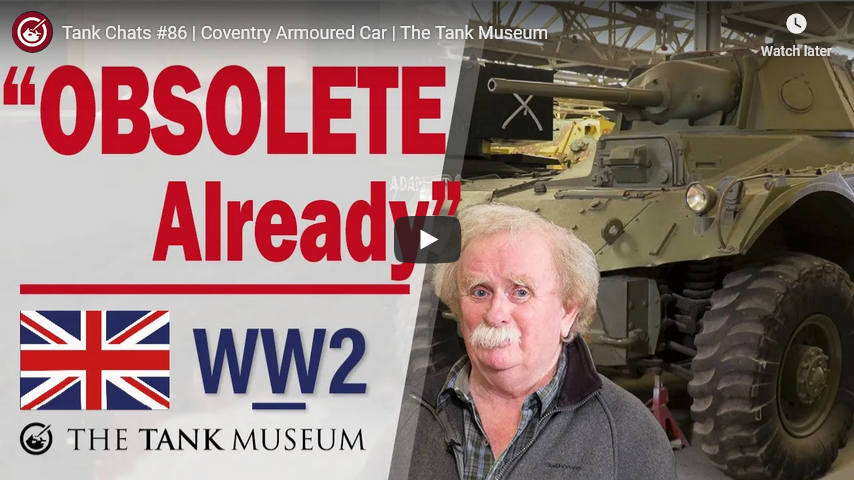
Tank Chats #86 | Coventry Armoured Car | The Tank Museum
The Tank Museum
Published 18 Oct 2019David Fletcher looks at the British WW2 Coventry Armoured Car. It never saw service and was already considered obsolete by the time it was built.
Support the work of The Tank Museum on Patreon: ► https://www.patreon.com/tankmuseum
Visit The Tank Museum SHOP: ► https://tankmuseumshop.org/
Twitter: ► https://twitter.com/TankMuseum
Instagram: ► https://www.instagram.com/tankmuseum/
Tiger Tank Blog: ► http://blog.tiger-tank.com/
Tank 100 First World War Centenary Blog: ► http://tank100.com/
#tankmuseum #tanks
November 25, 2020
Switzerland: Neutral or Nazi Ally? – WW2 Special
World War Two
Published 24 Nov 2020After the fall of France in June 1940, neutral Switzerland found itself surrounded on all sides by a hostile expansionist power. The small nation would have been a valuable possession but the jaws of the Reich hesitated to swallow it. How did Switzerland manage to exit the conflict intact and largely unscathed?
Join us on Patreon: https://www.patreon.com/TimeGhostHistory
Or join The TimeGhost Army directly at: https://timeghost.tvFollow WW2 day by day on Instagram @ww2_day_by_day – https://www.instagram.com/ww2_day_by_day
Between 2 Wars: https://www.youtube.com/playlist?list…
Source list: http://bit.ly/WW2sourcesHosted by: Spartacus Olsson
Written by: Lennart Visser & Francis van Berkel,
Director: Astrid Deinhard
Producers: Astrid Deinhard and Spartacus Olsson
Executive Producers: Astrid Deinhard, Indy Neidell, Spartacus Olsson, Bodo Rittenauer
Creative Producer: Maria Kyhle
Post-Production Director: Wieke Kapteijns
Research by: Lennart Visser
Edited by: Karolina Dołęga
Sound design: Marek Kamiński
Map animations: Eastory (https://www.youtube.com/c/eastory)Colorizations by:
Adrien Fillon – https://www.instagram.com/adrien.colo…
Cassowary ColorizationsSources:
– Pictures of Swiss Army by Strübin Theodor courtesy of Archäologie und Museum Baselland Lizenzbedingungen
– Bundesarchiv
– Imperial War Museums: HU56131
– ETH-Bibliothek Zürich: 03258, LBS MH05-02-04, M01-0756-0001
– Fortepan:3889, 92301
– National Archives
– Staatsarchiv Bern – P362
– Plan of the defence lines of the National Redoubt courtesy of Auge=mit from Wikimedia Commons
– Picture of Swiss Soldiers with anti-aircraft gun courtesy of Paebi from Wikimedia Commons
– Picture of Swiss aircraft in 1943 from theM.Pilloud – Archive familiale
– United States Holocaust Memorial MuseumSoundtracks from Epidemic Sound:
– “Other Sides of Glory” – Fabien Tell
– “Moving to Disturbia” – Experia
– “Remembrance” – Fabien TellArchive by Screenocean/Reuters https://www.screenocean.com.
A TimeGhost chronological documentary produced by OnLion Entertainment GmbH.
From the comments:
World War Two
1 hour ago
As we draw close to the end of 1941, it becomes clear that neutrality is not a guarantee of safety. Its utility as a diplomatic strategy has been discarded and is non-existent.A total of 12 sovereign and neutral nations have been invaded by Allied or Axis powers since the beginning of the war — Denmark and Norway on 9 April 1940; Belgium, the Netherlands, Iceland and Luxembourg on 10 May 1940; Lithuania on 15 June 1940 and Latvia and Estonia on 17 June; Greece on 28 October 1940 and Yugoslavia in April 1941; Iran in August 1941. Even those that are spared are compelled to assist either the Allies or the Axis or both in financial and economic terms, such as Switzerland and Sweden. Others offer voluntary military assistance such as Portugal and Spain.
Jan Morris, RIP
By an odd co-incidence, I began reading the third volume of Morris’s British Empire trilogy just last night and today I discovered that she recently died at age 94. The particular edition I have has Morris’s original male name on the cover, but her female name in the “note about the author”:
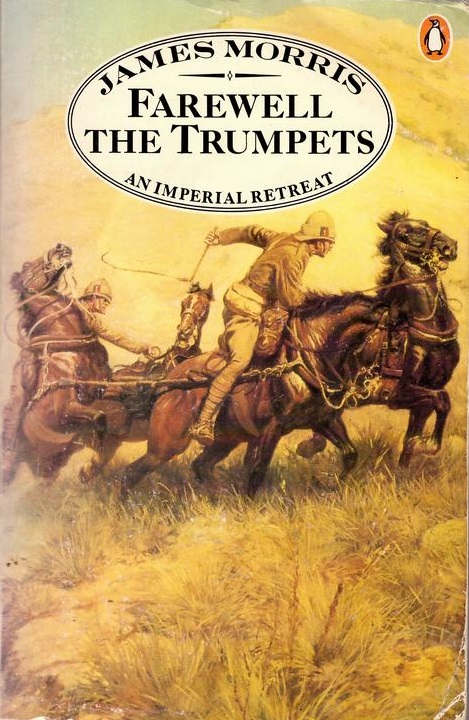
Jan Morris, who died last week at the age of 94, may have lived one of the more various and accomplished lives on record. She was, in turn, a soldier, a newspaper correspondent with a number of scoops to her name, a fine memoirist, and a writer of books whose scope encompassed the world.
Any dutiful obituarist must also note something else which happened fifty years ago. It is likely for ever to feature in the first paragraph, if not the first line, of everything written about Morris. She was born a man, named James by her parents, and underwent what her publishers and profilers term “a change of sexual role” in 1972 – back when such a thing was a rarity and rather dangerous to accomplish.
I hope to leave that subject aside for a moment while contemplating her place in letters. By the end of her long life, Morris had become something of a national treasure and an institution. Her quixotic obsessions – a personal, mythical interpretation of the Welsh side of her family and her home in that country, and the late First Sea Lord Jackie Fisher – became the subject of stories shared by friends, editors and admirers.
She gave wise and funny interviews to the papers about savouring mussels without dignity and why whether what one is doing is kind ought, in a good world, to be the modest test applied to action.
Other profilers note her long companionship with Elizabeth (née Tuckniss) – first through marriage, then a legally-divorced close friendship, and finally a civil partnership, with the ceremony witnessed by a local couple who afterwards invited the two for tea. Elizabeth survives Jan, but a visiting journalist or two was shown the headstone which is planned for both of them. They will lie on a Welsh island they owned in the Dwyfor, a river that runs by their home. The stone reads: “Here lie two friends, at the end of one life”.
These are beautiful stories, but they should not retroactively colour in fully our impressions of Morris. Nor should a sense – repeated in some otherwise careful obituaries – that as “James”, Morris’s “written voice always sounded certain”. Whereas as Jan, her writing grew more introspective and aware of the ways that time and tide conspire to decay the facades of men as much as they do institutions and places. This was exhibited notably in her Pax Britannica trilogy, which chronicled Britain’s imperial decline.
November 24, 2020
The History of Fabric Is the History of Civilization
ReasonTV
Published 23 Nov 2020Virginia Postrel’s new book explores economics, politics, and technology through textiles.
——————
Full text and links: https://reason.com/video/2020/11/23/t…Follow us on Twitter: https://twitter.com/reason
Reason is the planet’s leading source of news, politics, and culture from a libertarian perspective. Go to reason.com for a point of view you won’t get from legacy media and old left-right opinion magazines.
—————-The Fabric of Civilization: How Textiles Made the World, a new book by former Reason editor in chief Virginia Postrel, is a rich, endlessly fascinating history of the remarkable luck, invention, and innovation that made our fabric-rich world possible.
The book aims to make the mundane miraculous. Consider cotton. Most of the cotton we grow today is descended in part from a plant species that evolved in Africa and somehow got over to what is now Peru, where it mixed with New World strains.
“The fact that we have cotton at all, that it exists anywhere, is amazing,” says Postrel. “It happened long before there were human beings, but much more recently than when the continents were together. So we don’t know. It could have gotten caught up in a hurricane. It could have floated on a piece of pumice. So it’s this random, very unlikely happening that had tremendous world-changing consequences.”
The story of textiles is rife with attempts at protectionism and prohibition. In 17th and 18th century Europe, countries banned the importation of super-soft, super-colorful cotton prints from India known as calicos because they threatened domestic producers of everything from lower-quality cotton fabric to luxury silks. “For 73 years, France treated calico the way the U.S. treats cocaine,” Postrel says. “There was this huge amount of smuggling, and they were constantly ratcheting up the penalties [so] that they got quite grotesque, at least for the major traffic.” Some of “the earliest writings of classical liberalism are in this context, people saying not only is this not working, but … it is unjust to be sentencing people to the galleys in order to protect silk makers’ profits.”
Postrel also documents how the Luddites, the 19th century English textile workers famous for smashing the power looms threatening to put them out of work, owed their jobs to an earlier technological breakthrough: the spinning machines that emerged in the late 1700s.
“If you go back to that earlier period, when spinning machines were introduced, the same thing happened,” she says. “They had their own period of rebelling against the new technologies and saying they’re putting people out of work.”
The book also upends some contemporary myths, such as the claim that commercial production of hemp for clothing was a casualty of the war on drugs. “Hemp historically was a very coarse kind of fabric for poor people who didn’t have an alternative,” says Postrel. “It was replaced by cotton for good reasons. Cotton was also affordable, but it was soft and washable and just a much better fabric.”
“Human beings live in history and we inherit the legacies, positive and negative, of that history,” says Postrel, whose previous books include The Power of Glamour, The Substance of Style, and The Future and Its Enemies. Discussing the large themes of her work she says, “All you can do is start from where you are and try to do better from where you are.”
Narrated by Nick Gillespie. Edited by Isaac Reese.
Music: “Thoughts,” by ANBR
Photos: World History Archive/Newscom; The Print Collector Heritage Images/Newsroom; The “Réale” returning to port, Med/CC BY-SA 3.0; Smithsonian National Museum of African American History and Culture/CC0; Battle of Grand Port, Rama/Wikimedia Commons/CC BY-SA 2.0 FR; Fine Art Images Heritage Images/Newscom; Seton, M., Müller, R., Zahirovic, S., Gaina, C., Torsvik, T., Shephard, G., Talsma, A., Gurnis, M., Turner, M., Maus, S., and Chandler, M., 2012, Global continental and ocean basin reconstructions since 200 Ma: Earth-Science Reviews, v. 113, no. 3-4, p. 212-270

Is the day of the orator over?
In The Critic, Nigel Jones considers some of the great orators of history:
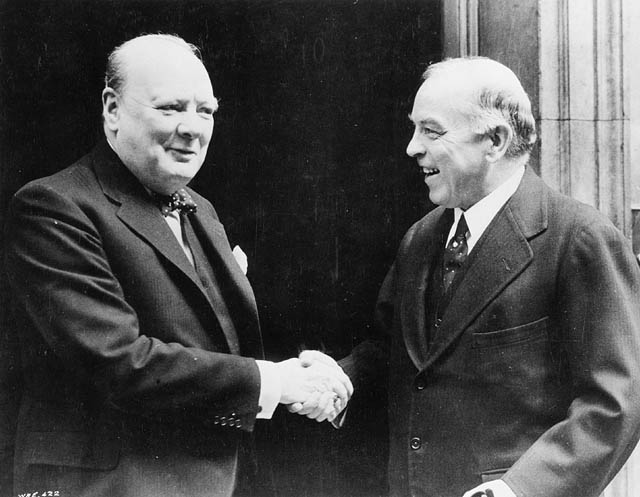
Prime Minister Winston Churchill greets Canadian PM William Lyon Mackenzie King, 1941. Churchill was certainly one of the great orators of history … Mackenzie King, on the other hand, certainly was not.
Photo from Library and Archives Canada (reference number C-047565) via Wikimedia Commons.
On 19 November 1863, President Abraham Lincoln rose to speak at Gettysburg, Pennsylvania, the battlefield which four and a half months before had seen the decisive turning point of the American Civil War. Lincoln was not even the principal speaker at the ceremony to dedicate a cemetery for those who had fallen in the battle.
Before he spoke, the President had to sit through a two-hour address by a pompous official orator, a windbag called Edward Everett. But when he finally got to his feet Lincoln entered political immortality. He spoke for only two minutes, but the few words he uttered about “Government of the people, by the people, and for the people” have echoed down the years – even Mrs Thatcher made a recording of them – inspiring and rousing generations to value and defend democracy.
Winston Churchill’s iconic status as Britain’s greatest Prime Minister largely rests on the handful of radio speeches he growled out to the nation in the darkest days of World War Two: “… fight them on the beaches … so much owed by so many to so few … this was their finest hour …” and so on.
Ever since Roman statesmen such as Cato and Cicero delivered their speeches on the Capitol, oratory like that spoken by Lincoln and Churchill has been a mainstay of western civilisation and governance. A carefully constructed argument or a few ringing phrases having the power to change minds, stiffen sinews, and bring down leaders.
Churchill himself was brought to supreme political power in 1940 by the power of the spoken word. Those words were spoken by one politician – his friend and schoolmate Leo Amery – quoting another, when Amery repeated Oliver Cromwell’s words dismissing the Long Parliament in calling for the end of Neville Chamberlain’s feeble administration: “You have sat here too long for any good you have been doing. Depart, I say, and let us have done with you: in the name of God, go!” Chamberlain, albeit reluctantly, went.
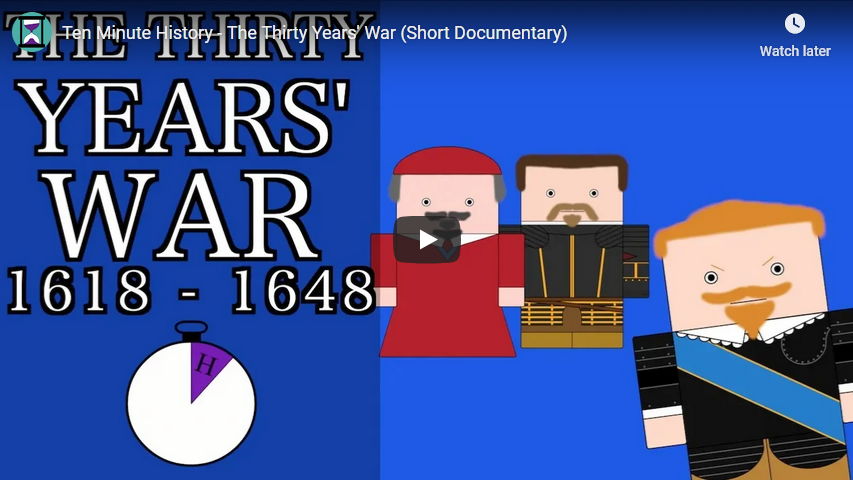
Ten Minute History – The Thirty Years’ War
History Matters
Published 30 Sep 2018Twitter: https://twitter.com/Tenminhistory
Patreon: https://www.patreon.com/user?u=4973164Special Thanks to the following Patrons for their support on Patreon:
Chris Fatta
Joshua
Mitchell Wildoer
Mason Cox
William Foster
Thomas Mitchell
Perry Gagne
Shaun Pullin
Anon
Spencer Smith
Matt M
RbjThis episode of Ten Minute History (like a documentary, only shorter) covers the outbreak of the Bohemian Revolt which was what would eventually spiral out of control into the Thirty Years’ War. The revolt was crushed fairly quickly but sparked intervention by Denmark, who didn’t do too well, and later Sweden who did very well. Both of these were aided by France who decided to get directly involved in 1635. By 1648 the Holy Roman Empire lay in ruins, with Austria and Spain struggling to pay for the war and rebuild the Habsburg Empire. This war saw the rise of Sweden and France but most importantly saw the foundations of modern diplomacy built.
Recommended books:
Mark Greengrass – Christendom Destroyed: Europe 1517-1648. Does a great job of outlying the theological currents in Europe at the time and how all of the religious changes led to the Thirty Years’ War.
Peter H. Wilson – Europe’s Tragedy: A New History of the Thirty Years’ War. The go-to text for the war; incredibly detailed and honestly can’t be beat for the topic. 100% recommend.
November 22, 2020
Surprise Attack On Rommel! – Operation Crusader Begins – WW2 – 117- November 21, 1941
World War Two
Published 21 Nov 2020The long planned Allied Offensive in North Africa — Operation Crusader — begins, but the Allies are worrying about how to defend Singapore in case of Japanese aggression. The Germans renew their drive on Moscow, but their number one flying ace perishes, a major PR hit.
Join us on Patreon: https://www.patreon.com/TimeGhostHistory
Or join The TimeGhost Army directly at: https://timeghost.tvFollow WW2 day by day on Instagram @ww2_day_by_day – https://www.instagram.com/ww2_day_by_day
Between 2 Wars: https://www.youtube.com/playlist?list…
Source list: http://bit.ly/WW2sourcesWritten and Hosted by: Indy Neidell
Director: Astrid Deinhard
Producers: Astrid Deinhard and Spartacus Olsson
Executive Producers: Astrid Deinhard, Indy Neidell, Spartacus Olsson, Bodo Rittenauer
Creative Producer: Maria Kyhle
Post-Production Director: Wieke Kapteijns
Research by: Indy Neidell
Edited by: Miki Cackowski
Sound design: Marek Kamiński
Map animations: Eastory (https://www.youtube.com/c/eastory)Colorizations by:
Ruffneck88 https://commons.wikimedia.org/wiki/Ca…
Julius Jääskeläinen – https://www.facebook.com/JJcolorization/
Daniel Weiss
Adrien Fillon – https://www.instagram.com/adrien.colo…
Norman Stewart – https://oldtimesincolor.blogspot.com/
Spatacus OlssonSources:
Narodowe Archiwum Cyfrowe
Bundesarchiv
Australian War Memorial
Yad Vashem 143BO2
IWM E 6661, K 1261, A 3898, A 10499, FE 487, TR153, E 2384ESoundtracks from the Epidemic Sound:
Johannes Bornlof – “Death And Glory 2”
Johan Hynynen – “Dark Beginning”
Farrell Wooten – “Blunt Object”
Reynard Seidel – “Deflection”
Johannes Bornlof – “Last Man Standing 3”
Johannes Bornlof – “The Inspector 4”
Philip Ayers – “Under the Dome”
Max Anson – “Ancient Saga”
Johannes Bornlof – “Deviation In Time”
Jon Bjork – “Disposal”Archive by Screenocean/Reuters https://www.screenocean.com.
A TimeGhost chronological documentary produced by OnLion Entertainment GmbH.
From the comments:
World War Two
3 days ago
On December 7th we will cover the Japanese attack on Pearl Harbor in real time, minute by minute, as it happens … for five solid hours starting 0610 local Hawaiian time right here on this channel. Don’t miss it!And if you want a dose of WW2 action every day, then check out our day by day instagram coverage of the war right here: https://www.instagram.com/world_war_two_realtime/