
Ten years back, I posted an excerpt from a WW2 American espionage manual showing workers in occupied Europe how to bureaucratically sabotage their organizations to harm Nazi Germany’s war efforts. At the time I joked that it also sounded like a lot of company meetings in the modern world. Brivael Le Pogam uses the same set of guidelines to illustrate just how much the EU has embraced these sabotage methods as their standard operating practices:
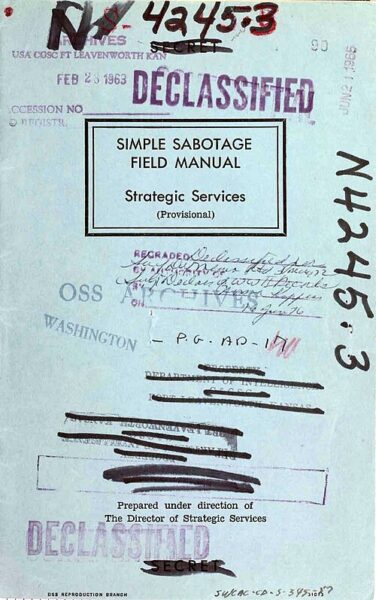
Link goes to full text at Wikisource
🚨 The OSS Simple Sabotage Field Manual (1944) describes how to paralyze an organization without explosives.
The European Union seems to have taken it as its official instruction manual. Here are the disturbing similarities:
1. “Insist on everything going through official channels.”
✅ 27 states, 24 official languages, 3 seats, thousands of committees and agencies. Even a directive on lightbulbs goes through 7 levels of validation.2. “Hold meetings. Speak at length with anecdotes.”
✅ 45-minute speeches in the European Parliament on minor topics. Strasbourg and Brussels locals applaud politely.3. “Refer everything to committees. Make them as large as possible (never fewer than 5 people).”
✅ The trilogue, COREPER, working groups, expert committees … A simple decision turns into a 3-to-7-year obstacle course.4. “Bring up unrelated matters repeatedly.”
✅ Talking agriculture? Let’s add the Green Deal, LGBT rights, Palestine, and the carbon border tax. Nothing is ever straightforward.5. “Haggle over the precise wording of communications.”
✅ Months of negotiation over a semicolon in a 400-page regulation. The word “should” vs. “must” can stall everything.6. “Reopen decisions that have already been made.”
✅ Directive adopted? We reopen it 2 years later for “revision”, “strengthening”, or “adaptation to the geopolitical context”.7. “Advocate caution and deliberation. Avoid all haste.”
✅ “We need more time to study the impact”, “let’s consult stakeholders more”, “better safe than sorry”. Result: nothing moves quickly.8. “Question the legitimacy of every decision.”
✅ “Is this really within the EU’s competence?” (even when it’s already in the treaties). Subsidiarity invoked when convenient, forgotten when not.The EU doesn’t need Russian or Chinese saboteurs. It has turned itself into a machine for slowing down Europe, exactly as the manual recommended to weaken the enemy.
The funniest part? All of this is done legally, democratically, and with the best intentions.
Automatically translated from the original French by X.



[…] YES. THIS IS WHAT WE USED TO CALL A “ZEAL STRIKE” BUT NOW IT’S JUST LIFE IN EUROPE: This used to be active sabotage … now it’s standard EU practice. […]
Pingback by Instapundit » Blog Archive » YES. THIS IS WHAT WE USED TO CALL A “ZEAL STRIKE” BUT NOW IT’S JUST LIFE IN EUROPE: This used to — July 13, 2026 @ 02:32
Thanks for the insight.
Comment by Dusty — July 13, 2026 @ 03:04
The authors were taking advantage of a human characteristic of complacency after a goal is achieved. And they described an analog for other events where The Law of Unintended Consequences is invoked; the move toward clogging an administrative system with its own rules takes advantage of the inertia of the system. Has anyone else been part of a trade union where a Safety Program is initiated for a work slowdown?
Comment by Dan Patterson — July 13, 2026 @ 05:38
My first job out of school was unionized and I saw enough deliberate obstruction even without a formal work slowdown or work-to-rule program that I actively avoided unionized workplaces for the rest of my career.
Comment by Nicholas — July 13, 2026 @ 09:54
A simple and effective strategy to neuter the deep state bureaucracy would be to mandate the opposite of these rules for policy making decisions.
Comment by Dondre — July 13, 2026 @ 06:51
Point 3. Should vs. must is a bad example for the point you’re trying to make. Must is mandatory and should is not. That’s a critical difference in a regulation.
Comment by Rick Higgins — July 13, 2026 @ 07:40
[…] Or read a far punchier bullet list, if somewhat inaccurate, as applied to the EU. […]
Pingback by Be of Good Cheer: The Modern State’s Greatest Saboteur Is Itself! - Hyehudi.org — July 16, 2026 @ 03:34