
World War Two
Published 10 Jun 2021Carl Gustaf Mannerheim is a national hero after his service in everything from the Finnish Civil War to the Winter War. But did he plan a war of aggression with Nazi Germany against the Soviet Union? And if so, did Hitler and Stalin even give him any choice in the matter?
(more…)
June 11, 2021
Is Finland an Ally of Nazi Germany? – Carl Gustaf Mannerheim – WW2 Biography Special
Comments Off on Is Finland an Ally of Nazi Germany? – Carl Gustaf Mannerheim – WW2 Biography Special
Tanks Chats #110 | T-72 | The Tank Museum
The Tank Museum
Published 13 Nov 2020Join David Willey as he discusses the T-72, a Soviet era main battle tank which first entered production in 1971. The T-72’s service life has proven to be extremely successful. With about 20,000 produced, it has seen service with over 40 countries, and thanks to refurbishment, is still in service to this very day.
With thanks to RecoMonkey for additional images https://www.recomonkey.com/
(more…)
Comments Off on Tanks Chats #110 | T-72 | The Tank Museum
June 10, 2021
The odd history of Irish Cream as we make Irish Cream hard candy at Lofty Pursuits
Lofty Pursuits
Published 25 Feb 2021Jake makes Irish Cream green shamrock hard candy for St. Patrick’s day. We discuss the history of the weird flavor and how it has become a tradition even though it was invented in the 1970’s
A great article about the history of Irish Cream
https://www.irishtimes.com/culture/bo…Buy our candy: http://www.pd.net
Listen to our podcast: http://loftypursuits.libsyn.com/website
Join our Patreon at https://www.patreon.com/LoftyPursuits

Comments Off on The odd history of Irish Cream as we make Irish Cream hard candy at Lofty Pursuits
QotD: “Defending” democracy using totalitarian methods
One of the peculiar phenomena of our time is the renegade Liberal. Over and above the familiar Marxist claim that “bourgeois liberty” is an illusion, there is now a widespread tendency to argue that one can only defend democracy by totalitarian methods. If one loves democracy, the argument runs, one must crush its enemies by no matter what means. And who are its enemies? It always appears that they are not only those who attack it openly and consciously, but those who “objectively” endanger it by spreading mistaken doctrines. In other words, defending democracy involves destroying all independence of thought. This argument was used, for instance, to justify the Russian purges. The most ardent Russophile hardly believed that all of the victims were guilty of all the things they were accused of: but by holding heretical opinions they “objectively” harmed the régime, and therefore it was quite right not only to massacre them but to discredit them by false accusations. The same argument was used to justify the quite conscious lying that went on in the leftwing press about the Trotskyists and other Republican minorities in the Spanish civil war. And it was used again as a reason for yelping against habeas corpus when Mosley was released in 1943.
These people don’t see that if you encourage totalitarian methods, the time may come when they will be used against you instead of for you. Make a habit of imprisoning Fascists without trial, and perhaps the process won’t stop at Fascists. Soon after the suppressed Daily Worker had been reinstated, I was lecturing to a workingmen’s college in South London. The audience were working-class and lower-middle class intellectuals — the same sort of audience that one used to meet at Left Book Club branches. The lecture had touched on the freedom of the press, and at the end, to my astonishment, several questioners stood up and asked me: Did I not think that the lifting of the ban on the Daily Worker was a great mistake? When asked why, they said that it was a paper of doubtful loyalty and ought not to be tolerated in war time. I found myself defending the Daily Worker, which has gone out of its way to libel me more than once. But where had these people learned this essentially totalitarian outlook? Pretty certainly they had learned it from the Communists themselves! Tolerance and decency are deeply rooted in England, but they are not indestructible, and they have to be kept alive partly by conscious effort. The result of preaching totalitarian doctrines is to weaken the instinct by means of which free peoples know what is or is not dangerous. The case of Mosley illustrates this. In 1940 it was perfectly right to intern Mosley, whether or not he had committed any technical crime. We were fighting for our lives and could not allow a possible quisling to go free. To keep him shut up, without trial, in 1943 was an outrage. The general failure to see this was a bad symptom, though it is true that the agitation against Mosley’s release was partly factitious and partly a rationalisation of other discontents. But how much of the present slide towards Fascist ways of thought is traceable to the “anti-Fascism” of the past ten years and the unscrupulousness it has entailed?
George Orwell, Unpublished Preface to Animal Farm, 1945.
Comments Off on QotD: “Defending” democracy using totalitarian methods
June 9, 2021
Do the Nazis Have Atomic Bombs? – WW2 – Spies & Ties 03 – Sam & Erwin part 2
World War Two
Published 8 Jun 2021All belligerents are working hard to develop a powerful nuclear super-weapon. The Americans wonder how far along the Germans are, and send in their spies.
(more…)
Comments Off on Do the Nazis Have Atomic Bombs? – WW2 – Spies & Ties 03 – Sam & Erwin part 2
Very Rare and Mostly Pointless: the Bren Fixed Line Sight
Forgotten Weapons
Published 25 Feb 2021http://www.patreon.com/ForgottenWeapons
https://www.floatplane.com/channel/Fo…
Cool Forgotten Weapons merch! http://shop.bbtv.com/collections/forg…
The very early production MkI Bren light machine guns were made with two dovetail brackets on the left side of the receiver. The rear one was for the standard rear sight, and the front one was to accommodate two types of optical sights. A mounting for the No.32 telescopic sight (the same one used on the No4(T) sniper rifle) was planned, but never produced. What was made in small numbers by the Plessey company was a “fixed line sight”. This was really more like a surveyor’s tool than a traditional sight, and it used the same optical element as the Vickers dial sight that was introduced alongside it in 1939. The purpose was to allow a tripod-mounted Bren to be set up with specific limits to its field of fire, and then for the gun to be removed, used on the bipod elsewhere, and returned to the tripod and confirm the field of fire, especially in the dark. This is a somewhat technically complex task, but not one that was actually needed very much for the Bren. As a result, production and use of the fixed line sights was very limited, and the sights are extremely rare today. The mounting bracket on the Bren receiver was rather quickly dropped from production as an unnecessary waste of machining time.
Contact:
Forgotten Weapons
6281 N. Oracle #36270
Tucson, AZ 85740

Comments Off on Very Rare and Mostly Pointless: the Bren Fixed Line Sight
June 8, 2021
QotD: Magna Carta
- That no one was to be put to death, save for some reason (except the Common People).
- That everyone should be free (except the Common People).
- That everything should be of the same weight and measure throughout the Realm (except the Common People).
- That the Courts should be stationary, instead of following a very tiresome medieval official known as the King’s Person all over the country.
- That “no person should be fined to his utter ruin” (except the King’s Person).
- That the Barons should not be tried except by a special jury of other Barons who would understand.
Magna Charter was therefore the chief cause of Democracy in England, and thus a Good Thing for everyone (except the Common People).
After this King John hadn’t a leg to stand on and was therefore known as `John Lackshanks’.
W.C. Sellar & R.J. Yeatman, 1066 And All That, 1930.
Comments Off on QotD: Magna Carta
June 7, 2021
Germany to Strike Strongest Fortress in the World – WW2 – 145b – June 6, 1942
World War Two
Published 6 Jun 2021Midway isn’t the only fight right now. Germany is trying to crack the mighty fortress of Sevastopol and take the whole Crimea. In North Africa, Rommel is routing the Allies, but in Malta the arrival of ever more fighter planes bodes well for the Allies.
(more…)
Comments Off on Germany to Strike Strongest Fortress in the World – WW2 – 145b – June 6, 1942
The History of the Scottish Flag
History With Hilbert
Published 4 May 2018One of the most prominent parts of the Union Flag is the Scottish Flag or Saltire, which is a bonny flag in its own right as well. In this video, as part 2 of my series on the Union Flag and the flags that make it up, I’m going to look at why this flag became the Scottish flag, what’s the symbolism behind it and which ones came before it. Lots of vexiology, historiography and etymology to come, strap in because this, is History with Hilbert!
Music Used:
“Sneaky Snitch” – Kevin MacLeod
“Up and Away” – Holfix
https://www.youtube.com/watch?v=9YmM_…
“Heroes – CO.AG”:
https://www.youtube.com/watch?v=V9yVZ…
“Eastern Thought” – Kevin MacLeod (incompetech.com)
Licensed under Creative Commons: By Attribution 3.0 LicenseAll images are from the Public Domain of Wikimedia Commons and Pixabay.

Comments Off on The History of the Scottish Flag
June 6, 2021
Turning Point of History: D-Day Juno Beach
ch1201
Published 8 Nov 2014Examines Canada’s role on June 6th, 1944 and the advance through Normandy, France.

Comments Off on Turning Point of History: D-Day Juno Beach
QotD: The Soviet Union in the Cold War, China today
Needless to say, it was gibbering nonsense. The late ’80s Soviet collapse revealed that the USSR was never any kind of power at all – an economy that didn’t produce, weapons that didn’t work, a populace addicted to drink and overwhelmed with despair. “Bulgaria with nukes” is how someone characterized it, and truer words were never spoken. That remains the case today, despite Vlad Putin’s chest-beating, and it’s likely to remain the case as far ahead as anyone can see.
The same trope is being repeated regarding China. China, we are told, is the coming nation. The second largest economy on Earth, soon to be the first. A billion and a half people, each more educated than any American; a military power second to none, with advanced weapons of a nature that we can only gape at. A country exercising its power over vast reaches of the Pacific and moving into the Indian Ocean, Africa, and the Mideast with no one to oppose it.
We hear this from the likes of Thomas Friedman, who has spent much of his career looking for his personal Mussolini. It’s repeated by deeper figures across the political spectrum. In fact, it can be said without exaggeration to have become received wisdom.
There’s no point in asking how true this is. The proper question to ask is whether it embodies any truth at all.
J.R. Dunn, “The Myth of China as Superpower”, American Thinker, 2019-01-09.
Comments Off on QotD: The Soviet Union in the Cold War, China today
June 5, 2021
Battle of Khalkhin Gol 1939 – Soviet-Japanese War
Kings and Generals
Published 17 May 2020Our animated historical documentary series on modern warfare continues with a coverage of the Battles of Khalkin Gol of 1939, as the USSR and Japan clashed in Mongolia and Manchuria. Although this short war didn’t change much in the Far East, it played a huge role during World War II.
Cold War channel: http://bit.ly/2UHebLI
Modern Warfare series: http://bit.ly/2W2SeXFSupport us on Patreon: http://www.patreon.com/KingsandGenerals or Paypal: http://paypal.me/kingsandgenerals
We are grateful to our patrons and sponsors, who made this video possible: https://docs.google.com/document/d/17…
The video was made by Leif Sick, while the script was developed by Ivan Moran
This video was narrated by Officially Devin (https://www.youtube.com/user/OfficiallyDevin)
✔ Merch store ► teespring.com/stores/kingsandgenerals
✔ Podcast ► Google Play: http://bit.ly/2QDF7y0 iTunes: https://apple.co/2QTuMNG
✔ Twitter ► https://twitter.com/KingsGenerals
✔ Instagram ► http://www.instagram.com/Kings_GeneralsProduction Music courtesy of Epidemic Sound: http://www.epidemicsound.com
#Documentary #KhalkinGol #WorldWar2

Comments Off on Battle of Khalkhin Gol 1939 – Soviet-Japanese War
The morality of collective intergenerational responsibility
Arthur Chrenkoff believes that the responsibility to compensate people for historical wrongs ends when the individuals who were harmed have died:
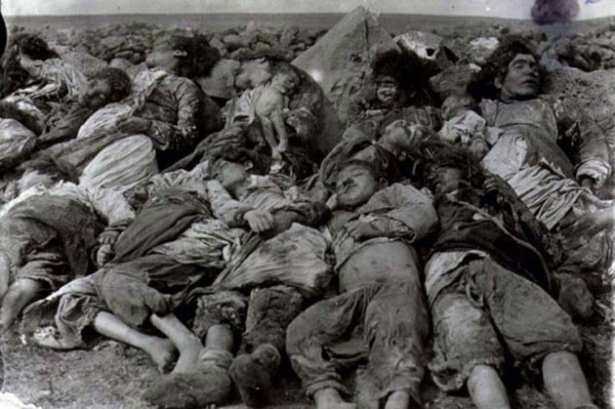
Victims of genocide
Photo by Cantetik2 via Wikimedia Commons.
What I was querying was the practicality and the morality of reparations being paid today: “If great-great-grandchildren of perpetrators have to pay great-great-grandchildren of survivors, is there any limit on historical liability? 200 years? 500 years?”
Before we get any further into the discussion, let me restate here my position, which has not changed at all in light of the subsequent online exchanges and name-calling: I do not believe in collective intergenerational responsibility. Far from modern and enlightened, it strikes me as a primitive, ancient principle, in line with the Old Testament’s “an eye for an eye” mentality. Thought to call it Old Testament might be unkind to Old Testament, since already by the time the Book of Ezekiel was being compiled during the Babylonian Exile, mid-first millennium BC, the Judaic theology had morally evolved beyond the belief that the sins of the fathers are visited on their children. We are each a moral agent, enjoying free will and exercising own judgments and actions, and for all that we are rightly held responsible and accountable. But it is unjust to blame (and, at the other end of the spectrum, absurd to praise) us for what our literal and metaphorical ancestors had done or failed to do at one point or another in the past, or what they have collectively achieved.
And so, to the comment that genocide has no statute of limitation, I say: it should, and it should be right about the time that all those who were alive at the time and affected by it have passed away.
The concept of reparations for historical wrongs is increasingly in the news. In the United States, the question revolves around the evil of slavery, but it’s hardly an American-centric debate. In many Western European countries there is talk of reparations for colonialism. Then there is the agitation in Poland, long supported by the ruling Law and Justice party, that Germany should pay Poland reparations for death and destruction caused during the Second World War. While the quantum has sometimes been calculated upward of US$15 trillion, the official suggestions have hovered around the more “modest” €850 billion (1947 estimates in today’s currency).
[…]
Not just genocide – everything that has ever happened, both bad and good, ripples across time and shapes the present. This is what history is about. Each event has an infinite number of causes and an infinite number of consequences. Hence, conceptual problems start popping up once you try to unscramble the egg and make simple adjudications about complex past situations. It’s one thing to make moral judgments about what had happened, it’s another to apply judicial standards used in disputes between contemporaries to met out sanctions and punishment in relations to historical wrongs, which might have occurred centuries ago. For starters, the collective approach to situations where each individual was affected it their own unique way might simplify things but it surely does not paint an accurate picture or deliver real justice. This goes for both the victims and the perpetrators. (At the extreme, for example, potentially forcing the descendants of German pacifists to compensate the descendants of Polish collaborators. In fairness, there were few of either at the time, but most other historical events are significantly more complicated than the black and white story of Nazi aggression and crimes against humanity.)
Which brings me to the second problem: the supposed intergenerational nature of responsibility and punishment. Not only are we talking about entire nations or ethnic (or social or religious or other) groups as monoliths for legal purposes, somewhat akin to a corporation, but also monoliths in time, across an unlimited number of generations. I find it morally odious, but you may well say “well, it’s not about moral blame per se, but whether you have, intentionally or not, benefitted at the expense of past others as a consequence of the evil actions of your ancestors” – in other words, it’s not a punitive but a restorative justice. Putting aside, again, the fact that no two individuals are ever affected in exactly the same way, the past is much more complex than your simplistic unicausal, zero-sum calculations allow and so, consequently, simple justice in theory is simply unjust in practice. Take Germany for example; if you think that Germany and Germans as a collective had benefitted from their rapacious actions during the war, you clearly have little idea what happened to them between, say, 1943 and 1946. You might think, as many did particularly in the immediate aftermath of the war, that this was still not a (collective) punishment enough considering the extent and the gravity of crimes committed (including the Holocaust) but if there was a time to tip the scales even more it was contemporaneously. The point I’m making is that any short-term German gains have been wiped out by the deliberate actions (military or otherwise) of the Allies, who in so doing destroyed much of the native German wealth as well as the wealth stolen by Germany from the occupied territories. That Germany is rich today is despite, not because of the Second World War. And while it’s true that Poland, for example, and at least some of its people are poorer today than they would have been had there been no war, I return back to my original position: how is it just and fair for a 25-year old from Bremen to compensate Poland as a whole (or the Polish government to be exact) for the “ripples” set off six decades before they were even born?
Bren MkI: The Best Light Machine Gun of World War Two
Forgotten Weapons
Published 24 Feb 2021http://www.patreon.com/ForgottenWeapons
https://www.floatplane.com/channel/Fo…
Cool Forgotten Weapons merch! http://shop.bbtv.com/collections/forg…
In the years after World War One, the British military wanted a new machine gun, and they wanted it to replace both the Lewis and the Vickers. Through the 1920s the British would tinker with most of the light machine guns that became available, but it was not until the early 1930s that a serious formal trial was conducted. The initial trials found three particularly encouraging guns; the ZB-26, Madsen, and Vickers-Berthier. Over a series of followup testing, the Madsen and Vickers-Berthier were both eliminated, leaving the Czechoslovakian ZB as the final choice.
The British were extremely enthusiastic about the qualities of the ZB, and it is understandable why. The final .303 British version, the Bren, is widely regarded as the best magazine-fed light machine gun ever made. In its final preproduction trial, one of the prototype guns endured a 150,000-round trial without any real problems.
The design was licensed for British production as well as in the Dominions, and would be put into production at both Enfield in England and the John Inglis company in Canada. About 30,000 were produced before the Dunkirk disaster, which would lead to simplification of the design. But those changes are a subject for another video later…
Contact:
Forgotten Weapons
6281 N. Oracle #36270
Tucson, AZ 85740
From the comments:
Jeffrey Holdeman
5 hours ago
Ian- “this video is getting a little long already”Everyone else- “so what!”
Notable Discomfort
2 hours ago
Ian: “This video is a little long already.”
Everyone: “Baby doll, you take all the time you need, I’m in love with every second you take. Every minute you take to explain this rifle is a minute I get to spend with you and your comforting voice. Don’t never apologize. There’s nothing to be sorry about.FLIBFLAGGAFLUP
2 hours ago
The sheer amount of Victoria Cross citations that start with “he picked up a Bren gun” is stupendous, like a WW2 cheat code.

Comments Off on Bren MkI: The Best Light Machine Gun of World War Two
QotD: British wartime censorship
At this moment what is demanded by the prevailing orthodoxy is an uncritical admiration of Soviet Russia. Everyone knows this, nearly everyone acts on it. Any serious criticism of the Soviet régime, any disclosure of facts which the Soviet government would prefer to keep hidden, is next door to unprintable. And this nation-wide conspiracy to flatter our ally takes place, curiously enough, against a background of genuine intellectual tolerance. For though you are not allowed to criticise the Soviet government, at least you are reasonably free to criticise our own. Hardly anyone will print an attack on Stalin, but it is quite safe to attack Churchill, at any rate in books and periodicals. And throughout five years of war, during two or three of which we were fighting for national survival, countless books, pamphlets and articles advocating a compromise peace have been published without interference. More, they have been published without exciting much disapproval. So long as the prestige of the USSR is not involved, the principle of free speech has been reasonably well upheld. There are other forbidden topics, and I shall mention some of them presently, but the prevailing attitude towards the USSR is much the most serious symptom. It is, as it were, spontaneous, and is not due to the action of any pressure group.
George Orwell, Unpublished Preface to Animal Farm, 1945.
Comments Off on QotD: British wartime censorship


