
Classic Vehicle Channel
Published Apr 19, 2020Transporting cars by sea, air and rail. This film features wonderful traffic archives.
April 28, 2024
Look at Life – The Car Has Wings (1963)
Comments Off on Look at Life – The Car Has Wings (1963)
April 27, 2024
“… when it comes to energy policy Germany is an undisputed champion of crazy”
eugyppius explains how Angela Merkel’s government reacted to the Japanese Fukushima disaster in a sane, measured, and sensible way … naw, I’m pulling your leg. They looked at all the options and then selected the dumbest possible reaction available to them:
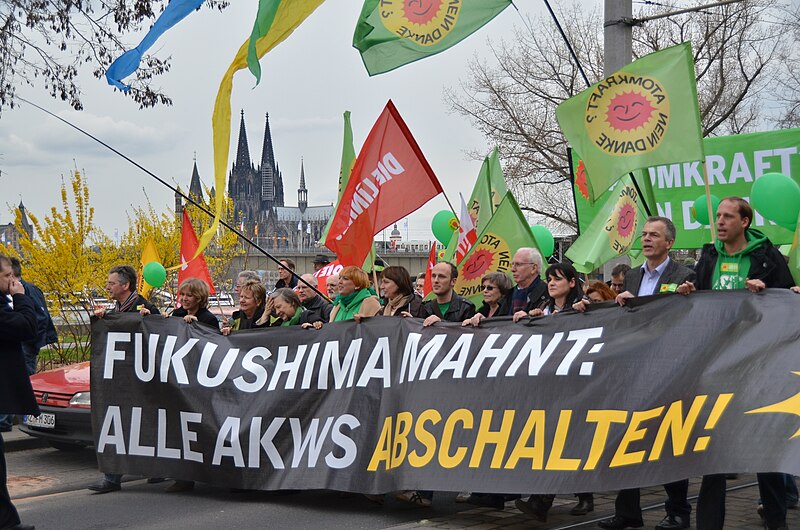
German anti-nuclear protest in Cologne, 26 March 2011.
Photo by Bündnis 90/Die Grünen Nordrhein-Westfalen via Wikimedia Commons.
All of our countries are crazy in various ways, but when it comes to energy policy Germany is an undisputed champion of crazy.
In 2011, a tsunami caused the Fukushima nuclear disaster. If you check a map, you’ll notice that Fukushima is in a country called Japan, which it turns out is a different country from Germany. The Fukushima disaster had zero to do with the Federal Republic, but then-Chancellor Angela Merkel felt the need to solve the problem of Fukushima by phasing out nuclear power in Germany, even though tsunamis and earthquakes are not a problem in Germany, because Germany is a country in Central Europe and not an island nation in Asia.
That is crazy enough, but it gets much crazier. Months before announcing the nuclear phase-out, Merkel’s government had passed energy transition legislation to secure Germany’s path towards a zero-emissions future. We resolved to ditch our most significant source of emissions-free power, in other words, just months after resolving an energy transition to emissions-free power. At this point you would be justified in wondering if Germany suffers from some kind of shamanistic cultural phobia of electricity in general, that is how crazy this is. These insane choices had the near-term consequence of increasing our dependence on Russian natural gas. Otherwise, they ensured that power generation in Germany would be vastly more expensive than necessary and also vastly more carbon intensive than necessary.
Now, crazy demands explanations, and observers have proposed various theories for the German climate nuclear crazy. Two of them deserve mention here:
1) The 1968 generation in Germany suffered from unusual radicalism, sharpened by moral anxiety over National Socialism, and resolved to outcompete all others in the project of self-abnegating virtue. Our culture developed a deranged anti-nuclear movement that in a fit of typical German thoroughness also came to embrace opposition to nuclear power. The Chernobyl disaster radicalised the pink-haired anti-nuclearists still further, and these cretins grew up to become news anchors, school teachers and book authors, effectively indoctrinating the next generation according to their parareligious delusions.
2) German politicians after the Cold War – especially Gerhard Schröder and Angela Merkel – harboured a subtle and not entirely unreasonable desire to strengthen ties with resource-rich Russia. They decided that the anti-nuclearists and the Green Party could be instrumentalised towards this end. The energy transition and the nuclear phase-out increased our dependence on Russian gas, and this was a feature more than it was a bug.
These are mutually supporting theories, but I don’t think either of them can fully account for the bizarre phenomenon before us. Germany energy crazy is a very deep problem and it will keep historians busy for many generations.
In 2022, Russia invaded Ukraine, and Germany under Merkel’s successor, Chancellor Olaf Scholz, decided along with the rest of the liberal West that Russia was bad, bad, bad and that evil Putin had to be punished with self-immolating sanctions, sanctions, sanctions. This new spasm of high-minded moralising further attenuated our energy situation, ushering in an entirely self-made energy crisis. The Greens, now in government, were determined to proceed with the last stages of the nuclear phase-out, even with our natural gas supplies in doubt. Only when they saw themselves staring into the abyss of political doom did they grudgingly agree to give our last nuclear plants a three-and-a-half month lease on life. We Germans and our energy policy had out-crazied everyone else, we had made ourselves the laughing stock of the entire world, that is how crazy we were.
Comments Off on “… when it comes to energy policy Germany is an undisputed champion of crazy”
Floating Fun: The History of the Amphibious Boat Car
Ed’s Auto Reviews
Published Aug 9, 2023A classic car connoisseur dives into the general history of amphibious cars and vehicles. When did people start to build boat-car crossovers? What made Hans Trippel’s Amphicar 770 and the Gibbs Aquada so special? And why don’t you see a lot of amphibious automobiles out on the road and water these days?
(more…)
Comments Off on Floating Fun: The History of the Amphibious Boat Car
QotD: Roman magistrates during the middle Republican period
Last time we discussed Rome’s popular assemblies, which at least notionally expressed the will of the people. One of the key tasks those assemblies had, we noted, was the election of magistrates, the executive officials of the Roman state. Those magistrates will be our focus this week, though we’re not going to get through all of them. Today we’re going to focus on the structure of a Roman political career, the cursus honorum and the first few steps on that career: serving as military tribunes, quaestors and aediles.
Similar to the magistrates in the Greek polis, Roman magistrates should not be thought of as bureaucrats within a unitary governing institution. Rather each magistrate is an independent actor, granted certain powers to oversee the public interest in a specific field. This is perhaps even more true of Roman magistrates, who rarely function as “boards” the way Greek magistrates often do (none of the senior magistrates in Rome function as a board, they are all individual actors). Instead of having an chief executive (like a president or prime minister) to coordinate the different actions of government, the Romans in the Middle Republic instead rely on the Senate, which will be our topic for next week, though the Senate’s guidance is going to show up a fair bit here as well.
Each of these offices has a range of functions and some interesting powers and prerogatives, so it is worth discussing each one in turn.
Bret Devereaux, “Collections: How to Roman Republic 101, Part IIIa: Starting Down the Path of Honors”, A Collection of Unmitigated Pedantry, 2023-08-11.
Comments Off on QotD: Roman magistrates during the middle Republican period
April 26, 2024
The British Army from the start of the Cold War
Dr. Robert Lyman discusses the state of the British Army through the Cold War years down to today, with emphasis on the defence budget tracking against perceived threats to the UK and allies over that period:
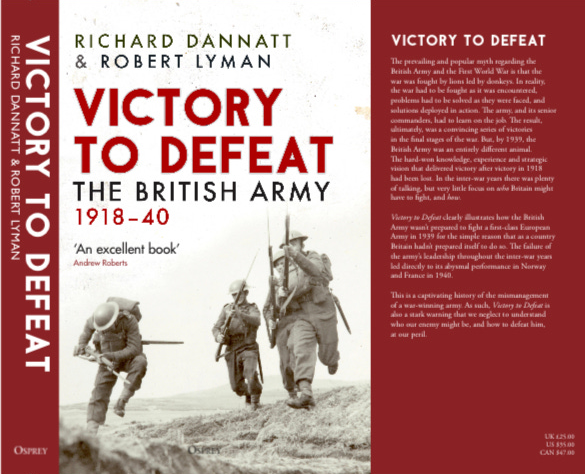
Last year General Lord Dannatt and I published an account of the British Army between 1918 — when it achieved a great victory — and 1940, when it did not. The book was written in part to challenge the UK to think seriously about what happens when our country neglects the requirement for an army able to fight at a high-intensity for a prolonged period against a peer adversary.
Part of our argument was to look at the amount of money the country spends on its defence as a barometer of the seriousness or otherwise of our political masters towards spending money on the primary duty of government, namely the security of its citizens. Our fear is that in the rampant feel-goodery that has plagued the West since 1991 the harsh realities of our unstable world have become forgotten. It has taken Putin’s invasion of Ukraine, and Russia’s subsequent bludgeoning of that benighted country for politicians to gradually wake up to the scale of the threat that this sort of instability offers to the world, not merely Europe or the West.
My fear, like that of many others, is that the wake-up call is taking too long and our country’s defences remain in a parlous state. We haven’t had an army able to deploy at divisional level or above in sustained all-arms manoeuvre for perhaps ten years or more. In other words, our ability to provide what our forefathers would have described as a robust “continental commitment” is almost non-existent.
In the book we trace the origins of the failure to think seriously about the need to have a deployable, expeditionary army, able to fight and operate alongside its allies in NATO on an all-arms battlefield. The reality is that the Cold War forced Britain to retain the ability to fight a general war in Europe, all the while finding the resources to undertake its other commitments across the world. Although worldwide events were dynamic from 1945 to 1989 with further conflicts for the United Kingdom in Malaya, Dhofar, Cyprus, Kenya, Borneo, the Falklands, and the long-running Troubles in Northern Ireland, it was the Cold War in Europe that principally drove the defence agenda and kept the budget at around 5 per cent of GDP. As the major bridge between the United States and Europe, the Royal Navy was heavily committed above and below the surface of the Atlantic Ocean to keep open the sea lines of communication to NATO’s dominant partner, while the British Army retained some 55,000 troops in four armoured divisions as part of NATO’s Northern Army Group and the Royal Air Force was also largely forward-based in West Germany as part of the Second Allied Tactical Air Force. These conventional deployments were all conducted under the nuclear umbrella of Mutual Assured Destruction. By the 1980s, with the West under the leadership of US President Ronald Reagan and British Prime Minister Margaret Thatcher and with increased spending on both conventional armaments and the highly experimental Inter-Continental Ballistic Missile Defence system, the strain of strategic military competition began to show on the political and economic stability of the Soviet Union. Despite the perestroika political movement for reform within the Communist Party of the Soviet Union and the associated openness of glasnost under General Secretary Mikhail Gorbachev, the cracks in the Berlin Wall that opened on 9 November 1989 led inexorably to the collapse of the Soviet Union two years later and the old flag of Russia being raised over the Kremlin on 26 December 1991. The Cold War was over, and an apparent New World Order had begun. The historian Francis Fukuyama declared – somewhat ambitiously – the end of history.
It was at this point that international leaders and their finance ministers in the West began to overlook the cautionary tale that the history of the 20th century might have taught them. With the Soviet Union gone and rump Russia apparently enfeebled, Western states eagerly embarked on military reduction and a peace dividend. In the United Kingdom, the “Options for Change” exercise saw a major slashing of defence capability, beneficially coincidental to help ameliorate a significant economic downturn. The British Army was reduced from 155,000 to 116,000 soldiers, notwithstanding the first Gulf War of 1990–91 which many wishful thinkers regarded as something of an aberration. However, despite that war and the subsequent deployment of large parts of the armed forces to Bosnia from 1992 and then to Kosovo in 1999, the new Labour government of Prime Minister Tony Blair continued with the implementation of its Strategic Defence Review of 1997–98. As a piece of policy work, this was considered an honest review of the United Kingdom’s defence policy and a progressive blueprint for future defence planning and expenditure. Endorsed by Tony Blair and the Chiefs of Staff, this review might have stood the nation in good stead for the future had the Chancellor of the Exchequer, Gordon Brown, fully funded its outcome. For his own reasons, he chose not to do so. The underfunding of the United Kingdom’s defence capability began to show its deficiencies a year after with the second Gulf War of 2003, and the situation was then exacerbated by a protracted campaign in Iraq for the British Army lasting until 2009 and an even more intense one in Afghanistan lasting until 2014.
Comments Off on The British Army from the start of the Cold War
Guns for the Pope’s Police: Mazzocchi Pinfire Revolver
Forgotten Weapons
Published Jan 22, 2024The revolver we are looking at today is a 9mm pinfire revolver adopted for the Papal Gendarmerie in 1868. At that time, the Papal States controlled roughly the same amount of territory as Switzerland today, and had its own armed forced for internal security — the Papal Gendarmerie. The Papal States had previously adopted a 12mm Lefaucheux revolver for its army, but this was deemed too bulky for the Gendarmes. So in 1867, they went looking for a smaller new pistol. The Mazzocchi brothers in Rome had been official armorers to the Vatican for three generations (their shop was actually located in Castel St Angelo until 1850!), and they won the contract for the Gendarmerie with this revolver model. A total of 2500 were made in 1868 and 1869, at 50 Papal Lira each.
(more…)
Comments Off on Guns for the Pope’s Police: Mazzocchi Pinfire Revolver
April 25, 2024
Were the Waffen-SS Really Germany’s Elite Fighters? – WW2 – OOTF 35
World War Two
Published 24 Apr 2024It’s time for another thrilling installment of Out of the Foxholes, but what sort of questions does Indy answer today? Well, it’s good stuff — about Allied security and logistics at the major conferences, about what the British navy was doing once the Atlantic and Mediterranean were secure, and about the skills (or lack thereof) of the soldiers of the Waffen SS. How can you live without knowing about such things? I suppose it’s possible, but it would be a sad life indeed, so check it out!
(more…)
Comments Off on Were the Waffen-SS Really Germany’s Elite Fighters? – WW2 – OOTF 35
Jeremy Black reviews Empireworld by Sathnam Sanghera
The author of a book on the same topic says that Sathnam Sanghera’s work “really should have devoted more attention to the pre-Western history“:
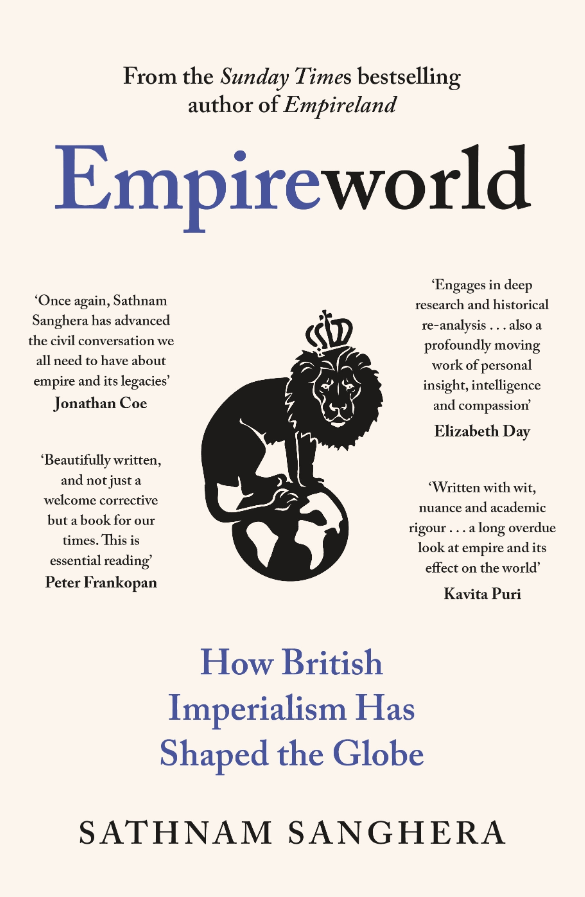
With its pretensions and authorial conceit, Sanghera’s book is actually rather a good laugh. He apparently is the word and the way for Britain, which “cannot hope to have a productive future in the world without acknowledging what it did to the world in the first place”, a process that is to be done on his terms in order to overcome a British allergy to the unattractive aspects of the imperial past.
Stripped to its essentials, this is a book that repeats well-established themes and serves them up in a familiar fashion. Although 461 pages long, only 247 are text and, with a generous typeface that is a pleasure to read, there is only so much space for his analysis. Unfortunately, that is what is on offer.
It might be thought appropriate to establish what was different or familiar in British imperialism in a Western European context by comparing in detail, say, Britain’s Caribbean empire with those of France, Spain and the Dutch. It might be thought useful to assess Britain as an Asian imperial power alongside Russia or the Ottomans, China or the Persians.
It might be appropriate to follow the direction of much of the world history approach over the last half-century and assess empires as shared projects in which there were many stakeholders, British and non-British. To turn to the British empire, it might be useful to discuss the oldest “colony”, Ireland, or to assess policy in (Highland) Scotland. It could be appropriate to consider how the causes, context, course and consequences of British imperialism varied greatly.
Sanghera has not risen to the challenge. His study is conceptually weak, methodologically flawed, historiographically limited and lacking basic skills in source assessment. This is a pity, as his position as a journalist, and his link with Penguin, provide an opportunity for using his abilities as a communicator to expand public understanding of the subject.
Sanghera criticises “an enervating culture war on the theme of British empire”. He rightly draws attention to the flaws of the “balance sheet” view of British empire, but I am less confident than he is about how best to consider what he terms “a culture war”. The promotion of “understanding” for which he calls is scarcely value-free, nor does he adequately address the degree to which there have always been “culture wars” in both Britain and its colonies and former colonies. Unsurprisingly so, as there were substantive issues at stake, and questions of goal and identity were very much part of the equation.
From reading journalists’ comment pieces, it is hard to avoid the sense that they feel that there is a correct view (theirs, what a surprise) and that others are variously culture wars, populist, ignorant, etc. This is the standard approach to history, notably national history, and, particularly in the case of Britain, empire and slavery. Yet, such a stance scarcely captures the complexities of the issue, a problem very much seen in Sanghera’s work, despite his claim to nuance.
Comments Off on Jeremy Black reviews Empireworld by Sathnam Sanghera
The Handley Page Hampden; A Plane for Fat Shaming
Ed Nash’s Military Matters
Published Apr 29, 2022One of the key British bombers at the start of the war, the Hampden was eclipsed by its more successful equivalent, the Vickers Wellington, and the later four-engine “heavies”. But it is worth remembering for the role it played in developing the RAF’s experience and methods during WW2.
(more…)
Comments Off on The Handley Page Hampden; A Plane for Fat Shaming
April 24, 2024
“What is to be done?” – N.S. Lyons at the National Conservatism Conference in Brussels
I suspect the recent National Conservatism Conference in Brussels would have been a mere blip in the media if it hadn’t been for the dedicated and persistent efforts of local Belgian politicians and activists to prevent it from happening at all, using almost every tool at their disposal. By chasing the event from venue to venue, intimidating the businesses who had contracted to provide services to the event and then finally sending in a massive police presence to physically prevent the conference from going forward, it became a nine-day wonder. One of the people invited to speak at the event was N.S. Lyons:
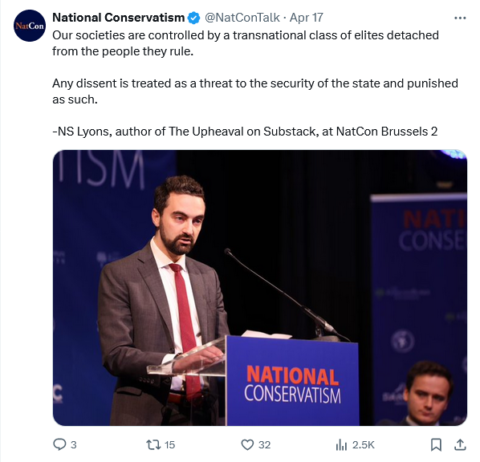
“What is to be done?” That seems to be the question on everyone’s lips these days. Answering it is I think in fact the real purpose of this conference on National Conservatism here in Brussels.
By now most of us are well aware of the scope of the problems we face. Our societies are controlled by a transnational class of managerial elites increasingly isolated from the people they rule, and from reality. These elites, and the many institutions they control, have been captured by a revolutionary ideology that seeks to remake the world, and everyone in it, from the top down.
The vast machinery of modern managerial technocracy has been turned against us, its bulging bureaucracies seeking to impose on us a totalizing project of internal colonization. Our systems of self-governance, the cultural fabric of our national ways of life, even our very human nature are being intentionally suppressed and replaced with the stifling conformity of a rigid system of ideological and technological control. All remaining semblances of democratic accountability are today being cast aside in favor of governance via mass manipulation and open coercion. Increasingly, any dissent is treated as a threat to the security of the state – and is punished as such.
As has been so amply demonstrated by the police outside our very doors, dispatched to shut down this conference, for conservatives and other dissidents this state of affairs means escalating exclusion and persecution. The reality is that any “liberal neutrality” or “rule of law” once maintained by the state no longer exists – such restraint was an artifact of the old order.
Meanwhile, managerialism’s progressive project has produced a deliberate inversion of moral values, a degradation of competence, and an implosion of social trust. This has begun to induce collapse in the basic systems upholding civilization. The result is a proliferation of crime, addiction, social atomization, and general despair, dysfunction, disorder, and decay. So now we suffer under a state of simultaneous anarcho-tyranny.
What is to be done? First of all, it should be clear by now that old guard conservatism will be of no use to us whatsoever. For decades, such a conservatism has failed to conserve much of anything at all. Even when successfully elected to political office with a strong mandate, conservatives of this mode are soon either coopted by the oligarchic establishment or find themselves isolated and helpless before the vast unelected managerial “deep state”.
They have proven themselves unable to combat either the relentless march of progressive cultural hegemony, or the growing technocratic tyranny that openly advertises its intent to ultimately destroy them. Over and over again, they are fast reduced to blustering uselessly at Congressional hearings, whining on talk shows, or settling in to merely grift whatever they can, while they can. So, unfortunately, just “voting harder” will not be enough to get us out of our present mess.
Comments Off on “What is to be done?” – N.S. Lyons at the National Conservatism Conference in Brussels
Alternative für Deutschland is gifted a blueprint for governing by their entrenched opponents
Was it Napoleon who said to never interrupt your enemy when they’re making a mistake? If so, the German populist Alternative für Deutschland leaders must be congratulated for not interrupting the latest mistake by the statists they want to replace:

Every day I encounter yet another hamfisted pseudoacademic propaganda operation eagerly churning out oceans of text to shore up the German political establishment. The idea seems to be that with just enough whitepapers, bursting with just enough words, the situation might still be saved.
There are just so many of these outfits, they grow like weeds in the fertile soil of government funding. This Sunday, it has been my dubious pleasure to stumble across the “academic and journalistic open access forum of debate on topical events and developments in constitutional law and politics” billing itself as the Verfassungsblog (the “Constitution Blog”). This factory of tedious prose and political special pleading that nobody will ever read is not just the eccentric side project of a very socially concerned lawyer named Maximilian Steinbeis, oh no. It is funded by the WZB Berlin Social Science Center (and therefore, indirectly, by the German taxpayer) and also by the Max Planck Institute for Comparative Public Law and International Law. We would do well to take these people seriously, in other words, and you should keep that in mind, because things are about to get very ridiculous.
Last year, our state-funded Verfassungbloggers realised that elections were approaching in Saxony, Thüringen and Brandenburg. This worried them terribly, because Alternative für Deutschland dominates polling in all three states. They feared that this “authoritarian populist party” might seize control of one or more state governments, just as other authoritarian populist parties have seized control “in Poland and Hungary, in Florida and Texas”. These parties are very bad, because they “use … power … so that they no longer have to relinquish it”. They “manipulate electoral law” and “stifle opposition” and “pack the administration and judiciary with their own people”. As if that were not bad enough, they also “make the media, scientific and cultural institutions dependent on their will”. Of course, the Federal Republic is presently ruled by a party cartel system that is already doing all of that, but the difference is that none of the parties involved are “authoritarian” or “populist”. The priests of democracy get to do whatever they want, and whatever they do is by definition democratic.
In this spirit, our Verfassungsbloggers launched the “Thüringen Project”. Their aim is to identify how the forces for humanitarian pluralism might manipulate the law, stifle the opposition and pack the administration and judiciary in even more extreme ways than have yet been imagined, all to subvert the will of east German voters and more effectively blunt the power of the AfD when they become the strongest party in the Thuringian Landtag.
[…]
All of this iterative looping has culminated in an overproduced, 36-page .pdf file bearing the characteristically cumbersome title “Strengthening the resilience of the rule of law in Thüringen: Action recommendations from the scenario analysis of the Thüringen Project“. No syllable can be spared in our campaign to defend democracy. In the pages of this plan, they finally define what “authoritarian populist parties” are. These are parties that “use the narrative of a natural, ‘true’ people in opposition to ‘corrupt elites’, for the purpose of delegitimising pluralistic democracy and establishing an authoritarian regime”. The AfD are of course “a clear example of such a party”. The more panicked all of these people get, the closer they come to saying plainly what they’re really afraid of, namely the growing hostility of native Germans to an increasingly isolated political elite, which plainly does not care much about “authoritarianism” (they are responsible for plenty of that themselves) as much as they are terrified of losing their hold on power.
Comments Off on Alternative für Deutschland is gifted a blueprint for governing by their entrenched opponents
What Were Victorian Attitudes Towards Sex?
History Hit
Published Dec 15, 2023They’re famously thought of as a buttoned up prudish bunch, but we all know they loved to bump uglies as much as anyone today.
Were the spanking punishments of boarding schools really the origins of brothels? Who were the pin-ups of Victorian women? And what did the saucy portrait Queen Victoria gave to Prince Albert look like?
Today we go Betwixt the Victorian Sheets with Dan Snow, from History Hit sister podcast Dan Snow’s History Hit, to find out all about Victorian relationships.
(more…)
Comments Off on What Were Victorian Attitudes Towards Sex?
April 23, 2024
Debating the economic impact of the Raj on India
At The Daily Sceptic, Nigel Biggar looks at a few books making or refuting the narrative on how much or how little British rule in India extracted or contributed to the economic life of the subcontinent:
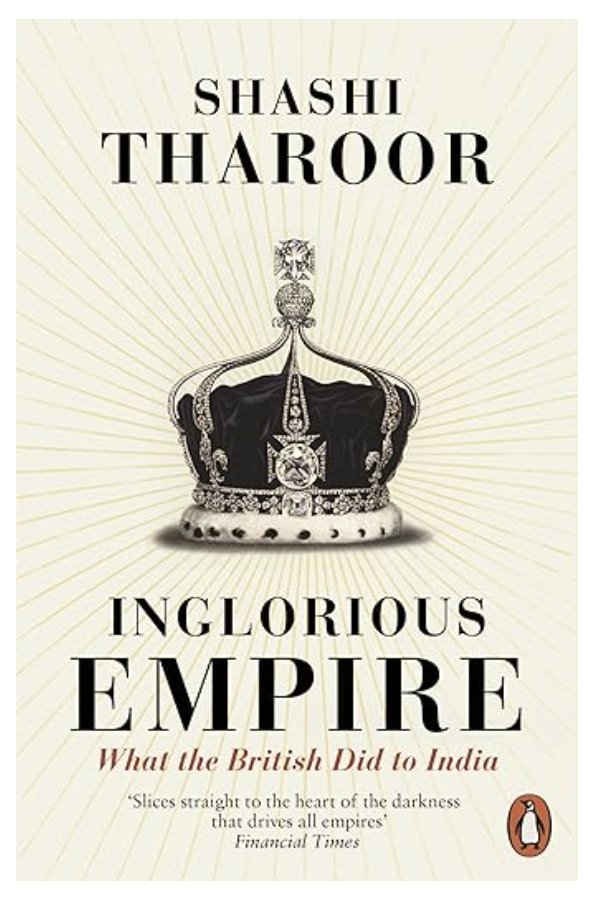
Beyond slave-trading and slavery, what were the economic effects of British imperial dominance? Can they be reduced to Britain’s leeching wealth from exploited subject peoples?
For over a century, that is what Indian nationalists have claimed. It is also what the politician Shashi Tharoor claims in his 2016 book, Inglorious Empire: What the British Did to India. Against him, however, the Bengali-born, LSE-based economic historian Tirthankar Roy has declared of the nationalist critique that “generations of historians … have shown that it is not [true]”. Pace Tharoor, the statistic that India produced 25 per cent of world output in 1800 and 2–4 per cent in 1900 does not prove that India was once rich and became poor: “[i]t only tells that industrial productivity in the West increased four to six times during this period … The proposition that the Empire was at bottom a mechanism of surplus appropriation and transfer has not fared well in global history”.
On the contrary, the British Empire’s commitment to free trade gave Indian entrepreneurs new opportunities to grow. Some of them visited England in the late 19th Century, observed the workings of manufacturing industry, imported machinery and expertise to India, built factories employing Indians, and then outcompeted Manchester. This is exactly how the Tata Iron and Steel Company began in Bombay – the same company that now owns what remains of the British steel industry.
What is more, colonial governments often protected native producers against British business, in order to moderate economic and social disruption, partly because they genuinely cared for the welfare of native people and partly because they didn’t want to have to manage the political unrest that foreign commercial intrusion could excite. Famously, in 1910-11 colonial officials barred Lever Brothers from acquiring concessions in Nigeria on which to establish palm-oil processing mills with widespread hinterlands, since Africans were already producing for the world markets and generating tax revenue and because the alienation of large areas of land risked provoking native opposition.
Further still, the British were the leading exporters of capital from the mid-19th Century to at least 1929. Between 1876 and 1914, Britain invested over a third of its overseas capital in the Empire, over 19% of it in India. Of course, British investors often made a profit out of this. That’s the thing about investment: you tend to want to grow your money, not waste it. But if the British gained, so did colonial peoples. Take railways. By 1947, British India had 45,000 miles of railway track, most of it constructed with private capital, whereas five years later un-colonised China still had less than 18,000 miles. For sure, the railways served military purposes. But they also served commercial and economic ones: one estimate reckons that when the railway network reached the average district, real agricultural income rose by about 16%. And it served the welfare purpose of efficient famine relief, too.
A basic reason why the British sent their capital overseas to the Empire, enabling the growth of businesses and the building of infrastructure, was that colonial states provided sufficient political stability and legal certainty to make the risks of financial ventures worth taking. (Badenoch hints at this in her reference to the economic effects of the Glorious Revolution of 1688.) That explains why Australia’s economic growth compares so favourably with that of many Latin American countries, and why, between the 1860s and 1890s, Australia was the richest country on earth.
In sum, the considered judgement of the Swiss historian Rudolf von Albertini, whose work – according to the world’s “leading imperial economic historian”, David Fieldhouse – was based “on exhaustive examination of the literature on most parts of the colonial world to 1940”, was simply this: “colonial economics cannot be understood through concepts such as plunder economics and exploitation”.
Comments Off on Debating the economic impact of the Raj on India
April 22, 2024
Roman Honor: The Fire in the Bones
From last week’s blog post, Bret Devereaux reviews a book by a former instructor from his undergraduate days, documenting Roman values and attitudes and how understanding their views of themselves helps put their actions into context:

I studied under Barton as an undergraduate at the University of Massachusetts at Amherst, but only looped back around to fully read her book on Roman honor during my Ph.D studies. This is a book about Roman culture and the Roman worldview – or more correctly the way the Romans view themselves and more crucially their innermost selves. This is an important exercise for the student of history, because, as L.P. Hartley famously put it, “The past is a foreign country; they do things differently there”. And so part of what the historian aims to do is not merely know what happened, but in order to understand why it happened, to be able to get into the minds of those people in the past, doing things differently. To put another way: we must also understand the vibes. This is a book about some serious Roman vibes.
The focus of Barton’s book, of course, is the Roman concept of honor and the whole constellation of ideas and concepts that circle around it (virtus, pudor and so on). For Barton, the Roman lived for the discrimen or certamen – that moment of testing and decision for which we have so many well-worn phrases (“sorting the wheat from the chaff”, “separating the men and the boys” and so on).1 It is in that moment that the Roman is, in a sense, most alive, propelled forward by virtus, guided by the other virtues, to pass the test and thereby win honor.
Two things, I think, distinguish Barton’s approach. The first is a focus on how these ideas make Romans feel and act; the man of honor shines, he is fiery, he glows. He stands tall, while others defer to him. The man filled with shame is the opposite. Understanding how real these ideas could be in Roman culture is in turn important for understanding how the Roman state – republic and empire – works, because it is predicated on those values, on the assumption that those not yet tested defer to those with honos who have been so tested and have shown their virtus. Second, the way Barton engages with the sources leaves a strong impression: the reader is bombarded with quotations (translated in the text, original in the footnotes) where the Romans can speak themselves about their values. And goodness do the Romans ever speak for themselves – almost never one example but half a dozen or more.
That strength can also be a weakness: to get that many references, Barton has to cast a wide net, especially chronologically and it isn’t unusual to see different examples for a point covering centuries, for instance from Plautus (late 3rd cent. BC) to Seneca (mid-late 1st cent. AD) in the same paragraph. That somewhat weakens the book’s ability to address chronological change, though Barton does work a bit of that chronology back in some of the later chapters. That said, Barton’s conception remains rooted with the bulk of her sources in the Late Republic (c. 133-31 BC) and while she stretches beyond this and notes some changes, this is fundamentally not a chronologically focused work. On the upside, the book is printed with footnotes (often taking up half a page or more!) with both original text for the translations and other useful notes, so for the student a trip from Barton’s prose to the original sources is quick and often quite fruitful.
Barton’s prose is very readable. As someone who sat in her classes, I can hear her lecture voice in the pages – she is well-known among the students as a passionate lecturer (now retired) who would shout and gesture, jump up and down and even get a bit misty-eyed at the fall of the Gracchi. The passion, I think, comes through in the book as well, to its benefit and that’s important, because this is fundamentally about things the Romans themselves were passionate about. I will also note, I think this book combines well with J.E. Lendon’s Empire of Honor (somewhat harder to obtain) to give a the fullest picture of honor in Roman affairs. But for someone looking to understand how the Romans thought about their own inner-lives and emotions, Roman Honor is, I think, the place to start.
1. One thing that’s striking: whereas the Greek equivalent, the agon is a contest against another, the Roman discrimen is a test against any sort of challenge or hardship. Greek arete (“excellence”) tends to be comparative in nature: the best, the strongest, the fastest and so on, whereas the Roman equivalents are less inherently comparative. Virtus is not zero-sum. That doesn’t mean the Romans aren’t competitive, but it is, I think, a subtle but real difference in ethos (especially aristocratic ethos).
Comments Off on Roman Honor: The Fire in the Bones
Did Japan Attack Pearl Harbor Because Of China?
Real Time History
Published Dec 1, 2023December 7, 1941: The Japanese attack on Pearl Harbor shocked the world and brought the US into the Second World War. But why did the Japanese resort to such an attack against a powerful rival and what did it have to do with the Japanese war in China?
(more…)
Comments Off on Did Japan Attack Pearl Harbor Because Of China?


