
… given this general lack of geographical knowledge, try to imagine embarking on a voyage of discovery. To an extent, you might rely on the skill and experience of your mariners. For England in the mid-sixteenth century, however, these would not have been all that useful. It’s strange to think of England as not having been a nation of seafarers, but this was very much the case. Its merchants in 1550 might hop across the channel to Calais or Antwerp, or else hug the coastline down to Bordeaux or Spain. A handful had ventured further, to the eastern Mediterranean, but that was about it. Few, if any, had experience of sailing the open ocean. Even trade across the North Sea or to the Baltic was largely unknown – it was dominated by the German merchants of the Hanseatic League. Nor would England have had much to draw upon in the way of more military, naval experience. The seas for England were a traditional highway for invaders, not a defensive moat. After all, it had a land border with Scotland to the north, as well as a land border with France to the south, around the major trading port of Calais. Rather than relying on the “wooden walls” of its ships, as it would in the decades to come, the two bulwarks in 1550 were the major land forts at Calais and Berwick-upon-Tweed.
Anton Howes, “The House of Trade”, Age of Invention, 2019-11-13.
April 22, 2024
QotD: Before England could rely on the “wooden walls” of the Royal Navy
April 21, 2024
300,000 Germans Surrender in the Ruhr – WW2 – Week 295 – April 20, 1945
World War Two
Published 20 Apr 2024The Soviet drive on Berlin continues, but it is now very much a race between the forces of Georgy Zhukov and those of Ivan Konev. In the west, over 300,000 Germans surrender to the Allies as the Ruhr Pocket is eliminated, though there are advances by all Allied armies this week on the whole Western Front. There is even an Allied breakthrough in Italy, though on Okinawa American attacks get nowhere. The Japanese are advancing in China, and in Burma the Allied drive for Rangoon continues.
(more…)
Publius Rutilius Rufus, an honest man in a dishonest era
Lawrence W. Reed discusses the life and career of Publius Rutilius Rufus, Roman consul and historian, who suffered the revenge of corrupt tax farmers (publicani) after attempting to protect taxpayers from extortion in the province of Asia:
In the last decades of the Roman Republic, as its liberties crumbled and the dictatorship of the subsequent Empire loomed, honesty decayed with each successive generation—an omen we should think long and hard about today. Among the lessons of the Roman experience is this: Liberty is ultimately incompatible with widespread indifference to truth. A society of liars succumbs to the tyrant who brings “order” to its chaos and corruption.
In a book I strongly recommend, The Lives of the Stoics: The Art of Living from Zeno to Marcus Aurelius, authors Ryan Holiday and Stephen Hanselman tell us about a man named Publius Rutilius Rufus (158 B.C.-78 B.C.). They regard him as “the last honest man” of the dying Republic. Though that description surely contains ample hyperbole to emphasize a point, Rufus’s exceptional honesty was indeed notable in his day because it was no longer the rule in a decadent age. As Mark Twain would note many centuries later, “an honest man in politics shines more than he would elsewhere”.
Rufus, the great-uncle of Julius Caesar (his sister Rutilia was Caesar’s maternal grandmother), built an illustrious career in the Roman military. Those under his command were known as “the best trained, the most disciplined, and the bravest” of the legions. He garnered enormous respect because of his Stoic virtues — courage, temperance, wisdom, and justice. In 105 B.C., he served in the highest political post in the Republic, the consulship. He was incorruptible, which meant he was a target of those who weren’t.
It had become a common practice in the late Republic for the government to hire private contractors to collect taxes. These “publicani” often extorted more from their victims than the taxes required because that’s the way the contracts were written. The government didn’t care what the publicani kept for themselves if it got its expected revenues. When Rufus attempted to stop the injustices this arrangement created, the publicani and their allies in the Roman Senate fought back. They arranged a sham trial with a pre-ordained verdict and charged Rufus with the very thing of which they themselves were guilty: extortion and corruption.
Historian Tom Holland in Rubicon: The Last Years of the Roman Republic writes that Rufus’s conviction was “the most notorious scandal in Roman legal history” and “an object lesson in how dangerous it could be to uphold ancient values against the predatory greed of corrupt officials”. With utterly no evidence and all credible testimony to the contrary, the accusers claimed Rufus had extorted money from Smyrna in the Roman province of Asia (what is now western Turkey).
Another historian, Mike Duncan, notes, “The charges were ludicrous as Rutilius [Rufus] was a model of probity and would later be cited by Cicero as the perfect model of a Roman administrator”.
As punishment for his trumped-up offense, Rufus was sent into exile but in deference to his past service, the court gave him the option of choosing where that would be. He chose Smyrna, the place he was charged with victimizing. When he arrived there, he was celebrated as the man who had tried to end the very practices of which he was wrongly convicted. Ryan Holiday and Stephen Hanselman describe what happened to Rufus as “a very old trick”:
Accuse the honest man of precisely the opposite of what they’re doing, of the sin you yourself are doing. Use their reputation against them. Muddy the waters. Stain them with lies. Run them out of town by holding them to a standard that if equally applied would mean the corrupt but entrenched interests would never survive … Smyrna, grateful for the reforms and scrupulous honesty of the man who had once governed them, welcomed [Rufus] with open arms … Cicero would visit there in 78 B.C. and call him “a pattern of virtue, of old-time honor, and of wisdom”.
How The Channel Tunnel Works
Practical Engineering
Published Jan 16, 2024Let’s dive into the engineering and construction of the Channel Tunnel on its 30th anniversary.
It is a challenging endeavor to put any tunnel below the sea, and this monumental project faced some monumental hurdles. From complex cretaceous geology, to managing air pressure, water pressure, and even financial pressure, there are so many technical details I think are so interesting about this project.
(more…)
QotD: The “omni-spear” of the Mediterranean World
So let us posit a spear. Its haft is made of wood – our ancient sources tend to be particular that certain kinds of wood, particularly ash and cornelian cherry (cornel wood), are best – and about 2.5 to 3m in length and roughly 2.5cm in diameter. Obviously, on one end we’ll have our iron spear head. On the other end, we probably have a smaller iron spear butt, sometimes called a ferrule.
For our spear tip, we’re going to have a hunk of iron about 250-450g in mass. It’s going to have a circular socket, about 2 to 2.5cm in diameter (to fit the haft) at its base. That socket will then proceed upwards into the tip as a “mid-ridge”, though it generally stops being entirely hollow at some point. In two directions from the mid-ridge are going to project some “blades” – if we’re French, we’ll call them flamme, “flames”, while if we’re Spanish they’ll be hoja, “blades”, and if we’re German they’re Blätter, “sheets, leaves”. These taper at the tip and widen towards the base, usually before curving gracefully inward on the socket a few inches up from its base. Often scholars have called this a “leaf shaped” spearhead, which I always find a bit awkward in phrasing (leaves can have many shapes), but the alternatives, like “tear-drop” shaped, aren’t any less awkward. If you are having a hard time conceptualizing that picture, here is an example of what I mean.
For the bottom of the spear we could just go with nothing. We could also make a simple conical socket in iron and secure it with a rivet or, if we’re being really creative, a nail hammered into the base of the shaft. If we want to be really fancy, we might make a spear-butt that combines a circular socket with a long square-sectioned projection so that it serves better as a backup point in a pinch. If you want to see the more developed version of that, here is a Greek “sauroter“, about the most elaborate this part of the spear gets.
And there we go. We have the “omni-spear”. Basic spear-butt, “leaf-shaped” spearhead with a strong mid-ridge, both generally in iron, joined by a 2.5-3m long wooden haft, about 2.5cm thick (though the haft might be thicker, as it could taper before meeting the socket) made of hardwood, with a grip at the center of balance.
That basic description describes the famous Greek dory, the spear of the hoplite. It also describes one of the more common forms of the Roman hasta, one with what I’ve termed a “Type A” Roman spearhead. And it also describes the La Tène spear, the native name of which we don’t know.1 And it also describes common thrusting spears of the Iberian Peninsula, both those used by the Iberians living in the coastal Levante and the Celtiberian peoples living on the Meseta; the names of those spears too are lost to us.2 And it also describes the common weapon of the Persian infantry, including their elite infantry which Herodotus calls “Immortals”. Almost certainly it describes spears even further afield, but we are rapidly reaching the edge of my expertise, so I’ll stop with the Persian Empire.
Bret Devereaux, “Collections: The Mediterranean Iron Omni-Spear”, A Collection of Unmitigated Pedantry, 2023-11-10.
1. And before you jump up to tell me “oh, it was called a gaesum“, no, that’s a javelin and we do not know what sort of javelin correlates to that name preserved in our sources.
2. And before someone jumps up and tells me, “oh, it was called a soliferreum, no, that’s also a javelin and we do know exactly what sort of javelin that correlates to. They’re super cool, but they are throwing weapons, not thrusting spears. Interestingly, all over the Iberian peninsula it seems to have been standard for warriors to carry one javelin (often, but not always a soliferreum) and one thrusting spear. We find that pattern over and over again in burial deposits.
April 20, 2024
How much of your language do you have to destroy to avoid the taint of historical fascist usage?
For understandable reasons, German governments since the end of World War 2 have been twitchy about any symbols, songs, words and phrases that were used by Hitler’s various fascist organizations … to the point of making many things illegal. eugyppius outlines one particular case where the use of a simple German phrase by an AfD politician has landed him in court, facing a possible three-year prison sentence even though he denies that he knew the phrase had such connotations:

Today, the leader of the Alternative für Deutschland faction in the Thuringian state parliament, Björn Höcke, appeared before the district court in Halle for the first day of his long-awaited speech trial. He stands accused of having used a forbidden Nazi slogan favoured by the Sturmabteilung at a political rally in Merseburg on 29 May 2021. Höcke pleads that he used the three-word phrase in a moment of spontaneous elaboration at the end of his speech, without knowing its National Socialist associations. Out of an abundance of caution, I won’t quote the phrase here, even in translation, but I’ll provide it in context below; it begins with the words “Everything for” (“Alles für“) and concludes with the name of the Federal Republic. As slogans go, it is so seemingly banal that before the trial many Germans would have been surprised to know it had any Nazi associations at all.
For the moment, not much has happened. Höcke’s lawyers filed a variety of requests, among them that the Federal Constitutional Court answer a question surrounding the court’s jurisdiction. In consequence, it’s unclear whether the trial will continue as scheduled next week or whether it will have to be substantially delayed. The state prosecutor’s position is that Höcke’s background as a history teacher makes his claims of ignorance implausible. The prosecutors’ office have also added an additional charge for Höcke’s defiance at a rally in Gera last December, where he shouted the first two words of the slogan at the crowd, and invited them to supply the last one. I fear that this was a grave mistake, because as we will see, the original case against Höcke is laughably weak.
If found guilty, Höcke could be fined or sentenced to prison for up to three years. It is also conceivable that his right to vote and run for office could be suspended. Whatever you think of Höcke or his politics, the political dimensions of this trial are undeniable, as it is occurring mere months ahead of the Thuringian state elections, and as Alternative für Deutschland commands a solid plurality of polling numbers in that state.
[…]
That Höcke deliberately used the SA slogan as a subtle enticement to the extreme right is more than doubtful; that he also did so in hopes that he would be prosecuted and profit politically from his victimisation is so ridiculous, I can’t imagine that even Hillje really believes this. This obnoxious thesis nevertheless recurs whenever the German press report on the harassment of AfD politicians; it is somehow their fault, because they are held to benefit from it.
Der Spiegel, always a source of unintentional amusement, ran a headline today mocking Höcke as a “history teacher with no knowledge of history“. “He claims not to know it was an SA slogan”, they report, “but there are doubts about this”. Alas, the very same news magazine last September accidentally used the forbidden phrase to headline an approving article on Olaf Scholz’s proposed “Germany Pact”. They rapidly changed the headline, appending this brief and embarrassing correction to the bottom:
An earlier version of the article was headed with a line that was used by the SA as a slogan. This was not intended by the author and editors and has now been changed.
Russian and French Nazis Defend the Reich – ϟϟ Foreign Fighters Part 3
World War Two
Published 19 Apr 2024As the war turns ever more against Germany, Reichsführer-SS Heinrich Himmler keeps loosening the racial standards of his Waffen SS. More and more non-Germans fill the ranks of his forces. Some of these non-German fighters will be among the last defenders of the Third Reich.
Click here for parts one and two:
“Identity quakes”
Andrew Doyle explains why some people cling to aspects of their worldview so tightly because to admit that they were mistaken would actually threaten their individual identity:

Both Gosse’s memoir and Potter’s dramatisation grapple with what Peter Boghossian and James Lindsay (in their book How to Have Impossible Conversations) call an “identity quake”, the “emotional reaction that follows from having one’s core values disrupted”. Their point is that when arguing with those who see the world in an entirely different way, we must be sensitive to the ways in which certain ideas constitute an aspect of our sense of self. In such circumstances, to dispense with a cherished viewpoint can be as traumatic as losing a limb.
The concept of identity quakes helps us to understand the extreme political tribalism of our times. It isn’t simply that the left disagrees with the right, but that to be “left-wing” has become integral to self-conceptualisation. How often have we seen “#FBPE” or “anti-Tory” in social media bios? These aren’t simply political affiliations; they are defining aspects of these people’s lives. This is also why so many online disputes seem to be untethered from reason; many are following a set of rules established by their “side”, not thinking for themselves. When it comes to fealty to the cause, truth becomes irrelevant. We are no longer dealing with disputants in an argument, but individuals who occupy entirely different epistemological frameworks.
Since the publication of the Cass Review, we have seen countless examples of this kind of phenomena. Even faced with the evidence that “gender-affirming” care is unsafe for children, those whose identity has been cultivated in the gender wars will find it almost impossible to accept the truth. Trans rights activists have insisted that “gender identity” is a reality, and their “allies” have been the most strident of all on this point. As an essentially supernatural belief, it should come as no surprise that it has been insisted on with such vigour, and that those who have attempted to challenge this view have been bullied and demonised as heretics.
Consider the reaction from Novara Media, a left-wing independent media company, which once published some tips on how to deceive a doctor into prescribing cross-sex hormones. Novara has claimed that “within hours of publication” the Cass Review had been “torn to shreds”. Like all ideologues, they are invested in a creed, and it just so happens that the conviction that “gender identity” is innate and fixed (and simultaneously infinitely fluid) has become a firm dogma of the identity-obsessed intersectional cult.
Identity quakes will be all the more seismic within a movement whose members have elevated “identity” itself to hallowed status. When tax expert Maya Forstater sued her former employers for discrimination due to her gender-critical beliefs in 2019, one of the company’s representatives, Luke Easley, made a revealing declaration during the hearing. “Identity is reality,” he said, “without identity there’s just a corpse”.
This sentiment encapsulates the kind of magical thinking that lies at the core of the creed. So while it becomes increasingly obvious that gender identity ideology is a reactionary force that represents a direct threat to the rights of women and gay people, there will be many who simply will not be able to admit it. In Easley’s terms, if their entire identity is based on a lie, only “a corpse” remains. From this perspective, to abandon one’s worldview is tantamount to suicide.
April 19, 2024
Humza Yousuf, the “Thug King of Scotland”
I don’t know what Scotland did to deserve Humza Yousuf as their first minister, but it must have been really bad:
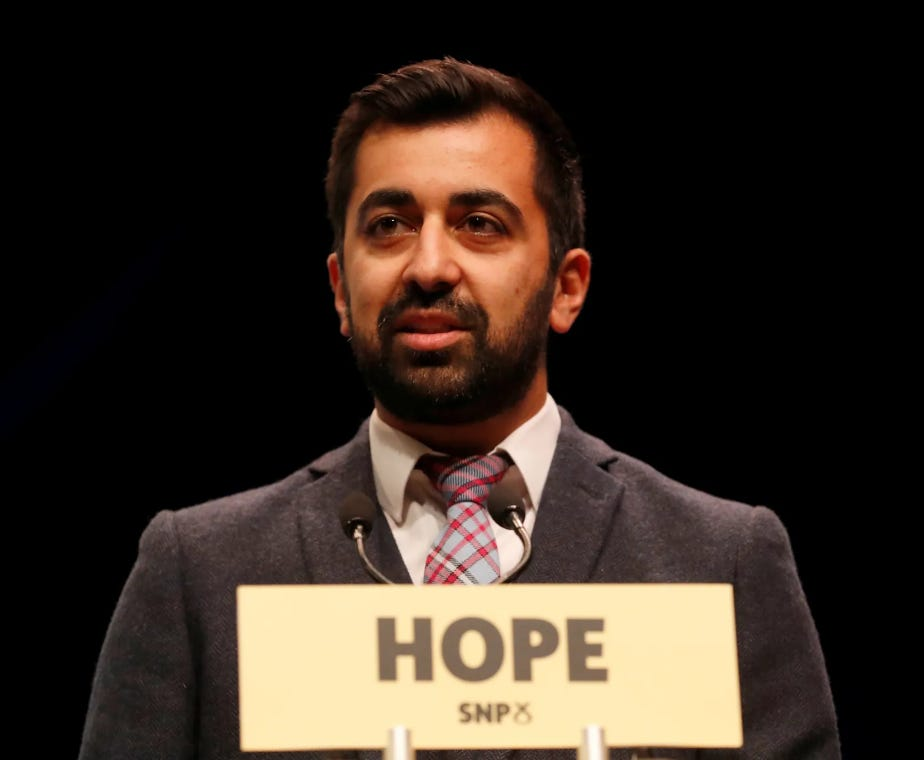
Not what you were hoping for.
Assuming he doesn’t get removed by a leadership coup before voters sink the leaking Tory battleship, Sunak will be gone by January of 2025 at the latest. That just leaves Humza Yousuf, characterized by Morgoth as The Thug King of Scotland: a post-ideological, apolitical opportunist interested purely in power for its own sake and quite happy to use the absurd public morality of the despised rubes that he rules over to keep the wretches in their place.
And boy, does he despise them.
Yousuf first came to the Internet’s attention in 2020, when he was filmed ranting in the Scottish parliament about how disgustingly racist it was that most of the high public offices in a country with an overwhelmingly White population were occupied by presumptively racist White cavebeasts:
The Lord President is white, the Lord Justice Clerk is white, every High Court judge is white, the Lord Advocate is white, the Solicitor General is white, the chief constable is white, every deputy chief constable is white, every assistant chief constable is white, the head of the Law Society is white, the head of the Faculty of Advocates is white and every prison governor is white.
That is not the case only in justice. The chief medical officer is white, the chief nursing officer is white, the chief veterinary officer is white, the chief social work adviser is whiteand almost every trade union in the country is headed by white people. In the Scottish Government, every director general is white. Every chair of every public body is white. That is not good enough.
If you haven’t watched the video, you should. You need to hear the contempt dripping off of his tongue, the way he spits out the awful word “White” like bitter venom.
In the immediate aftermath of this angry foreigner’s tirade, a sane country would have immediately marched their ill-mannered guest out of parliament, stripped him of office and citizenship, thrown him on a rusty fishing vessel, hauled him up north of the Orkneys, tossed him into the North Sea wearing nothing but a life preserver, and sent him on his way with a cheery wave and a reminder to mind the orcas.
Instead, they gave him the keys to the kingdom.
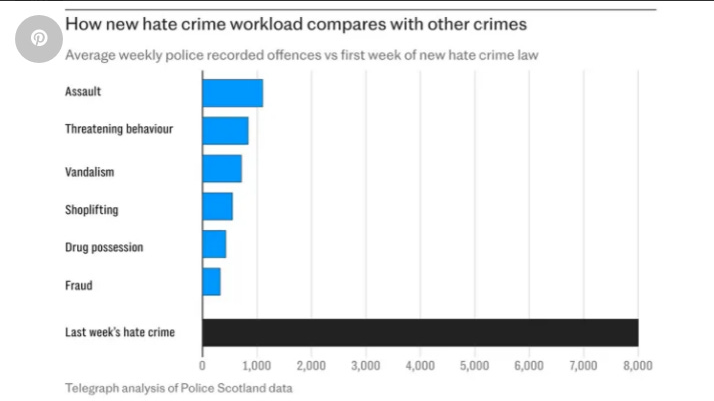
But while the infamous White Speech might not have prevented his elevation to the highest office in the land – indeed, given the derangement of our elites, if anything it smoothed his ascent – it has come back to haunt him. Thin-skinned and insecure as he is, Yousuf’s first priority on taking office was to ram through a new hate speech law with which to prevent the contemptible White worms from critiquing him or his noble tribe of vape-shop owners, cabbies, and grooming gang pimps. The law was ridiculously broad and invasive: one could be reported for the criminal offence of hate speech merely for making a remark in the privacy of one’s home, around the dinner table, with no one present but one’s kith and kin.
The day that the bill was finally forced through the Scottish parliament, and predictably enough for anyone who glanced at the law and had a passing understanding of the Scottish national character, the Scottish people responded by DDoSing the police with a deluge of hate crime reports, a very large number of which were reporting Yousuf’s rant as a hate crime … which, apparently, under the strict interpretation of the new law, it certainly was, with the only thing standing between Yousuf and indictment under his own half-baked law being that his ill-considered harangue took place prior to the law being passed. Which hasn’t stopped the Scots from taking the piss and continuing to report him.
It turns out that the Scots really do not like a ban on bantz, not one bit, and respond to demands that they cease the bantz by cranking up the bantz. Yousuf, being a humourless Pakistani who is confused and angered by this entirely foreseeable reaction, has risen to the occasion with all the grace, poise, and wit you would expect. In an attempt to stem the savage tide of mockery, Yousuf has tried claiming that reporting his hate speech is hate speech (lulz); has ordered Scottish police to read verbatim a prewritten transcript defending him each time his hate speech is thrown back at him (because that doesn’t look ridiculous); and faked a hate crime against himself by having his house sprayed with graffiti (did anyone fall for this?).
The next Scottish general election is two years away. Whether Humza survives the interim as First Minister, and if so whether he is able to guide the “Scottish” “National” Party to victory, remains to be seen. I don’t fancy his chances. He is a cunning and ruthless brute, to be sure. But he is also clumsy, clueless, and very stupid. Yousuf’s popularity has already plummeted. I’m sure he can find ways to plummet further. I believe in you, Yousuf. You can do it!
The Führerbunker – Hitler’s Grave
World War Two
Published 18 Apr 2024The man who once conquered Europe, Adolf Hitler, now cowers underground in the Führerbunker as bombs and artillery rain down on the ruins of the Reich. Today Sparty gives you a tour of the damp and claustrophobic concrete maze that will soon become the dictator’s coffin.
(more…)
Breakfast in Jane Austen’s England
Tasting History with Max Miller
Published Jan 16, 2024What you could tell about someone from their breakfast in Jane Austen’s England, and a recipe for Bath buns as she might have eaten them for her first meal of the day.
Caraway buns topped with glaze, sugar, and caraway, served with butter. Perfect for a Jane Austen inspired breakfast with some hot chocolate
City/Region: England
Time Period: 1769It is a truth universally acknowledged that a person who has recently risen from bed must be in want of breakfast. In Jane Austen’s time, breakfast could be around 8:00 or 9:00 in the morning if you were a manual laborer or servant, or it could be as late as 3:00 or 4:00 in the afternoon if you were upper class.
Jane wrote a letter to her sister Cassandra saying that she wanted to join her on her trip to Bath, but didn’t want to inconvenience their hosts, so she would fill up on bath buns for breakfast. I can see why this would have been a sound strategy. The buns are denser than modern versions, but still soft and very good (they would certainly fill you up). The caraway is present but not overpowering, and they’re sweet but not as sweet as a dessert.
Caraway comfits were candy-coated caraway seeds (think M&Ms), but they don’t use caraway to make them anymore. I mimic them as best I can with caraway seeds and sugar.
To make Bath Cakes.
Rub half a pound of butter into a pound of flour, and one spoonful of good barm, warm some cream, and make it into a light paste, set it to the fire to rise, when you make them up, take four ounces of carraway comfits work part of them in, and strew the rest on the top, make them into a round cake, the size of a French roll, bake them on sheet tins, and send them in hot for breakfast.
— The Experienced English Houskeeper by Elizabeth Raffald, 1769
April 18, 2024
Wagner’s Ring Cycle, summarized
I have to admit that aside from some amazing helicopter music, most of Wagner’s music isn’t my cup of tea drinking horn of mead. As a result, I didn’t know what the whole Ring Cycle was all about and mostly didn’t care. Coming to my rescue, Kulak provides a summary for my fellow non-Wagner fans:
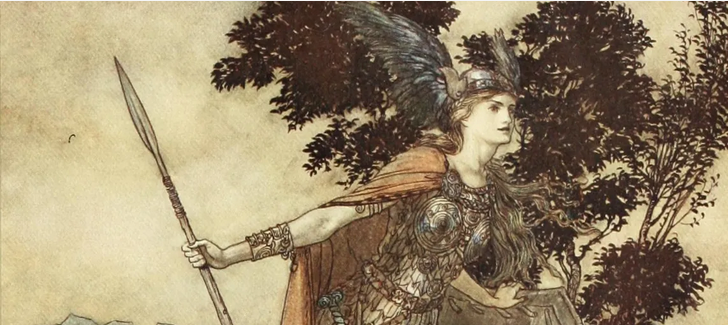
So researching my epic length piece on female warriors, pre-Christian sexual politics, and the unique development of North European culture I got really into Richard Wagner’s Ring Cycle after stumbling on Arthur Rackham’s gorgeous illustrations to the English translations of the text of the operas (Link 1, Link 2).
And one of the things that immediately jumped out to me, even beyond everything listed in the long piece, is how weird and unique the sexual politics of Pagan Germanic culture is.
Sure it’s Wagner, it’s not a primary source. It’s a 19th century romantic composer interpreting several different legends of pagan era Germany and Scandinavia, as record by Christian monks and scholars 100s of years after the fact. So academically not the most accurate thing to draw conclusions from, however if you subscribe to any blood memory, or spirit of a people, or eternal culture theory … it’s almost better.
This is the version of the tale that’s survived and been refined across first oral, then written traditions, then preserved by Christian monks, then revived by high Victorian romantics into one of the most celebrate and popular operas of all time. If there’s anything we could learn about the eternal character of North European women, sexuality, and sexual politics (and by extension modern sexual politics, we’re all North Europeans now) it is here.
And damned … what a datapoint.
What follows is a MeToo story on hyperborean crack.
The Female lead Brunhilde starts out as a Valkyrie who disobeys her master/father the god Wotan (Odin) in a matter of divine importance so as to save a mortal man. For her disobedience Wotan strips her of her divine nature and curses her to sleep on the earth as a mortal woman until such a time as the first man to find her wakes her, then she is to be his wife. However, taking pity Wotan lays out an magical wall of fire to guard her so no coward, only a great hero, would ever succeed. (end opera 1/3).
20-ish years later Siegfried, the son of the man Brunhilde saved, finds her (she hasn’t aged a day), and perfectly fearless he braves the fire to wake her, where-upon they fall in love (end opera 2/3)… then taking leave for more adventure Siegfried takes off promising to return and remember their. Where-upon he meets the King Gunther and his sister Gutrune, who seduces Siegfried and makes him forget Brunhilde. Making friends with Gunther, Siegfried conspires with him that he should have Brunhilde for a wife (given she’s the best woman he can think of for his friend), but there’s a problem … Gunther cannot brave the fire, he’s not fearless like Siegfried. So Siegfried, conspires to impersonate Gunther using his magic, brave the fire again, seduce Brunilde again, get her to consent to marry him in the Guise of Gunther, spend the night using his sword to divide himself from Brunhilde. Then in the morning swap back, Siegfried Married to Gutrune, Gunther to Brunhilde … The plan worked perfectly.
Then Brunhilde found out.
Learning what had been done she conspires with Siegfried’s enemies to have him killed, falsely accuses him of rape, and successfully maneuvers him into admitting to lying in an oath he wasn’t even aware was a lie … so that his fearless perfect life can end with a stab in the back.
So you may ask: Having avenged herself does she settle-down with her husband?
Hell no! You think you could fill the shoes of Siegfried you curr, you coward, you beta-cuck?! You will NEVER be Siegfried.
Instead she gives the mother of all angry speeches denounces Gertrude and everyone else of the court to their face, and then rides Siegfried’s horse onto his funeral pyre, determined it is better to die with Chad than live with Brad.
THE END.
Of the entire opera cycle. No more.
The Fat Lady has sung.
Your 4 day trip into the German mountains to experience 3 1/2 Operas over as many days and a combined 15 hours has concluded. Go Home.
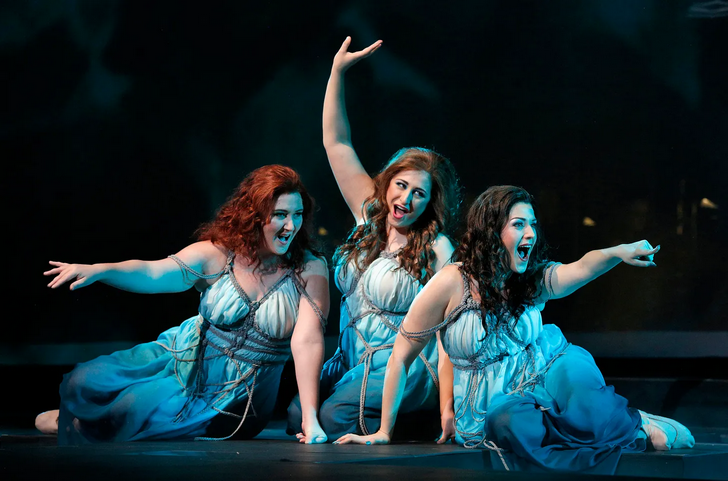
Rhinemaidens, Minnesota Opera production of Das Rheingold
I’m Sorry bros, the hoes have always been like this.
Even in the mythical past of high Germanic mythology … the hoes were like this.
What to do if Romans Sack your City
toldinstone
Published Jan 12, 2024Chapters:
0:00 Introduction
0:34 Progress of a siege
1:55 Looting and violence
3:42 Recorded atrocities
4:45 Captives
5:27 BetterHelp
6:36 Surviving a Roman sack
7:13 Where to hide
8:27 What to do if you’re captured
9:20 Advice for women
10:09 The fate of captives
(more…)
April 17, 2024
Soviet Berlin Offensive Begins – WW2 – Week 294B – April 16, 1945
World War Two
Published 16 Apr 2024The final Soviet assault on Berlin begins today. The Soviets have two million men supported by tens of thousands of guns, tanks, and aircraft. Opposite them stand millions of men and boys of the German Wehrmacht, Waffen SS, Volkssturm, and Hitler Youth. The forces of Nazism are weakened and disorganised but determined to fight on as long as possible.
00:41 Roosevelt’s death
03:09 Preparations for the Soviet drive on Berlin
08:49 Zhukov’s Offensive
12:48 Konev’s Offensive
14:57 Summary & Conclusion
(more…)
Pay no attention to what “tax me more” folks say – instead watch what they do
One way for an a wealthy person to get a lot of free media attention is to performatively declare that they should be paying more taxes. This ostentatious virtue-signalling is frequent enough that Tim Worstall has been writing the occasional article about it for quite some time:

For there is this:
Public donations to pay off the national debt have hit their highest level in at least a decade amid growing concern about the UK’s soaring debt mountain.
Members of the public handed almost £700,000 over to the Government through six individual bequests and donations last year, according to Debt Management Office (DMO) figures obtained via a Freedom of Information request.
The amount for the 2023-24 financial year was the highest in at least a decade, with the biggest single payment to help pay off Britain’s £2.65 trillion debt pile coming from a £500,000 bequest, according to the DMO, which did not provide names of individual donors.
One way to think of this — an entirely correct way to think of it too — is that an entire 6 people last year thought that inheritance tax was too low. Which, out of the about 600k deaths (not looked it up but that’s right order of magnitude, it’s not 6 million and it’s not 60k) is not actually a lot. 0.001% in fact.
One of the grand insistences of economics is that watching what people do gives more information about their true beliefs than listening to what they say – revealed preferences, not expressed. So, by what people actually do we have 0.001% of the people leaving estates of any size whatever who think that the tax on estates is too small. This is not a large majority in favour of higher taxes upon estates being left.
But back to the far more important subject, me.
As far as the UK is concerned I did start this off. The reporting on how much people voluntarily leave to the government. Who pays extra that is – who makes a voluntary donation to government. Back in 2006 in fact, back in the depths of the Brown Terror:
LAST YEAR there were five people in Britain who thought that their taxes were too low. No, this isn’t the number of people who have called for higher taxes. Rather, it is those who were so convinced of the righteousness of state spending that they voluntarily sent extra money to the Treasury.
The Americans have been doing this since 1843. It’s always been possible to pay extra to HM Treasury — Stanley Baldwin actually handed over one fifth of his estate while he was still alive. Admittedly, he was Financial Secretary to the Treasury at the time and was asking for donations to aid in paying down war debt but still, props for money where mouth is.
Cheques, by the way, should be made out to “The Accountant, HM Treasury”, and sent to 1 Horse Guards Road, London SW1A 2HQ. A 2nd-class stamp is sufficient and you are encouraged to add a covering note so that your donation is spent in the way you like.
I wrote that piece for The Times simply because I thought it would be a cute thing to do — and I wanted the £200 that went with writing it. As ever with freelance journalism, my money is important.
I also know that that was the first piece that appeared in UK journalism on this point. For when I asked the Treasury they’d no idea at all how many had in fact paid extra. Took them months to find out too. The donations had happened before, but no one had been writing about it. At least, not since Baldwin’s generation.
His Majesty King Charles, in right of Canada, would also be happy to accept any unwanted sums of money above your mandatory tax rate here. Go wild, wealthy and patriotic Canadian multi-millionaires!


