
World War Two
Published 4 May 2024So much goes on this week, and this is the longest episode of the war by like 15 minutes. But there’s so much to cover! The Battle of Berlin ends; the war in Italy ends; the war in Burma ends- well, it ends officially, though there are still tens of thousands of Japanese soldiers scattered around Burma. And there’s a whole lot more to these stores and a whole lot more stories this week in the war. You can’t miss this one.
01:27 The End of the War in Italy
03:40 Western Allied Advances
07:02 Relief Operations in the Netherlands
15:45 Hitler’s Death and the Surrender of Berlin
24:20 Walther Wenck’s Retreat
28:00 The Polish Situation
31:09 What About Prague?
32:44 The End of the Burma Campaign
36:04 THE FIGHT FOR TARAKAN ISLAND BEGINS
37:24 Okinawa
40:11 Other Notes
41:04 Summary
41:43 Conclusion
(more…)
May 5, 2024
Allied Victory in Berlin, Italy, and Burma! – WW2 – Week 297 – May 4, 1945
M98kF1 ZF41: Norway Recycles Germany’s Worst Sniper Rifle
Forgotten Weapons
Published Jan 29, 2024When Germany capitulated at the end of World War Two, several hundred thousand German soldiers were stuck in Norway (thanks to the efforts of the Norwegian Resistance preventing them from moving south to reinforce against Allied landings in Normandy). These solders’ arms were surrendered to the Norwegians, and they formed the basis of Norwegian Army and Home Guard armaments for many years. With hundreds of thousands of K98k rifles to choose from, the Norwegians were able to pick out plenty in good condition. This included 400 ZF41 DMR/sniper rifles that were kept intact and taken into Norwegian service. Three different branches used the rifles, and they are marked on the chamber with either HAER (Army), FLY (Air Force), or K.ART (Naval Artillery).
In 1950, Norway began to get US military aid in .30-06, and they decided to rebarrel these Mausers to that cartridge. The process began in 1952 and they were all converted by the end of 1956. The new barrels are marked “KAL 7.62”, for 7.62x63mm. There was only a small amount of experimental further conversion to 7.62mm NATO. The ZF-41 models like this one were also given a new serial number tag riveted onto the scope mount with the rifle’s serial number (150001 through 150400).
Converted Mausers served in the Home Guard until the early 1970s, when they were replaced by the AG3 (HK91).
(more…)
May 3, 2024
The History of Half-tracks, by the Chieftain
World War Two
Published 2 May 2024Is it a tank? Is it a truck? No, it’s a half-track! Nicholas Moran aka “The Chieftain” stops by to cover this Frankenstein of a vehicle. He looks at their origins at the turn of the twentieth century, their heyday as troop transporting, artillery towing, flak gunning, jacks-of-all-trades during the war, and their sudden decline after the war.
(more…)
QotD: Colonialism in the ancient Mediterranean
We should start with a basic understanding of who we are talking about here, where they are coming from and the areas they are settling in. First we have our Greeks, who I am sure that most of our readers are generally familiar with. They don’t call themselves Greeks – it is the Romans who do (Latin: graeci); by the classical period they call themselves Hellenes (Έλληνες), a term that appears in the Iliad but once (Homer prefers Ἀχαιοί and Δαναοί, “Achaeans” and “Danaans”). That’s relevant because a lot of the apparent awareness of the Greeks (or more correctly, the Hellenes) as a distinct group, united by language and culture against other groups, belongs to late Archaic and early Classical and the phenomenon we’re going to look at begins during the Greek Dark Age (1100-800) and crests in the Archaic (800-480).
Greek settlement in the late Bronze Age (c. 1500-1100) was focused on the Greek mainland, though we have Greek (“Mycenean”) settlements on the Aegean islands (and Crete) and footholds on the west coast of Asia Minor (modern Turkey). Over the Dark Age – a period where our evidence is very poor indeed, so we cannot see very clearly – the area of Greek-speaking settlement in the Aegean expands and Greek settlements along that West coast of Asia Minor expand dramatically. Our ancient sources preserve legends about how these Greeks (particularly the Ionians, inhabiting the central part of that coastal strip) got there, having been supposedly expelled from Achaia on the northern side of the Peloponnese, but it’s unclear how seriously we should take those legends. But the key point here is that the outward motion of Greeks from mainland Greece proper begins quite early (c. 1100) and is initially local and probably not as organized as the subsequent second phase beginning in the 8th century, which is going to be our focus here.
Our other group are the Phoenicians. They did not call themselves that either; it derives from the Greeks who called them Phoinices (φοίνικες), which like the Roman Poeni may have had its roots in Egyptian fnḫw or perhaps Israelite Ponim.1 In any case, the word is old, as it appears in Linear B tablets dating to the Mycenean period (that 1500-1100 period). The Phoenicians themselves, if asked to call themselves something, would more likely have said Canaans, Kn’nm, though much like the Greeks tended to be Athenians, Spartans, Thebans and so on first, the Phoenicians tended to be Sidonians, Tyrians and so on first. They spoke a Semitic language which we call Phoenician (closely related to Biblical Hebrew) and they invented the alphabet to represent it; this alphabet was copied by the Greeks to represent their language, who were in turn copied by the Romans to represent their language, whose alphabet in turn was adopted by subsequent Europeans to represent their languages – which is the alphabet which I am writing with to you now.
Since at least the late bronze age, they lived in a series of city states on the eastern edge of the Mediterranean in Phoenicia in the Levant in what today would mostly be Lebanon. During the late bronze age, this was the great field of contested influence between the Hittite, (Middle) Assyrian and (New Kingdom) Egyptian Empires. The Late Bronze Age Collapse removed those external influences, leading to a quick recovery from the collapse and then efflorescence in the region. They had many cities, but the most important by this point are Sidon and Tyre; by the 9th century, Tyre emerged as chief over Sidon and may at times have controlled it directly, but this was short lived as the whole region came under the control of the (Neo)Assyrian Empire in 858. The Assyrians demanded heavy tribute (which may contribute to colonization, discussed below) but only vassalized rather than annexed Tyre, Byblos and Sidon, the three largest Phoenician cities.
Both the Greeks and the Phoenicians have one thing in common at the start, which is that these are societies oriented towards the sea. Their initial area of settlement is coastal and both groups were significant sea-faring societies even during the late Bronze Age and remained so by the Archaic period. Both regions, while not resource poor (Phoenicia was famous for its timber, Lebanese cedar), are not resource rich either, particularly in agricultural resources. Compared to the fertility of Mesopotamia, Egypt or even Italy, these were drier, more marginal places, which may go some distance to explaining why both societies ended up oriented towards the sea: it was there and they could use the opportunities.
Bret Devereaux, “Collections: Ancient Greek and Phoenician Colonization”, A Collection of Unmitigated Pedantry, 2023-10-13.
1. The former is what I’ve found in dictionary entries for etymologies, the latter is what Dexter Hoyos suggests, Carthaginians (2010), 1. I am not an expert on Semitic languages, linguistics or etymologies, so don’t ask me to decide between them.
May 2, 2024
When Malcolm Muggeridge investigated P.G. Wodehouse for MI6
Alan Ashworth explains the circumstances under which the great P.G. Wodehouse became the subject of an MI6 (Britain’s Secret Intelligence Service) treason investigation near the end of the Second World War:
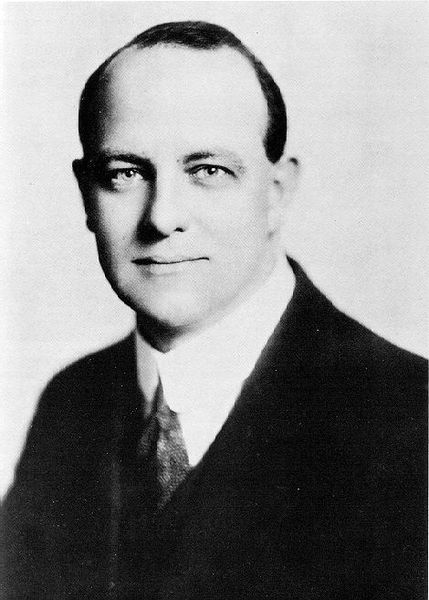
P.G. Wodehouse, circa 1904.
The American Legion Weekly, 24 October, 1919 via Wikimedia Commons.
[Malcolm Muggeridge:] “I first made Wodehouse’s acquaintance in circumstances which might have been expected to shake even his equanimity. This was in Paris just after the withdrawal of the German occupation forces. As Wodehouse well understood, the matter of his five broadcasts from Berlin would now have to be explained; and in the atmosphere of hysteria that war inevitably generates, the consequences might be very serious indeed. It would have been natural for him to be shaken, pale, nervous; on the contrary I found him calm and cheerful. I thought then, and think now more forcibly than ever, that this was due not so much to a clear conscience as to a state of innocence which mysteriously has survived in him.”
Muggeridge explains that he was attached to an MI6 contingent and a colleague “mentioned to me casually that he had received a short list of so-called traitors who cases needed to be investigated, one of the names being PG Wodehouse”. Muggeridge readily agreed to take on the case, “partly out of curiosity and partly from a feeling that no one who had made as elegant and original a contribution to the general gaiety of living should be allowed to get caught up in the larger buffooneries of war”. He duly visited Wodehouse at his hotel that same evening and the author described what had happened to him from the collapse in 1940 of France, where he was living with his wife Ethel, to his internment at a former lunatic asylum in Tost, Poland.
“The normal wartime procedure is to release civilian internees when they are sixty. Wodehouse was released some months before his sixtieth birthday as a result of well-meant representations by American friends – some resident in Berlin, America not being then at war with Germany. He made for Berlin, where his wife was awaiting him. The Berlin representative of the Columbia Broadcasting System asked him if he would like to broadcast to his American readers about his internment and foolishly he agreed, not realising the broadcasts would have to go over the German network and were bound to be exploited in the interest of Nazi propaganda.” [Here are German transcripts of the offending items.]
Muggeridge goes on: “It has been alleged that there was a bargain whereby Wodehouse agreed to broadcast in return for being released from Tost. This has frequently been denied and is, in fact, quite untrue but nonetheless still widely believed.”
Wodehouse came under virulent attack, particularly from Cassandra, the Daily Mirror columnist William Connor, who denounced him as a traitor to his country. Public libraries banned his books. Wodehouse wrote to the Home Secretary admitting he had been “criminally foolish” but said the broadcasts were “purely comic” and designed to show Americans a group of interned Englishmen keeping up their spirits. But the damage was done and the stigma stuck. After the war he spent the rest of his life in America.
In words that resonate half a century after their publication, Muggeridge says: “Lies, particularly in an age of mass communication, have much greater staying power than the truth.
“In the broadcasts there is not one phrase or word which can possibly be regarded as treasonable. Ironically enough, they were subsequently used at an American political warfare school as an example of how anti-German propaganda could subtly be put across by a skilful writer in the form of seemingly innocuous, light-hearted descriptive material. The fact is that Wodehouse is ill-fitted to live in an age of ideological conflict. He just does not react to human beings in that sort of way and never seems to hate anyone – not even old friends who turned on him. Of the various indignities heaped upon him at the time of his disgrace, the only one he really grieved over was being expunged from some alleged roll of honour at his old school, Dulwich.”
[…]
Muggeridge records that, when the war ended, the Wodehouses left France for America. “Ethel has been back to England several times but Wodehouse never, though he is always theoretically planning to come. I doubt if he ever will [he didn’t, dying in 1975 at the age of 93]. His attitude is like that of a man who has parted, in painful circumstances, from someone he loves and whom he both longs for and dreads to see again.”
May 1, 2024
The Death of Adolf Hitler – WW2 – Week 296B – April 30, 1945
World War Two
Published 30 Apr 2024Europe is broken, its cities in ruins, and millions have died in war and genocide. The world has risen against the Nazi threat, and now the Nazi leader cowers in his bunker under Berlin — this is how Adolf Hitler’s last 15 weeks unfold, and why he ultimately chooses suicide to escape responsibility for his actions.
Watch the Führerbunker special here:
Lobscouse, Hardtack & Navy Sea Cooks
Tasting History with Max Miller
Published Jan 23, 2024Hearty meat and potato stew thickened with crushed hardtack (clack clack)
April 30, 2024
TikTok for Tots (and Instagram, and Facebook, and Twitter, and …)
Ted Gioia has some rather alarming information on just how many kids are spending a lot of time online from a very early age:
The leader in this movement is TikTok. But the other major platforms (Instagram, Twitter, Facebook, YouTube, etc.) are imitating its fast-paced video reels.
My articles have stirred up discussion and debate—especially about the impact of slot machine-ish social media platforms on youngsters.
So I decided to dig into the available data on children and social media. And it was even worse than I feared.
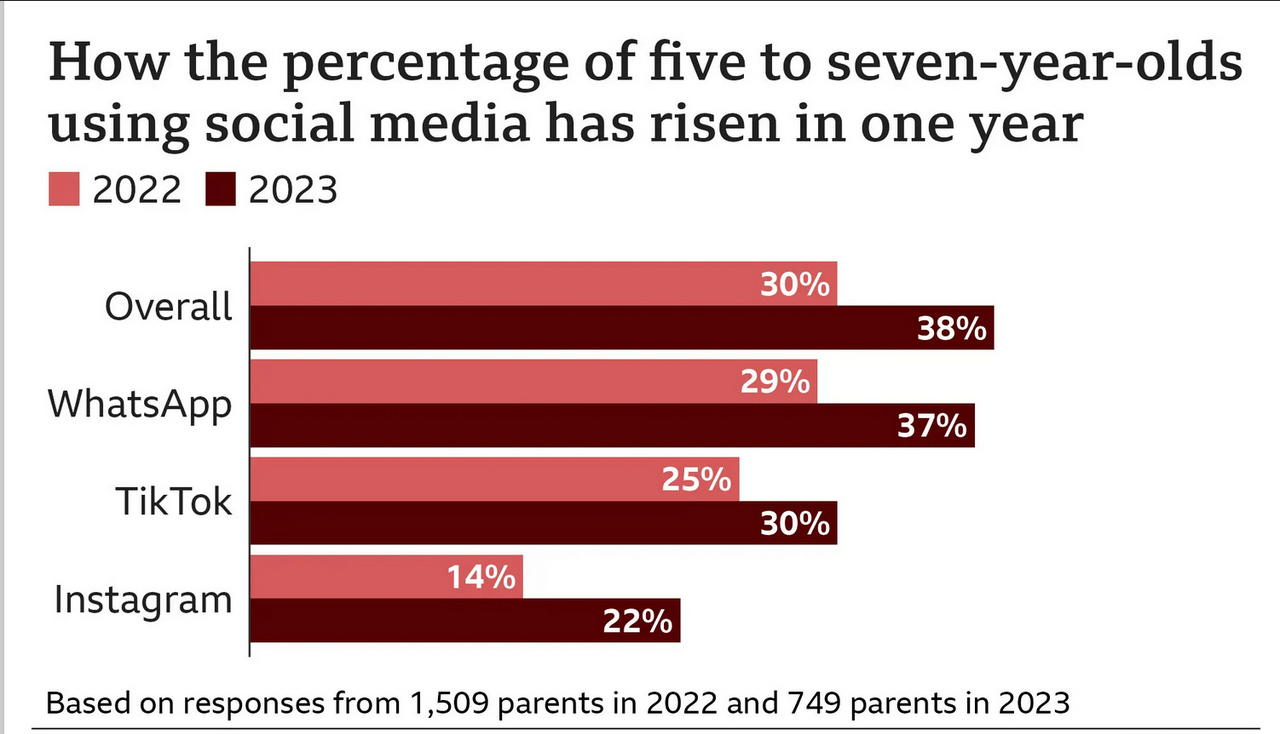
30% of children ages 5 through 7 are using TikTok — despite the platform’s policy that you can’t sign up until age 13.
The story gets worse. The numbers are rising rapidly — usage among this vulnerable group jumped 5% in just one year.
By the way, almost a quarter of children in this demographic have a smartphone. More than three-quarters use a tablet computer.
These figures come from Ofcom, a UK-based regulatory group. I’ll let you decide how applicable they are to other countries. My hunch is that the situation in the US is even worse, but that’s just an educated guess based on having lived in both countries.
What happened in 2010?
One thing is certain — the mental health of youths in both the US and UK is deteriorating rapidly. There are dozens of ways of measuring the crisis, but they all tell the same tragic story.
Something happened around 2010, and it’s destroying millions of lives. […]
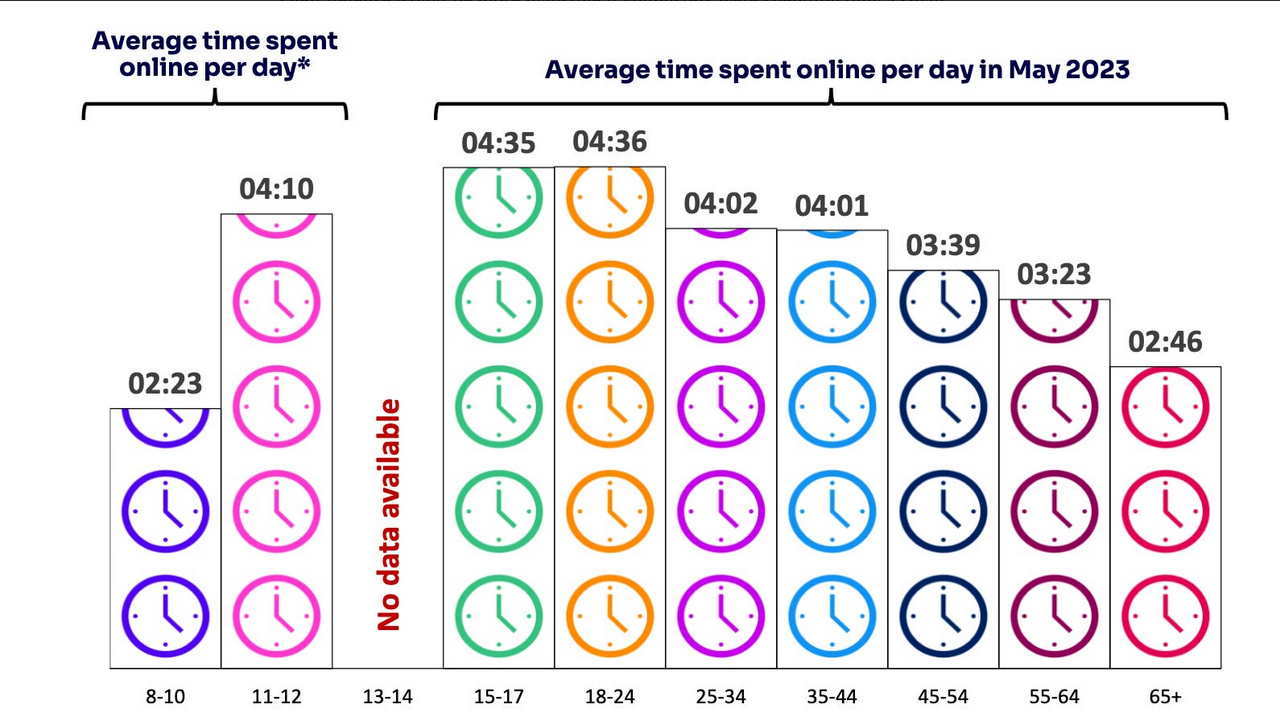
As early as age 11, children are spending more than four hours per day online.
Here’s a comparison of time spent online by age. Even before they reach their teens, youngsters are spending more than four hours per day staring into a screen.
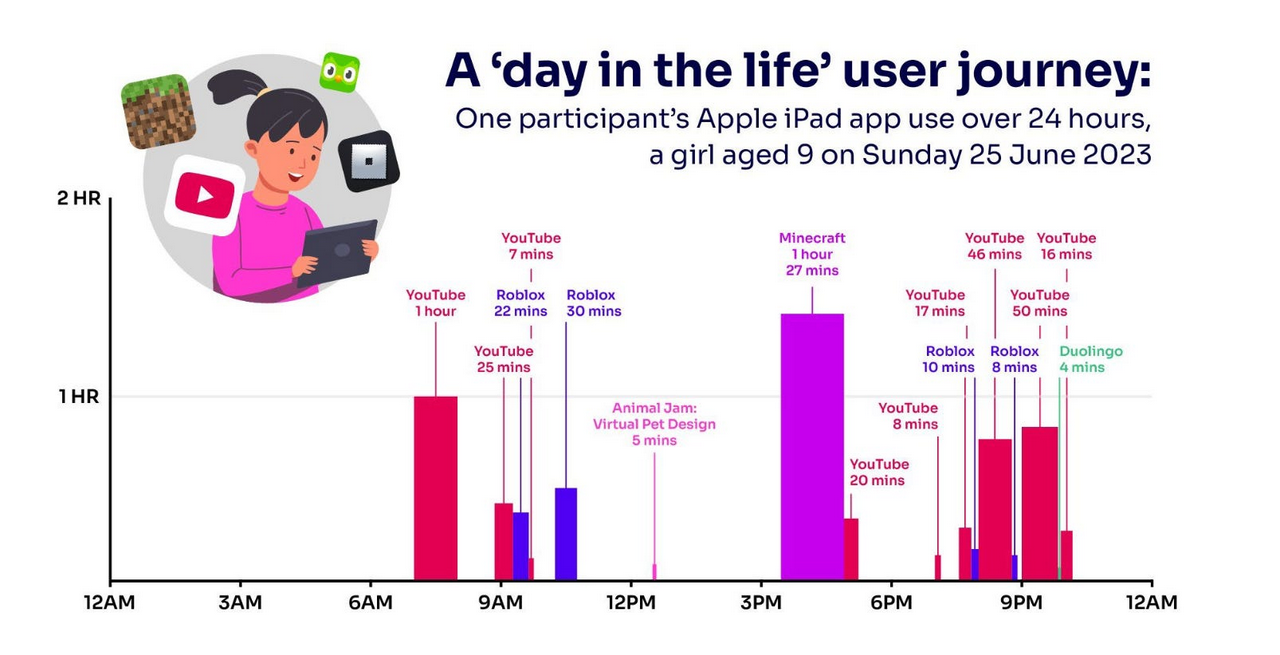
Here’s what a day in the digital life of a typical 9-year-old girl looks like.
I don’t find any of this amusing. But if you’re looking for dark humor, I’ll point to the four minutes spent on the Duolingo language training app at the end of the day. This provides an indicator of the relative role of learning in the digital regimen on the rising generation.
The CDU’s “five-point plan to protect German democracy from … the free and open internet”
German mainstream politicians are struggling to keep extreme right populist anti-democratic voices from being heard by innocent and trusting German voters, so the leader of the CDU in Thuringia has a master plan:

The duel between our leading Thuringian politicians was all but unwatchable, as indeed almost all political debates turn out to be. While [AfD leader Björn] Höcke could’ve acquitted himself better, [CDU leader Mario] Voigt’s performance was flat, uninspired and profoundly banal. Among other things, the man suffers from a peculiar rodentine aspect; he bites his way stiffly through bland preformulated arguments like a squirrel chewing a stale nut or a beaver gnawing through saplings. After the event, the CDU took to the press to declare victory, but polls showed that viewers found Höcke on balance more persuasive, which is of course the real reason that everybody told Voigt to avoid the confrontation. Voigt is intensely democratic and therefore extremely right about everything, but somehow – and this is very awkward to discuss – his being eminently righteous and correct in all things does not manifest in an ability to defeat the very wrong and evil arguments of his opponents. It’s very weird how that works, perhaps somebody should look into it.
Stung by this failure, Voigt has set off to find other means of defending democracy. This week, in the Thüringen state parliament, he gave an amazing speech outlining a five-point plan to protect German democracy from that other great menace, the free and open internet:
So how do we protect democracy in the area of social media? There are five approaches:
Ideally, we should agree to ban bots and to make the use of fake profiles a criminal offence.
There is also the matter of requiring people to use their real names, because freedom of expression should not be hidden behind pseudonyms.
Then there’s the question of whether we should create revocable social media licences for every user, so that dangerous people have no place online.
We need to consider how we can regulate algorithms so that we can revitalise the diversity of opinions in social networks.
And we also have to improve media skills.
For all that Björn Höcke is supposed to be a “populist authoritarian” opposed to representative government, I’ve never heard him say anything this crazy. Voigt, meanwhile, is a leading politician for the officially “democratic” Christian Democratic Union (you know they are democratic because the word is in their name), and he’s actually dreaming of requiring Germans to obtain state-issued licenses for permission to post their thoughts to the internet.
Because Voigt’s regulatory regime would entirely abolish online “freedom of expression”, it is unclear how banning bots and pseudonymity could ever defend it. Generally speaking, for a thing to be defended, it must first exist. Equally curious is Voigt’s belief that any “diversity of opinion” will survive his social media license scheme to benefit from the regulation of social media algorithms.
QotD: The ambitious Roman’s path to glory and riches
At no point, however, did the putative justification for war come into play. Picking a war with the Parthians wasn’t bad in itself. Nor was “picking a war with the Parthians because you gots to get paid”. Certainly picking a war with, say, the Gauls wasn’t bad in itself, and “picking a war with the Gauls because I need to capture and sell a few thousand slaves to cover my debts” was so far from being bad, guys like Caesar, if I recall my Gallic Wars correctly, openly declared it from jump street. And though Caesar surely would’ve been prosecuted if he’d lost, and Crassus if he’d lived, suggesting that anyone owed an apology to the Gauls or Parthians would’ve gotten you locked up as a dangerous lunatic.
A confident, manly power might lose a war or two. Hell, they might lose a bunch — the Romans got beat all the time, and so did the British. But no matter how bad the loss, or how embarrassing the peace treaty, they shrugged it off. You win some, you lose some, and when it’s clear you’re going to lose — or when it becomes clear that there’s no possible way “victory” will ever be worth the cost — you cut your losses and came home. HM forces, for instance, lost no less than three wars in Afghanistan. And so what? Great Britain was still the world’s preeminent power. They never even dreamed of apologizing — that’s the Great Game, old sock.
Severian, “Friday Mailbag / Grab Bag”, Rotten Chestnuts, 2021-07-23.
April 29, 2024
“The disaster at Imphal was perhaps the worst of its kind yet chronicled in the annals of war”
Dr. Robert Lyman makes the case for the Japanese defeat at the battles of Imphal and Kohima being one of the four great turning points in the Second World War:
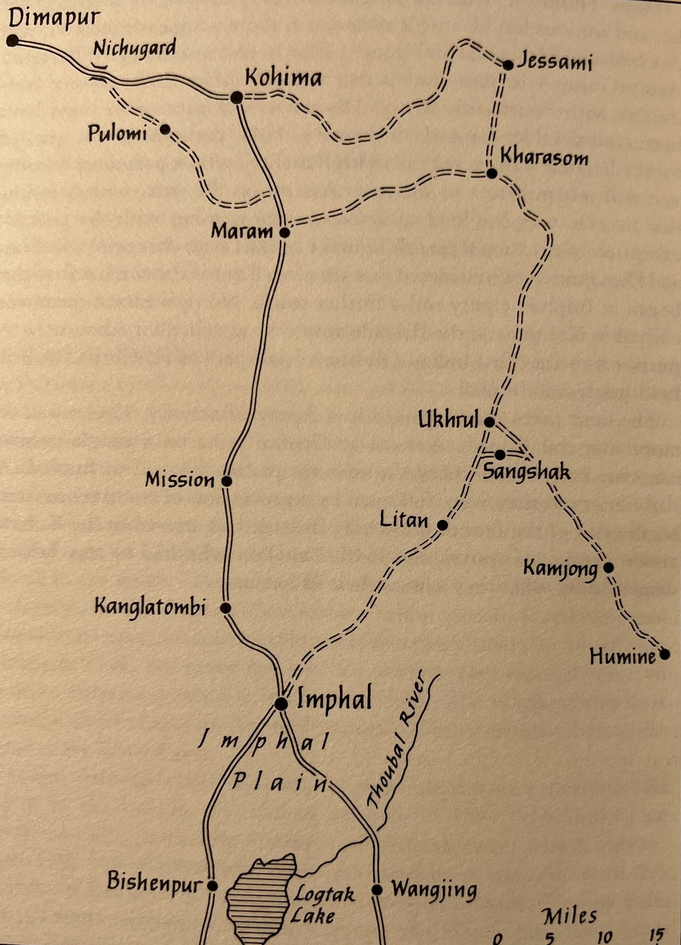
It is clear to me that the great twin battle of Imphal & Kohima, which raged from March through to late July 1944, was one of four great turning-point battles in the Second World War, when the tide of war changed irreversibly and dramatically against those who initially held the upper hand.
The first great turning point was arguably at Midway in June 1942 when the US Navy successfully challenged Japanese dominance in the Pacific. The second was at Stalingrad between August 1942 and January 1943 when the seemingly unstoppable German juggernaut in the Soviet Union was finally halted in the winter bloodbath of that city, where only 94,000 of the original 300,000 German, Rumanian and Hungarian troops survived. The third was at El Alamein in October 1942 when the British Commonwealth triumphed against Rommel’s Afrika Korps in North Africa and began the process that led to the German surrender in Tunisia in May 1943. The fourth was this battle, that at Kohima and Imphal between March and July 1944 when the Japanese “March on Delhi” was brought to nothing at a huge cost in human life, and the start of their retreat from Asia began. Adjectives such as “climactic” and “titanic”, struggle to give proper impact to the reality and extent of the terrible war that raged across the jungle-clad hills during these fearsome months.
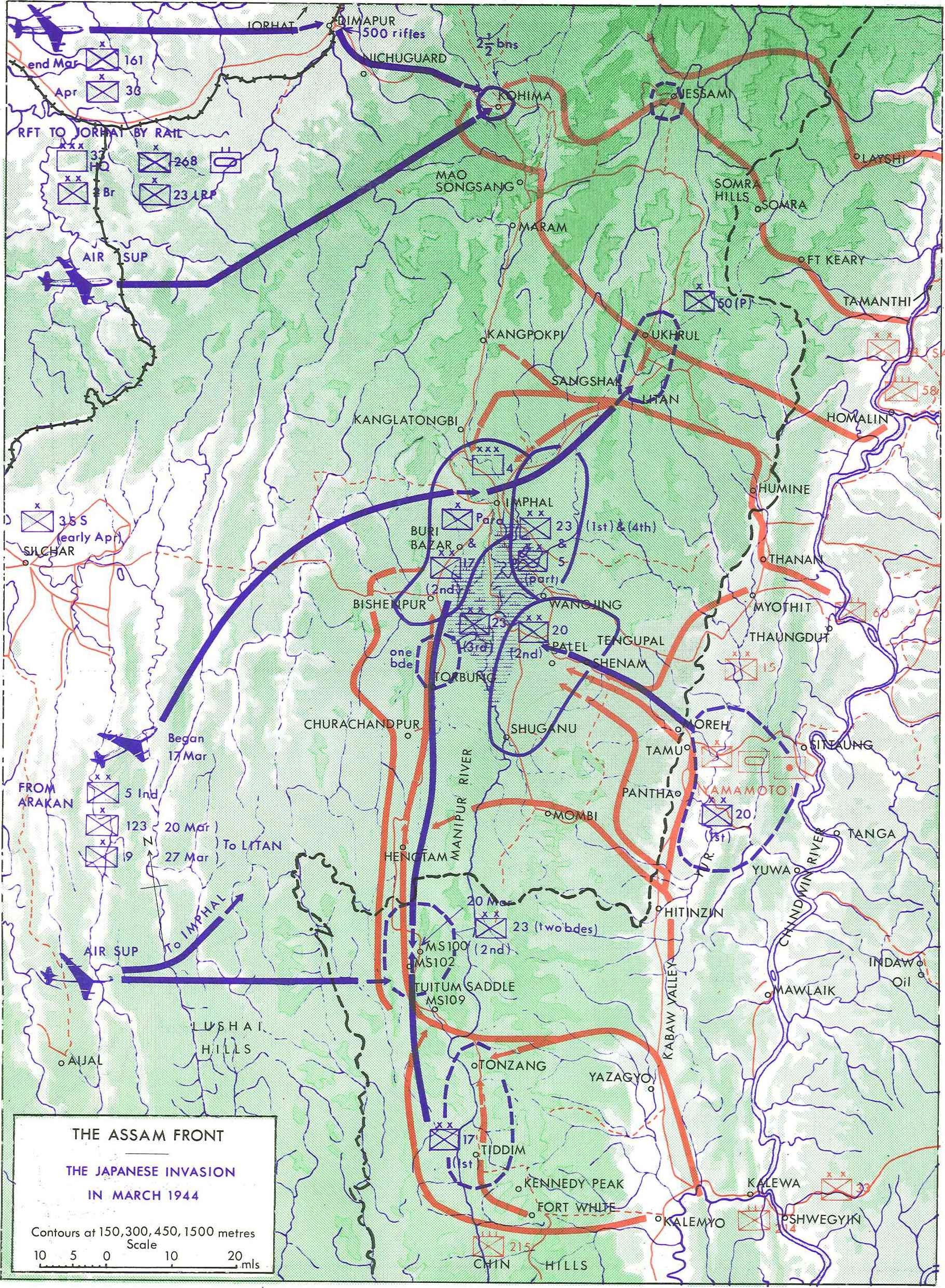
That the Japanese were contemplating an offensive against India in early 1944 was a surprise to Allied planners, who had given no thought to its possibility. By this time Japan had reached the apogee of its power, having extended the violent reach of its Empire across much of Asia since it launched its first surprise attacks in late 1941. Its initial surge in 1942 into what was briefly to be Japan’s “Greater East Asia Co-Prosperity Sphere” was as dramatic as it was rapid and two years further on several millions of peoples across Asia laboured under its heavy yoke. But by early 1944 the tide had turned decisively in the Pacific, the American island-hopping advance reaching steadily but surely towards Japan itself, its humiliated enemies fighting back with desperation, and with every ounce of energy they could muster. They were beginning to prevail in the fight although the struggle on the landmass of Asia was a strategic sideshow in the context of a global conflict: at this time the British and American High Commands were totally occupied with Europe and the Pacific. The British and Americans were preparing for D Day. The Soviets were advancing in Ukraine. There was a stalemate in Italy at Monte Cassino. The Americans were preparing to land in the Philippines. Germany and Japan were both in retreat, but not defeated. In this global context India and Burma appeared strategically peripheral, even inconsequential. Yet in this month, at a time when on every other front the Japanese were on the strategic defensive, Japan launched a vast, audacious offensive deep into India in an attack designed to destroy for ever Britain’s ability to challenge Japan’s hegemony in Burma.
The Japanese commander was General Mutaguchi Renya, a gutsy go-getter who had played a significant role in the collapse of Singapore in February 1942. His evaluation of the British position in northeast India revealed that the three key strategic targets in Assam and Manipur were Imphal; the mountain town of Kohima, and the huge supply base further back on the edge of the Brahmaputra Valley at Dimapur. If Kohima were captured, Imphal would be cut off from the rest of India by land. From the outset Mutaguchi believed that with a good wind Dimapur, in addition to Kohima, could and should be secured. He reasoned that capturing this massive depot would be a devastating, possibly terminal blow to the British ability to defend Imphal, supply the Americans in Northern Burma under Vinegar Joe Stilwell, support the Hump airlift into China and mount an offensive into Burma. It would also enable him to feed his own, conquering army, which would advance across the mountains from the Chindwin on the tightest imaginable supply chain. With Dimapur captured, the Japanese-led Indian National Army under the Bengali nationalist Subhas Chandra Bose could pour into Bengal, initiating the long-awaited anti-British uprising.
(Click to enlarge)
The essence of the battle for India in 1944 can be quickly told. Mutaguchi’s 15th Army advanced in four separate columns into Manipur. The Japanese made determined, even desperate, efforts to seize their objectives: in the north Kohima, with a scratch British and Indian garrison of 1,200 trained fighting soldiers – about two thirds of them Indian – was attacked by an entire division of about 15,000 men in early April. Surrounded and slowly forced back onto a single hill they were supplied by air until relief came on 20 April, although the battle to dislodge the Japanese from Kohima continued bloodily, in appalling weather and battlefield conditions – the annual monsoon was in full spate – through to early June. Further south the Japanese plan entailed attacking Imphal from north, east and south. The plan of the commander of the 14th Army, Lieutenant General Bill Slim, was to withdraw his forces into the hills and there to allow the Japanese to expend themselves fruitlessly against well-supplied and aggressive British bastions, equipped with tanks, artillery and supported by air. The battle for Imphal in Manipur and for Kohima to the north-west in the neighbouring Naga Hills settled down to a bloody hand-to-hand struggle as the Japanese tried to gain the foothold necessary for their survival. They travelled lightly, and reserves soon exhausted themselves and further supplies were almost non-existent. Just as the air situation was becoming critical for Slim through poor weather and shortages of aircraft the relieving division from Kohima – the British 2nd Infantry Division that had last seen action at Dunkirk – began fighting its way towards Imphal, and the four beleaguered divisions began to push out from the Imphal pocket. By 22 June the 2nd Division and the 5th Indian Division met north of Imphal and the road to the plain was open. Four weeks later the Japanese withdrawal to Burma began.
Of all the invading armies of history, it is hard to think of one that was repulsed more decisively, or more ignominiously, than the Japanese 15th Army launched against India in March 1944. Its defeat was not the fault of the Japanese soldiers, who fought courageously, tenaciously and fiercely, but of their commanders, who sacrificed the lives of their troops on the altar of their own hubris. The battle had provided the largest, most prolonged and most intense engagement with a Japanese army yet seen in the war. “It is the most important defeat the Japs have ever suffered in their military career” wrote Mountbatten exultantly to his wife on 22nd June 1944, “because the numbers involved are so much greater than any Pacific Island operation.” The extent of the disaster that befell the 15th Army is captured by a comment by Kase Toshikazu, a member of the wartime Japanese Foreign Office, who lamented: “Most of this force perished in battle or later of starvation. The disaster at Imphal was perhaps the worst of its kind yet chronicled in the annals of war.” The latter might better have included the caveat “Japanese” to avoid charges of exaggeration, but his comment captures something of the enormity of the human disaster that overwhelmed the 15th Army. It might more fairly be described as the greatest Japanese military disaster of all time. The Indian, Gurkha, African and British troops of this remarkably homogeneous organisation had also decisively removed any remaining notions of Japanese superiority on the battlefield.
The importance of this victory was overshadowed at the time, and downplayed for decades afterwards, by the massive victories in 1945 which brought World War II to an end in Europe and the Pacific. But this lack of publicity and of awareness does not remove the fact that, objectively speaking, the battles in India in 1944, epitomized in the fulcrum battle at Kohima, were an epic comparable with Thermopylae, Gallipoli, Stalingrad, and other better known confrontational battles where the arrogant invader became, in time, the ignominious loser.
Greek History and Civilization, Part 7 – Alexander
seangabb
Published Apr 28, 2024This seventh lecture in the course covers the career of Alexander the Great and its consequences for the world.
(more…)
Battle Rifles of World War Two: Overview
Forgotten Weapons
Published Jan 26, 2024Today we are going to take a look at the three main battle rifles of World War Two — the M1 Garand, the SVT-40, and the Gewehr 43. We will also consider the SVT-38, Gewehr 41(W), and Gewehr 41(M). The United States, Soviet Union, and Germany were the three countries that fielded large numbers of semiautomatic full-power rifles in combat in WW2; how did they differ in their approaches to infantry firepower?
(more…)
April 28, 2024
The Battle of Berlin! – WW2 – Week 296 – April 27, 1945
World War Two
Published 27 Apr 2024The battle for the German capital rages on all week, as the Soviets get ever closer to the Reich Chancellery, under which lies Hitler’s bunker. Berlin is surrounded, but can it be relieved? There are also Allied advances in East Prussia, Czechoslovakia, and in Western Germany, but beyond that, it looks like the Axis lines have completely collapsed in Italy. The Allies are also advancing — and quickly — in Burma toward Rangoon, though not much at all on Okinawa, and it is the Japanese who are on the move in Western Hunan. It’s a real rollercoaster of a week.
Chapters
01:10 Recap
01:43 Soviets fight their way into Berlin
07:45 Berlin surrounded
10:28 Rokossovsky advances
12:48 Göring and Himmler betray Hitler
13:57 Fighting on the Eastern Front
15:23 Allied advance in the West
15:51 German collapse in Italy
17:31 4th Corps racing through Burma
19:36 The Battle of Western Hunan
21:40 Okinawa and the Philippines
22:59 Notes
23:59 Conclusion
(more…)
How Britain got out of the Great Depression (and no, it wasn’t WW2)
Tim Worstall, in refuting something being pushed by Willie Hutton, explains how the British government escaped from the Great Depression and set off a nice little boom in the mid- to late-1930s:
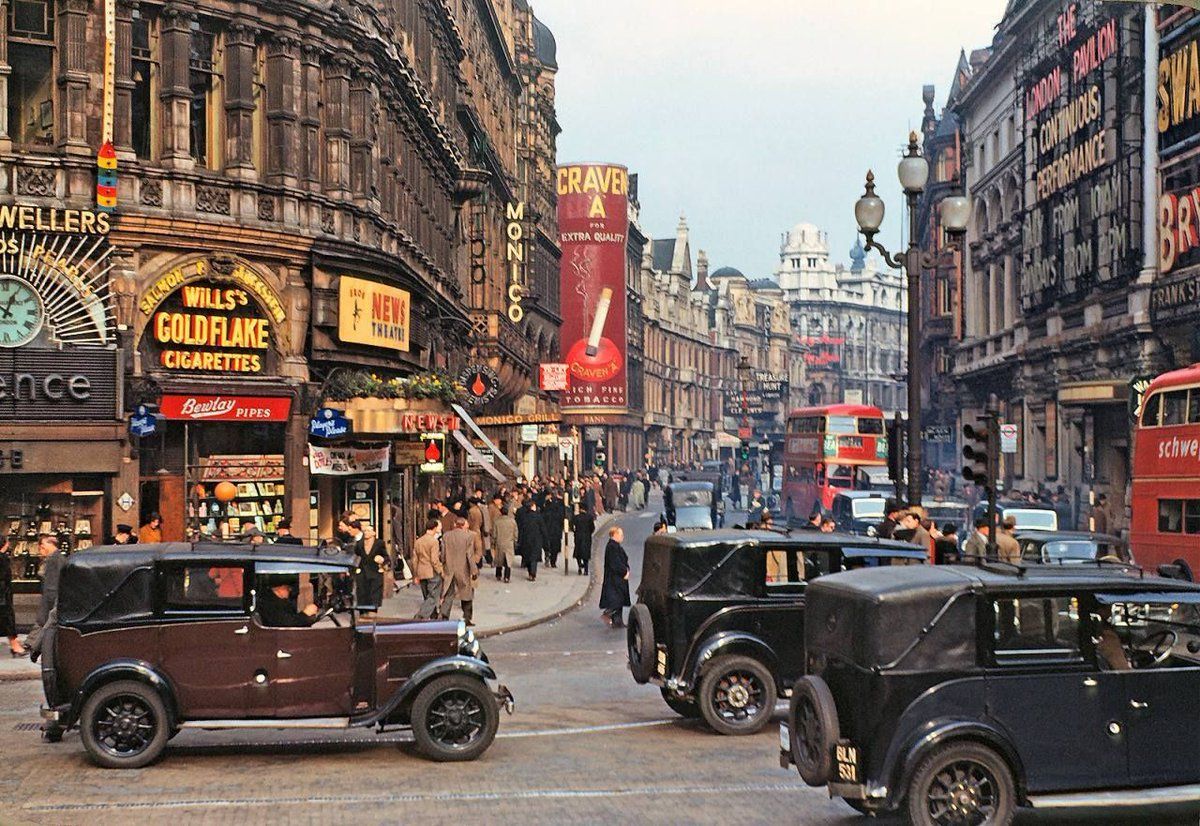
Piccadilly Circus in London, mid-1930s.
Colourized photo via Reddit.
Well, yes. Except that’s not actually what did drag Britain out of the Depression. What did was expansionary fiscal austerity. You know, that thing the Tories talked of in 2010 and which everyone laughed at? Somewhat annoyingly I was one of the very few (it’s annoying because I was clearly right in what I was saying) who pointed this out back then.
When we boil this right down it’s an argument about the effectiveness of monetary policy. Absolutely no one thinks that it has no effect. But there’s many who think that it has no effect at the zero lower bound: when interest rates are zero. That’s really the argument that leads to fiscal policy, that idea that government might tax less, or spend more, blow out that deficit and get the economy moving again. We’ve done all we could with monetary policy and we’ve still got to do something so here’s fiscal policy.
To put it as simply as possible. We’ve two major macroeconomic tools, monetary policy and fiscal. The first is interest rates, exchange rates and money printing and so on. The second is the difference between taxes collected and money spent by government — the government deficit or surplus (note, please, for purists, this is being very simple).
OK, either lever or tool can be used to loosen conditions — gee stuff up — or tighten them. Which we use when is somewhere between a matter of taste and necessarily correct given the circumstances. But clearly the total amount of geeing up out of a recession — or tightening to prevent inflation — or depression is the combination of the two sets of policies, applications of levers and tools.
It’s thus theoretically possible to tighten with one, loosen with the other and gain, overall, either tightening or loosening. Depends upon how much of each you do.
Britain in the 30s tightened fiscal policy. The opposite of what the Keynesians said, the opposite of what the US did and so on. Cut — no, really cut, not just slowed the increase in — government spending and thereby cut the government deficit (might, actually, have gone into surplus, not sure). This is, according to the Keynesian line, something that should make the recession/depression worse.
But at the same time they came off the gold standard — Churchill had taken us back in in 1925 at far too high a rate — and lowered interest rates. That’s a loosening of monetary policy.
As it happens, on balance, the monetary was loosened more than the fiscal was tightened and so we have expansionary fiscal austerity. Which set off a very nice little boom in fact. The mid- to late- 30s in Britain were economic good times. Driven, nicely driven, by a housebuilding boom — the last time the private sector built 300 k houses a year in fact (this is before the Town and Country Planning Act stopped all that). Mixed in was that the motor car was becoming a fairly standard bourgeois item and so housing spread out along the roads.


