
Sometimes I think (or is it feel?) that we are living in a propaganda state, not like that of North Korea, of course, in which the source of a univocal doctrine is clear and unmistakable, but one in which we are constantly under bombardment by an opinion-forming class that wants to make us believe, or be enthusiastic about, something to which we were previously indifferent or even hostile. There is no identifiable single source of the propaganda, and yet there seems also to be coordination: for how else to explain its sudden ubiquity? It is more Kafka than Orwell.
For example, quite recently there has been a concerted attempt to persuade the European public that women’s football (soccer) is interesting and exciting. The newspapers and online publications suddenly carry stories about it, with pictures, reports, profiles, and the like, whereas, shortly before, most people were only vaguely aware that women even played football.
No one can object to their doing so, of course, but the fact remains that they are not very good at it, at least not by comparison with men. They may be good — but with for women always appended. It is not the fault of women that they are not very good at football, any more than it is the fault of fish that they are illiterate, but the fact that everyone pretends not to notice it and dares not say it, at least in public, is surely a little sinister. A man of seventy may still play a good game of tennis, but it is always for his age: one wouldn’t expect him to win Wimbledon, nor would one expect excited, breathless reports on an over-seventies’ tennis tournament. The sudden interest in women’s football thus has a bogus feel about it, like the simulated enthusiasm of a crowd for the dictator in a communist state.
Theodore Dalrymple, “Propaganda & uglification”, New English Review, 2023-12-21.
May 10, 2024
QotD: The artificially induced public interest in women’s football
May 9, 2024
“The ability to believe entire gargling nonsense is strong in the [environmental] sector – as with this particular claim that we’re going to run out of rock”
Tim Worstall really, really enjoys kicking the stuffing out of strawman arguments, especially when they touch on something he’s very well informed about:
Some environmental claims are not just perfectly valid they’re essential for the continuation of life at any level above E. Coli. None of us would want the Thames to return to the state of 1950 when there was nothing living in it other than a collection of that E. Coli reflecting the interesting genetic and origin mix of the population of London. Sure, the arguments from Feargal and the like that a river running through 8 million people must be clean enough to swim in at all times is a bit extreme the other way around. One recent estimate has it that to perform that task for England would cost £260 billion — a few swimming baths sounds like a more sensible use of resources than getting all the rivers sparkling all the time.
Some are more arguable — violent and immediate climate change would be a bad idea, losing Lowestoft below the waves (possibly Dartford too) in 2500 AD might be something we can all live with. Arguable perhaps.
But some of these claims are wholly and entirely doolally. So much so that it’s difficult to imagine that grown adults take them seriously. But, sadly, they do and they do so on our money too.
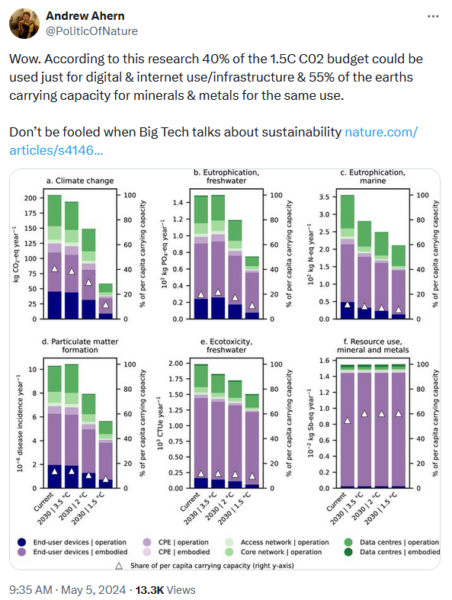
Wow. According to this research 40% of the 1.5C C02 budget could be used just for digital & internet use/infrastructure & 55% of the earths carrying capacity for minerals & metals for the same use.
The internet alone could use 55% of the Earth’s carrying capacity of metals and minerals? Well, to take that seriously is insane. That is not mere hyperbolic insult, that actually is insane. I write as someone who has written an entire book on this very subject (available here, for free, save your money to buy a subscription to this excellent Substack instead). There is no metal or mineral that we’re even going to run short of — in the technical, not economic, sense that is — for tens of millions of years yet. As the average lifetime of a species is perhaps 2 million years that should see us out.
So, clearly, they’re using some odd definition of how many minerals and metals we’ve got that we can use. I thought they’d do the usual Club of Rome thing (no, read the book to find out), confuse mineral reserves with what’s available and thus insist we all died last Tuesday afternoon. Rather to my surprise, no, they didn’t. They went further into raging lunacy.
It’s not wholly obvious as they don’t really quite announce their assumption, it’s necessary to track back a bit — and that’s a problem in itself. A top tip about scientific papers — if they say “As Bloggs said” then what that really means is that many people accept what Bloggs said as being true and also useful. You do not have to reprove Einstein every time you do physics, you can just say “As is known”. You’ve only got to reprove Al if that’s what you’re really trying to do.
Thus, if a definition is a referral back to something else, elsewhere, then you can be sure that the definition is a building block being used by others in their own papers. It’s a generalised insanity, not a specific one.
So, what is that limit?
Here we quantify the environmental impacts of digital content consumption encompassing all the necessary infrastructure linked to the consumption patterns of an average user. By applying the standardised life cycle assessment (LCA) methodology, we evaluate these impacts in relation to the per capita share of the Earth’s carrying capacity using 16 indicators related to climate change, nutrients flows, air pollution, toxicity, and resources use, for which explicit thresholds that should never be exceeded were defined
Now this is in Nature Communications. So it’s science. Even, it’s Science. It’s also lunatic. For, tracking back to try to find what those “resources use” are that will be 55% used up by the internet. It’s possible to think that maybe we’re going to use too much germanium in the glass in the fibreoptic cables say, or erbium in the repeaters, or … specific elements might be in short supply? As the book wot I wrote above points out, that’s nonsense. So, what is the claim?
Tracking back we get to this:
Resource use, mineral and metals MRD kg Sb eq Abiotic resource depletion (ADP ultimate reserves) 2.19E+08 3.18E-02 JRC calculation based on factor 2 concept Bringezu (2015); Buczko et al. (2016) Resource use
That’s from Table 3.
Which takes us one stage further back. This paper here is talking about Planetary Boundaries and as with the building block idea. PBs — I assume — make the assumption that Bringzeu, and Biczlo et al have given us a useful guide to what those PBs are. Which is why they just use their method, not invent a new one. But that, in turn, also means that other people working on PBs are likely to be using that same definition.
[…]
Note what they’re doing. Humans should not take out of that environment more than nature puts back into it each year. That’s some pretty dumb thinking there, as we don’t, when we use a metal or mineral — except in very rare circumstances — take it off planet. We move it around a bit, no more. But the claim really is that we should abstract, for use, no more than is naturally added back each year.
So, the correct limitation on our minerals use is how much magma volcanoes add each year.
No, really, humanity can use no more earth than gets thrown out of a volcano each year. That’s it. To use more would mean that we are depleting the stock and that’s not sustainable, see?
The Liri Valley: Canada’s Breakthrough to Rome
WW2TV
Published 8 May 2024The Liri Valley: Canada’s Breakthrough to Rome
With Mark Zuehlke
Part of our “Italy 1944 – Monte Cassino and Beyond” series
• Monte Cassino and BeyondFor the Allied armies fighting their way up the Italian boot in early 1944. Rome was the prize that could only be won through one of the greatest offensives of the war. The Liri Valley was a long, flat corridor through miles of rugged mountains. At one end stood the formidable Monte Cassino, at the other, Rome. In May 1944, I Canadian Corps drops up this valley toward the Italian capital, facing the infamous Hitler Line — a bastion of concrete bunkers fronted by wide swaths of tangled barbed wire, minefields, and “Tobruk” weapon pits. The ensuing battle resulted in Canada’s single bloodiest day of the Italian campaign. But the sacrifice of young Canadians during the twenty-four days of relentless combat it took to clear the valley paved the way for the Allies to take Rome.
Mark Zuehlke is an award-winning author generally considered to be Canada’s foremost popular military historian. His Canadian Battle Series is the most exhaustive recounting of the battles and campaigns fought by any nation during World War II to have been written by a single author.
(more…)
“[B]ad music does seem to disappear – you just need to wait 70 or 80 years, more or less”
I’m far from a modern music fan, so I find Ted Gioia’s analysis of the genre to be hopeful for the future … there’s so much objectively bad music being released these days, but the vast majority of it will sink without a trace:

Handwritten score by Bach
“No stupid literature, art or music lasts.”
That’s a quote from literary critic George Steiner (1929-2020) — in his highly recommended book Real Presences from 1986.
I was shocked when I read that sentence. But pleasantly shocked.
Could it really be true that all the sonic detritus circulating in our culture will just magically disappear? It seems too good to be true.
And Steiner wrote that before the rise of the Internet and AI. If he thought we were drowning in crappy art back in the 1980s, what would he think now?
Around 100,000 songs are uploaded online every day. I can’t listen to more than a fraction of them, but almost every day I check out random new tracks on Bandcamp — and sometimes the process is painful.
Nobody can say that I’ve shirked my responsibilities as a music critic. In recent months, I’ve listened to death metal bands from Croatia who sounded like they were ready to bludgeon the entire population of Zagreb; incoherent Christian drone pop that only delivers the Good News when it’s finally over; entire albums of static, buzzes, burps, or toots; people singing to backup tracks, but apparently unaware that they are in different keys; and various home recordings that should never have left the basement.
It’s an ugly job, but somebody has to do it. I occasionally find that rare gem, a self-produced needle of rare pointedness in the otherwise dismal haystack. That makes it all worthwhile.
But Steiner may be on to something. Most of the bad stuff disappears without anyone worrying about it. In fact, it disappears for that very reason — because nobody worries about it.
And the deeper I peer into the past, the more I see the same Darwinian trend. He called it survival of the fittest.
My considered judgment is that almost every musical work from the 17th and 18th centuries that survives in the standard repertoire possesses some merit. An interesting case is Bach, who is the presiding genius among the known composers from that era. Bach was unfairly forgotten in the years following his death — in fact, his sons got more acclaim than their dad.
Bach had been dead for more than 75 years before his reputation started rising again. The neglect was unfair, almost horrendously so. But with the passage of time, he gained preeminence, almost as if an invisible hand — much like those the economists describe — was setting things right. You could tell similar stories about other composers, from Antonio Vivaldi to Scott Joplin. It’s almost magical the way things work.
I must say that this is a judgment that takes a long time to make. Back at age twenty, I couldn’t have told you if Bach wrote better fugues than other composers, or Joplin composed better rags. Yet after decades seeking lost masterpieces from the past, and picking through the works of secondary and tertiary figures, I’ve concluded that the legendary figures from the past definitely earned their preeminence.
As a result, I worry more about the artists whose work has disappeared completely. Those are wrongs that can’t be rectified.
How the First World War Created the Middle East Conflicts
The Great War
Published Dec 8, 2023The modern Middle East is a region troubled by war, terrorism, weak and failed states, and civil unrest. But how did it get this way? The map of today’s Middle East was mostly drawn after the First World War, and the war that planted many of the seeds of conflict that still plague Israel, Palestine, Iraq, Syria and even Iran today.
(more…)
QotD: Rome’s socii system
In any case, the Romans win the war and impose a peace treaty the terms of which, according to Dionysius of Halicarnassus went thusly:1
Let there be peace between the Romans and all the Latin cities as long as the heavens and the earth shall remain where they are. Let them neither make war upon another themselves nor bring in foreign enemies nor grant a safe passage to those who shall make war upon either. Let them assist one another, when warred upon, with all their forces, and let each have an equal share of the spoils and booty taken in their common wars. Let suits relating to private contracts be determined within ten days, and in the nation where the contract was made. And let it not be permitted to add anything to, or take anything away from these treaties except by the consent both of the Romans and of all the Latins.
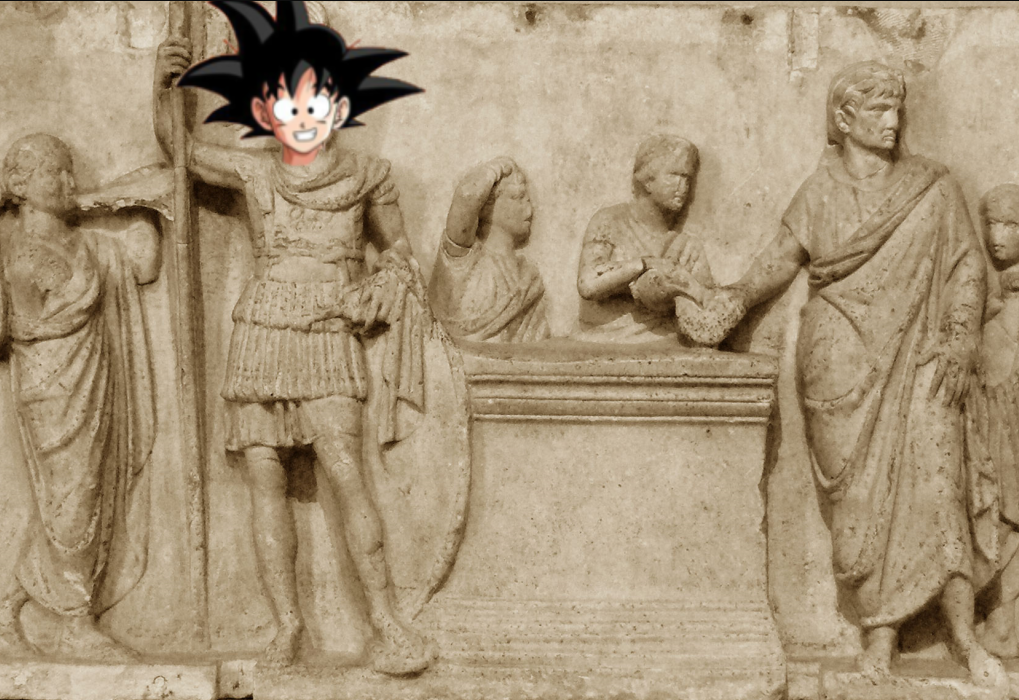
This is the origin point for Rome’s use of what I’ve termed the “Goku Model of Imperialism” – “I beat you, therefore we are friends”. Having soundly defeated – at least according to our sources – the Latins, Rome doesn’t annex or destroy them, nor does it impose tribute, but rather imposes a treaty of alliance on them (in practice I suspect we might want to understand that Rome’s position was not so dominant as our sources suggest, thus the relatively good terms the Latins get). The treaty sounds like an equal relationship, until one remembers that it is the entire Latin league – thirty or more communities – as one party and then just Rome as the other party.
I will still make no apologies for this visual gag.
Image modified by Bret Devereaux.Rome proceeds, in the century or so that follows, to use this alliance to defeat their other neighbors, both the nearest major Etruscan centers as well as the Aequi and Sabines who lived in the hills to the north-east of Rome and the Volsci who lived to the south of Latium. Roman relations with the Latins seem to fray in the early 300s, presumably because the greatest threat to their communities was increasingly not the Volsci, but Rome’s emerging regional power. That leads to a collapse of the Foedus Cassianum in 341 and another war between Rome and the Latin League. Once again our sources are much later, so we might be somewhat skeptical of the details they provide, but the upshot is that at the end the Romans won by 338.
Rome’s expansion into most areas follows a familiar pattern: Rome enters a region by concluding an alliance with some weaker power in a region and then rushing to the aid of that weaker power; in some cases this was a long-term relationship that had been around for some time (like the long Roman friendship with Etruscan Caere) and in some cases it was a very new and opportunistic friendship (as with Capua’s appeal to the Romans for aid in 343). In either case, Rome formed a treaty with the community it was “protecting” and then moved against its local enemies. Once defeated, it imposed treaties on them, too. Rome might also seize land in these wars from the defeated party (before it imposed that treaty); if these were far away, Rome might settle a colony on that land rather than annexing it into Rome’s core territory (the ager Romanus). These new communities – the Latin colonies – were created with treaty obligations towards Rome.
Note the change: what was initially an alliance between one party (Rome) and another party (the Latin League) has instead become an alliance system, a series of bilateral treaties between Rome and a slew of smaller communities. And they were smaller, because Rome often took land in these wars, so that by the third century, the Roman citizen body represented roughly 40% of the total, making Rome much bigger than any other allied community. This shift was probably gradual, rather than there being some dramatic policy change at any point. Rome accrued its Italian empire the same way it would accrue its Mediterranean one: as a result of a series of localized, ad hoc decisions which collectively added up to the result without ever being intended to constitute a single, unified policy.
The Romans called all of these allied communities and their people socii, “allies” – a bit of a euphemism, because these were no longer equal alliances. We’ll get into the terms in a moment, but it seems clear that by 338 that these “allies” are promising to have no foreign policy save for their alliance with Rome and to contribute soldiers to Roman armies. So Rome is in the driver’s seat determining where the alliance will go; Rome does not have to consult the allies when it goes to war and indeed does not do so. The socii cannot take Rome to war (but Rome will go to war immediately if a community of socii is attacked). This is no longer an equal arrangement, but it is useful for the Romans to pretend it is.
The next major series of Roman conflicts are with the Samnites. Rome is, according to Livy, at least, drawn into fighting the Samnites because of its suddenly concluded alliance with Capua and the Campanians (though Rome had been more loosely allied to the Samnites shortly before). In practice, the first two Samnite Wars (343-341, 326-304) were fought to determine control over Campania and the Bay of Naples, with Rome fighting to expand its influence there (by making those communities allies or protecting those who were) while the Samnites pushed back.
The Third Samnite War (298-290) becomes something rather different: a containment war. Rome’s growing power – through its “alliance” system – was clearly on a course to dominate the peninsula, so a large coalition of opponents, essentially every meaningful Italian power not already in Rome’s alliance system, banded together in a coalition to try to stop it (except for the Greeks). What started as another war between Rome and the Samnites soon pulled in the remaining independent Etruscan powers and then even a Gallic tribe (the Senones) in an effort to contain Rome. The Romans manage to pull out a victory (though it was a close run thing) and in the process managed to pull yet more communities into the growing alliance system. It seems – the sources here are confused – that the decade that followed, the Romans lock down much of Etruria as well.
The Greek cities in southern Italy now at last recognize their peril and call in Pyrrhus of Epirus to try to beat back Rome, leading to the Pyrrhic War (280-275). Pyrrhus wins some initial battles but – famously – at such cost that he is unable to win the war. Pyrrhus withdraws in 275 and Rome is then able over the next few years to mop up the Greek cities in Southern Italy, with the ringleader, Tarentum, falling to Rome in 272. Rome imposed treaties on them, too, pulling them into the alliance system. Thus, by 264 Rome’s alliance system covered essentially the whole of Italy South of the Po River. It had emerged as an ad hoc system and admittedly our sources don’t give us a good sense of how and when the terms of the alliance change; in many cases it seems our sources, writing much later, may not know. They have the foedus Cassianum, with its rather more equal terms, and knowledge of the system as it seems to have existed in the late third century and the dates and wars by which this or that community was voluntarily or forcibly integrated, but not the details of by what terms and so on.
Bret Devereaux, “Collections: How to Roman Republic 101, Addenda: The Socii“, A Collection of Unmitigated Pedantry, 2023-10-20.
1. trans. Earnest Clay (1940).
May 8, 2024
The cocoa shortage is really the same economic trend that caused the Victorian “servant problem”
Tim Worstall explains not only why your favourite chocolate bar is going to be more expensive, but also why your olive oil will do the same and why it really is the same thing as the Victorian and Edwardian upper class complaints about “the help”:
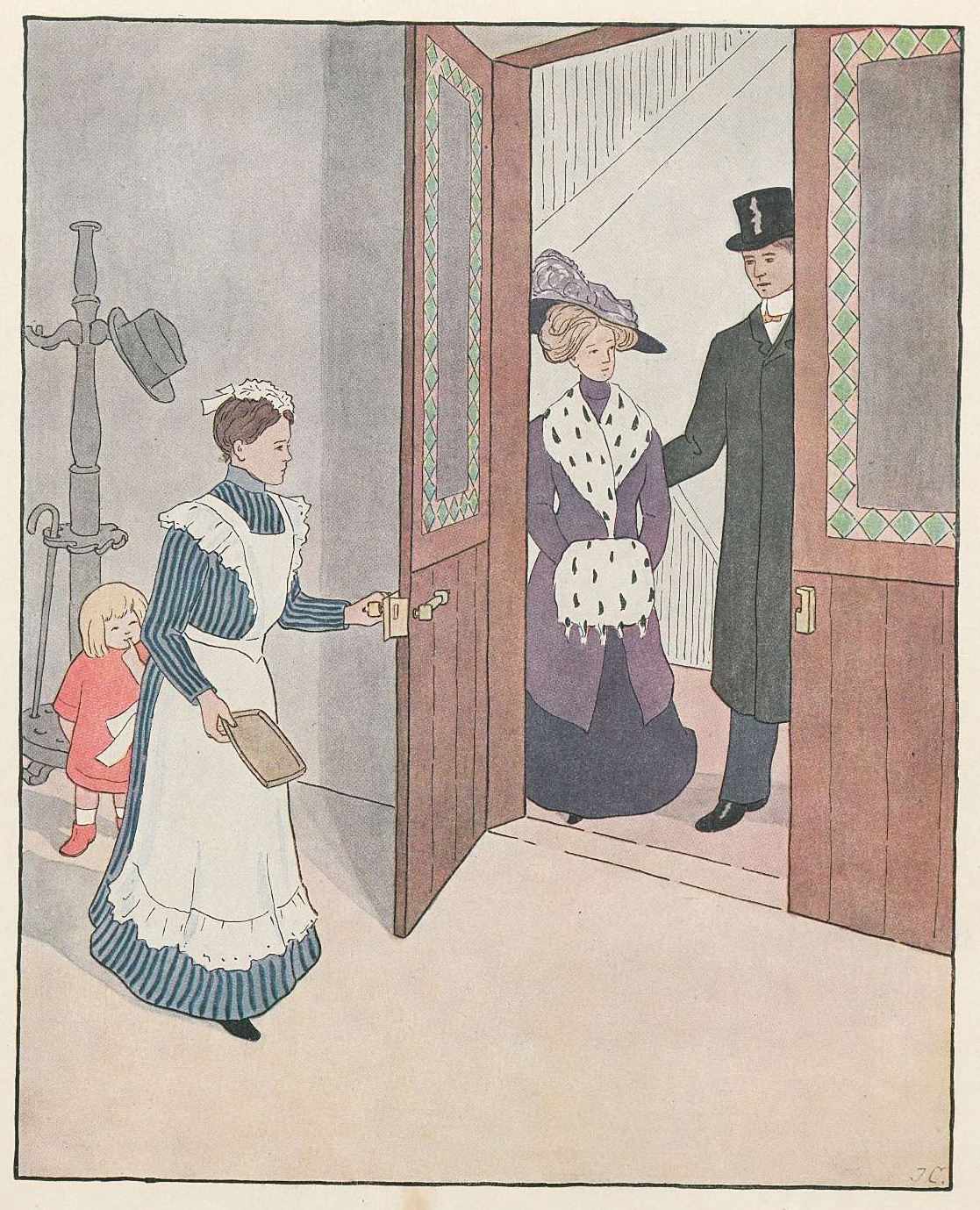
Upper classes expected maids and other servants to be cheap, eager, and easy to replace. This began to change quickly in the Victorian era, as women found better-paying jobs in commerce and industry that didn’t require bowing and scraping and putting up with constand, casual abuse from oblivious wealthy snobs.
As you might have noticed, cocoa is getting very much more expensive. Futures prices (no, futures are not a good guide to actual market prices but still) have gone from $3,000 a tonne or so (-ish, you understand ) to $12,000 and back to $8,000 or so. According to the usual suspects this is climate change. According to those a little more informed there’s El Nino, there have been a few rusts and plant plagues to deal with. Low prices led to not much planting in recent years — all sorts of little problems that led to that burst of higher prices.
Real prices have changed, the sort of Cadbury’s bar that my wife likes a piece of with her afternoon coffee has gone up by a € a bar in recent weeks (I know, I know, “Send Munnies! Quick!”) and so something must be done.
But there’s a much larger and more significant problem here and one to which there may or may not be a solution. The servant problem.
One of those things you learn when living in foreign is that the poorer a country is the easier it is to get a servant and the cheaper a servant is when you get one. This doesn’t wholly make sense to folk until it’s explained. A poor place is one where wages are low — where wages are low is a poor place. They’re the same statement. So, wages for a servant are low in poor countries.
We can up that a little as well. Poor people spend — truly poor people that is — some 80% of their income on food and shelter. So, when you’re in one of those truly poor places you can gain access to a servant — their fulltime, undivided services — for $2 a day plus a bowl of boiled rice and being allowed to sleep in the barn. Because, if they were out there in the cash economy they’d be paid $2 a day (800 million still live at that level out there) and they’d have to buy their own bowl of rice and a tarpaulin to shelter under out of that.
Servants are cheap in poor places because human labour is cheap in poor places because a place with cheap labour is a poor place. QED.
As places become richer human labour costs more. Which is why the letters pages of The Lady started to fill up with complaints about the uppityness and demands of servants from about the 1880s onwards — about the time that British wages at that low and untrained end first started to substantially rise above mere subsistence. This is also one of our major political problems now that middle class women have the vote. They’re using the franchise to insist that government do something about that servant problem. That’s what all that insistence upon child care subsidies and freebies is about. Those middle class women going off to their terribly important power skirt jobs can no longer afford to hire some working class popsie to look after their kids — so government must be forced to do so instead. The correct answer being look after your own damn kids, obviously.
But cheap labour in poor places:
Britain is at risk of olive oil shortages as the industry is wracked by a production crisis.
Fears are growing over the risk of empty shelves as growers across Europe battle a combination of extreme weather, inflation and high interest rates.
Interest rates matter because you plant, wait some number of years, only then do you gain olives. You will then gain them for many decades even centuries, but that wait without income is more painful the higher interest rates get.
There are rusts, plant plagues, afflicting the crop across much of Europe. Of course we’ve those blaming everything on climate change but that’s just the usual bollocks.
However, low wages in poor places. I live in the middle of an oil producing area. Vast waving acres of olive trees in fact. I’ve also lived, until recently, in an historically poorer area of the same country. Where much of the land — little 2 and 4 acre farms (if they were lucky) which might raise a few goats, a sheep (cheese more than anything) and have a couple or four olive trees — has been simply abandoned. The place is getting richer, no one wants to scrape a living on 4 acres of land these days. Rightly so. 4 acres is an adventurous garden, not a living. The absence of those goats is also why the wildfires are getting so much worse — there’s more scrub to burn.
I can take you to places where there are hundreds of acres of such land. Plenty of olive trees in there too, all fruiting and none of them being picked. Because picking olives from the occasional tree is hard bloody work. Spread a net beneath it, hit the tree hard, a lot. Collect up the net with all the olives. Then sort them. By hand. Each single one needs to be checked (for worms and rot) and then nicked. Then you can take them down to the oil mill (every village has at least one) and you hand over the olives and get back the oil, minus a percentage for the mill owner.
The nonsensical “right of return” debate
George Monastiriakos explains why he should have the right of return to his ancestral homeland:
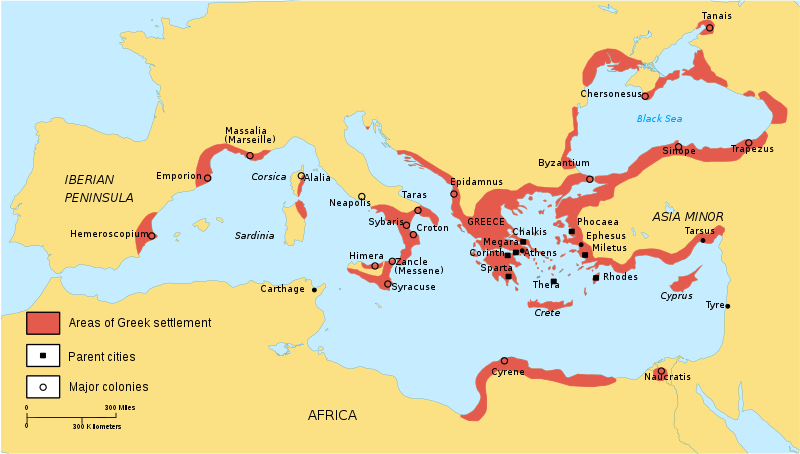
Greek colonization in the Archaic period.
Map by Dipa1965 via Wikimedia Commons.
My family hails from a small Greek village in Anatolia, in modern day Turkey, but I have unfortunately never been to my ancestral homeland because I was born a “refugee” in Montreal. Living in the “liberated zone” of Chomedey, Que., one of the biggest Greek communities in Canada, is the closest I’ve ever felt to my beloved Anatolia.
The Republic of Turkey does not have a legal right to exist. It is an illegitimate and temporary colonial project built by and for Turkish settlers from Central Asia. My ancestors resided on the Aegean coast of Asia Minor for thousands of years before the first Turks arrived on horseback from the barren plains of Mongolia. I will never relinquish my right to return to my ancestral homeland.
If you think these assertions are ridiculous, it’s because they are. I copied them from the shallow, even childish, anti-Israel discourse that’s prevalent on campuses in the United States and Canada, including the University of Ottawa, where I studied and now teach. I am a proud Canadian citizen, with no legal or personal connection to Anatolia. I have no intention, or right, to return to my so-called ancestral homeland. Except, perhaps, for a much-needed vacation. Even then, my stay would be limited to the extent permitted by Turkish law.
The Second Greco-Turkish War concluded with the Treaty of Lausanne in 1923. Among other things, this agreement finalized the forced displacement of nearly one-million Ottoman Greeks to the Kingdom of Greece, and roughly 500,000 Greek Muslims to the newly formed Republic of Turkey. This ended the over 3,000 years of Greek history in Anatolia, and served as a model for the partition of British India, which saw the emergence of a Hindu majority state and a Muslim majority state some two decades later.
With their keys and property deeds in hand, my paternal grandmother’s family fled to the Greek island of Samos, on the opposite side of the Mycale Strait at a nearly swimmable distance from the Turkish coast. While they practised the Greek Orthodox religion and spoke a dialect of the Greek language, they were strangers in a foreign land with no legal or personal connection to the Kingdom of Greece.
The Great War channel produced an overview of the Greco-Turkish War of 1919-1923 that resulted in the vast human tragedy of the expulsion of ethnic Greek civilians from Anatolia and ethnic Turkish civilians from mainland Greece here.
Walther Volkspistole
Forgotten Weapons
Published Mar 11, 2015As the Second World War started to really take a toll on German industrial production, several companies started to work on alternatives to the P38 handgun in an effort to reduce production cost and time. This is one such example made by Walther, with a normal type of milled slide and an experimental frame made from stamped sheet steel. It uses a rotating barrel mechanism taken from Nickl (and the Steyr-Hahn before him), and uses standard P38 magazines. None of these designs actually made it into production before the end of the war.
(more…)
QotD: Imperial Spain’s “House of Trade”
And it was something that the English tried, for decades, to emulate. Before they embarked on their first explorations of the icy seas around Russia in the 1550s, they first poached the Casa‘s principal navigator, the Pilot Major, Sebastian Cabot. And later, during the few years that England and Spain were united in matrimony, under Mary I, one English navigator, Stephen Borough, had the chance to visit and glean some of its secrets. He was instrumental in having Spain’s key navigational manual translated in English, and he petitioned Elizabeth I to create an English version of the Casa. That dream never materialised, but the quest to emulate the Casa informed many of the smaller-scale projects — lectures, manuals, globes, and maps — which meant that the English did not sail completely into the unknown.
Anton Howes, “The House of Trade”, Age of Invention, 2019-11-13.
May 7, 2024
But Carbon Dioxide is scary, m’kay?
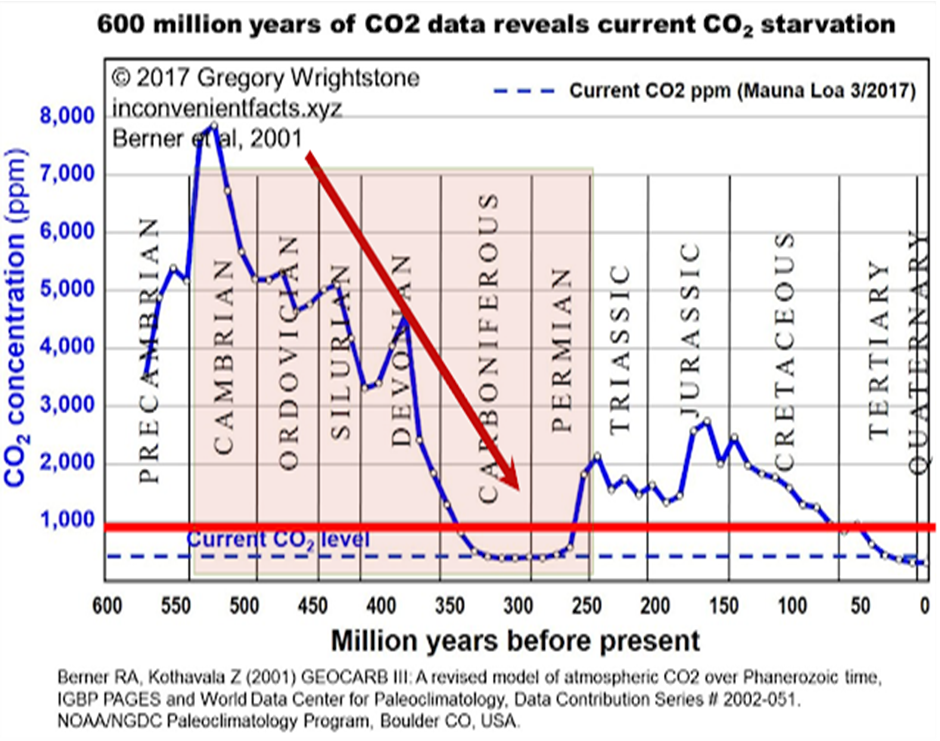
Last week, Chris Morrison shared some charts that show atmospheric carbon dioxide to be nowhere near high enough to be a concern … in fact, compared to ancient atmospheric conditions, CO2 may be at a potentially concerning low point:
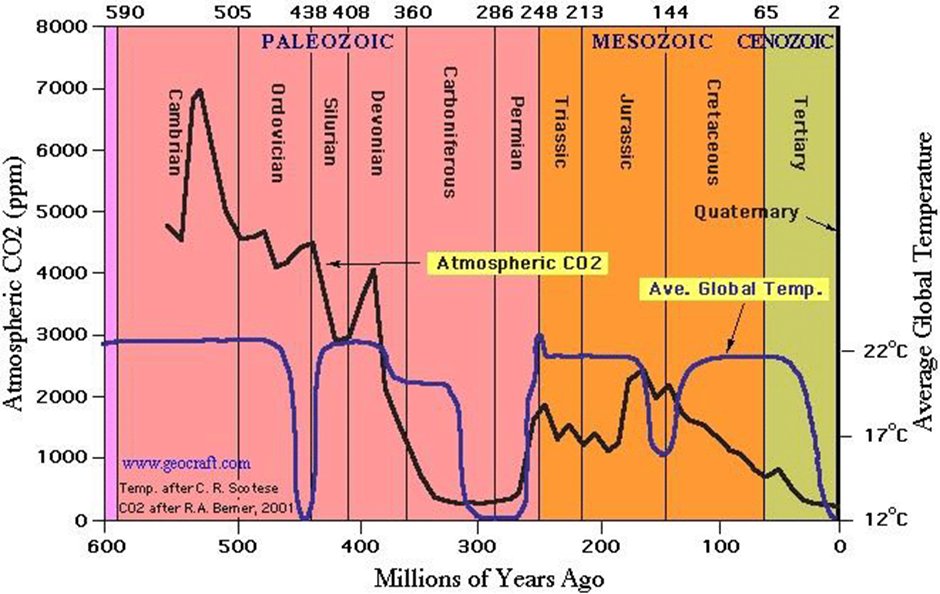
Last year, Chris Packham hosted a five-part series on the BBC called Earth, which compared a mass extinction event 252 million years ago to the small rise in atmospheric carbon dioxide seen in the last 150 years. He said he hoped the “terror factor” generated by his programme would “spur us to do something about the environment crisis”. But as we shall see, the only terror factor is having to sit through an hour-long film consisting of cherry-picked science data and unproven assertions in the hope of persuading us that the increase in global temperatures in the last 150 years or so is comparable to the rise in temperatures over a considerable swath of geological time. Great play was made of a 12°C rise in average global temperatures 252 million years ago as CO2 levels started to rise, although Packham fails to report that CO2 levels were already at least four times higher back then than in modern times. The “science” that Packham cloaks himself with on every occasion is hardly served by terrorising the viewer with what is little more than a highly personal political message.
Think of all that suffering and wastage, he says about the fourth great mass extinction. I don’t think we want a comparable extinction to the one that happened 252 million years ago on our conscience, he adds. Of course, Packham is not the first person to politicise the end-Permian extinction when most plant and animal life disappeared to be replaced eventually with what became known as the age of the dinosaurs. As we can see from the graph below, even though that extinction event coincided with an uptick in CO2 levels, the general trend over a 600-million-year period was downwards ending in the near denudation currently experienced today. But scientists note that the rise started some time before the extinction event, with most of the Permian characterised by very low levels of CO2.
It is obvious why the three other great extinctions are of little interest to modern day climate alarmists. The Ordovician extinction 445 million years ago occurred when CO2 levels were 12 times higher than today, the Devonian wipe-out happen 372 millions ago when CO2 levels were falling, while the later Triassic/Jurassic event 201 million years ago occurred at a time of stable CO2. Hard to see a pattern there suggesting rising CO2 levels equals a mass extinction event. The disappearance of the dinosaurs 66 million years ago is generally attributed to the impact of a giant meteorite, while the current sixth mass extinction exists only inside the head of the Swedish doom goblin, and need not detain us at this point.
Since Packham was essentially making a BBC political film promoting Net Zero, he inevitably started with the fixed view that all our current environmental problems are the fault of CO2. An intense period of volcanic eruptions that led to huge coal deposits catching fire increased CO2 levels and almost instantly sent temperatures soaring at the end of the Permian period. About 20 million years of rain subsequently followed, he observed, taking some of the CO2 out of the atmosphere and order it seems was restored. Certainly, CO2 resumed a small descent but levels remained almost as high, or for some periods higher, as those at the end of the Permian period for another 120 million years. Packham does not provide an explanation of what happened to the average global temperature at this time.
The graph above shows why he avoided the subject. Temperatures did rise at the end of the Permian period after a long decline, but only as far as previous highs recorded 200 million years earlier. They then stayed at those levels for most of the next 200 million years, throughout the age of the dinosaurs. Helped by the increased levels of CO2, this is considered one of the most verdant periods in Earth’s history.
Charles Holden and the Ministry of Truth
Jago Hazzard
Published Jan 28, 2024The strange connection between George Orwell and the London Underground.
May 6, 2024
Germans and Americans fighting side by side! – WW2 – Week 297B – May 5, 1945
World War Two
Published 5 May 2024I don’t want to give too much away about this extra regular episode here in the description, but it’s true- German and American soldiers fought side by side in the waning days of the European part of WW2, and not just once! And the second time is an all-time great tale of adventure.
(more…)
James Holland | Top 5 Tanks | The Tank Museum
The Tank Museum
Published Oct 4, 2019WW2 Historian James Holland came to The Tank Museum to choose his Top 5 Tanks. Unsurprisingly they are all from the Second World War!
(more…)
QotD: Confident cultures … unlike our modern one
Only in the modern period do we feel we need black-letter law for everything. And once we’ve got formal law, of course, the very next thing we do is start carving out penumbras and emanations, because we are so far from a self-confident culture that we must constantly prove to ourselves what clever, clever boys we are …
Severian, “Barely Legal”, Rotten Chestnuts, 2021-06-21.


