
We should start with the sort of supplies our army is going to need. The Romans neatly divided these into four categories: food, fodder, firewood and water each with its own gathering activities (called by the Romans frumentatio, pabulatio, lignatio and aquatio respectively; on this note Roth op. cit. 118-140), though gathering food and fodder would be combined whenever possible. That’s a handy division and also a good reflection of the supply needs of armies well into the gunpowder era. We can start with the three relatively more simple supplies, all of which were daily concerns but also tended to be generally abundant in areas that armies were.
For most armies in most conditions, water was available in sufficient quantities along the direction of march via naturally occurring bodies of water (springs, rivers, creeks, etc.). Water could still be an important consideration even where there was enough to march through, particularly in determining the best spot for a camp or in denying an enemy access to local water supplies (such as, famously at the Battle of Hattin (1187)). And detailing parties of soldiers to replenish water supplies was a standard background activity of warfare; the Romans called this process aquatio and soldiers so detailed were aquatores (not a permanent job, to be clear, just regular soldiers for the moment sent to get water), though generally an army could simply refill its canteens as it passed naturally occurring watercourses. Well organized armies could also dig wells or use cisterns to pre-position water supplies, but this was rarely done because it was tremendously labor intensive; an army demanded so much water that many wells would be necessary to allow the army to water itself rapidly enough (the issue is throughput, not well capacity – you can only lift so many buckets of so much water in an hour in a single well). For the most part armies confined their movements to areas where water was naturally available, managing, at most, short hops through areas where it was scarce. If there was no readily available water in an area, agrarian armies simply couldn’t go there most of the time.
Like water, firewood was typically a daily concern. In the Roman army this meant parties of firewood forages (lignatores) were sent out regularly to whatever local timber was available. Fortunately, local firewood tended to be available in most areas because of the way the agrarian economy shaped the countryside, with stretches of forest separating settlements or tended trees for firewood near towns. Since an army isn’t trying to engage in sustainable arboriculture, it doesn’t usually need to worry about depleting local wood stocks. Moreover, for our pre-industrial army, they needn’t be picky about the timber for firewood (as opposed to timber for construction). Like water gathering, collecting firewood tends to crop up in our sources when conditions make it unusually difficult – such as if an army is forced to remain in one place (often for a siege) and consequently depletes the local supply (e.g. Liv. 36.22.10) or when the presence of enemies made getting firewood difficult without using escorts or larger parties (e.g. Ps.-Caes. BAfr. 10). Sieges could be especially tricky in this regard because they add a lot of additional timber demand for building siege engines and works; smart defenders might intentionally try to remove local timber or wood structures to deny an approaching army as part of a scorched earth strategy (e.g. Antioch in 1097). That said apart from sieges firewood availability, like water availability is mostly a question of where an army can go; generals simply long stay in areas where gathering firewood would be impossible.
Then comes fodder for the animals. An army’s animals needed a mix of both green fodder (grass, hay) and dry fodder (barley, oats). Animals could meet their green fodder requirements by grazing at the cost of losing marching time, or the army could collect green fodder as it foraged for food and dry fodder. As you may recall, cut grain stalks can be used as green fodder and so even an army that cannot process grains in the fields can still quite easily use them to feed the animals, alongside barley and oats pillaged from farm storehouses. The Romans seem to have preferred gathering their fodder from the fields rather than requisitioning it from farmers directly (Caes. BG 7.14.4) but would do either in a pinch. What is clear is that much like gathering water or firewood this was a regular task a commander had to allot and also that it often had to be done under guard to secure against attacks from enemies (thus you need one group of soldiers foraging and another group in fighting trim ready to drive off an attack). Fodder could also be stockpiled when needed, which was normally for siege operations where an army’s vast stock of animals might deplete local grass stocks while the army remained encamped there. Crucially, unlike water and firewood, both forms of fodder were seasonal: green fodder came in with the grasses in early spring and dry fodder consists of agricultural products typically harvested in mid-summer (barley) or late spring (oats).
All of which at last brings us to the food, by which we mostly mean grains. Sources discussing army foraging tend to be heavily focused on food and we’ll quickly see why: it was the most difficult and complex part of foraging operations in most of the conditions an agrarian army would operate. The first factor that is going to shape foraging operations is grain processing. [S]taple grains (especially wheat, barley and later rye) make up the vast bulk of the calories an army (and it attendant non-combatants) are eating on the march. But, as we’ve discussed in more detail already, grains don’t grow “ready to eat” and require various stages of processing to render them edible. An army’s foraging strategy is going to be heavily impacted by just how much of that processing they are prepared to do internally.
This is one area where the Roman army does appear to have been quite unusual: Roman armies could and regularly did conduct the entire grain processing chain internally. This was relatively rare and required both a lot of coordination and a lot of materiel in the form of tools for each stage of processing. As a brief refresher, grains once ripe first have to be reaped (cut down from the stalks), then threshed (the stalks are beaten to shake out the seeds) and winnowed (the removal of non-edible portions), then potentially hulled (removing the inedible hull of the seed), then milled (ground into a powder, called flour, usually by the grinding actions of large stones), then at last baked into bread or a biscuit or what have you.
It is possible to roast unmilled grain seeds or to boil either those seeds or flour in water to make porridge in order to make them edible, but turning grain into bread (or biscuits or crackers) has significant nutritional advantages (it breaks down some of the plant compounds that human stomachs struggle to digest) and also renders the food a lot tastier, which is good for morale. Consequently, while armies will roast grains or just make lots of porridge in extremis, they want to be securing a consistent supply of bread. The result is that ideally an army wants to be foraging for grain products at a stage where it can manage most or all of the remaining steps to turn those grains into food, ideally into bread.
As mentioned, the Romans could manage the entire processing chain themselves. Roman soldiers had sickles (falces) as part of their standard equipment (Liv. 42.64.2; Josephus BJ 3.95) and so could be deployed directly into the fields (Caes. BG 4.32; Liv. 31.2.8, 34.26.8) to reap the grain themselves. It would then be transported into the fortified camp the Romans built every time the army stopped for the night and threshed by Roman soldiers in the safety of the camp (App. Mac. 27; Liv. 42.64.2) with tools that, again, were a standard part of Roman equipment. Roman soldiers were then issued threshed grains as part of their rations, which they milled themselves (or made into a porridge called puls) using “handmills”. These were not small devices, but roughly 27kg (59.5lbs) hand-turned mills (Marcus Junkelmann reconstructed them quite ably); we generally assume that they were probably carried on the mules on the march, one for each contubernium (tent-group of 6-8; cf. Plut. Ant. 45.4). Getting soldiers to do their own milling was a feat of discipline – this is tough work to do by hand and milling a daily ration would take one of the soldiers of the group around two hours. Roman soldiers then baked their bread either in their own campfires (Hdn 4.7.4-6; Dio Cass. 62.5.5) though generals also sometimes prepared food supplies in advance of operations via what seem to be central bakeries. This level of centralization was part and parcel of the unusual sophistication of Roman logistics; it enabled a greater degree of flexibility for Roman armies.
Greek hoplite armies do not seem generally to have been able to reap, thresh or mill grain on the march (on this see J.W. Lee, op. cit.; there’s also a fantastic chapter on the organization of Greek military food supply by Matthew Sears forthcoming in a Brill Companion volume one of these years – don’t worry, when it appears, you will know!). Xenophon’s Ten Thousand are thus frequently forced to resort to making porridge or roast grains when they cannot forage supplies of already-milled-flour; they try hard to negotiate for markets on their route of march so they can just buy food. Famously the Spartan army, despoiling ripe Athenian fields runs out of supplies (Thuc. 2.23); it’s not clear what sort of supplies were lacking but food and fodder seems the obvious choice, suggesting that the Spartans could at best only incompletely utilize the Athenian grain. All of which contributed to the limited operational endurance of hoplite armies in the absence of friendly communities providing supplies.
Macedonian armies were in rather better shape. Alexander’s soldiers seem to have had handmills (note on this Engels, op. cit.) which already provides a huge advantage over earlier Greek armies. Grain is generally (as noted in our series on it) stored and transported after threshing and winnowing but before milling because this is the form in which has the best balance of longevity and compactness. That means that granaries and storehouses are mostly going to contain threshed and winnowed grains, not flour (nor freshly reaped stalks). An army which can mill can thus plunder central points of food storage and then transport all of that food as grain which is more portable and keeps better than flour or bread.
Early modern armies varied quite a lot in their logistical capabilities. There is a fair bit of evidence for cooking in the camp being done by the women of the campaign community in some armies, but also centralized kitchen messes for each company (Lynn op. cit. 124-126); the role of camp women in food production declines as a product of time but there is also evidence for soldiers being assigned to cooking duties in the 1600s. On the other hand, in the Army of Flanders seems to have relied primarily on external merchants (so sutlers, but also larger scale contractors) to supply the pan de munición ration-bread that the army needed, essentially contracting out the core of the food system. Parker (op. cit. 137) notes the Army of Flanders receiving some 39,000 loaves of bread per day from its contractors on average between April 1678 and February of 1679.
That created all sorts of problems. For one, the quality of the pan de munición was highly variable. Unlike soldiers cooking for themselves or their mess-mates, contractors had every incentive to cut corners and did so. Moreover, much of this contracting was done on credit and when Spanish royal credit failed (as it did in 1557, 1560, 1575, 1596, 1607, 1627, 1647 and 1653, Parker op. cit. 125-7) that could disrupt the entire supply system as contractors suddenly found the debts the crown had run up with them “restructured” (via a “Decree of Bankruptcy”) to the benefit of Spain. And of course that might well lead to thousands of angry, hungry, unpaid men with weapons and military training which in turn led to disasters like the Sack of Antwerp (1576), because without those contractors the army could not handle its logistical needs on its own. It’s also hard not to conclude that this structure increased the overall cost of the Army of Flanders (which was astronomical) because it could never “make the war feed itself” in the words of Cato the Elder (Liv 34.9.12; note that it was rare even for the Romans for a war to “feed itself” entirely through forage, but one could at least defray some costs to the enemy during offensive operations). That said this contractor supplied bread also did not free the Army of Flanders from the need to forage (or even pillage) because – as noted last time – their rations were quite low, leading soldiers to “offset” their low rations with purchase (often using money gained through pillage) or foraging.
Of course added to this are all sorts of food-stuffs that aren’t grain: meat, fruits, vegetables, cheeses, etc. Fortunately an army needs a lot less of these because grains make up the bulk of the calories eaten and even more fortunately these require less processing to be edible. But we should still note their importance because even an army with a secure stockpile of grain may want to forage the surrounding area to get supplies of more perishable foodstuffs to increase food variety and fill in the nutritional gaps of a pure-grain diet. The good news for our army is that the places they are likely to find food (small towns and rural villages) are also likely to be sources of these supplementary foods. By and large that is going to mean that armies on the march measure their supplies and their foraging in grain and then supplement that grain with whatever else they happen to have obtained in the process of getting that grain. Armies in peacetime or permanent bases may have a standard diet, but a wartime army on the march must make do with whatever is available locally.
So that’s what we need: water, fodder, firewood and food; the latter mostly grains with some supplements, but the grain itself probably needs to be in at least a partially processed form (threshed and sometimes also milled), in order to be useful to our army. And we need a lot of all of these things: tons daily. But – and this is important – notice how all of the goods we need (water, firewood, fodder, food) are things that agrarian small farmers also need. This is the crucial advantage of pre-industrial logistics; unlike a modern army which needs lots of things not normally produced or stockpiled by a civilian economy in quantity (artillery shells, high explosives, aviation fuel, etc.), everything our army needs is a staple product or resource of the agricultural economy.
Finally we need to note in addition to this that while we generally speak of “forage” for supplies and “pillage” or “plunder” for armies making off with other valuables, these were almost always connected activities. Soldiers that were foraging would also look for valuables to pillage: someone stealing the bread a family needs to live is not going to think twice about also nicking their dinnerware. Sadly we must also note that very frequently the valuables that soldiers looted were people, either to be sold into slavery, held for ransom, pressed into work for the army, or – and as I said we’re going to be frank about this – abducted for the purpose of sexual assault (or some combination of the above).
And so a rural countryside, populated by farms and farmers is in essence a vast field of resources for an army. How they get them is going to depend on both the army’s organization and capabilities and the status of the local communities.
Bret Devereaux, “Collections: Logistics, How Did They Do It, Part II: Foraging”, A Collection of Unmitigated Pedantry, 2022-07-29.
January 17, 2025
QotD: Foraging for supplies in pre-modern armies
December 22, 2024
QotD: “Sparta Is Terrible and You Are Terrible for Liking Sparta”
“This. Isn’t. Sparta.” is, by view count, my second most read series (after the Siege of Gondor series); WordPress counts the whole series with just over 415,000 page views as I write this, with the most popular part (outside of the first one; first posts in a series always have the most views) being the one on Spartan Equality followed by Spartan Ends (on Spartan strategic failure). The least popular is actually the fifth part on Spartan Government, which doesn’t bother me overmuch as that post was the one most narrowly focused on the spartiates (though I think it also may be the most Hodkinsonian post of the bunch, we’ll come back to that in a moment) and if one draws anything out of my approach it must be that I don’t think we should be narrowly focused on the spartiates.
In the immediate moment of August, 2019 I opted to write the series – as I note at the beginning – in response to two dueling articles in TNR and a subsequent (now lost to the ages and only imperfectly preserved by WordPress’ tweet embedding function) Twitter debate between Nick Burns (the author of the pro-Sparta side of that duel) and myself. In practice however the basic shape of this critique had been brewing for a lot longer; it formed out of my own frustrations with seeing how Sparta was frequently taught to undergraduates: students tended to be given Plutarch’s Life of Lycurgus (or had it described to them) with very little in the way of useful apparatus to either question his statements or – perhaps more importantly – extrapolate out the necessary conclusions if those statements were accepted. Students tended to walk away with a hazy, utopian feel about Sparta, rather than anything that resembled either of the two main scholarly “camps” about the polis (which we’ll return to in a moment).
That hazy vision in turn was continually reflected and reified in the popular image of Sparta – precisely the version of Sparta that Nick Burns was mobilizing in his essay. That’s no surprise, as the Sparta of the undergraduate material becomes what is taught when those undergrads become high school teachers, which in turn becomes the Sparta that shows up in the works of Frank Miller, Steven Pressfield and Zack Snyder. It is a reading of the sources that is at once both gullible and incomplete, accepting all of the praise without for a moment thinking about the implications; for the sake of simplicity I’m going to refer to this vision of Sparta subsequently as the “Pressfield camp”, after Steven Pressfield, the author of Gates of Fire (1998). It has always been striking to me that for everything we are told about Spartan values and society, the actual spartiates would have despised nearly all of their boosters with sole exception of the praise they got from southern enslaver-planter aristocrats in the pre-Civil War United States. If there is one thing I wish I had emphasized more in “This. Isn’t. Sparta.” it would have been to tell the average “Sparta bro” that the Spartans would have held him in contempt.
And so for years I regularly joked with colleagues that I needed to make a syllabus for a course simply entitled, “Sparta Is Terrible and You Are Terrible for Liking Sparta”. Consequently the TNR essays galvanized an effort to lay out what in my head I had framed as “The Indictment Against Sparta”. The series was thus intended to be set against the general public hagiography of Sparta and its intended audience was what I’ve heard termed the “Sparta Bro” – the person for whom the Spartans represent a positive example (indeed, often the pinnacle) of masculine achievement, often explicitly connected to roles in law enforcement, military service and physical fitness (the regularity with which that last thing is included is striking and suggests to me the profound unseriousness of the argument). It was, of course, not intended to make a meaningful contribution to debates within the scholarship on Sparta; that’s been going on a long time, the questions by now are very technical and so all I was doing was selecting the answers I find most persuasive from the last several decades of it (evidently I am willing to draw somewhat further back than some). In that light, I think the series holds up fairly well, though there are some critiques I want to address.
One thing I will say, not that this critique has ever been made, but had I known that fellow UNC-alum Sarah E. Bond had written a very good essay for Eidolon entitled “This is Not Sparta: Why the Modern Romance With Sparta is a Bad One” (2018), I would have tried to come up with a different title for the series to avoid how uncomfortably close I think the two titles land to each other. I might have gone back to my first draft title of “The Indictment Against Sparta” though I suspect the gravitational pull that led to Bond’s title would have pulled in mine as well. In any case, Sarah’s essay takes a different route than mine (with more focus on reception) and is well worth reading.
Bret Devereaux, “Collections: This. Isn’t. Sparta. Retrospective”, A Collection of Unmitigated Pedantry, 2022-08-19.
November 29, 2024
Greek History and Civilization, Part 8 – The Hellenistic Age
seangabb
Published Jul 17, 2024This eighth lecture in the course covers the Hellenistic Age of Greece — from the death of Alexander in 323 BC to about the death of Cleopatra in 30 BC.
(more…)
November 10, 2024
QotD: The low social status of shepherds in the ancient and medieval world
One the one hand, there is a robust literature, beginning in the Greek and Roman literary corpus, which idealizes rustic life, particularly shepherding. Starting with Theocritus’ short pastoral poems (called eidullion, “little poems” from where we get the word idyll as in calling a scene “idyllic”) and running through Vergil’s Eclogues and Georgics, which present the pure rural simplicity of the countryside and pastoralism as a welcome contrast to the often “sordid” and unhealthy environment of the city (remember the way these “gentlemen farmers” tend to think about merchants and markets in cities, after all). This idolization only becomes more intense in Europe with the advent of Christianity and the grand metaphorical significance that shepherding in particular – as distinct from other rural activities – takes on. It would thus be easy to assume just from reading this sort of high literature that shepherds were well thought of, especially in a Christian social context.
But by and large just as the elite love of the idea of rural simplicity did not generally lead to a love of actual farming peasants, so too their love of the idea of pastoral simplicity did not generally lead to an actually high opinion of the folks who did that work, nor did it lead shepherds to any kind of high social status. While the exact social position of shepherds and their relation to the broader society could vary (as we’ll see), they tended to be relatively low-status and poor individuals. The “shepherds out tending their flocks by night” of Luke 2:8 are not important men. Indeed, the “night crew” of shepherds are some of the lowest status and poorest free individuals who could possibly see that religious sign, a point in the text that is missed by many modern readers.
We see a variety of shepherding strategies which impact what kind of shepherds might be out with flocks. Small peasant households might keep a few sheep (along with say, chickens or pigs) to provide for the household’s wool needs. In some cases, a village might pool those sheep together to make a flock which one person would tend (a job which often seems to have gone to either fairly young individuals or else the elderly – that is, someone who might not be as useful in the hard labor on the farm itself, since shepherding doesn’t necessarily require a lot of strength).
Larger operations by dedicated shepherds often involved wage-laborers or enslaved laborers tending flocks of sheep and pastured owned by other, higher status and wealthier individuals. Thus for instance, Diodorus’s description of the Sicilian slave revolts (in 135 and 104 BC; the original Diodorus, book 36, is lost but two summaries survive, those of Photios and Constantine Porphyrogennetos), we’re told that the the flocks belonging to the large estates of Roman magnates in the lowland down by the coast were tended by enslaved shepherds in significant numbers (and treated very poorly; when a Greek source like Diodorus who is entirely comfortable with slavery is nevertheless noting the poor treatment, it must be poor indeed). Likewise, there is a fair bit of evidence from ancient Mesopotamia indicating that the flocks of sheep themselves were often under state or temple control (e.g. W. Sallaberger, “The Value of Wool in Early Bronze Age Mesopotamia” or S. Zawadzki, “‘If you have sheep, you have all you need’: Sheep Husbandry and Wool in the Economy of the Neo-Babylonian Ebaddar Temple at Sippar” both in Wool Economy in the Ancient Near East and the Aegean eds. C. Breniquet and C. Michel, (2014)) and that it was the temple or the king that might sell or dispose of the wool; the shepherds were only laborers (free or unfree is often unclear).
Full time shepherds could – they didn’t always, but could – come under suspicion as effective outsiders to the fully sedentary rural communities they served as well. Diodorus in the aforementioned example is quick to note that banditry in Sicily was rife because the enslaved shepherds were often armed – armed to protect their flocks because banditry was rife; we are left to conclude that Diodorus at least thinks the banditry in question is being perpetrated by the shepherds, evidently sometimes rustling sheep from other enslaved shepherds. A similar disdain for the semi-nomadic herding culture of peoples like the Amorites is sometimes evident in Mesopotamian texts. And of course that the very nature of transhumance meant that shepherds often spent long periods away from home sleeping with their flocks in temporary shelters and generally “roughing it” exposed to weather.
Consequently, while owning large numbers of sheep and pastures for them could be a contributor to high status (and thus merit elite remark, as with Pliny’s long discussion of sheep in book 8 of his Natural History), actually tending sheep was mostly a low-status job and not generally well remunerated (keeping on poor Pliny here, it is notable that in several long sections on sheep he never once mentions shepherds). Shepherds were thus generally towards the bottom of the social pyramid in most pre-modern societies, below the serf or freeholding farmer who might at least be entitled to the continued use of their land.
Bret Devereaux, “Collections: Clothing, How Did They Make It? Part I: High Fiber”, A Collection of Unmitigated Pedantry, 2021-03-05.
November 3, 2024
Ancient Sparta Historian Breaks Down 300 Movie | Deep Dives
History Hit
Published Jul 8, 2024Ancient Greek historian Roel Konijnendijk takes a deep dive into the historical accuracy of one of the most iconic and ridiculous depictions of the Spartans – 300 (2006).
00:00 Introduction
00:33 Spartan Society and Customs
02:34 Xerxes’ Messenger
06:56 The Ephors, the Oracle and the Carneia
10:30 The 300
15:39 The Persian Fleet
16:14 Thermopylae, the “Hot Gates”
17:17 Spartan Battle Technique
19:12 The Persian Army
24:42 Xerxes
28:28 Ephialtes
32:01 Dilios – Why Did the Spartans Stay?
34:18 The Final Stand
38:44 Aftermath of Thermopylae and Delios
40:53 Movie Quotes: Fact or Fiction?
(more…)
October 28, 2024
QotD: Democracy as theatre
One thing we are learning about modern democracy is that it is a myth. The people are not in charge. They get to vote on things and select representatives, but those representative don’t actually represent the interests of the people, who voted them into their positions. The office holders in a modern democracy represent the interests of the money-men who sponsored them. Politicians in a democracy are like prize fighters, in that they are controlled by a management team.
Like a prize fighter, one of the demands placed upon a modern politician is that he must at all times seek the attention of the public. Much of what we see in our modern democracies is false drama, designed to gain attention. This is why women have proven to be so successful as politicians. Women are naturally gifted with the ability to get attention, especially through false drama. It turns out that democracy is a form of governance modelled on the beauty pageant.
This is the point of the impeachment fiasco. The Democrats are the party of girls and gay men, so they naturally seek drama. Trump’s great sin is that he is a great showman, so he gets all the attention. Impeachment allows the vagina party to one-up him and force him to pay attention to them. If you look at the people celebrating in the streets, it’s lesbians and middle-aged woman. They are not celebrating because they hate Trump. They are happy someone is noticing them.
The Z Man, “Impeaching Democracy”, The Z Blog, 2019-12-19.
October 5, 2024
QotD: The polis as a physical place
But in a larger polis – and remember, a lot of Greeks lived in larger poleis even though they were few, because they were large – the chora was going to be large enough to have nucleated settlements like villages in it; for very large poleis it might have whole small towns (like Eleusis or Thoricus/Laurion in Attica, the territory of Athens) as part of the chora. But we usually do not see a sort of nested heirarchy of sites in larger poleis; instead there is the astu and then the chora, the latter absorbing into its meaning any small towns, villages (the term here is usually kome), isolated homesteads or other settlements. The polis in the sense of the core city at the center of the community was not a settlement first-among-equals but qualitatively different from every other settlement in the polis – an ideal neatly expressed in that the name of the city served as synecdoche for the entire community (imagine if it was normal to refer to all Canadians as “Ottawans” regardless of if they lived in Ottawa and indeed to usually do so and to only say “Canada” when it was very clear you meant the full extent of its land area).
That is not to say that the astu and chora were undivided. Many poleis broke up their territory into neighborhood units, called demes (δημοι) or komai (κῶμαι, the plural of kome used already) for voting or organizational purposes and we know in Athens at least these demes had some local governing functions, organizing local festivals and sometimes even local legal functions, but never its own council or council hall (that is, no boule or bouleuterion; we’ll get to these next time), nor its own mint, nor the ability to make or unmake citizen status.
There are also some physical places in the town center itself we should talk about. Most poleis were walled (Sparta was unusual in this respect not being so), with the city core enclosed in a defensive circuit that clearly delineated the difference between the astu and the chora; smaller settlements on the chora were almost never walled. But then most poleis has a second fortified zone in the city, an acropolis (ἀκρόπολις, literally “high city”), an elevated citadel within the city. The acropolis often had its own walls, or (as implied by the name) was on some forbidding height within the city or frequently both. This developed in one of two ways: in many cases settlement began on some defensible hill and then as the city grew it spilled out into the lowlands around it; in other cases villages coalesced together and these poleis might not have an acropolis, but they often did anyway. The acropolis of a polis generally wasn’t further built on, but rather its space was reserved for temples and sometimes other public buildings (though “oops [almost] all temples” acropoleis aren’t rare; temples were the most important buildings to protect so they go in the most protected place!).
While the street structure of poleis was generally organic (and thus disorganized), almost every polis also had an agora (ἀγορά), a open central square which seems to have served first as a meeting or assembly place, but also quickly became a central market. In most poleis, the agora would remain the site for the assembly (ekklesia, ἐκκλησία, literally “meeting” or “assembly”), a gathering-and-voting-body of all citizens (of a certain status in some systems); in very large poleis (especially democratic ones) a special place for the assembly might exist outside the agora to allow enough space. In Athens this was the Pnyx but in other large poleis it might be called a ekklesiasterion. The agora would almost always have a council house called a bouleuterion where a select council, the boule (βουλή) would meet; we’ll talk about these next time but it is worth noting that in most poleis it was the boule, not the ekklesia that was the core institution that defined polis government. In addition the agora would also house in every polis a prytaneion, a building for the leading magistrates which always had a dining room where important guests and citizens (most notably citizens who were Olympic victors) could be dined at state expense. Dedicated court buildings might also be on the agora, but these are rarer; in smaller poleis often other state buildings were used to house court proceedings. Also, there are almost always temples in the agora as well; please note the agora is never on the acropolis, but almost always located at the foot of the hill on which the acropolis sits, as in Athens.
And this is a good point to reiterate how these are general rules, especially in terms of names. Every polis is a little different, but only a little. So the Athenian ekklesiaterion was normally on the Pnyx (and sometimes in the Theater of Dionysus, an expedient used in other poleis too since theaters made good assembly halls), the Spartan boule is the gerousia, the acropolis of Thebes was the Cadmeia and so on. Every polis is a little different, but the basic forms are recognizable in each, even in relatively strange poleis like Sparta or Athens. But it really is striking that self-governing Greek settlements from Emporiae (Today, Empúries, Spain) to Massalia (Marseille, France) to Cyrene (in modern Libya) to Panticapaeum (in Crimea, which is part of Ukraine) tend to feature identifiably similar public buildings mirroring their generally similar governing forms.
Bret Devereaux, “Collections: How to Polis, 101: Component Parts”, A Collection of Unmitigated Pedantry, 2023-03-10.
September 30, 2024
Sulla, civil war, and dictatorship
Adrian Goldsworthy. Historian and Novelist
Published Jun 5, 2024The latest instalment of the Conquered and the Proud looks at the first few decades of the first century BC. We deal with the final days of Marius, the rise of Sulla, the escalating spiral of civil wars and massacres as Rome’s traditional political system starts breaking down.
Primary Sources – Plutarch, Marius, Sulla, Pompey, Crassus, Cicero and Caesar. Appian Civil Wars and Mithridatic Wars.
Secondary (a small selection) –
P. Brunt, Social Conflicts in the Roman Republic & The Fall of The Roman Republic
A. Keaveney, Sulla – the last Republican
R. Seager, Pompey the Great: A political Biography
September 25, 2024
The Life and Times of Xerxes
seangabb
Published Jun 10, 2024An occasional lecture for our Classics Week, this was given to provide historical background for a lecture from the Music Department on Handel’s opera “Serse” (1738).
Books by Sean Gabb: https://www.amazon.co.uk/kindle-dbs/e…
His historical novels (under the pen name “Richard Blake”): https://www.amazon.co.uk/Richard-Blak…
If you have enjoyed this lecture, its author might enjoy a bag of coffee, or some other small token of esteem: https://www.amazon.co.uk/hz/wishlist/…
August 13, 2024
QotD: The weird world of the Iliad
Homer (“Homer“) presents the gods as having unified identities, desires, and attributes, which of course you have to have in order to have any kind of coherent story but which is not at all the way the Greeks understood their gods before him (or even mostly after). The Greeks didn’t have a priestly caste with hereditary knowledge, or Vedas, or anything like that, so their religion is even more chaotic than most primitive religions. “The god” is a combination of the local cult with its rituals, the name, the myths, and the cultic image, and these could (and often did) spread separately from one another. The goddess with attributes reminiscent of the ancient Near Eastern “Potnia Theron” figure is Hera, Artemis, Aphrodite, Demeter, or Athena, depending on where you are. Aphrodite is born from the severed testicles of Ouranos but is also the daughter of Zeus and Dione. “Zeus” is the god worshipped with human sacrifice on an ash altar at Mt. Lykaion but also the god of the Bouphonia but also a chthonic snake deity. Eventually these all get linked together, much later, primarily by Homer and Hesiod, but even after the stories are codified — okay, this is the king of the gods, he’s got these kids and this shrewish wife, he’s mostly a weather deity — the ritual substrate remains. We still murder the ox and then try the axe for the crime, which has absolutely nothing to do with celestial kingship but it’s what you do. If you’re Athenian. Somewhere else they do something completely different.
I also really enjoyed this book, and I think for similar reasons to you. Because you’re right, at the end of the classical world it wasn’t just the philosophers. One major theme in Athenian drama is the conscious attempt to impose rationality/democracy/citizenship/freedom (all tied together in the Greek imagination) in place of the bloody, chthonic, archaic world of heredity.1 It’s an attempt at a transition, and one which gets a lot of attention I think in part because people read the Enlightenment back into it. But my favorite part of the The Ancient City is Fustel de Coulanges’s exploration of the other end of the process: where did all the weird inherited ritual came from in the first place?!
The short version of the answer is “the heroön“. Or as he puts it: “According to the oldest belief of the Italians and Greeks, the soul did not go into a foreign world to pass its second existence; it remained near men, and continued to live underground.” Everything else follows from here: the tomb is required to confine the dead man, the burial rituals are to please him and bind him to the place, the grave goods and regular libations are for his use, and he is the object of prayers. Fustel de Coulanges is incredibly well-read (that one sentence I quoted above cites Cicero’s Tusculan Disputations, “sub terra censebant reliquam vitam agi mortuorum“, plus Euripides’ Alcestis and Hecuba), and he references plenty of Vedic and later Hindu texts and practices too. I also immediately thought of the Rus’ funeral described by ibn Fadlan and retold in every single book about the Vikings, in which, after all the exciting sex and human sacrifice is over, the dead man’s nearest kinsman circles the funerary ship naked with his face carefully averted from it and his free hand covering his anus. This seems like precautions: there’s something in the ship-pyre that might be able, until the rites are completed, to get out.2 And obviously we now recognize tombs and burial as being very important to the common ancestors of the classical and Vedic worlds — from Marija Gimbutas’s kurgan hypothesis to the identification of the Proto-Indo-Europeans with the Yamnaya culture (Ямная = pit, as in pit-grave) — their funerary practices have always been core to how we understand them. But I’m really curious how any of this would have worked, practically, for pastoral nomads! Fustel de Coulanges makes it sound like you have your ancestor’s tomb in your back yard, more or less, which obviously isn’t entirely accurate when you’re rolling around the steppe in your wagon.
I’d also be interested to see an archeological perspective on his next section, about the sacred hearth. This is the precursor of Vesta/Hestia and also Vedic Agni, the reconstructed *H₁n̥gʷnis (fire as animating entity and active force) as opposed to *péh₂ur (fire as naturally occurring substance). I looked back through my copy of The Wheel, the Horse, and Language and (aside from a passing suggestion that the hearth-spirit’s genderswap might be due to the western Yamnaya’s generally having more female-inclusive ritual practices, possibly from the influence of the neighboring Tripolye culture), I didn’t find anything. I suppose this makes sense — you can’t really differentiate between the material remains of a ritual hearth and a “we’re cold and hungry” hearth, especially if people are also cooking on the ritual hearth so there’s not a clear division anyway. But if anyone has done it I’d like to see.
I don’t know enough of the historiography to know whether Fustel de Coulanges was saying something novel or contentious in the mid-19th century, but he seems to be basically in line with more recent scholarship even if he’s not trendy. But The Ancient City can be read as a work of political philosophy as well as ancient history!
Jane and John Psmith, “JOINT REVIEW: The Ancient City, by Numa Denis Fustel de Coulanges”, Mr. and Mrs. Psmith’s Bookshelf, 2023-02-20.
1. And of course that tension is extra intriguing because the dramas are always performed at one of these inherited rituals, in this case the city-wide Great Dionysia festival, although it was a relatively late addition to the ritual calendar. Incidentally it’s way less bizarre than the Attic “rustic” Dionysia which is all goat sacrifices and phallus processions. (There’s also the Agrionia in Boeotia which is about dissolution and inversion and nighttime madness, and another example of “the god” being a rather fluid concept.)
2. Neil Price, in his excellent Children of Ash and Elm, says that the archaeological evidence seems to confirm this:
“Most of the objects [in the Oseberg ship burial] were deposited with great care and attention, but at the very end most of the larger wooden items — the wagons, sleds, and so on — were literally thrown onto the foredeck, beautiful things just heaved over the side from ground level and being damaged in the process. The accessible end of the burial chamber was then sealed shut by hammering planks across the open gable, but using any old piece of wood that seems to have been at hand. The planks were just laid across at random — anything to fill the opening into the chamber where the dead lay. The nails were hammered in so fast one can see where the workers missed, denting the wood and bending or breaking off the nail heads.”
August 11, 2024
QotD: Greek and Roman notions of courage
I would not rate a man worth mention or account
either for speed of foot or wrestling skill,
not even if he had a Cyclops’ size and strength
or could outrun the fierce north wind of Thrace;
I would not care if he surpassed Tithonus’ looks,
or Cinyras’ or Midas’ famous wealth,
or were more royal than Pelops son of Tantalus,
or had Adrastus’ smooth persuasive tongue,
or fame for everything save only valour: no,
no man’s of high regard in time of war
unless he can endure the sight of blood and death,
and stand close to the enemy and fight.
This is the highest worth, the finest human prize
and fairest for a bold young man to win.
It benefits the whole community and state,
when with a firm stance in the foremost rank
a man bides steadfast, with no thought of shameful flight,
laying his life and stout heart on the line,
and standing by the next man speaks encouragement
This is the man of worth in time of war.This is not a daring courage, but a stoic (in the general sense) courage – the courage of standing a place in the line. And note for Tyrtaeus, that courage is more important than skill, or strength or speed; it matters not how well he fights, only that he “bides steadfast” “with a firm stance”. There is no place for individual exploits here. Indeed, when Aristodemus (another Spartan), eager to regain his honor lost by having survived the Battle of Thermopylae, recklessly charged out of the phalanx to meet the Persian advance at the Battle of Plataea, Herodotus pointedly notes that he was not given the award for bravery by the Spartans who instead recognized those who had held their place in line (Hdt. 9.71; Herodotus does not entirely concur with the Spartan judgement).
This was a form of courage that was evolving alongside the hoplite phalanx, where either shameful retreat or a reckless charge exposed one’s comrades to danger by removing a shield from the line. While, as Lendon is quick to note, there was still a very important aspect of personal competition (seeking to show that you, personally, had more bravery to hold your position than others), this is a fundamentally collective, not individual style of combat and it has values and virtues to match. Indeed, the Greeks frequently disparaged the fighting style of “barbarians” who would advance bravely but retreat quickly as cowardly.
And so the man who holds his place in the group and does not advance recklessly is the bravest of Greeks, but among the Crow Native Americans would seem a coward, while the bravest Crow who cleverly and daringly attacked, raided and got away before the enemy could respond would in turn be regarded by the Greeks as a reckless coward, unworthy of honor. These notions of courage aren’t merely different, they are diametrically opposed demanding entirely different actions in analogous circumstances!
The translator will call both of these ideas “courage”, but clearly when one gets down to it, they demand very different things. And these are just two examples. As Lendon notes (op. cit.), the virtus of the Roman was not the same as the andreia of the Greek, though both words might well be translated as “courage” or “valor” (and both words, etymologically mean “manliness”, lest we forget that these are very gender-stratified societies). Roman virtus was often expressed in taking individual initiative, but always restrained by Roman disciplina (discipline), making that system of military values still different from either the Crow or the Greek system.
Bret Devereaux, “Collections: The Universal Warrior, Part IIa: The Many Faces of Battle”, A Collection of Unmitigated Pedantry, 2021-02-05.
August 10, 2024
History Summarized: Athens (Accidentally) Invents Democracy
Overly Sarcastic Productions
Published Apr 26, 2024“TOP FIVE Athenian Tyrants – #2 will surprise you and #3 will get murdered in a polycule-gone-wrong!”
-Herodotus if he had a blog.SOURCES & Further Reading:
“Revolution & Tyranny” & “The Origins of Democracy” from Ancient Greek Civilization by Jeremy McInerney
Athens: City of Wisdom by Bruce Clark, 2022
The Greeks: A Global History by Roderick Beaton, 2021
The Greeks: An Illustrated History by Diane Cline, 2016
I also have a university degree in Classical Civilization.
(more…)
August 3, 2024
The Battle of Lepanto, 7 October 1571
Big Serge looks at the decisive battle between the “Holy League” (Spain, Venice, Genoa, Savoy, Tuscany, the Papal States and the Order of St. John) against the Ottoman navy in the Ionian Sea in 1571:
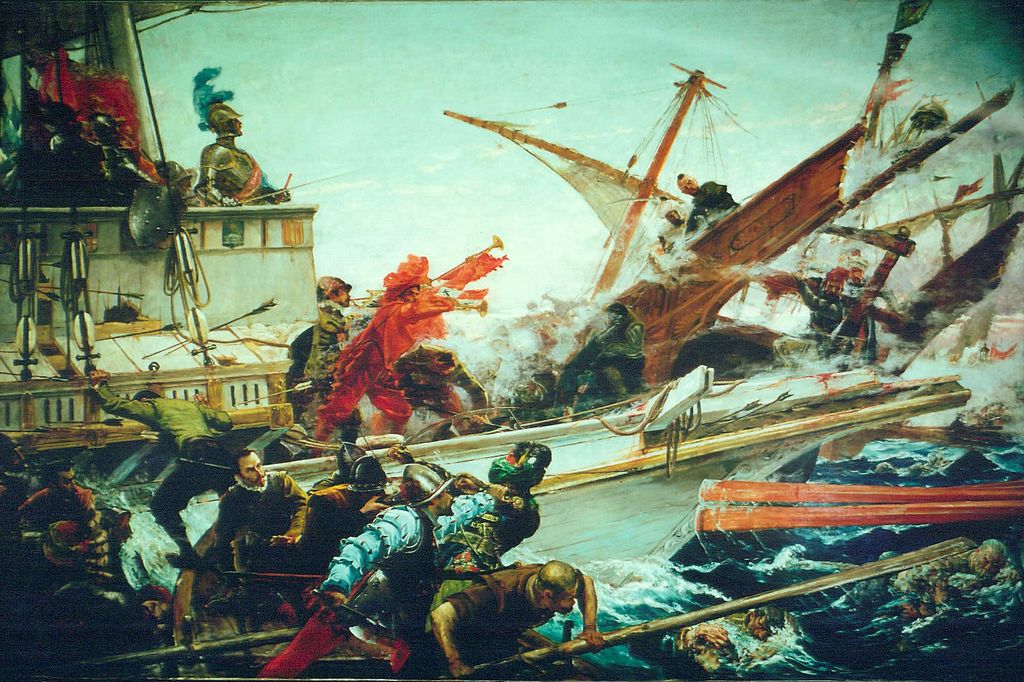
“The Battle of Lepanto”
Oil painting by Juan Luna, 1887. From the Senate of Spain collection via Wikimedia Commons.
Lepanto is a very famous battle, and one which means different things to different people. To a devout Roman Catholic like Chesterton, Lepanto takes on the romanticized and chivalrous form of a crusade — a war by the Holy League against the marauding Turk. At the time it was fought, to be sure, this was the way many in the Christian faction thought of their fight. Chesterton, for his part, writes that “the Pope has cast his arms abroad for agony and loss, and called the kings of Christendom for swords about the Cross”.
For historians, Lepanto is something like a requiem for the Mediterranean. Placed firmly in the early-modern period, fought between the Catholic powers of the inland sea and the Ottomans, then on the crest of their imperial rise, Lepanto marked a climactic ending to the long period of human history where the Mediterranean was the pivot of the western world. The coasts of Italy, Greece, the Levant, and Egypt — which for millennia had been the aquatic stomping grounds of empire — were treated to one more great battle before the Mediterranean world was permanently eclipsed by the rise of the Atlantic powers like the French and English. For those particular devotees of military history, Lepanto is very famous indeed as the last major European battle in which galleys — warships powered primarily by rowers — played the pivotal role.
There is some truth in all of this. The warring navies at Lepanto fought a sort of battle that the Mediterranean had seen many times before — battle lines of rowed warships clashing at close quarters in close proximity to the coast. A Roman, Greek, or Persian admiral may not have understood the swivel guns, arquebusiers, or religious symbols of the fleets, but from a distance they would have found the long lines of vessels frothing the waters with their oars to be intimately familiar. This was the last time that such a grand scene would unfold on the blue waters of the inner sea; afterwards the waters would more and more belong to sailing ships with broadside cannon.
Lepanto was all of these things: a symbolic religious clash, a final reprise of archaic galley combat, and the denouement of the ancient Mediterranean world. Rarely, however, is it fully understood or appreciated in its most innate terms, which is to say as a military engagement which was well planned and well fought by both sides. When Lepanto is discussed for its military qualities, stripped of its religious and historiographic significance, it is often dismissed as a bloody, unimaginative, and primitive affair — a mindless slugfest (the stereotypical “land battle at sea”) using an archaic sort of ship which had been relegated to obsolescence by the rise of sail and cannon.
Here we wish to give Lepanto, and the men who fought it, their proper due. The continued use of galleys well into the 16th century did not reflect some sort of primitiveness among the Mediterranean powers, but was instead an intelligent and sensible response to the particular conditions of war on that sea. While galleys would, of course, be abandoned eventually in favor of sailing ships, at Lepanto they remained potent weapons systems which fit the needs of the combatants. Far from being a mindless orgy of violence, Lepanto was a battle characterized by intelligent battle plans in which both the Turkish and Christian command sought to maximize their own advantages, and it was a close run and well fought affair. Lepanto was indeed a swan song for a very old form of Mediterranean naval combat, but it was a well conceived and well fought one, and Turkish and Christian fleets alike did justice to this venerable and ancient form of battle.
July 30, 2024
Sparta’s bane – Cicero labelled him “the foremost man of Greece”
The Theban general who finally broke the military power of Sparta:
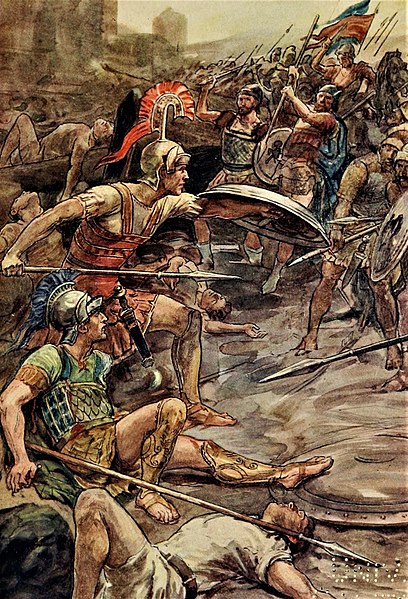
Epaminondas defending Pelopidas by William Rainey.
Illustration from Plutarch’s Lives for Boys and Girls: being selected lives freely retold (1900) via Wikimedia Commons.
The ancient Roman orator and statesman Cicero labeled him “the foremost man of Greece”. Cornelius Nepos, a biographer and contemporary of Cicero’s, regarded him as “incorruptible”. The 16th-century French Renaissance philosopher Michel de Montaigne judged him “one of the three worthiest and most excellent men” in all of history.
This man was a warrior-philosopher, a revolutionary, an ascetic, a statesman and diplomat, a liberator, and a military genius. Yet the deeds for which he is best remembered spanned less than two decades (379–362 BC), 2,400 years ago.
To whom am I referring?
His name was Epaminondas. If it doesn’t ring a bell, you’re not alone. Outside of Greece, few people anywhere today know of him. I never heard his name until this past April when an economist friend, Dr. Luke Jasinski of Maria Sklodowska University in Lublin, Poland, suggested I write about him. Luke says he:
…was a broad-minded man with a libertarian streak, a visionary who showed the Greek world a viable alternative to the endless wars of the time. For modern libertarians, his story is worth remembering. Impressed by it myself, I dedicated one of my economics books to him.
What we know about Epaminondas comes entirely from secondary sources. He left behind no writings that have survived, but from contemporaries and later historians, we do know at least this much about him:
- He was born in the Greek city-state of Thebes in the central Greek region of Boeotia, sometime between 419 and 411 BC, when Thebes was a tiny backwater. It would be largely due to Epaminondas and his loyal friend and fellow general Pelopidas that Thebes would become a powerhouse a few decades later.
- Sparta, the brutal city-state that governed the Greek region of the Peloponnesus, orchestrated a coup against the Theban government in 382 BC and installed an armed garrison there. Three years later, Epaminondas played a key role in a revolution that ended the Spartan dictatorship, restoring local, democratic government.
- In the wake of the Theban revolution, Sparta went to war with Thebes and its Boeotian allies for the next decade. When peace talks broke down in 371 BC, the stage was set for the climactic Battle of Leuctra. Through masterful and unprecedented tactics on the battlefield, Epaminondas led the outnumbered Theban armies to a decisive victory over the Spartans.
- To end the Spartan threat for good, Epaminondas invaded the Peloponnesus a year later. He liberated the region of Messenia that the Spartans had occupied and savaged two centuries earlier. Epaminondas did not subsume and subdue the Messenians; instead, he introduced democratic rule and then left. Grateful for their liberation, the Messenians became allies of Thebes and a buffer against the Spartans. Shortly thereafter, Epaminondas founded a new city in the northern Peloponnesus and named it Megalopolis. With Sparta shrunken and bottled up, its days as a menacing bully were numbered.
July 23, 2024
Why Most “Ancient” Buildings are Fakes
toldinstone
Published Apr 12, 2024Almost every ancient monument has been at least partially reconstructed, for a wide range of reasons …
Chapters:
0:00 Introduction
1:06 The Forum and Colosseum
2:27 The Ara Pacis
3:24 Early restorations
4:37 Mondly
5:47 Roman forts and baths
6:42 Knossos
7:23 The Stoa of Attalus
8:59 The Acropolis
10:05 When to restore?
(more…)


