
Overly Sarcastic Productions
Published Mar 15, 2024Ancient Greece created a social ecosystem of numerous independent cities to cater to my tastes specifically.
SOURCES & Further Reading:
The Greeks: A Global History by Roderick Beaton, 2021
The Greeks: An Illustrated History by Diane Cline, 2016
Men of Bronze: Hoplite Warfare in Ancient Greece by Donald Kagan & Gregory F. Viggiano, 2013
“Revolution” & “Tyranny” from Ancient Greek Civilization by Jeremy McInerney
“Dark Age and Archaic Greece” from The Foundations of Western Civilization by Thomas F. X. Noble
“Dark Age and Archaic Greece” & “The Greek Way of Waging War” & “Greek Language, Literacy, and Writing” from The Greek World: A Study of History and Culture by Robert Garland
I also have a degree in Classical Studies
(more…)
July 5, 2024
History Summarized: The Greek Age of Cities
June 30, 2024
Why Democracies Always Fail
The Why Minutes
Published Feb 21, 2024Why do democracies have a pesky habit of destroying themselves?
June 25, 2024
A Travel Guide to Crete in the Sixties (1964) | British Pathé
British Pathé
Published Apr 13, 2014This segment of Pathé Pictorial gives a snapshot of what the beautiful island of Crete, Greece looked like in the nineteen-sixties. From a rich history that is ever present in the architecture of the city to sunny beaches, Crete truly has it all.
A look at the many attractions on the island of Crete.
Various shots of tourists water skiing or lying on the beach in swimsuits and eating in restaurants. Various shots of the seashore caves where locals live in the summer. Various shots as they harvest grain, bake bread and weave outside. There are also shots of windmills in the fields and men milking goats.
People play the lyre and dance in a circle. Various shots of the ruined palace at Knossos including the pots, and paintings on the walls. Several more shots of holidaymakers on the beach.
(more…)
June 22, 2024
The End of Everything
In First Things, Francis X. Maier reviews Victor Davis Hanson’s recent work The End of Everything: How Wars Descend into Annihilation:
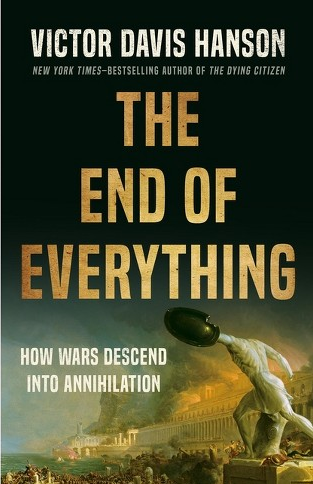
A senior fellow in military history and classics at Stanford University’s Hoover Institution, Hanson is a specialist on the human dimension and costs of war. His focus in The End of Everything is, as usual, on the past; specifically, the destruction of four great civilizations: ancient Thebes, Carthage, Constantinople, and the Aztec Empire. In each case, an otherwise enduring civilization was not merely conquered, but “annihilated” — in other words, completely erased and replaced. How such catastrophes could happen is the substance of Hanson’s book. And the lessons therein are worth noting.
In every case, the defeated suffered from fatal delusions. Each civilization overestimated its own strength or skill; each misread the willingness of allies to support it; and each underestimated the determination, strength, and ferocity of its enemy.
Thebes had a superb military heritage, but the Thebans’ tactics were outdated and their leadership no match for Macedon’s Alexander the Great. The city was razed and its surviving population scattered. Carthage — a thriving commercial center of 500,000 even after two military defeats by Rome — misread the greed, jealousy, and hatred of Rome, and Roman willingness to violate its own favorable treaty terms to extinguish its former enemy. The long Roman siege of the Third Punic War saw the killing or starvation of 450,000 Carthaginians, the survivors sold into slavery, the city leveled, and the land rendered uninhabitable for a century.
The Byzantine Empire, Rome’s successor in the East, survived for a millennium on superior military technology, genius diplomacy, impregnable fortifications, and confidence in the protection of heaven. By 1453, a shrunken and sclerotic Byzantine state could rely on none of these advantages, nor on any real help from the Christian West. But it nonetheless clung to a belief in the mantle of heaven and its own ability to withstand a determined Ottoman siege. The result was not merely defeat, but the erasure of any significant Greek and Christian presence in Constantinople. As for the Aztecs, they fatally misread Spanish intentions, ruthlessness, and duplicity, as well as the hatred of their conquered “allies” who switched sides and fought alongside the conquistadors.
The industrial-scale nature of human sacrifice and sacred cannibalism practiced by the Aztecs — more than 20,000 captives were ritually butchered each year — horrified the Spanish. It reinforced their fury and worked to justify their own ferocious violence, just as the Carthaginian practice of infant sacrifice had enraged the Romans. In the end, despite the seemingly massive strength of Aztec armies, a small group of Spanish adventurers utterly destroyed Tenochtitlán, the beautiful and architecturally elaborate Aztec capital, and wiped out an entire culture.
History never repeats itself, but patterns of human thought and behavior repeat themselves all the time. We humans are capable of astonishing acts of virtue, unselfish service, and heroism. We’re also capable of obscene, unimaginable violence. Anyone doubting the latter need only check the record of the last century. Or last year’s October 7 savagery, courtesy of Hamas.
The takeaway from Hanson’s book might be summarized in passages like this one:
Modern civilization faces a toxic paradox. The more that technologically advanced mankind develops the ability to wipe out wartime enemies, the more it develops a postmodern conceit that total war is an obsolete exercise, [assuming, mistakenly] that disagreements among civilized people will always be arbitrated by the cooler, more sophisticated, and more diplomatically minded. The same hubris that posits that complex tools of mass destruction can be created but never used, also fuels the fatal vanity that war itself is an anachronism and no longer an existential concern—at least in comparison to the supposedly greater threats of naturally occurring pandemics, meteoric impacts, man-made climate change, or overpopulation.
Or this one:
The gullibility, and indeed ignorance, of contemporary governments and leaders about the intent, hatred, ruthlessness, and capability of their enemies are not surprising. The retreat to comfortable nonchalance and credulousness, often the cargo of affluence and leisure, is predictable given unchanging human nature, despite the pretensions of a postmodern technologically advanced global village.
I suppose the lesson is this: There’s nothing sacred about the Pax Americana. Nothing guarantees its survival, legitimacy, comforts, power, or wealth. A sardonic observer like the Roman poet Juvenal — were he alive — might even observe that today’s America seems less like the “city on a hill” of Scripture, and more like a Carthaginian tophet, or the ritual site of child sacrifice. Of course, that would be unfair. A biblical leaven remains in the American experiment, and many good people still believe in its best ideals.
June 18, 2024
QotD: The peoples incorporated or “allied” to Rome in the Republic’s Italian expansion
In one way, pre-Roman Italy was quite a lot like Greece: it consisted of a bunch of independent urban communities situated on the decent farming land (that is the lowlands), with a number of less-urban tribal polities stretching over the less-farming-friendly uplands. While pre-Roman urban communities weren’t exactly like the Greek polis, they were fairly similar. Greek colonization beginning in the eighth century added actual Greek poleis to the Italian mix and frankly they fit in just fine. On the flip side, there were the Samnites, a confederation of tribal communities with some smaller towns occupying mostly rough uplands not all that dissimilar to the Greek Aetolians, a confederation of tribal communities and smaller towns occupying mostly rough uplands.
In one very important way, pre-Roman Italy was very much not like Greece: whereas in Greece all of those communities shared a single language, religion and broad cultural context, Roman Italy was a much more culturally complex place. Consequently, as the Romans slowly absorbed pre-Roman Italy into the Roman Italy of the Republic, that meant managing the truly wild variety of different peoples in their alliance system. Let’s quickly go through them all, moving from North to South.
The Romans called the region south of the Alps but north of the Rubicon River Cisalpine Gaul and while we think of it as part of Italy, the Romans did not. That said, Gallic peoples had pushed into Italy before and a branch of the Senones occupied the lands between Ariminum and Ancona. Although Gallic peoples were always a factor in Italy, the Romans don’t seem to have incorporated their communities as socii; indeed the Romans were generally at their most ruthless when it came to interactions with Gallic peoples (despite the tendency to locate the “unassimilable” people on the Eastern edge of Rome’s empire, it was in fact the Gauls that the Romans most often considered in this way, though as we will see, wrongly so). That’s not to say that there was no cultural contact, of course; the Romans ended up adopting almost all of the Gallic military equipment set, for instance. In any event, it wouldn’t be until the late first century BCE that Cisalpine Gaul was merged into Italy proper, so we won’t deal too much with the Gauls just yet. I do want to note that, when we are thinking about the diversity of the place, even to speak of “the Gauls” is to be terribly reductive, as we are really thinking of at least half a dozen different Gallic peoples (Senones, Boii, Inubres, Lingones, etc) along with the Ligures and the Veneti, who may have been blends of Gallic and Italic peoples (though we are more poorly informed about both than we’d like).
Moving south then, we first meet the Etruscans, who we’ve already discussed, their communities – independent cities joined together in defensive confederations before being converted into allies of the Romans – clustered on north-western coast of Italy. They had a language entirely unrelated to Latin – or indeed, any other known language – and their own unique religion and culture. The Romans adopted some portions of that culture (in particular the religious practices) but the Etruscans remained distinct well into the first century. While a number of Etruscan communities backed the Samnites in the Third Samnite War (298-290 BC) culminating in the Battle of Sentinum (295) as a last-ditch effort to prevent Roman hegemony over the peninsula, the Etruscans subsequently remained quite loyal to Rome, holding with the Romans in both the Second Punic and Social Wars. It is important to keep in mind that while we tend to talk about “the Etruscans” (as the Romans sometimes do) they would have thought of themselves first through their civic identity, as Perusines, Clusians, Populinians and so on (much like their Greek contemporaries).
Moving further south, we have the peoples of the Apennines (the mountain range that cuts down the center of Italy). The people of the northern Apennines were the Umbri (that is, Umbrian speakers), though this linguistic classification hides further cultural and political differences. We’ve met the Sabines – one such group, but there were also the Volsci and Marsi (the latter particularly well known for being hard fighters as allies to Rome; Appian reports that the Marsi had a saying prior to the Social War, “No Triumph against the Marsi nor without the Marsi”). Further south along the Apennines were the Oscan speakers, most notably the Samnites (who resisted the Romans most strongly) but also the Lucanians and Paelignians (the latter also get a reputation for being hard fighters, particularly in Livy). The Umbrian and Oscan language families are related (though about as different from each other as Italian from Spanish; they and Latin are not generally mutually intelligible) and there does seem to have been some cultural commonality between these two large groups, but also a lot of differences. Their religion included a number of practices and gods unknown to the Romans, some later adopted (Oscan Flosa adapted as Latin Flora, goddess of flowers) and some not (e.g. the “Sacred Spring” rite, Strabo 5.4.12).
Also Oscan speakers, the Campanians settled in Campania (surprise!) at some early point (perhaps around 1000-900 BC) and by the fifth century were living in urban communities politically more similar to Latium and Etruria (or Greece, which will make sense in a moment) than their fellow Oscan speakers in the hills above, to the point that the Campanians turned to Rome to aid them against the also-Oscan-speaking Samnites. The leading city of the Campanians was Capua, but as Fronda (op. cit.) notes, they were meaningful divisions among them; Capua’s very prominence meant that many of the other Campanians were aligned against it, a division the Romans exploited.
The Oscans struggled for territory in Southern Italy with the Greeks – told you we’d get to them. The Greeks founded colonies along the southern part of Italy, expelling or merging with the local inhabitants beginning in the seventh century. These Greek colonies have distinctive material culture (though the Italic peoples around them often adopted elements of it they found useful), their own language (Greek), and their own religion. I want to stress here that Greek religion is not equivalent to Roman religion, to the point that the Romans are sticklers about which gods are worshipped with Roman rites and which are worshipped with the ritus graecus (“Greek rites”) which, while not a point-for-point reconstruction of Greek rituals, did involve different dress, different interpretations of omens, and so on.
All of these peoples (except the Gauls) ended up in Rome’s alliance system, fighting as socii in Rome’s wars. The point of all of this is that this wasn’t an alliance between, say, the Romans and the “Italians” with the latter being really quite a lot like the Romans except not being from Rome. Rather, Rome had constructed a hegemony (an “alliance” in name only, as I hope we’ve made clear) over (::deep breath::) Latins, Romans, Etruscans, Sabines, Volsci, Marsi, Lucanians, Paelignians, Samnites, Campanians, and Greeks, along with some people we didn’t mention (the Falisci, Picenes – North and South, Opici, Aequi, Hernici, Vestini, etc.). Many of these groups can be further broken down – the Samnites consisted of five different tribes in a confederation, for instance.
In short, Roman Italy under the Republic was preposterously multicultural (in the literal meaning of that word) … and it turns out that’s why they won.
Bret Devereaux, “Collections: The Queen’s Latin or Who Were the Romans, Part II: Citizens and Allies”, A Collection of Unmitigated Pedantry, 2021-06-25.
May 19, 2024
“Alcibiades … would surely have spawned numerous Hollywood movies and novelistic treatments, had his name not been so long and complicated”
In The Critic, Armand D’Angour outlines the fascinating career of one of the great “characters” of ancient Greece, Alcibiades:
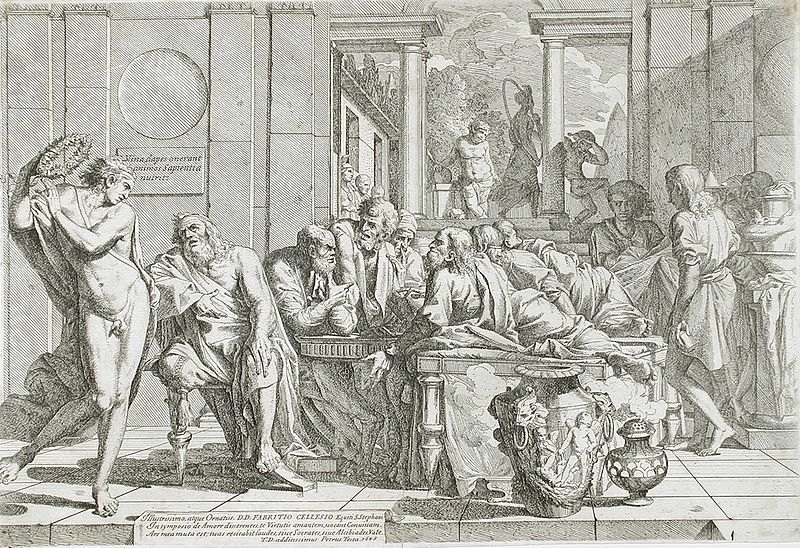
“Drunken Alcibiades interrupting the Symposium”, an engraving from 1648 by Pietro Testa (1611-1650)
Via Wikimedia Commons.
The career of the aristocratic Athenian politician, lover, general and traitor Alcibiades (c. 451–404 BC) is so well documented and colourful that it would surely have spawned numerous Hollywood movies and novelistic treatments, had his name not been so long and complicated (the standard English pronunciation is Al-si-BUY-a-deez).
His popularity, duplicity and unwavering self-regard make for ready points of comparison with modern politicians. The sheer amount of historical detail attached to his story is reflected in Aristotle’s comment in his Poetics: “Poetry is more scientific and serious than history, because it offers general truths whilst history gives particular facts … A ‘particular fact’ is what Alcibiades did or what was done to him.”
We know about “what Alcibiades did and what was done to him” from several authoritative ancient writers. The most entertaining portrayal, however, is that of the philosopher Plato (c. 425–347 BC), whose dialogue Symposium relates how Alcibiades gatecrashed a party at the home of the playwright Agathon, where several speeches had already been delivered on the theme of eros (love):
Suddenly there was a loud banging on the door, and the voices of a group of revellers could be heard outside along with that of a piper-girl. Agathon told his servants to investigate: “If they’re friends, invite them in,” he said.” If not, tell them the party’s over.” A little later they heard the voice of Alcibiades echoing in the courtyard. He was thoroughly drunk, and kept booming “Where’s Agathon? Take me to Agathon.” Eventually he appeared in the doorway, supported by a piper-girl and some servants. He was crowned by a massive garland of ivy and violets, and his head was flowing with ribbons. “Greetings, friends,” he said, “will you permit a very drunken man to join your party?”
Alcibiades proceeds to eulogise the wisdom and fortitude of his beloved mentor, the philosopher Socrates, detailing how the latter saved his life in a battle in Northern Greece in 432 BC at the start of the Peloponnesian War between Athens and Sparta, a conflict that dragged on until Athens’ defeat in 404 BC.
The prominence of Alcibiades in Platonic writings stems from his long and close relationship with Plato’s teacher Socrates. He was born in Athens to aristocratic forebears and at around the age of four lost his father Clinias, who was killed in battle in 447 BC. Along with his brother, Alcibiades entered the guardianship of Pericles, his mother’s cousin and Athens’ leading politician.
Shortly afterwards, Pericles was to take Aspasia of Miletus, a clever woman admired by Socrates, as his partner. Aspasia’s sister was married to Alcibiades the Elder, Clinias’ father, so Aspasia was Alcibiades’ great-aunt by marriage. Her acquaintance with Socrates might have been what led Pericles to appoint Socrates as a mentor for his young ward.
As a teenager Alcibiades was widely admired for his good looks and spirited personality, but he was also notorious for misdemeanours, such as when he struck a teacher for dishonouring Homer, released a bird into the Council chamber to disrupt proceedings, and paraded his dog in public with its tail docked.
Ambitious Athenians were expected to espouse a “love of honour” (philotimia), and Alcibiades displayed this to extremes. He married the daughter of a wealthy Athenian, and when she tried to divorce him because of his affairs, he lifted her bodily and carried her home through the crowded Agora.
May 18, 2024
The plight of Greek refugees after the Greco-Turkish War
As part of a larger look at population transfers in the Middle East, Ed West briefly explains the tragic situation after the Turkish defeat of the Greek invasion into the former Ottoman homeland in Anatolia:

“Greek dialects of Asia Minor prior to the 1923 population exchange between Greece and Turkey. Evolution of Greek dialects from the late Byzantine Empire through to the early 20th century leading to Demotic in yellow, Pontic in orange, and Cappadocian in green. Green dots indicate Cappadocian Greek speaking villages in 1910.”
Map created by Ivanchay via Wikimedia Commons.
While I understand why people are upset by the Nakba, and by the conditions of Palestinians since 1948, or particular Israeli acts of violence, I find it harder to understand why people frame it as one of colonial settlement. The counter is not so much that Palestine was 2,000 years ago the historic Jewish homeland – which is, to put it mildly, a weak argument – but that the exodus of Arabs from the Holy Land was matched by a similar number of Jews from neighbouring Arab countries. This completely ignored aspect of the story complicates things in a way in which some westerners, well-trained in particular schools of thought, find almost incomprehensible.
The 20th century was a period of mass exodus, most of it non-voluntary. Across the former Austro-Hungarian, Russian and Ottoman empires the growth in national consciousness and the demands for self-determination resulted in enormous and traumatic population transfers, which in Europe reached its climax at the end of the Second World War.
Although the bulk of this was directed at Germans, the aggressors in the conflict, they were not the only victims – huge numbers of Poles were forcibly moved out of the east of the country to be resettled in what had previously been Germany. The entire Polish community in Lwów, as they called it, was moved to Wrocław, formerly Breslau.
Maps of central and eastern Europe in the 19th century would have shown a confusing array of villages speaking a variety of languages and following different religions, many of whom wouldn’t have been aware of themselves as Poles, Romanians, Serbs or whatever. These communities had uneasily co-existed under imperial rulers until the spread of newspapers and telegraph poles began to form a new national consciousness, usually driven by urban intellectuals LARPing in peasant fantasies.
This lack of national consciousness was especially true of the people who came to be known as Turks; the Balkans in the late 19th century had a huge Muslim population, most of whom were subsequently driven out by nationalists of various kinds. Many not only did not see themselves as Turks but didn’t even speak Turkish; their ancestors had simply been Greeks or Bulgarians who had adopted the religion of the ruling power, as many people do. Crete had been one-third Muslim before they were pushed out by Greek nationalists and came to settle in the Ottoman Empire, which is why there is still today a Greek-speaking Muslim town in Syria.
This population transfer went both ways, and when that long-simmering hatred reached its climax after the First World War, the Greeks came off much worse. Half a million “Turks” moved east, but one million Greek speakers were forced to settle in Greece, causing a huge humanitarian crisis at the time, with many dying of disease or hunger.
That population transfer was skewed simply because Atatürk’s army won the Greco-Turkish War, and Britain was too tired to help its traditional allies and have another crack at Johnny Turk, who – as it turned out at Gallipoli – were pretty good at fighting.
The Greeks who settled in their new country were quite distinctive to those already living there. The Pontic Greeks of eastern Anatolia, who had inhabited the region since the early first millennium BC, had a distinct culture and dialect, as did the Cappadocian Greeks. Anthropologically, one might even have seen them as distinctive ethnic groups altogether, yet they had no choice but to resettle in their new homeland and lose their identity and traditions. The largest number settled in Macedonia, where they formed a slight majority of that region, with many also moving to Athens.
The loss of their ancient homelands was a bitter blow to the Greek psyche, perhaps none more so than the permanent loss of the Queen of Cities itself, Constantinople. This great metropolis, despite four and a half centuries of Ottoman rule, still had a Greek majority until the start of the 20th century but would become ethnically cleansed in the decades following, the last exodus occurring in the 1950s with the Istanbul pogroms. Once a mightily cosmopolitan city, Istanbul today is one of the least diverse major centres in Europe, part of a pattern of growing homogeneity that has been repeated across the Middle East.
But the Greek experience is not unique. Imperial Constantinople was also home to a large Jewish community, many of whom had arrived in the Ottoman Empire following persecution in Spain and other western countries. Many spoke Ladino, or Judeo-Spanish, a Latinate language native to Iberia. Like the Greeks and Armenians, the Jews prospered under the Ottomans and became what Amy Chua called a “market-dominant minority”, the groups who often flourish within empires but who become most vulnerable with the rise of nationalism.
And with the growing Turkish national consciousness and the creation of a Turkish republic from 1923, things got worse for them. Turkish nationalists and their allies murdered vast numbers of Armenians, Greeks and Assyrian Christians in the 1910s, and the atmosphere for Jews became increasingly tense too, with more frequent outbursts of communal violence. After the First World War, many began emigrating to Palestine, now under British control and similarly spiralling towards violence caused by demographic instability.
May 8, 2024
The nonsensical “right of return” debate
George Monastiriakos explains why he should have the right of return to his ancestral homeland:
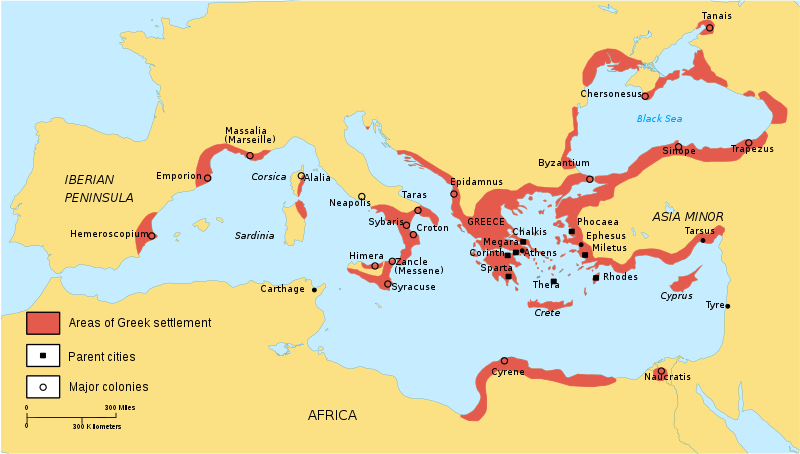
Greek colonization in the Archaic period.
Map by Dipa1965 via Wikimedia Commons.
My family hails from a small Greek village in Anatolia, in modern day Turkey, but I have unfortunately never been to my ancestral homeland because I was born a “refugee” in Montreal. Living in the “liberated zone” of Chomedey, Que., one of the biggest Greek communities in Canada, is the closest I’ve ever felt to my beloved Anatolia.
The Republic of Turkey does not have a legal right to exist. It is an illegitimate and temporary colonial project built by and for Turkish settlers from Central Asia. My ancestors resided on the Aegean coast of Asia Minor for thousands of years before the first Turks arrived on horseback from the barren plains of Mongolia. I will never relinquish my right to return to my ancestral homeland.
If you think these assertions are ridiculous, it’s because they are. I copied them from the shallow, even childish, anti-Israel discourse that’s prevalent on campuses in the United States and Canada, including the University of Ottawa, where I studied and now teach. I am a proud Canadian citizen, with no legal or personal connection to Anatolia. I have no intention, or right, to return to my so-called ancestral homeland. Except, perhaps, for a much-needed vacation. Even then, my stay would be limited to the extent permitted by Turkish law.
The Second Greco-Turkish War concluded with the Treaty of Lausanne in 1923. Among other things, this agreement finalized the forced displacement of nearly one-million Ottoman Greeks to the Kingdom of Greece, and roughly 500,000 Greek Muslims to the newly formed Republic of Turkey. This ended the over 3,000 years of Greek history in Anatolia, and served as a model for the partition of British India, which saw the emergence of a Hindu majority state and a Muslim majority state some two decades later.
With their keys and property deeds in hand, my paternal grandmother’s family fled to the Greek island of Samos, on the opposite side of the Mycale Strait at a nearly swimmable distance from the Turkish coast. While they practised the Greek Orthodox religion and spoke a dialect of the Greek language, they were strangers in a foreign land with no legal or personal connection to the Kingdom of Greece.
The Great War channel produced an overview of the Greco-Turkish War of 1919-1923 that resulted in the vast human tragedy of the expulsion of ethnic Greek civilians from Anatolia and ethnic Turkish civilians from mainland Greece here.
May 3, 2024
QotD: Colonialism in the ancient Mediterranean
Greek settlement in the late Bronze Age (c. 1500-1100) was focused on the Greek mainland, though we have Greek (“Mycenean”) settlements on the Aegean islands (and Crete) and footholds on the west coast of Asia Minor (modern Turkey). Over the Dark Age – a period where our evidence is very poor indeed, so we cannot see very clearly – the area of Greek-speaking settlement in the Aegean expands and Greek settlements along that West coast of Asia Minor expand dramatically. Our ancient sources preserve legends about how these Greeks (particularly the Ionians, inhabiting the central part of that coastal strip) got there, having been supposedly expelled from Achaia on the northern side of the Peloponnese, but it’s unclear how seriously we should take those legends. But the key point here is that the outward motion of Greeks from mainland Greece proper begins quite early (c. 1100) and is initially local and probably not as organized as the subsequent second phase beginning in the 8th century, which is going to be our focus here.
Our other group are the Phoenicians. They did not call themselves that either; it derives from the Greeks who called them Phoinices (φοίνικες), which like the Roman Poeni may have had its roots in Egyptian fnḫw or perhaps Israelite Ponim.1 In any case, the word is old, as it appears in Linear B tablets dating to the Mycenean period (that 1500-1100 period). The Phoenicians themselves, if asked to call themselves something, would more likely have said Canaans, Kn’nm, though much like the Greeks tended to be Athenians, Spartans, Thebans and so on first, the Phoenicians tended to be Sidonians, Tyrians and so on first. They spoke a Semitic language which we call Phoenician (closely related to Biblical Hebrew) and they invented the alphabet to represent it; this alphabet was copied by the Greeks to represent their language, who were in turn copied by the Romans to represent their language, whose alphabet in turn was adopted by subsequent Europeans to represent their languages – which is the alphabet which I am writing with to you now.
Since at least the late bronze age, they lived in a series of city states on the eastern edge of the Mediterranean in Phoenicia in the Levant in what today would mostly be Lebanon. During the late bronze age, this was the great field of contested influence between the Hittite, (Middle) Assyrian and (New Kingdom) Egyptian Empires. The Late Bronze Age Collapse removed those external influences, leading to a quick recovery from the collapse and then efflorescence in the region. They had many cities, but the most important by this point are Sidon and Tyre; by the 9th century, Tyre emerged as chief over Sidon and may at times have controlled it directly, but this was short lived as the whole region came under the control of the (Neo)Assyrian Empire in 858. The Assyrians demanded heavy tribute (which may contribute to colonization, discussed below) but only vassalized rather than annexed Tyre, Byblos and Sidon, the three largest Phoenician cities.
Both the Greeks and the Phoenicians have one thing in common at the start, which is that these are societies oriented towards the sea. Their initial area of settlement is coastal and both groups were significant sea-faring societies even during the late Bronze Age and remained so by the Archaic period. Both regions, while not resource poor (Phoenicia was famous for its timber, Lebanese cedar), are not resource rich either, particularly in agricultural resources. Compared to the fertility of Mesopotamia, Egypt or even Italy, these were drier, more marginal places, which may go some distance to explaining why both societies ended up oriented towards the sea: it was there and they could use the opportunities.
Bret Devereaux, “Collections: Ancient Greek and Phoenician Colonization”, A Collection of Unmitigated Pedantry, 2023-10-13.
1. The former is what I’ve found in dictionary entries for etymologies, the latter is what Dexter Hoyos suggests, Carthaginians (2010), 1. I am not an expert on Semitic languages, linguistics or etymologies, so don’t ask me to decide between them.
April 29, 2024
Greek History and Civilization, Part 7 – Alexander
seangabb
Published Apr 28, 2024This seventh lecture in the course covers the career of Alexander the Great and its consequences for the world.
(more…)
April 12, 2024
Greek History and Civilization, Part 6 – The Search for Stability
seangabb
Published Apr 7, 2024This sixth lecture in the course deals with the period of Greek history between the end of the Persian Wars and the assassination of Philip II of Macedon.
(more…)
April 2, 2024
QotD: Supersizing the Polis, Roman-style
Which leads into the other major difference: size. We’re going to be taking a snapshot of the Roman Republic, necessary because the republic changed over time. In particular what we’re going to look at here is really a snapshot of the republic as it functioned in the third and second centuries, what Roman historians call the “Middle Republic” (c. 287-91BC). Harriet Flower defines this period as part of “the republic of the nobiles” which as we’ll see is an apt title as well.
But even by the beginning of this period, the Roman Republic is enormous by the standards of a polis. While a polis like Athens or Sparta with total populations in the low hundreds of thousands was already very large by Greek standards, the Roman Republic was much bigger. We know that in Italy in 225 there was something on the order of three hundred thousand Roman citizens liable for conscription, which implies a total citizen population right around a million. And that massive polity in turn governed perhaps another two million other Italians who were Rome’s “socii” (“allies”), perhaps the social category at Rome closest to “resident foreigners” (metics) in Greek poleis. This is in Italy alone, not counting Rome’s “overseas” holdings (at that point, Sicily, Corsica and Sardinia). In short, the Roman Republic may in some ways be shaped like a polis, but it was a full order of magnitude larger than the largest poleis, even before it acquired provinces outside of Italy. As you may imagine, that has implications!
Bret Devereaux, “Collections: How to Roman Republic 101, Part I: SPQR”, A Collection of Unmitigated Pedantry, 2023-07-21.
March 22, 2024
Rome conquered Greece … militarily, anyway
In The Critic, Gavin McCormick reviews Charles Freeman’s new book The Children of Athena: Greek writers and thinkers in the age of Rome, 150BC – 400AD:
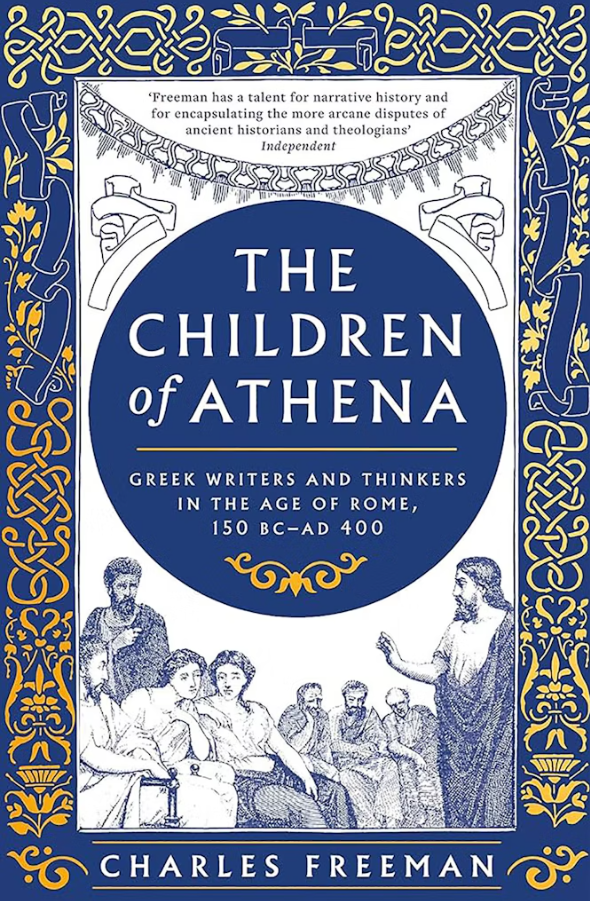
“To a wise man,” said the first-century wonderworker Apollonius of Tyana, “everywhere is Greece.” That is to say, Greece is not a mere place, but a special state of mind. For Apollonius, on his extensive travels around the Greco-Roman world, the purported truth of this maxim is seldom open to doubt.
The author of Apollonius’s colourful biography, Philostratus, depicts his hero as not just a philosopher but also an impossibly accomplished champion of culture — a confounder of logic and expectations who could vanish in plain sight, now fascinating Roman emperors and foreign sages, now inspiring whole towns into acts of celebration and renewal. The guiding ideology that drove this hero is a heady mix of philosophy, religion, magic and political insouciance — or, to give it another name, Hellenism.
In the context of the third-century world, where Christianity was an increasingly noteworthy presence in the towns and cities of the Roman empire, pagans such as Philostratus were keen to highlight what their own tradition had to offer.
In fact, he seems almost to present his hero as a pagan rival to Jesus. And, in turn, Apollonius — in his successful renewal of the shrines and local cults of Hellas — seems to hint at what Philostratus would like to see happen in his own contemporary context.
Despite living under Rome, Apollonius (and Philostratus) wants to celebrate an emphatically Greek form of culture. The celebration of Greek culture in the Roman world was, of course, nothing new, and it was something the Romans themselves had long enjoyed.
Alongside their admiration for Greek literature, philosophy, art and architecture, there was the successful movement known as the “Second Sophistic” — whose parade of Greek-speaking intellectuals left a heavy imprint on the public life of the High Roman Empire.
But it is striking nonetheless that the virtues of Hellas — not Rome itself — were what many educated citizens of the empire turned to when they thought of cultural renewal. Indeed his was precisely the route taken later in the fourth century by the last pagan emperor of Rome, himself a champion of all things Greek, Julian the so-called Apostate.
Charles Freeman’s latest book, Children of Athena, is a highly readable tour through the lives and accomplishments of some of the great exponents of Greek culture under Rome. He introduces readers to a bracingly varied and energetic cast of characters — the geographers, doctors, polymaths, botanists, satirists, and orators are just part of the repertoire. In an early chapter, we meet the brilliant Greek historian Polybius, who wrote in the tradition of Herodotus and Thucydides, while training his sights on the rise of Rome in his own time.
March 20, 2024
QotD: Ancient Greek tyranny
We see the first major wave of tyrannies emerging in Greek poleis in the sixth century, although this is also about the horizon where we can see political developments generally in the Greek world, still our sources seem to understand this development to have been somewhat novel at the time and it is certainly tempting to see the emergence of tyranny and democracy in this period both as responses to the same sorts of pressures and fragility found in traditional polis oligarchies, but again our evidence is thin. Tyrants tend to come from the elite, oligarchic class and often utilize anti-oligarchic movements (civil strife or stasis, στάσις) to come to power.
Because most poleis are small, the amount of force a tyrant needed to seize power was also often small. Polycrates supposedly seized power in Samos with just fifteen soldiers (Hdt. 3.120), though we may doubt the truth of the report and elsewhere Herodotus notes that he did so in conspiracy with his two brothers of whom he killed one and banished the other (Hdt. 3.39). I’ve discussed Peisistratos’ takeover(s) in Athens before but they were similarly small-ball affairs. In Corinth, Cypselus seized power by using his position as polemarch (war leader) to have the army (which, remember, is going to be a collection of the non-elite but still well-to-do citizenry, although this is early enough that if I call it a hoplite phalanx I’ll have an argument on my hands) expel the Bacchiadae, a closed single-clan oligarchy. A move by any member of the elite to put together their own bodyguard (even one just armed with clubs) was a fairly clear indicator of an attempt to form a tyranny and the continued maintenance of a bodyguard was a staple of how the Greeks understood a tyrant.
Having seized power, those tyrants do not seem to have abolished key civic institutions: they do not disband the ekklesia or the law courts. Instead, the tyrant controls these things by co-opting the remaining elite families, using violence and the threat of violence against those who would resist and installing cronies in positions of power. Tyrants also seem to have bought a degree of public acquiescence from the demos by generally targeting the oligoi, as with Cypselus and his son Periander killing and banishing the elite Bacchiadae from Corinth (Hdt. 5.92). But this is a system of government where in practice the laws appeared to still be in force and the major institutions appeared to still be functioning but that in practice the tyrant, with his co-opted elites, armed bodyguard and well-rewarded cadre of followers among the demos, monopolized power. And it isn’t hard to see how the fiction of a functioning polis government could be a useful tool for a tyrant to maintain power.
That extra-constitutional nature of tyranny, where the tyrant exists outside of the formal political system (even though he may hold a formal office of some sort) also seems to have contributed to tyranny’s fragility. Thales was supposedly asked what the strangest thing he had ever seen was and his answer was, “An aged tyrant” (Diog. Laert. 1.6.36) and indeed tyranny was fragile. Tyrants struggled to hold power and while most seem to have tried to pass that power to an heir, few succeed; no tyrant ever achieves the dream of establishing a stable, monarchical dynasty. Instead, tyrants tend to be overthrown, leading to a return to either democratic or oligarchic polis government, since the institutions of those forms of government remained.
Bret Devereaux, “Collections: How to Polis, 101, Part IIa: Politeia in the Polis”, A Collection of Unmitigated Pedantry, 2023-03-17.
March 19, 2024
Greek History and Civilization, Part 5 – The Greeks Fight Back
seangabb
Published Mar 17, 2024This fifth lecture in the course deals with the defeat of Persian invasion of Greece in 480 BC, ending with the creation of the Delian League and the varying fortunes of Xerxes and Themistocles.
(more…)


