
seangabb
Published Feb 18, 2024This fourth lecture in the course deals with the Persian invasion of Greece in 480 BC, ending with the glory of Thermopylae and the burning of Athens.
(more…)
February 27, 2024
Greek History and Civilisation, Part 4 – The Ancient Greeks: The Great Invasion
Comments Off on Greek History and Civilisation, Part 4 – The Ancient Greeks: The Great Invasion
February 21, 2024
Greek History and Civilisation, Part 3 – The Ancient Greeks: Rising Tensions with Persia
seangabb
Published Feb 18, 2024This third lecture in the course deals with the rise of the Persian Empire, and the growing tensions between the Persians and the Greeks, culminating in an account of the Battle of Marathon in 490 BC.
(more…)
Comments Off on Greek History and Civilisation, Part 3 – The Ancient Greeks: Rising Tensions with Persia
February 15, 2024
The Big Picture – NATO: Partners in Peace (1954)
Army University Press
Published Nov 13, 2023NATO: Partners in Peace follows the creation and impact of the North Atlantic Treaty Organization (NATO). Created in April 1949 with twelve founding members, this organization’s goal was to protect the inherent rights of individual states through collective defense. In this episode from The Big Picture series, General Dwight D. Eisenhower offers a speech before he deploys to Europe to become the first Supreme Allied Commander Europe (SACEUR). This is followed with footage of the buildup and training of European forces. Once Eisenhower leaves NATO to campaign for the presidency, General Matthew Ridgway replaces him as NATO commander. One significant problem NATO forces faced was the fact that each nation had its own weapon systems and ammunition, an issue the U.S. wanted to address with the standardization of the 7.62mm cartridge. Perhaps as a deterrent to the Soviet Union, NATO: Partners in Peace depicts new weapons that could be used against a large enemy force such as remote-controlled missiles, napalm bombs, and the massive atomic cannon.
Comments Off on The Big Picture – NATO: Partners in Peace (1954)
February 13, 2024
Greek History and Civilisation, Part 2 – Sparta and Athens: Contrasting Societies
seangabb
Published Feb 11, 2024This second lecture in the course contrasts Athens and Sparta, the two leading societies in Greece — one a commercial society with high levels of personal freedom and citizen participation, the other a militarised oligarchy.
[NR: Some additional information to supplement Dr. Gabb’s lecture:
– “Citizenship” in the ancient and clasical world
– Sparta had Lycurgus, while Athens had Solon … who at least actually existed
– The Constitution of Athens
– The Constitution of the Spartans
– The Myth of Spartan Equality
– Relative wealth among the Spartiates
– Sparta’s military reputation as “the best warriors in all of Greece”
– Sparta – the North Korea of the Classical era
– Spartan glossary]
(more…)
Comments Off on Greek History and Civilisation, Part 2 – Sparta and Athens: Contrasting Societies
February 6, 2024
Greek History and Civilisation, Part 1 – What Makes the Greeks Special?
seangabb
Published Feb 1, 2024This first lecture in the course makes a case for the Greeks as the exceptional people of the Ancient World. They were not saints: they were at least as willing as anyone else to engage in aggressive wars, enslavement, and sometimes human sacrifice. At the same time, working without any strong outside inspiration, they provided at least the foundations for the science, mathematics, philosophy, art and secular literature of later peoples.
(more…)
Comments Off on Greek History and Civilisation, Part 1 – What Makes the Greeks Special?
January 26, 2024
QotD: How an oath worked in pre-modern cultures
You swear an oath because your own word isn’t good enough, either because no one trusts you, or because the matter is so serious that the extra assurance is required.
That assurance comes from the presumption that the oath will be enforced by the divine third party. The god is called – literally – to witness the oath and to lay down the appropriate curses if the oath is violated. Knowing that horrible divine punishment awaits forswearing, the oath-taker, it is assumed, is less likely to make the oath. Interestingly, in the literature of classical antiquity, it was also fairly common for the gods to prevent the swearing of false oaths – characters would find themselves incapable of pronouncing the words or swearing the oath properly.
And that brings us to a second, crucial point – these are legalistic proceedings, in the sense that getting the details right matters a great deal. The god is going to enforce the oath based on its exact wording (what you said, not what you meant to say!), so the exact wording must be correct. It was very, very common to add that oaths were sworn “without guile or deceit” or some such formulation, precisely to head off this potential trick (this is also, interestingly, true of ancient votives – a Roman or a Greek really could try to bargain with a god, “I’ll give X if you give Y, but only if I get by Z date, in ABC form.” – but that’s vows, and we’re talking oaths).
Thus for instance, runs an oath of homage from the Chronicle of the Death of Charles the Good from 1127:
“I promise on my faith that I will in future be faithful to count William, and will observe my homage to him completely against all persons in good faith and without deceit.”
Not all oaths are made in full, with the entire formal structure, of course. Short forms are made. In Greek, it was common to transform a statement into an oath by adding something like τὸν Δία (by Zeus!). Those sorts of phrases could serve to make a compact oath – e.g. μὰ τὸν Δία! (yes, [I swear] by Zeus!) as an answer to the question is essentially swearing to the answer – grammatically speaking, the verb of swearing is necessary, but left implied. We do the same thing, (“I’ll get up this hill, by God!”). And, I should note, exactly like in English, these forms became standard exclamations, as in Latin comedy, this is often hercule! (by Hercules!), edepol! (by Pollux!) or ecastor! (By Castor! – oddly only used by women). One wonders in these cases if Plautus chooses semi-divine heroes rather than full on gods to lessen the intensity of the exclamation (“shoot!” rather than “shit!” as it were). Aristophanes, writing in Greek, has no such compunction, and uses “by Zeus!” quite a bit, often quite frivolously.
Nevertheless, serious oaths are generally made in full, often in quite specific and formal language. Remember that an oath is essentially a contract, cosigned by a god – when you are dealing with that kind of power, you absolutely want to be sure you have dotted all of the “i”‘s and crossed all of the “t”‘s. Most pre-modern religions are very concerned with what we sometimes call “orthopraxy” (“right practice” – compare orthodoxy, “right doctrine”). Intent doesn’t matter nearly as much as getting the exact form or the ritual precisely correct (for comparison, ancient paganisms tend to care almost exclusively about orthopraxy, whereas medieval Christianity balances concern between orthodoxy and orthopraxy (but with orthodoxy being the more important)).
Bret Devereaux, “Collections: Oaths! How do they Work?”, A Collection of Unmitigated Pedantry, 2019-06-28.
Comments Off on QotD: How an oath worked in pre-modern cultures
December 31, 2023
Budapest Under Siege – WW2 – Week 279 – December 30, 1944
World War Two
Published 30 Dec 2023In the west, the Allies break the siege of Bastogne, but the fight for the Ardennes continues. and British commander Bernard Montgomery is maneuvering to take command of the Western Front ground forces. In Hungary Budapest is cut off by the Soviets and under siege, with hundreds of thousands of civilians still in the city. The fight in Italy is winding down for the winter, but the fight in the Philippines continues. In fact, American landings on Luzon are planned to go off soon.
00:00 INTRO
01:22 The Siege of Bastogne
03:10 The failure of 5th and 6th Panzer Armies
06:11 Montgomery wants command
09:27 Guderian appeals to Hitler, “stop the Ardennes Offensive!”
12:11 Budapest surrounded and under siege
17:04 Wrapping up the Gothic Line Campaign
19:29 Churchill in Athens
20:30 The fight in the Philippines
23:07 SUMMARY
(more…)
Comments Off on Budapest Under Siege – WW2 – Week 279 – December 30, 1944
December 24, 2023
The Siege of Bastogne Begins – WW2 – Week 278 – December 23, 1944
World War Two
Published 23 Dec 2023The German Ardennes Offensive, called by the Allies the Battle of the Bulge, is in full swing in Luxembourg and Belgium this week, and the Germans have the key junction town of Bastogne under siege. On the Allied side there comes a large American surrender, plans for counterattacks, and tension growing between British and American Commands. The fight in both Italy and the Philippines continues, and in Hungary the Soviets have nearly surrounded Budapest.
00:26 Intro
01:06 The Battle of the Bulge
03:54 The Malmedy Massacre
06:25 Bastogne
10:00 American Surrender on Schnee Eifel
12:06 Patton plans a counterattack
15:44 Bernard Montgomery and Omar Bradley
18:12 The Red Army advances around Budapest
21:39 Fighting in Italy and Greece
22:45 Leyte and Mindoro
25:07 Conclusion
(more…)
Comments Off on The Siege of Bastogne Begins – WW2 – Week 278 – December 23, 1944
December 17, 2023
The Battle of the Bulge Begins – WW2 – Week 277 – December 16, 1944
World War Two
Published 16 Dec 2023Adolf Hitler’s Ardennes counteroffensive finally goes off this week, and it does indeed catch the Allies by surprise, and they suspend other offensive operations in the west. They are still attacking in Italy, and the Soviets are still advancing in Hungary, trying to cut off Budapest. In the Far East, there are Allied landings on Mindoro, and they are also on the march in Burma, hoping to pin down the enemy.
0:00 Intro
0:55 Recap
1:22 Street fighting in Athens
04:07 Operation Queen ends
06:33 Autumn Mist Offensive plans
09:51 Allied intelligence failures
12:26 The Ardennes Offensive Begins
16:57 Allied attacks in Italy and Soviet plans to surround Budapest
20:07 The Allied offensive in Burma
22:10 Mindoro Landings
24:33 Summary
25:14 Conclusion
(more…)
Comments Off on The Battle of the Bulge Begins – WW2 – Week 277 – December 16, 1944
December 13, 2023
How Churchill Started the Cold War in Greece in 1944 – War Against Humanity 121
World War Two
Published 12 Dec 2023You might think that the Cold War starts after this war ends. But already, as the Germans withdraw from Greece, the ideologically opposed Greek resistance groups ELAS and EDES are at each others’ throats. It all culminates in Athens in December 1944; British troops fire some of the first shots of the Cold War as Greece descends into Civil War.
(more…)
Comments Off on How Churchill Started the Cold War in Greece in 1944 – War Against Humanity 121
December 10, 2023
Can the Americans Stop the Kamikazes? – WW2 – Week 276 – December 9, 1944
World War Two
Published 9 Dec 2023This is a very busy week of the war. In the west, the Americans manage to reach the Roer River in force, but haven’t taken any of its dams; in Italy, the Allies liberate Ravenna; the Soviet advance in Hungary continues, and the Soviets even set up a new Hungarian government; martial law is declared in Greece; the Japanese make a corridor to Indochina; the fighting on Leyte continues, and the kamikaze menace becomes ever more worrisome.
00:00 INTRO
01:10 British intelligence failure
01:55 Allies reach the Roer River
05:35 Problems with Devers’ 6th Army Group
07:41 Allies liberate Ravenna
08:50 Soviet advances in Hungary
12:10 Soviets set up a new Hungarian government
13:47 A deadly demonstration and martial law in Greece
18:33 Japanese establish a corridor to Indochina
19:59 Leyte and kamikaze attacks
23:45 CONCLUSION
(more…)
Comments Off on Can the Americans Stop the Kamikazes? – WW2 – Week 276 – December 9, 1944
December 3, 2023
Was Hürtgen Forest Worth it? WW2 – Week 275 – December 2, 1944
World War Two
Published 2 Dec 2023The bulk of the fight for Hürtgen Forest is now over, and today we look at the results. We also look at Soviet plans for their January offensive. In the field this week, the Red Army is still fighting in Hungary, the Allies are still trying to reach the Roer River in the west, and in the Pacific Theater the kamikaze menace is wreaking havoc with Allied scheduling.
00:00 INTRO
01:06 Soviet Offensive Plans for 1945
03:12 Red Army attacks in Hungary
06:19 The Port of Antwerp is clear for use
07:23 The Battle of Hurtgen Forest is Over
12:20 Allied advances to the Roer
14:19 Tension builds in Greece
15:32 The aerial situation in the Philippines
21:36 CONCLUSION
(more…)
Comments Off on Was Hürtgen Forest Worth it? WW2 – Week 275 – December 2, 1944
November 24, 2023
QotD: “Citizenship” in the ancient and classical world
Citizenship status was clearly extremely important to the ancients whose communities had it. Greek and Roman writers, for instance, do not generally write that “Athens” or “Carthage” do something (go to war, make peace, etc), but rather that “the Athenians” or “the Carthaginians” do so – the body of citizens acts, not the state. Only citizens (or more correctly, adult citizen-males) were permitted to engage in direct political activity – voting, speaking in the assembly, or holding office – in a Greek polis; at Athens, for a non-citizen to do any of these things (or to pretend to be a citizen) carried the death penalty. This status was a jealously guarded one. It had other legal privileges; as early as Draco’s homicide law (laid down in 622/1) it is clear that there were legal advantages to Athenian citizenship. After Solon (Archon in 594), Athenian citizens became legally immune to being reduced to slavery; non-citizen foreigners who fell into debt were apparently not so protected (for more on this, see S. Lape, Race and Citizen Identity in the Classical Athenian Democracy (2010), 9ff). Citizenship, for those who had it, was likely the most important communal identity they had – certainly more so than linguistic or ethnic connections (an Athenian was an Athenian first, a Greek a distant second).
So then who got to be a citizen? At Athens, the rules changed a little over time. Solon’s reforms may mark the point at which citizenship became the controlling identity (Lape, op. cit. makes this argument). While Solon himself briefly opened up Athenian citizenship to migrants with useful skills, that door was soon slammed shut (Plut. Sol. 24.2); citizenship was largely limited to children with both a citizen father and a citizen mother (this seems to have been more flexible early on but was codified into law in 451/0 by Pericles). Bastards (the Greek term is nothoi) were barred from the citizenship at least from the reforms of Cleisthenes in 509/8. This exclusivity was not unique to Athens; recall that Spartiate status worked the same way (albeit covering an even smaller class of people). Likewise, our Latin sources on Carthage – no Carthaginian account of their government (or indeed any Carthaginian literature) survives – suggest that only Carthaginians whose descent could be traced to the founding settlers had full legal rights. Under the reforms of Cleisthenes (509/8), each Athenian, upon coming of age, had their claim to citizenship assessed by the members of their respective deme (a legally defined neighborhood) to determine if they were of Athenian citizen stock on both sides.
It is worth discussing the implication of those rules. The rules of Athenian citizenship imagine the citizen body as a collection of families, recreating itself, generation to generation, with perhaps occasional expulsions, but with minimal new entrants. Citizens only married other citizens because that was the only condition under which they could have valid citizen children. Such a policy creates a legally defined ethnic group that is – again, legally – incapable of incorporating or mixing with other groups. In this sense, Athenian citizenship, like most ancient citizenship, was radically exclusionary. Thousands of people lived permanently in Athens – resident foreigners called metics – with no hope of ever gaining Athenian citizenship, because there were no formal channels to ever do so.
(As an aside, it was possible for the Athenian citizenry to admit new members, but only by an act of the Ekklesia, the Athenian assembly. For a modern sense of what that means, imagine if it was only possible to become an American citizen by an act of Congress (good luck with the 60 votes to break a filibuster!) that names you, specifically as a new citizen. We don’t know exactly how many citizens were so admitted into the Athenian citizen body, but it was clearly very low – probably only a few hundred through the entire fourth century, for instance. In practice, this was a system where there were no formal mechanisms for naturalizing new citizens at all, that only occasionally made very specific exceptions for individuals or communities.)
In short, while there were occasional exceptions where the doorway to citizenship in a community might open briefly, in practice the citizen body in a Greek polis was a closed group of families which replaced themselves through the generations but did not admit new arrivals and instead prided themselves on the exclusive value of the status they held. The fact that the citizen body of these poleis couldn’t expand to admit new members or incorporate new communities but had become calcified and frozen would eventually doom the Greeks to lose their independence, since polities of such small size could not compete in the world of great kingdoms and empires that emerged with Philip II and Alexander.
Bret Devereaux, “Collections: The Queen’s Latin or Who Were the Romans, Part II: Citizens and Allies”, A Collection of Unmitigated Pedantry, 2021-06-25.
Comments Off on QotD: “Citizenship” in the ancient and classical world
November 20, 2023
QotD: Flax and linen in the ancient and medieval world
Flax is a productive little plant that produces two main products: flax seeds, which are used to produce linseed oil, and the bast of the flax plant which is used to make linen. The latter is our focus here so I am not going to go into linseed oil’s uses, but it should be noted that there is an alternative product. That said, my impression is that flax grown for its seeds is generally grown differently (spaced out, rather than packed together) and generally different varieties are used. That said, flax cultivated for one purpose might produce some of the other product (Pliny notes this, NH 19.16-17)
Flax was a cultivated plant (which is to say, it was farmed); fortunately we have discussed quite a bit about farming in general already and so we can really focus in on the peculiarities of the flax plant itself; if you are interested in the activities and social status of farmers, well, we have a post for that. Flax farming by and large seems to have involved mostly the same sorts of farmers as cereal farming; I get no sense in the Greco-Roman agronomists, for instance, that this was done by different folks. Flax farming changed relatively little prior to mechanization; my impression reading on it is that flax was farmed and gathered much the same in 1900 BC as it was in 1900 AD. In terms of soil, flax requires quite a lot of moisture and so grows best in either deep loam or (more commonly used in the ancient world, it seems) alluvial soils; in both cases, it should be loose, unconsolidated “sandy” (that is, small particle-sized) soil. Alluvium is loose, often sandy soil that is the product of erosion (that is to say, it is soil composed of the bits that have been eroded off of larger rocks by the action of water); the most common place to see lots of alluvial soil are in the flood-plains of rivers where it is deposited as the river floods forming what is called an alluvial plain.
Thus Pliny (NH 19.7ff) when listing the best flax-growing regions names places like Tarragona, Spain (with the seasonally flooding Francoli river) or the Po River Basin in Italy (with its large alluvial plain) and of course Egypt (with the regular flooding of the Nile). Pliny notes that linen from Sætabis in Spain was the best in Europe, followed by linens produced in the Po River Valley, though it seems clear that the rider here “made in Europe” in his text is meant to exclude Egypt, which would have otherwise dominated the list – Pliny openly admits that Egyptian flax, while making the least durable kind of linen (see below on harvesting times) was the most valuable (though he also treats Egyptian cotton which, by his time, was being cultivated in limited amounts in the Nile delta, as a form of flax, which obviously it isn’t). Flax is fairly resistant to short bursts of mild freezing temperatures, but prolonged freezes will kill the plants; it seems little accident that most flax production seems to have happened in fairly warm or at least temperate climes.
Flax is (as Pliny notes) a very fast growing plant – indeed, the fastest growing crop he knew of. Modern flax grown for fibers is generally ready for harvesting in roughly 100 days and this accords broadly with what the ancient agronomists suggest; Pliny says that flax is sown in spring and harvested in summer, while the other agronomists, likely reflecting practice further south suggest sowing in late fall and early winter and likewise harvesting relatively quickly. Flax that is going to be harvested for fibers tended to be planted in dense bunches or rows (Columella notes this method but does not endorse it, De Rust. 2.10.17). The reason for this is that when placed close together, the plants compete for sunlight by growing taller and thinner and with fewer flowers, which maximizes the amount of stalk per plant. By contrast, flax planted for linseed oil is more spaced out to maximize the number of flowers (and thus the amount of seed) per plant.
Once the flax was considered ready for harvest, it was pulled up out of the ground (including the root system) in bunches in handfuls rather than as individual plants […] and then hung to dry. Both Pliny and Columella (De Rust. 2.10.17) note that this pulling method tended to tear up the soil and regarded this as very damaging; they are on to something, since none of the flax plant is left to be plowed under, flax cultivation does seem to be fairly tough on the soil (for this reason Columella advises only growing flax in regions with ideal soil for it and where it brings a good profit). The exact time of harvest varies based on the use intended for the flax fibers; harvesting the flax later results in stronger, but rougher, fibers. Late-pulled flax is called “yellow” flax (for the same reason that blond hair is called “flaxen” – it’s yellow!) and was used for more work-a-day fabrics and ropes.
Bret Devereaux, “Collections: Clothing, How Did They Make It? Part I: High Fiber”, A Collection of Unmitigated Pedantry, 2021-03-05.
Comments Off on QotD: Flax and linen in the ancient and medieval world
November 17, 2023
Prometheus
Virginia Postrel tries to correct the common misinterpretation of the story of the Titan Prometheus:
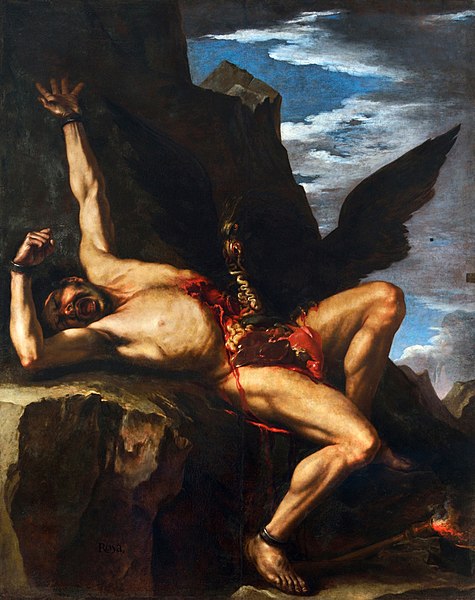
“The Torture of Prometheus” by Salvator Rosa (1615-1673)
Oil painting in the Galleria Nazionale d’Arte Antica di Palazzo Corsini via Wikimedia Commons.
Listening to Marc Andreessen discuss his Techno-Optimist Manifesto on the Foundation for American Innovation’s Dynamist podcast, I was struck by his repetition of something that is in the manifesto and is completely wrong. “The myth of Prometheus – in various updated forms like Frankenstein, Oppenheimer, and Terminator – haunts our nightmares,” he writes.1 On the podcast, he elaborated by saying that, although fire has many benefits, the Prometheus myth focuses on its use as a weapon. He said something similar in a June post called “Why AI Will Save the World“:
The fear that technology of our own creation will rise up and destroy us is deeply coded into our culture. The Greeks expressed this fear in the Prometheus Myth – Prometheus brought the destructive power of fire, and more generally technology (“techne”), to man, for which Prometheus was condemned to perpetual torture by the gods.
No. No. No. No.
Prometheus is punished for loving humankind. He stole fire to thwart Zeus’ plans to eliminate humanity and create a new subordinate species. He is a benefactor who sacrifices himself for our good. His punishment is an indicator not of the dangers of fire but of the tyranny of Zeus.
Prometheus is cunning and wise. His name means foresight. He knows what he is doing and what the likely consequences will be.
Eventually his tortures end when he is rescued by the hero Herakles (aka Hercules), who shoots the eagle charged with eating Prometheus’ liver every day, only for it to grow back to be eaten again.
The Greeks honored Prometheus. They celebrated technē. They appreciated the gifts of civilization.
The ancient myth of Prometheus is not a cautionary tale. It is a reminder that technē raises human beings above brutes. It is a myth founded in gratitude.
1. Frankenstein isn’t The Terminator either. Frankenstein is a creator who won’t take responsibility for his creation, a father who rejects and abandons his child. The Creature is frightening and dangerous but he is also the book’s moral center, a tragic, sympathetic character who is feared and rejected by human beings because of his appearance. Only then does he turn deadly. Frankenstein arouses pity and terror because we empathize with its central figure and understand his rage.
The novel’s most reasonable political reading is not as a story of the dangers of science but as a parable of slavery and rebellion. “By the eighteen-fifties, Frankenstein’s monster regularly appeared in American political cartoons as a nearly naked black man, signifying slavery itself, seeking his vengeance upon the nation that created him,” writes historian Jill LePore, who calls the “Frankenstein-is-Oppenheimer model … a weak reading of the novel.” I agree.
The Romantics tended to identify with Prometheus and Mary Shelley’s husband, Percy Bysshe Shelley, wrote a play called Prometheus Unbound, further undermining the reading of Frankenstein as an anti-Promethean fable.
Comments Off on Prometheus


