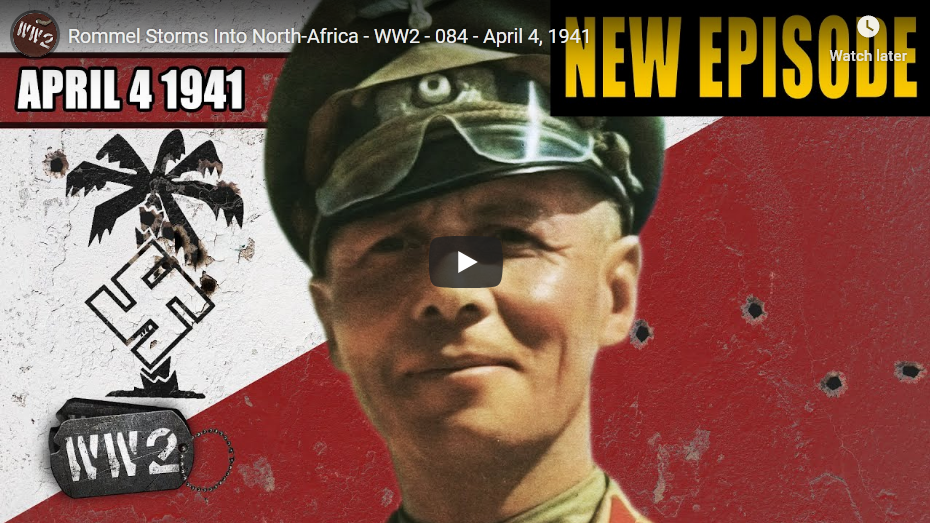
There is no more evocative phrase to emerge from World War II than Afrika Korps. The name conjures up a unique theater of war, a hauntingly beautiful empty quarter where armies could roam free, liberated from towns and hills, choke points and blocking positions, and especially those pesky civilians. It calls forth a war of near-absolute mobility, where tanks could operate very much like ships at sea, “sailing” where they wished, setting out on bold voyages hundreds of miles into the deep desert, then looping around the enemy flank and emerging like pirates of old to deal devastating blows to an unsuspecting foe. Finally, it implies a bold hero, in this case Field Marshal Erwin Rommel, a noble commander who fought the good fight, who hated Hitler and everything he stood for, and who couldn’t have been farther away from our stereotyped image of the Nazi fanatic. Everything about him attracts us — the manly poses, the out-of-central-casting good looks, even the goggles perched just so. Placing Rommel and his elite Afrika Korps to the fore allows us to view the desert war as a clean fight against a morally worthy opponent. It was war, yes, but almost uniquely in World War II, it was a “war without hate.”
It’s an attractive image all around, and it is unfortunate that practically all of it is false. The desert was hardly a haven of beauty or romance. It was a pain, and fighting in it was a nightmare for both sides. Far from letting the respective tank fleets roam free, the desert chained them irresistibly to their supply lines, and a single failed supply convoy or a lost column of trucks could stop an entire offensive dead in its tracks. Contrary to the alleged mobility of desert warfare, both sides would spend far more time in static defensive positions, often quite elaborate, then they would launching tank charges.
That leaves us with Rommel. Here, too, we should challenge the mythology. He was hardly apolitical. His entire career had been based on Hitler’s favor, and we might reasonably describe his attitude toward the Führer as worshipful. He was Hitler’s fair-haired boy, a young officer repeatedly promoted over more senior candidates. He was a media creation. Nazi propaganda painted him not only as a garden-variety hero, but as a model National Socialist and Aryan, a man who could overcome stronger enemies through the sheer force of his will. He was not merely a passive bystander to the hype; he was an active accomplice. He loved nothing better than having a camera crew along with him on campaign, and he would regularly order scenes to be reshot if his posture was insufficiently heroic or the lighting had not shown him to best advantage. As is often the case, his relationship to the media was both self-serving and self-destructive. During the years of victory, the German propaganda machine used him as an example to the nation. When things went sour, he became a diversion from the increasingly bad news on other fronts. Finally, when he was no longer useful for any purpose at all, the regime dropped him altogether and eventually killed him.
Robert Citino, “Drive to Nowhere: The Myth of the Afrika Korps, 1941-43″, The National WWII Museum, 2012. (Originally published in MHQ, Summer 2012).
March 2, 2020
QotD: The legend of Rommel and the Afrika Korps
March 1, 2020
The Nazis Building Bridges, Not Walls – WW2 – 079 – February 28, 1941
World War Two
Published 29 Feb 2020Parts of the British forces in North-Africa are being send to Greece to strengthen the Allied position there. While the remaining British plan for the near future, others make huge advances in East-Africa and Hitler plans his attack on Greece through Bulgaria.
Join us on Patreon: https://www.patreon.com/TimeGhostHistory
Or join The TimeGhost Army directly at: https://timeghost.tvFollow WW2 day by day on Instagram @World_war_two_realtime https://www.instagram.com/world_war_t…
Join our Discord Server: https://discord.gg/D6D2aYN.
Between 2 Wars: https://www.youtube.com/playlist?list…
Source list: http://bit.ly/WW2sourcesWritten and Hosted by: Indy Neidell
Produced and Directed by: Spartacus Olsson and Astrid Deinhard
Executive Producers: Bodo Rittenauer, Astrid Deinhard, Indy Neidell, Spartacus Olsson
Creative Producer: Joram Appel
Post-Production Director: Wieke Kapteijns
Research by: Indy Neidell
Edited by: Mikołaj Cackowski
Map animations: Eastory (https://www.youtube.com/c/eastory)
Additional animation: Ryan WeatherbyColorizations by:
– Julius Jääskeläinen – https://www.facebook.com/JJcolorization/
– Norman Stewart – https://oldtimesincolor.blogspot.com/Sources:
IWM: E 2386, E 2372, E 2368, E 2388, E 450, E 1579, FL 10025
National Portrait Gallery
Letter by Mochammad Kafi from the Noun Project
Mil.ru
BASA (3K-15- 84-2, 3K-7-436-41)
Narodowe Archiwum Cyfrowe
Museum of Science and Technology BelgradeArchive by Screenocean/Reuters https://www.screenocean.com.
A TimeGhost chronological documentary produced by OnLion Entertainment GmbH.
The Freikorps Marches On Berlin – The Kapp Putsch I THE GREAT WAR 1920
The Great War
Published 28 Feb 2020Sign up for Curiosity Stream and Nebula: https://curiositystream.com/thegreatwar
Dissatisfied with the new German Republic and the terms of the Treaty of Versailles, parts of the new Reichswehr and the paramilitary Freikorps decide to take matters into their own hands. The Marinebrigade Ehrhardt marches on Berlin to topple the government: It’s the Kapp Putsch.
» SUPPORT THE CHANNEL
Patreon: https://www.patreon.com/thegreatwar
Merchandise: https://shop.spreadshirt.de/thegreatwar/» SOURCES
Grevelhörster, Ludwig: Kleine Geschichte der Weimarer Republik. 1918-1933. Ein
problemgeschichtlicher Überblick, 2000.
Haffner, Sebastian: Die Deutsche Revolution 1918/1919. 2010.
Heiden, Konrad: Adolf Hitler: Das Zeitalter der Verantwortungslosigkeit. Ein Mann gegen
Europa, 2016.
Kotowski, Georg (Hrsg.): Historisches Lesebuch. 1914-1933, 1968.
Möller, Horst: Die Weimarer Republik. Demokratie in der Krise, 2018.
Pöppinghege, Rainer: Republik im Bürgerkrieg. Kapp-Putsch und Gegenbewegung an Ruhr
und Lippe 1919/1920, 2019.
Stackelberg, Roderick & Winkle, Sally (Ed.), The Nazi Germany Sourcebook: An Anthology of Texts, (Florence : Taylor and Francis, 2003)
Ulrich, Volker: Adolf Hitler. Band 1: Die Jahre des Aufstiegs 1889-1939. 2013.
Sturm, Reinhard (2011). “Weimarer Republik, Informationen zur politischen Bildung”. Bonn: Bundeszentrale für politische Bildung.» SOCIAL MEDIA
Instagram: https://instagram.com/the_great_war
Twitter: https://twitter.com/WW1_Series
Reddit: https://reddit.com/r/TheGreatWarChannel»CREDITS
Presented by: Jesse Alexander
Written by: Mark Newton
Director: Toni Steller & Florian Wittig
Director of Photography: Toni Steller
Sound: Toni Steller
Editing: Toni Steller
Mixing, Mastering & Sound Design: http://above-zero.com
Maps: Daniel Kogosov (https://www.patreon.com/Zalezsky)
Research by: Markus Linke
Fact checking: Florian WittigChannel Design: Alexander Clark
Original Logo: David van StepholdA Mediakraft Networks Original Channel
Contains licensed material by getty images
All rights reserved – Real Time History GmbH 2020
February 29, 2020
The metallic nickname of Henry VIII
In the most recent Age of Invention newsletter, Anton Howes outlines the rocky investment history for German mining firms in England during the Tudor period:

Cropped image of a Hans Holbein the Younger portrait of King Henry VIII at Petworth House.
Photo by Hans Bernhard via Wikimedia Commons.
It’s an especially interesting case of England’s technological backwardness, given that copper was a material of major strategic importance: a necessary ingredient for the casting of bronze cannon. And it was useful for other industries, especially when mixed with zinc to form brass. Brass was the material of choice for accurate navigational instruments, as well as for ordinary pots and kettles. Most importantly, brass wire was needed for wool cards, used to straighten the fibres ready for spinning into thread. A cheaper and more secure supply of copper might thus potentially make England’s principal export, woollen cloth, even more competitive — if only the English could also work out how to produce brass.
The opportunity to introduce a copper industry appeared in 1560, when German bankers became involved in restoring the gold and silver content of England’s currency. The expensive wars of Henry VIII and Edward VI in the 1540s had prompted debasements of the coinage, to the short-term benefit of the crown, but to the long-term cost of both crown and country. By the end of Henry VIII’s reign, the ostensibly silver coins were actually mostly made of copper (as the coins were used, Henry’s nose on the faces of the coins wore down, revealing the base metal underneath and earning him the nickname Old Coppernose). The debased money continued to circulate for over a decade, driving the good money out of circulation. People preferred to hoard the higher-value currency, to send it abroad to pay for imports, or even to melt it down for the bullion. The weakness of the pound was an especial problem for Thomas Gresham, Queen Elizabeth’s financier, in that government loans from bankers in London and Antwerp had to be repaid in currency that was assessed for its gold and silver content, rather than its face value. Ever short of cash, the government was constantly resorting to such loans, made more expensive by the lack of bullion.
Restoring the currency — calling in the debased coins, melting them down, and then re-minting them at a higher fineness — required expertise that the English did not have. From France, the mint hired Eloy Mestrelle to strike the new coins by machine rather than by hand. (He was likely available because the French authorities suspected him of counterfeiting — the first mention of him in English records is a pardon for forgery, a habit that apparently died hard as he was eventually hanged for the offence). And to do the refining, Gresham hired German metallurgists: Johannes Loner and Daniel Ulstätt got the job, taking payment in the form of the copper they extracted from the debased coinage (along with a little of the silver). It turned out to be a dangerous assignment: some of the copper may have been mixed with arsenic, which was released in fumes during the refining process, thus poisoning the workers. They were prescribed milk, to be drunk from human skulls, for which the government even gave permission to use the traitors’ heads that were displayed on spikes on London Bridge — but to little avail, unfortunately, as some of them still died.
Loner and Ulstätt’s payment in copper appears to be no accident. They were agents of the Augsburg banking firm of Haug, Langnauer and Company, who controlled the major copper mines in Tirol. Having obtained the English government as a client, they now proposed the creation of English copper mines. They saw a chance to use England as a source of cheap copper, with which they could supply the German brass industry. It turns out that the tale of the multinational firm seeking to take advantage of a developing country for its raw materials is an extremely old one: in the 1560s, the developing country was England.
Yet the investment did not quite go according to plan. Although the Germans possessed all of the metallurgical expertise, the English insisted that the endeavour be organised on their own terms: the Company of Mines Royal. Only a third of the company’s twenty-four shares were to be held by the Germans, with the rest purchased by England’s political and mercantile elite: people like William Cecil (the Secretary of State) and the Earl of Leicester, Robert Dudley (the Queen’s crush). It was an attractive investment, protected from competition by a patent monopoly for mines of gold, silver, copper, and mercury in many of the relevant counties, as well as a life-time exemption for the investors from all taxes raised by parliament (in those days, parliament was pretty much only assembled to legitimise the raising of new taxes).
February 28, 2020
“The Future of Warfare” – British Tanks of the Great War – Sabaton History 056 [Official]
Sabaton History
Published 27 Feb 2020Tanks! What a terrible and frightening sight they must have been for the Germans, the first time they had appeared on the battlefield at the Somme in 1916. The tanks were the product of many different ideas and prototypes, that all sought to overcome the perils of the modern battlefield — the machine gun, the bombed out ground and the barbed wire. The British Mark I tank would crush those obstacles through its sheer weight and begin a new age of mechanized warfare!
Support Sabaton History on Patreon: https://www.patreon.com/sabatonhistory
Listen to “The Future of Warfare” on the album The Great War:
CD: http://nblast.de/SabatonTheGreatWar
Spotify: https://sabat.one/TheGreatWarSpotify
Apple Music: https://sabat.one/TheGreatWarAppleMusic
iTunes: https://sabat.one/TheGreatWarItunes
Amazon: https://sabat.one/TheGreatWarAmazon
Google Play: https://sabat.one/TheGreatWarGooglePlayWatch the official lyric video of “The Future of Warfare” here:
https://www.youtube.com/watch?v=t8qJi…Check out the trailer for Sabaton’s new album The Great War right here: https://www.youtube.com/watch?v=HCZP1…
Listen to Sabaton on Spotify: http://smarturl.it/SabatonSpotify
Official Sabaton Merchandise Shop: http://bit.ly/SabatonOfficialShopHosted by: Indy Neidell
Written by: Markus Linke and Indy Neidell
Directed by: Astrid Deinhard and Wieke Kapteijns
Produced by: Pär Sundström, Astrid Deinhard and Spartacus Olsson
Creative Producer: Joram Appel
Executive Producers: Pär Sundström, Joakim Broden, Tomas Sunmo, Indy Neidell, Astrid Deinhard, and Spartacus Olsson
Post-Production Director: Wieke Kapteijns
Edited by: Iryna Dulka
Sound Editing by: Marek Kaminski
Maps by: Eastory – https://www.youtube.com/c/eastoryArchive by: Reuters/Screenocean https://www.screenocean.com
Music by Sabaton.Sources:
– Bundesarchiv
– Bibliothèque nationale de France
– Library and Archives Canada
– National Library of Scotland
– Australian War Museum
– National Army Museum
– IWM: Q 53204, Q 115391, Q 1419, Q 78121, Q 72864, HU 55578, Q 14496, Q 14495, Q 2487, Q 2486, Q 5574, Q 52, Q 43463, Q 3565, Q 3542, Q 5578, Q 80026, Q 68975
– IWM ART: REPRO 000684 7
– Sound of tracktor engine by viertelnachvier, tank sound by nicstage, from freesound.orgAn OnLion Entertainment GmbH and Raging Beaver Publishing AB co-Production.
© Raging Beaver Publishing AB, 2019 – all rights reserved.
February 27, 2020
Appeasement – How the West Helped Hitler Start WW2 | BETWEEN 2 WARS I 1938 Part 1 of 4
TimeGhost History
Published 26 Feb 2020With the increasing aggression of Italy, Japan, and Germany in the 1930s, the League of Nations is becoming increasingly ineffective in regulating international disputes. Britain and France adopt a diplomatic strategy of appeasement to hold off all-out war and buy some crucial time. But will it work, and can Adolf Hitler’s territorial ambitions be contained?
Join us on Patreon: https://www.patreon.com/TimeGhostHistory
Hosted by: Indy Neidell
Written by: Francis van Berkel and Spartacus Olsson
Directed by: Spartacus Olsson and Astrid Deinhard
Executive Producers: Bodo Rittenauer, Astrid Deinhard, Indy Neidell, Spartacus Olsson
Creative Producer: Joram Appel
Post-Production Director: Wieke Kapteijns
Research by: Tom Meaden, Izzy Wilson, and Francis van Berkel
Edited by: Daniel Weiss
Sound design: Marek KamińskiSources:
Bundesarchiv_Bild:
102-08806, 102-08810, 102-09042,
119-5243, 146-1970-052-24, 146-1985-108-27A,
183-1987-0922-500, 183-R03618,
Photo from color by klimbim.Colorizations by:
– Daniel Weiss
– Norman Stewart
– Julius Jääskeläinen – https://www.facebook.com/JJcolorization/Soundtracks from Epidemic Sound:
– “The Inspector 4” – Johannes Bornlöf
– “Last Point of Safe Return” – Fabien Tell
– “Split Decision” – Rannar Sillard
– “Death And Glory 1” – Johannes Bornlöf
– “Guilty Shadows 4” – Andreas Jamsheree
– “Disciples of Sun Tzu” – Christian Andersen
– “First Responders” – Skrya
– “Easy Target” – Rannar Sillard
– “Death And Glory 3” – Johannes Bornlöf
– “The Charleston 3” – Håkan ErikssonA TimeGhost chronological documentary produced by OnLion Entertainment GmbH.
From the comments:
TimeGhost History
2 days ago (edited)
Hindsight is 20/20. It’s easy to look back at Anglo-French foreign policy in the 1930s and be shocked at how many mistakes politicians like Neville Chamberlain could make. This video will probably only add to that judgement, it more or less charts all the times Hitler could have been stopped but wasn’t. But put yourself in the context of the time. Memories of the Great War are only twenty years ago old, and the public has no appetite for another massive conflict. The global economy is only just showing signs of recovery after the Great Depression, and Britain and France barely have the industrial capacity to fight a modern war. So, imagine you’re Chamberlain (or any other politician of the time), are you really going to commit your country to war over a territorial disagreement between Germany and Czechoslovakia? The invasion of Poland in September 1939 shows that appeasement was a mistake. But maybe it was an understandable one? Let us know what you think in the comments.Cheers,
Francis.
A French Civil War in 1937? – WW2 feat. Hearts of Iron IV [sponsored]
World War Two
Published 26 Feb 2020This video is sponsored by Paradox Interactive. Indy shares his thoughts on what he thinks would have happened if the French would have decided to meddle in the Spanish Civil War – triggering a Civil War.
Hearts of Iron IV: La Résistance is now available! You can play Hearts of Iron IV for free until next Sunday, the 1st of March! Discover it here: https://pdxint.at/39Re5ld
Watch our first collab video with HoI4 about the Spanish Civil War here: https://youtu.be/7QE1hvH8ZVU
Watch our Between Two Wars episode on the Spanish Civil War here: https://youtu.be/ncUkPavahCU
Watch our Between Two Wars episode on the French February Revolution in 1934 here: https://youtu.be/tLm1gWnlcYwJoin us on Patreon: https://www.patreon.com/TimeGhostHistory
Or join The TimeGhost Army directly at: https://timeghost.tvFollow WW2 day by day on Instagram @World_war_two_realtime https://www.instagram.com/world_war_t…
Join our Discord Server: https://discord.gg/D6D2aYN.
Between 2 Wars: https://www.youtube.com/playlist?list…
Source list: http://bit.ly/WW2sourcesWritten and Hosted by: Indy Neidell
Produced by: Spartacus Olsson and Astrid Deinhard
Directed by: Wieke Kapteijns
Executive Producers: Bodo Rittenauer, Astrid Deinhard, Indy Neidell, Spartacus Olsson
Creative Producer: Joram Appel
Post-Production Director: Wieke Kapteijns
Research by: Indy Neidell
Edited by: Guido Becker
Gameplay scenes: Sietse KenterColorizations by:
Dememorabilia – https://www.instagram.com/dememorabilia/
Julius Jääskeläinen – https://www.facebook.com/JJcolorization/
Adrien Fillon – https://www.instagram.com/adrien.colo…
Daniel WeissArchive by Screenocean/Reuters https://www.screenocean.com.
A TimeGhost chronological documentary produced by OnLion Entertainment GmbH.
February 26, 2020
Powell’s Cartridge Counter Luger: The First Military 9mm
Forgotten Weapons
Published 10 Nov 2019The US first tested the Luger in 1901, and it seemed potentially good enough that the government spent $15,000 to buy 1,000 of the pistols (in 7.65mm Luger; the only cartridge available at the time) for field trials. The trials resulted in a variety of complaints, but particular among them was a dislike for the small caliber. In response, Georg Luger necked the 7.65mm round up to 9mm, and the US would be the first to trial the new model. After presenting 3 samples in 1903, Luger made a deal to swap 50 of the American 7.65mm pistols for 50 new 9mm ones. The US also specified that new guns had to be fitted with a cartridge counter grip system designed by one Graham Powell. The resulting guns (s/n 22401-22450) were delivered in April of 1904.
American testing did not find the 9mm much more satisfactory than the old 7.65mm, however. At the same time, the Thompson-La Garde tests of terminal ballistics were concluding that a new service pistol should be no less than .45 caliber. Luger would make one last effort to interest the US in 9mm with a duplex load in 1906, but this would also fail. Instead, he would redesign the Luger for .45 ACP and enter that in the US 1907 pistol trials.
http://www.patreon.com/ForgottenWeapons
Cool Forgotten Weapons merch! http://shop.bbtv.com/collections/forg…
Contact:
Forgotten Weapons
6281 N. Oracle #36270
Tucson, AZ 85704
February 23, 2020
The British Will Walk 500 Miles, and They Will Walk 500 more – WW2 – 078 – February 22, 1941
World War Two
Published 22 Feb 2020As the British make spectacular advances in East-Africa, with even more spectacular advances on the horizon, South-Eastern Europe is getting increasingly tense.
Join us on Patreon: https://www.patreon.com/TimeGhostHistory
Or join The TimeGhost Army directly at: https://timeghost.tvFollow WW2 day by day on Instagram @World_war_two_realtime https://www.instagram.com/world_war_t…
Join our Discord Server: https://discord.gg/D6D2aYN.
Between 2 Wars: https://www.youtube.com/playlist?list…
Source list: http://bit.ly/WW2sourcesWritten and Hosted by: Indy Neidell
Produced and Directed by: Spartacus Olsson and Astrid Deinhard
Executive Producers: Bodo Rittenauer, Astrid Deinhard, Indy Neidell, Spartacus Olsson
Creative Producer: Joram Appel
Post-Production Director: Wieke Kapteijns
Research by: Indy Neidell
Edited by: Iryna Dulka
Map animations: Eastory (https://www.youtube.com/c/eastory)Colorizations by:
– Daniel Weiss
– Julius Jääskeläinen – https://www.facebook.com/JJcolorization/
– Dememorabilia – https://www.instagram.com/dememorabilia/
– Norman Stewart – https://oldtimesincolor.blogspot.com/
– Olga Shirnina, a.k.a. Klimbim – https://klimbim2014.wordpress.com/Sources:
– Bundesarchiv
– Library of Congress
– IWM: E 6661
– National Library of Australia
– National Portrait Gallery
– Letter by Mochammad Kafi, post icon by Bonegolemfrom, from the Noun Project
– Photot of Goethe Medal by Mondfreund from Wikimedia Commons
– Eirik Sundvor, The Municipal Archives of TrondheimArchive by Screenocean/Reuters https://www.screenocean.com.
A TimeGhost chronological documentary produced by OnLion Entertainment GmbH.
February 20, 2020
Why the Nazis Weren’t Socialists – ‘The Good Hitler Years’ | BETWEEN 2 WARS I 1937 Part 2 of 2
TimeGhost History
Published 19 Feb 2020The Nazi economy appears to do well during the 1930s. But this is largely myth, as the German economy under Hitler is based on a self destructive, ideologically or selfishly fuelled irrationality driven by conquest and criminal practice.
Join us on Patreon: https://www.patreon.com/TimeGhostHistory
Hosted by: Indy Neidell
Written by: Spartacus Olsson
Directed by: Spartacus Olsson and Astrid Deinhard
Executive Producers: Bodo Rittenauer, Astrid Deinhard, Indy Neidell, Spartacus Olsson
Creative Producer: Joram Appel
Post-Production Director: Wieke Kapteijns
Research by: Spartacus Olsson
Edited by: Daniel Weiss
Sound design: Marek KaminskiSources:
Bundesarchiv_Bild:
192-269, 183-T0706-503, 183-S68029, 183-S68014,
183-S38324, 183-S33516, 183-S07227, 183-R98364,
183-H29131, 183-H25824, 183-H01704, 183-H13192,
183-H06734, 183-H00455, 183-C12671, 183-86686-0008,
183-2008-0826-506, 183-2008-0826-502, 183-2006-1128-504,
183-2004-0729-507, 183-1989-0630-504, 183-1988-0113-500,
146-2005-0191, 146-1990-048-29A, 146-1990-023-06A,
146-1984-040-26, 146-1981-124-32A, 146-1972-025-10,
102-13533, 102-12733, 102-11649, 102-06795, 102-04640,
145_Bild-P046280, 145_Bild-020683,Colorizations by:
Daniel WeissSoundtracks from Epidemic Sound:
– “Document This 1” – Peter Sandberg
– “March Of The Brave 10” – Rannar Sillard – Test
– “Ominous” – Philip Ayers
– “The Inspector 4” – Johannes Bornlöf
– “Disciples of Sun Tzu” – Christian Andersen
– “Guilty Shadows 4” – Andreas Jamsheree
– “Last Point of Safe Return” – Fabien Tell
– “Death And Glory 1” – Johannes Bornlöf
– “Easy Target” – Rannar Sillard
– “Split Decision” – Rannar Sillard
– “First Responders” – Skrya
– “The Charleston 3” – Håkan ErikssonA TimeGhost chronological documentary produced by OnLion Entertainment GmbH.
From the comments:
Spartacus Olsson
1 day ago
From an intellectual viewpoint, this is perhaps the most challenging episode I have written in this series. First of all it’s hard to make economic policy interesting, even when it’s about the Nazis. It tends to get, well … grey. Second of all it’s not that easy to simplify things without completely losing the essence of what was going on. Third of all, I’m fighting an uphill battle against a post truth, political talking point based on … let’s just call it less than ingenious purposes.Obviously that’s the idea that the Nazis were Socialists. And perhaps that is not so far fetched when you think of the name of their party, the way they framed their anti-semitic rhetoric in a way that it would sound friendly to the working class, and their absolute disregard for telling the truth about anything, and everything. But although we have painstakingly showed you the facts, I am painfully aware that it won’t make a difference to stop the nonsense out there and in here — some pundits will religiously stick to their ideas, because if they don’t, they might have to face that some of the ideas they have are mutual with the people they so desperately want to distance themselves from. The same happened with the far left between the 1930s and 1970s, when they tried with cramped desperation to frame Stalinism as a right wing, Fascist movement — Red Fascism was the term — obviously as much nonsense as the alt-right idea that Naziism is Socialism.
And is it important? Well yes and no — the dumbos will probably get worn out at some point, it’s after all quite challenging to look for ways to distort the record over, and over again. I don’t really care if the extremists try to push their mutual garbage in each other’s lap — as a supporter of democracy and humanism, I have no regard for either end. I do however have an incredible amount of respect for conservatives, liberals, and progressives who are equally dedicated to democracy and human rights — and there is where it matters.
When the far left tries to frame Stalinism as right wing, and the far-right tries to frame Naziism is left-wing, they are trying to co-opt a position of less extremism. It’s an invasive attempt for Communists and (real) Socialists to just look like regular Progressives, and Fascists and Nazis to just look like regular Conservatives. And that my friends is dangerous, to all of us, regardless of our nationality, creed, political affiliation, or opinion — because it is specifically our individual rights and democracy that is at stake in this game. That’s what they want to take away, or in some places stop from developing.
An American .30-06 MG-42, and GPMGs after WWII
Forgotten Weapons
Published 31 Oct 2019http://www.patreon.com/ForgottenWeapons
Cool Forgotten Weapons merch! http://shop.bbtv.com/collections/forg…
The perk for $100 Patrons is choosing a gun they would like me to find and film, and one such Patron (Mark) expressed a curiosity about US testing and lack of adoption of an MG-42 in .30-06 caliber. So, today we will discuss that (the trials gun was designated the T24) as well as why it took so long for the FN MAG to be developed and adopted.
For the full T24 trials report and photos, go here:
https://www.forgottenweapons.com/ligh…Resources for this video included:
MG34-MG42: German Universal Machine Guns (https://amzn.to/2VtY314)
German Universal Machine Guns, Vol II: MG08-MG3 (https://amzn.to/2M2f67t)
Rock in a Hard Place: The Browning Automatic Rifle (https://amzn.to/315Dbi2)
The Browning Machine Gun, Vol I (https://amzn.to/2M4KgeA)
Ars Mechanica (https://amzn.to/324JT9h)
The Machine Gun, Vol I (https://www.ibiblio.org/hyperwar/USN/…)Contact:
Forgotten Weapons
6281 N. Oracle #36270
Tucson, AZ 85704
February 19, 2020
Great Blunders of WWII: The Scattering of Convoy PQ17
Anthony Coleman
Published 4 Nov 2016From the History Channel DVD series Great Blunders of WWII.
This is of interest for many reasons, but particularly because my late father-in-law served in the Royal Navy on the Arctic convoys and spent a full winter in the Soviet Union when his convoy couldn’t return before the ice closed the convoy route.
February 18, 2020
Royal Resistance in Benelux and Scandinavia 1940 – WW2 – War Against Humanity 008
World War Two
Published 17 Feb 2020When the Racism of Naziism hits the Nationalism of Monarchism, it doesn’t quite go like Hitler would have imagined.
Join us on Patreon: https://www.patreon.com/TimeGhostHistory
Or join The TimeGhost Army directly at: https://timeghost.tvFollow WW2 day by day on Instagram @World_war_two_realtime https://www.instagram.com/world_war_t…
Join our Discord Server: https://discord.gg/D6D2aYN.
Between 2 Wars: https://www.youtube.com/playlist?list…
Source list: http://bit.ly/WW2sourcesWritten and Hosted by: Spartacus Olsson
Produced and Directed by: Spartacus Olsson and Astrid Deinhard
Executive Producers: Bodo Rittenauer, Astrid Deinhard, Indy Neidell, Spartacus Olsson
Creative Producer: Joram Appel
Post-Production Director: Wieke Kapteijns
Research by: Spartacus Olsson
Edited by: Mikołaj Cackowski
Map animations: Eastory (https://www.youtube.com/c/eastory)Colorizations by:
Norman Stewart – https://oldtimesincolor.blogspot.com/
Julius Jääskeläinen – https://www.facebook.com/JJcolorization/
Sources:
National Museum of Denmark https://natmus.dk/museer-og-slotte/fr…
Archive of I.M. Bondarenko
Regionaal Archief Nijmegen
CegeSoma, n°34706
NationalSocialistMovementintheNetherlands (1).png by Ec1801011 from wikimedia commons https://commons.wikimedia.org/wiki/Fi…
Resistance_15_December_1940 by SiefkinDR from wikimedia commons https://en.wikipedia.org/wiki/File:Re…
IWM (FL 24877, HU 66187)
The Dubbo Liberal and Macquarie Advocate (NSW : 1894 – 1954), p. 3 http://nla.gov.au/nla.news-article132…
Yousuf Karsh, National Archives of the Netherlands / Fotocollectie Anefo
Narodowe Archiwum Cyfrowe
Delphin, Rigmor Dahl, Oslo MuseumSoundtracks from the Epidemic Sound:
Johannes Bornlof – “Deviation in Time”
Farrell Wooten – “Blunt Object”
Wendel Scherer – “Reunion”
Fabien Tell – “Last Point of Safe Return”
Howard Harper-Barnes – “London”
Hakan Eriksson – “The End of The World 2”
Phoenix Tail – “At the Front”Archive by Screenocean/Reuters https://www.screenocean.com.
A TimeGhost chronological documentary produced by OnLion Entertainment GmbH.
From the comments:
Spartacus Olsson
3 days ago
You’d think that the Nazis would know how nationalism works … well, it turns out that when Hitler’s fantasies of race meet the very real nationalism of the old European monarchies, race doesn’t have the trump. Now, in 1940 nationalism isn’t that old, but it’s anchored in old traditions that the monarchies now occupied by the Nazis have managed to reconcile with modernity rather successfully. And here’s an important point: nationalism is often decried as the root of all of these conflicts, and perhaps it is, but in some places it’s also proved to be fertile ground for modern democracy. Perhaps there’s a lesson to be learnt somewhere in there, and maybe that’s that in the end it’s not what, but how that makes a difference. What’s particularly interesting, in for instance the Netherlands with the February Strike or in the Germany resistance rings, is that when faced with a common enemy to the nation, patriotism unites people across the political spectrum, well except those obsessed with the idea of race.
February 16, 2020
Diamonds vs. Self Determination – South West Africa and the League of Nations I THE GREAT WAR 1920
The Great War
Published 15 Feb 2020Sign up for Curiosity Stream and Nebula: https://curiositystream.com/thegreatwar
Woodrow Wilson’s 14 Points and their idea of self-determination didn’t go unnoticed in the former German colonies like German Southwest Africa. But especially South Africa had other ideas at the Paris Peace Conference and lobbied to take control over future Namibia and its lucrative diamond mines.
» SUPPORT THE CHANNEL
Patreon: https://www.patreon.com/thegreatwar
Merchandise: https://shop.spreadshirt.de/thegreatwar/» SOURCES
Emmett, Tony. 1999. Popular Resistance and the Roots of Nationalism in Namibia, 1915-1966. Basel, Switzerland: P. Schlettwein Publishing.
Olusoga, David, and Casper W. Erichsen. 2011. The Kaiser’s Holocaust: Germany’s Forgotten Genocide and the Colonial Roots of Nazism. London, UK: Faber and Faber.
Onselen, Charles van. 1980. Chibaro: African mine labour in Southern Rhodesia 1900-1933. London, UK: Pluto Pr.
Pirio, Gregory. 1988. “The Role of Garveyism in the Making of Namibian Nationalism.” In Namibia 1884-1984: Readings on Namibia’s History and Society: Selected Papers and Proceedings of the International Conference on “Namibia 1884-1984: 100 Years of Foreign Occupation; 100 Years of Struggle”, London 10-13 September, 1984, Organised by the Namibia Support Committee in Co-Operation with the SWAPO Department of Information and Publicity, edited by International Conference on “Namibia 1884-1984: 100 Years of Foreign Occupation; 100 Years of Struggle,” Brian Wood, Namibia Support Committee, United Nations Institute for Namibia, SWAPO, and Department of Information and Publicity. London: The Committee in cooperation with United Nations Institute for Namibia.
“Report on the Natives of South-West Africa and Their Treatment by Germany.” 1918. 1918. https://ufdc.ufl.edu/UF00072665/00001/1j.
Silvester, Jeremy, and Jan-Bart Gewald, eds. 2003. Words Cannot Be Found: German Colonial Rule in Namibia: An Annotated Reprint of the 1918 Blue Book. Sources for African History, v. 1. Leiden, NL ; Boston, USA: Brill.
Smith, Iain R. 1999. “Jan Smuts and the South African War.” South African Historical Journal 41 (1): 172–95. https://doi.org/10.1080/0258247990867….
Vinson, Robert Trent. 2012. Americans Are Coming! Dreams of African American Liberation in Segregationist South Africa. Athens: Ohio University Press. http://public.eblib.com/choice/public….
Wallace, Marion, and John Kinahan. 2013. A History of Namibia from the Beginning to 1990. Oxford, UK: Oxford University Press.
William Blakemore Lyon. 2015. “The South West Africa Company and Anglo-German Relations, 1892-1914.” Master’s thesis, Cambridge University.
Zimmerer, Jürgen, and Joachim Zeller. 2008. Genocide in German South-West Africa. Monmouth, UK: Merlin Press.
Michell, Lewis (1910). The Life and Times of the Right Honourable Cecil John Rhodes 1853-1902, Volume 2. New York and London: Mitchell Kennerly
Rhodes, Cecil, (1902) “The Last Will and Testament of Cecil John Rhodes: With Elucidatory Notes to Which Are Added Some Chapters Describing the Political and Religious Ideas of the Testator”, London: “Review of Reviews” Office
Cecil Rhodes, “Confession of Faith”, 1877 https://pages.uoregon.edu/kimball/Rho…» SOCIAL MEDIA
Instagram: https://instagram.com/the_great_war
Twitter: https://twitter.com/WW1_Series
Reddit: https://reddit.com/r/TheGreatWarChannel»CREDITS
Presented by: Jesse Alexander
Written by: Jesse Alexander
Director: Toni Steller & Florian Wittig
Director of Photography: Toni Steller
Sound: Toni Steller
Editing: Toni Steller
Mixing, Mastering & Sound Design: http://above-zero.com
Maps: Daniel Kogosov (https://www.patreon.com/Zalezsky)
Research by: Jesse Alexander
Fact checking: Florian WittigChannel Design: Alexander Clark
Original Logo: David van StepholdA Mediakraft Networks Original Channel
Contains licensed material by getty images
All rights reserved – Real Time History GmbH 2020
Enter Erwin Rommel – The British Advance in Africa – WW2 – 077 – February 15 1941
World War Two
Published 15 Feb 2020While the Germans send one of their best generals to North Africa to bail out the Italians, Great Britain switches focus from Libya to Greece, but make symbolically important gains in East Africa.
Join us on Patreon: https://www.patreon.com/TimeGhostHistory
Or join The TimeGhost Army directly at: https://timeghost.tvFollow WW2 day by day on Instagram @World_war_two_realtime https://www.instagram.com/world_war_t…
Join our Discord Server: https://discord.gg/D6D2aYN
Between 2 Wars: https://www.youtube.com/playlist?list…
Source list: http://bit.ly/WW2sourcesWritten and Hosted by: Indy Neidell
Produced and Directed by: Spartacus Olsson and Astrid Deinhard
Executive Producers: Bodo Rittenauer, Astrid Deinhard, Indy Neidell, Spartacus Olsson
Creative Producer: Joram Appel
Post-Production Director: Wieke Kapteijns
Research by: Indy Neidell
Edited by: Iryna Dulka
Map animations: Eastory (https://www.youtube.com/c/eastory)Colorizations by:
– Julius Jääskeläinen – https://www.facebook.com/JJcolorization/
– Norman Stewart – https://oldtimesincolor.blogspot.com/Sources:
– Bundesarchiv
– A German soldier poses atop a tank, photo credit: United States Holocaust Memorial Museum, courtesy of Perquimans County Library
– US National Archive
– IWM: A 4035, HU 39482Archive by Screenocean/Reuters https://www.screenocean.com.
A TimeGhost chronological documentary produced by OnLion Entertainment GmbH.
From the comments:
World War Two
2 days ago
When you know the story going forward it’s fascinating to see how the decisions unfold this week — the reshuffling of command both on the Axis and Allied side might seem like innocuous administrative decisions when you don’t know the future. But if you have a crystal ball, you’ll know that not just Rommel arriving in North Africa, but also the decisions on the British side this week will have momentous impact on the war in total. That’s one of the things we discovered early-on with a chronological narrative, it suddenly puts things in a new perspective. The relationship between events changes, and things that might seem too boring, or undramatic to include in a “great story” take on a whole new meaning, increasing our understanding of cause and effect of the “greater” events that will come. On a different note, we just finished shooting a new batch of videos today and we’ll be announcing some fascinating developments on our program in the coming weeks. Stay tuned, and stay awesome, you all are by far the best community on YouTube!