First, just to define my terms, what are the humanities? Broadly, they are the disciplines that study human society (that is, that are concerned with humanity): language study, literature, philosophy, history, art history, archaeology, anthropology, and so on. It is necessarily a bit of a fuzzy set. But what I think defines the humanities more than subject matter is method; the humanities study things which (we argue) cannot be subjected to the rigors of the scientific method or strictly mathematical approaches. You cannot perform a controlled trial in beauty, mathematical certainty in history is almost always impossible, and there is no way to know much stress a society can bear except to see it fail. Some things cannot be reduced to numbers, at least not by the powers of the technology-aided human mind.
By way of example, that methodological difference is why there’s a division between political science and history, despite the two disciplines historically being concerned with many of the same subjects and the same questions (to the point that Thucydides is sometimes produced as the founder of both): they use different methods. History is a humanities discipline through and through, whereas political science attempts to hybridize humanities and STEM (Science, Technology, Engineering and Mathematics) approaches; that’s not to say historians never use statistical approaches (I do, actually, quite a lot) but that there are very real differences in methodology. As you might imagine, that difference leads to some competition and conflict between the disciplines as to whose methodology best answers those key questions or equips students to think about them. Given that I have a doctorate in history and self-identify as a historian, you will have no trouble guessing which side of this I come down on, although that might be a bit self-interested on my part.
So if the STEM fields are, at some level, fundamentally about numbers, the humanities are fundamentally about language. The universe may be made of numbers, but the human mind and human societies are constructed out of language. Unlike computers, we do not think in numbers, but in words and consequently, the study of humans as thinking creatures is mostly about those words (yes, yes, I see you there, economics and psychology; there are edge cases, of course). Our laws are written in words because our thoughts form in our heads as words; we naturally reason with words and we even feel with words. Humans are linguistic creations in a mathematical universe; consequently, while the study of the universe is mediated through math, the study of humans and human minds is fundamentally linguistic in nature.
Thus, the humanities.
Bret Devereaux, “Collections: The Practical Case on Why We Need the Humanities”, A Collection of Unmitigated Pedantry, 2020-07-03.
March 1, 2023
QotD: What do we mean by “the humanities”?
February 27, 2023
“From nine or so I could memorise all the dates of the kings and queens of England … all of which proved hugely useful when it came to impressing the opposite sex in my teens”
The preview portion of an Ed West article on how history should be taught as black comedy rather than a morality tale:
I love history; it is my greatest passion. If I didn’t have to worry about money I’d go and live in a former Templar castle in the Languedoc and spend my afternoons reading 19th-century French historians (pretending to read in the original for my Instagram account, obviously, but actually using a translation).
From a very young age I was obsessed with the subject. The first history tale I remember being engrossed by was the story of Ethelred the Unready and Edward the Martyr. I suppose I felt some sort of nominative solidarity with Edward, the rightful king murdered by a wicked stepmother who then put her own son Ethelred on the throne — and who turned out to be the worst combination of both useless and backstabbing.
Of course, I later learned that the story was more complicated; Edward may not have been murdered, and Ethelred was dealt a very difficult hand. But as a child it sent my mind away to a far off place in a similar way that King Arthur first captured the imagination of many others. Like them, I was first attracted to history via the medieval world, with its kings, castles and sword fights, and its colourful jousts where fair maidens watched heroic knights beat the crap out of each other (although the early medieval had almost none of those things, but again, don’t let that ruin the fun).
There was obviously a very nerdy aspect to this. From nine or so I could memorise all the dates of the kings and queens of England (although I got a bit vague when it got as far as the Edwys and Edwigs), all of which proved hugely useful when it came to impressing the opposite sex in my teens.
Dates are not the most important thing, but for a certain type of mind they make it easier to connect everything. If I learned of an insane pope who liked to torture his cardinals or “Wenzel the Drunkard“, the German king fond of throwing enemies off bridges, I could put it in context that this was the time of Richard II, and it is easier to place. If I’m now reading about Chinese emperors or what was happening in the Umayyad caliphate, where the connection with England would be slim or non-existent, my understanding of English dates still makes it easier to understand.
I loved the fantasy and the expanded sense of imagination, but as I got older, I came to better appreciate the most beautiful thing about history, that it’s all one great black comedy, filled with petty emotions and motivations, and the psychodrama and human absurdity is not some side issue, but the whole point.
Yet the subject is never really taught like that, and perhaps can’t be; and the national history curriculum when I was at school seemed structured in such a way as to suck all the life out of it. It’s not just the incoherence or emphasis; everyone complains about what is taught at school, and no one will ever be satisfied. But worse was the way the subject was almost designed to make it as boring as possible. An area of study was introduced, and then almost immediately we were asked to evaluate the primary and secondary sources; the aim was to invite scepticism, but most teens and pre-teens simply drift off at this point.
Just tell us the story — we can deconstruct it later. Personally, I feel that history shouldn’t be primarily an analysis of how hegemonic power structures orchestrate public relations; it shouldn’t be a morality tale about good and evil; it shouldn’t be a means to make society more inclusive; it should be fun, and when done correctly, it’s the most fun subject in the world.
I’ve heard a lot of other folks’ complaints about how history was taught when they were in school, and it generally aligns with my own experience. The overall plan seemed to be to actively avoid anything that might interest the students (battles, treachery, romance, excitement in general) and instead concentrate on treaty negotiations, lists of dates, and any other dry-as-dust ways to fill the lecture time. As anyone can tell by the subjects I tend to include here on the blog, I’m a big history nerd, but I actively hated the topic in school even as I was reading history for myself outside of school hours.
Ed also recommends the brilliant podcast series The Rest is History with Dominic Sandbrook and Tom Holland (now also available on YouTube, which is where I started listening to it a few weeks back). I’d read several books by each of them, so it was quite a treat to discover they were co-operating on a history podcast that more than met my expectations.
February 23, 2023
QotD: Academic types
You do acknowledge, of course, that it’s in the nature of math that 50% of the population are below average?
Our default “solution” for university shooters […] is psychiatry. More access to better “mental health care”, we say, would’ve prevented this. Maybe, maybe not, but at least it’s something. The problem, though, is that the only diagnostic criterion you can realistically use is “So-and-So is a twitchy, weird loner”, which — trust me — exactly describes 99% of grad students and 100% of professors. Do we force feed all of them powerful prescription psychotropics on the off-chance?
Before you jump to agree — and yes, I fully acknowledge how awesome that would be, if you put it on Pay-per-View I’d be the first to sign up […] I’d ask you to consider two things:
First, it’s the government doing this. The same stupid motherfuckers who can’t manage to rig a poll where only a handful of addled old farmers vote. Do you really want to bet America’s future social stability on them loading the right drug into the sprayers? Given the federal bureaucracy’s sterling reputation for basic competence, they’d probably crop-dust the ‘hood with meth.
Severian, “The Scientific Management of Populations”, Rotten Chestnuts, 2020-02-15.
February 21, 2023
Smart people are at least as likely to fall for false beliefs as anyone else
Gurwinder explains why people well above average intelligence are actually more likely to adopt irrational ideas:
What causes delusion?
The prevailing view is that people adopt false beliefs because they’re too stupid or ignorant to grasp the truth. This may be true in some cases, but just as often the opposite is true: many delusions prey not on dim minds but on bright ones. And this has serious implications for education, society, and you personally.
In 2013 the Yale law professor Dan Kahan conducted experiments testing the effect of intelligence on ideological bias. In one study he scored people on intelligence using the “cognitive reflection test”, a task to measure a person’s reasoning ability. He found that liberals and conservatives scored roughly equally on average, but the highest scoring individuals in both groups were the most likely to display political bias when assessing the truth of various political statements.
In a further study (replicated here), Kahan and a team of researchers found that test subjects who scored highest in numeracy were better able to objectively evaluate statistical data when told it related to a skin rash treatment, but when the same data was presented as data regarding a polarizing subject — gun control — those who scored highest on numeracy actually exhibited the greatest bias.
[…]
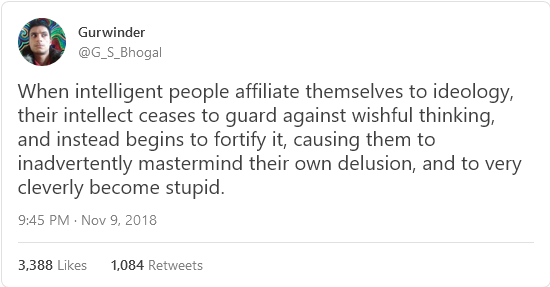
Since we’re a social species, it is intelligent for us to convince ourselves of irrational beliefs if holding those beliefs increases our status and well-being. Dan Kahan calls this behavior “identity-protective cognition” (IPC).
By engaging in IPC, people bind their intelligence to the service of evolutionary impulses, leveraging their logic and learning not to correct delusions but to justify them. Or as the novelist Saul Bellow put it, “a great deal of intelligence can be invested in ignorance when the need for illusion is deep”.
What this means is that, while unintelligent people are more easily misled by other people, intelligent people are more easily misled by themselves. They’re better at convincing themselves of things they want to believe rather than things that are actually true. This is why intelligent people tend to have stronger ideological biases; being better at reasoning makes them better at rationalizing.
This tendency is troublesome in individuals, but in groups it can prove disastrous, affecting the very structure and trajectory of society.
For centuries, elite academic institutions like Oxford and Harvard have been training their students to win arguments but not to discern truth, and in so doing, they’ve created a class of people highly skilled at motivated reasoning. The master-debaters that emerge from these institutions go on to become tomorrow’s elites — politicians, entertainers, and intellectuals.
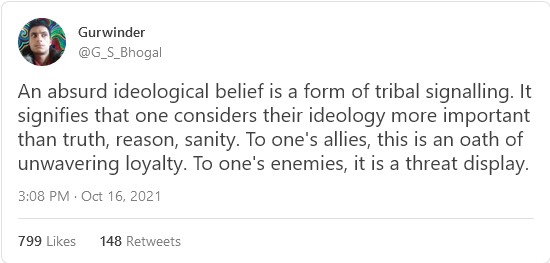
Master-debaters are naturally drawn to areas where arguing well is more important than being correct — law, politics, media, and academia — and in these industries of pure theory, secluded from the real world, they use their powerful rhetorical skills to convince each other of FIBs. During their master-debatery circlejerks, the most fashionable delusions gradually spread from individuals to departments to institutions to societies.
Some of these FIBs can now be found everywhere. A particularly prominent example is wokeism, a popularized academic worldview that combines elements of conspiracy theory and moral panic. Wokeism seeks to portray racism, sexism, and transphobia as endemic to Western society, and to scapegoat these forms of discrimination on white people generally and straight white men specifically, who are believed to be secretly trying to enforce such bigotries to maintain their place at the top of a social hierarchy.
February 11, 2023
Americans tend to think other countries are just like America, but with weird accents and quaint clothing
Sarah Hoyt on the common problem Americans (and to a lesser extent, Canadians) have in trying to understand other nations even if they’ve done some international travel:
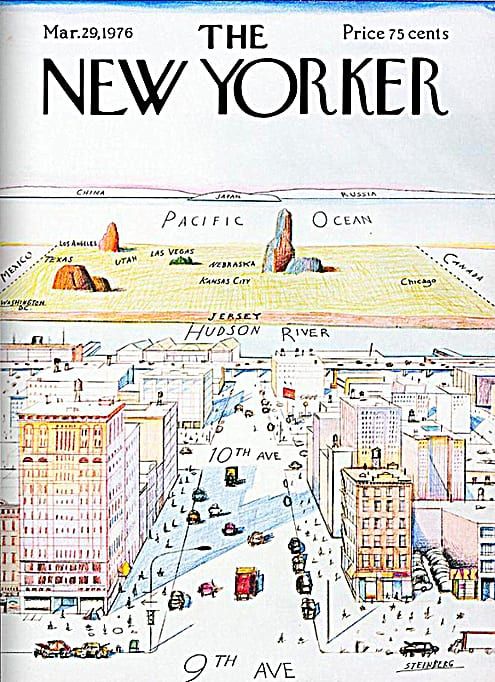
I also see every country, regardless of their history making the assumption that the modus operandi and motives of other cultures and organizations is exactly the same as theirs. I’ve now mentioned about a million times the idiots who went over as Human Shields to Iraq because “they can’t even provide drinking water for their people, how would they have missiles” thereby completely missing the fact that other countries — dictatorships at that — have different priorities than say the US or England, even. In the same way, Portugal assumes that every country is as fraught as corruption as they are. Which works fine for other Latin countries, but fails them when it comes to other places, because as corrupt as we are … yeah. It’s nowhere near there yet. Russia assumes everyone moves, breathes and thinks only about them, and that everyone’s intention is to threaten them or conquer them, because they are obsessed with their dreams of national glory, and they think they should rule the world. And the US by and large goes around like a large vaguely autistic child who really, really, really doesn’t understand how different it is from other nations, or if it does assumes it’s worse.
Look, it’s part of the reason our intelligence services are so sucky. To completely understand what other countries are doing and why, you have to know they have very different cultures. They’re not you. Most countries can sort of extrapolate other countries, but America is so different we suck at it. This is why we tend to think places like the USSR (Russia’s party mask) were totes super powers. Because for America to do and say the things they did and said, we’d have to be very sure of our power. But other countries aren’t America. So we go through the world acting like gullible giants.
In fact Americans have one of the weirder cultures in the world. It’s just not in your face weird as China (whose history reads like they should be extra-terrestrials.) It’s subtle and more in the mental furniture.
Because of this, and because we’re a continent-sized nation, born and bred Americans (as opposed to imports like me) read not just the rest of the world but history hilariously wrong. (The history part is because at least when I went through school here — one year — American schools suck at teaching history. It’s all names and dates, not “Why did France do that?” Yeah, probably not worse than the rest of the world, now that all the books have just-so Marxist explanations, but still stupid.)
I had friends in my writers’ group back when who were writing, say, ancient Egyptian families and couldn’t understand in most of them the teens wouldn’t be/act the same as American teens now. Heck, my dad’s generation in Portugal, less than 100 years ago weren’t “teens” really. Their equivalent was under ten. Because by 12 most of the boys in the village were apprenticed in the job they’d have for life. (And dad was in school, yes, but it was way tougher than even I had.) They didn’t have time. And even I — and you guys know my basic disposition — didn’t sass my parents as American teens do, because there was a deep “fund” of “respect the elders” in the culture. I still have trouble calling people older than I — even colleagues — by their first name.
And then there’s the hilarious — or sad — misunderstandings like the Human Shields mentioned above. It’s sad, because they will buy other countries at face value, but are willing to entertain their own country might be evil. Which is why we have a large contingent of open-mouth guppies who think that the US invented slavery. Even though places around the world still have slavery. Including China, where everyone is a slave, it’s the degree that varies, of course.
The problem is made worse — not better — by idiotic travel abroad.
To understand the differences in a country, you need to live with them, as one of them, for a while. You need to speak the language well enough you understand overheard conversations. Etc.
My experience coming over as an exchange student for 12th grade was about ideal. I lived with an American family, as one of their kids, and attended a school nowhere USA (okay, a suburb of Akron, Ohio) and yeah, I had slight celebrity status in the school — being one of three foreign exchange students — but not that much. So I got to experience the normal life of normal people in normal circumstances, which was an eye-opener.
I always wanted my kids to follow me in this experience, but you know, things got complicated around the time they were of age to do it. So they didn’t. They still have experienced life as an every day foreigner when we visit my parents. In fact the issue there is that they never get past the irritation “What do you mean we can’t do that” and towards “oh, it’s just different. Still sucky, but different.”
Going over for two weeks, with or without the guided tour, staying in nice hotels and associating only with people at your social level and not past the level of polite interaction does not enlarge the mind. Instead, it gives a false sense of knowing what the world is like. This is where we get the “socialists” who know it’s good, because look at all the magnificent buildings in Europe, and the fact everyone has time to sit in the coffee shop and socialize with friends. And look at all the amazing public transportation. And and and. If you lived there, or knew history, you’d know most of the buildings created by socialists in the 20th and 21st century are already crumbling. (Some start before being finished.) You’d know people sit around in coffee shops either because they are unemployed, they pretend to work and their boss pretends to pay them, or all of the above. And all of it is paid for in a significant reduction in lifestyle and just the general comfort of life. (Take it from me. Their lifestyle is two social economic levels down from us, for the same relative “income level.” So, you know, upper class is middle-middle class here.) And you’d know the frustration of waiting for the bus on a rainy, windy day, getting soaked, but the bus is late because all the bus drivers went out for a pint together. And suddenly there’s five of them in a row, but you’re already soaked and starting to cough. More importantly you’d know the public transport only works because everyone works in the city and lives in crowded suburbs, in stack-a-prole apartments, while the countryside is relatively empty. And the people who live there need to buy gas at ridiculous prices, so they can barely afford it.
QotD: “The rest of philosophy is not, as Alfred North Whitehead would have it, a series of footnotes to Plato … but all secular religions are”
And Plato’s actually pretty clear, as philosophers go. You’d really get into trouble with a muddled writer … or a much clearer one. A thinker like Nietzsche, for example, who’s such a lapidary stylist that you get lost in his prose, not realizing that he’s often saying the exact opposite of what he seems to be saying. To briefly mention the most famous example: “God is dead” isn’t the barbaric yawp of atheism triumphant. The rest of the paragraph is important, too, especially the next few words: “and we have killed him.” Nietzsche, supposedly the greatest nihilist, is raging against nihilism.
[…]
So here’s what I’d do, if I were designing a from-scratch college reading list. I’d go to the “for Dummies” versions, but only after clearly articulating the why of my reading list. I’d assign Plato, for example, as one of the earliest and best examples of one of mankind’s most pernicious traits: Utopianism. The rest of philosophy is not, as Alfred North Whitehead would have it, a series of footnotes to Plato … but all secular religions are. The most famous of these being Marxism, of course, and you’d get much further into the Marxist mindset by studying The Republic than you would by actually reading all 50-odd volumes of Marx. “What is Justice?” Plato famously asks in this work; the answer, as it turns out, is pretty much straight Stalinism.
How does he arrive at this extraordinary, counter-intuitive(-seeming) conclusion? The Cliff’s Notes will walk you through it. Check them out, then go back and read the real thing if the spirit moves you.
Articulating the “why” saves you all kinds of other headaches, too. Why should you read Hegel, for example? Because you can’t understand Marx without him … but trust me, if you can read The Republic for Dummies, you sure as hell don’t have to wade through Das Kapital. Marxism was a militantly proselytizing faith; they churned out umpteen thousand catechisms spelling it all out … and because they did, there are equally umpteen many anti-Marxist catechisms. Pick one; you’ll get all the Hegel you’ll ever need just from the context.
Severian, “How to Read ‘The Classics'”, Rotten Chestnuts, 2020-02-13.
February 9, 2023
“Prediction is very difficult, especially about the future” … but sometimes it’s almost prophetic
Once again, Ted Gioia’s Honest Broker Substack has something interesting I’d like to share with you (I wouldn’t blame you at all for cutting out the middleman and just subscribing for yourself):
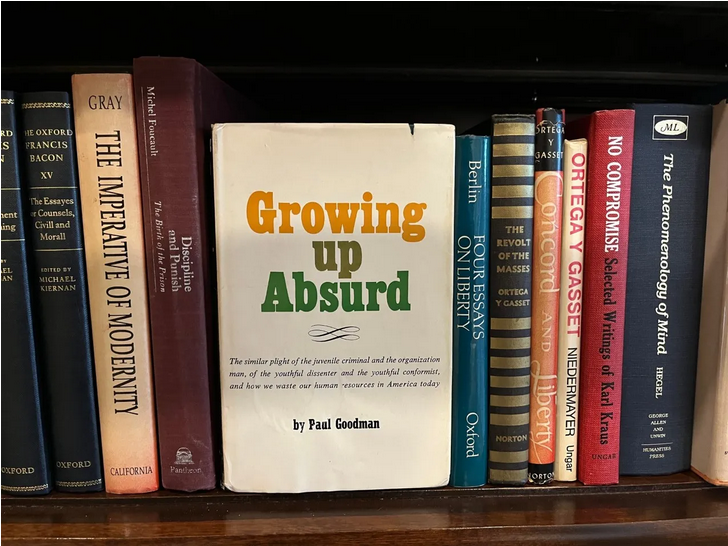
Today I want to focus on a single paragraph published in 1960.
You’re asking yourself: How much can a single paragraph matter — especially if it was written 63 years ago? But read it first and judge for yourself.
It’s a chilling paragraph.
[…]
By any measure, [Paul Goodman] was one of the most eccentric thinkers of the era. Yet he anticipated our current situation with more insight than any of his peers.
Let’s look at this one paragraph from the Preface to Growing Up Absurd. It’s a long paragraph — it takes up most of two pages. So we will break it down into pieces.
Goodman begins with a puzzle he needs to solve — society is stagnating everywhere, and we all can see it. But there’s no action plan to fix it. There’s a lot of huffing and puffing and finger-pointing everywhere, but nobody has even started on developing a practical agenda.
According to Goodman, this is because people “have ceased to be able to imagine alternatives”. Everybody accepts that the current system “is the only possibility of society, for nothing else is thinkable”.
Now comes his analysis, and — to my surprise — Goodman begins by talking about music. This was the last thing I expected in a social critique, but for Goodman the manufacturing of hit songs is a metaphor for everything else that’s wrong in a stagnant society.
He writes:
Let me give a couple of examples of how this [inability to imagine healthy alternatives] works. Suppose (as is the case) that a group of radio and TV broadcasters, competing in the Pickwickian fashion of semi-monopolies, control all the stations and channels in an area, amassing the capital and variously bribing Communications Commissioners in order to get them; and the broadcasters tailor their programs to meet the requirements of their advertisers of the censorship, of their own slick and clique tastes, and of a broad common denominator of the audience, none of whom may be offended: they will then claim not only that the public wants the drivel that they give them, but indeed that nothing else is being created. Of course it is not! Not for these media; why should a serious artist bother?
When I first read this, I was dumbstruck. Goodman wrote this during the winter of 1959 and 1960, when radio stations were independent and freewheeling. Back in my teen years, a single business was only allowed to control one AM station and one FM station. In 1985 this was increased to 12 stations on each band. And in 1994 this was raised again, this time to 20 AM stations and 20 FM stations.
But then all hell broke lose when the Telecommunications Act of 1996 passed in the Senate by a 91 to 5 margin and was signed into law. Now the sky was the limit — and all the airwaves it contained.
Soon Clear Channel Communications owned more than 1,200 radio stations in some 300 cities. The company began the process of standardizing and homogenizing our musical culture. We still suffer from that today.
Even after radio started losing influence in the Internet Age, huge streaming platforms (Spotify, Apple Music, etc.) ensured that access to the ears of America would be controlled by a tiny number of huge corporations. A musical culture that was once local, indie, and flexible has become centralized, corporatized, and stagnant.
How could Paul Goodman even dream of such a scenario back in 1960? That future was decades away at the time.
But we are only at the start of this visionary paragraph. Goodman now explains that the same thing will happen in universities.
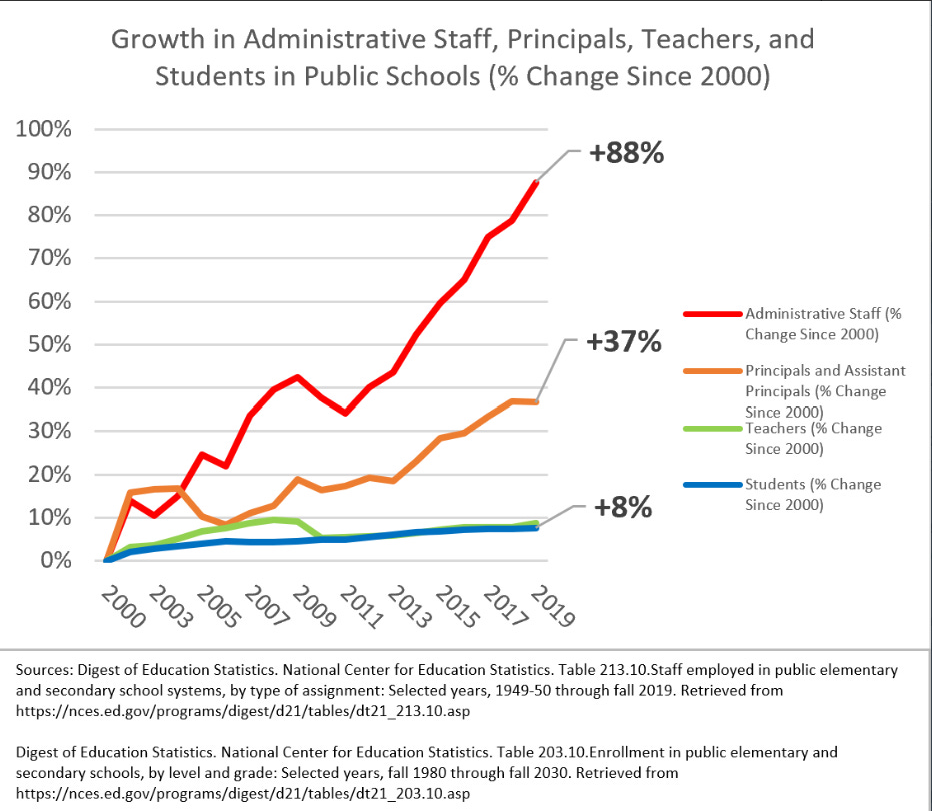
Colleges and schools were small and non-bureaucratic back in 1960. Yet Goodman sees a crisis looming. On the next page Goodman warns against “the topsy-turvy situation that a teacher must devote himself to satisfying the administrator and financier rather than to doing his job, and a universally admired teacher is fired for disobeying an administrative order that would hinder teaching”.
Administration at US colleges has grown exponentially in the last two decades and has turned almost every academic institution into a plodding bureaucracy — but how in the world did Goodman anticipate this in 1960?
Now let’s return to our chilling paragraph. Immediately after discussing radio stations, Goodman adds a gargantuan sentence. It jumps all over the place but hits the target at every twist and turn:
Or suppose again (as is not quite the case) that in a group of universities only faculties are chosen that are “safe” to the businessmen trustees or the politically appointed regents, and these faculties give out all the degrees and licenses and union cards to the new generation of students, and only such universities can get Foundation or government money for research, and research is incestuously staffed by the same sponsors and according to the same policy, and they allow no one but those they choose, to have access to either the classroom or expensive apparatus: it will then be claimed that there is no other learning or professional competence; that an inspired teacher is not “solid”; that the official projects are the direction of science; that progressive education is a failure; and finally, indeed — as in Dr. James Conant’s report on the high schools — that only 15 per cent of the youth are “academically talented” enough to be taught hard subjects.
Here in a nutshell is the credentialing crisis of our times. Learning is replaced by exclusionary certification programs that limit career opportunities — unless you take out loans and “purchase” the necessary credential from these academic gatekeepers.
This has become so destructive in our own time that many are crushed by student loans, and others seek ingenious ways of bypassing college entirely. There’s no way that Goodman could have grasped this in 1960 — when only 7.7 percent of Americans had college degrees.
Nor could he have known about the replicability crisis in science or the destructive games now played in awarding of scientific grants. Those are the problems of our times — not his.
But somehow Paul Goodman saw it coming.
February 7, 2023
QotD: The misery of certainty
So why are they always so fucking miserable?
Let’s stipulate, for instance, that gender really is just a social construction. Even if it’s not, you’re dogmatically certain of this. Crucially, everyone else in your world is equally dogmatically certain, so even if it’s not, it is. Shouldn’t you be much, much, much happier? So you’re really a wingless golden-skinned dragonkin. Cool. Everyone else is 100% on board with this. You should be the happiest wingless golden-skinned dragonkin on earth … but you’re not. You’re miserable, and you do your damnedest to make every single other person you come in contact with miserable, too.
As a wise man once put it, if you run into an asshole in the morning, well, you just ran into an asshole. If you run into nothing but assholes all day, then you’re the asshole.
Same question to atheists. I can understand nonbelievers being tormented by their uncertainty, but an atheist is dogmatically certain there’s no god … so why aren’t y’all happier? Why, exactly, does the kid with cancer make you mad? The universe, you’re sure, is nothing but the random collision of atoms. It sucks for the kid that those atoms collided in that particular way, but why are you mad? More to the point, why are you mad? It’s like getting mad at gravity for that apple bonking you on the head. There’s no cosmic injustice without cosmic justice. I’d expect a zenlike calm, but instead, every time I write something about atheism (which I really don’t very often), I get a whole bunch of sour, bitter, angry atheists dropping in to tell me that I’m the asshole.
Severian, “The Emotion is the Tell”, Rotten Chestnuts, 2020-01-24.
January 31, 2023
“Thorstein Veblen’s famous ‘leisure class’ has evolved into the ‘luxury belief class'”
Rob Henderson had a particularly difficult childhood, but thanks to his own efforts ended up going to Yale after leaving the military. He discovered a very different world when he began his studies:
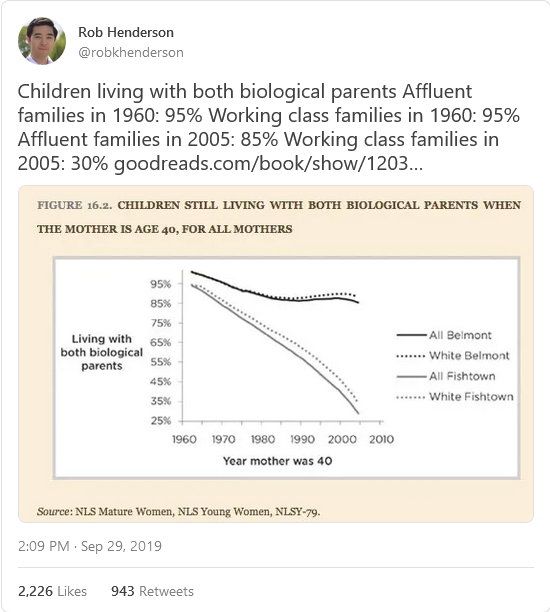
I was bewildered when I encountered a new social class at Yale four years ago: the luxury belief class. My confusion wasn’t surprising given my unusual background. When I was three years old, my mother was addicted to drugs and my father abandoned us. I grew up in multiple foster homes, was then adopted into a series of broken homes, and then experienced a series of family tragedies. Later, after a few years in the military, I went to Yale on the GI Bill. On campus, I realized that luxury beliefs have become fashionable status symbols. Luxury beliefs are ideas and opinions that confer status on the rich at very little cost, while taking a toll on the lower class.
In the past, people displayed their membership in the upper class with their material accoutrements. But today, luxury goods are more affordable than before. And people are less likely to receive validation for the material items they display. This is a problem for the affluent, who still want to broadcast their high social position. But they have come up with a clever solution. The affluent have decoupled social status from goods, and re-attached it to beliefs.
[…]
You might think that rich students at elite universities would be happy because they are in the top 1% of income earners. But remember, they’re surrounded by other members of the 1%. Their social circle, their Dunbar number, consists of 150 baby millionaires. Jordan Peterson has discussed this phenomenon. Citing figures from his experience teaching at Harvard in the 1990s, Peterson noted that a substantial proportion of Ivy League graduates go on to obtain a net worth of a million dollars or more by age 40. And yet this isn’t enough for them. Not only do top university graduates want to be millionaires-in-the-making, they also want the image of moral righteousness. Elite graduates desire high status not only financially, but morally as well.
For our affluent social strivers, luxury beliefs offer them a new way to gain status.
Thorstein Veblen’s famous “leisure class” has evolved into the “luxury belief class”. Veblen, an economist and sociologist, made his observations about social class in the late nineteenth century. He compiled his observations in his classic work, The Theory of the Leisure Class. A key idea is that because we can’t be certain of the financial standing of other people, a good way to size up their means is to see whether they can afford to waste money on goods and leisure. This explains why status symbols are so often difficult to obtain and costly to purchase. These include goods such as delicate and restrictive clothing, like tuxedos and evening gowns, or expensive and time-consuming hobbies like golf or beagling. Such goods and leisurely activities could only be purchased or performed by those who did not live the life of a manual laborer and could spend time learning something with no practical utility. Veblen even goes so far as to say, “The chief use of servants is the evidence they afford of the master’s ability to pay.” For Veblen, butlers are status symbols, too.
Converging on these sociological observations, the biologist Amotz Zahavi proposed that animals evolve certain displays because they are so costly. The most famous example is the peacock’s tail. Only a healthy bird is capable of growing such plumage while managing to evade predators. This idea might extend to humans, too. More recently, the anthropologist and historian Jared Diamond has suggested that one reason why humans engage in displays such as drinking, smoking, drug use, and other physically costly behaviors, is because they serve as fitness indicators. The message is “I’m so healthy that I can afford to poison my body and continue to function.” Get hammered while playing a round of golf with your butler, and you will be the highest status person around.
January 30, 2023
QotD: Teaching … back in the day
Of course, this was so long ago that students used to be unsure how to address me. Most professors had gone “hip” and had students call them by first name, but there were enough crusty old codgers around who insisted on “Dr. So-and-So” that they didn’t assume. After which I started telling them “you can call me whatever you want, but as a general rule life runs smoother if we respect each other’s station. If you know someone has a title, it’s best to use it unless they specifically tell you otherwise, and it’s always good to respect the social distance between yourself and someone who has something you want. So, choose accordingly.” 20 years ago, most of them got it, and addressed me by my title. 15 years ago, I started getting lots of puzzled puppy dog looks (“what’s a ‘social station’?”). 10 years ago, they all just assumed first names were fine, and before I retired I counted myself lucky if I got so much as a “hey dude”.
Meanwhile, as far as the students were concerned, my job went from “trying to teach them something” to “the annoying meat puppet whose presence we have to tolerate until he puts the A+ in the gradebook for record-keeping purposes”.
Severian, responding to a comment on “Movies Made On Mars”, Rotten Chestnuts, 2019-02-04.
January 29, 2023
D.C. Public Schools – “if this were a corporation, it would be in liquidation. If it were a house, it would be condemned”
Andrew Sullivan on the latest PR campaign by the disaster that is the DC Public School system:
In my web-reading this week, I stumbled across two statistics that made me sit up straight. The first came from a devastating story last September about my home city’s public schools. I had just watched a slick new video from DC Public Schools about their new “equity” push, which aims to go “beyond students’ academics” and “call out inequities”. The video is full of vague-sounding pabulum — they never define what they mean by “equity”, for example, apart from invoking Ibram X Kendi’s term “antiracism” — but the message is very clear: “equity” is now the central focus of the school district. And it’s a bright new day!
Now check out the data on how the DC Public School system is faring. A key metric is what they call “proficiency rates” — a test of whether the kids are passing the essentials of reading and math at every stage of their education. Overall, only 31 percent of DC students have proficiency in reading and just 19 percent have proficiency in math. Drill down further in the racial demographics and the picture is even worse: among African-American kids, the numbers are 20 percent and 9 percent, respectively. Among black boys, it’s 15 percent and 9 percent. Which means to say that DC Public Schools graduate kids who are overwhelmingly unable to do the most basic reading and math that any employer would need.
This is not a function of money. In the most recent federal analysis: DC spends far more per student — $30,000 a year — than any other state, double the amount in many states across the country.
Let’s put it this way: if this were a corporation, it would be in liquidation. If it were a house, it would be condemned. But since it’s a public school system, it can avoid this catastrophic failure by emphasizing “equity”!
Call this the woke dodge. As they fail to educate kids in the very basics, they brandish a shiny object over there — “Diversity! Equity! Inclusion!” — to distract us. Or they claim that these scores are caused by “white supremacy” or “systemic racism”. Or they argue that now, they are educating “the whole child”. From the DCPS video: “The racial equity lens is a critical component of ‘whole child’ for us because being a whole child means thinking about all of your identities, but certainly the racial identity is a gap in what we’re discussing as a country.” Anything but do the basic job of teaching math and reading as they are supposed to do.
The truth is: they obviously can’t teach those subjects successfully. I’m sure many are good teachers doing their best, and some manage to rescue some of these kids, who often face terrible trauma in their homes and neighborhoods. But the data overall are damning. Imagine spending $30K a year on a student, any kid, in any country, and after 12 years, he still can’t spell or do basic math. It must be really hard to pull that off. And as a reward, you get a shitload of money from the city and the feds to keep it up. Criticize them? You’re a “white supremacist”.
Then there’s the other stat that blew my mind — on the post-BLM surge in murders of African-Americans, including many children. The rise in homicide has cooled off somewhat, as Robert Verbruggen notes. But check this out:
Between the 2018–2019 and 2020–2021 periods, the black homicide rate went up by about 40 percent and the white one by 15 percent — already a glaring disparity. But since the black homicide rate started out so much higher than the white one, this translated to an increase of just 0.4 per 100,000 for whites and 9.7 per 100,000 for blacks — nearly 25 times as large. The increase in the black homicide rate was greater than the total homicide rate for the nation as a whole.
Read that last sentence again.
January 21, 2023
A club for autodidacts?
Ed West regrets the lacunae in his knowledge of many things, which I suspect also describes a lot of my blog visitors (given how often my own autodidactic web explorations end up here or on my social media accounts). His proposed solution is a club to study the western canon:
I’m ashamed of how little I know about a lot of things. Classical music, for instance, is a huge ocean of unknowns to me. I appreciate it, and I would like to know more, but it still feels like a language in which I have only the barest of vocabulary.
I’m so clueless and lightweight on that front that my favourite classical music LP when I still had a record player was a double album which told you which advert each piece was from (“The Hovis advert with the boy walking up the hill” for Dvorak, “the Hamlet cigar ad with Gregor Fisher” by Bach).
My knowledge of poetry is quite poor, too, and I wish I could recite more of it, rather than, say, the lyrics of the first seven Iron Maiden albums I learned off by heart at 13 (nothing against Iron Maiden, I still love them, but I’ve found this a slightly less useful skill down the years when trying to impress people).
Poetry has never been my thing. I enjoy hearing others read poetry, but there’s always something that prevents me from reading poetry on the printed page and “getting” the rhythm of it for more than a stanza or so. However, with song lyrics the underlying music provides sufficient support that I undoubtedly know far more lyrics by heart than any other kind of poet-created text.
YouTube is full of videos following in George Birkbeck’s tradition of adult learning. There are podcasts like Peter Adamson’s History of Philosophy Without Any Gaps or The Partially Examined Life. One of the most popular Twitter accounts at the moment is The Cultural Tutor, with over a million followers, producing threads on the art, architecture, music and literature you should know about. People really want to learn this stuff, and regret that they were never made to do so earlier.
Some of this is due to the education system, although I don’t want to be one of those tedious people who go on Twitter and blame the curriculum for the gaps in their knowledge of history: “why weren’t we taught about the Second Schleswig war in school? Why am I only learning this now?” as if their teachers had thousands of hours spare rather than a very limited amount of time. But it’s also true that most people leave the British state education system knowing very little about the western canon, and are afterwards playing catch-up with a less absorbent mind.
In my case, with a couple of exceptions, the way that history — especially Canadian history — was taught in school seemed to be deliberately made as bland and uninteresting as possible … we of course skipped over most of the battles and campaigns so we could concentrate on the diplomats and treaties. Steve Sailer noted a similar phenomenon in US schools:
In Europe, anthropologists have promoted the “pots not people” theory to argue that trade and changes in fashion must explain why Corded Ware pots suddenly showed up all over Europe about 4,900 years ago. (So did battle axes; indeed, early scientists called this the Battle Axe Culture. But that sounded too awesome. Hence, more recent academics renamed it after its pottery style to make these brutal barbarians sound dweebier and thus less interesting to boys.)
Oddly, we were at least given some minimal insight into the plight of First Nations children in the residential school system which was not true when my son went to school a generation later. I’m still puzzled about that change in the curriculum. But back to Ed’s proposal:
Perhaps the main reason is that there already aren’t enough people who know about these things to teach in the first place, and who are also willing to endure the strain of having to keep order among an unwilling audience. So the knowledge does not get passed on, and public culture becomes ever more lowbrow.
But while it’s a hopeful sign that so many people go online to learn these things, my take-away from lockdown is that in-person is always better — going to something live, meeting people face to face, allowing your sensory perception to aid the learning process. I also believe that the more clubs and institutions we have, the healthier and happier our society.
That is why I’m proposing an idea, for a sort of club where people come and listen to talks about a particular feature of the western canon — Virgil, Goethe, Milton, Van Eyck, whatever — and fill in all these enormous holes in our knowledge. It would be a bit like an old-fashioned salon, or a Lyceum club. Although there are local salons still running, this would ideally be national. This canon club — I’m open to suggestions for a different name — would initially start in one city, presumably London, but if there was further interest we could help set up branches across Britain (and then even maybe abroad). Each local club would run semi-independently, but the wider organisation would help with arranging speakers and so on.
I see his point, but in my experience a lot of autodidacts are also rather introverted by nature so a physical salon or club with a lot of strangers might be less appealing than some of the existing online options.
January 20, 2023
QotD: Michael Ignatieff
Google “Michael Ignatieff” and you wonder if it was really legal for one man to have enjoyed so many blessings. Everything the Canadian intellectual touched turned to gold. At boarding school in Toronto in the Sixties he was captain of the soccer team and editor of the yearbook. He taught at Oxford and the London School of Economics. He presented The Late Show for the BBC and wrote columns for the Observer. His documentaries won awards; his biography of Isaiah Berlin was shortlisted for some of the world’s most prestigious non-fiction prizes; his novel was even shortlisted for the Booker Prize. He was awarded a professorial chair at Harvard, then another at Toronto. And when his friends in the Canadian Liberal Party invited him to make a bid for the leadership, further glory seemed inevitable.
What happened next, however, makes Kwarteng’s stewardship of the Treasury look like a triumph. In 2011 Ignatieff led the Liberals to the worst defeat in their history, finishing third with just 34 seats. What was worse, he even lost his own seat in Etobicoke–Lakeshore, the first Canadian opposition leader to do so since 1900. His staff were in tears, the world was watching, and all those book prizes must have seemed an awfully long way away. In the cruellest twist imaginable, the man who always came top in exams had failed the most public exam of all.
Dominic Sandbrook, “Kwasi Kwarteng was the wrong sort of clever”, UnHerd, 2022-10-17.
January 19, 2023
“Sir, was everyone in history a racist?”
At The Critic, Fred Skulthorp explains how British history is being taught in schools these days:
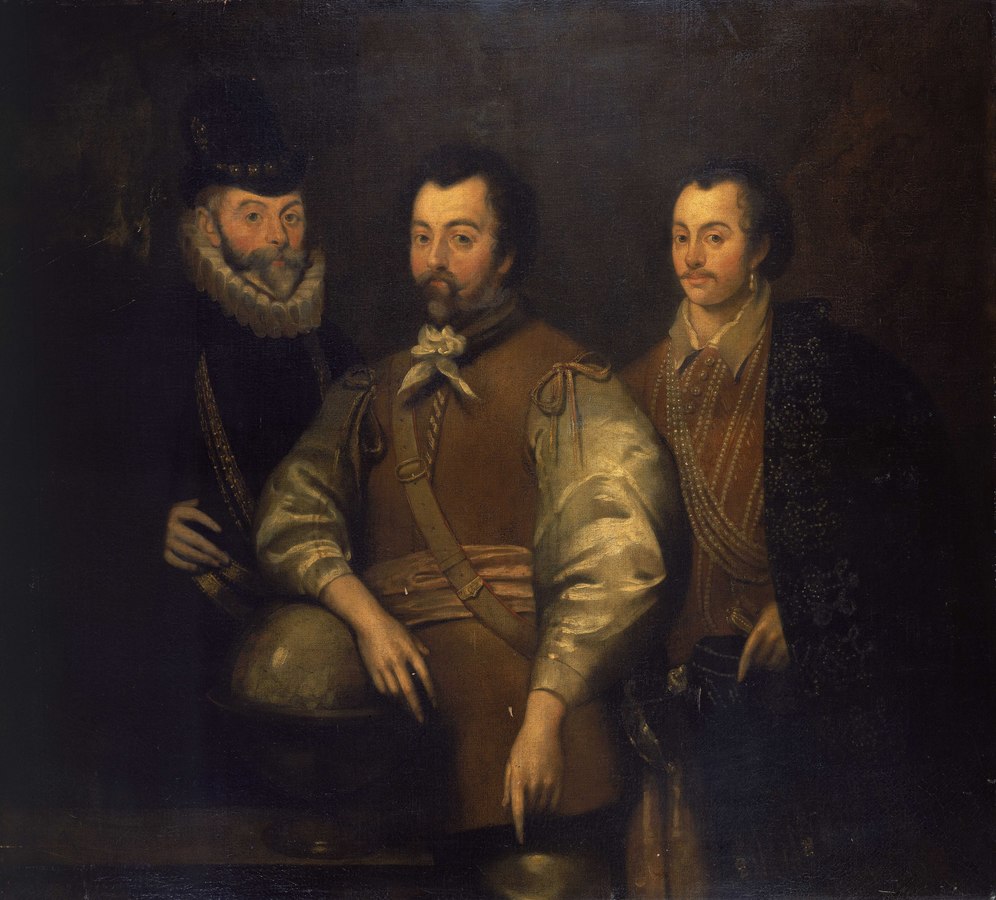
Sir John Hawkins (1532-1595), Sir Francis Drake (1540?-1596), and Thomas Cavendish (1560-1592).
Probably a copy of Daniel Myten’s’ painting of the same subject, now part of the Royal Museums Greenwich collection via Wikimedia Commons.
“Sir, was everyone in history a racist?” said Daniel one slow Thursday afternoon at my old school in North London. Daniel hadn’t put up his hand, so of course, I had to tell him off. Even worse, being in my usual teacherly bad mood, I wasn’t exactly Mr Chips with my response. What a silly question, I snapped, before going back to trying to teach a set of pandemic weary teenagers about the Reformation.
Daniel deserved a better answer than that. Not least because some version of his question has now worked its way onto the lips of the certain adults who run schools. The latest “yes” in a primary school in Lewisham saw an “overwhelming” majority vote to remove the stain of Sir Francis Drake’s name from the school. Who knows what arguments went into the decision, but one can only hope they delved a little bit more into his career than the BBC who initially served him up as a “16th century slave trader”.
The decision didn’t surprise me. I had briefly taught in another secondary school just down the road, and another in North London, where making the curriculum inclusive, diverse, decolonised, equal etc was all the rage. For me, Drake was a fascinating target. I had actually taught the man to a class of Year 8s. Funnily enough then, Drake was one of the few old white men of British history deemed more accessible — largely given his relationship with an escaped slave called Diego. According to Miranda Kaufman, whose book Black Tudors was gleefully worked into our history curriculum, Diego became Drake’s “right-hand man” in his various endeavours across the high seas.
This wasn’t enough to exonerate him in Lewisham. When it comes to slavery and being a dead white man, even flirt with it and you’re out. Beyond the expected uproar, the bigger issue here is the increasingly strange way we feel compelled to serve up our history to make it accessible for “minorities” in the name of “diversity, equality and inclusivity”.
Both schools I taught in during my short-lived career were some of the most diverse in London. This isn’t something that particularly interested me, but it certainly played on the conscience of some of my colleagues. One of the most cringe-inducing conversations I have ever had was with a fellow teacher, who on discussing changes to the curriculum in the name of “diversity” recalled something along the lines of: that they had looked down the register, seen the names and wondered how we might better tell their story. Presumably, this meant anything other than the usual fare of boring old “white” British history
What exactly is their story? As British citizens, their story is our story; our history, their history and vice versa. The attempts to presume exactly what these teenagers found relatable end up pretty disingenuous. Roman Britain? Ever heard of Ivory Bangle Lady? The Tudors? All old dead white guys, huh? Nope, check out this cool black trumpeter who was in the court of Henry VII! These are interesting curios, but sprinkling them throughout the curriculum all too often seemed to advance the misconception that Britain has always been a multiracial, multicultural society — something not only historically inaccurate but incredibly patronising to the children of second, third, even fourth generation immigrants.
This all came to a head during a unit on World War One, which our head of department insisted be based on the book The World’s War: Forgotten Soldiers of Empire by David Olusoga. The book is an interesting piece of revisionism about the role of colonial soldiers in WW1. In obsessing over race and teaching the Western Front, it does at some point have to contend with the fact that the vast majority who died there were, err … white men. In one particularly painful lesson, I ended up having to teach the Battle of the Somme by asking the class: what does the story of Chinese labourers reveal about World War One? Funnily enough, as it turns out, not that much! I’m sure being subjected to racial slurs whilst doing manual labour behind the front wasn’t much fun. But I felt something fundamentally dishonest, even borderline offensive, in prioritising their story over those of the Pals Battalions who went over the top that morning.
January 17, 2023
How ideological programming in British schools make men like Andrew Tate inevitable
To be honest, I don’t think I’d ever heard of Andrew Tate before his legal troubles in Romania hit the headlines, and I’m not well-versed on his achievements (such as they might be). Janice Fiamengo also admits that Tate wasn’t on her radar before then, but she’s done some work to try to put him into perspective:
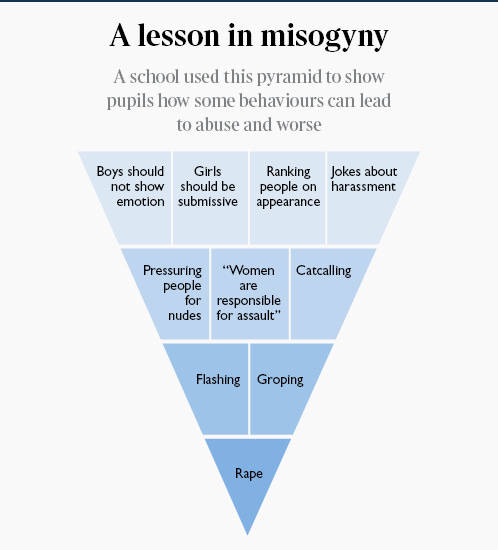
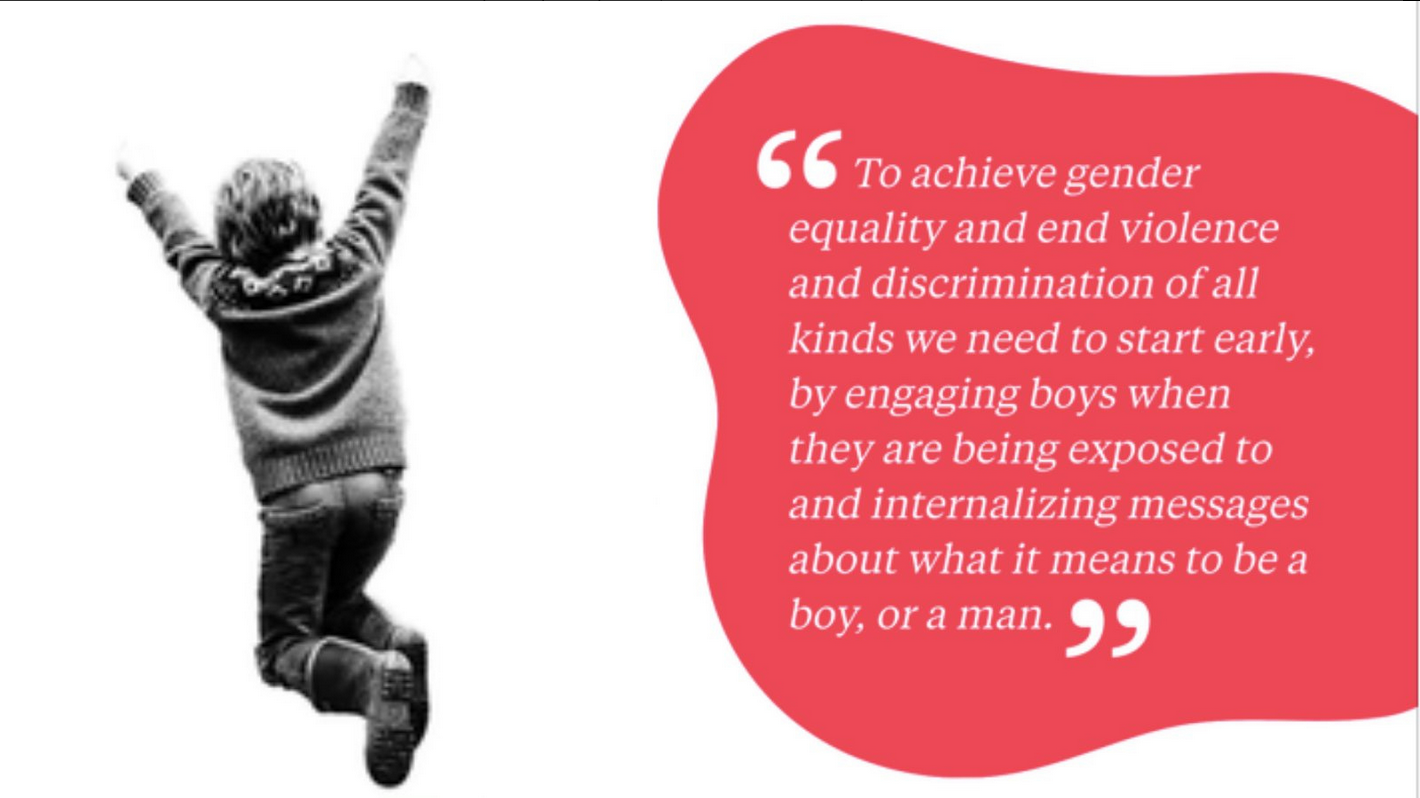
What has Tate got to do with UK education, except perhaps as a telling symbol of its unintended consequences? Why not just model and enforce ideals such as courtesy, self-restraint, and hard work, while upholding high academic standards? The article demonstrates how deeply committed schools have become to ideological programming. Some schools have drawn up “entire lessons focused on Tate” (!!!) while others deal more generally with “misogyny and gender stereotypes”. Whatever the particulars, the general message is unvarying: “We’ve all got to work collaboratively and collectively to support young men to reframe masculinity—away from this toxic ideology that’s presented by the likes of Tate.”
No one who’s been following the feminist narrative over the past decade or two will be surprised by the dogmatic reference to “toxic ideology,” now standard in any discussion of “reframing” boyhood. There is just one problem for the concerned teachers: Tate is five steps ahead of them, having already made clear to his millions of followers why injunctions about “reframing masculinity” are just code for the continual marginalization that most boys naturally want nothing to do with. The moment Tate and his allies expressed their scorn for the project, it lost its power overs the millions of boys forced to sit in feminist classrooms across the UK. Tate confirmed what boys intuitively knew: having their masculinity “reframed” will prevent them from pursuing masculine dreams, from being proud of themselves as male, admired by their male peers, and able to attract the interest of pretty girls. Teachers can keep on telling boys that peer approval through masculine moxy isn’t important, but that won’t make it true.
The point is not whether Tate’s (“I’ve got 33 cars“) program is an unalloyedly good one; the point is that it is manifestly better than the recipe for self-loathing and irrelevance being offered by the schools. The school’s program is the same that has been tried for years without any enthusiastic uptake because it offers nothing affirmatively male for young men to be and do (see especially White Ribbon UK, which has been trying for years to turn boys into handmaidens of feminism). All the normal things that centuries of boys in every major civilization on earth have cared about—competitiveness, status, toughness, mastery, knowledge, self-reliance, stoicism, high-jinks, displays of ability, and male bonding—are now frowned upon and must be replaced by feminine traits like empathy, egalitarianism, conformity, verbal display, and tone-policing. It doesn’t take a gender studies specialist to see that the life being offered these boys is one of deference, self-suppression, and self-contempt. No boy should want that.
In case you doubt my characterization, take a look at the Global Boyhood Initiative’s report on The State of UK Boys: Understanding and Transforming Gender in the Lives of UK Boys, published in 2022. The report was written for “teachers, youth workers, early-years practitioners and other professionals” to achieve “gender equity and social justice”.
Incidentally, the report includes a section attacking an alleged “overemphasis” on research showing boys and men as victims of intimate partner violence by women. While the report enthusiastically promotes the end of “gender” through transgenderism and social constructivism, it emphatically does not support the end of gendered norms about which sex is violent. On this front, the report laments that “even young boys” now believe that male persons can be victimized by female persons, citing the case of Johnny Depp’s abuse by Amber Heard. Nothing could more clearly signal the report authors’ chagrined awareness of the difficulty of controlling boys’ thoughts in the internet age.
The rest of the report explores pathways to weaken masculinity. On a number of occasions, it takes aim at “simplistic notions that boys require male ‘role models'” because such notions “frame women as inadequate to parent and teach boys”. Taking for granted that “gender is not tied to sex organs, hormones, or biological traits” (one wonders, then, why trans persons elect to take hormones and to change their sex organs), the emphasis throughout the report is on “realigning” masculinity to highlight gender fluidity, transgenderism, and inclusion of girls. The document has absolutely nothing good to say about masculinity, which it describes, variously, as “a seductive form of power”, “hegemonic”, and “oppressive”. It even uses the derogatory term “boysplaining” to stigmatize boys’ alleged way of talking.
Even such seemingly benign behaviors as “laughter, banter, and entertaining one another” are said to be “laddish” and linked to the exclusion of women and homosexuals. Taking pleasure in being good at sport is also given a negative valence by being associated with bullying.
As in all such feminist propaganda, the report seeks the evacuation of all positive content from masculinity. “Realigned” boys are to anchor their sense of self mainly in not being what boys have always been. They are to shun the allegedly “hegemonic” characteristics of “physical, sexual, and mental prowess; being action-oriented; ‘knowing’; having autonomy […]; and being emotionally tough.” It is surely no coincidence that modern boys and young men have fallen well behind their female peers in educational attainment, economic status, and performance on the job market. “Prowess” is out, knowing is out, being active is out, toughness is out. No wonder so many boys feel lost, disaffected, and resentful, and no wonder some see Andrew Tate as a hero.