
I will mention just one of the courses on offer, the “building” of multi-disciplinary teams, so called. I have some experience of multi-disciplinary teams once they have been “built”, or should I say “assembled”, “agglomerated” or “accumulated”. More often than not, in my experience, they are not so much multi-disciplinary as undisciplined. Lacking a clear structure of overall authority, and therefore of responsibility, they lead to endless disputes as to who is to do what, as well as the grossest neglect of the ostensible aims of the “team”.
The power struggles are interminable and insoluble, for no one is truly in charge and any instructions are regarded as an infringement of or attack upon the idea of equality of disciplines and equality within disciplines. The pretence that the most junior is equal to the most senior means that supervision scarcely happens, or only retrospectively, after a disaster, when the most junior person who can plausibly be blamed is singled out.
The inevitable squabbles that result lead to accusations of bullying, usually defined in purely subjective terms: you are bullied if you feel you are (in the absence of a requirement of objective correlates of feeling, thought is, of course, quite unnecessary and probably best avoided). Such accusations can result in a Kafka-esque procedure lasting months and occupying days, weeks and months of labour-time.
Meanwhile, neglect of the real work is ascribed to a shortage of “resources” and the object of the team’s attentions, that is to say members of the public, are offered perfunctory services, for example never seeing the same member of the team twice. Between holidays, team meetings and courses on how to make the team function better, there is no time left for the elementary compassion of consistency.
Every public enquiry into every disaster that comes within the remit of the services set up to ameliorate the social pathology brought about by years of social engineering finds the same thing: lack of communication between the various parts of the multi-disciplinary teams. Time, surely, for a course on Communication Skills.
Theodore Dalrymple, “Workshops and why you must avoid them”, The Social Affairs Unit, 2009-11-18.
April 23, 2023
April 22, 2023
“I’d stock every preschool classroom with The Anarchist’s Cookbook if I could”
I’m also a libertarian, but I might not go quite as far as Freddie deBoer in the quote in the headline:
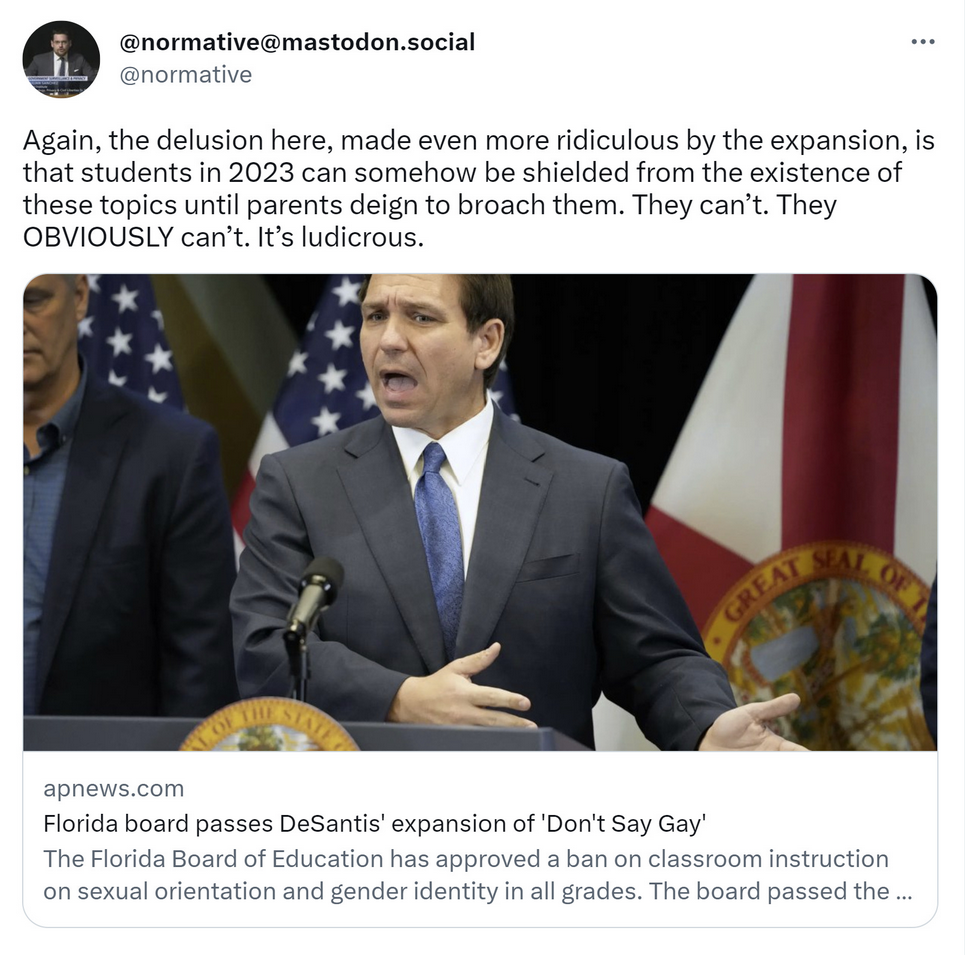
Julian Sanchez makes good sense here on recent bills in Florida designed to regulate and censor LGBTQ content in schools:
Yes, indeed. Kids will learn about LGBTQ issues sooner or later. It’s pointless to try and keep them from finding out about the existence of homosexuality, of gay love, of gay marriage, of trans people and gender nonconformity. They’re gonna find out. They have smartphones, usually much younger than they should. They’re curious and the world is always a click away. It’s foolish to try and prevent them from learning about this stuff. And, in fact, the more that you try to restrict what they learn, the more likely they are to explore this world in a way that openly defies your efforts. LGBTQ people, politics, art, and culture exist. You’re entitled to object to LGBTQ rights, in a free society, but you’re not entitled to (or able to) create a bubble in which others are kept hidden from knowledge of the existence of LGBTQ people. People love that I’m forever tweaking liberals about their attachment to various forms of unreality, to thinking that they can wish away facts of life that they’re uncomfortable with. But it’s the same deal here.
Look, I will acknowledge that some of the reporting on the “Don’t Say Gay” bill has distorted and exaggerated what the bill calls for, and I also think there’s a lot of motivated dismissal about the nature of some of the content that’s being debated. For example, some people have gone to the ramparts to defend access to the book This Book is Gay, which explicitly advertises itself as a guide to sex, despite the fact that the author herself says it’s not for children. (Pictures of the book that are routinely circulated are typically dismissed as conservative fabrications, but you just have to look at the book to know that isn’t true.) Probably that particular example is a matter of some groups being lazy when putting together reading lists, but of course there are always going to be debates and edge cases.
Would I ban that book? Of course not. Personally, I’m completely libertarian about this stuff; I’d stock every preschool classroom with The Anarchist’s Cookbook if I could. But there’s a difference between holding that position and believing it’s credible to pretend that there’s literally nothing to debate there. It’s pointless to pretend that books in a public school classroom are going to remain untouched by these disagreements. The views of parents will inevitably be expressed through the democratic apparatus that presides over those schools. Of course people are going to debate this stuff. Vociferously.
Still, the objections are ultimately misguided for the reasons Sanchez says. Plenty of kids in extremely repressive conservative environments dreamed of a future as an openly gay person in a liberal city, before the internet. I’ve always had qualms about the “born this way” framing — if being gay was a choice, would society have any legitimate right to refuse people from making it? — but the simple reality is that gay people and trans people etc have always transcended restrictive social and religious environments in their interior life, even if it was too dangerous for them to express it. If a kid is gay, they’re gonna figure that out. You don’t have to speed along the process, but trying to artificially impede their progress won’t work. That’s an “is” statement, not an “ought” statement.
Epistemology, but not using the term “epistemology” because reasons
At Founding Questions, Severian responds to a question about the teaching profession in our ever-more-self-beclowning world:

Proposed coat of arms for Founding Questions by “urbando”.
The Latin motto translates to “We are so irrevocably fucked”.
I know a guy who teaches at a SPLAC where they have some “common core” curriculum — everyone in the incoming class, regardless of major, is required to take a few set courses, and all of them revolve around that question. How do we know what we know? So it’s not just a public school / grade school thing. And epistemology IS fascinating … almost as fascinating as the fact that the word “epistemology” never shows up on my buddy’s syllabi.
I think the problem is especially acute for “teachers”, because the Dogmas of the Church of Woke are so ludicrous that it takes real effort to not see the obvious absurdities. It takes real hermeneutical talent to reconcile the most obvious empirical facts with the Dogmas of the Faith, and very few kids have it. So they either completely check out, or just repeat the Dogmas by rote.
The other problem has to do with teacher training. I know a little bit about this (or, at least, a little bit about how it stood 15 years ago), because a) I was “dating” an Education Theory person, and b) I went through Flyover State’s online
indoctrinationeducation Certificate Program.The former is just awful, even by ivory tower standards, so I’ll spare you the gory details. Just know that however bad you think “social science” is, it’s way way worse. The “certification program” was something I got my Department to sign off on — I was the guy who “knew computers” (which is just hilarious if you know me in real life; I’m all but tech-illiterate), so I got assigned all the online classes, which the Department fought against with all its might, and only grudgingly agreed to offer when the Big Cheese threatened to pull some $$$ if they didn’t. So even though I wouldn’t have been eligible for all the benefits and privileges thereunto appertaining, me being a lowly adjunct, none of the real eggheads could bring themselves to do it, so I was the guy.
The Education Department, being marginally smarter than the History Department, saw which way the wind was blowing, so they started offering big money incentives for professors to sign up for this “online teaching certification program” they’d dreamed up. No, really: It was something like $5000 for a two course, which really meant “two hours a day, four days a week,” because academia works like that (it’s a 24/7 job, remember — 24 hours a week, 7 months a year). By my math, $5000 by 16 hours is something like $300 an hour, so hell yeah I signed right up …
It was torture. Sheer torture. I knew it would be, but goddamn, man. Take the worst corporate struggle session you’ve ever been forced to attend, put it on steroids. Make the “facilitator” — not professor, by God, not in Education! — the kind of sadistic bastard that got kicked out of Viet Cong prison guard school for going overboard. Add to that the particularities of the Education Department, where all of academia’s worst pathologies are magnified. You know how egghead prose hews to the rule “Why use 5 words when 50 will do?” In the Ed Department, it’s “why use 50 when 500 will do.” The first two hours of the first two struggle sessions were devoted to Bloom’s Taxonomy of Success Words, and click that link if you dare.
I know y’all won’t believe this, but I’ll tell you anyway: I spent more than an hour rewriting the “objectives” section of my class syllabus to conform to that nonsense. Instead of just “Students will learn about the origins, events, and outcomes of the US Civil War,” I had to say shit like “Engaging with the primary sources” and “evaluating historical arguments,” and yes, the “taxonomy” buzzwords had to be both underlined and italicized, for reasons I no longer remember, but which were of course retarded.
Given that this is fairly typical Ed Major coursework, is it any surprise that they have no idea what learning is?
April 20, 2023
We strongly believe in academic freedom, except when research turns up “inconvenient” results
Tom Knighton on a sad situation at a London university with publicly funded research having arrived at a politically unwelcome result:
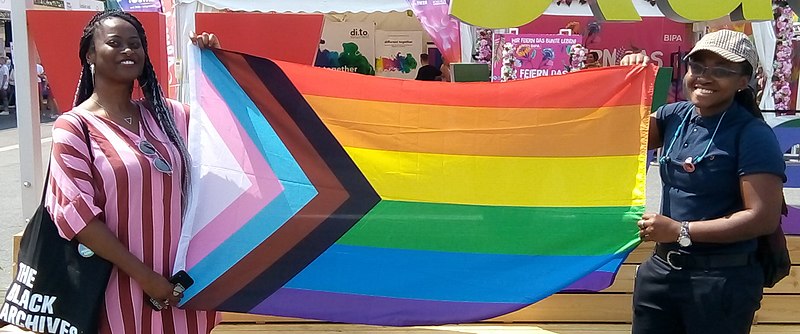
Two people at EuroPride 2019 in Vienna holding an LGBTQ+ pride rainbow flag featuring a design by Daniel Quasar; this variation of the rainbow flag was initially promoted as “Progress” a PRIDE Flag Reboot.
Photo by Bojan Cvetanović via Wikimedia Commons.
In the UK, one academic decided to look at the “gender wars”, particularly how academics feel silenced on the whole trans issue.
It sounds to me like both an interesting subject for study and one that might be very necessary in this day and age.
It seems that while the researcher in question was approved to study it, her findings are problematic and that got her canned.
From The Telegraph:
A university has “confiscated” the findings of an academic studying Britain’s gender wars in a row over her “dangerous” research data, The Telegraph can reveal.
Dr Laura Favaro began the first ever taxpayer-funded study into whether social scientists at universities feel censored over their views on transgender issues in March 2020 at City, University of London.
But it has descended into chaos, with the study’s author allegedly hounded out of the university, stripped of the findings she collected and barred from publishing them amid claims of transphobia.
[…]
Her study involved 50 individual interviews with academics in gender studies who identified as feminists, a representative survey of social scientists with 650 responses and hundreds of documents and tweets.
Scholars told her that they had threats of violence in the gender debate, hostility from colleagues, and others said they felt their careers “can’t survive that sort of backlash”, and that they have to have “secret conversations” to avoid reprisal and because “we are all so afraid”.
Her final work has not been published, as it was derailed by complaints about an article for Times Higher Education in which she warned that “a culture of discrimination, silencing and fear has taken hold”.
Following this, she says, her line managers told her that the study had “become an institutionally sensitive issue” and that “City considers my data to be dangerous” and is “frightened of making it public”.
So, what Favaro was finding was accurate.
That’s the big takeaway for me here. She said that academics were concerned about being attacked or that they had been because they didn’t play along with the trans agenda, and she was attacked and basically canceled because of it.
What’s even dumber is that Favaro was lured to City University from Spain so that she could conduct this research. She received roughly £28,000 from the British government via two different governmental entities to conduct the research.
Then she was silenced because the research found inconvenient truths.
That’s not what academia is supposed to be about. That’s not what academic freedom is about.
Freedom of any kind requires one to accept things that we would rather not have to accept. If you’re not free to say or do something that doesn’t actually harm a specific person but is otherwise objectionable, you don’t really have any freedom.
April 11, 2023
Canada’s colonial past
Peter Shawn Taylor talks to Nigel Biggar, author of the recent book Colonialism: A Moral Reckoning:
C2C Journal: Explain what you mean by a “moral reckoning” for colonialism – and how does that differ from the now-standard historians’ view that it was a shameful era characterized by exploitation, racism and violence?
Nigel Biggar: My first degree from Oxford is in history but professionally I am a theologian and ethicist. An ethicist is in the business of thinking about rights and wrongs and complicated moral issues. As I have previously written about the morality of war, I wanted to bring that ethical expertise to the very complicated historical phenomenon of empire.
And while my critics claim I am not an historian, they are not ethicists. My book is not a chronology. Each chapter deals with a different moral issue: motives, violence, racism, slavery, et cetera. Then I try to bring it to a conclusion with an overall view of the record of British imperialism, morally speaking. There are the evils of the British Empire, and there are its benefits as well.
[…]
C2C: One of your chapters takes a close look at Canada’s Indian Residential Schools. Take us through an ethicist’s view of a topic that has come to be considered this country’s greatest sin.
NB: The motivation for establishing residential schools was basically humanitarian. That is, they were meant to enable pupils to survive in a world that was changing radically. Notwithstanding any abuses and deficiencies that may have come later, we have to deal with the fact that native Canadians were asking for these schools in the beginning. They lobbied for them in treaties. And this was because they recognized that for their people to survive, they needed to adapt. They wanted their young people to learn English or French and how to farm. They recognized that the old ways could not be sustained any longer.
A lot of people today have a hard time coming to grips with the fact that the past was a very different place. For most people, the 19th century was pretty damn brutal. When we consider the conditions in residential schools today, we are horrified. But what is horrifying are the conditions in which most people of that time had to live. It is true mortality among native kids in these schools was generally higher and conditions were poorer. Sexual abuse was also a problem, but mostly by fellow pupils. I don’t want to sweep any of that under the table. Maybe the Canadian government should have spent more money on residential schools. But to make that case you need to identify what the government of the day should have spent less on. And I haven’t seen that argument made anywhere.
The Truth and Reconciliation Commission has many lurid tales about kids being seized from their parents. No doubt that, after education became compulsory in the 1920s, some children were distressed at being taken away. But this too has to be understood in light of the fact that the idea all children must have a certain level of education was gaining tremendous traction in Canada, Britain and throughout Europe at this time. So compulsory education for native children must be considered in that regard. And what might people say today if the Government of Canada had refused to educate Indigenous children?
Again, I don’t want to downplay the defects of residential schools. But we need to provide context in order to understand these things in proportion. It must also be considered significant that since the early 1990s, Canadian media have declined to give voice to many natives who want to offer positive expressions of residential schools, as J.R. Miller points out in his authoritative history of the residential school system, Shingwauk’s Vision. According to Miller, the verdict for the schools must be given in “muted and equivocal terms”. The wholesale damnation of residential schools is overwrought and unfair.
April 7, 2023
QotD: The effluvium of the university’s overproduction of progressive “elites”
What became of them? No single answer is possible. They joined the work force. Some became baristas, tech supporters, Amazon staffers and real estate agents. Others with intellectual ambitions found positions with the remaining newspapers and online periodicals, but most often they landed jobs as writers or researchers with liberal government agencies, foundations, or NGOs. In all these capacities they brought along the sensibilities and jargon they learned on campus.
It is the exodus from the universities that explains what is happening in the larger culture. The leftists who would have vanished as assistant professors in conferences on narratology and gender fluidity or disappeared as law professors with unreadable essays on misogynist hegemony and intersectionality have been pushed out into the larger culture. They staff the ballooning diversity and inclusion commissariats that assault us with vapid statements and inane programs couched in the language they learned in school. We are witnessing the invasion of the public square by the campus, an intrusion of academic terms and sensibilities that has leaped the ivy-covered walls aided by social media. The buzz words of the campus — diversity, inclusion, microaggression, power differential, white privilege, group safety — have become the buzz words in public life. Already confusing on campus, they become noxious off campus. “The slovenliness of our language”, declared Orwell in his classic 1946 essay, “Politics and the English Language“, makes it “easier for us to have foolish thoughts.”
Orwell targeted language that defended “the indefensible” such as the British rule of India, Soviet purges and the bombing of Hiroshima. He offered examples of corrupt language. “The Soviet press is the freest in the world.” The use of euphemisms or lies to defend the indefensible has hardly disappeared: Putin called the invasion of Ukraine “a special military operation”, and anyone calling it a “war” or “invasion” has been arrested.
But today, unlike in 1946, political language of Western progressives does not so much as defend the indefensible as defend the defendable. This renders the issue trickier than when Orwell broached it. Apologies for criminal deeds of the state denounce themselves. Justifications for liberal desiderata, however, almost immunize themselves to objections. If you question diversity mania, you support Western imperialism. Wonder about the significance of microaggression? You are a microaggressor. Have doubts about an eternal, all-inclusive white supremacy? You benefit from white privilege. Skeptical about new pronouns? You abet the suicide of fragile adolescents.
Russell Jacoby, “The Takeover”, Tablet, 2022-12-19.
April 4, 2023
QotD: We used to have this concept of “healthy socialization” for kids
30 years ago, that kind of thing wasn’t just possible, it was pretty easy, since Little League was still about silly stuff like having fun, and when high school coaches gave you the speech about teamwork and character building, he — get this — actually meant it. I know how crazy this sounds, but it was pretty much expected of us benchwarmers to take the piss out of the kid who carried on like he was some kind of Big League prospect. Nobody but parents came to the games, anyway, and wearing a letter jacket didn’t help you get girls (I tested this hypothesis extensively). Nowadays, of course, Little League squads are ruthlessly culled, and if you make the team, you’d better be ready to be put on a nutrition plan and workout schedule, to attend summer skills camps, to be no-shit scouted, by professionals, at an age where you’re still not really sure what girls are for.
You don’t get to be “a jock” for a semester, in other words. You are one, and that’s all you are, starting before puberty, and woe to the kid who only made the team because his hormonal clock was set a little ahead of the other boys’. The kid who can throw 75 at age ten, as we all know, is 99.8% certain to still be throwing 75 at age sixteen, when everyone on the JV team can catch up to it. In my day, that’s when the coach pulled you aside and explained a few things to you, gently but firmly pointing you towards the Model UN Club. He was good at it, and since he was good at giving those “teamwork and character” speeches, too, he’d tell you that this, right here, is one of those situations, so man up and accept your limitations.
Ah well. So much for being a jock. Cross it off the list, and try not to notice the relief in Mom’s eyes — and, yeah, the little bit of sadness in Dad’s — when they realize they don’t have to schlep you all over the goddamn place on summer evenings, sitting in the bleachers watching you ride the pine. Time to find something else …
Severian, “Alienation”, Rotten Chestnuts, 2020-10-29.
March 31, 2023
QotD: The education racket
Indeed, it’s not going too far to say that these types of institutions are designed to chase off anyone brighter, more honest, or more hardworking than the average member. If you haven’t had any experience with teachers or school boards lately (you lucky bastards), think back to your last encounter with Human Resources, or your neighborhood’s Homeowners’ Association. The only person who can stand to work for HR or be part of the HOA is … well, is the kind of person who works in HR or is part of the HOA — dull, vapid, lazily malicious busybodies. They’re as lazy as they are dumb, as dumb as they are malicious. The key to dealing with them, like the Sovietologist’s key to predicting the Politburo, is figuring out which of their lovely personality traits is likely to come to the fore in a given situation.
Severian, “How Dumb Are Liberals?”, Rotten Chestnuts, 2020-07-31.
March 25, 2023
South Africa – from bad to indescribably worse
John Psmith reviews South Africa’s Brave New World: The Beloved Country Since The End Of Apartheid by R.W. Johnson. It isn’t a pretty picture at all:
The whole world had come to Pretoria to see the inauguration of Nelson Mandela as the first democratically elected South African President. It was the greatest assemblage of heads of state since John F. Kennedy’s funeral … But it was the flight of nine SAAF [South African Air Force] Mirages overhead, dipping their wings in salute, which brought tears to many eyes. It said so many things: the acceptance of, indeed, the deference to, Mandela by the white establishment, the acknowledgement that he was fully President, able to command all the levers of power — and, for many black people in the crowd, it meant that for the first time the Mirages’ awesome power and white pilots were on their side, part of the same nation … All the products of that white power, including South Africa’s sophisticated economy and infrastructure, were being handed over intact.
A little over a decade later and that same South African Air Force was no longer able to fly. It wasn’t for lack of planes: new ones were procured from European arms manufacturers in an astonishingly expensive and legendarily corrupt deal. But once purchased the planes rotted from lack of maintenance and languished in hangers for lack of anybody able to fly them. Most of the qualified pilots and technicians had been purged, and most of the remainder had resigned. The air force did technically still have pilots, after all it would be a bit embarrassing not to, but those pilots were chosen for patronage reasons and didn’t technically have any idea how to fly a fighter jet.
It isn’t just the air force. That whole “sophisticated economy and infrastructure” that got “handed over intact” now by and large no longer exists. Consider something as basic as running water: in 1994, South Africa had some of the most sophisticated water infrastructure on earth, with a whole system of dams, reservoirs, and long-distance inter-basin conduits working together to conquer the geographical challenges of having several major cities and mining centers located on an arid plateau. All of this water was safe, drinkable, and actually came out of the tap when you turned the handle. This picture was marred of course by poor delivery to black rural communities and squatter camps, but in the early 90s the government was making rapid progress towards serving more of those people too.
Like the air force, that water system is now basically non-functional. It’s estimated that something like 10 million people no longer have reliable access to running water. When the water does run, it’s frequently filthy and contaminated with human sewage. South Africa had its first urban cholera outbreak in the year 2000, and they are now a regular occurrence. Again, like the air force, this isn’t for lack of money or effort. The state has spent billions on trying to fix the water problems, and the government’s water bureaucracy has tripled in size since 1994. Something else has gone wrong.
Neither of these examples is cherry-picked. Ask about literally any of the necessities for human life, and the picture is the same: basically first-world quality under the apartheid Nationalist government, and basically post-apocalyptic today. The electric grid is failing, with rolling blackouts consuming the country on a daily basis. The rail network, once one of the finest on earth, is now so degraded that mines in the North of the country prefer to truck their products overland to ports in Mozambique rather than risk the rail journey to Durban. The medical system was once the jewel of Africa and now teeters on the brink of collapse, with qualified doctors and nurses fleeing the country in droves. As for education, one South African author notes: “When Anthony Sampson’s authorized biography of Mandela appeared one of its more embarrassing asides was that all the educational institutions which had nourished Mandela had since collapsed. A Mandela could be produced in colonial times, but no longer.”
Had enough yet? At last count between a third and a half of the population is unemployed. Public order is non-existent outside gated communities and tourist areas patrolled by private security. The murder rate in South Africa exceeds that of many active war zones. Every major city in South Africa is among the most dangerous cities on earth, and the countryside is much worse than the cities. The reported cases of rape alone establish South Africa as the worst country on earth for rape, and the vast majority of cases are likely unreported, since the police have essentially stopped prosecuting this crime.
Something has gone very wrong. What happened? That’s the subject of this book by R.W. Johnson, an ultra-detailed examination of the 10 or so years following the end of apartheid in 1994. Johnson is the right guy to write this book — he’s lived in South Africa since the 1960s, and was active in the movement against apartheid from its earliest days, so he personally knows most of the players who’ve been running the country. And now he has the bittersweet task of writing a book documenting how what happened is “just what white racists predicted and what white radicals like myself scorned”.
March 21, 2023
Few professions are as “optimism biased” as primary school teachers
Freddie deBoer was commissioned to write this for a professional publication for teachers, but it was “too hot” for the editors, so he’s posted it to his Substack instead:
There’s a bias that runs throughout our educational discourse, coming from our media, academia, and the think tanks and foundations that have such sway in education policy. It’s a bias that exists both because of a natural human desire to see every child succeed and because the structural incentives in the field make rejecting that bias professionally risky. The bias I’m talking about is optimism bias, the insistence that all problems in education are solvable and that we can fix them if only we want to badly enough. At least a half-century of research, spending, policy experimentation, and dogged effort has utterly failed to close the gaps that so vex our political class. But still we hear the same old song about how we could close those gaps tomorrow if we really wanted to, an attitude that has distorted education policy and analysis for decades.
My first book, The Cult of Smart, was a commercial failure. It was released during the height of the pandemic and thus my ability to promote it was limited, but by any measure the market rejected it. It’s tough to produce a labor of love like that and find that few people were interested in it.
But there was a silver lining: since publication in 2020 I’ve heard from dozens and dozens of teachers, thanking me for putting their thoughts to print. These educators come from public, private, and charter schools, from schools with affluent study bodies and schools that are mired in poverty, from big city school districts and from low-population regional rural schools. And again and again, these teachers shared the same perspective: they agreed with the book’s overall argument, and often had thought similar things themselves for years, but felt they could not express them publicly for fear of professional consequences.
The essential argument of the book is that overwhelming empirical evidence shows that students sort themselves into academic ability bands in the performance spectrum early in life, with remarkable consistency; that the most natural and simplest explanation for this tendency is that there is such a thing as individual academic potential; and that the most likely source of this individual academic potential is likely influenced by genes. When we look at academic performance, what we see again and again is that students perform at a given level relative to peers early in schooling and maintain that level throughout formal education. (I make that case at considerable length here.) A vast number of interventions thought to influence relative performance have been revealed to make no difference in rigorous research, including truly dramatic changes to schooling and environment. Meta-analyses and literature reviews that assess the strength of many different educational interventions find effect sizes in the range of .01 to .3 standard deviations, small by any standards and subject to all sorts of questions about research quality and randomization. Even the most optimistic reading of the research literature suggests that almost nothing moves the needle in academic outcomes. Almost nothing we try works.
This implies that common sense is correct and that individual students have their own natural or intrinsic level of academic potential, which we have no reason to believe we can dramatically change. I believe that we can change large group disparities in education (such as the racial achievement gap) by addressing major socioeconomic inequalities through government policy. But even after we eliminate racial or gender gaps, there will be wide differences between individual students, regardless of pedagogy or policy. When Black students as a group score at parity with white students, there will still be large gaps within the population of Black students or white or any other group you can name, and we have no reliable interventions to make the weakest perform like the strongest.
My book’s argument is attractive to teachers because they’ve lived under an educational ideology that insists that every student is a budding genius whose potential waits to be unlocked by a dedicated teacher – and which holds teachers to that unachievable standard. From the right, they’re subject to “no excuses” culture, the constant insistence from the education reform movement that student failures are the result of lazy and feckless teachers; from the left, they’re subject to a misguided egalitarianism that mistakes the fact that every child is important and deserves to be nurtured for the idea that every child has perfectly equal potential. The result is a system that presses teachers to deliver learning outcomes in their classrooms that they can’t possibly achieve. But many of them feel that they can’t push back, for fear of professional consequences. If they speak frankly about the fact that different students have different levels of individual potential, they’ll likely be accused of shirking their duty.
March 15, 2023
Not only is the science “settled” … it’s already in the school textbooks
David Friedman on his attempts to follow up on claims made in a textbook on climate change already in use in US public schools:
Introduction to Modern Climate Change by Andrew Dessler is an elementary climate science textbook, now in its third edition. In Chapter 9, “Impacts of Climate Change”, it has:
Scientists predict that sea level will rise 47 to 73 cm (19 to 29 inches) above 1995–2014 levels by 2100. This may not sound like a significant challenge, but it is much larger than the 18 cm of sea level experienced over the twentieth century, which is already challenging for many who live near sea level. Like temperature, these predictions of sea-level rise might sound small but, also like temperature, they are not. In Florida, for example, a sea-level rise in the middle of the projected range would inundate 9 percent of Florida’s current land area at high tide. This includes virtually all of the Florida Keys as well as 70 percent of Miami-Dade County. Almost one-tenth of Florida’s current population, or nearly 2 million people, live in this vulnerable zone, and it includes residential real estate valued at hundreds of billions of dollars. It also includes important infrastructure, such as two nuclear reactors, three prisons, and 68 hospitals.
That struck me as implausible, given what else I had seen on the effect of sea level rise. The footnote for the claim was to Stanton and Ackerman (2007), which turned out to be not a peer reviewed journal article but a report commissioned by the Environmental Defense fund, an environmentalist group. It includes the same claims, but for 27 inches of sea-level rise not the 24 inches that is Dessler’s “middle of the projected range”. It refers the reader to Appendix C for “detailed sources and methodology”. Going there, I found:
To estimate the impact of sea-level rise on land area, populations, and public and private assets and infrastructure, we began with a 1:250,000 Digital Elevation Model (DEM) map of the State of Florida, and divided the state into “vulnerable” and “not vulnerable” zones demarcated by 1.5 meters of elevation and other factors described by Titus and Richman (2000) as corresponding to 27 inches of sea-level rise.
So what they are showing as the vulnerable area is not the 27 inch or 24 inch contour but the 1.5 meter (5 feet) contour. The explanation, from Titus, J.G. and C. Richman (2001). “Maps of lands vulnerable to sea level rise: modeled elevations along the US Atlantic and Gulf coasts“. Climate Research 18: 205–228, a journal article written by two EPA people and presumably peer reviewed:
Thus, at a typical site, the 1.5-meter contour would be flooded by spring high tides (i.e., high tides during new and full moons) when sea level rises 80 cm
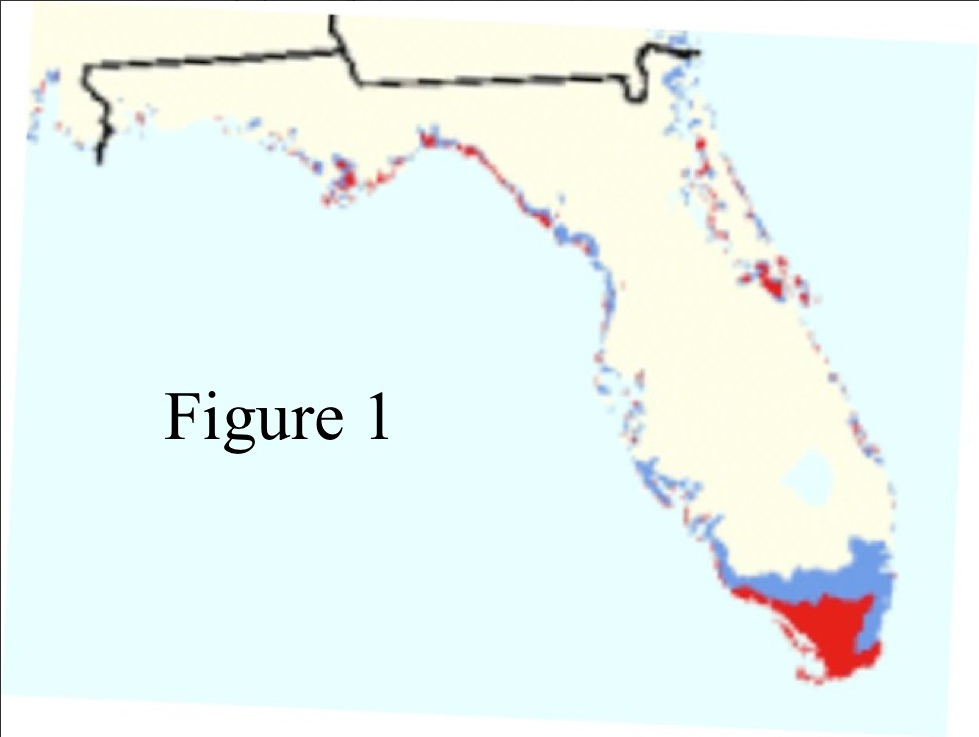
Figure 1 below (Titus and Richman Figure 4) is a map of Florida with the region within the 1.5 meter contour colored red, the region between 1.5 and 3.5 blue. Dessler’s middle of the projected range is 60 cm. Stanton and Ackerman’s 27 inches is 68.6 cm. The map shows what its authors claim would be flooded at 80cm.
Figure 2 below is a population density map of Florida from Wikipedia to which I have added the 1.5m contours from Figure 1. The large flooded area on the southern tip of Florida includes none of the densely populated area around Miami; only one of the tiny areas farther north appears to be in part on a populated area. That is not surprising — areas very close to sea level are likely to be marsh, in this case the everglades, and poor places to build on.
Stanton and Ackerman claim that their own calculations, using data bases of elevation and population, produce a total population in the at-risk area of 1.5 million. That was the figure Dessler gave in his first edition, presumably increased to almost 2 million in the third edition to reflect the increase in Florida’s population. Figure 2 shows why I don’t believe it. The flooded areas are in places almost all of which have very low population density, making it hard to see how flooding nine percent of the land area, most of it in the everglades, can flood almost ten percent of the population. Even if all of the Florida Keys are flooded, their total population is only about 80,000.
That problem is in addition to the fact that Dessler’s claim is for 60 cm of sea level rise, Stanton and Ackerman’s, from which Dessler got his figure for how many people are flooded, is for 68.6 cm (27 inches), and Titus and Richman get the 1.5 m contour that Stanton and Ackerman say they are using by assuming 80cm of sea level rise. Further reasons for suspicion are that Stanton and Ackerman gave figures for sea level rise substantially higher than either the IPCC figure at the time or the current IPCC figure, which suggests that they were trying to make the consequences of climate change look as scary as possible, and that they write “1.5 meters of elevation and other factors described by Titus and Richman (2000) as corresponding to 27 inches of sea-level rise” when Titus and Richman actually describe 1.5 meters as corresponding to 80 cm (31.5 inches) of sea level rise.

March 11, 2023
QotD: We used to call them “parlour pinks”
What’s life like in the Soviet Union? They neither know nor care, until the brute facts of life in the USSR are rubbed into their faces for so long that they have to acknowledge them. At which point they simply switch allegiances. Kolakowski’s essay doesn’t mention Paul Hollander’s Political Pilgrims, but they arrive at essentially the same conclusion — that instead of becoming disillusioned with Communism (Socialism, “social justice”) itself, the irritated butterflies of the Left grow disillusioned with a particular country or leader. The USSR has failed, yes, but — all together now! — “real Communism has never been tried”, so let’s put all our faith in Mao … and then Castro … and then Chavez, et cetera ad nauseam.
It’s all about maintaining the purity of the idea in the face of disappointing, vulgar, grubby reality. An honest-to-Marx Communist will come into plenty of contact with reality. A Leftist never will, because xzhey have convinced xzhemself that even the mugging they’re currently experiencing is a lofty and noble expression of authenticity. They’re willing to die for the Revolution, certainly — the urge for martyrdom has always been highly conspicuous on the Left. So long as they never feel that base, grubby, vulgar proletarian urge to defend themselves, they’ll be fine.
[…]
“Never cheer for your own.” When you come right down to it, that’s the Leftist motto. Leftists don’t deride “sportsball”, for instance, because they’re un-athletic little dweebs who were always picked last at recess (well, ok, not only that). It’s because cheering for a team, any team, is vulgar. It’s what grubby little proles do. (That’s another way to distinguish a Communist from a Leftist, by the way. Actual Commies love sports; look at all the resources the USSR poured into the Olympics, for instance. That’s because sports are good training for war).
Is Leftism curable? Can they be made to cheer for their own? Experience suggests that the cure will be very harsh indeed … if indeed it’s possible at all.
Severian, “Grubby Little Proles”, Rotten Chestnuts, 2020-05-31.
March 7, 2023
Getting rid of the SAT won’t help low-income or minority students – in fact, it’ll hurt them
Rob Henderson explains why the notion of getting rid of SAT requirements will to the opposite of what is being claimed, based on his own experience:
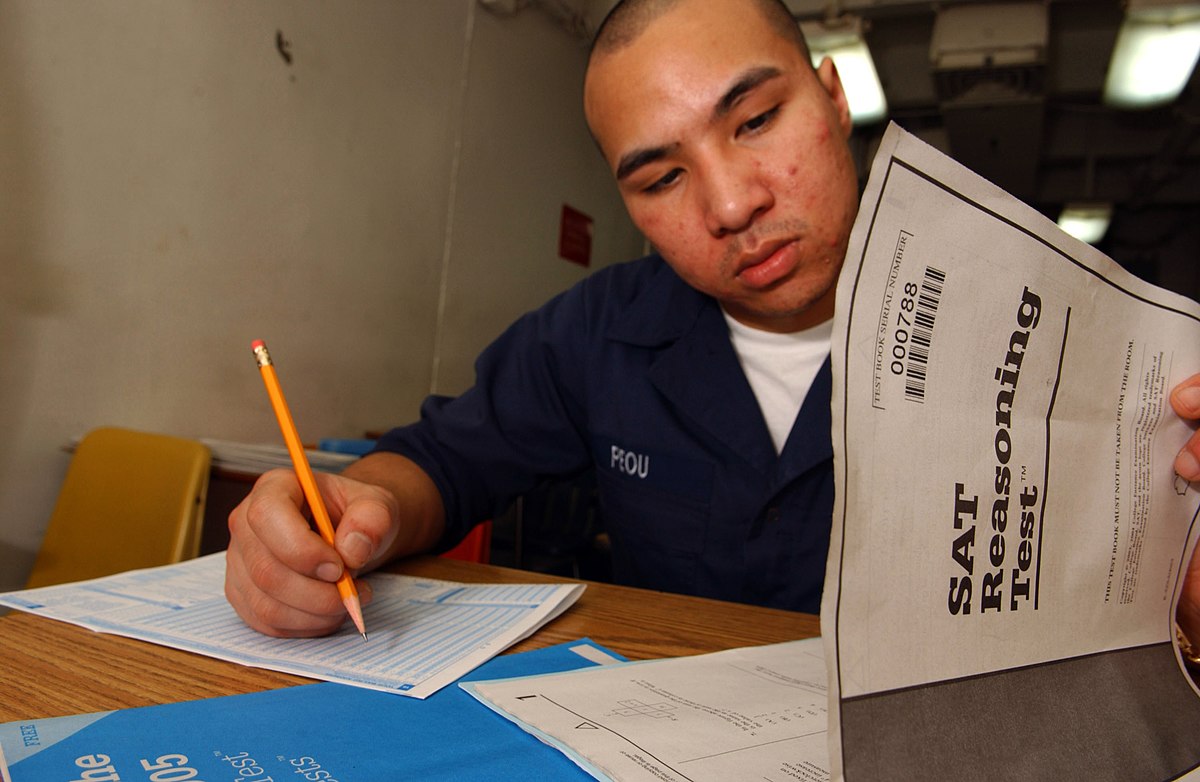
US Navy Seaman Chanthorn Peou takes the SAT aboard USS Kitty Hawk, 23 February, 2004.
US Navy photograph by Photographer’s Mate 3rd Class Jason T. Poplin via Wikimedia Commons.
I graduated in the bottom third of my high school class with a 2.2 GPA. Didn’t think of myself as “smart”. I thought a lot and read a lot. But I hated homework, teachers, rules, etc. I thought “smart” meant kids who did their homework and raised their hand in class. Those types.
My senior year of high school I took the required test to join the military — the Armed Services Vocational Aptitude Battery (ASVAB). Half my motivation to take this test was because I got to skip class. I spent the night before with my friends drinking Four Loko and playing Fight Night Round 3 on Xbox 360. Woke up with a hangover, chugged 20 ounces of Rockstar energy drink, and took the test. Afterwards, the Air Force recruiter showed me how to convert ASVAB to SAT scores. I got the same score as my smartest friend who always got straight-As and was headed for college. What the fuck? I thought.
At the time, I wasn’t aware these tests are thinly veiled IQ tests. The SAT, ASVAB, and the ACT are all highly correlated with IQ at about r = .8.
A study on Army recruits found that scores on an intelligence test, along with 2-mile run time, were the best predictors of success in infantry training.
Research on tank gunners found that replacing a gunner who scores around the 20th percentile with one who scores around the 55th percentile improves the likelihood of hitting a target by 34 percent.
To qualify, potential military recruits must score higher than roughly one-third of all who take the ASVAB. The lowest acceptable percentile score to join is 36 for the Air Force, 35 for the Navy, 32 for the Marine Corps, and 31 for the Army. By definition, the worst test taker who makes it into the military still scores higher than one-third of his or her peers. The military slices off the bottom third of standardized test-takers, not allowing them to join.
The psychologist and intelligence researcher Linda Gottfredson has written:
IQ 85 … the U.S. military sets its minimum enlistment standards at about this level … The U.S. military has twice experimented with recruiting men of IQ 80-85 (the first time on purpose and the second time by accident), but both times it found that such men could not master soldiering well enough to justify their costs.
In the 1960s, Secretary of Defense Robert McNamara launched Project 100,000 which lowered the testing requirement. This allowed people at the 10th percentile (80~ IQ) — a standard deviation lower than the previous standard — to join.
Supposedly, the aim was to alleviate poverty. LBJ had recently begun his War on Poverty program. The story was that getting more recruits into the military would help them move into the middle class. And they needed more recruits for the Vietnam War. Lowering recruitment standards was an easy way to get them.
Recruits of Project 100,000 were 9 times more likely to require remedial training and training took up to 4 times longer to complete compared to their peers who had entered under the higher score requirement. In Vietnam, men recruited under the lower testing threshold were 2.5 times more likely to die in combat.
Did the veterans who made it home achieve upward mobility? No. Compared to civilians with similar attributes who were not recruited, McNamara’s Morons (as they were later termed) were less likely to be employed, less likely to own a business, and obtained less education. Later, the policy changed to improve the talent pool of the armed forces. Higher ASVAB score thresholds were reinstated. Along with additional rigid requirements.
Today, eight out of ten Americans between 17 and 24 are ineligible for military service. Mostly due to obesity, medical issues, and criminal records.
Anyway, seeing my ASVAB score was the first time I learned I could have been a good student. It was possible. How many kids out there are like this. Kids who have fucked up lives and get bad grades which mask their underlying potential. Potential that a standardized test could reveal.
The SAT is a “barrier” according to that NYT op-ed. But it’s also a gateway. Most poor kids don’t take the SAT. Or any other standardized test. More should.
March 3, 2023
QotD: What’s the opposite of university? “Diversity”
Severian, “Advice to Young Dissidents”, Rotten Chestnuts, 2020-04-01.
March 2, 2023
QotD: The rise of the overeducated mediocrity
The son of a friend of mine applied for a place at medical school and was turned down on the grounds that his personal statement was inadequate. I don’t know what was wrong with it; perhaps he employed incorrect old clichés rather than the correct new ones. Having the means to do so, my friend sent his son to a tutor who specialized in personal statements (every bureaucratic requirement is an economic opportunity for an ex-bureaucrat wanting to strike out for himself). No doubt the tutor in personal statements advised him to put in more about his passion for social justice and equality. At any rate, it worked and he was accepted.
In these statements — apparently as much a requirement in the private sector as in the public — you have to not only explain why you have dreamt all your life of this position in the marketing department (selling the unnecessary to the insolvent) and why you, of all the 7,000,000,000 people in the world, are the most suited to it, but also proclaim your deep sense of social responsibility, which you will bring to whatever task you are told to perform. People have never been entirely straightforward, thank goodness (what need of art and literature if they had been?), but we do seem to be breeding up a generation of Pecksniffs and Uriah Heeps.
I don’t want to indulge in what has been called the hermeneutics of suspicion, the habit of finding the supposedly real, occult, and sinister explanation behind perfectly straightforward social phenomena, but nevertheless I cannot help but wonder what the true purpose is of mission statements and their cognates, such as annual declarations of probity and the like. I think (though of course I cannot indubitably prove) that it is to make the world safe for overeducated mediocrities.
Theodore Dalrymple, “In Defense of Mediocrity”, Taki’s Magazine, 2018-02-17.


