
Schadenfreude is of course the German word for taking pleasure in the discomfort of others. There should be a specific Canadian variant to indicate our enjoyment of Americans’ discomfort, which is and always has been a major source of satisfaction for many of our media elites. Maybe schadenfreud-eh?
William Watson, “Smug Canada probably wouldn’t let in a caravan of migrants either”, Financial Post, 2018-10-26.
April 26, 2021
QotD: Maple-flavoured schadenfreude
Comments Off on QotD: Maple-flavoured schadenfreude
April 21, 2021
QotD: Freedom of speech in Canada
Further, our Human Rights Tribunals are Soviet-style shadow courts that discard due process in adjudicating cases of supposed discrimination or “hate speech.” As Canadian Human Rights Commissioner Dean Steacy said: “Freedom of speech is an American concept, so I don’t give it any value.” Openness to everything except freedom of speech, chartered principle and practical reason is the hallmark of our justice system, as it is of the nation. As Carl Sagan quipped in The Demon-Haunted World: “It pays to keep an open mind, but not so open your brains fall out.”
David Solway, “The Canadian Mind: A Culture So Open, Its ‘Brains Fall Out'”, PJ Media, 2018-10-10.
Comments Off on QotD: Freedom of speech in Canada
April 17, 2021
“Today’s Liberal government is […] the most anti-Internet government in Canadian history”
Michael Geist gives both barrels to Justin Trudeau’s government, then reloads and fires again:

Canadian Heritage Minister Steven Guilbeault, 3 February 2020.
Screencapture from CPAC video.
As I watched Canadian Heritage Minister Steven Guilbeault yesterday close the Action Summit to Combat Online Hate, I was left with whiplash as I thought back to those early days. Today’s Liberal government is unrecognizable by comparison as it today stands the most anti-Internet government in Canadian history:
- As it moves to create the Great Canadian Internet Firewall, net neutrality is out and mandated Internet blocking is in.
- Freedom of expression and due process is out, quick takedowns without independent review and increased liability are in.
- Innovation and new business models are out, CRTC regulation is in.
- Privacy reform is out, Internet taxation is in.
- Prioritizing consumer Internet access and affordability is out, reduced competition through mergers are in.
- And perhaps most troublingly, consultation and transparency are out, secrecy is in.
This is not hyperbole. The Action Summit is a case in point. I was part of the planning committee and I am proud that the event produced two days of thoughtful discussion and debate, where the both the importance and complexity of addressing online hate brought a myriad of perspectives, including from the major Internet platforms. There was none of that nuance in Guilbeault’s words, who spoke the evil associated with the “web behemoths” and promised that his legislation would target content and Internet sites and services anywhere in the world provided it was accessible to Canadians. The obvious implications – much discussed in Internet circles in Ottawa – is that the government plans to introduce mandated content blocking to keep such content out of Canada as a so-called “last resort”. When combined with a copyright “consultation” launched this week that also raises Internet blocking, Guilbeault’s vision is to require Internet providers to install blocking capabilities, create new regulators and content adjudicators to issue blocking orders, dispense with net neutrality, and build a Canadian Internet firewall.
If that wasn’t enough, his forthcoming bill will also mandate content removals within 24 hours with significant penalties for failure to do so. The approach trades due process for speed, effectively reducing independent oversight and incentivizing content removal by Internet platforms. Just about everyone thinks this is a bad idea, but Guilbeault insists that “it is in the mandate letter.” In other words, consultations don’t matter, expertise doesn’t matter, the experience elsewhere doesn’t matter. Instead, a mandate letter trumps all. If this occurred under Stephen Harper’s watch, the criticism would be unrelenting.
In fact, one of the reasons that the government finds itself committed to dangerous policy is that it did not conduct a public consultation on its forthcoming online harms bill. Guilbeault was forced yesterday to admit that the public has not been consulted, which he tried to justify by claiming that it could participate in the committee review or in the development of implementation guidelines once the bill becomes law. This alone should be disqualifying as no government should introduce censorship legislation that mandates website blocking, eradicates net neutrality, harms freedom of expression, and dispenses with due process without having ever consulted Canadians on the issue.
Comments Off on “Today’s Liberal government is […] the most anti-Internet government in Canadian history”
April 14, 2021
War Stories We Didn’t Get to Tell – WW2 – Reading Comments
World War Two
Published 13 Apr 2021Another edition of Across the Airwaves, where Indy, Sparty, and Astrid look at interesting and unique comments from our videos. In this episode, some amazing war stories that we didn’t get to tell.
Join us on Patreon: https://www.patreon.com/TimeGhostHistory
Or join The TimeGhost Army directly at: https://timeghost.tvFollow WW2 day by day on Instagram @ww2_day_by_day – https://www.instagram.com/ww2_day_by_day
Between 2 Wars: https://www.youtube.com/playlist?list…
Source list: http://bit.ly/WW2sourcesHosted by: Indy Neidell, Spartacus Olsson, and Astrid Deinhard
Director: Astrid Deinhard
Producers: Astrid Deinhard and Spartacus Olsson
Executive Producers: Astrid Deinhard, Indy Neidell, Spartacus Olsson, Bodo Rittenauer
Creative Producer: Maria Kyhle
Post-Production Director: Wieke Kapteijns
Edited by: Karolina Dołęga
Sound design: Marek Kamiński
Map animations: Eastory (https://www.youtube.com/c/eastory), Karolina DołęgaSources:
– Bundesarchiv
– Library of Congress
– Australian War Memorial
– Icons from the Noun Project: Boat by Richard Cordero, captain by Gan Khoon Lay, Mine Ship by Luke Anthony Firth, Wrench by Gregor Cresnar
– Explosion animation by Ignisium from YouTube
– Uboat.net, picture of SS Oklahoma courtesy of Texaco ArchivesSoundtracks from Epidemic Sounds:
– “Other Sides of Glory” – Fabien Tell
– “London” – Howard Harper-Barnes
– “Deflection” – Reynard Seidel
– “The Inspector 4” – Johannes Bornlöf
– “What Happens in the Park” – Claude SignetArchive by Screenocean/Reuters https://www.screenocean.com.
A TimeGhost chronological documentary produced by OnLion Entertainment GmbH.
From the comments:
World War Two
2 hours ago (edited)
Day in day out, we review thousands of comments from people across the world. It’s always heartening to come across the ones that are particularly interesting, educational, touching, or even funny. This format, “Across the Airwaves”, is a great way for us to interact directly with our community and in this episode, Indy, Sparty and Astrid mainly look at comments from people offering extra details and analysis that we didn’t have the chance to include in our regular content.Hope you enjoy hearing them. A big thanks to our community, especially our TimeGhost Army members.
Comments Off on War Stories We Didn’t Get to Tell – WW2 – Reading Comments
April 13, 2021
“… loving a country also means being honest. We should never get high on our own own flag-covered, syrup-scented supply.”
In The Line, Lauren Dobson-Hughes sits Canada down for a bit of an intervention:

Once upon a time, there was a fairytale castle with soaring turrets and gabled windows. The castle had long been undergoing renovations, so the owners draped the scaffolding with trompe l’oeil cloths — fabric imprinted with the image of the historical building beneath, to maintain an impression of the beauty hidden below.
From the cloth, you imagined the castle must be stunning. And yet behind the façade, it is crumbling. Its walls are mold-ridden, and the floors are rotten. The scaffolding props up a shell.
This metaphor has come to represent the way I’ve come to think about Canada since this pandemic began. As a country, we are so fixated on the mythology we project out to others — the trompe l’oeil cloth — that we’ve allowed the actual capacities, systems and structures of our country to crumble.
The first inkling came early in the pandemic. As COVID-19 numbers rose, it was revealed that the Public Health Agency of Canada did not have nationwide case numbers. This piece delves further, but “Ottawa does not have automatic access to data in [provincial and territorial] systems.” Provinces were sending daily case numbers to Ottawa on paper. This is one small example, but a revealing one. In fact, we lack a nationwide public-health system at all. And as the auditor-general’s report showed, we also lack the knowledge and expertise — the skilled people — to manage crises like this, too.
Then came protracted discussions about financial support for Canadians affected by lockdowns. The debate was not about whether Canadians deserved help — it was that Canada’s financial systems are so outdated and disjointed, that we literally could not work out how to get money from the federal government into bank accounts. It shouldn’t be this complex. In a functioning country, the central revenue agency should be able to transfer money to people without task forces of bureaucrats and experts, the establishment of new IT systems, and McGyvering an assortment of existing programs.
[…]
The list it goes on — the chaotic vaccine roll-out, the fractured public communications, the devolving of responsibilities to the very most local level with little overarching purpose or even organization. All of it marked by disjointed, outdated systems, lack of skills and know-how, and no overall goal or narrative. We need to face it — we have allowed our nation to crumble from the inside, while holding tight to the mythology that we’re an effective, functioning country.
At this point, I feel the need for a disclaimer that I love Canada. But loving a country also means being honest. We should never get high on our own own flag-covered, syrup-scented supply.
Comments Off on “… loving a country also means being honest. We should never get high on our own own flag-covered, syrup-scented supply.”
April 12, 2021
Tom Longboat: The “Bronze Streak to a Wildfire”
The History Guy: History Deserves to Be Remembered
Published 6 May 2019Tom Longboat has been called Canada’s first professional athlete. But amid his setting records and gaining accolades, he served his country in the Great War and fought discrimination. His life is history that deserves to be remembered.
This is original content based on research by The History Guy. Images in the Public Domain are carefully selected and provide illustration. As images of actual events are sometimes not available, images of similar objects and events are used for illustration.
All events are portrayed in historical context and for educational purposes. No images or content are primarily intended to shock and disgust. Those who do not learn from history are doomed to repeat it. Non censuram.
Patreon: https://www.patreon.com/TheHistoryGuy
The History Guy: History Deserves to Be Remembered is the place to find short snippets of forgotten history from five to fifteen minutes long. If you like history too, this is the channel for you.
Awesome The History Guy merchandise is available at:
teespring.com/stores/the-history-guyScript by HCW
#wwi #thehistoryguy #canada

Comments Off on Tom Longboat: The “Bronze Streak to a Wildfire”
QotD: Four lessons on free trade
Below are the lessons, taken almost entirely verbatim from the bank’s online lesson (except where I’ve provided a bit of additional description). It’s a terrific lesson and all within a mere 1,400 words and a short video.
Lesson 1: All parties reap the rewards of free trade.
Specialization means focusing on what each country produces most efficiently and trading for the rest. And because specialization is more efficient, it creates more wealth than if each country tried to do it all on its own. International trade is no different from domestic specialization and internal trade — few of us grow our own food or do our own dry cleaning. Instead, we specialize and trade. The lesson includes a short cartoon video featuring “Mark and Lucy” — aimed at kids but worth a presidential view — that explains the concepts of comparative advantage and opportunity costs.
Lesson 2: Trade protectionism makes everyone worse off.
While freer trade — in both exports and imports — makes us better off, the opposite is also true. Barriers to free trade, such as tariffs, have a negative impact on our economic well being.
Lesson 3: The pie isn’t divided equally.
Freer trade has raised incomes across the global economy, but it has not benefited everyone. Countries engaged in free trade are better off overall, but some sectors and communities within countries have suffered. Governments have used policies such as ongoing learning and retraining programs to help affected workers adjust. This a better approach than shrinking the pie through trade protection. That would be worse for everyone.
Lesson 4: Trade deficits and surpluses are not a scorecard.
It’s important to debunk the myth that cheap imports are the cause of all the pain and that a trade deficit with another country is a bad thing. Looking at trade balances between a country and its trade partners, we should expect to see surpluses with some and deficits with others. This is specialization in action.
Terence Corcoran, “Amazing! Canada has one government department that actually comprehends free trade!”, Financial Post, 2018-10-04.
Comments Off on QotD: Four lessons on free trade
April 11, 2021
HMCS Warrior (R31) – Colossus-class Light Aircraft Carrier
canmildoc
Published 30 Mar 2013HMS Warrior (R31) was a Colossus-class light aircraft carrier which served in the Royal Canadian Navy from 1946 to 1948 (as HMCS Warrior). She was transferred to the Royal Canadian Navy, commissioned as HMCS Warrior and placed under the command of Captain Frank Houghton. She entered Halifax harbour on 31 March 1946, a week after leaving Portsmouth. She was escorted by the destroyer HMCS Micmac and the minesweeper HMCS Middlesex. The RCN experienced problems with the unheated equipment during operations in cold North Atlantic waters off eastern Canada during 1947. The RCN deemed her unfit for service and, rather than retrofit her with equipment heaters, made arrangements with the Royal Navy to trade her for a more suitable aircraft carrier of the Majestic class which became HMCS Magnificent (CVL 21) on commissioning. [Original text from Wikipedia]
Tags: Colossus Class Light Aircraft Carrier, HMCS Warrior, HMCS, RCN, Royal Canadian Navy, aircraft carrier, CV, Halifax
From the Wikipedia description of HMCS Warrior:
Warrior was a Colossus-class light aircraft carrier that was 630 feet 0 inches (192.0 m) long between perpendiculars and 695 feet 0 inches (211.8 m) overall with a beam at the waterline of 80 feet 0 inches (24.4 m) and an overall width of 112 feet 6 inches (34.3 m). The ship had a mean draught of 23 feet 3 inches (7.1 m). Warrior had a standard displacement of 13,350 long tons (13,560 t) when built and a full load displacement of 18,300 long tons (18,600 t). The aircraft carrier had a flight deck 690 feet 0 inches (210.3 m) long that was 80 feet 0 inches (24.4 m) wide and was 39 feet 0 inches (11.9 m) above the water. The flight deck tapered to 45 feet (14 m) at the bow. For takeoffs, the flight deck was equipped with one BH 3 aircraft catapult capable of launching 16,000-pound (7,257 kg) aircraft at 66 knots (122 km/h). For landings, the ship was fitted with 10 arrestor wires capable of stopping a 15,000-pound (6,804 kg) aircraft, with two safety barriers rated at stopping a 15,000-pound aircraft at 40 knots (74 km/h). Warrior had two aircraft elevators located along the centreline of the ship that were 45 by 34 feet (13.7 by 10.4 m) and could handle aircraft up to 15,000 pounds on a 36-second cycle. The aircraft hangar was 275 by 52 feet (83.8 by 15.8 m) with a further 57 by 52 feet (17.4 by 15.8 m) section beyond the aft elevator, all with a clearance of 17 feet 6 inches (5.3 m). The hangar was divided into four sections by asbestos fire curtains. The hangar was fully enclosed and could only be entered by air locks and the lifts, due to the hazardous nature of aviation fuel and oil vapours. The vessel had stowage for 98,600 Imperial gallons (448,244 l; 118,414 US gal) of aviation fuel.
The ship was powered by steam created by four Admiralty 3-drum type boilers driving two Parsons geared turbines, each turning one shaft. The machinery was split into two spaces, each containing two boilers and one turbine, separated by 24-foot (7.3 m) spaces containing aviation fuel. The spaces were situated en echelon within the ship to prevent a single disabling torpedo strike. The engines were rated at 42,000 shaft horsepower (31,319 kW) and the vessel had a capacity for 3,196 long tons (3,247 t) of fuel oil, with an range of 8,300 nautical miles (15,372 km) at 20 knots (37 km/h). The ship’s maximum speed was 25 knots (46 km/h). There was no armour aboard the vessel save for mantlets around the torpedo storage area. There were no longitudinal bulkheads, but the transverse bulkheads were designed to allow the ship to survive two complete sections of the ship being flooded.
Warrior was designed to handle up to 42 aircraft. The aircraft carrier carried a wide range of ordnance for their aircraft from torpedoes, depth charges, bombs, 20 mm cannon ammunition and flares. For anti-aircraft defence, the aircraft carrier was initially armed with four twin-mounted and twenty single-mounted 40 mm Bofors guns. The original radar installation included the Type 79 and Type 281 long-range air search radars, the Type 293 and Type 277 fighter direction radar and the “YE” aircraft homing beacon. The ship had a maximum ship’s company of 1,300, which was reduced in peacetime.
After service with the RCN, Warrior was returned to the Royal Navy, and subsequently sold to Argentina, entering service as ARA Independencia until 1971 when she was struck from the Argentinian navy list and scrapped.
Comments Off on HMCS Warrior (R31) – Colossus-class Light Aircraft Carrier
QotD: Canada’s “Natural Governing Party”
Checks and balances? Canada? Third parties can’t even participate fully in electoral campaigns here. Checks and balances are very few in this centralized, caucus whipped, PMO-run federal government. Let us pass on quickly lest the good doctor/statesman becomes completely embarrassed by his own rhetoric.
John the Mad, “Lloyd’s Unworthy Letter”, John the Mad, 2005-03-05.
Comments Off on QotD: Canada’s “Natural Governing Party”
April 10, 2021
The monarchy is a weird anachronism from our history … but it’s better than any likely replacement
I’m a very soft monarchist myself, largely for the same reasons that The Line articulates here:
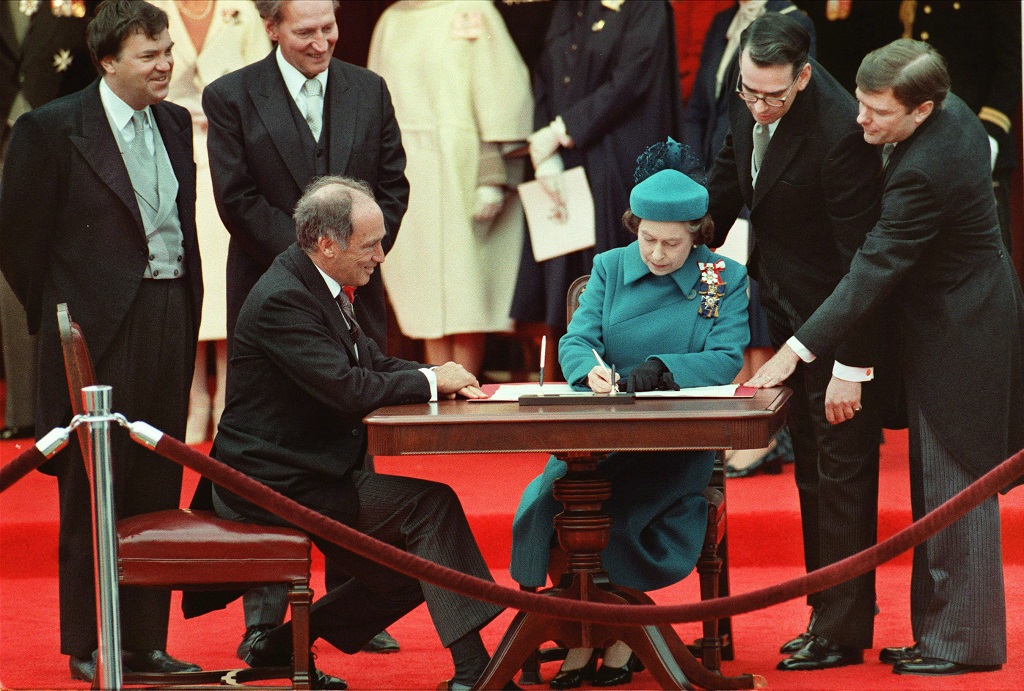
Queen Elizabeth II signs Canada’s constitutional proclamation in Ottawa on April 17, 1982 as Prime Minister Pierre Trudeau looks on.
THE CANADIAN PRESS/Stf-Ron Poling
A little more seriously, though your Line editors wouldn’t describe themselves as ardent monarchists, we do believe that we shouldn’t invest much time and energy into trying to fix what ain’t broke. Canada’s system of government doesn’t always deliver optimal outcomes — we mean, look around, folks — but it is stable, reliable and proven. Given our track record at big new policies, those are three things we have absolutely zero confidence any successor system to the monarchy would be, even in the fantastically unlikely chance we could design and implement one.
Is it weird putting a ton of our reserve powers and our very sovereignty inside the living essence of an old woman on an island across the ocean? Yes. Does it work? Also yes. Would we botch any effort to replace said old lady with literally any other system? A resolute yes. The monarchy is weird, and it’s not how we’d design Canada if we were starting Canada from scratch today, but it works, folks, and these days, there’s not much else we can say that about. Further, it’s hard not to like Her Majesty. Our thoughts are with her today. Whatever your qualms with royalty or the royals may be, surely you can spare a thought to a woman who lost her husband … oh, who are we kidding? Lots of people can’t or won’t.
April 9, 2021
HRH Prince Philip, Duke of Edinburgh, 1921-2021
Sad, but not unexpected news this morning as His Royal Highness Prince Philip has died. Along with all of his many earthly titles and awards, he was considered divine by villagers in Vanuatu. Janet Davison reports for the CBC:
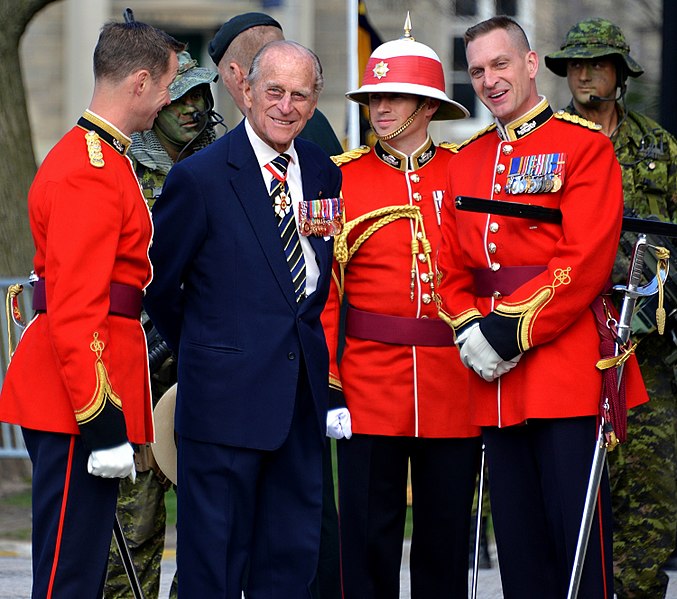
HRH Prince Philip was the Colonel-in-Chief of the Royal Canadian Regiment. In April 2013, he presented the Regimental Colours to the 3rd Battalion.
Photo by Jamie McCaffrey via Wikimedia Commons.
Prince Philip, the Duke of Edinburgh and husband of Queen Elizabeth, died today at 99. He was the longest-serving royal consort in British history.
His death, announced by Buckingham Palace, came more than three-and-a-half years after Philip formally stepped back from public life, a retreat that had been happening gradually for several years.
In an interview in June 2011 with the BBC, the no-nonsense Philip spoke about “winding down” and reducing his workload as a member of the Royal Family.
“I reckon I’ve done my bit so I want to enjoy myself a bit now, with less responsibility, less frantic rushing about, less preparation, less trying to think of something to say,” he said.
His final official public engagement came on Aug, 2, 2017, when he attended a parade of Royal Marines at Buckingham Palace and met servicemen who had taken part in a charity race.
Prime Minister Justin Trudeau issued a statement Friday calling Philip “a man of great service to others” who maintained a special relationship with the Canadian Armed Forces and was a patron to more than 40 Canadian organizations.
“Prince Philip was a man of great purpose and conviction, who was motivated by a sense of duty to others,” he said. “He will be fondly remembered as a constant in the life of our Queen – a lifelong companion who was always at her side offering unfailing support as she carried out her duties.”
Through the Queen’s 69 years on the throne, the man whom she had called her “strength and stay” carried out more than 22,000 solo engagements and made nearly 5,500 speeches. He attended events periodically with the Queen and other members of the Royal Family after stepping back from official duties.
Update: Colby Cosh recounts a story about Prince Philip’s WW2 naval career that I’d never heard before:
Socially he was entitled to the style of “royal highness” in his own right, yet he was looked down on by mere aristocrats, and even commoners, who had superior public-school credentials and polish. Marriage to a princess might have been impossible if Philip hadn’t impressed George VI personally. As a junior officer he was well-liked, but strict about shipboard order and neatness. He was said to have a natural intuition for command. If he wanted something done, his word put everything in motion at once.
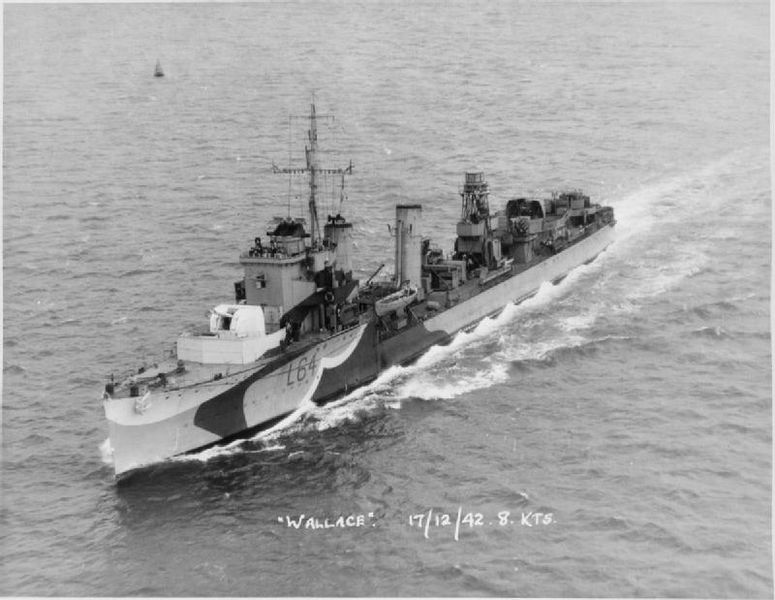
The Royal Navy destroyer HMS Wallace in December, 1942.
Imperial War Museum photo FL 10546 of collection 8308-29 via Wikimedia Commons.He performed well throughout the war, but his finest moment as an officer was not common knowledge until Harry Hargreaves, a Royal Navy yeoman who ended up in Westport, Ont., published a memoir of his own service in 1999. Hargreaves served with Philip aboard HMS Wallace, an old “flotilla leader” ship that had been finished in 1919 and modified for speed. Its original shore-bombardment hardware was pulled in favour of anti-aircraft guns and submarine-killing equipment.
Wallace’s and the prince’s great moment came in July 1943 when the ship was assigned to escort Convoy KMF18 from the Algerian harbour of Bône to the beaches of Sicily. As it happens, this convoy carried the First Canadian Division, which Mackenzie King had lobbied to put in action for the first large-scale amphibious invasion of occupied Europe. Wallace was to ward off U-boats on the trans-Mediterranean journey and then protect the landing party from German air attacks.
On the evening of July 8, Wallace was spotted on a clear, bright night and attacked by flights of Stuka dive-bombers. One damaging near-miss, Hargreaves wrote, had everybody prepared to die when the Stukas came back. Philip, the ship’s first lieutenant, quickly cooked up a plan to build a raft and set it afloat with smoke floats attached, hoping it would look enough like the wreckage of a destroyed ship to distract the returning planes.
“It had been marvellously quick thinking,” Hargreaves said, “conveyed to a willing team and put into action as if rehearsed.” But it required Wallace to steam away from the decoy and await its fate in silence and darkness. When the Stukas came back into earshot, the yeoman “screwed up (his) shoulders in anticipation of the bombs.”
The Germans took the bait and attacked the decoy. “Prince Philip,” Hargreaves concluded, “saved our lives that night.” He also saved the ship, which went on to cover the British-Canadian landing near Pachino.
Having survived the scrape, the prince was alive and intact to attend the Royal Family’s Christmas pantomime at Windsor Castle. Princess Elizabeth’s governess, Marion Crawford, found that combat had turned a “bumptious boy” into a “grave and charming man.” But the princess’s already longstanding crush on her distant cousin had not flagged, and never would.
Comments Off on HRH Prince Philip, Duke of Edinburgh, 1921-2021
April 2, 2021
The science must bow to the political narrative yet again
In Quillette, Bruce Bourque outlines some fascinating archaeological discoveries on Canada’s east coast and how the scientific findings are being actively blocked to avoid offending First Nations people for undermining or even contradicting their beliefs:
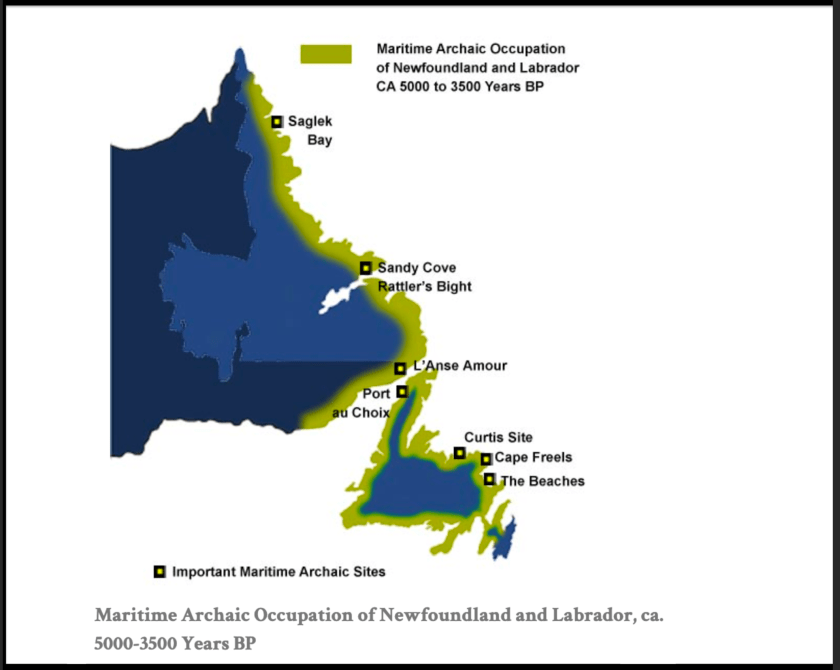
One of the major North American archaeological discoveries of the 20th century was made in 1967 by a bulldozer crew preparing a site for a movie theater in the small fishing village of Port au Choix (PAC), on Newfoundland’s Northern Peninsula. It was a vast, 4,000-year-old cemetery created by a complex maritime culture known among researchers as the Maritime Archaic. The graves contained beautifully preserved skeletons covered in a brilliant red powder called red ocher (powdered specular hematite). Buried with the skeletons were many finely crafted artifacts. A few similar ones had previously turned up in earlier field surveys on the island, but no archaeologist had suspected that such a large and magnificent ceremonial site existed in the North American subarctic.
Had the discovery been made only a few years earlier, it is likely that no trained archaeologist would have taken over from the bulldozer crew. But fortunately, Memorial University in St. Johns had just added archaeologist James (“Jim”) Tuck (1940–2019) to its faculty. The American-born scholar set out to explore the cemetery, eventually excavating more than 150 graves spread over three clusters (which he referred to as loci).
[…]
In regard to the Red Paint People, Reich’s lab at Harvard Medical School analyzed material from the Nevin site in Blue Hill, Maine — the only known Red Paint cemetery that is likely ever to produce well-preserved human remains. Reich’s analysis was not confined to mDNA (which, unlike nuclear DNA, is transmitted through the maternal line, and so cannot address paternal ancestry), and focused instead on autosomal DNA (aDNA) found in cell nuclei, thereby adding information on the paternal line. (This addition can be critically important because, as Reich’s lab had demonstrated, a population can be founded by males and females with very different origins.) The Reich team has yet to publish comprehensive results of its Nevin site analysis. But from what I have heard, their work will confirm the existence of genetic discontinuities between the Red Paint People and later populations in the region, much as with Duggan’s work in regard to the Maritime Archaic.
But this is where events took a strange turn: It was when Duggan’s group announced that they’d gained the capacity to analyze aDNA, and made known their plans to apply this technology to the male genome of their Labrador/Newfoundland skeletal sample, that a sense of apprehension seemed to spread through some quarters of the paleogenetic community.
During the summer of 2020, amid the COVID-19 pandemic and Black Lives Matter protests, Duggan’s project went noticeably quiet. I inquired among team members with whom I regularly communicated, but received oblique and evasive responses about the pace of research and publication. Suspecting that this might be related to sensitivities surrounding Indigenous populations (a topic that has consumed Canadian academia in recent years), I contacted Duggan directly, expressing concern that her valuable work might not be published.
[…]
When the Maritime Archaic tradition vanished, it was replaced, as noted earlier, by unrelated Paleoeskimos, an Arctic people who had then recently derived from Siberia. Following their own disappearance, more recently arrived inhabitants migrated from Labrador, these probably being ancestors of the historic Beothuk, who still lived in the region when Europeans arrived. The last surviving Beothuk, a woman named Shanawdithit, died of tuberculosis in 1829. And since that time, there has been no descendant Beothuk community with whom Duggan, or anyone else, could engage in the “discussions and agreements” she’d described to me.
And even if there were, moreover, Duggan’s own research has demonstrated that the Beothuk were not descended from the Maritime Archaic people of Port au Choix. The only community Duggan might be referring to is the (genealogically unrelated) Newfoundland Mi’kmaq community, whose ancestors arrived on Newfoundland from Nova Scotia in the 18th century, several hundred years after the arrival of Europeans.
Comments Off on The science must bow to the political narrative yet again
March 31, 2021
“Rosalie”: Trench Art SMLE with a Most Improbable Story
Forgotten Weapons
Published 21 Dec 2020http://www.patreon.com/ForgottenWeapons
https://www.floatplane.com/channel/Fo…
Cool Forgotten Weapons merch! http://shop.bbtv.com/collections/forg…
Henri Lecorre was a French immigrant to Canada who enlisted in the 22nd Regiment of the Canadian Army in April, 1915. He had a knack for carving things in his rifles, which he started right in basic training, with a Ross rifle he named “Josephine”. That got him sternly rebuked by his Colonel, but he would take up the habit again in 1916 when he arrived in France and began to see combat. At this point the Canadians were issuing SMLE rifles, and Lecorre named his “Rosalie”, after the French bayonet’s nickname.
Lecorre served through 14 major campaigns, and carved each name into his rifle as the years of the war dragged on. He was twice caught and punished for destruction of government property and fined for the cost of the rifle, although he managed to avoid more serious punishment both times. He only embellished the left side of Rosalie, so that his work would be hidden against his leg when standing at attention. By the summer of 1918, Rosalie’s service record included Vimy, Kemmel, St. Eloi, Hoodge, Zellebeck, Courcelette, Bully Grenay, Neuvilles Vaade, Mericour, Lievin, Lens, Cote 70, Passchendaele and Arras.
Fate eventually caught up to Private Lecorre, and in mid-1918 he was seriously wounded in an attack, and woke up in a military hospital in Dieppe. Rosalie was long gone, and Lecorre did not return to combat again.
The story is far from over, however. Rosalie was recovered from the battlefield, and sent back to Enfield with a batch of damaged rifles for refurbishment and reissue. Someone in the factory noticed the carving on it, and it was set aside. The arsenal commander took a liking to it, and it was hung in his office — where it remained for some 30 years. A Canadian officer from the 22nd Regiment noticed it at Enfield — thanks to Lecorre carving his unit’s name into it — during the Second World War, and thought it would be appropriate to return it to the unit’s home town, where the Citadelle Museum was established in 1950, with Rosalie as one of its original exhibits.
In 1956, Lecorre himself happened to visit an exhibition near Quebec City where the museum had set up, and was shocked to see his own Rosalie on display. After some understandable difficulty convincing the officer on duty that it was actually *his* rifle (which Lecorre did by reciting back its serial number unseen), a remarkable reunion took place. The rifle remained with the museum, but now with its full story known. It remains there to this day, on permanent display.
The Citadelle Museum commissioned a reproduction of Rosalie to be used for demonstrations, and it is this rifle which was graciously made available to me for filming, as the original is inaccessible on short notice because of its display case. Many thanks to the Citadelle for the opportunity to present it to you! If you are in Quebec City, make sure to take time to visit them:
https://www.lacitadelle.qc.ca/en/
Contact:
Forgotten Weapons
6281 N. Oracle #36270
Tucson, AZ 85740

Comments Off on “Rosalie”: Trench Art SMLE with a Most Improbable Story
March 28, 2021
“Canadians are largely full of shit on climate change”
The Line wraps up the week with, among other things, an explanation of why they didn’t cover anything to do with the “Conservative” Party’s virtual convention:
We said in last week’s dispatch that we were monitoring the Conservative Party of Canada’s virtual convention, and that we’d bring you any commentary that it warranted. We brought you no such commentary this week. Draw your own conclusions.
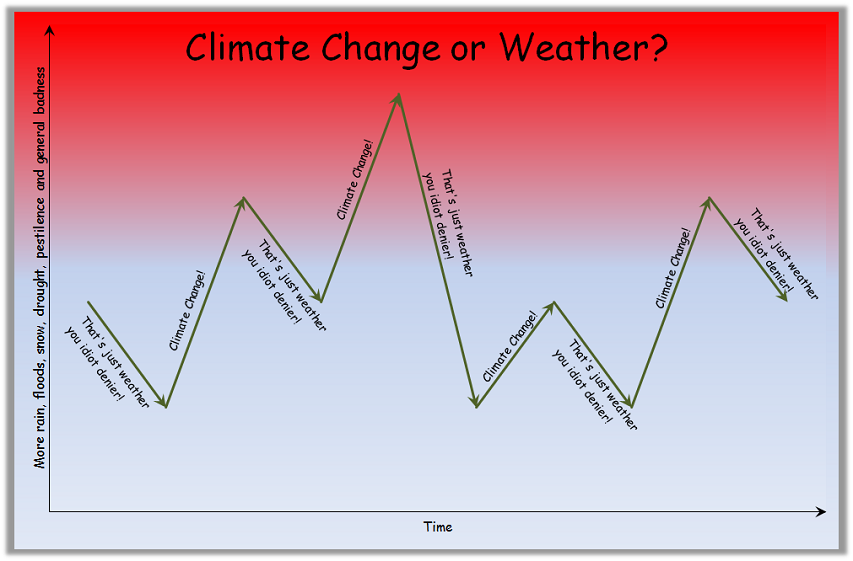
We will say, this, though. We think the kerfuffle about the party delegates’ vote to not affirm their belief in climate change is overblown, for two big reasons. The first is that Canadians are largely full of shit on climate change. Yes, it’s true that polls indicate we are concerned about the issue — Very Concerned, even. But polls also show how much we’re actually willing to do about it, and the answer is, not a fuck of a lot.
The second point we’d make is that every Conservative convention comes with warnings of deep splits within the party, with long features by Toronto- or Ottawa-based writers explaining how out of touch Tories are with “mainstream Canadians” like them, how unelectable they are outside their western base, and so on and so on. We agree that the Tories have problems, and it’s clear that not everybody is happy inside that big blue tent (or any big tent). But the Conservatives won the popular vote last time, and though Brownface Trudeau did a lot of the heavy lifting don’t forget: Andrew Scheer was the CPC leader. Can we suggest that one comes out a wash?
Don’t read too much into the doom and gloom that surrounds every CPC convention. There are always stories just like the climate change one, and if you don’t believe us, just recall that long-ago era of, ahem, one week ago, when all the coverage was warning that pro-life insurgents in the party were going to hijack the agenda and cause a meltdown by chanting about abortion all weekend.
Didn’t happen. Went nowhere. We suspect the coverage of the climate change issue, though unhelpful and awkward, will vanish just as quickly now that the chattering classes, ourselves included, have filed the obligatory quota of “convention stories” and moved on to something more interesting (which is almost anything).
Comments Off on “Canadians are largely full of shit on climate change”
March 27, 2021
“Unfortunately for the RCMP, obstruction of justice and tampering with evidence is very much a criminal offence and it looks like the boys in red should lawyer up”
An investigation into the conduct of the Royal Canadian Mounted Police (RCMP) shows an organization that firmly believes — and acts — as though it is above the law:

To its credit, RCMP leadership accepted the findings of the CRCC [Civilian Review and Complaints Commission]. But the rank and file membership, the actual police officers who interact with the public, and their union, have rejected the report, calling it biased.
All of this is a stain on Canada’s top law enforcement agency, and part of a deeper failure by the RCMP to meaningfully address its own reluctantly acknowledged systemic racism toward Indigenous peoples, but it is far from criminal misconduct.
Unfortunately for the RCMP, obstruction of justice and tampering with evidence is very much a criminal offence and it looks like the boys in red should lawyer up.
In the course of the CRCC investigation, the commission requested all recordings, transcripts, and radio communications from the day of the shooting. These communications would have undoubtedly been important to the investigation and could have provided a window into why the RCMP engaged in illegal and discriminatory conduct.
But the RCMP destroyed those records. They claimed that it was part of a routine procedure and that records with no evidentiary value have a shelf life of two years. Except the RCMP knew that there was an ongoing CRCC investigation and a civil lawsuit by the Boushie family when they destroyed the records.
If you or I destroyed relevant records, while staring down a barrel of a civil lawsuit or investigation, we would end up before a judge on charges.
Every time I ask the RCMP to destroy records relating to my clients who have been acquitted at trial, even after years have passed, I am met with a wall of resistance. So it seems a bit convenient when relevant documents are so easily destroyed when it is the RCMP who are being investigated.
The CRCC report also discloses that the RCMP conducted a parallel investigation into the Boushie incident — with officers questioned and evidence gathered. This RCMP investigation not only potentially contaminated the CRCC inquiry, but the RCMP kept their investigation a secret and failed to disclose the fruits of their internal investigation to the CRCC.
This all reeks of a cover up and an attempt to obstruct justice.
Comments Off on “Unfortunately for the RCMP, obstruction of justice and tampering with evidence is very much a criminal offence and it looks like the boys in red should lawyer up”


