
In industrialized countries, people belong to one institution or another at least until their twenties. After all those years you get used to the idea of belonging to a group of people who all get up in the morning, go to some set of buildings, and do things that they do not, ordinarily, enjoy doing. Belonging to such a group becomes part of your identity: name, age, role, institution. If you have to introduce yourself, or someone else describes you, it will be as something like, John Smith, age 10, a student at such and such elementary school, or John Smith, age 20, a student at such and such college.
When John Smith finishes school he is expected to get a job. And what getting a job seems to mean is joining another institution. Superficially it’s a lot like college. You pick the companies you want to work for and apply to join them. If one likes you, you become a member of this new group. You get up in the morning and go to a new set of buildings, and do things that you do not, ordinarily, enjoy doing. There are a few differences: life is not as much fun, and you get paid, instead of paying, as you did in college. But the similarities feel greater than the differences. John Smith is now John Smith, 22, a software developer at such and such corporation.
In fact John Smith’s life has changed more than he realizes. Socially, a company looks much like college, but the deeper you go into the underlying reality, the more different it gets.
What a company does, and has to do if it wants to continue to exist, is earn money. And the way most companies make money is by creating wealth. Companies can be so specialized that this similarity is concealed, but it is not only manufacturing companies that create wealth. A big component of wealth is location. […] If wealth means what people want, companies that move things also create wealth. Ditto for many other kinds of companies that don’t make anything physical. Nearly all companies exist to do something people want.
And that’s what you do, as well, when you go to work for a company. But here there is another layer that tends to obscure the underlying reality. In a company, the work you do is averaged together with a lot of other people’s. You may not even be aware you’re doing something people want. Your contribution may be indirect. But the company as a whole must be giving people something they want, or they won’t make any money. And if they are paying you x dollars a year, then on average you must be contributing at least x dollars a year worth of work, or the company will be spending more than it makes, and will go out of business.
Someone graduating from college thinks, and is told, that he needs to get a job, as if the important thing were becoming a member of an institution. A more direct way to put it would be: you need to start doing something people want. You don’t need to join a company to do that. All a company is is a group of people working together to do something people want. It’s doing something people want that matters, not joining the group.*
For most people the best plan probably is to go to work for some existing company. But it is a good idea to understand what’s happening when you do this. A job means doing something people want, averaged together with everyone else in that company.
* Many people feel confused and depressed in their early twenties. Life seemed so much more fun in college. Well, of course it was. Don’t be fooled by the surface similarities. You’ve gone from guest to servant. It’s possible to have fun in this new world. Among other things, you now get to go behind the doors that say “authorized personnel only.” But the change is a shock at first, and all the worse if you’re not consciously aware of it.
Paul Graham, “How to Make Wealth”, Paul Graham, 2004-04.
April 17, 2022
QotD: How jobs differ from school
April 11, 2022
QotD: Programmers as craftsmen
A programmer can sit down in front of a computer and create wealth. A good piece of software is, in itself, a valuable thing. There is no manufacturing to confuse the issue. Those characters you type are a complete, finished product. If someone sat down and wrote a web browser that didn’t suck (a fine idea, by the way), the world would be that much richer.*
Everyone in a company works together to create wealth, in the sense of making more things people want. Many of the employees (e.g. the people in the mailroom or the personnel department) work at one remove from the actual making of stuff. Not the programmers. They literally think the product, one line at a time. And so it’s clearer to programmers that wealth is something that’s made, rather than being distributed, like slices of a pie, by some imaginary Daddy.
It’s also obvious to programmers that there are huge variations in the rate at which wealth is created. At Viaweb we had one programmer who was a sort of monster of productivity. I remember watching what he did one long day and estimating that he had added several hundred thousand dollars to the market value of the company. A great programmer, on a roll, could create a million dollars worth of wealth in a couple weeks. A mediocre programmer over the same period will generate zero or even negative wealth (e.g. by introducing bugs).
This is why so many of the best programmers are libertarians. In our world, you sink or swim, and there are no excuses. When those far removed from the creation of wealth — undergraduates, reporters, politicians — hear that the richest 5% of the people have half the total wealth, they tend to think injustice! An experienced programmer would be more likely to think is that all? The top 5% of programmers probably write 99% of the good software.
Wealth can be created without being sold. Scientists, till recently at least, effectively donated the wealth they created. We are all richer for knowing about penicillin, because we’re less likely to die from infections. Wealth is whatever people want, and not dying is certainly something we want. Hackers often donate their work by writing open source software that anyone can use for free. I am much the richer for the operating system FreeBSD, which I’m running on the computer I’m using now, and so is Yahoo, which runs it on all their servers.
* This essay was written before Firefox.
Paul Graham, “How to Make Wealth”, Paul Graham, 2004-04.
April 10, 2022
“Canadian media, ‘independent’ or otherwise, is about as sparkly as dry toast”
It’s impossible to disagree with the editors at The Line about the negative impact of government involvement, oversight and subsidization of the media, and the ensuing neutralization (or even Pablumization) of the news presented to Canadians:

“Newspaper Boxes” by Randy Landicho is licensed under CC BY 2.0

There is no way to create such a system without an inherently political process to answer philosophically fraught questions like “what is news?” and “what is a journalist?” And that takes us ever closer to the perilous path of state credentialization of a profession that only operates properly when it is free of both undue government interference and of government assistance. State meddling is bad for journalism whether the intent be good, bad or indifferent.
Every outlet is beholden to the people who cut the cheque, and if your business model relies on impressing government grant gifters or corporate social responsibility committees, then your content is going to reflect the milquetoast sensibilities of your true audience.
Which, bluntly, is why so much Canadian media, “independent” or otherwise, is about as sparkly as dry toast. Whole grain. To rely on government money is not only philosophically untenable, it is almost inherently corrupting. There are public journalism enterprises in Canada, including, for instance, the CBC and TVO, and your Line editors contribute to both. You can trust us when we tell you that the people in charge of those organizations work very, very hard to avoid the impossible conflicts public funding of journalism cannot help but produce. The readers can judge the results, but no one in either outlets pretends it’s easy. It’s not.
And in case it needs to be noted here again, The Line accepts no public cash. Not a dime. We rely entirely on paid subscriptions from our reader base, and we like it that way. Our relationship with you, the reader, is what allows us to be risky, innovative, and occasionally belligerent. You’re here because you like us — you really like us! — and as a result, we serve only you. That doesn’t mean that you’re always going to agree with us, of course, but rather that you can trust us to tell you what we really think.
We looked into the QCJO program and although we believe we would qualify for the program, we are simply too horrified by its mere existence to consider applying. This puts us at a severe competitive disadvantage, and one that can only be overcome by outperforming everyone else.
April 9, 2022
“Woke Disney” is far from a new thing
Geoff Shullenberger points out that Disney’s reputation for family-friendly media rests rather uneasily on the corporation’s actual products:

“Disney is the worst enemy of family harmony.” You’d be forgiven for thinking those words were uttered yesterday, given the number of conservative politicians and pundits castigating Disney for “grooming children” following its criticism of the “Don’t say gay” bill.
In fact, the statement appeared just over 50 years ago, in a polemical analysis of Disney cartoons written by two Marxist militants, the Chilean writer Ariel Dorfman and the Belgian sociologist Armand Mattelart. How to Read Donald Duck: Imperialist Ideology in the Disney Comic was published in Chile during the brief rule of Salvador Allende as part of an attempt by Allende’s leftist allies to push back against American cultural influence. The book became a bestseller, but after Augusto Pinochet’s 1973 coup, it was banned and publicly burned.
The Right’s current lament for the betrayal of “traditional families who want to hold onto innocent entertainment for their kids” proceeds from the premise that this “woke Disney” is a deviation from the company’s benevolent past. But Dorfman and Mattelart, all the way back in 1971, contested this assumption of innocence. Although their methodology is Marxian and their aims overtly anti-capitalist, their allegations foreshadow the American Right’s current concerns in surprising ways.
[…]
How to Read Donald Duck contains many of the expected Left-wing criticisms of patriarchy and gender roles, but it also includes observations that might be surprising to ideologues today. Notably, as one illustration of the propaganda functions taken on by Disney in the Global South, the authors remark that the US Agency for International Development has circulated films featuring Disney characters promoting contraception. They reinforce this association with the title of their chapter on Disney family dynamics: “Uncle, buy me a contraceptive …”
Like many radicals at the time, Dorfman and Mattelart saw the US state’s growing interest in controlling fertility in the developing world as consistent with a broader campaign to suppress the value placed on family in the subject nations of its economic empire; this was deemed to be in tension with values such as efficiency, productivity, individualism, and competition. Disney’s exclusion of references to reproductive sexuality, in this light, looks less like an attempt to protect childhood innocence, than part and parcel of the larger modern decoupling of sex from reproduction.
It all suggests that the supposed sexual innocence of Disney’s dreamscapes was never aligned with “family values” in the first place and the Right’s current war on Disney isn’t about family — it is simply the latest phase of its realisation that corporate America has now largely aligned itself with the values of the cultural Left.
For, in fact, Disney’s vast influence on the imaginations of children has been enabled by market society’s weakening of the authority of the family. With parents overburdened by the demands of work, important aspects of child-rearing are entrusted to the entertainment industry. Disney has capitalised on this exploding demand more than any other company. If we take “grooming” to simply mean instilling values alien to the family into children, Dorfman and Mattelart would suggest that Disney has never been innocent of this charge.
March 20, 2022
Florida’s new passenger rail service
Thomas Walker-Werth contrasts the different experiences of California and Florida in trying to build new passenger railway services:



When the Federal Government ordered the construction of the Interstate Highway System in the 1950s and 1960s (at a cost to taxpayers of roughly $580 billion in 2022 dollars), it all but killed America’s privately operated passenger railroads. Since then, rail travel in America has mostly consisted of government-subsidized Amtrak services of deteriorating quality that amble across the country, catering to a niche market of leisure travelers and those with no other options. On the busy Northeast Corridor between Boston and Washington D.C. there is still enough demand to operate a busy, profitable service, but elsewhere Amtrak’s services are too slow, inconvenient, and infrequent to effectively compete with highways and airlines.
But with gas prices rising and traffic congestion strangling many American cities, passengers, investors, and government planners are all reconsidering railroads. Several new projects have sprung up across the country, aiming to link major cities a few hundred miles apart, where a train might provide a more convenient journey than a plane, car, or bus. Some of these projects are led by state governments, others by private companies. The contrast between the two is dramatic. To illuminate that difference, compare the government-run California High Speed Rail project with Brightline, a new private rail system in Florida.
Approved in 2008, California High Speed Rail (CHSR) was expected to deliver a 520-mile two-track, electrified high-speed railway on an all-new route between Los Angeles and San Francisco by 2029. Fourteen years later, CHSR is now only expected to have a 171-mile single-track section between Madera and Bakersfield will be operational by 2030. Meanwhile the project’s cost has ballooned to $80 billion from an original budget of $33 billion, and costs are expected to rise further to $100 billion, or triple the original budget.
Meanwhile in Florida, a very different kind of passenger railroad is already up and running. Brightline was launched in 2012 by the Florida East Coast Railway, a private freight railroad. Unlike CHSR, Brightline mostly uses existing routes, removing the need to acquire (or appropriate) large amounts of land. Instead of building the whole line before beginning any passenger services (as CHSR is doing), Brightline began construction on a 70-mile section from Miami to West Palm Beach in 2014 and opened it to passengers in 2018. This meant that Brightline already had an operational, revenue-producing service before embarking on the 170-mile northward extension to Orlando Airport. That extension is expected to open in 2023, and the entire project will cost about $1.75 billion, raised through private financing.
This equates to about $7.3 million per mile for Brightline, compared to $153.8 million per mile for CHSR (using the current $80 billion budget). Why will CHSR cost at least twenty times more per mile than Brightline? How has Brightline managed to deliver a high-speed intercity passenger rail system within ten years whereas CHSR needs twenty-two years to deliver an incomplete, scaled-down version of its original plan? Much of the answer comes down to the fundamental nature of public works projects such as CHSR.
This isn’t quite a fair apples-to-apples comparison between Brightline and CHSR, as Brightline’s services will have to interact with freight trains on conventional rails while CHSR — if ever completed — will be a separate line hosting only CHSR’s own high-speed passenger trains. Brightline’s trains will probably not have the theoretical top speed that CHSR is intended to use, as the physical plant of rail lines intended for mixed-use traffic will limit the speeds due to signalling, traffic density and braking distances of the respective types of trains.
March 18, 2022
The “DeSantis Doctrine”
Kurt Schlichter confesses a man-crush on Florida governor Ron DeSantis:
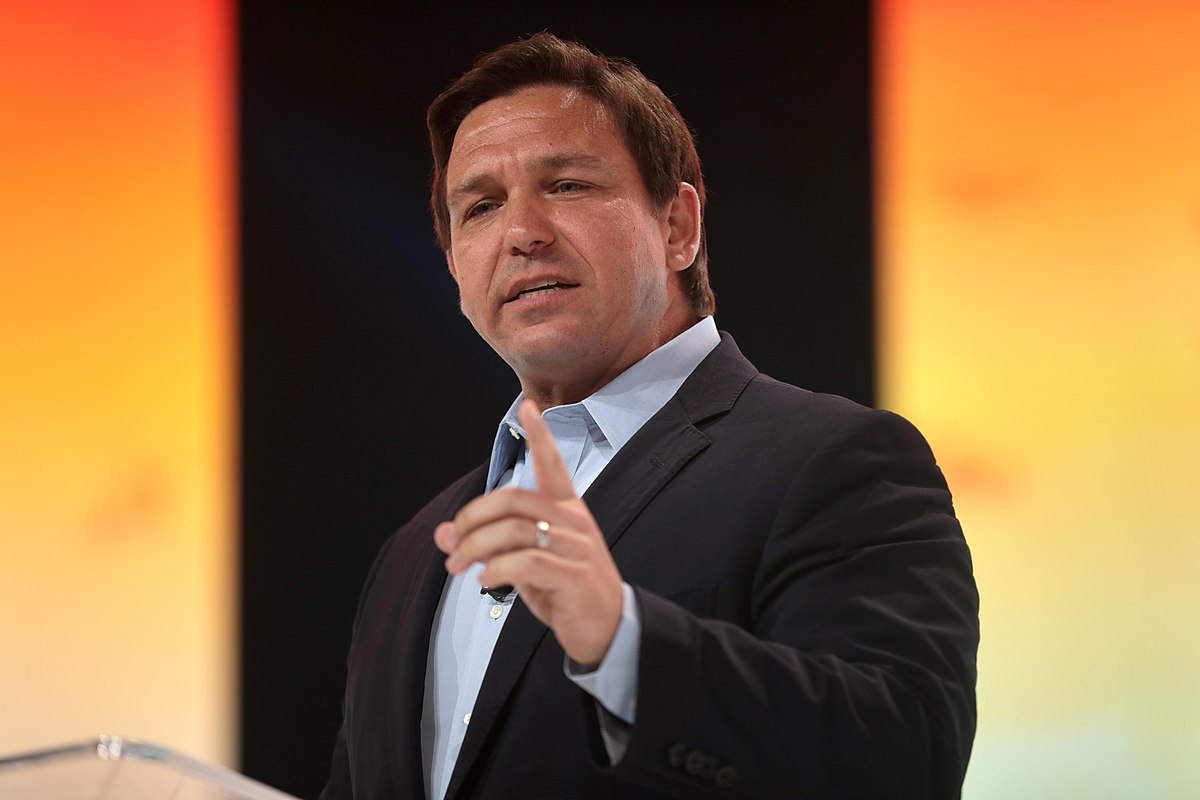
Governor Ron DeSantis speaking at the 2021 Student Action Summit hosted by Turning Point USA at the Tampa Convention Center in Tampa, Florida on 18 July, 2021.
Photo by Gage Skidmore via Wikimedia Commons.
You gotta hand it to a guy who convinces Democrats to die on the hill of defending perverted groomers talking about sex with little school kids. It’s on-brand for their fellow travelers at The Lincoln Project, but you would think that Democrats actually want to win elections. But no – they want to make the schools safe for pedos, and they don’t care who knows it. But they’ll care plenty in November when parents around the country come out and vote for The Party of Not Hitting on Der Kinder.
Donald Trump has his record of achievement – economic success and peace abroad. But Ron DeSantis has the DeSantis Doctrine, sort of like the Monroe Doctrine, except instead of keeping shady foreigners out of our hemisphere, the DeSantis Doctrine keeps woke fascists out of our lives.It was DeSantis who started the fire that burned the pyre of Democrat hopes and dreams they jumped onto in their campaign against the Florida anti-grooming statute. But that’s only his latest fight with the elite. DeSantis has been laying down the law in Florida, literally, and in a way even Donald Trump never did. At some level, Donald Trump still has some residual respect for the trappings of the elite. He’s impressed by name universities and huge corporations, and for all his much-justified complaining, he still cavorts with institutions that hate him, like the NYT. He’s not yet completely done with the institutions, but DeSantis is. DeSantis is all honey badger, laying waste and making the rubble bounce.
It’s the DeSantis Doctrine, and it’s summed up this way: Your garbage institutions don’t mean Schiff to me. I am going to ruthlessly wield my power to protect normal people from your depredations. And I’m going to smile doing it.
Did the head of China-hugging Disney really think he was going to push Big Ron around? The nattering twenty-somethings and woke pronoun people in his company and on social media thought they could leverage their power to make this huge Florida employer bring DeSantis to heel over the threat that creepy weirdos could no longer chat up kindergartners about sex in schools. So this dude – who shrimps Chi Com toes even as his commie masters torment, torture, and terminate Uighurs and prop up Putin – comes out and really expects that DeSantis will fold. And then DeSantis, delighted at the chance to figuratively post a rodent skull on a pike, told the Mouse to pound some Sunshine State sand.
But I was informed by all the smart people with blue checks trapped in a vortex, which keeps them forever in the year 2005, that conservatives were supposed to hate regulation and love big corporations.
Well, things change – among them, the left, which decided that it was going to weaponize every institution against us, including corporations. A key element of that campaign is neutralizing normal people’s retaliation by barring us – through the application of principles that exist only in a paradigm that no longer does – from exercising our own power. “It’s so unseemly for a governor to attack a corporation!” Perhaps, in a world where corporations tend to literally mind their own business and not use their economic power to affect policy. But it’s ridiculous to expect that, in a world where corporations regularly use their power to affect politics, we normal people are somehow barred from using our own power – political power, including the power to regulate – to protect ourselves. You don’t get to change the rules, then expect us to remain bound by the old ones.
Well, you can expect that – many do, in fact – but Ron DeSantis scoffs at such unilateral disarmament. He’s all about the massive retaliation.
March 12, 2022
Governments hate Bitcoin and other alternative currencies because they hate competition
Fifteen to twenty years ago, someone put together a funny-but-disturbing presentation on ordering pizza in the future, where the linked and integrated databases of health, banking, insurance, police, etc. are all available even to the order-taker at a pizza delivery place (the earliest example I found was this one). It was unsettling enough in the early oughts, but as N.S. Lyons illustrates, it’s far closer to reality than to fiction today:

You awake to find that today is special: it’s Stimmie Day! When you roll over and check your phone, you see a notification from your FedWallet app letting you know that another $2,000 in FedCoins has just been added directly to your account by the U.S. Federal Reserve.
To be honest, part of you would love to save that money for the long term, given that things have been getting rather uncertain and actually kind of crazy lately, what with the war and the economy and all… But you can’t, since these FedCoins are coded as usable for consumer purchases only, and will expire and vanish in seven days. So you’d better spend em while you’ve got em!
The latest PlayBox it is then. Everyone says Elden Ring 3 is the hottest VR game on the Metaverse right now, and you’ve really wanted to join in. Since you’re stubbornly old fashioned, you decide to check it out at BezosMart on the way home from work today before you get it delivered by drone to your tiny apartment.
But first you begin your day as you always do, with a quick stop at the local Starbrats’ automated, no-contact drive-through latte dispensary. Opening your FedWallet app and vaguely waving your smartphone at the machine is enough to complete the transaction. $14 in FedCoins are instantly deleted from your digital account at the Fed and recreated in Starbrats’ corporate account, well before the sweet, coffee-flavored milk beverage is deposited into your eager, grasping hands.
Your morning starts to go downhill quickly, however, when you realize that your SUV is almost out of gas. You pull the old clunker, with its antiquated combustion engine, into the nearest open station you can find – it looks pretty run-down – and roll up to the pump. A dull-eyed teenager in a facemask inserts a nozzle into your vehicle and waits for you to pre-pay. You wave your phone at the pump. Nothing happens. You try again. Your phone buzzes, and you look at it. There’s a message from the Fed: “You have already spent more than the $400 maximum weekly limit on fossil fuels specified in the FedWallet User Agreement. Your remaining account balance cannot be used to purchase non-renewable energy resources. Please make an alternative purchase. Have you considered a clean, affordable New Energy Vehicle? Thank you for doing your part to build a more just and sustainable world!”
You have in fact considered purchasing a clean, affordable New Energy Vehicle. But they still aren’t very affordable for you, what with the supply chain shortages. Despite the instant credit the Fed would add to your balance when buying an electric car – plus the permanent ten percent general subsidy you automatically receive on every purchase as a BIPOC individual thanks to the Fed’s Reparations Alternatives for Comprehensive Equity (RACE) program – the down payment on a new car would still be more than you can afford, even with your new stimmie coins.
Well, you’re not going to be able to make it to work at the warehouse on what you have in the tank. How could you be so foolish? You’re going to have no choice but to park here and blow a bunch of money on hailing one of those sleek, incredibly expensive self-driving electric cabs to take you there instead. But, as you’re about to tap the screen to do so, you notice there’s a classic fast-food joint next door. Might as well head there first to unload a little stimmie money. Nothing makes you feel better like a greasy breakfast sandwich.
Entering the establishment and sidling up to the old touchscreen kiosk, you order a McKraken with extra bacon. But when you wave your phone to pay, an error message pops up again. “You have exceeded your weekly purchase limit for complex animal protein, as stipulated in the FedWallet User Agreement. Have you considered purchasing a delicious vegan or mealworm alternative? Thank you for doing your part to build a more just and sustainable world!”
This is a sandwich too far for you during an especially hard week. “Ugh FedWallet is so fucking lame!” you post on Twatter as you idle hungrily in front of the kiosk. “Your message has been flagged for review,” says an immediate notification. “As a reminder, using ableist hate speech may impact your ESG score and future financing opportunities. Thank you for doing your part to build a more just and inclusive world!”
“Omg this is absurd, life was so much better before FedCoin, when we still had cash!” you post again to Twatter, unable to control yourself. “Your account has been locked pending national security review,” says a notification from FedWallet. “As a reminder, the proliferation of false or misleading narratives which sow discord or undermine public trust in government institutions is classified as a potential domestic terrorism offence by the Department of Homeland Security. We value your feedback.”
[Updated because I forgot to link to the original post.]
February 28, 2022
Hunting for books in the age of Amazon
In the latest SHuSH newsletter, Kenneth Whyte remembers book searches before the internet got commercial:

“Beat Ground Zero San Francisco 2014” by Mobilus In Mobili is licensed under 
Back in the late twentieth century, I used to build my vacations around book searches. Before going to any new town, I’d make a list of new and used bookstores and hit the best of them during my stay. There was a genuine excitement about entering each store: you never knew what you were going to find, and you were acutely aware that at any moment you might see something you’d never seen before or something you might never see again.
It was especially the fear of blowing that one chance of acquiring something special that turned me into a book hoarder. (I was never disciplined enough to be a collector; I only bought for my own use). Over the years, I accumulated tens of thousands of books. I’d rummage through them, once or twice a decade, and throw out the ones that no longer interested me to make room for new acquisitions. There were always new acquisitions, whether I was traveling or not.
Then came the internet and suddenly the whole concept of book scarcity blew up. Amazon had every new title one could want. I still go to my favorite bookstores when I travel — Daunt’s in London, Prairie Lights in Iowa City, Three Lives & Co. in Manhattan (the world’s most perfect small bookstore), Politics & Prose in DC, City Lights in San Francisco, The Last Bookstore in LA (further below), to name a few. I make the visits (none in the past two years) in part out of a sense of nostalgia for the waning era of brick-and-mortar, and also because well-curated shops often suggest books I might otherwise overlook.
Looking for books on vacation was always one of my habits, and before Amazon came along, I’d carefully search for bookstores along the route we’d be driving during our holiday and I rarely came back without a few armfuls of books. These days, especially since the era of lockdowns began, book stores are mostly just a memory … which is just as well in some sense because I have no disposable cash to spend on fripperies any more.
Of Ken’s list of favourite stores, I’ve only visited City Lights in San Francisco, back in early 1991. It was, bar none, the busiest bookstore I’d ever been in in my life. It rather felt like a record store (remember those?) on a big album release weekend than a staid, stodgy bookstore.
The internet also allowed used bookstores to put their wares online, and Bookfinder.com came along to organize their inventories. Bookfinder.com is a meta-search portal that allows book shoppers to scan the inventories of 100,000 booksellers at once. Type in a title and it will cough up an array of purchasing options: new, used, good condition, poor condition, former library copy, first edition, signed, etc. You compare editions and prices, make your choice, and click through to the bookseller’s site to finalize your purchase.
Bookfinder was launched by a Berkeley student named Anirvan Chatterjee in 1997, just a couple of years after Amazon was born. Chatterjee sold out to AbeBooks in 2005.
AbeBooks is a Canadian tech success story, originally operated out of Victoria by Rick & Vivian Pura and Keith & Cathy Waters. It is a digital marketplace that allows you to search the stock of a wide variety of established retailers. What differentiates it from Bookfinder is that you make your purchase right on the AbeBooks site. AbeBooks also sells the books it represents on other platforms, including eBay, Barnes & Noble, and Amazon. AbeBooks, in short, is a retail business while Bookfinder is a search tool.
AbeBooks was a dangerous discovery for me, and I bought a lot of books through them for a couple of years after discovering the service. Today, of course, not so much, especially as the shipping charges frequently run higher than the initial purchase price of the books themselves. Initially an independent service, AbeBooks is now owned by Amazon.
These days a lot of people want to shop for books anywhere but Amazon or its subsidiaries. For a non-Amazon version of AbeBooks you might try Alibris, founded by Martin Manley in California in 1997 (it’s been passed around to a range of venture capitalists and holding companies and is now in the hands of private investors). Biblio.com is another marketplace, serving mostly collectors. For non-Amazon alternatives to Bookfinder, viaLibri is a slick search tool that I only recently discovered, although it’s not quite as comprehensive as Bookfinder. Bookgilt is a good meta-search site for antiquarian and rare books. For new books, the best alternative to Bezos is your local bookstore, which can get you almost anything you need. See the map at the very bottom of this page or go to Bookshop.org or Indiebound.org. Or you can visit one of the chains, Chapters/Indigo or Barnes & Noble.
I still start most of my used book searches on Bookfinder. It’s old technology, Web 1.0, as hopelessly dated as the Drudge Report, but it works. I find it easy to navigate and it offers far more listings (and more information on each listing) than Amazon. I order from its smaller independents whenever practicable, although it’s often difficult to know exactly who you’re ordering from because the smaller shops are frequently represented on Bookfinder by their resellers, AbeBooks, Alibris, Amazon, and Biblio.
February 27, 2022
Who is Springfield Armory? A Tale of Two Entities
Forgotten Weapons
Published 20 Feb 2018Today we will take a look at the history of Springfield Armory – both the American national arsenal founded in the 1770s and the commercial entity founded in the 1970s.
http://www.patreon.com/ForgottenWeapons
Cool Forgotten Weapons merch! http://shop.bbtv.com/collections/forg…
If you enjoy Forgotten Weapons, check out its sister channel, InRangeTV! http://www.youtube.com/InRangeTVShow

February 11, 2022
QotD: “By their proposals, shall ye know them”
That is why the proposal that the IRS should have access to the data of all bank accounts from which or into which more than $600 a year are paid (hardly a king’s ransom) is so important, despite the fact that it has not been enacted. The very fact that someone wanted to enact it, and thought it right that it should be enacted, is highly significant — and sinister — in itself, for the proposal demonstrates a totalitarian mindset.
The ostensible purpose of the proposal, of course, is the elimination of tax evasion. (Incidentally, I have noticed recently an increasing tendency, in the press and elsewhere, for the term tax avoidance to be used interchangeably with that of tax evasion, as if the difference between legality and illegality were of no real importance. This conflation is itself indicative of a totalitarian attitude, according to which a governmental end may be reached without the necessity for any law.)
The people who proposed that, in effect, every bank account should be routinely available for examination by the IRS, without any specific warrant for such an examination, thereby revealed that they thought that the gathering of tax so important that it superseded all other considerations.
Psalm 24 begins: “The earth is the Lord’s, and the fulness thereof, the world and they that dwell therein. For he hath founded it upon the seas, and established it upon the floods.”
A better version, according to the proposers, would be: Money is the government’s, and the fulness thereof, money and they that have any. For it hath founded it upon the printing press, and established it as legal tender.
I do not go as far as some economists of my acquaintance, who believe that tax evasion is a citizen’s civic duty: at least it is not in the circumstances prevailing in any western country, however unsatisfactory they may be. In my own case, I do not evade taxes and even my attempts to avoid them are rather feeble, for unfortunately there is so little at stake.
But I reject completely the idea that, morally, the first call on anyone’s money is the government’s, which in effect has the right to leave you pocket money by its grace and favor after you have paid your taxes at any rate that it likes. This is the very tyranny that the founders of America feared in majoritarian democracy, untempered by inalienable rights — inalienable even, or especially, by or to the government.
Theodore Dalrymple, “Monitoring Bank Accounts Would Make the People of the Government, Not the Government of the People”, The Iconoclast, 2021-11-01.
February 9, 2022
A Tour of Chapuis Armes: Home of the MR-73 Revolver
Forgotten Weapons
Published 5 Oct 2021http://www.patreon.com/ForgottenWeapons
https://www.floatplane.com/channel/Fo…
Cool Forgotten Weapons merch! http://shop.forgottenweapons.com
With the MR-73 revolvers finally becoming regularly available in the US, I figured it would be really interesting to see how they are made! So, I headed over to Chapuis Armes, where the Directeur Général, Vincent Chapuis, gave me a really nice tour. Want to see? Let’s go in …
Contact:
Forgotten Weapons
6281 N. Oracle 36270
Tucson, AZ 85740

QotD: Paper or plastic?
This point is illustrated in microcosm by those trying to get rid of single use plastic bags. The 5p charge for plastic bags has meant the sale of billions of so-called bags for life, which use twice as much plastic as the cheaper alternative. All those bags for life mean we use more plastic than we started with and even, possibly, more bags themselves. This was something that was warned about before the plastic bag charge was introduced, with some observing that even “single use” bags did tend to get used more than once.
So far, then, we have learnt that the planning deployed to reduce plastic has had the opposite effect. That, however, has not stopped the central planners from redoubling their efforts. The necessary charge for a bag is to double, the system is to be expanded to the tens of thousands of small shops that don’t currently have to charge. “It doesn’t work, let’s have more of it”, the cry of bureaucracies through the ages.
But this is the blending of government planning with the fashionable nostrums of our day so of course it gets worse. It’s not even true that the bags for life – and especially not the cotton ones, even less so the organic cotton – are more environmentally friendly than the single use ones. Even recycled ones use more resources than single-use ones – for yes, recycling is an industrial activity using energy and other resources.
We can even construct a little spectrum here. How many times do we need to reuse a bag for it to have as little resource use – and thus environmental effect – as just the one use of those thin single use plastic ones? Obviously enough, the single use that we’re told not to use has a value of one here. The bag for life must be reused 35 times. A bag for life from recycled plastic 84 times. A paper bag must be reused 43 times – yes, paper. A cotton bag 7,100 times and an organic cotton? 20,000.
Which is the environmentally friendly option here? Clearly and obviously the one that everyone insists we must not use. So much for fashionable nostrums then.
Tim Worstall, “Plastic bags and the problem with central planning”, CapX, 2019-01-02.
February 8, 2022
QotD: The East India Company’s rise to power
In many ways the EIC was a model of corporate efficiency: 100 years into its history, it had only 35 permanent employees in its head office. Nevertheless, that skeleton staff executed a corporate coup unparalleled in history: the military conquest, subjugation and plunder of vast tracts of southern Asia. It almost certainly remains the supreme act of corporate violence in world history. For all the power wielded today by the world’s largest corporations – whether ExxonMobil, Walmart or Google – they are tame beasts compared with the ravaging territorial appetites of the militarised East India Company. Yet if history shows anything, it is that in the intimate dance between the power of the state and that of the corporation, while the latter can be regulated, it will use all the resources in its power to resist.
When it suited, the EIC made much of its legal separation from the government. It argued forcefully, and successfully, that the document signed by Shah Alam – known as the Diwani – was the legal property of the company, not the Crown, even though the government had spent a massive sum on naval and military operations protecting the EIC’s Indian acquisitions. But the MPs who voted to uphold this legal distinction were not exactly neutral: nearly a quarter of them held company stock, which would have plummeted in value had the Crown taken over. For the same reason, the need to protect the company from foreign competition became a major aim of British foreign policy.
The transaction depicted in the painting [Wiki] was to have catastrophic consequences. As with all such corporations, then as now, the EIC was answerable only to its shareholders. With no stake in the just governance of the region, or its long-term wellbeing, the company’s rule quickly turned into the straightforward pillage of Bengal, and the rapid transfer westwards of its wealth.
Before long the province, already devastated by war, was struck down by the famine of 1769, then further ruined by high taxation. Company tax collectors were guilty of what today would be described as human rights violations. A senior official of the old Mughal regime in Bengal wrote in his diaries: “Indians were tortured to disclose their treasure; cities, towns and villages ransacked; jaghires and provinces purloined: these were the ‘delights’ and ‘religions’ of the directors and their servants.”
Bengal’s wealth rapidly drained into Britain, while its prosperous weavers and artisans were coerced “like so many slaves” by their new masters, and its markets flooded with British products. A proportion of the loot of Bengal went directly into Clive’s pocket. He returned to Britain with a personal fortune – then valued at £234,000 – that made him the richest self-made man in Europe. After the Battle of Plassey in 1757, a victory that owed more to treachery, forged contracts, bankers and bribes than military prowess, he transferred to the EIC treasury no less than £2.5m seized from the defeated rulers of Bengal – in today’s currency, around £23m for Clive and £250m for the company.
William Dalrymple, “The East India Company: The original corporate raiders”, Guardian, 2015-03-04.
February 2, 2022
Neil Young revives the PMRC
Jim Treacher invites you on a trip down memory lane to a time when musicians like Neil Young were [gasp!] against censorship:
If you’re Generation X or older, you might be getting flashbacks over this whole “Neil Young vs. Joe Rogan & Spotify” contretemps. On one side, we’ve got a popular public figure who’s expressing his thoughts and opinions, just as America’s Founding Fathers told us we get to do. On the other side, we’ve got a bunch of miserable old fuddy-duddies who want to shut down free speech because they believe it hurts people.
In other words, Neil Young just revived the PMRC.
If you don’t know what the PMRC was and you’re too lazy to google it, here’s the short version:
Back in the ’80s, a senator’s wife named Tipper Gore got sick of her kids listening to music she didn’t like, so she started an organization called the Parents Music Resource Center. The PMRC compiled a list of songs they found unacceptable, including “Darling Nikki” by Prince, “We’re Not Gonna Take It” by Twisted Sister, and “She Bop” by Cyndi Lauper. Then Tipper used her political connections to convince the Senate to hold hearings about this supposedly dangerous music.
A lot of Americans decided they liked what popular entertainers were saying, and a handful of busybodies tried to put a stop to it. “If we don’t want to listen to it, nobody should get to listen to it. We need to protect the helpless unwashed masses from themselves!”
Sound familiar?
But then this happened:
If you’ve got a half-hour to spare, you can watch Dee Snider’s entire Senate testimony here. By the time he was done, the PMRC had been exposed for the meddling, hypocritical clowns they were. Their brief moment of relevance was over, at the hands of a guy who looked like Bette Midler transitioning into a Wookie.
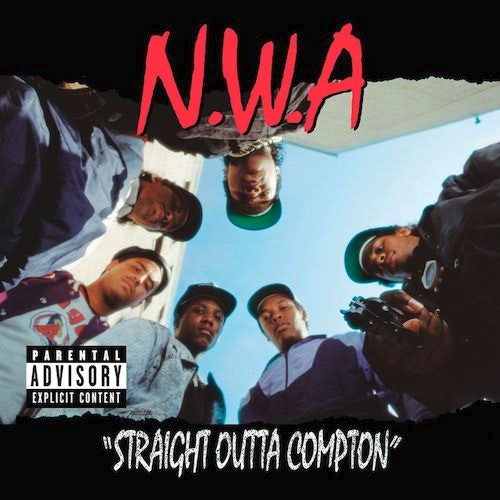
The PMRC did get a consolation prize, though: the “PARENTAL ADVISORY” sticker you can find on a lot of cassettes and CDs from the era. Y’know, the sticker that made kids want to listen to what was inside because their parents wouldn’t like it.
Over the next couple of decades, the PMRC ended up helping a lot of artists sell a lot of records. Like this one:
I remember seeing that CD cover for the first time and thinking, “Damn … this must be awesome.” And it was! If not for Tipper Gore, NWA might not have become superstars and Dr. Dre probably wouldn’t be a near-billionaire now.

January 31, 2022
QotD: Weird attempts to violate the Efficient Markets Hypothesis
The book begins and ends with a celebration of contrarianism. Contrarians are the only people who will ever be able to violate the EMH. Not every weird thing nobody else is doing will earn you a billion dollars, but every billion-dollar plan has to involve a weird thing nobody else is doing.
Unfortunately, “attempt to find violations of the EMH” is not a weird thing nobody else is doing. Half of Silicon Valley has read Zero To One by now. Weirdness is anti-inductive. If everyone else knows weirdness wins, good luck being weirder than everyone else.
Thiel describes how his venture capital firm would auto-reject anyone who came in wearing a suit. He explains this was a cultural indicator: MBAs wear suits, techies dress casually, and the best tech companies are built by techies coming out of tech culture. This all seems reasonable enough.
But I have heard other people take this strategy too far. They say suit-wearers are boring conformist people who think they have to look good; T-shirt-wearers are bold contrarians who expect to be judged by their ideas alone. Obviously this doesn’t work. Obviously as soon as this gets out – and it must have gotten out, I’ve never been within a mile of the tech industry and even I know it – every conformist putting image over substance starts wearing a t-shirt and jeans.
When everybody is already trying to be weird, who wins?
Part of the answer is must be that being weird is a skill like any other skill. Or rather, it’s very easy to go to an interview with Peter Thiel wearing a clown suit, and it will certainly make you stand out. But will it be “contrarian”? Or will it just be random? Anyone can conceive of the idea of wearing a clown suit; it doesn’t demonstrate anything out of the ordinary except perhaps unusual courage. The real difficulty is to be interestingly contrarian and, if possible, correct.
(I wrote that paragraph, and then I remembered that I know one person high up in Peter Thiel’s organization, and he dresses like a pirate during random non-pirate-related social situations. I always assumed he didn’t do this in front of Peter Thiel, but I just realized I have no evidence for that. If this advice lands you a job at Thiel Capital, please remember me after you’ve made your first million.)
Scott Alexander, “Book Review: Zero to One”, Slate Star Codex, 2019-01-31.


