
The Korean War by Indy Neidell
Published Jan 13, 2026Operation Strangle, to destroy enemy logistical capability with air power, has been in progress for months now, and yet the enemy is still able to bring up men and supplies, and even slowly stockpile them for possible future offensives. The UN position now is that should there be an armistice, and should the other side break its terms, retaliation would be broader and would include actions against Communist China, but will the UN have the force to do such retaliation? That is the question.
00:00 Intro
00:44 Recap
01:09 POW Issues
03:30 The Airfields
08:29 UN Declaration
10:15 Operation Strangle
14:13 Summary
14:35 Conclusion
15:25 Call To Action
(more…)
January 14, 2026
The Korean War Week 82: Ridgway’s Nuclear Warning! – January 13, 1952
Comments Off on The Korean War Week 82: Ridgway’s Nuclear Warning! – January 13, 1952
January 9, 2026
Mark Carney’s play-acting on the international stage
There is no way that Canada can make itself economically independent of the United States, no matter how much wishcasting power is exerted to persuade anti-American boomers who habitually vote Liberal. Our entire economy is oriented to serve the vast market to our south, and we’ve been freeloading on our own military because the Americans have been willing to take up the slack and — until recently — not castigate our leaders for their fecklessness. It was bad under Justin Trudeau, but it’s actually gotten worse under Mark Carney’s leadership. Trudeau was performative and loved to play to the world media, but Carney seems to actually believe that he can reverse the entire direction of the Canadian economy by jetting around the world and bad-talking Donald Trump. The Canadian economy has been stalled for ten years now, and if Trump finally loses patience with our idiotic elites, it’ll go into free-fall.
On the social media site formerly known as Twitter, James E. Thorne points out just how few cards Carney actually has in his hand:
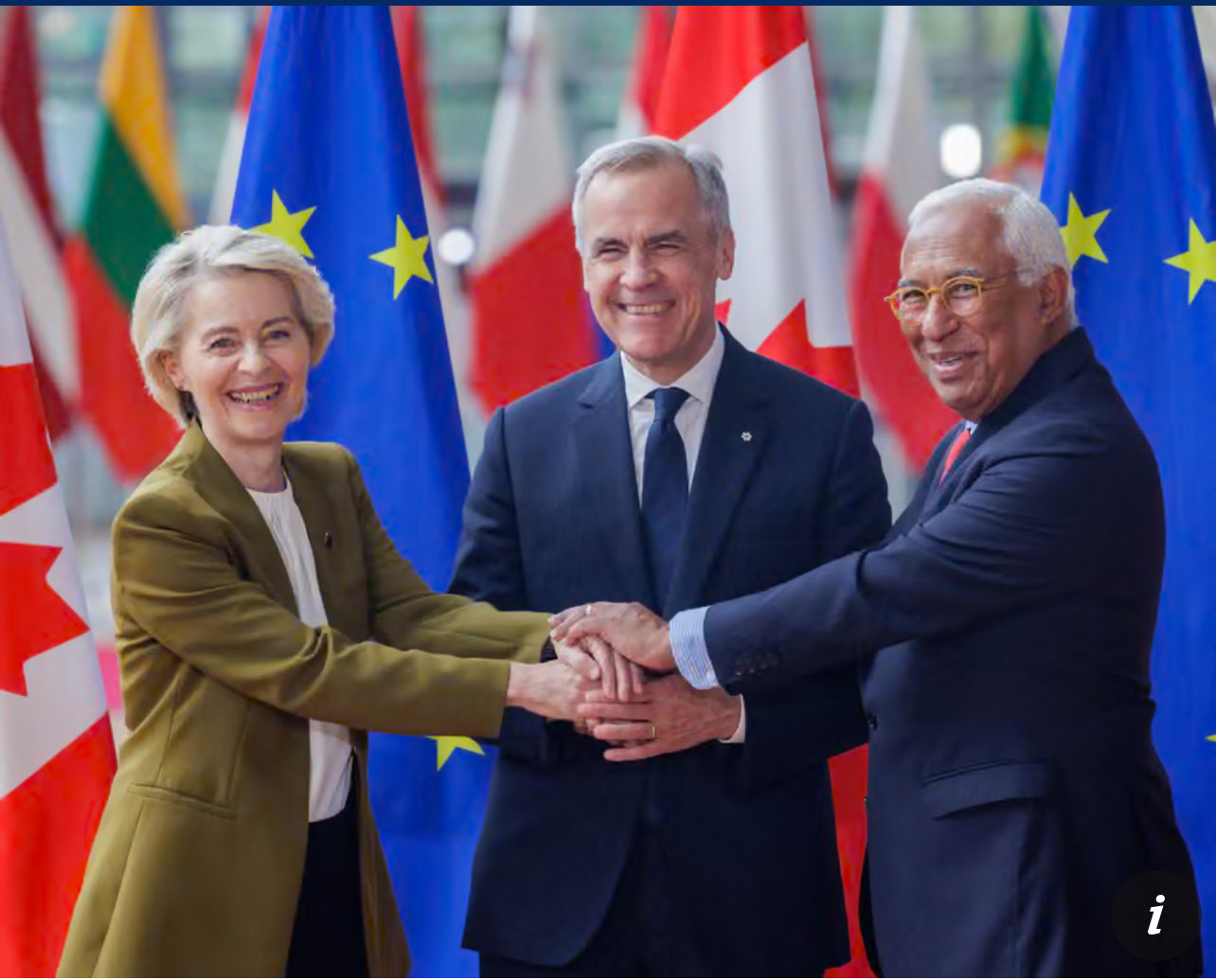
Mark Carney’s and Canada’s Dangerous Refusal to Face Reality.
Mark Carney and most Canadians are behaving as if Canada is an independent pole in a multipolar order, when the world he actually inhabits is a hierarchy being brutally clarified by Washington. Trump’s revamped National Security Strategy and the “Trump Corollary” — asserted through the seizure of Nicolás Maduro and open threats toward Cuba and Colombia, make plain that the United States now treats the Western Hemisphere as an American security estate, not a debating society among equals.
In that framework, Canada is not a co-author of the rules. It is a dependency inside the U.S. sphere, structurally lashed to American markets, finance and supply chains. AND after decades without a serious sovereign industrial or energy strategy, Canada is at best a weak Middle Power, that has for decades squandered its competitive advantage through proformative politics and virtue signalling.
In this era, the Western Hemisphere is now a “secure production platform” for American industry and technology, defined not by territorial control but by ownership, access and compliance. The Trump doctrine logic is clear and blunt yet internally coherent: if the Western Hemispheres natural resources and supply chains are secured, the economic and geopolitical dividends will follow.
Carney’s answer to the Trump Doctrine, however, remains the same “City-of-London” orthodoxy that produced him: more proformative political grandstanding, more process, more declarations, more meetings, and more boondoggles.
The Greenland consulate, rhetorical red lines over annexation, the flying around the world, and ritual protests against U.S. action in Venezuela all presume that we still live in the post WWII rules based order. We do not! Will live in the era of the Trump Doctrine, and no we can’t wait it out. And in this era, Greenland will not be allowed to be under the influence of Russia or China.
Thucydides warned that “the strong do what they can and the weak suffer what they must”. Carney’s tragedy is that he quotes the rules-based order while presiding over a country whose economic structure is colonial and whose security ultimately depends on the very power he is theatrically chastising. Posturing without power is not prudence. It is provocation without a plan. And yes it’s dangerous.
The irony is that Carney understands all of this perfectly well, which only sharpens the question: what, exactly, is he doing by posturing as a rules-based equal in a hierarchy where he knows Canada lacks the hard power to back his stance?
Comments Off on Mark Carney’s play-acting on the international stage
January 8, 2026
Drawing lessons from the Venezuelan operation
Following up on an item that I shared as part of yesterday’s Venezuela post, ESR expands on the notion that China (among other potentially hostile nations) will be having a lot of time to rethink due to the noted failure of Russian SAM-300s, Chinese anti-air radar, and other high tech items fielded by the Venezuelan military:
I’ve been contemplating the reactions to this post and I realized there is an important point about which I should have been clearer. There are several different ways in which Chinese radars can just NOT FUCKING WORK. My point was intended to be that almost all of them create huge operational uncertainty for the Chinese.
I gather a lot of people thought that “not fucking work” means they’re intrinsically shitty and would fail to do their job even in the absence of countermeasures. I think this is possible, but unlikely.
There are other values of not fucking work. Including:
* Easily neutralized by ECM.
* Easily taken out by cheap anti-rad missiles or drones.
* Easily fried by some kind of monster secret HERF gun.
* U.S. anti-radar stealth is good. I mean, really, mind-bogglingly good. Better than anybody without a top-secret security clearance knows.
Out of all the possibilities, the only scenario that does not threaten the sphincter control of Chinese military planners is “Venezuelan air defense had stand-down orders”. And if that were true, I’m pretty sure it would already have leaked.
Comments Off on Drawing lessons from the Venezuelan operation
QotD: Canned food and the early days of the Raj
Consider the history of canned food. It has obvious military applications — Napoleon famously quipped that an army marches on its stomach, and as canning was largely invented in France, he made some effort to issue food to his troops (as opposed to local procurement and / or “living off the land”). He didn’t quite get there, but the resultant revolution in logistics was as important to the conduct of war, in its way, as just about anything else. If you don’t know how armies are provisioned, you’re likely to miss something when you talk about wars.
You might even miss something culturally. For instance, there’s an entire sub-subdiscipline called “Food and Foodways”, and it’s not as silly as it sounds. Canned food was an important part of British cultural life in the Raj, for instance. File it under “Women Ruin Everything” — once it got safe enough for ladies to have a reasonable chance of surviving East of Suez, the awesome freewheeling decadence of the “White Mughals” period was replaced by dour, dowdy Victorian bullshit. Every summer the “fishing fleet” pulled into Calcutta harbor, disembarking scads of ugly British girls with a Bible in one hand and a can of spotted dick in the other, determined to snag the highest-ranking ICS man they could and, in the process, turn India into another boring suburb of Edinburgh. Anglo-Indian cookbooks are full of recipes for horrid British glop straight out of cans, and if you routinely got really, really sick from eating spoiled stuff, well, hard cheese, old chap! Heaven forbid you eat the delicious, nutritious, climate-optimized cuisine that was literally right there …
If you want to argue that the Indian Army fought so many border wars just to get away from sour, hectoring memsahibs and their godawful tinned slop, I’m not going to stop you.
Anyway, the point is, IF you are conversant enough with the relevant technical stuff, it occurs to me that you can get a snapshot of embedded cultural assumptions by looking at a period’s characteristic or representative technology.
Severian, “Assumption Artifacts”, Founding Questions, 2024-04-30.
Comments Off on QotD: Canned food and the early days of the Raj
January 7, 2026
“All of that operational brilliance was always there; it persisted through the Stupid Era”
I missed this Chris Bray piece when it was published a few days ago, but it’s still fully relevant. In it, he discusses the contrast between the faltering and visibly failing military operations like Operation Craven Bugout, sorry, I mean “Operation Allies Refuge”, in 2021 as the US and allied forces abandoned the Afghanistan mission leaving behind billions in military equipment and untold numbers of pro-western Afghans to the “mercy” of the Taliban and the recent brilliant military success in Venezuela:
For years, I’ve been shouting two related messages. First, “we’re in a contest of persistence between elite cosplayers and low-status producers”. Institutions that advance leaders on the basis of their ability to engage in au courant symbol-chanting are crushing the people in those institutions who do the work, and therefore hollowing out the institutions. Second, and so closely related you could just call it the same point in different words, “We’re healthy from the bottom up, and sick from the top down”. The “making stuff” people are mostly just fine; the “running stuff” people are mostly insane.
After years of dismal military failures, like the bafflingly inept withdrawal from Afghanistan after twenty years of ineffective warfare against the Taliban, the raid that captured Nicolás Maduro was operationally brilliant. It required perfection from everyone in a giant list of moving parts, executing a detailed plan with absolute precision. If you haven’t watched the briefing from Chairman of the Joint Chiefs of Staff Dan Caine, who was ritually denounced by the idiot media and the Democratic Party as an unqualified choice for the job, take some time to watch at least some of it. You aren’t used to seeing competence and clarity from an American institutional leader, so it’ll bring back some parts of your consciousness that may have gone to sleep for a while.
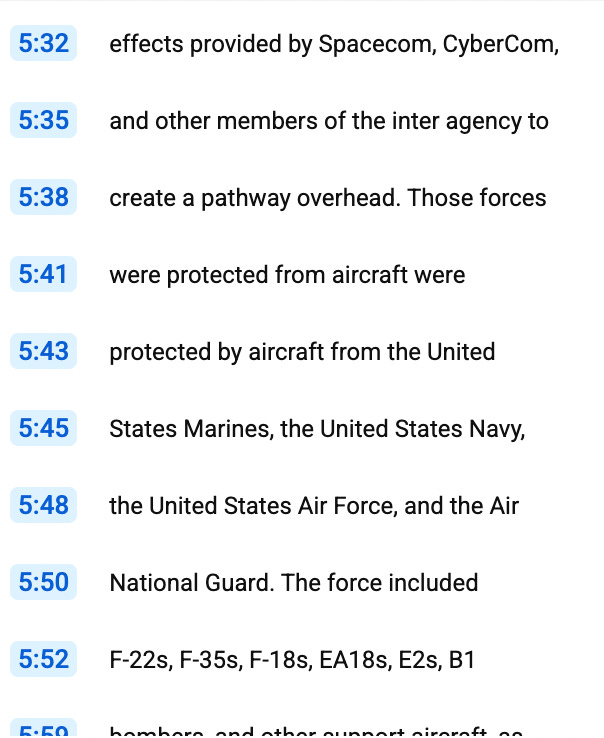
With 150 aircraft in the air, launching from something close to two dozen points of origin, every asset arrived in place and on time, while the lights went out below them. From the transcript:
The “pathway overhead” was that the US military switched off the Venezuelan military. They pressed the off switch on another nation’s command, control, and communications systems. Venezuela spent 2025 posturing at the US Navy, displaying their power as a warning against American aggression:
Similarly, “Experts had warned that Venezuela’s layered air-defence network could complicate US air operations”. Apparently not. At the designated moment, it all just went away.
I’ve talked for years about “recipe knowledge”, about the ability to know the steps that will produce a desired outcome. If I want to produce X result, I have to perform steps A, B, C, D, E, and F, in that order. If I skip Step C, Result X doesn’t occur, even though I’ve performed all the other steps.
We’ve just watched a military that apparently lacked the recipe knowledge to destroy the Taliban, or even to withdraw from a failed war in an orderly fashion and without leaving a bunch of weapons behind, demonstrate a shockingly high level of recipe knowledge. A failing institution isn’t a failing institution. Brilliant planning, flawless execution, ruthless competence.
There’s no way in hell that a single year of top-down intervention reversed years of hard decline. All of that operational brilliance was always there. It persisted through the Stupid Era.


On Substack Notes, John Carter commented on the article:
This, right here, is the meta-message of the Venezuelan raid. Competence collapse isn’t a purely military pathology, nor is it solely an American affliction. It applies to every institution in every Western country. We’ve been living with the frustrations and humiliations of this imposed decline for decades now.
With one decisive act, Trump has demonstrated that decline is a choice made by a small, false elite – and that if that elite is removed, decline can be reversed.
Removing the elite is the fix-everything switch in the presidency, the US military, and the Venezuelan government.
And now the whole world sees it.
A related post from ESR on the social media site formerly known as Twitter explores one of the more geographically distant ramifications of the US operation in Venezuela:
The Watcher On The Web @WatcherontheWeb
“ThIs Is GoInG tO cAuSe ChInA tO aTtAcK tAiWaN”
Yes retard, the country that just got shown all it’s calculations based on weapons systems which depended on being able to use RADARS to engage US aircraft/ships are essentially worthless and billions of dollars in investment and research have been wasted is going to feel VERY brave in launching an assault against a fortified island nation armed with US weapons, US fighters, backed up by the US navy and Japanese defense force …
I’m sure they are just giddy with excitement to try and pull that off. Practically chomping at the bit
This is an extremely important point that I’ve been thinking about ever since we got an unexpected audit of Venezuela’s air defenses. Russian SAM-300s and BUKs, Chinese anti-air radar, all proved completely worthless against U.S. gear and operators.
I guarantee you that if you are a Chinese military planner contemplating how to get an invasion army across 100 miles of the Straits of Taiwan, you are shitting your pants right about now. Because you have just learned that if you had tried to bust that move yesterday, your nice shiny new invasion fleet would have gotten absolutely gacked by U.S. airpower and missiles that you wouldn’t see coming BECAUSE YOUR FUCKING RADARS DON’T FUCKING WORK.
Also, the Soviet anti-air missile designs you cloned turn out to be about as useful as so many busted shopping carts.
Some of your guys are going to be saying “That’s impossible. The fix must have been in. Air defense must have had orders not to engage.” Which is an extremely cheering thought, but …
… isn’t that what the Americans would want you to believe? The only thing better than having complete technological dominance of an adversary is having complete technological dominance of an adversary who’s been conned into believing it isn’t true and walks blithely into getting utterly wrecked by it.
Yep. Before this went down I was figuring a very high probability that the Chinese make their move on Taiwan in 2027. Now? I guarantee you that their confidence in their previous risk assessments has evaporated. They no longer know what they’ll be facing, and there’s a significant possibility that mainland China’s domestic air defenses are worthless too.
Now I’m going to suggest that you juxtapose two phrases: “thermobaric bombs” and “Three Gorges Dam”. A China that’s naked from the air has the biggest glass jaw in human history.
Now I think there’s pretty good odds that the invasion of Taiwan will never happen at all.
Update, 8 January: Welcome, Instapundit readers! Please do have a look around at some of my other posts you may find of interest. I send out a daily summary of posts here through my Substack – https://substack.com/@nicholasrusson that you can subscribe to if you’d like to be informed of new posts in the future.
The Korean War Week 81: Ridgway Admits the UN is Little Threat! – January 6, 1952
The Korean War by Indy Neidell
Published 6 Jan 2026The year may have changed, familiar faces come and go, but some things remain the same. The POW issue continues to dominate and frustrate armistice talks, the fear of an expanded war in Asia re-emerges, and the snow remains cold. The war found no end and no pause in either 1950 or 1951, but third time’s the charm, surely?
00:00 Intro
00:29 Recap
01:24 Britain and the US
06:49 The US Proposal
10:57 The Slave Trade?
12:12 Summary
13:35 Conclusion
(more…)
Comments Off on The Korean War Week 81: Ridgway Admits the UN is Little Threat! – January 6, 1952
January 1, 2026
QotD: Niccolao Manucci’s improbable early career
That sounded pretty good to the teenager, so he disembarked with Bellomont at Smyrna, made the hazardous journey across Ottoman Anatolia, thence through Armenia, and finally to the Safavid Empire, where Bellomont declared himself an ambassador from the rightful king of England and sought Persian intervention in the English Civil War (!). The Shah was horrified by the regicide and amazed that the other Christian kings of Europe had not come to the aid of Charles I,1 but gently rebuffed Bellomont’s request by pointing out that it would be quite impractical to send a large army from Persia to England.
Frustrated, Bellomont set off once again with his young charge, this time to the Mughal Empire. He got as far as the port of Surat, where he suddenly died, leaving the teenage Manucci completely on his own, thousands of miles from his home, in the middle of a civil war.
I sometimes wonder how often this sort of thing happens without us ever finding out. Perhaps history is full of ridiculous people having ridiculous adventures, it’s just that most of them aren’t Zhu Yuanzhang, or they don’t write detailed memoirs, or those memoirs are lost or destroyed before they reach us. Something like this very nearly happened to Manucci. The Venetian teenager left all alone in India not only survived, but flourished socially and financially, lived to a ripe old age, and wrote thousands of pages of penetrating social observations. His account is both the most entertaining and the most reliable history of the Mughal Empire at its zenith. Manucci had the singular talent of moving through every social circle, from the royal court to the lowest of peasants. He interacted with generals and statesmen, harem attendants, Islamic jurists, Hindu sages, elephant drivers,2 Portuguese mercenaries, eunuchs, merchants, prostitutes, common soldiers, missionaries, beggars, and even the emperor himself. There are very few cases where we get to see a premodern society laid out in all its intimate detail and from every angle, and we only missed losing this one by the barest of lucky strokes.
The story of Manucci’s manuscript is a twisting one. The original copies of his tale fell into the hands of a French Jesuit who mutilated the text — excising all the fun parts, all the personal observations, the adventure stories, and of course anything remotely critical of the Catholic Church. The resulting “edition” found its way back to India and into Manucci’s hands before his death. Naturally, he freaked out and tried to reproduce his original text from memory, sending it along with a letter of protest by sealed courier directly to the Venetian Senate. But this second copy is the work of a much older man, much farther from the stories and events described, and has numerous omissions and differences from the original.3 In 1763, the Jesuit order was expelled from France and their Paris library, including Manucci’s first manuscript, was seized by the state. It was then lost during the Revolution and believed destroyed, before turning up in damaged and partial form at an auction-house in Berlin a century later.
Countless European intellectuals have tried their hand at stitching the mishmash of fragments we have back into a cohesive whole, including a “J. Bernoulli” (yes, one of those Bernoullis, but I can’t figure out which brother it was). But everybody agrees the most successful of these efforts was that by William Irvine, a British colonial administrator and fellow of both the Royal Asiatic Society and the Asiatic Society of Bengal, who also helpfully translated the whole thing into English. Irvine’s edition has been republished many times, most recently by the wonderful people at Forgotten Books, which is how it found its way into my hands.4
Irvine is not the sort of editor who confines his remarks to a preface and some footnotes. Instead, he directly injects his own commentary inline, into the body of the text. These asides range from bracketed remarks like “[here I have deleted a coarse and obscene description]” all the way up to essays dozens of pages long containing his reflections and opinions on the text. And this is layered on top of the various modifications and emendations made by French Jesuits and Venetian scribes. All of this gives the book a meta-textual, almost postmodern feeling. It’s a bit like House of Leaves. Sometimes you’re reading Manucci, and sometimes you’re reading three nested layers of people commenting on people commenting on people commenting on Manucci. And the effect is heightened when you suddenly realize that Manucci, like the protagonist of a Gene Wolfe story, is not telling you all that he knows.
John Psmith, “REVIEW: Storia do Mogor, by Niccolao Manucci”, Mr. and Mrs. Psmith’s Bookshelf, 2025-09-08.
- Bellomont’s only real success in his mission was to completely poison the well for all future European travelers in Persia. Manucci reports that the next Englishman to visit the court of the Shah was thrown into a dungeon for disloyalty to his liege lord (a story independently corroborated by the French adventurer Jean-Baptiste Tavernier). “[The shah’s] object was to give a lesson to his own nobles as to the manner in which they should serve their king and the fidelity they ought to display, when the occasion arose, in defence of their monarch.”
- The book contains extensive discussion of how all elephants and horses that the Mughal princes might want to ride are pre-ridden by an attendant, to “loosen its stomach” and eliminate any flatulence.
- This is actually a huge simplification — there are four distinct Venetian codices, all with major differences from each other.
- I started with the Forgotten Books paperback, but halfway through the first volume I was hooked, and seeing that I had a thousand pages left to go, picked up a handsome leatherbound set from a used book seller for a song. I would normally never dream of buying a second copy of a book I already own just because it feels nicer in my hands, but you, dear subscribers, have spoiled me.
Comments Off on QotD: Niccolao Manucci’s improbable early career
December 31, 2025
The Korean War Week 80: Empty Lines and Guerrillas: X-mas ’51 in Korea! – December 30, 1951
The Korean War by Indy Neidell
Published 30 Dec 2025It’s Christmas, 1951, and though peace on earth and goodwill to all men might have a general appeal, peace seems as far away as ever in Korea. There are, though, no large scale offensives being planned at the moment, as the frozen winter grips Korea and the peace talks drag on and on. However, just because the war between armies is quiet, doesn’t mean Korea is; anti-guerrilla operations claim lives by the thousands, and the general drudgery of the war also takes thousands of lives on both sides each and every month. Christmas in Korea is grim.
00:00 Intro
00:27 Recap
00:49 POW Lists
02:25 New Offensive
05:29 Fighting the Guerrillas
07:20 Casualty Numbers
09:04 Boatner and the 23rd
11:54 Inspections and China
13:27 Summary
13:59 Conclusion
(more…)
Comments Off on The Korean War Week 80: Empty Lines and Guerrillas: X-mas ’51 in Korea! – December 30, 1951
December 27, 2025
Campaign Furniture by Christopher Schwarz
I try not to clutter the blog with woodworking-related posts, as I know it’s a niche interest among my readership, but every now and again I find something I just have to share. Today, it’s a post from Lost Art Press on the book Campaign Furniture written by Christopher Schwarz:
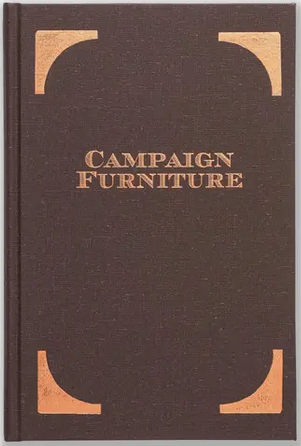
My 2014 book Campaign Furniture is now a free pdf download for everyone. You can download it via this link (a compressed version for slower connections is available here). And customers will always be able to download it from the book’s page in our store.
I’m a fan of the book … I ended up buying two copies through Lee Valley Tools (I loaned my first copy out and it got lost in the shipwreck of a friend’s messy divorce). I like Chris’s writing style and I’ve long been a fan of Campaign furniture.
Why Do I Do This?
I get asked by fellow publishers why I offer my books for free download. “Surely you use it to gather emails to market to readers.” Nope. “Are these out-of-print books that you are using to get eyeballs on your website?” Nope. “So what’s the strategy?”
I think – as much as possible – that information should be free. I think the best hope for inspiring other woodworkers is to give them whatever they need to begin in the craft.
And, I fu&%ing hate this world we’ve created where people can’t own anything. Companies come into your house and your phone and change things or take away stuff you’ve bought. Many times they take back stuff you owned then rent it back to you.
That’s why we make books. Buy a book from us, and it’s yours. Its contents can’t be changed by some ideologue a thousand miles away. All of our digital products are free of DRM (digital rights management). That means they can’t be locked or disabled. And you can copy them onto whatever device you like.
OK, the holiday rant is over.
I hope you find something of interest in Campaign Furniture. We still use three of the pieces from the book every day in our home. Other pieces are with my kids. So my family’s love of this neglected furniture style continues.
Comments Off on Campaign Furniture by Christopher Schwarz
December 24, 2025
The Korean War Week 79: Soviet Technology Surpasses the USA – December 23, 1951
The Korean War by Indy Neidell
Published 23 Dec 2025Both sides finally release POW information to each other, as required by the Geneva Convention, but neither side is happy with the information, charging it either wildly incomplete or grossly mischaracterized. The Communists also refuse to allow the Red Cross in and the UN doesn’t want compulsory repatriation of POWs, but both are required under Geneva. And away from the truce tables, the Communist air power menace continues to grow, but should there be an armistice will they be allowed to rebuild air bases in North Korea?
00:00 Intro
00:38 Recap
00:58 POW Lists
05:02 Repatriation
07:52 Geoje-Do
09:01 Ambush Program
09:54 Airfields or Armistice
12:00 Communist Air Power
13:23 Summary
13:32 Conclusion
14:50 Call to Action
(more…)
Comments Off on The Korean War Week 79: Soviet Technology Surpasses the USA – December 23, 1951
December 17, 2025
The Korean War Week 78: Communists See 100% Success in the Skies! – December 16, 1951
The Korean War by Indy Neidell
Published 16 Dec 2025The Communist forces’ air power grows and grows, to the point where the UN wonders if they will lose aerial supremacy. This colors the Peace Talks, because should infrastructure be allowed to be rebuilt and rehabilitated during an eventual armistice, what airfields might the Communist side soon have in North Korea? Not just as a threat should an armistice fail, but to Japan as well.
Chapters
00:00 Intro
00:49 Recap
01:23 General Hsieh Probes
06:22 Communist Air Power
12:06 POW Issues
14:54 Summary
15:14 Conclusion
15:51 Call to Action
(more…)
Comments Off on The Korean War Week 78: Communists See 100% Success in the Skies! – December 16, 1951
December 14, 2025
Hitler becomes a German – Rise of Hitler 23, January-March 1932
World War Two
Published 13 Dec 2025The big news this winter is the German Presidential elections, held now in March for the first time since 1932, which pit current President Paul von Hindenburg against Nazi Party leader Adolf Hitler. Hitler, though, must become a German citizen before he can run; he been stateless since he gave up his Austrian citizenship seven years ago. The campaigns are quite different, but both effective, and the German people head for the polls.
(more…)
Comments Off on Hitler becomes a German – Rise of Hitler 23, January-March 1932
December 13, 2025
QotD: Victorian mores, homosexuality, and the Empire
This is where modern identity politics really messes up historical analysis. We probably all know that the vast majority of Victorian homosexuals were married, because the vast majority of Victorians were married. This isn’t my professional field, but because I went to grad school I’m pretty well up on it – the ivory tower finds Victorian poofters endlessly fascinating, because they are huge homo cheerleaders (obviously), but also because of the costumes.
Women and gay men love playing dress up — have you noticed? — and Victorian dress up is the best, because it’s a) expensive, and b) time consuming, but also c) flattering to just about any body type. It was socially acceptable among the upper classes to be porky (and nobody dresses up like a chimney sweep or factory hand), so both men’s and women’s fashion in the Late Victorian era can accommodate modern bodies. (Unlike the early Victorian era, which continued Regency fashion. They’d love to dress up Regency style — there’s a reason “Regency romance” is the most popular genre of light porno books for cat ladies — but it takes a specific physical type to pull off, and they don’t have it). […]
Anyway, where was I? Oh yeah — lots of people in grad school really, really into Victorian queers, so if I seem extremely well informed on this topic, don’t read too much into it.
“Repressed homosexual” was redundant back then. Oscar Wilde, for instance, was sort of the ur-homo — he was so gay, just gazing too long at a picture of him at his dandiest could give you an uncomfortably strong urge to touch a penis. […] Oscar Wilde was also married, and had two children, because that’s how even the queerest of the queer rolled in Victorian London.
Given that, you’d expect one of two things to happen to public schoolboys once they got out into the bush. Either they’d totally let their freak flag fly — you know, given that everyone else in their social world was an equally repressed public schoolboy — or they’d bottle it up even further, because it was important to show nothing but the best image of Her Majesty’s servants to the wogs at all times.
As far as I know, the latter was almost universally the case. Before the opening of the Suez Canal (1869), you could have a nonstop bacchanalia over there … if you were straight. Those guys could, and did, rock the casbah with extreme prejudice. It started tapering off early in Victoria’s reign, but in the late 1700s you had British army officers converting to Islam (no, really) for the express purpose of getting even more tail, by marrying the Koranically sanctioned four wives (sometimes with all the age of consent queasiness that implies).
The repressed homos, on the other hand, got really into scholarship. It’s not generally known (because even then the vast majority of their works were of interest only to micro-specialists) but Anglo-Indians were insanely productive scholars, on every conceivable topic. You could fill a decent sized library with their five-, seven-, nine-volume works on Sanskrit philology, and the botany of the lower Himalayas, or the migratory habits of tigers, or pretty much anything. And if they weren’t the scholarly sort, the repressed homos simply threw themselves into their work, of which there was always an endless supply — take a look at a map of India, recall that there were at most 200,000 Britons in the whole place, and you’ll see what I mean.
So: Were they going out there to get away from Victorian women? Absolutely. Were they therefore going to turn the place into Studio 54? Absolutely not.
Severian, “Ruling Caste II”, Founding Questions, 2022-03-10.
Comments Off on QotD: Victorian mores, homosexuality, and the Empire
December 12, 2025
Re-orient your map to understand China’s view of the world
CDR Salamander provides a helpful guide to seeing the world, specifically their Pacific front, by turning your map sideways. I hope you won’t look back on this from a slightly later date when the maps get all flaggy and arrow-y:
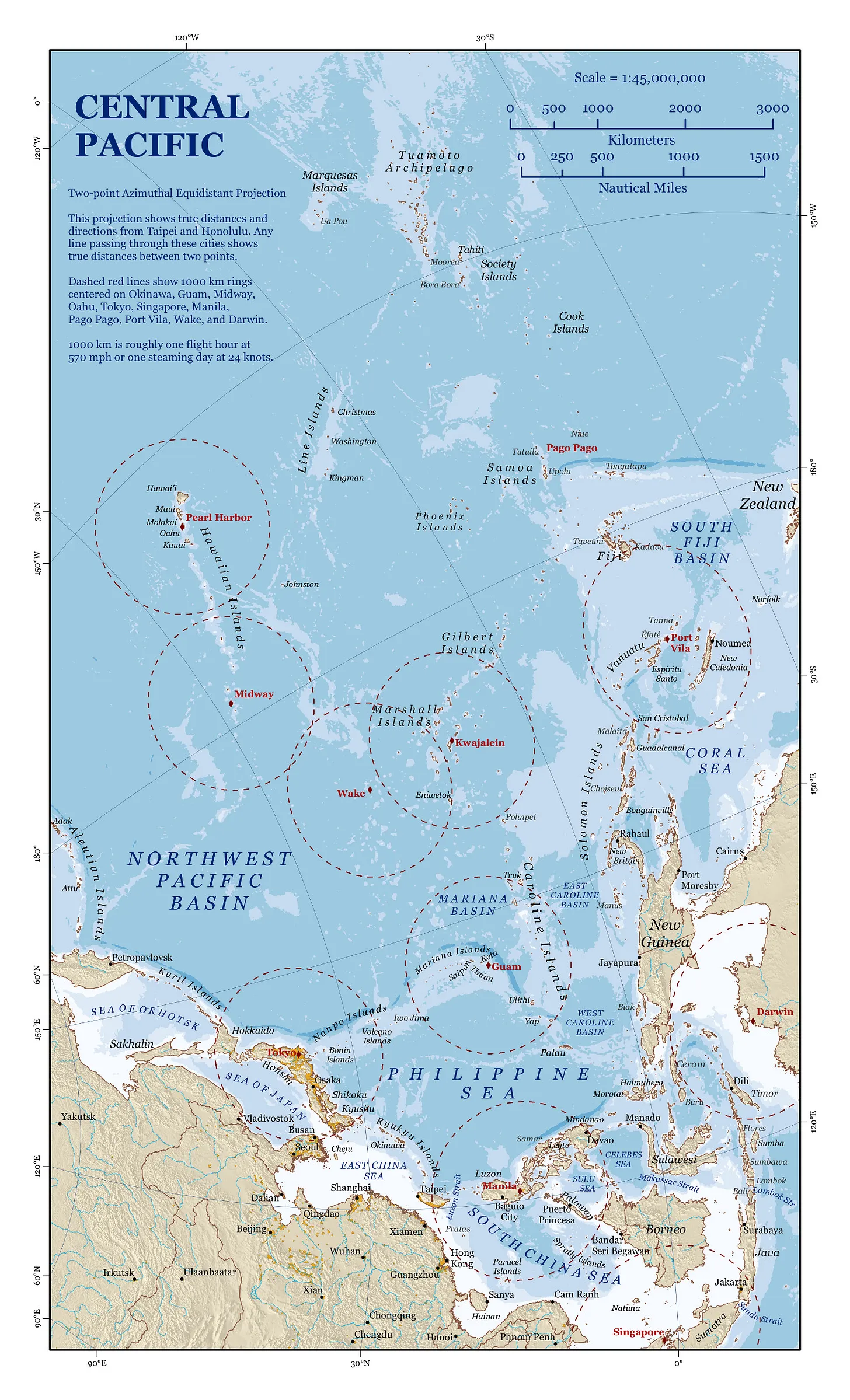
I first saw this map three years ago, and it recently resurfaced in my thoughts.
I remain convinced that a lot of the problem with trying to get everyone to fully understand the challenge in the Western Pacific is that to a large part, we think in a “north-up” orientation.
I don’t think that is all that helpful.
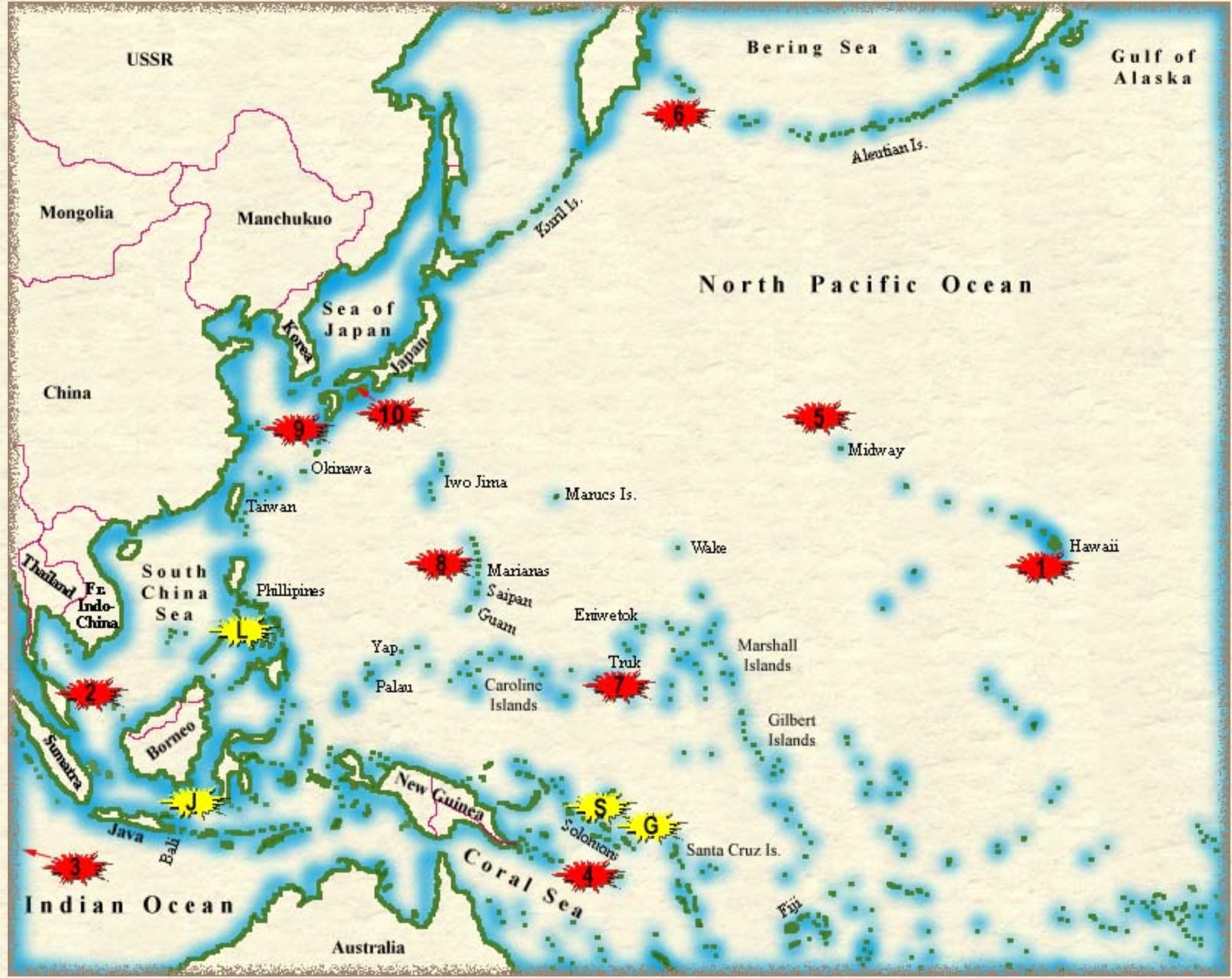
Just a few days ago, we had another Pearl Harbor Day anniversary and we’ve all seen the maps, usually centered on Hawaii, where the Imperial Japanese Navy’s Kidō Butai comes at the Pacific Fleet from stage left off the map. Then we fought battles in the Coral Sea, Midway, and so on.
To the lay eye — or to those who don’t have time to dig into the reasons — a traditional north-up map looks disjointed; things seem all over the place.
No, not really. Let’s bring back that first map.
[Click to embiggenate]
For both Imperial Japan in the early-mid 20th century and Communist China today, the most important part of this map is the access to the resources in or going through the bottom-right hand corner.
Today’s greatest bone of contention — not unrelated to the most important part of the map mentioned above — is Taiwan, right at the mouth of the funnel.
If we need to bring a fight there, that is one hell of a fight to get there if the People’s Republic of China (PRC) wants to prepare a proper welcome for us.
For the PRC, the primary military threat to plan for comes across the Pacific into a funnel that terminates at its most important SLOC. It’s the United States of America, and the US has a series of islands leading right into the heart of the PRC’s. It starts in Hawaii — Midway, Wake, Guam — and then to U.S. allies: the Philippines, Japan, and Australia.
They’re planning a layered defensive fight. Their actions make that clear.
Make no mistake, we may say we are going to “defend Taiwan”, but to do that we will have to fight an aggressive war across the Pacific, into the enemy’s prepared funnel.
Update, 13 December: Welcome, Instapundit readers! Please do have a look around at some of my other posts you may find of interest. I send out a daily summary of posts here through my Substack – https://substack.com/@nicholasrusson that you can subscribe to if you’d like to be informed of new posts in the future.
December 10, 2025
The Korean War Week 77: The Korean Winter Bites Hard – December 9, 1951
The Korean War by Indy Neidell
Published 9 Dec 2025Now that they’ve agreed on a Demarcation Line, the talk this week at the Panmunjom peace talks has turned to whether there will be restrictions or not after the signing of an armistice. Also, how would inspections work to make sure the other side is complying with the armistice terms? Perhaps a group of representatives from neutral nations? Meanwhile the troops are digging in to their winter defenses, as the frozen Korean winter descends upon them.
Chapters
00:00 Intro
00:48 Recap
01:16 Two New Points
08:42 Korean Winter
11:47 Communist Defenses
13:20 Summary
13:33 Conclusion
14:28 Call to Action
(more…)


