
TimeGhost History
Published 13 Jul 2025Why couldn’t France crush the Viet Minh after war broke out in Vietnam? In this episode we dive into the brutal opening years of the First Indochina War, from the outbreak of violence in Hanoi in December 1946 to France’s failed military campaigns and the rise of Vietnamese resistance.
Despite having superior weapons, colonial experience, and Foreign Legion reinforcements, France failed to defeat Ho Chi Minh’s forces. We explore why early offensives like Operation Léa and Ceinture fell short, how the Viet Minh’s rural strategy kept them alive, and why French hopes of ending the war quickly vanished.
As Mao Zedong’s Communist China consolidates power just across the border, the Viet Minh gain strength, support, and a long-term advantage that France simply cannot match.
This video is part of War 2 War, our Cold War history series covering the decade after WW2, a time of seismic global transformation.
(more…)
July 15, 2025
Why France Couldn’t Crush the Viet Minh – W2W 36
July 9, 2025
The Korean War Week 55: Ceasefire Talks Planned – But the War Isn’t Paused
The Korean War by Indy Neidell
Published 8 Jul 2025It’s huge news — the Chinese and North Koreans have agreed to hold peace talks with the American led UN forces, to begin next week! That’s all well and good, but everyone on every side now has to figure out exactly what they want from the talks and what they’re prepared to give up to get it. There are also plenty of people, like UN Commander Matt Ridgway, who don’t want to have peace talks at all just now. Still, a UN liaison party flies in to Kaesong at the end of the week to lay the groundwork. Exciting times.
Chapters
00:00 Intro
00:57 Recap
01:26 The Chinese Response
05:21 Instructions for Ridgway
09:30 The Negotiators
12:01 Summary
13:10 Call to Action
(more…)
July 8, 2025
Korea: War Without End by Richard Dannatt and Robert Lyman
Taylor Downing reviews the latest co-operative work between former British Chief of the General Staff Lord Dannatt and Dr. Robert Lyman:
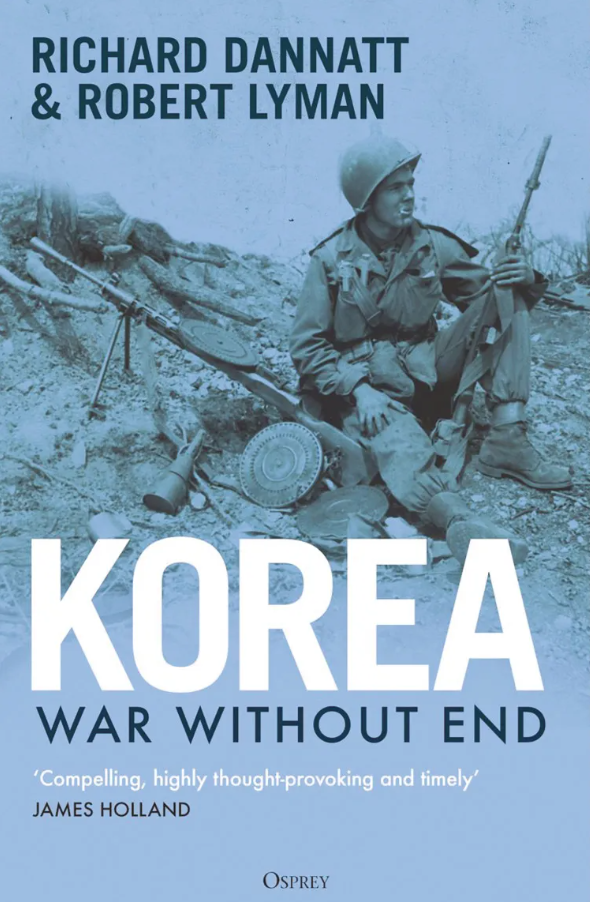
Their book has three premises. First, that the conflict in Korea is a forgotten one that very much deserves retelling. Second, that the war is very topical today partly because it shows how to fight (or not to fight) a conventional war in a nuclear age, and partly because it shows how politics must always take precedence over military ambition. And, third, the authors argue that the war was not a single conflict but was in fact two wars, quite separate but consecutive.
The “first” war is the story of the surprise invasion of South Korea by the North Korean People’s Army (NKPA), or the In Mun Gun, in June 1950 as their leader Kim Il Sung sought to reunite the Korean peninsula under Communist control without having any sense of the political response he would unleash. What followed was a rapid advance towards the southern city of Pusan in a form of Blitzkrieg that had not been seen since World War II.
This early phase covers the establishment of a US-led United Nations force for the first time in its history – only formed because the Soviet Union was boycotting the Security Council at the time. US troops finally slowed the NKPA advance and then, in a brilliant counterstroke masterminded by General Douglas MacArthur, an amphibious troop landing took place behind enemy lines at Inchon. This resulted in a complete reversal in the fortunes of the North Koreans and their retreat to pretty well their starting lines on the 38th Parallel that had divided the peninsula since 1945.
This, the authors argue, is where the war should have ended. The UN had achieved its aim of liberating the south from a Communist takeover. But instead a “second” war unfolded in which General MacArthur, convinced that he was fighting a crusade against world Communism, advanced rapidly through North Korea towards the Yalu River and the border with Communist or (as he called it) “Red” China. For him, victory had to include total defeat of the enemy. In scenes of remarkable hubris, MacArthur was convinced he had the war wrapped up and his troops would be home by Christmas. Instead, he provoked an attack by the Chinese People’s Volunteers on a massive scale, leading to the humiliating rout of US troops and a midwinter retreat back into southern Korea.
This “second” war had as its next phase the final standstill along lines roughly similar to the 38th Parallel and two years of stalemate, before an armistice was signed. The breakdown of the war into two separate conflicts is a fine way of interpreting the remarkable see-saw events of the first year of fighting. Seoul was captured and recaptured four times in nine months. Pyongyang was captured and lost, becoming the only Communist capital to have been taken in battle during the entire Cold War.
In the first stages of the conflict, UN troops, largely Americans who had been sent in from keeping the peace in Japan and who were entirely untrained and unprepared for combat, were thrown back so rapidly that many simply threw down their weapons and retreated. The NKPA, using the tactics the Japanese had used in their invasions of Malaya and Burma, completely outclassed the unprepared US forces.
Then, a few months later, the US-led advance made the Americans feel completely unstoppable as they headed north, only to be turned once more by the Chinese. Again, tactically outclassed and totally unprepared for mountain warfare in midwinter, where conditions were brutal, the UN forces collapsed. It is a remarkable story that very much merits the retelling.
July 2, 2025
The Korean War Week 54 – The War is One Year Old – July 1, 1951
The Korean War by Indy Neidell
Published 1 Jul 2025Over a year has passed since North Korean forces crossed the 38th Parallel and invaded South Korea, and while the war has seen the advantage switch hands time and again, one thing it has not seen is any sort of cease fire or peace negotiations. However, that might change soon, as this week both the Chinese and the Americans indicate their willingness to sit down and talk. South Korean President Syngman Rhee, however, is against any cease fire talks that do not set out to meet a big variety of his demands, demands which which the other warring parties do not see as being in their own best interests.
(more…)
July 1, 2025
Tibet’s Last Stand: The Snow Lion vs. The Dragon – W2W 34
TimeGhost History
Published 29 Jun 2025The fate of Tibet is decided on the roof of the world as Mao’s China sets its sights on Lhasa. This episode traces the dramatic showdown between the snow lion and the dragon — from imperial legacies and British invasions to the last years of de facto Tibetan independence. Discover how realpolitik, Cold War indifference, and the carrot-and-stick tactics of Mao’s regime sealed Tibet’s fate. Watch as the Dalai Lama faces impossible choices, world powers look away, and the dream of independence is crushed beneath the weight of history.
(more…)
June 28, 2025
Breathtaking hypocrisy in the BC Ferries deal to buy ships from China
As you’d imagine, with the coastal geography of British Columbia, there’s a lot of demand for ferry service between the mainland and Vancouver Island (and other less-accessible-by-land locations). BC Ferries runs a fleet of ships to handle this traffic and needed some new ferries to replace older vessels. They decided, in the middle of a trade war, to source the ships from China rather than a Canadian shipyard. And the federal government financially backed the purchase:
So just to recap — because this one’s almost too absurd to believe: BC Ferries cuts a billion-dollar deal with a Chinese state-owned shipyard to build four new ferries. Canada’s Deputy Prime Minister Chrystia Freeland — always quick to perform outrage when the cameras are on — writes a stern letter saying how “dismayed” she is. She scolds British Columbia for daring to do business with a hostile foreign regime that’s literally attacking our critical infrastructure in real time.
And then — wait for it — it turns out her own federal government quietly financed the whole thing.
Yes, really.
According to an explosive report from The Globe and Mail, the Canada Infrastructure Bank — a federal Crown corporation — provided $1 billion in low-interest financing for the very same China shipbuilding deal Freeland claimed to oppose. The contract was signed in March 2025. The outrage? That only came later, when the public found out about it in June.
Freeland’s letter to BC’s Transportation Minister was loaded with warnings. She talked about China’s “unjustified tariffs” and “cybersecurity threats”. She demanded assurances that “no federal funding” would support the purchase. But what she didn’t mention — what she conveniently left out — was that Ottawa had already cut the cheque. The financing was already in place. The loan had been approved. Freeland just didn’t say a word.
And when reporters asked for clarification, what did her office say? Nothing. They passed the buck to another minister. The new Infrastructure Minister, Gregor Robertson, now claims the government had “no influence” in the procurement decision. No influence? You loan a billion dollars to a company and have no opinion on where it goes?
Let’s be clear: This wasn’t some harmless miscommunication. If it wasn’t a cover-up, then it was sheer incompetence — the same brand of incompetence that’s driven our shipyards into obsolescence, our economy into dependence, and our country into managed decline. An entire federal cabinet stood by, watched this unfold, signed the cheque — and then pretended they had nothing to do with it.
And British Columbia’s government? Just as bad. Premier David Eby, the man who pretends to champion “BC First”, claims he was “not happy” with the China deal but says it’s “too late” to change course. Too late? This isn’t an asteroid heading for Earth. It’s a contract. And contracts can be rewritten, canceled, renegotiated — if anyone in charge had the political will to stand up and say, “No, we don’t hand billion-dollar infrastructure projects to hostile regimes”.
But instead, we get excuse after excuse. They say BC Ferries is independent. They say there was no capacity in Canada. They say we had no choice. All the while, Canadian shipyards sit idle, unionized workers are frozen out, and the Canadian taxpayer is stuck subsidizing Chinese shipbuilding — and Chinese espionage.

June 25, 2025
The Korean War Week 53 – Moscow Says ‘End the War!’ – June 24, 1951
The Korean War by Indy Neidell
Published 24 Jun 2025Soviet Ambassador Jacob Malik speaks to the world on UN radio, saying that the Soviet position on Korea is that ceasefire talks should begin among the belligerents. The Americans are thinking of how they can bring in more non-American UN units, even as South Korean President Syngman Rhee denounces the British and Commonwealth forces and says they should go home.
00:00 Intro
00:41 Recap
01:07 Jacob Malik Speaks
02:02 Chinese Change Plans
03:19 10th Corps Advances
05:37 More Non-American UN Units
07:52 Rhee Denounces his Allies
12:17 Summary
12:40 Conclusion
14:15 Call to action
(more…)
June 18, 2025
The Korean War Week 52 – MacArthur Fades, Ceasefire Hopes Rise – June 17 , 1951
The Korean War by Indy Neidell
Published 17 Jun 2025The UN troops continue their advance to the Kansas Line, meeting no resistance at Pynoggang, but heavy resistance beyond it inside the Iron Triangle. 8th Army Commander Jim Van Fleet does not want to advance much beyond where they are now, though, since territory further north would be tougher to defend, should ceasefire talks begin. And Douglas MacArthur continues to tour the states, but to ever smaller crowds.
(more…)
June 17, 2025
BC is buying ferries from China … to spite Trump!
After all the “buy Canadian” blather of the last federal election campaign, it was only a matter of time before the feds or one of the provinces did something astoundingly out-of-step with the mantra. Smart money was always on Quebec being the first (because that often makes sense for internal provincial political reasons), but no, this time it’s British Columbia going a long way out of their way to not buy Canadian for a huge government purchase:
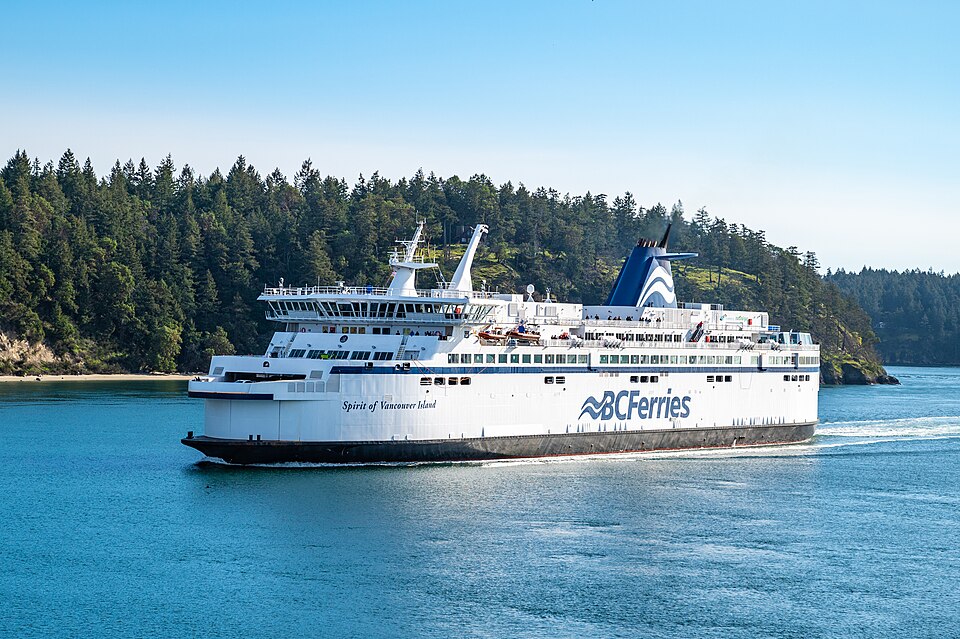
BC Ferries’ MV Spirit Of Vancouver Island between Galiano Island (Bluffs Park) and Mayne Island, en route from Tsawwassen to Swartz Bay, BC on April 6, 2022.
Photo by Gordon Leggett via Wikimedia Commons.
British Columbia’s transportation minister claimed Friday that buying new ferries from European shipyards would have cost roughly $1.2 billion more than buying them from a Chinese government-owned shipyard in Weihai, Shandong province, which is a city roughly the size of Montreal that I had never heard of until this week. China knows how to build cities. They burst into existence from nothing, like popcorn. China also knows how to build ships, and highways, and high-speed rail, and just about anything else you would care to name, better and more efficiently than the Canadian public service can realistically comprehend.
The four ships B.C. Ferries is fixing to replace, of 1960s and 1970s vintage, were built at Seaspan in North Vancouver (which is an active shipyard), at the Victoria Machinery Depot (which is no longer an active shipyard), and at the Burrard Dry Dock (which is also defunct). Canada’s shipyards, for better or worse — certainly for expensive! — are very busy building things for the navy.
B.C. Ferries has plenty of experience with foreign-built vessels. Its current fleet includes ships built in Romania, Poland, Germany and Greece. Other than the Baynes Sound cable ferry on Vancouver Island — which is not especially popular — the Crown corporation’s newest Canadian-built boat went into service in 1997. So “foreign” obviously isn’t the problem.
But China is China, and that’s legitimately another thing. China is not a Canadian ally. They try to screw with our democracy, and most other democracies by the sounds of it. And right now we are in a profoundly protectionist moment: Across the political spectrum, mostly because of President Donald Trump, “buy Canadian” is the only philosophy really on offer.
But does that make sense? We should pay over the odds for ferries … because of Trump? There wasn’t half of all this foofaraw when Marine Atlantic on the East Coast bought its newest ferry from Weihai. Since last year it has safely been shepherding Canadians between Nova Scotia and Newfoundland, without a whisper of controversy in the Rest of Canada.
I don’t quite get the Trump angle, which is perhaps why I’m more interested in Dean Broughton‘s take:
… I’m not just disappointed — I’m furious — about the NDP government’s decision to award the construction of four new BC Ferries vessels to a Chinese state-owned shipyard. This isn’t just outsourcing. It’s betrayal dressed up as budget management.
Back in 2021, the NDP government unveiled a “Made-in-B.C.” shipbuilding strategy with great fanfare. They formed a Shipbuilding Advisory Committee, posed for cameras, and promised to rebuild a long-neglected industry. It was supposed to be a turning point, a real investment in local jobs and industrial capacity.
Now, many of those same politicians have turned their backs on everything they claimed to support. Not only did they ship the contracts overseas, but, according to Eric McNeely, president of the BC Ferry and Marine Workers’ Union, they didn’t even give B.C. shipyards a fair shot. The procurement process was so rushed and restrictive that no local yard could realistically compete. They didn’t lose the bid — they were boxed out.
That’s not fiscal prudence. That’s political cowardice.
The hypocrisy is staggering. This is the same government that talks endlessly about investing in clean industry and supporting working families, and they just handed a massive public contract to a country with a well-documented record of environmental abuses and human rights violations.
They talk about reconciliation and sustainable development—and then funnel hundreds of millions to an authoritarian regime.
Worse still, they did this knowing full well that B.C.’s industrial base is already in decline.
We have so little left beyond resource extraction. Shipbuilding could have been part of our economic renewal. Instead, it’s another casualty of government optics and empty promises.
I remember my father’s outrage in 1990 when the federal government cancelled the Polar 8 icebreaker — a Canadian-built vessel meant to defend our Arctic sovereignty. That decision was dismissed as a “cost-saving measure” and today our claim to the North has never been weaker.
The BC Ferries decision reeks of the same short-sighted logic.
June 11, 2025
The Korean War Week 51 – China: Acheson’s Cold Calculus – June 10 , 1951
The Korean War by Indy Neidell
Published 10 Jun 2025The UN forces Operation Piledriver gets bogged down by the weather and the terrain. 8th Army Commander Jim Van Fleet says that though the enemy has been hurt, he still has another big offensive left in him by summer’s end, but there are murmurs and hints that some of the forces fighting this war are ready to talk about an armistice. And in the Senate, Dean Acheson spends five solid days talking about the US position on China.
Chapters
00:00 Hook
01:00 Recap
01:28 Operation Piledriver
04:04 ROK 6th Division
07:18 Van Fleet’s Appraisal
08:18 Armistice Overtures?
17:00 Summary
17:15 Conclusion
(more…)
June 4, 2025
The Korean War Week 50 – Trapped in the Triangle: Korea’s Killing Zone – June 3, 1951
The Korean War by Indy Neidell
Published 3 Jun 2025The MacArthur Senate Hearings continue this week, with US Secretary of State Dean Acheson now in the hot seat. He takes a rather confusing barrage of questions, and yet manages to signal to the world at large, i.e. the Chinese, that the US is open to negotiations to end the war. The war still continues in the field, of course, with the UN forces’ Operation Piledriver in action, driving into the “Iron Triangle” and trying to trap as much of the enemy as possible.
Chapters
00:00 Intro
01:07 Recap
01:35 Acheson Speaks
05:44 Operation Piledriver
09:10 Attacks Begin
10:53 A Unifying JCS Directive
16:54 Summary
(more…)
June 2, 2025
The progressive case for unlimited immigration
Theophilus Chilton takes on the progressive arguments for bringing in as many “high quality” immigrants as humanly possible from his own professional background:
One of the constants that you can count on in any debate about the value of immigration (of every sort) is the inevitable assertion about the NECESSITY of immigration. Immigrants POWER AMERICA. Without them, NOTHING WOULD HAPPEN! They are ELITE HUMAN CAPITAL without which the White American chuds who did things like build the atom bomb and otherwise created modern technological civilisation would barely be able to keep the lights on in their single-wides. It’s not just that immigrants want a new life or might be useful — they are an absolutely necessity and the ones coming here are the cream of the world’s crop.
As a result, the recent move by Marco Rubio and the State Department to revoke visas from Chinese students in American universities (especially those associated with the CCP or who are in positions to commit especially damaging industrial espionage) will certainly not be well-received by this crowd. For example, witness Alex Nowrasteh, who’s whole schtick is to burble on about “meritocracy” and whine about “affirmative action for White Americans” while filling a useless sinecure at the Cato Institute that he got by being the token immigrant. He is appalled that we’d act in our own national interest rather than in the interests of a bunch of random foreigners.
Immigration man have big sad
Many people who know me on X already know this, but most readers here may not. Before I made a radical life-changing vocational choice a few years ago, I used to be a scientist in Big Pharma. For a little over two decades, I worked in the biotech/biopharma industry, covering a wide range of drug development stages and product types. I’ve developed vaccines (which is why I was skeptical about the Covid vaxx from the very beginning). I’ve developed small molecule drugs. I helped to bring to market several of the pharmaceuticals that millions take regularly and which you see advertised on television. I’ve done everything from bench scale analytical work to protein purification on 5000-liter batches used in support of human clinical trials. I’m proficient in literally dozens of different analytical techniques. Before that, in both undergraduate and graduate school, I specialised in synthetic organic small molecule development across a number of different subspecialties. And I’m good at all of this.
One other thing that I did throughout was work side-by-side with, and later manage, LOTS of visa holders and immigrants, especially from “tech heavy” countries like India and China, the stereotypical “H1-Bers”. As a result, I consider myself to be a pretty good judge of the value which visa holders bring to tech fields.
My judgment is, and has been for decades, that their value is minimal and it certainly does not live up to the hype. Indeed, one of the constants that I observed among most Indian, Chinese, and other visa holders was that they did not really, truly understand the science that was involved with the products being developed and the techniques being used to develop and test them. Most of these folks were the living embodiment of cramming to pass the test. When the test methods and the SOPs being employed were straightforward, these folks were great. They had a robot-like efficiency that comes with repetitively doing the same thing over and over and over again. Unfortunately, for anything requiring innovative or independent thinking, they’d be totally lost. If results from a test deviated from expectations and required some commonsense interpretation? That’s where the wheels came off. I mean, there was little to no capacity to deal with anything that wasn’t completely textbook.
Even basic scientific sense was often missing. At one job, there was an Indian guy who would takes dumps in the bathroom and then walk straight out back to his manufacturing suite in the cell line division without even washing his hands. I know this because I observed it for myself several times. I mean, even if you don’t care about getting fecal coliform bacteria all over door handles and whatnot, at least don’t carry them back into the suite where you’re helping to grow batches of genetically engineered E. coli. I assume he was properly gowned before going in, but still, there’s just that basic lack of sense there.
And then there are the ethics (or lack thereof) displayed by many visa holders (especially Chinese and Middle Eastern). Data manipulation, tweaked results, etc. etc. These tend to occur because both of those groups are under intense social pressure within their own cultures to “get the right results” rather than just dealing with the results you get. The “tiger mom” mentality carries over into the workplace. There is a reason for why these two groups are disproportionately overrepresented on the FDA’s debarment list. Indians can be subject to serious lapses in integrity as well, though theirs tend to revolve more around cutting corners and mistreating underlings, as I illustrated in a thread on X about three years ago where I recounted my time working for an Indian-owned company.
Over the years, my observations have been substantiated and reiterated by any number of people in various tech-heavy industry to whom I’ve related them. Whether it’s pharma or IT or medicine or metallurgy or whatever else, the familiar story is told. It’s really, really difficult to reconcile this mass of lived experience with the theoretical assertions made by people like Nowrasteh that immigrants are this valuable resource that we absolutely need to be or remain competitive in world markets.
In effect, the goal with this type of white-collar mass immigration is to “roboticise” tech fields which can’t be given over to AI or actual robotics just yet. The formula is to import masses of workers who can simply follow a script and save companies money on labour costs. If you think about it, this is really a low IQ, high time preference approach by corporations whereby they sacrifice real innovativeness and future competitiveness for short-term savings. I’d argue that the entry of H1-B and other visa holders in large numbers into American tech industries which accelerated around the late 2000s-early 2010s has actually led to a slowdown in real innovation. We may have tons of new apps for our phones, but fewer truly groundbreaking advances in tech across the board.
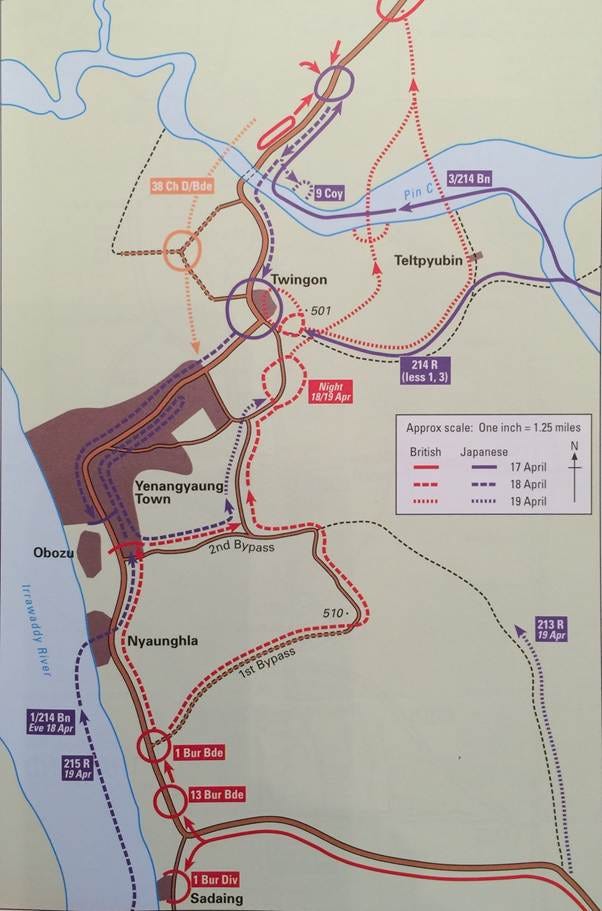
Fighting at Yenangyaung, 17-19 April 1942
Dr. Robert Lyman on the battle at Yenangyaung between 17-19 April 1942 early in the Burma campaign:
… the Yenangyaung battle is a fascinating one, with its own small degree of controversy, I decided to lay it out in this post. A mystery of the battle is the differing accounts of the Chinese attacks on the 19th April. In the British accounts (including Bill Slim’s in Defeat into Victory) the Chinese are blamed for failing to attack in the morning as they had promised, adding further jeopardy to the fate of the encircled 1st Burma Division. But was this true? The Japanese, Chinese and American accounts differ, so I thought I’d lay out the story to allow you, dear reader, to come to your own conclusion.
The fabulous map of Yenangyaung produced by the late Ian Lyall Grant.
The scrap at Yenangyaung was the final Corps-sized battle before the order to evacuate Burma Corps was given in early May. The Japanese had pushed out of Rangoon in mid-March, driving up the Irrawaddy on the left and against Toungoo on the right. Allied plans for the defence of Burma were inadequate, both Chinese (on the right) and Slim’s Burcorps (on the left) effectively fighting separate battles. Attempts by General Harold Alexander, the Army Commander, to control the battle and constrain the advancing Japanese ultimately came to naught. Alexander, Slim and Lieutenant General Joe Stilwell, nominally commanding the Chinese 5th Army, tried every trick in the tactical rule book to bring a halt to the relentless Japanese advance, and to destroy them in battle. After a month of fighting in which the Chinese were pushed out of Toungoo, the British lost control of Prome and an attempt to consolidate a defensive line across the country failed, the Japanese moved up the Irrawaddy in an attempt to turn the British flank, breaking in at the oilfield town of Yenangyaung on 17 April. At the time Slim’s Burma Corps was attempting to withdraw to the north from Allamyo. The Japanese infiltration into Yenangyaung cut the British in half. The 1st Burma Division was now cut off in Yenangyaung. The battle by the already weakened division (amounting to probably no more than 4,000 troops) into the Yenangyaung pocket over the period 17 and 19 April proved to be the severest trial yet faced by British troops in the short Burma campaign, the pressure applied by the Japanese exacerbated by the intense heat and the lack of water.
It was critical that Slim defeated this Japanese infiltration, rescue the 1st Burma Division from encirclement and retain the integrity of his Corps. If Yenangyaung were lost the Japanese would be free to sweep north to threaten Mandalay. It was crucial therefore that the divisional commander – Major General Bruce Scott – held on for as long as he could. But Slim had no reserve. The only hope of relief lay in assistance from the Chinese far to his right. He concluded that if he could engineer a attack into the pocket by the Chinese, across the Pin Chaung, combined with a breakout attack by 1st Burma Division, they might have a chance of escape. Nothing else looked likely to succeed.
When asked, Stilwell agreed to Alexander’s request for help to be provided to Slim, and gave him Lieutenant General Sun Lijen’s 38th Division – responsible for the defence of Mandalay – for the task. Chiang Kai-shek had given Sun responsibility for defending Mandalay. At midnight on 16 April Sun received an order from General Lo Cho-yin, “to dispatch his 113th Regiment to Kyaukpadaung, there to be commanded by the British General Slim …” Sun’s friend, Dr Ho Yungchi, recorded that by 3 a.m. he had arrived at Lo’s HQ at Pyawbe to discuss the order. Lo explained that the British were in serious trouble “in the oil town of Yenangyaung and had sent repeated requests for help”. By 6.30 a.m. it was agreed that Sun would personally take command of the 113th Regiment, while the two remaining regiments stayed to defend Mandalay. Sun and 1,121 men of 113th Regiment (commanded by Colonel Liu Fang-wu) arrived at Kyaukpadaung on the morning of 17 April.
Slim recalled: “The situation was not encouraging, and I was greatly relieved to hear that 113 Regiment of the Chinese 38th Division was just arriving at Kyaukpadaung. I dashed off in my jeep to meet their commander and give him his orders … this was the first time I had had Chinese troops under me … I got to like all, or almost all, my Chinese very much. They are a likeable people and as soldiers they have in a high degree the fighting man’s basic qualities – courage, endurance, cheerfulness, and an eye for country.”1
At Yenangyaung, Slim’s plan was for Sun’s 38th Division to attack from the north on the morning of 18th April while the 1st Burma Division, within the pocket, fought its way out. As Slim and Sun Lijen talked, discussing the details of the attack planned for the following morning Slim decided that he would place the Stuart tanks of the 7th Armoured Brigade directly under Sun’s command. It was only a move a man confident in the capabilities of his allies could make. Slim commented that “I was impressed by Sun and it was essential to gain his confidence. His division had no artillery or tanks of its own, and I was therefore arranging that all the artillery we had this side of the Pin Chaung and all available tanks should support his attack.” The commander of the British armoured brigade – Brigadier John Anstice – accepted this arrangement and according to Slim “he and Sun got on famously together”. What’s more, the soldiers worked well together too, Slim recording that the “gunners and tank crews, as is the way of British soldiers, soon got on good terms with their new comrades, and, in spite of language difficulties of an extreme kind, co-operation was, I was assured by both sides, not only close but mostly friendly.”2 Accordingly, at 6.15 a.m. on 18 April, Major Mark Rudkin of 2nd Royal Tank Regiment (2RTR) reported as instructed by Anstice to 38th Division HQ:
There was little activity except for the cooking of breakfast and it seemed most unlikely that the attack could start on time. I asked the British liaison officer with the Chinese what was happening and he informed me that as the Chinese realized that they would not be ready to attack at 0630 hours, they had put their watches back one hour, so that officially they were still attacking at 0630 though the time would in reality be 0730. They had, therefore, not lost “face” by being late.
The plan was that a troop of tanks would follow the leading troops of the leading Chinese battalion and give what support it could. Another troop was to follow the leading infantry battalion and assist the leading troop if required. The tanks would be almost entirely road bound owing to the going off the road.
At 0730 the assaulting Chinese moved forward off the ridge on a front of about four hundred yards, the leading troop keeping very close behind on the road. On foot near the tanks was a Chinese interpreter who carried out liaison between the tanks and infantry.
After advancing about half a mile the leading tank was hit by a Japanese 75-mm gun situated on the road just north of the Pin Chaung which was firing straight up 300 yards of road. The tank was disabled but there were no casualties.
The Chinese advance continued and by afternoon had almost reached the line of the ford on the Pin Chaung which was still held by the enemy. The Chinese had had heavy casualties, especially amongst officers, as it was the custom for Chinese officers to lead, whatever their rank. It was finally decided to hold positions about half a mile north of the crossing and continue the attack next day.3
With the first attack a failure, the Japanese retained their grip on both the ford and the village of Twingon. The situation for the surrounded remnants of the 1st Burma Division was desperate; the Japanese close to achieving a complete victory. Slim and Sun then worked through a plan for another attempt to be made the following morning, 19th April. This day also began badly, however. The Chinese attack was scheduled to begin at 7 a.m. British accounts subsequently recorded that a Chinese attack did not materialise at this time. Slim subsequently recorded in Defeat into Victory that the failure to attack must have been a function of the administrative difficulties faced by the Chinese. He wrote that with the Chinese “lack of signalling equipment, of means of evacuating wounded and of replenishing ammunition, and their paucity of trained junior leaders it was not surprising that to sort themselves out, reform, and start a fresh attack took time”.4 Slim was invariably impressed with what he saw of the Chinese soldier in action, but considered their support and command functions to be shockingly poor and a source of constant frustration to themselves, and to all who had occasion to operate with them.
Slim, and most other British published accounts, including the Indian and British Official Histories, record that the attack finally went in at 3 p.m., when Colonel Liu’s 113th Regiment successfully captured the ford and penetrated into Yenangyaung.5 “When the Chinese did attack they went in splendidly” wrote Slim in admiration. “They were thrilled at the tank and artillery support they were getting and showed real dash. They took Twingon, rescuing some two hundred of our prisoners and wounded. Next day, 20th April, the 38th Division attacked again and with tanks penetrated into Yenangyaung itself, repulsing a Japanese counter-attack. The fighting was severe and the Chinese acquitted themselves well, inflicting heavy losses, vouched for by our own officers.”
1. Slim, Defeat into Victory (1956), p. 63.
2. Ibid., p. 65.
3. Bryan Perrett, Tank Tracks to Rangoon: The Story of British Armour in Burma (London: Robert Hale, 1978)
4. Slim, op. cit., p. 70.
5. Bisheshwar Prasad (ed,) The Retreat from Burma 1941 – 42 (Calcutta, Combined Inter-Service Historical Section, 1954), p. 296.
May 28, 2025
The Korean War Week 49 – Race to Trap 70,000 Soldiers – May 27, 1951
The Korean War by Indy Neidell
Published 27 May 2025The Chinese Spring Offensive continues this week, but comes to its end — it has cost the Communist forces tens of thousands of men, but even as it ends, the UN counteroffensive begins — and costs them tens of thousands more! And in Washington the MacArthur hearings continue, and it is obvious by now to all and sundry that General Douglas MacArthur had been very much out of line and President Truman was within his authority for firing him.
Chapters
00:00 Intro
00:41 Recap
01:12 More PVA and KPA Attacks
03:41 The Counterattack Begins
07:14 Advances Everywhere
13:07 NSC 48/5
17:45 End of the Hearings?
19:05 Summary
19:18 Conclusion
(more…)
May 23, 2025
Yasukuni-jinja, Japan’s most controversial historical site
Nigel Biggar on the Yasukuni-jinja in the Imperial Gardens in Toyko, where the Japanese shrine to their war dead also celebrates fourteen convicted WW2 war criminals:
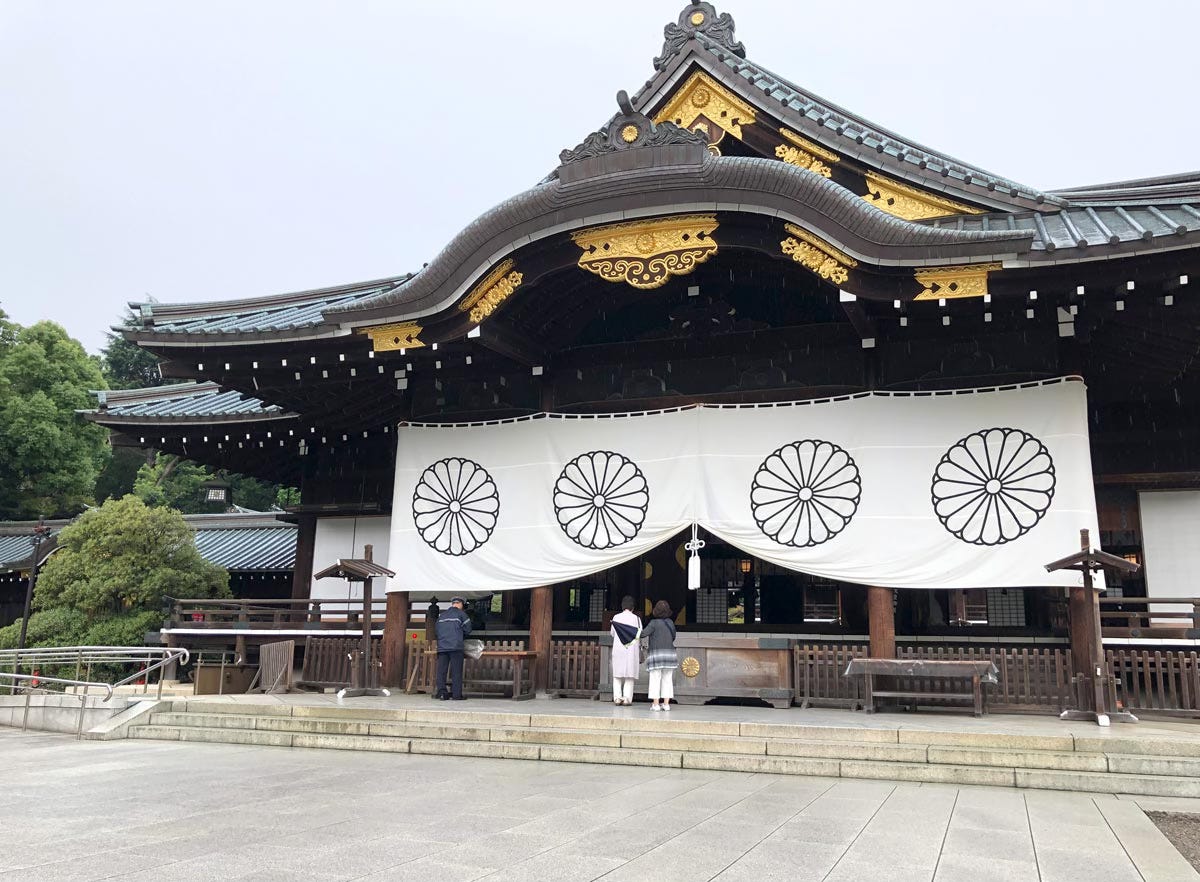
The Yasukuni Shrine in the Imperial Gardens, Tokyo.
Photo by Pierre Hazan
If ever you find yourself in the centre of Tokyo, make your way to the north-west corner of the Imperial Gardens, and turn left. A few minutes will bring you to the Yasukuni-jinja, Japan’s most controversial site. This is the national shrine to the war-dead, whose two and half million resident “glorious souls” include fourteen Class A war criminals.
A hundred yards to the right of the main shrine stands a museum, the Yushukan. Upon entering it, a visitor finds himself immediately face to face with a locomotive.
Now, when an Anglo-Saxon puts together Japan, Second World War, and locomotive, he arrives at one thing only: the “Burma Railway”. This is the railway that was hacked through the Burmese jungle partly by Allied prisoners-of-war, who were treated as slave labour and perished in their thousands. Over 12,000 Westerners died — about one in five — alongside perhaps 90,000 Asians.
So our Anglo-Saxon visitor beholds the locomotive with a mixture of disbelief, rising horror, and curiosity. He approaches the machine, looking for an explanatory text. Finding it, he learns that this locomotive is one of ninety that ran along the Burma Railway. He also learns the name of the military unit responsible for the railway’s construction. But of the Allied prisoners, the slave-labour, and the number of their deaths he learns nothing at all.
The Burma Railway wasn’t Auschwitz, either in genocidal intent or in murderous scale. But it was similar in its cruel contempt for human life. So the experience of confronting this Tokyo locomotive is analogous to stepping into a museum in Berlin and being confronted by one of the trains that shipped Jews to Auschwitz, and then reading an explanation that omits any mention of its cargo or the nature of its destination. If there were such a museum in Berlin, I’d have found it.
When our Anglo-Saxon ventures deeper into the Yushukan, he eventually discovers the exhibition on the 1930s and World War Two in the Far East. And here he learns that Japan’s imperial expansion was in fact a war of liberation, waged on behalf of subjugated Asian peoples, against Western colonial domination. And he learns that, even though Japan lost the war militarily, she won it politically, since the example of her early victories over the French in Vietnam, the Americans at Pearl Harbor, and the British at Singapore helped to inspire anti-colonial movements worldwide and so succeeded in ridding the world of European empires.
He also learns that what is known outside Japan as “the Rape of Nanking” (1937-8) is referred to demurely in the museum as “the Chinese incident”. And that whereas the “Rape of Nanking” is reckoned to have involved the indiscriminate massacre by Japanese troops of about 300,000 Chinese civilians, “the Chinese incident” only involved the severe treatment of Chinese troops who had violated the laws of war by disguising themselves in civilian clothes.


