A much more interesting scenario happens when seemingly legitimate, competent rulers find themselves at the helm during a major crisis. Marcus Aurelius has an overinflated rep among the laity, but he was decent at his job … until he wasn’t, thanks to things like the Antonine Plague. This, and a large barbarian invasion, brought all the Empire’s long-term structural problems into sharp focus. Yeah, Marcus is overrated, but it’s no knock on him that he didn’t fix these problems, or cure the plague; those were probably beyond the skill of even the most extraordinary man. His reaction, though, and the reaction of his subjects, is instructive.
Marcus faced no rebellion; no one sought to usurp him. For one thing, Marcus won his wars — no mean feat, considering the plague etc. But for another, it’s hard to blame Marcus for the plague, the weakness of the army staffing system, the structural weakness of the currency. And that’s where it gets interesting, because even though you can’t consciously blame Marcus for this, all those things create excessive anxiety among the people, and that anxiety has to go somewhere …
… so they persecuted Christians.
“The extent to which Marcus Aurelius himself directed, encouraged, or was aware of these persecutions is unclear and much debated by historians,” Wiki informs us, but it doesn’t matter if he had a hand in them or not. The important thing is that the Christians were the perfect target for free-floating anxiety, since plagues etc. were supernatural events and the Christians were ostentatiously opposed to the official belief system. Perhaps Marcus didn’t lose the Mandate of Heaven; perhaps it was stripped from him. Burn the unbelievers, and maybe the world gets back into focus.
This is the pattern whenever the Powers That Be find themselves trying to ride out a massive, structural sea-change — one where it’s obvious to the stressed-out public that something HAS to change, but a mere change in leadership won’t cut it. You’ll have to trust me on this, I guess, unless you’re up on your Chinese history, but almost all their “rebellions” had this mystical character — widespread banditry was assumed, in itself, to be a sign that the Emperor had lost the Mandate of Heaven, and the bandit groups usually ended up looking like the White Lotus sect, who caused endless trouble for something like 300 years. And then there’s the Taiping Rebellion — led by Jesus Christ’s brother! — and by now I’m sure y’all take my point. You can’t really blame the Qing for everyone’s opium addiction, or getting stomped by the British, but you’ve got to blame someone – hence the mystical character of pretty much all Chinese rebellions, certainly including the Maoist.
Severian, “Witch Trial Syndrome”, Rotten Chestnuts, 2021-01-27.
May 3, 2021
QotD: Marcus Aurelius and the “Mandate of Heaven”
May 2, 2021
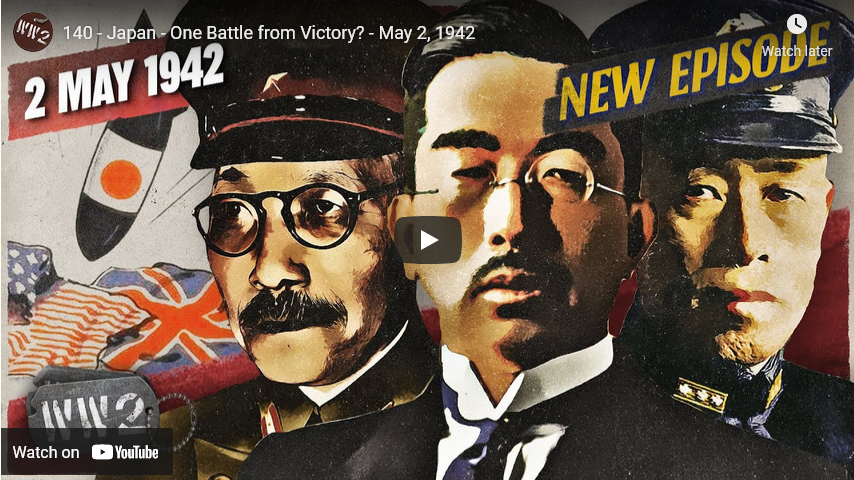
Japan – One Battle from Victory? – 140 – May 2, 1942
World War Two
Published 1 May 2021Now Burma and control of the Burma Road have fallen to the Japanese. Can nothing stop them? The Allies are thinking about maybe using the Solomon Islands as a base to build to try and fight back, but to do that they’ll need control of the Coral Sea, but both sides are sending warships there since the Japanese plan to take Port Moresby. The Allies are aware of this, however, since they have the advantage of being able to read a substantial part of Japan’s radio traffic. It is a week of foreshadowing not just there, but also as the Allies send ships to take Madagascar from the Vichy French and the Soviets prepare to launch an offensive in the south of the Eastern Front.
Join us on Patreon: https://www.patreon.com/TimeGhostHistory
Or join The TimeGhost Army directly at: https://timeghost.tvFollow WW2 day by day on Instagram @ww2_day_by_day – https://www.instagram.com/ww2_day_by_day
Between 2 Wars: https://www.youtube.com/playlist?list…
Source list: http://bit.ly/WW2sourcesWritten and Hosted by: Indy Neidell
Director: Astrid Deinhard
Producers: Astrid Deinhard and Spartacus Olsson
Executive Producers: Astrid Deinhard, Indy Neidell, Spartacus Olsson, Bodo Rittenauer
Creative Producer: Maria Kyhle
Post-Production Director: Wieke Kapteijns
Research by: Indy Neidell
Edited by: Iryna Dulka
Sound design: Marek Kamiński
Map animations: Eastory (https://www.youtube.com/c/eastory)Colorizations by:
– Daniel Weiss
– Norman Stewart – https://oldtimesincolor.blogspot.com/Sources:
– IWM JAR 1240, A 9483Soundtracks from the Epidemic Sound:
– Rannar Sillard – “Easy Target”
– Jo Wandrini – “Dragon King”
– Fabien Tell – “Other Sides of Glory”
– Brightarm Orchestra – “On the Edge of Change”
– Edward Karl Hanson – “Spellbound”
– Johan Hynynen – “Dark Beginning”
– Rannar Sillard – “Split Decision”
– Dream Cave – “The Beast”Archive by Screenocean/Reuters https://www.screenocean.com.
A TimeGhost chronological documentary produced by OnLion Entertainment GmbH.
April 23, 2021
Taiwan Under Occupation, Axis Solidarity, and U-Boats in the Med – WW2 – OOTF 022
World War Two
Published 22 Apr 2021Ever wonder what life was like in Taiwan during the Second World War? Or if German U-Boats were active in the Mediterranean? You can find out the answers in this episode of Out of the Foxholes!
Join us on Patreon: https://www.patreon.com/TimeGhostHistory
Or join The TimeGhost Army directly at: https://timeghost.tvFollow WW2 day by day on Instagram @ww2_day_by_day – https://www.instagram.com/ww2_day_by_day
Between 2 Wars: https://www.youtube.com/playlist?list…
Source list: http://bit.ly/WW2sourcesHosted by: Indy Neidell
Written by: Ian Sowden, Lewis Braithwaite, Timothy Smith
Director: Astrid Deinhard
Producers: Astrid Deinhard and Spartacus Olsson
Executive Producers: Astrid Deinhard, Indy Neidell, Spartacus Olsson, Bodo Rittenauer
Creative Producer: Maria Kyhle
Post-Production Director: Wieke Kapteijns
Research by: Ian Sowden, Lewis Braithwaite, Timothy Smith
Edited by: Miki Cackowski
Sound design: Marek Kamiński
Map animations: Miki Cackowski and Eastory (https://www.youtube.com/c/eastory)Sources:
David Rumsey Map Collection, David Rumsey Map Center, Stanford Libraries
Chapman University Digital CommonsSoundtracks from the Epidemic Sound:
Yi Nantiro – “Watchman”
Max Anson – “Ancient Saga”
Skrya – “First Responders”Archive by Screenocean/Reuters https://www.screenocean.com.
A TimeGhost chronological documentary produced by OnLion Entertainment GmbH.

April 21, 2021
“The error in Western thinking was to view CCP officials as civilised counterparts”
In Quillette, Aaron Sarin traces the last twenty years of successful diplomacy, industrial espionage, and ever-increasing CCP media influence in China’s relationships with western nations:
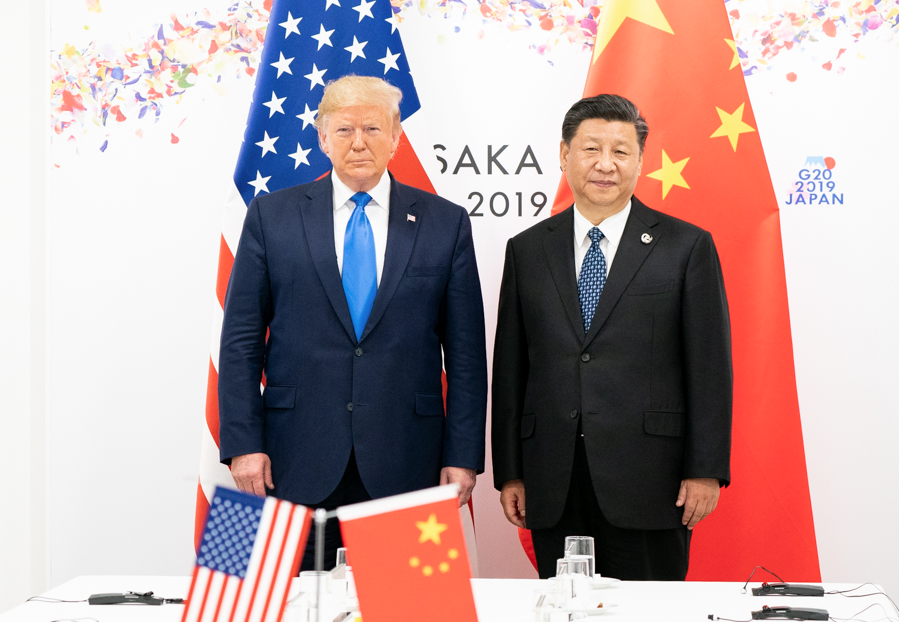
President Donald Trump and PRC President Xi Jinping at the G20 Japan Summit in Osaka, 29 June, 2019.
Cropped from an official White House photo by Shealah Craighead via Wikimedia Commons.
By the end of 2020, China’s relationships with the US and Australia had reached their lowest point in living memory, while Sino-British relations weren’t far behind. Yet the European Commission chose this moment to sign a major new investment treaty with Beijing. The deal appeared to have been rushed to completion just before Joe Biden’s inauguration, as if to avoid the fuss that a new American administration would be sure to make. Indeed, incoming National Security Adviser Jake Sullivan felt sore enough to send a pointed tweet: “The Biden-Harris administration would welcome early consultations with our European partners on our common concerns about China’s economic practices.”
The truth is that Brussels has been drifting further and further from Washington ever since the election of Donald Trump, and there are few signs the winds will change now that Biden has taken office. In 2017, Merkel said that Europe could no longer rely on America. By 2020, it seemed truer to say that Europe would rely on China from now on. Indeed, diplomats like Emmanuel Bonne (Macron’s foreign policy adviser) have been most enthusiastic about “France’s readiness to step up strategic communication with China.” In his gushing deference, Bonne can sometimes sound like a man with a gun to his head: “France respects China’s sovereignty, appreciates the sensitivity of Hong Kong-related issues, and has no intention of interfering in Hong Kong affairs.” There are times when the language of neutrality reveals with painful clarity that a side has been chosen.
Brussels officials talk of “strategic autonomy,” of course. They hope to carve out a path to self-sufficiency while at the same time enjoying mutually beneficial relationships with partners like Beijing. The problem is that mutually beneficial relationships are not possible with predators. As successive American administrations have found, those who maintain close connections with the Communist Party will eventually suffer large-scale intellectual property theft and the loss of millions of manufacturing jobs.
Brussels can hardly expect that Beijing will respect this new agreement. Recall the various promises that were made regarding Hong Kong: all of them were broken. Party officials may have signed a legal document recognising the city’s special administrative status, but this was purely for show. In 2017, having apparently now ascended to a position above the law, they declared that the document had “no practical significance.” Remember how Barack Obama was given firm assurance that Beijing would never militarize the South China Sea? There were handshakes and smiles all round, and then Beijing proceeded to militarize the South China Sea.
Indeed, some of the commitments included as part of the new deal echo those made 20 years ago, when China first joined the World Trade Organisation. It was agreed in 2001 that prices in every sector would be determined by market forces; that state-owned enterprises would begin operating free of state influence; that international norms regarding intellectual property would be respected; and so on. After two decades, we can see that the Communist Party has kept not one of its promises.
The error in Western thinking was to view CCP officials as civilised counterparts. We failed to see that we were dealing with a pack of thugs and grifters — men for whom the rule of law is neither reality nor ideal, but façade. This lesson has now been learned in some quarters, but clearly not in the upper echelons of the European Union. This new investment deal even includes a reference to “commitments on forced labour,” which is little short of an insult when we consider the hundreds of thousands of Uyghurs who have been made to toil all day till dusk in the cotton fields of Xinjiang. The truth is that the EU has been fooled. There will be no “win-win situation.” Not when dealing with the Communist Party, which has always viewed geopolitics as a zero-sum game. In the words of Bilahari Kausikan, once Singapore’s top diplomat, “only the irredeemably corrupt or the terminally naïve take seriously Beijing’s rhetoric about a ‘community of common destiny.'”
April 18, 2021
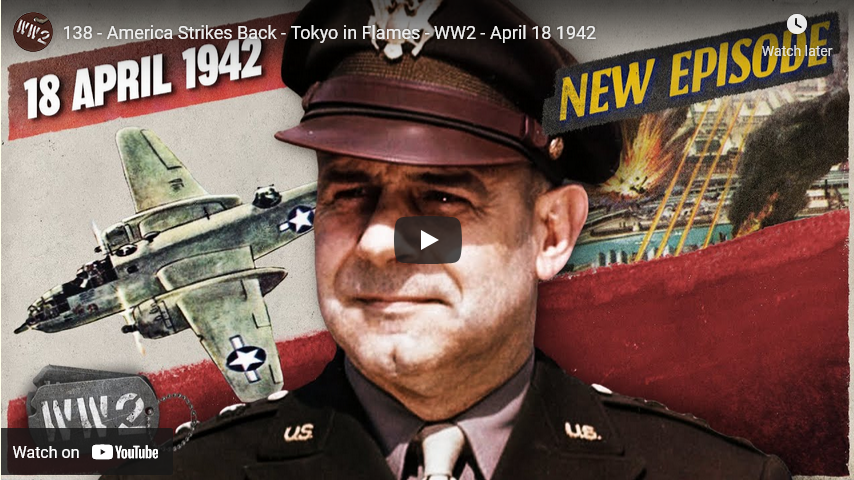
America Strikes Back – Tokyo in Flames – WW2 -138 – April 18 1942
World War Two
Published 17 Apr 2021The Doolittle Raid is just a little bombing raid over Tokyo that doesn’t do that much physical damage. It does, however, have big repercussions — partly in terms of future offensive plans for the Japanese fleet, and partly in terms of the thousands of Chinese lives taken in reprisals for allowing the US bombers to land in China. There is small scattered action on the Eastern Front, more Japanese advances in Burma, and a French VIP escapes captivity in Germany and heads for Switzerland and freedom.
Join us on Patreon: https://www.patreon.com/TimeGhostHistory
Or join The TimeGhost Army directly at: https://timeghost.tvFollow WW2 day by day on Instagram @ww2_day_by_day – https://www.instagram.com/ww2_day_by_day
Between 2 Wars: https://www.youtube.com/playlist?list…
Source list: http://bit.ly/WW2sourcesWritten and Hosted by: Indy Neidell
Director: Astrid Deinhard
Producers: Astrid Deinhard and Spartacus Olsson
Executive Producers: Astrid Deinhard, Indy Neidell, Spartacus Olsson, Bodo Rittenauer
Creative Producer: Maria Kyhle
Post-Production Director: Wieke Kapteijns
Research by: Indy Neidell
Edited by: Iryna Dulka
Sound design: Marek Kamiński
Map animations: Eastory (https://www.youtube.com/c/eastory)Colorizations by:
– Mikołaj Uchman
– Norman Stewart – https://oldtimesincolor.blogspot.com/Sources:
– Stan S. Katz
– IWM: IND 3595
– Image of ‘The Fortress of Königstein from the North-West’ by Bernardo Bellotto, © National Gallery of Art, WashingtonSoundtracks from the Epidemic Sound:
– Rannar Sillard – “Easy Target”
– Howard Harper-Barnes – “London”
– Jo Wandrini – “Dragon King”
– Dream Cave – “The Beast”
– Reynard Seidel – “Rush of Blood”
– Wendel Scherer – “Out the Window”
– Brightarm Orchestra – “On the Edge of Change”
– Gunnar Johnsen – “Not Safe Yet”
– Johan Hynynen – “Dark Beginning”
– Philip Ayers – “Trapped in a Maze”Archive by Screenocean/Reuters https://www.screenocean.com.
A TimeGhost chronological documentary produced by OnLion Entertainment GmbH.
April 4, 2021
The Carpet Bombing of Germany begins – WW2 – 136 – April 3, 1942
World War Two
Published 3 Apr 2021Britain’s campaign to firebomb the old towns of Germany where civilians reside begins in earnest this week. The British also destroy the port at St. Nazaire in commando action. In the Indian Ocean, however, they are avoiding contact with the Japanese, even while on land the Japanese advance in both Burma and New Guinea.
Check out Indy’s Tie Barn to get your own tie right here: https://www.youtube.com/c/IndysTieBar…
Join us on Patreon: https://www.patreon.com/TimeGhostHistory
Or join The TimeGhost Army directly at: https://timeghost.tvFollow WW2 day by day on Instagram @ww2_day_by_day – https://www.instagram.com/ww2_day_by_day
Between 2 Wars: https://www.youtube.com/playlist?list…
Source list: http://bit.ly/WW2sourcesWritten and Hosted by: Indy Neidell
Director: Astrid Deinhard
Producers: Astrid Deinhard and Spartacus Olsson
Executive Producers: Astrid Deinhard, Indy Neidell, Spartacus Olsson, Bodo Rittenauer
Creative Producer: Maria Kyhle
Post-Production Director: Wieke Kapteijns
Research by: Indy Neidell
Edited by: Iryna Dulka
Sound design: Marek Kamiński
Map animations: Eastory (https://www.youtube.com/c/eastory)Colorizations by:
– Daniel Weiss
– Carlos Ortega Pereira, BlauColorizations – https://www.instagram.com/blaucolorizations
– Election1960 from Wiki CommonsSources:
– Bundesarchiv – 101II-MW-3722-03
– IWM C 2351, A 11787, H_018753_1, R 1827Soundtracks from the Epidemic Sound:
– Rannar Sillard – “Easy Target”
– Edward Karl Hanson – “Spellbound”
– Phoenix Tail – “At the Front”
– Jo Wandrini – “Dragon King”
– Phoenix Tail – “Last Minute Reaction”
– Craft Case – “Secret Cargo”
– Fabien Tell – “Last Point of Safe Return”
– Howard Harper-Barnes – “Underlying Truth”
– Flouw – “A Far Cry”
– Fabien Tell – “Break Free”
– Wendel Scherer – “Time to Face Them”Archive by Screenocean/Reuters https://www.screenocean.com.
A TimeGhost chronological documentary produced by OnLion Entertainment GmbH.

March 30, 2021
Leaky labs and the WHO’s whitewash efforts
In the latest NP Platformed newsletter, Colby Cosh outlines some of the historic “diseases escaping from the lab” events that certainly allow us to be … dubious about the WHO maintaining the line that the Wuhan Coronavirus was “unlikely” to have escaped from the biological lab in Wuhan:
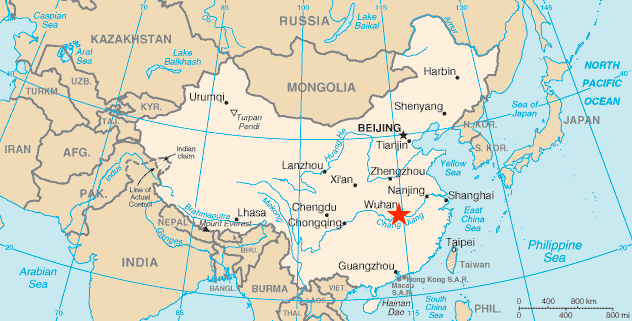
The original SARS virus, which terrorized Canada in 2003, has escaped from laboratories and infected humans at least six times since its successful suppression in the wild — once in Singapore, once in Taiwan and four times from one laboratory in Beijing.
And then there’s the great enigma in the history of infectious disease (maybe the second greatest — I for one would still really like to know what the English sweat was). How in blazes did the H1N1 flu virus come back? A strain of H1N1 was responsible for the Spanish flu of 1918-19; it lingered in human populations and continued to evolve until it was seemingly supplanted by a cousin, H2N2, which swept the world during the 1957-58 “Asian flu.”
H1N1 just plain vanished for two decades, then reappeared rather puzzlingly in Russia in 1977, causing a “Russian flu” pandemic and 700,000 deaths. This strain wasn’t especially lethal, but it knocked those too young to have natural immunity to H1N1 flat on their rears. Since then, H1N1 has been endemic in humans — it is incorporated as a matter of course into seasonal flu vaccines — and modern genetic analysis shows that the 1977 strain of H1N1 was, DNA-wise, pretty much a carbon copy of H1N1 strains from before the Asian flu years.
The “Russian flu” therefore almost certainly cannot have reappeared naturally, since it had undergone almost no discernible evolution. It probably crossed into Siberia from (wait for it) mainland China, which was then not yet a WHO member state. Some analysts think this may have happened because of a lab leak. Others think it more likely that it was a botched effort to create an H1N1 vaccine from old samples; H1N1 had crossed over to a small number of humans in the United States in 1976, creating the famous “swine flu” scare.
Still others ask: uh, is the difference between a lab leak and a botched vaccination experiment particularly meaningful? The general public may not know it, but a pandemic originating in a research laboratory isn’t just a hypothetical. It has not only happened, but there’s a decent chance that you, personally, have suffered from the resulting disease.
March 24, 2021
“By now it has dawned on even the most glossy-eyed internationalists that we are well into another sides-picking era of global geopolitics”
Like it or not, we’re already a few years into a new Cold War, this time with the Chinese Communist Party. The Canadian government seems to be among the last in the world to recognize this change in the geopolitical situation. In The Line, Andrew Potter shows why Justin Trudeau must stop trying to cuddle up to Xi:
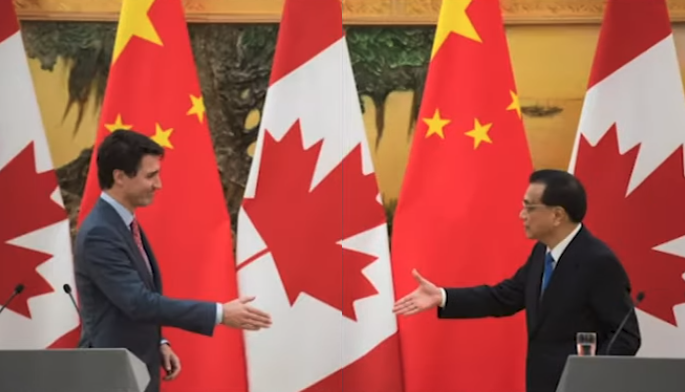
The outrageous secret trials in China of Michael Spavor last Friday and Michael Kovrig this Monday are nothing more than punctuation marks on a storyline that has been obvious for some time now.
Which is why it was enormously gratifying to see more than two dozen diplomats show up to seek admittance to Kovrig’s trial. The fact that none was admitted is unfortunate but largely beside the point — what matters is the public display of solidarity. Even more gratifying perhaps is the announcement (by Canadian officials) that the U.S. has promised to treat the two Canadians as if they were American citizens. After all, it was our acquiescence to a U.S. request to arrest Huawei executive Meng Wanzhou at Vancouver International Airport in 2018 that prompted Beijing to nab Spavor and Kovrig in retaliation. While Chinese officials have denied that what this amounts to is hostage diplomacy, they’ve also made it clear that the fate of the Michaels is tied to that of Meng.
What makes the public support from all of these countries so remarkable is that a lot of them — the Czechs, the Finns, the Romanians — have very little to gain from sticking their neck out for Canada. More to the point, every one of these countries has good reason to wonder just how committed Canada itself is to this show of collective strength. After all, it was only five years ago that senior members of the Liberal party were freely — privately, but freely — saying that as far as the Liberal government was concerned, the U.S. was yesterday’s news and China was the horse Canada was going to ride into the future.
And while a lot has changed over the last five years (not least of which is the fact that Donald Trump has come and gone as president of the United States), it remains incomprehensible that it was just last year the Canadian National Research Council placed its disastrous COVID-19 vaccine bet with CanSino Biologics, a Chinese company with close ties to the Chinese military. What are our allies to make of the fact that only last month, the federal granting agency NSERC partnered with Huawei to sponsor computer engineering at Canadian universities. Or that Canada’s visa office in Beijing is owned and staffed by a Chinese police force?
Whether it is a matter of naïveté, bad faith, or outright cravenness, Canada continues to give every indication that it is a country that is still hedging its bets.
March 21, 2021
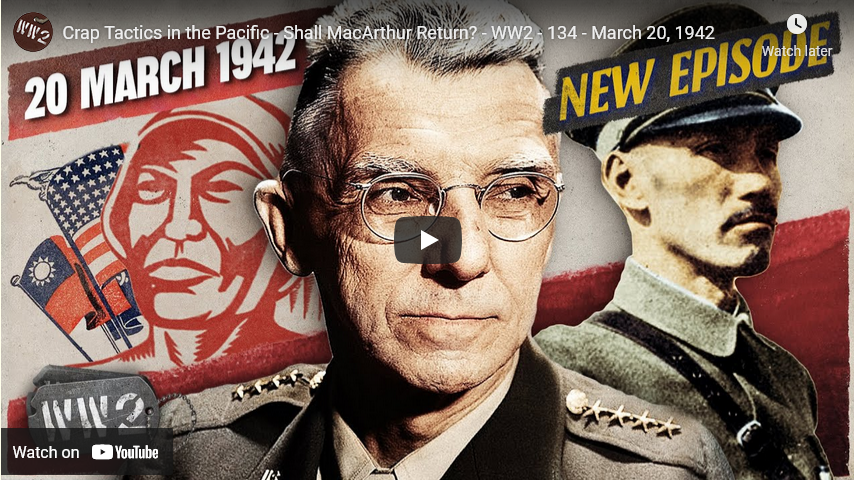
Crap Tactics in the Pacific – Shall MacArthur Return? – WW2 – 134 – March 20, 1942
World War Two
Published 20 Mar 2021MacArthur makes one of the most iconic remarks of the whole war, but considering the fact that the Philippines seem unsalvageable, it’s pretty unclear just how he’ll do it, especially since even though ever more American soldiers are arriving in Australia, the Japanese threat to Australia grows daily. Bill Slim arrives in Burma to take command of I Burma Corps, and Joe Stilwell has taken over two Chinese Nationalist armies, so the defense of Burma looks like it might go on a while longer, though the Allies are at a serious disadvantage after losing Rangoon. The Japanese, for their part, are trying to figure out how the heck they’re going to administer all the territory they’ve taken this year and bring natural resources to Japan itself. There is still scattered fighting in the USSR, but the spring muds have put pad to any major offensives for the time being. As for the British, they launch Operation Outward, a hydrogen balloon campaign over Germany. Yep, you read that right. What a week.
Join us on Patreon: https://www.patreon.com/TimeGhostHistory
Or join The TimeGhost Army directly at: https://timeghost.tvFollow WW2 day by day on Instagram @ww2_day_by_day – https://www.instagram.com/ww2_day_by_day
Between 2 Wars: https://www.youtube.com/playlist?list…
Source list: http://bit.ly/WW2sourcesWritten and Hosted by: Indy Neidell
Director: Astrid Deinhard
Producers: Astrid Deinhard and Spartacus Olsson
Executive Producers: Astrid Deinhard, Indy Neidell, Spartacus Olsson, Bodo Rittenauer
Creative Producer: Maria Kyhle
Post-Production Director: Wieke Kapteijns
Research by: Indy Neidell
Edited by: Iryna Dulka
Sound design: Marek Kamiński
Map animations: Eastory (https://www.youtube.com/c/eastory)Colorizations by:
– Mikołaj Uchman
– Daniel Weiss
– Norman Stewart – https://oldtimesincolor.blogspot.com/
– Adrien Fillon – https://www.instagram.com/adrien.colo…
– Olga Shirnina, a.k.a. Klimbim – https://klimbim2014.wordpress.com/Soundtracks from the Epidemic Sound:
– Rannar Sillard – “Easy Target”
– Jo Wandrini – “Dragon King”
– Wendel Scherer – “Time to Face Them”
– Howard Harper-Barnes – “London”
– Philip Ayers – “The Unexplored”
– Farrell Wooten – “Duels”
– Johan Hynynen – “Dark Beginning”
– Craft Case – “Secret Cargo”
– Johannes Bornlöf – “The Inspector 4”Archive by Screenocean/Reuters https://www.screenocean.com.
A TimeGhost chronological documentary produced by OnLion Entertainment GmbH.
March 14, 2021
Tumbling Capitals – MacArthur on the Run – March 13, 1942 – WW2 – 133
World War Two
Published 13 Mar 2021Rangoon in Burma falls to the invaders without a shot, the Dutch East Indies surrender 100,000 men to them at Batavia, and the Japanese land on New Guinea and begin their advance on Port Moresby. The first phase of their offensives is now over. The Philippines still hold out, their armies under siege at Bataan, but Douglas MacArthur, Allied commander there, has made his getaway, one day to hopefully return. American troops do begin landings on New Caledonia, to build a base there to begin the fight back.
Join us on Patreon: https://www.patreon.com/TimeGhostHistory
Or join The TimeGhost Army directly at: https://timeghost.tvFollow WW2 day by day on Instagram @ww2_day_by_day – https://www.instagram.com/ww2_day_by_day
Between 2 Wars: https://www.youtube.com/playlist?list…
Source list: http://bit.ly/WW2sourcesWritten and Hosted by: Indy Neidell
Director: Astrid Deinhard
Producers: Astrid Deinhard and Spartacus Olsson
Executive Producers: Astrid Deinhard, Indy Neidell, Spartacus Olsson, Bodo Rittenauer
Creative Producer: Maria Kyhle
Post-Production Director: Wieke Kapteijns
Research by: Indy Neidell
Edited by: Iryna Dulka
Sound design: Marek Kamiński
Map animations: Eastory (https://www.youtube.com/c/eastory)Colorizations by:
– Mikołaj Uchman
– Norman Stewart – https://oldtimesincolor.blogspot.com/Sources:
– bockelsound from Freesound.orgSoundtracks from the Epidemic Sound:
– Rannar Sillard – “Easy Target”
– Jo Wandrini – “Dragon King”
– Fabien Tell – “Break Free”
– Philip Ayers – “The Unexplored”
– Howard Harper-Barnes – “Underlying Truth”
– Gunnar Johnsen – “Not Safe Yet”
– Reynard Seidel – “Rush of Blood”
– Flouw – “A Far Cry”
– Philip Ayers – “Trapped in a Maze”Archive by Screenocean/Reuters https://www.screenocean.com.
A TimeGhost chronological documentary produced by OnLion Entertainment GmbH.

March 5, 2021
Privateering today?
In a recent post at Astral Codex Ten, Scott Alexander posted a link to an article in the US Naval Institute Proceedings putting forward arguments for the United States issuing modern day Letters of Marque. Today he posted a few reactions from his readers to the proposal:
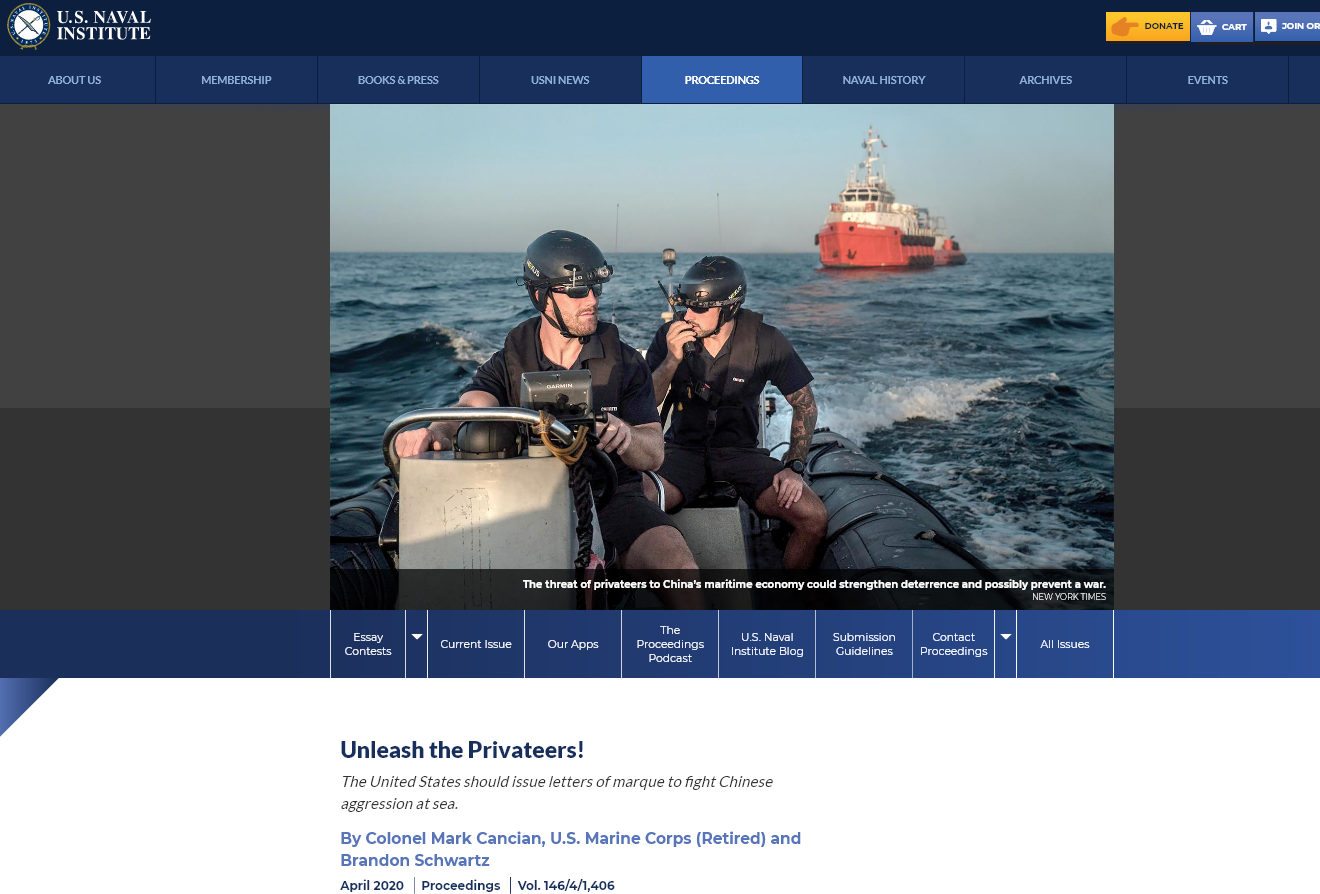
On the article about privateers, local naval expert Bean writes:
It’s time for the standard disclaimer any time Proceedings comes up: Proceedings is intended as a forum for discussion of matters of interest to naval officers, and it is not peer reviewed. Often very not peer reviewed. Like in this case. Please don’t judge the USNI on the basis of this stuff. They do a lot of good work.
And yes, it is that stupid. First, privateering is probably illegal today. The US didn’t sign the 1856 Paris declaration outlawing it, but the ban is almost certainly considered customary international law today, and thus binding on the US, too. (International law is very weird.)
Second, it makes no sense. It was something that people did in an era when the ability of the state to do things was sharply constrained, and it was never all that profitable. These days, the government is a lot more effective, and if it wants to hunt Chinese commerce (never mind the issues about who owns the cargo, which is rather different in the days of worldwide communications and the shipping container) it will make auxiliary commerce raiders of its own. There’s definitely no need to have a DDG sit outside a Brazilian port waiting. Take any reasonable civilian ship (big yacht, fishing boat, tug, whatever) and fit it with a couple of 40mm guns and a boarding party. Have it do the waiting instead.
And our other defense expert, John Schilling, writes:
Modern naval weapons are too good at sinking ships, whereas privateering requires capturing ships intact to be profitable. For a trivial, and in this context uncontroversial, investment, China can equip their merchant fleet with defensive weapons that will sink any privateer, unless the privateer sinks them first.
– Privateers, being incapable of surviving a fight with real warships (especially modern ones), need to be able to hide from and if necessary outrun enemy warships. That’s a lot harder to manage in a world of radio, radar, maritime patrol aircraft, and satellites. Harder still if you insist on taking prizes, which will be Lojacked beyond your ability to clear at sea. Even in a hot war with the United State, China will probably be able to spare e.g. an H-6K for a day to sink the privateer that just sank one of China’s freighters, and that’s all it will take.
– The rest of the world regards privateering as flat-out illegal, so virtually all of the ports of the world will be closed to the privateers *and their prizes*. Operating in the South China Sea directly from Hawaii, without any intermediate bases (what’s left of Guam will have its hands full), is going to be logistically challenging to say the least. And the value of that prize ship you just took is greatly diminished if it can only be used in the US coastal trade, its cargo sold only on the US domestic market never to be reexported.
This is a stupid idea that keeps coming back every year or two because somebody read too many Napoleonic sea-adventure stories and thinks they’re the only one who read those stories so their clever “obscure” idea is something the rest of us haven’t heard and rejected a dozen times already.
There’s a problem in medicine where people think doctors are trustworthy experts. While this is often true, there are about a million doctors, and some tiny fraction of them are insane. The reasonable doctors mostly keep their mouths shut, but sometimes an insane doctor will endorse some sort of terrible alternative medicine, and then people will get excited: “A doctor endorsed it! It must be real!” The fact is, you can find doctors saying pretty much any bizarre thing — I hear some of them even have Substacks.
My thought when reading that article was “this sounds crazy … but wait! It’s written by a colonel and published by the US Naval Institute! That sounds just wacky enough to make a good link!”
Now I am concerned that colonels work the same way as doctors. I wonder what else is like this.
Colonels absolutely do work the same way as doctors, lawyers, and (especially) journalists — Michael Chrichton christened this the “Gell-Mann Amnesia Effect”.
The topic is as good an excuse as I’m likely to find to post Mark Knopfler’s “Privateering”:
“Privateering”
Yon’s my privateer
See how trim she lies
To every man a lucky hand
And every man a prize
I live to ride the ocean
The mighty world around
To take a little plunder
And to hear the cannon sound
To lay with pretty women
To drink Madeira wine
To hear the rollers thunder
On a shore that isn’t mine
Privateering we will go
Privateering, yo ho ho ho
Privateering we will go
Yo ho ho, yo ho ho
The people on your man o’ war
Are treated worse than scum
I’m no flogging captain
And by God I’ve sailed with some
Come with me to Barbary
We’ll ply there up and down
Not quite exactly
In the service of the Crown
To lay with pretty women
To drink Madeira wine
To hear the rollers thunder
On a shore that isn’t mine
Privateering we will go
Privateering, yo ho ho ho
Privateering we will go
Yo ho ho, yo ho ho
Look’ee there’s my privateer
She’s small but she can sting
Licensed to take prizes
With a letter from the King
I love the streets and taverns
Of a pretty foreign town
Tip my hat to the dark-eyed ladies
As we sally up and down
To lay with pretty women
To drink Madeira wine
To hear the rollers thunder
On a shore that isn’t mine
Privateering we will go
Privateering, yo ho ho ho
Privateering we will go
Yo ho ho, yo ho ho
Britannia needs her privateers
Each time she goes to war
Death to all her enemies
Though prizes matter more
Come with me to Barbary
We’ll ply there up and down
Not quite exactly
In the service of the Crown
To lay with pretty women
To drink Madeira wine
To hear the rollers thunder
On a shore that isn’t mine
Privateering we will go
Privateering, yo ho ho ho
Privateering we will go
Yo ho ho, yo ho ho
February 27, 2021
Profiles in Cowardice — Justin Trudeau
Matt Gurney on how Prime Minister Justin Trudeau’s latest act of moral cowardice probably won’t hurt him at all in the polls:

Typical image search results for “Justin Trudeau socks”
It has been fascinating to watch the reaction to Prime Minister Justin Trudeau’s profile in non-courage this week, after he and most of his cabinet skipped a vote on a Tory motion seeking to declare China’s brutal campaign against the Uyghur people a genocide. (Marc Garneau, who was probably desperately wishing he was back in low-Earth orbit, showed up to abstain … because that’s a good use of an astronaut.) If there is anything close to a consensus on the matter, it’s that the PM was in a difficult spot and found a way to slither out of it at the cost of some dignity, but no other real loss.
Kaveh Shahrooz, in a piece here at The Line on Thursday, made that case well. He savaged Trudeau for his hypocrisy — “when the chips were down, the [gender-based analysis], the intersectional lens and the feminist foreign policy were tossed aside in favour of appeasing China,” he wrote — but he also noted that the entire affair won’t really hurt the PM. “Sadly, the worst that will happen to Trudeau because of the hypocrisy and incompetence displayed is some angry tweets and a few articles like this one,” said Shahrooz.
Maybe. But maybe not. Shahrooz and others are certainly right that the prime minister won’t pay an electoral price, and probably won’t see his polling waver. But history makes its own judgments. And I suspect this prime minister is more aware of that than most.
It seems a long time ago now, but in his first term, Trudeau made a habit of apologizing. Only rarely for stuff that he was actually himself responsible for — he’s kinda averse to doing that. But formal and public apologies for past failures? He was all over those. In 2018, the BBC even ran a piece noting the PM’s habit, and asked in the headline, “Does Justin Trudeau apologize too much?”
It’s not that there weren’t things worth apologizing for. In 2016, he apologized for Canada turning back the Komagata Maru, a ship carrying mostly Sikhs that was then forced to return to India, where 20 of them were killed in a riot. The next year, he apologized to survivors of residential schools in Newfoundland and Labrador, and to LGBT Canadians for discrimination they faced at the hands of the federal government. The next year, Jews and members of the Tsilhqot’in Nation received apologies for historical wrongs inflicted on them. And so on. It was a thing.
A man who so clearly adores taking a stage to shed a few tears while acknowledging wrongs committed by someone else, long ago, probably can’t avoid wondering who, in a hundred years, will be apologizing to Uyghurs for his refusal to clearly state that what is happening to them is a genocide.
February 24, 2021
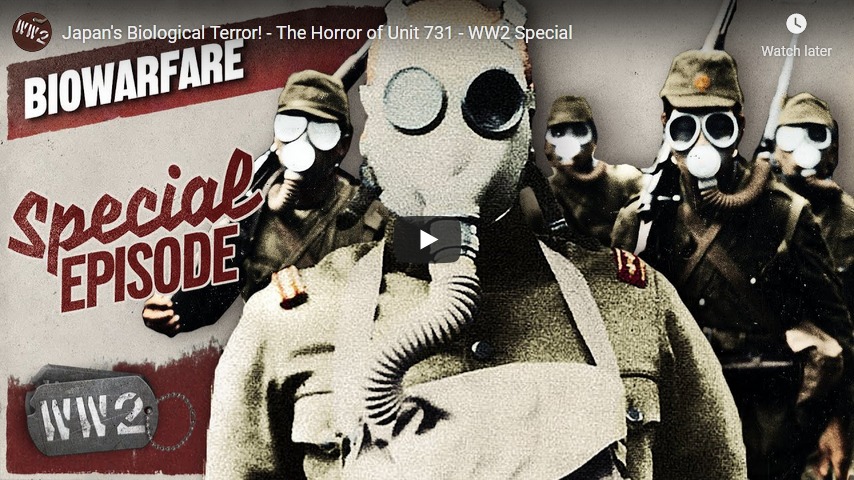
Japan’s Biological Terror! – The Horror of Unit 731 – WW2 Special
World War Two
Published 23 Feb 2021As one of the few nations during World War Two, Japan made expensive use of biological and chemical weapons, both on and off the battlefield. Unit 731 is their special bio-warfare department, which conducts testing on living human civilians.
Join us on Patreon: https://www.patreon.com/TimeGhostHistory
Or join The TimeGhost Army directly at: https://timeghost.tvFollow WW2 day by day on Instagram @ww2_day_by_day – https://www.instagram.com/ww2_day_by_day
Between 2 Wars: https://www.youtube.com/playlist?list…
Source list: http://bit.ly/WW2sourcesHosted by: Spartacus Olsson
Written by: Joram Appel
Director: Astrid Deinhard
Producers: Astrid Deinhard and Spartacus Olsson
Executive Producers: Astrid Deinhard, Indy Neidell, Spartacus Olsson, Bodo Rittenauer
Creative Producer: Maria Kyhle
Post-Production Director: Wieke Kapteijns
Research by: Joram Appel
Edited by: Karolina Dołęga
Sound design: Marek KamińskiColorizations by:
– Daniel Weiss
– Mikołaj Uchman
– Dememorabilia – https://www.instagram.com/dememorabilia
– Klimbim
– Norman Stewart – https://oldtimesincolor.blogspot.com/Sources:
– National Archive NARA
– Imperial War Museums: D 3162, HU67224, HU 44941, Q 114057
– BundesarchivSoundtracks from Epidemic Sound:
– “For the Many STEMS INSTRUMENTS” – Jon Bjork
– “Weapon of Choice” – Fabien Tell.
– “Moving to Disturbia” – Experia
– “Symphony of the Cold-Blooded” – Christian Andersen
– “It’s Not a Game” – Philip Ayers
– “Please Hear Me Out STEMS INSTRUMENTS” – Philip Ayers
– “London” – Howard Harper-Barnes
– “Break Free” – Fabien Tell
– “Not Safe Yet” – Gunnar JohnsenArchive by Screenocean/Reuters https://www.screenocean.com.
A TimeGhost chronological documentary produced by OnLion Entertainment GmbH.
February 20, 2021
Confessed genocidal nation refuses to accuse China of genocide
Jen Gerson considers the moral smallness of Canadian government wiggling out of labelling China’s treatment of their Uyghur minority as the genocide it certainly is:
This week, the Prime Minister of an admittedly genocidal G7 state refused to condemn China for its treatment of its minority Uyghur population. A treatment that has included family separation, forced sterilization, and warehousing thousands of people in what can only be described as modern concentration camps.
Justin Trudeau failed to condemn China, noting, quite rightly, that genocide is an “extremely loaded” term. One not to be bandied about lightly. It demonstrates some moral cowardice on his part, certainly, but also a degree of pragmatism. Canada’s squeaky and lonely objection would do little good. We’re already in a vulnerable position, what with the ongoing captivity of two Canadians who remain in Chinese detention as an act of retaliation for our arrest of Huawei executive Meng Wanzhou. A declaration of genocide in this case is probably better handled by a collection of nations. As long as we can live with the shame of the smallness that such an argument implies.
(Although perhaps it was unwise to pin so many of our early hopes of an early vaccine rollout on a doomed collaboration with a Chinese manufacturer with a vaccine backed by China’s Institute of Biotechnology and its Academy of Military Medical Sciences. Who could have predicted we would run into problems with such a notoriously reliable and honourable global partner that occasionally engages in hostage diplomacy? But I digress.)
The real issue with Trudeau’s grovelling little deflection on the question of Chinese genocide is that it made his own position on the subject not two years ago impossible to ignore in comparison. The final report of the Missing and Murdered Indigenous Women and Girls inquiry stated that the truths it uncovered in the process of its years-long investigations:
… tell the story — or, more accurately, thousands of stories — of acts of genocide against First Nations, Inuit and Métis women, girls, and 2SLGBTQQIA people. This violence amounts to a race-based genocide of Indigenous Peoples … This genocide has been empowered by colonial structures, evidenced notably by the Indian Act, the Sixties Scoop, residential schools, and breaches of human and Inuit, Métis and First Nations rights, leading directly to the current increased rates of violence, death, and suicide in Indigenous populations.
Several pundits at the time noted at the time that this stretched the definition of “genocide” beyond ordinary recognition. “Genocide” is not the result of a set of compounding government failures over time: it’s a word that we reserve to describe a discreet set of acts motivated by the deliberate intent to decimate or totally exterminate an ethnic population. But after a day or so of hemming and hawing on the issue after the report was released, our prime minister noted: “The issue that we have is that people are getting wrapped up in debates over a very important and powerful term … We accept the finding that this was genocide, and we will move forward to end this ongoing national tragedy.”
There was some careful phrasing in this response. Note, Trudeau agreed that this was genocide, not that it is genocide. The prime minister dodged the implication that Canada is engaged in deliberate ethnic cleansing. But it’s worth peeling back the skin of the onion, past the obvious and easy allegation of hypocrisy, and instead ask ourselves why?
Why can we get away with calling ourselves a genocidal state, but not China?
February 19, 2021
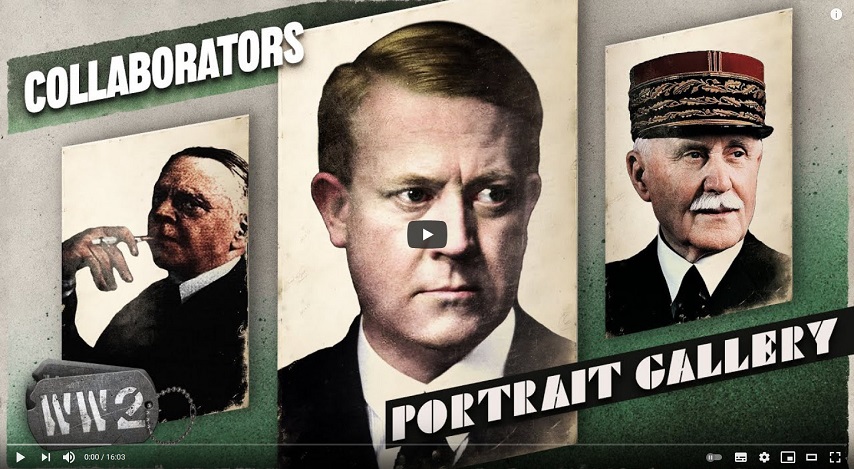
Quislings! – Traitors of World War Two – WW2 Gallery 02
World War Two
Published 18 Feb 2021The name of Norwegian National Socialist Politician Vidkun Quisling became synonymous with “traitor” and “collaborator”. In this gallery episode, we’ll cover some of the most prominent Quislings in World War Two.
Join us on Patreon: https://www.patreon.com/TimeGhostHistory
Or join The TimeGhost Army directly at: https://timeghost.tvFollow WW2 day by day on Instagram @ww2_day_by_day – https://www.instagram.com/ww2_day_by_day
Between 2 Wars: https://www.youtube.com/playlist?list…
Source list: http://bit.ly/WW2sourcesHosted by: Indy Neidell
Written by: Joram Appel
Director: Astrid Deinhard
Producers: Astrid Deinhard and Spartacus Olsson
Executive Producers: Astrid Deinhard, Indy Neidell, Spartacus Olsson, Bodo Rittenauer
Creative Producer: Maria Kyhle
Post-Production Director: Wieke Kapteijns
Research by: Joram Appel
Edited by: Miki Cackowski
Sound design: Marek Kamiński
Map animations: Eastory (https://www.youtube.com/c/eastory)Colorizations by:
Norman Stewart – https://oldtimesincolor.blogspot.com/
Adrien Fillon – https://www.instagram.com/adrien.colo…
Jaris Almazani (Artistic Man) – https://instagram.com/artistic.man
Julius Jääskeläinen – https://www.facebook.com/JJcolorization/
Carlos Ortega Pereira, BlauColorizations – https://www.instagram.com/blaucolorizations
Dmitriy Vasilyev – https://commons.wikimedia.org/wiki/Fi…Sources:
USHMM
Narodowe Archiwum Cyfrowe
Bundesarchiv
efsyn.gr
Yad Vashem 85DO
Amsab Institute of Social History www.amsab.be
Picture of Mussert shaking hands with Hitler, courtesy of Beeldbankwo2 https://beeldbankwo2.nl/Soundtracks from the Epidemic Sound:
Johannes Bornlof – “The Inspector 4”
Philip Ayers – “Trapped in a Maze”
Cobby Costa – “Flight Path”
Rannar Sillard – “March Of The Brave 4”
Johan Hynynen – “Dark Beginning”
Farrell Wooten – “Blunt Object”
Reynard Seidel – “Deflection”
Yi Nantiro – “Watchman”
Hakan Eriksson – “Epic Adventure Theme 4”Archive by Screenocean/Reuters https://www.screenocean.com.
A TimeGhost chronological documentary produced by OnLion Entertainment GmbH.