
… you know I’m always up for the humiliation of a dominant scientific paradigm. I especially like examples where that paradigm in its heyday replaced some much older and unfashionable view that we now know to be correct. It’s important to remind people that knowledge gets lost and buried in addition to being discovered.
The wonderful thing about ancient DNA is it gives us an extreme case of this. Basically, the first serious attempt at creating a scientific field of archaeology was done by 19th century Germans, and they looked around and dug some stuff up and concluded that the prehistoric world looked like the world of Conan the Barbarian: lots of “population replacement”, which is a euphemism for genocide and/or systematic slavery and mass rape. This 19th century German theory then became popular with some 20th century Germans who … uh … made the whole thing fall out of fashion by trying to put it into practice.
After those 20th century Germans were squashed, any ideas they were even tangentially associated with them became very unfashionable, and so there was a scientific revolution in archaeology! I’m sure this was just crazy timing, and actually everybody rationally sat down and reexamined the evidence and came to the conclusion that the disgraced theory was wrong (lol, lmao). Whatever the case, the new view was that the prehistoric world was incredibly peaceful, and everybody was peacefully trading with one another, and this thing where sometimes in a geological stratum one kind of house totally disappears and is replaced by a different kind of house is just that everybody decided at once that the other kind of house was cooler. The high-water mark of this revisionist paradigm even had people saying that the Vikings were mostly peaceful traders who sailed around respecting the non-aggression principle.
And then people started sequencing ancient DNA and … it turns out the bad old 19th century Germans were correct about pretty much everything. The genetic record is one of whole peoples frequently disappearing or, even more commonly, all of the men disappearing and other men carrying off the dead men’s female relatives. There are some exceptions to this, but by and large the old theory wins.
I used to have a Bulgarian coworker, and I asked him one day how things were going in Bulgaria. He replied in that morose Slavic way with a long, sad disquisition about how the Bulgarian race was in its twilight, their land was being colonized by others, their sons and daughters flying off to strange lands and mixing their blood with that of alien peoples. I felt awkward at this point, and stammered something about that being very sad, at which point he came alive and declared: “it is not sad, it is not special, it is the Way Of The World”. He then launched into a lecture about how the Bulgarians weren’t even native to their land, but had been bribed into moving there by the Byzantines who used them as a blunt instrument to exterminate some other unruly tribes that were causing them trouble. “History is all the same,” he concluded, “we invaded and took their land, and now others invade us and take our land, it is the Way Of The World.”
Even a cursory study of history shows that my Bulgarian friend was correct about the Way Of The World. There’s a kind of guilty white liberal who believes that European colonization and enslavement of others is some unique historical horror, a view that has now graduated into official state ideology in America. But that belief is just a weird sort of inverted narcissism. I guess pretending white people are uniquely bad at least makes them feel special, but white people are not special. Mass migration, colonization, population replacement, genocide, and slavery are the Way Of The World, and ancient DNA teaches us that it’s been the Way Of The World far longer than writing or agriculture have existed. It wasn’t civilization that corrupted us, there are no noble savages, “history is all the same”, an infinite history of blood.
Land acknowledgments always struck me as especially funny and stupid: like you really think those people were the first ones there? What about acknowledging the people that they stole it from? Sure enough one of the coolest parts of Reich’s book is his recounting the discovery that there were probably unrelated peoples in the Americas before the ancestors of the American Indians arrived here, and that a tiny remnant of them might even remain deep in Amazonia. So: what does it actually mean to be “indigenous”? Is anybody anywhere actually “indigenous”?
Jane Psmith and John Psmith, “JOINT REVIEW: Who We Are and How We Got Here, by David Reich”, Mr. and Mrs. Psmith’s Bookshelf, 2023-05-29.
September 2, 2023
QotD: Ancient DNA
August 22, 2023
QotD: Megafauna extinction
There is, sadly enough, a common misconception about our ancestors. Nature loving, that Rousseauesque fantasy of just drinking the clear water, munching on the acorns that fall unbidden. That humans don’t thrive on acorns matters not a whit to those who share this fantasy of an Elysian past. The truth being that humans – and proto- – were the most vicious beasts out there. That’s why we survived to thrive. It’s not just modern day humans who would scale down a cliff to throttle babbie seabirds for the pot after all.
So too with the bargain bucket meal on legs just found:
Half-tonne birds may have roamed Europe at same time as humans
They roamed, we eated, they roamed no more. As with the arrival of the Maori in New Zealand and the exit of moas. The American horse disappearing about the same time Amerinds made it past the ice barriers into British Columbia and points south. Dodos and sailing ships and on and on around the globe. The major factor in megafauna going extinct being humans turning up to eat them.
Tim Worstall, “Crimea Fried Ostrich – And Then We Eated It”, Continental Telegraph, 2019-06-27.
July 19, 2023
Ever wonder where the term “two-spirit” came from?
In Spiked, Malcolm Clark explains the origin of the now commonly used term as a portmanteau for many different words — with significant variation in meaning — in indiginous languages:
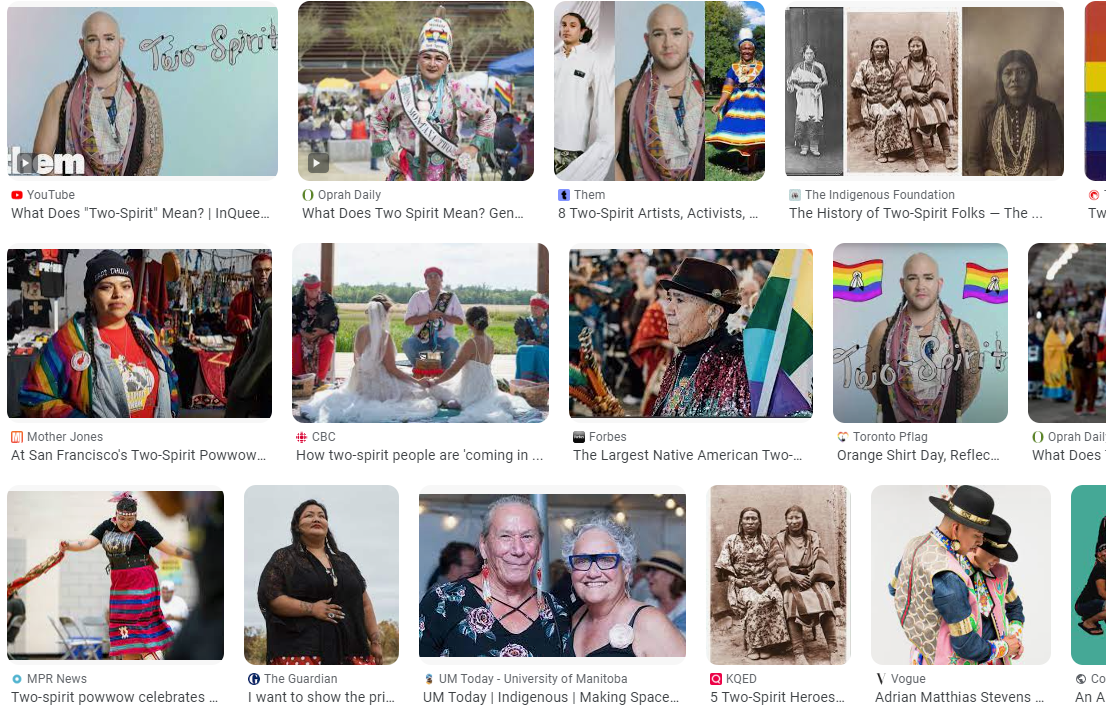
Typical media presentation of Two-spirit individuals
The term two-spirit was first formally endorsed at a conference of Native American gay activists in 1990 in Winnipeg in Canada. It is a catch-all term to cover over 150 different words used by the various Indian tribes to describe what we think of today as gay, trans or various forms of gender-bending, such as cross-dressing. Two-spirit people, the conference declared, combine the masculine and the feminine spirits in one.
From the start, the whole exercise reeked of mystical hooey. Myra Laramee, the woman who proposed the term in 1990, said it had been given to her by ancestor spirits who appeared to her in a dream. The spirits, she said, had both male and female faces.
Incredibly, three decades on, there are now celebrities and politicians who endorse the concept or even identify as two-spirit. The term has found its way into one of Joe Biden’s presidential proclamations and is a constant feature of Canadian premier Justin Trudeau’s doe-eyed bleating about “2SLGBTQQIA+ rights”.
The term’s success is no doubt due in part to white guilt. There is a tendency to associate anything Native American with a lost wisdom that is beyond whitey’s comprehension. Ever since Marlon Brando sent “Apache” activist Sacheen Littlefeather to collect his Oscar in 1973, nothing has signalled ethical superiority as much as someone wearing a feather headdress.
The problem is that too many will believe almost any old guff they are told about Native Americans. This is an open invitation to fakery. Ms Littlefeather, for example, may have built a career as a symbol of Native American womanhood. But after her death last year, she was exposed as a member of one of the fastest growing tribes in North America: the Pretendians. Her real name was Marie Louise Cruz. She was born to a white mother and a Mexican father, and her supposed Indian heritage had just been made up.
Much of the fashionable two-spirit shtick is just as fake. For one thing, it’s presented as an acknowledgment of the respect Indian tribes allegedly showed individuals who were gender non-conforming. Yet many of the words that two-spirit effectively replaces are derogatory terms.
In truth, there was a startling range of attitudes to the “two-spirited” among the more than 500 separate indigenous Native American tribes. Certain tribes may have been relaxed about, say, effeminate men. Others were not. In his history of homosexuality, The Construction of Homosexuality (1998), David Greenberg points out that those who are now being called “two spirit” were ridiculed by the Papago, held in contempt by the Choctaws, disliked by the Cocopa, treated by the Seven Nations with “the most sovereign contempt” and “derided” by the Sioux. In the case of the Yuma, who lived in what is now Colorado, the two-spirited were sometimes treated as rape objects for the young men of the tribe.
June 30, 2023
QotD: Changing patterns of combat on the Great Plains
F.R. Secoy (op. cit.) essentially breaks warfare into four phases, which happen at different times in different places, based on if they have horses, guns, both or neither. Because horses entered the Great Plains from the South (via the Spanish) but firearms entered the region from the North (via the British and the French, the Spanish having prohibited gun-sales to Native Americans) and spread out from there, for a brief time many of these systems were active on the Plains at once, as both guns and horses diffused through the region.
In the pre-horse, pre-gun phase (described by McGinnis as well, op. cit., 8-9), battles consisted of long-range missile exchanges between warriors who stood behind large shields which protected their whole bodies. Native American warriors in this system also wore armor, heavy leather coats, laminated in multiple layers using thick hide with glue that was sometimes mixed with sand or gravel (one more example of how “leather armor” is almost always hardened leather armor, not modern clothing-leather). Some of this armor may have been effectively quilted leather as well. Clearly, there was plenty of concern about survivability here.
Both guns and horses were apt to disrupt this system. Horses allowed attackers to rapidly close the distance between the two opposing lines of shield-protected foot-missile-warriors, causing the shield-lines to drop away (though smaller shields, used on horseback to ward off arrows and blows were still used) and for both sides to seek instead the mobility of mounted fighting. That was not the end for armor though, because contact with a supply of horses meant contact with the Spanish, and the Apache at least swiftly adopted some of the Spanish methods of making leather “buff coats” into their own armor tradition and copied the shape and pattern of the buff coat itself (while often still making the material using their own tradition). As Secoy notes (op. cit., 18-20), our sources are quite clear that these forms of armor (both original and Spanish-influenced Native armors) were quite effective at resisting the archery fire that dominated both the pre-horse, pre-gun system and the post-horse, pre-gun system.
Meanwhile on the Northern Plains, while the horse had not yet arrived, firearms had, and these had different effects. Firearms spelled the end of the armor once they became common enough, since there was no protection which could resist bullets; some shield use survived, since arrows remained fairly common as well. But this didn’t lead to suicidal warfare. Instead – as had happened on the East Coast as well, Native Americans adapted their warfare to the increased lethality of firearms (on this, note Lee, op. cit. above) by mostly avoiding pitched battles as they became too lethal (which, by the by, the relatively low lethality of pitched battles pre-gunpowder is often taken to mean that Native North American warfare in general was low-lethality; this is wrong. As with most forms of non-state warfare, most of the killing happened in surprise raids and ambushes, which could be extremely lethal and were still quite common).
Once the horse and the firearm were both in wide use in an area, warfare shifted again. War parties became smaller, faster moving and more reliant on surprise (essentially an extension of the raiding-focus of the pre-horse, post-gun system to the high mobility horses supplied). Infantry battle dropped away entirely because it was too lethal and resulted in casualties that low-population density nomads could not sustain (the contrast with the much higher population-density agrarian United States, which was self-immolating in massively costly massed-infantry engagements during the American Civil War, 1861-1865, at exactly this time is striking). These are fairly big, noticeable changes in warfare patterns!
In short, the tactics used in all four of these systems were conditions by casualty aversion, which makes a lot of sense in the context of a low-population density society which simply cannot afford massive losses.
Bret Devereaux, “Collections: That Dothraki Horde, Part IV: Screamers and Howlers”, A Collection of Unmitigated Pedantry, 2021-01-08.
June 24, 2023
Official mythmaking about the Empire Windrush in 1948
The Armchair General unpacks some of the story-spinning being conducted by the British government and various charities to mark the 75th anniversary of the voyage of the Empire Windrush from Jamaica to Britain:
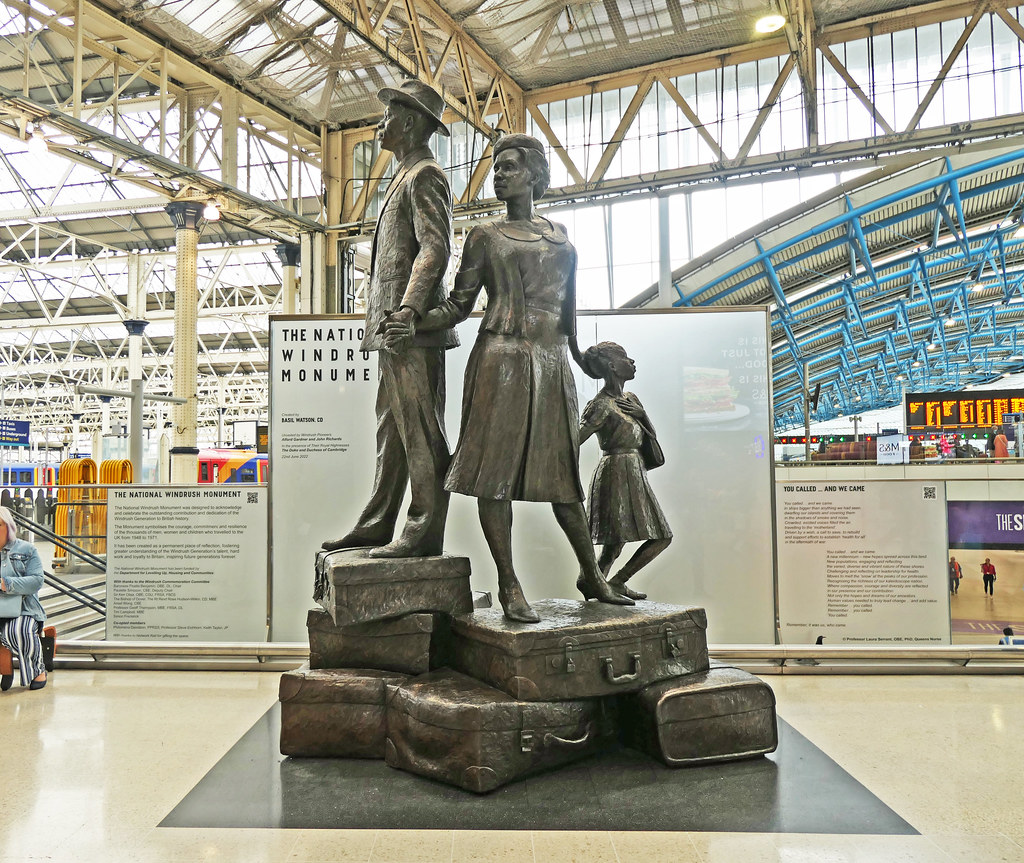
“The National Windrush Monument” by amandabhslater is licensed under CC BY-SA 2.0 

 .
.
The Armchair General notes that there is much excitement about the 75th anniversary of the arrival of the ship called the Empire Windrush — which arrived on 22 June 1948 — and the contribution of the so-called Windrush Generation.
The myth currently being constructed is that those coming from Jamaica on the ship were invited, in order to rebuild a Britain struggling to recover from Word War II; we are told that, with so many young men killed in the fighting, Britain needed menial workers to selflessly come and rebuild our economy. Indeed, this view of events has been cemented in a much-lauded poem by Professor Laura Serrant.
Remember … you called.
Remember … you called
YOU. Called.
Remember, it was us, who came.Like almost any story constructed by governments and charities over at least the last thirty years, this narrative is dodgy at best and downright dishonest at worst. The simple fact is that the ship’s operator had expected to leave Jamaica under capacity and so offered passage at half price: many local men (and it was all men) took the opportunity.
Writing in The Spectator, in an article well worth reading in full, Ed West points out that the British government certainly did not encourage these immigrants at all.
Far from calling them, the British government was alarmed by the news. A Privy Council memo sent to the Colonial Office on 15 June stated that the government should not help the migrants: “Otherwise there might be a real danger that successful efforts to secure adequate conditions of these men on arrival might actually encourage a further influx.”
Colonial Secretary Arthur Creech Jones replied: “These people have British passports and they must be allowed to land.” But, he added confidently: “They won’t last one winter in England.” Indeed, Britain had recently endured some very harsh winters.
The Ministry of Labour was also unhappy about the arrival of the Jamaican men, minister George Isaacs warning that if they attempted to find work in areas of serious unemployment “there will be trouble eventually”. He said: “The arrival of these substantial numbers of men under no organised arrangement is bound to result in considerable difficulty and disappointment. I hope no encouragement will be given to others to follow their example.”
Nor was it the solely the evil Tories who were concerned:
Soon afterwards, 11 concerned Labour MPs wrote to Prime Minister Clement Attlee stating that the government should “by legislation if necessary, control immigration in the political, social, economic and fiscal interests of our people … In our opinion such legislation or administration action would be almost universally approved by our people.” The letter was sent on 22 June; that same day the Windrush arrived at Tilbury.
One can hardly be surprised: after all, 75 years ago, the Labour Party at least strove to represent the working class of Britain and the simple fact is that there was, at the time, massive unemployment — so much so that the government was heavily subsidising tickets to Australia (at £10) in order to encourage British people to emigrate (over 2 million British people left between 1948 and 1960).
There is a certain amount of well-intentioned inclusive myth-making in this story, and from a historical point of view the idea that “diversity built Britain”, the birthplace of the Industrial Revolution, is bizarre. Until 1952 Britain was the richest country in Europe, after which we massively fell behind our continental rivals – so if diversity did “build” the country, it didn’t do a great job.
One can argue, I think, that the Windrush Generation made a great many contributions, in common with many immigrants; and if their contribution was not, in reality, as large as is claimed, then they share that with the EEC/EU’s Common Market which, again (and despite all the claims), brought no discernible benefit to the UK.
H/T to Tim Worstall for the link.
June 18, 2023
QotD: Good intentions do not automatically mean good results
Another United Nations agency, its peacekeeping force in Haiti, was responsible for the most serious epidemic of cholera of the twenty-first century so far. Before 2010, cholera had been unknown in Haiti despite the country’s poverty and lack of hygiene. Then, from 2010 to 2018, it suffered outbreaks of cholera that have affected perhaps a tenth of the population and caused between 10,000 and 80,000 deaths (the exact figure will never be known).
The evidence suggests that cholera was brought to Haiti by United Nations peace-keeping troops from Nepal. Whether Haiti needed peacekeeping troops at all may be doubted: at the time it suffered from civil unrest rather than from war. One suspects that the peacekeeping force was employed more to keep the Haitians from leaving Haiti than to keep the peace.
Be that as it may, some Nepali troops arrived fresh from a cholera epidemic in Nepal, established a camp next to the Artibonite River from which many Haitians drew their water. The Nepalis emptied their sewage directly into the river, and some of them were infected with the cholera germ. There was soon an outbreak of cholera among the local population of extraordinary violence. The Haitians guessed at once that the Nepali troops had brought the cholera, but this was strongly denied.
Theodore Dalrymple, “Negligence and Unaccountability at the United Nations”, New English Review, 2019-07-09.
June 1, 2023
Recent discoveries in ancient DNA
The Psmiths, John and Jane, decided to jointly review a book by David Reich called Who We Are and How We Got Here: Ancient DNA and the New Science of the Human Past. This is Jane’s first contribution to an extended email thread between the Psmiths:
The problem with history is that there just isn’t enough of it. We’ve been around for, what, fifty thousand years? Conservatively.1 And we’ve barely written things down for a tenth of that. Archaeological excavation can take you a little farther back, but as the archaeologists always like to remind us, pots are not people. If you get lucky with a society that made things out of durable materials in a cold and/or dry environment (or you get very lucky with anaerobic preservation of organic materials, like in ice or bogs), maybe you can trace a material culture’s expansion and contraction across time and space. But that won’t tell you whether it’s a function of people moving and taking their stuff with them, or people’s neighbors going “ooh, using string to make patterns on your pots, that’s cool” and copying it. It certainly doesn’t tell you what their descendants were doing several thousand years later, potentially in an entirely different place and probably using an entirely different suite of technologies. Trying to understand what happened in the human past based on the historical and archaeological records is like walking into a room where a bomb has gone off and trying to reconstruct the locations of all the objects before the explosion. You can get some idea, but it’s all very broad strokes. And actually it’s worse than that, because it wasn’t just one explosion, it was lots, and we wouldn’t even know how many if we didn’t have a way of winding the clock back. But these days we do, and it’s ancient DNA.
Sometime between when my grandfather gave me a copy of Luca Cavalli-Sforza’s Genes, Peoples, and Languages for my birthday and when you and I decided to read Reich’s book together, two big things happened: humans got really, really good at sequencing and reading genomes, and Svante Pääbo’s lab in Leipzig got really, really good at extracting DNA from ancient bones. (How they developed their procedures is actually a really interesting story, which Pääbo retells in his book, but Reich — whose lab uses the same techniques on an industrial scale — gives a good, brief summary of how it works.) Together, these two advances unlocked … well, not quite everything about the deep past, but an absolutely enormous amount. Suddenly we can track the people, not just the pots, and the story is more complicated and fascinating than anything we might have expected. I’ve written elsewhere about some of the aDNA discoveries about human evolution (Neanderthal admixture, the Denisovans, etc.), but I’m even more excited about what ancient DNA reveals about our more recent past. Luckily, that’s what Reich spends most of the book on, with discussion of ancient ghost populations who now exist only in admixture and then chapters on the specific population genetic histories of Europe, India, North America, East Asia, and Africa, each of which contains some discoveries that would make (at least the more sensible) archaeologists and historical linguists go “well, duh” and others that are real surprises.
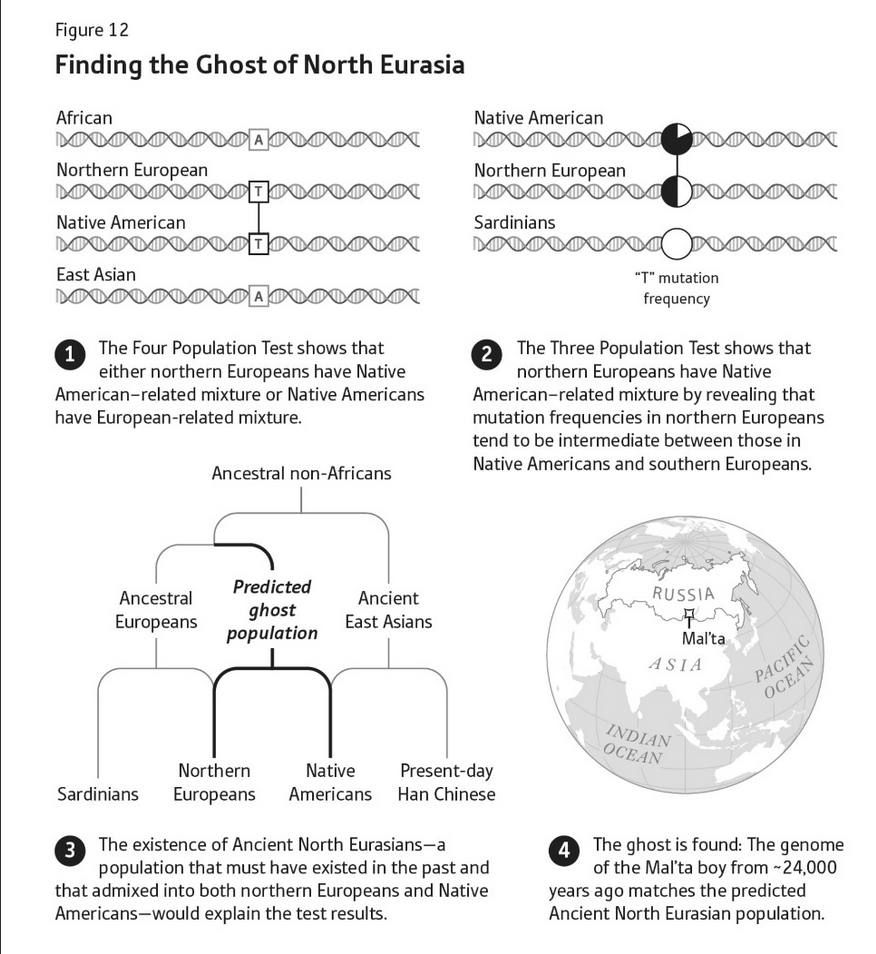
One of the “duh” stories is the final, conclusive identification of the people who brought horses, wagons, and Indo-European languages to Europe with the Yamnaya culture of the Pontic Steppe and their descendants. (David Anthony gives a very good overview of the archaeological case for this in The Wheel, the Horse, and Language, including some very cool experimental archaeology about horse teeth; you have my permission to skim the sections on pots.) My favorite surprising result, though, comes from a little farther north. People usually assume that Native Americans and East Asians share a common ancestor who split from the ancestors of Europeans and Africans before dividing into those two populations, but when Reich’s lab was trying to test the idea they found, to their surprise, that in places where Northern European genomes differ from Africans’, they are closer to Native Americans than to East Asians. Then, using a different set of statistical techniques, they found that Northern European populations were the product of mixture between two groups, one very similar to Sardinians (who are themselves almost-unmixed descendants of the first European farmers) and one that is most similar to Native Americans. They theorized a “ghost” population, which they called the “Ancient North Eurasians”, who had contributed DNA both to the population that would eventually cross the Bering land bridge and to the non-Early European Farmer ancestors of modern Northern Europeans. Several years later, another team sequenced the genome of a boy who died in Siberia 24kya and who was a perfect match for that theorized ghost ANE population.
But we’ve already established that I’m the prehistory nerd in this family; were you as jazzed as I was to read about the discovery of the Ancient North Eurasians?
1. That’s the latest plausible date for the arrival of full “behavioral modernity” in Africa, though our genus goes back about two million years, tool use probably three million, and I think there’s a good case that Homo was meaningfully “us” by 500kya. (That’s “thousand years ago” in “I talk about deep history so much I need an acronym”, fyi.)
May 28, 2023
This Gun Could Reach Space
Real Engineering
Published 18 Feb 2023
(more…)
May 24, 2023
The Original PB&J from 1901
Tasting History with Max Miller
Published 23 May 2023
(more…)
May 21, 2023
What Are The Falklands Like Today? | BFBS
BFBS Creative
Published 24 Jun 2021We take you behind the scenes on a BFBS creative shoot, 8000 miles from home. With access all areas, we take a look at the current military presence on the Falkland Islands as well as the incredible wildlife.
May 7, 2023
QotD: The long-term instability of bison hunting on the Great Plains
So to be clear, the Great Plains Native Americans are not living off of their horses, they are using their horses to live off of the bison. The subsistence system isn’t horse based, but bison-based.
At the same time, as Isenberg (op. cit. 70ff) makes clear that this pure-hunting nomadism still existed in a narrow edge of subsistence. From his description, it is hard not to conclude that the margin or survival was quite a bit narrower than the Eurasian Steppe subsistence system and it is also clear that group-size and population density were quite a bit lower. It’s also not clear that this system was fully sustainable in the long run; Pekka Hämäläinen argues in The Comanche Empire (2008) that Comanche bison hunting was potentially already unsustainable in the very long term by the 1830s. It worked well enough in wet years, but an extended drought (which the Plains are subjected to every so often) could cause catastrophic decline in bison numbers, as seems to have happened the 1840s and 1850s. A sequence of such events might have created a receding wave phenomenon among bison numbers – recovering after each dry spell, but a little less each time. Isenberg (op. cit., 83ff) also hints at this, pointing out that once one factors for things like natural predators, illness and so on, estimates of Native American bison hunting look to come dangerously close to tipping over sustainability, although Isenberg does not offer an opinion as to if they did tip over that line. Remember: complete reliance on bison hunting was new, not a centuries tested form of subsistence – if there was an equilibrium to be reached, it had not yet been reached.
In any event, the arrival of commercial bison hunting along with increasing markets for bison goods drove the entire system into a tailspin much faster than the Plains population would have alone. Bison numbers begin to collapse in the 1860s, wrecking the entire system about a century and a half after it had started. I find myself wondering if, given a longer time frame to experiment and adapt the new horses to the Great Plains if Native American society on the plains would have increasingly resembled the pastoral societies of the Eurasian Steppe, perhaps even domesticating and herding bison (as is now sometimes done!) or other animals. In any event, the westward expansion of the United States did not leave time for that system to emerge.
Consequently, the Native Americans of the plains make a bad match for the Dothraki in a lot of ways. They don’t maintain population density of the necessary scale. Isenberg (op. cit., 59) presents a chart of this, to assess the impact of the 1780s smallpox epidemics, noting that even before the epidemic, most of the Plains Native American groups numbered in the single-digit thousands, with just a couple over 10,000 individuals. The largest, the Sioux at 20,000, far less than what we see on the Eurasian Steppe and also less than the 40,000 warriors – and presumably c. 120-150,000 individuals that implies – that Khal Drogo alone supposedly has [in Game of Thrones]. They haven’t had access to the horse for nearly as long or have access to the vast supply of them or live in a part of the world where there are simply large herds of wild horses available. They haven’t had long-term direct trade access to major settled cities and their market goods (which expresses itself particularly in relatively low access to metal products). It is also clear that the Dothraki Sea lacks large herds of animals for the Dothraki to hunt as the Native Americans could hunt bison; there are the rare large predators like the hrakkar, but that is it. Mostly importantly, the Plains Native American subsistence system was still sharply in flux and may not have been sustainable in the long term, whereas the Dothraki have been living as they do, apparently for many centuries.
Bret Devereaux, “That Dothraki Horde, Part II: Subsistence on the Hoof”, A Collection of Unmitigated Pedantry, 2020-12-11.
April 27, 2023
M1908 Mondragon Semiauto Rifle
Forgotten Weapons
Published 24 Nov 2014The M1908 Mondragon is widely acknowledged to have been the first self-loading rifle adopted as a standard infantry arm by a national military force. There are a couple of earlier designs used by military forces, but the Mondragon was the first really mass-produced example and deserves its place in firearms history.
Designed by Mexican general Manuel Mondragon (who had a number of other arms development successes under his belt by this time), the rifles were manufactured by SIG in Switzerland. They are very high quality guns, if a bit clunky in their handling.
The design used a long-action gas piston and a rotating bolt to lock. Interestingly, the bolt had two full sets of locking lugs; one at the front and one at the rear as well as two set of cams for the operating rod and bolt handle to rotate the bolt with. The standard rifle used a 10-round internal magazine fed by stripper clips, but they were also adapted for larger detachable magazines and drums.
Unfortunately, the rifle required relatively high-quality ammunition to function reliably, and Mexico’s domestic production was not up to par. This led to the rifles having many problems in Mexican service, and Mexico refused to pay for them after the first thousand of their 4,000-unit order arrived. The remaining guns were kept by SIG, and ultimately sold to Germany for use as aircraft observer weapons.
(more…)
April 10, 2023
US Army and Marine Corps deployments other than with the American Expeditionary Forces (AEF)
Another excerpt from John Sayen’s Battalion: An Organizational Study of United States Infantry currently being serialized on Bruce Gudmundsson’s Tactical Notebook shows where US infantry units (US Army and USMC) were deployed aside from those assigned to Pershing’s AEF on the Western Front in France:
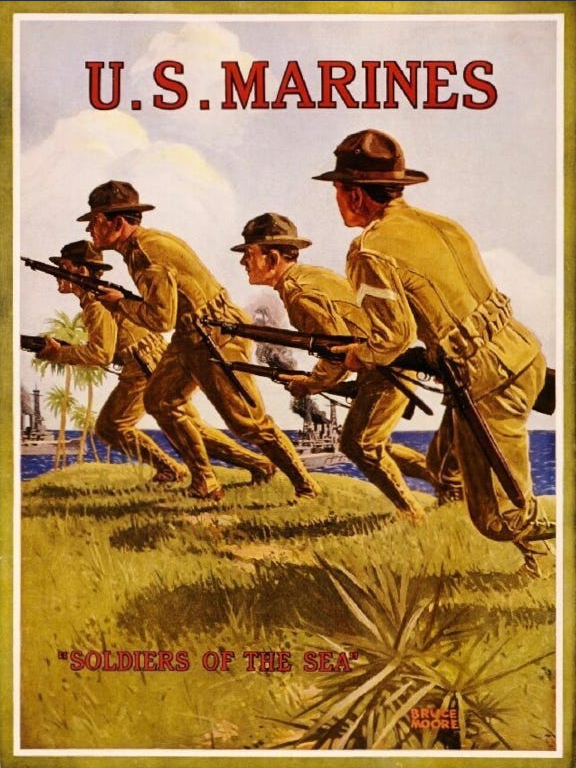
Apart from the war in Europe, the principal military concern of the Wilson administration during 1917-18 was the protection of resources and installations considered vital to the war effort. The threat of German sabotage in the United States was taken very seriously. In addition, Mexico was still unstable politically and sporadic border clashes continued to occur into 1919. Mexican oil was also regarded as an essential resource and the troops stationed on the Mexican border were prepared to invade in order to keep it flowing. However, all the National Guard, National Army, and even the Regular Army regiments raised for wartime only were reserved for duty with the AEF. (The National Army 332nd and 339th Regiments did deploy to Italy and North Russia, respectively, but both remained under AEF command.) This left non-AEF assignments in the hands of the pre-war Regular Army regiments.
Out of 38 Regular infantry regiments available in 1917, 25 were on guard duty within the Continental United States or on the Mexican border and 13 garrisoned U.S. possessions overseas. Local defense forces raised in Hawaii and the Philippines eventually freed the pre-war regiments stationed in those places for duty elsewhere. By the end of the war the 15th Infantry in China, the 33rd and 65th (Puerto Rican) Infantry in the Canal Zone, and the 27th and 31st Infantry (both under the AEF tables) in Siberia were the only non-AEF regiments still overseas. Inside the United States state militia (non-National Guard) units and 48 newly raised battalions of “United States Guards” (recruited from men physically disqualified for overseas service) had freed 20 regiments from stateside guard duties, but not in time for any of them to fight in France.
Only twelve pre-war regiments actually saw combat in the AEF. Nine of them served with the early-arriving 1st, 2nd, and 3rd AEF Divisions. The other three were with the late arriving 5th and 7th Divisions. One more reached France with the 8th Division, but only days ahead of the Armistice. By this time, the Regular Army regiments had long ago been stripped of most of their pre-war men to provide cadre for new units. They were refilled with so many draftees that their makeup scarcely differed from those of the National Army.*
The situation with the Marines was similar to that of the Regular Army. Most Marine regiments had to perform security and colonial policing duties that kept them away from the “real” war in France. Also like the Army, the Marines made Herculean efforts to accommodate a flood of recruits, acquiring training bases at Quantico Virginia and Parris Island South Carolina, as their existing facilities became too crowded. The Second Regiment (First Provisional Brigade) continued to police Haiti while the Third and Fourth Regiments (Second Provisional Brigade) did the same for the Dominican Republic. The First Regiment remained at Philadelphia as the core of the Advance Base Force (ABF) but its role soon became little more than that of a caretaker of ABF equipment.
Although there was little danger from the German High Seas Fleet ABF units might still be needed in the Caribbean to help secure the Panama Canal and a few other critical points against potential attacks by German surface raiders or heavily armed “U-cruisers.” Political unrest was endangering both the Cuban sugar crop and Mexican oil. To address such concerns, the Marines raised the Seventh, Eighth, and Ninth Regiments as infantry units in August, October, and November 1917, respectively. The Seventh, with eight companies went to Guantanamo, Cuba, to protect American sugar interests. The Ninth Regiment (nine companies) and the headquarters of the Third Provisional Brigade followed. The Eighth Regiment with 10 companies, meanwhile, went to Fort Crockett near Galveston, Texas to be available to seize the Mexican oil fields with an amphibious landing, should the situation in Mexico get out of hand.
Three other rifle companies (possibly the ones missing from the Seventh and Ninth Regiments) occupied the Virgin Islands against possible raids by German submarines. In August 1918, the Seventh and Ninth Regiments expanded to 10 companies each. The situation in Cuba having subsided, the Marine garrison there was reduced to just the Seventh Regiment. The Ninth Regiment and the Third Brigade headquarters joined the Eighth at Fort Crockett.**
* Order of Battle of the United States Land Forces in the World War op cit pp. 310-314 and 1372-1379. A battalion of United States Guards was allowed 31 officers and 600 men. These units were recruited mainly from draftees physically disqualified for overseas service. The 27th and 31st Infantry when sent to Siberia were configured as AEF regiments, though they were never part of the AEF. Large numbers of men had to be drafted out of the 8th Division to build these two regiments up to AEF strength. This seriously disrupted the 8th Division’s organization.
** Order of Battle of the United States Land Forces in the World War op cit pp. 1372-78; Truman R. Strobridge, A Brief History of the Ninth Marines (Washington DC, Historical Division HQ US Marine Corps; revised version 1967) pp. 1-2; James S. Santelli, A Brief History of the Eighth Marines (Washington DC, Historical Division HQ US Marine Corps; 1976) pp. 1-3; and James S. Santelli, A Brief History of the Seventh Marines (Washington DC, Historical Division HQ US Marine Corps; 1980) pp. 1-5.
April 5, 2023
Justin Trudeau chooses the Argentinian model over the Canadian model
In The Line, Matt Gurney considers the proposition that “Canada is broken”:
To the growing list of articles grappling with the issue of whether Canada is broken — and how it’s broken, if it is — we can add this one, by the Globe and Mail‘s Tony Keller. I can say with all sincerity that Keller’s is one of the better, more thoughtful examples in this expanding ouevre. Keller takes the issue seriously, which is more than can be said of some Canadian thought leaders, whose response to the question is often akin to the Bruce Ismay character from Titanic after being told the ship is doomed.
(Spoiler: it sank.)
But back to the Globe article. Specifically, Keller writes about how once upon a time, just over a century ago, Canada and Argentina seemed to be on about the same trajectory toward prosperity and stability. If anything, Argentina may have had the edge. Those with much grasp of 20th-century history will recall that that isn’t exactly how things panned out. I hope readers will indulge me a long quote from Keller’s piece, which summarizes the key points:
By the last third of the 20th century, [Argentina] had performed a rare feat: it had gone backward, from one of the most developed countries to what the International Monetary Fund now classifies as a developing country. Argentina’s economic output is today far below Canada’s, and consequently the average Argentinian’s income is far below that of the average Canadian.
Argentina was not flattened by a meteor or depopulated by a plague. It was not ground into rubble by warring armies. What happened to Argentina were bad choices, bad policies and bad government.
It made no difference that these were often politically popular. If anything, it made things worse since the bad decisions – from protectionism to resources wasted on misguided industrial policies to meddling in markets to control prices – were all the more difficult to unwind. Over time the mistakes added up, or rather subtracted down. It was like compound interest in reverse.
And this, Keller warns, might be Canada’s future. As for the claim made by Pierre Poilievre that “Canada is broken”, Keller says this: “It’s not quite right, but it isn’t entirely wrong.”
I disagree with Keller on that, but I suspect that’s because we define “broken” differently. We at The Line have tried to make this point before, and it’s worth repeating here: we think a lot of the pushback against the suggestion that Canada might be broken is because Canada is still prosperous, comfy, generally safe, and all the rest. Many, old enough to live in paid-off homes that are suddenly worth a fortune, may be enjoying the best years of their lives, at least financially speaking. Suggesting that this is “broken” sometimes seems absurd.
But it’s not: it’s possible we are broken but enjoying a lag period, spared from feeling the full effects of the breakdown by our accumulated wealth and social capital. The engines have stopped, so to speak, but we still have enough momentum to keep sailing for a bit. Put more bluntly, “broken” isn’t a synonym for “destroyed”. A country can still be prosperous and stable and also be broken — especially if it was prosperous and stable for long enough before it broke. The question then becomes how long the prosperity and stability will last. Canada is probably rich enough to get away with being broken for a good long while. What’s already in the pantry will keep us fed and happy for years to come.
But not indefinitely.

March 5, 2023
The clear drawbacks of depending too much on oral history
In The Line, Jen Gerson explains why you need to exercise caution when dealing with oral traditions:
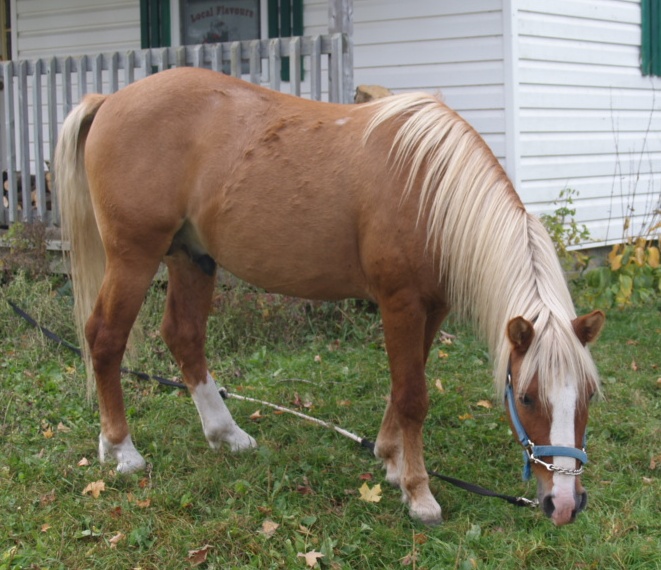
Lac La Croix Indian Pony stallion – Mooke (Ojibway for – he comes forth), October 2008.
Photo by Llcips09 via Wikimedia Commons.
A BBC travel feature published several weeks ago had the hallmarks of a classic progressive narrative. It was the tale of the “endangered Ojibwe spirit horse; the breed, also known as the Lac La Croix Indian pony, is the only known indigenous horse breed in Canada.”
The spirit horse was reduced to near extinction by European settlers who treat these magical creatures, deemed “guides and teachers”, as a mere nuisance to be culled and eliminated in favour of more profitable animals like cattle, or so the telling goes. A native breed of a beloved animal struggling to survive in the face of voracious colonial settlers.
Someone call James Cameron.
Unless you know a little evolutionary history, that is. In which case, you will already be aware that this story is pure pseudoscientific hokum.
Look, no one likes to be disrespectful about sensitive matters where the legitimately oppressed and aggrieved claims of First Nations peoples are concerned. This is a nation that is struggling to come to terms with its own horrific colonial past. This process is taking on many forms: witness the applause granted to singer Jully Black, who recently amended the national anthem “our home on native land”. Or, perhaps, the calls by one NDP MP to combat residential school denialism by passing new laws on hate speech — which would make questioning certain narratives not only an act of heresy, but also a literal crime.
Listening to stories, and respecting lived experiences and oral histories Indigenous people at the core of Canadian history and identity has given a new credibility to the traditional knowledge of First Nations people in academia, media, and in society at large.
But the story of the Ojibwe spirit horse is a clear example of the limits of oral history.
The horses now roaming the plains of North America are not a native species. The horse did evolve on this continent before migrating to Asia and Europe. However, the North American breed is believed to have been extirpated about 10,000 years ago (or thereabouts) during a mass extinction event that wiped out almost all large land mammals.
There is some evidence that isolated pockets of a native horse breed may have survived in North America much later than this, but the horses roaming about today are descended from those that were brought from Europe after the 15th century.
Of course, science is always evolving, but the overwhelming bulk of genetic and archeological evidence to date supports this theory. The native North American horse is long, long gone. The bands of horses freely wandering the backcountry are not wild, but feral; they’re the product of escaped or abandoned horse stock of distant European origin.


