Quotulatiousness

July 5, 2026

Progressives are only against “some people” getting wealthy

Filed under: Business, Economics, Media, Politics, USA — Tags: , , , — Nicholas @ 03:00

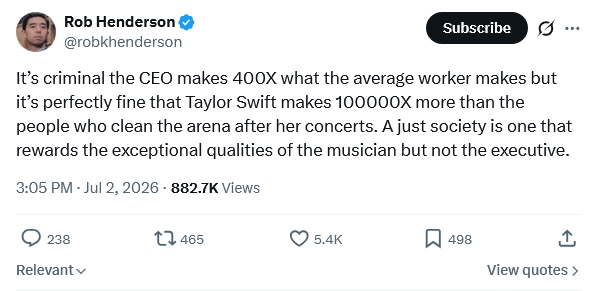
Rob Henderson posted an accurate assessment of how progressives view certain kinds of wealthy people as being undeserving of their fortunes:

Konstantin Kisin explained why this is the case:

This is because the anti-capitalist left is not actually against people being crazy rich. They’re against certain types of people being crazy rich.

Artists and athletes make sense to them because they’ve played music and sports and because their success can be explained by “luck” and “talent”. Messi’s wealth is not offensive to them because they understand Messi is much better at football than they are.

But when it comes to business, the anti-capitalist leftist has no framework for understanding why Jeff Bezos might be super rich since 99% of them have never ever created a product, business or service that was of value to other people. They’ve never taken entrepreneurial risk. They’ve never employed people and felt the burden of responsibility that comes with that. They’ve never pick up a business and given it a play in the way they’ve picked up a ball or a guitar.

They *literally* don’t understand wealth creation. They think there is a fixed amount of money and the only thing a business does is split it unfairly.

It’s why they rage at Elon and other successful business leaders. Because they genuinely don’t understand why they’re wealthy.

Also, and this is just as important, athletes and artists are disproportionately young, attractive, “diverse”, left wing etc. Business leaders are “evil” middle aged white men whose success offends the average anti-capitalist leftist because they don’t understand a) what it is they do and b) that Elon Musk has the same talent advantage on them as Messi does, it’s just harder to measure.

Terni Model 1921: Italian Interwar Assault Rifle with a Cube Mag

Filed under: History, Italy, Military, Weapons — Tags: , , , , , — Nicholas @ 02:00

Forgotten Weapons
Published 16 Feb 2026

After World War One, the Italian military spent some time studying the effectiveness of reduced-power cartridges, including both pistol calibers semiautomatic carbines and submachine guns as well as intermediate-caliber rifles. One of the rifles developed for the subsequent testing was the Terni Arsenal model 1921, of which 200 appear to have been made in total during the 1920s. This rifle used a surprising advanced 7.35x32mm cartridge, firing a 135 grain bullet at 1970 fps. It was a short recoil design and used a Fiat-Revelli style cube magazine. Ultimately the concept was not adopted (probably for reasons of cost), and some of the surviving rifles ended up in Ethiopia — where this example was found a few years ago.
(more…)

QotD: Battlefield communication in the pre-modern world

Filed under: History, Military, Quotations — Tags: , , , , , — Nicholas @ 01:00

Let us assume, picking up our discussion of information last time, that our army is formed up into its battle array (pre-planned the night before, recall) and is advancing and our general has just now noticed something that demands a change in the plan. It could be a dangerous enemy attack (perhaps on the flank) or an opportunity to split the enemy line. Whatever it is, our general needs to make some alteration to the battle plan. It is almost certainly a fairly minor alteration, as with a battle line anywhere from a kilometer to several kilometers long, it would, for instance, take far too long to shuffle the right-to-left order of the line just due to the marching time involved. Nevertheless, the general needs to issue an unplanned, on-the-spot command; how does he do it?

The first option, of course, is shouting. The problem here is obvious: how is the commander’s command to be heard? Interestingly, there has been a fair bit of research by ancient historians looking at the question of how many people can possibly hear a short address unaided by modern loudspeakers and the like; figures vary but generally a few thousand if they are reasonably compact and quiet. That might work for a general’s pre-battle speech, delivered before the army advances, but it will not do for an army that is already in motion, much less once the chaos of battle has begun. Thousands of men marching (let alone fighting!) are noisy!

The modern solution to this problem is radio, but of course that’s hardly available to our pre-modern commander. Instead, to judge by films, the mind quickly jumps to signal flags. I am reminded of Braveheart (1995)’s rendition of the Battle of Falkirk, where Edward I uses signal flags to order his archers forward. HBO’s Rome also does this in its version of the Battle of Philippi, with flags being jostled and then pointed forward to signal the advance. Unfortunately, signal flags – as distinct from unit flags (which we’ll come back to in a moment) – have a few key problems, the most notable of which is that no one will be looking at them: after all the army is advancing, the soldiers are looking forward but signal flags (again, as opposed to unit flags) are going to be behind them, not placed out in the middle of No Man’s Land between the armies. As a result, signal flags are useful for sending information long distances (in a chain of stations or operators), for instance from one commander at distance to another, but not in battle; operational, rather than tactical tools. In practice, the use of signal flags like this is confined to the modern era; the first successful “optical telegraphs” (as iterations on things like smoke signals and fire relays) date to the late 18th century.

Unit flags – a banner or other big, obvious symbol (like a statue of an eagle on a stick) – are more useful. These can be positioned at the front of a unit, typically at its center. If it advances, then the soldiers in the unit also know to advance, following the standard they can see (because it is elevated, large and visible) even if they cannot hear the orders. There are two complications here though: first, the unit banner or flag is a relatively late innovation in antiquity, really only coming into its own with the Romans. The Achaemenids may have used some kinds of ensigns or standards, but the Greeks do not seem to have done. Instead our first really good documentation of something like a battle flag comes from the Romans: each legion had a signa (eventually standardized to the legionary eagle, the aquila), which was a shiny metal statue mounted on a pole so it could be easily seen. Units of the legion broken off to do other things might instead follow a less impressive cloth banner, a vexillum, by which such detachments became known as vexillationes. But the broader problem is that of course your general may not be particularly close to your flags (or other standards) which are generally at the front-center of each component unit of your army. The flags may allow a subordinate officer to “drive” the unit over the battlefield – and that’s good – but it doesn’t let the general tell that officer what to do.

A better option is music, but once again development seems to come fairly late in antiquity. Greek hoplites seem to have advanced to the music of the aulos, a double-reeded flute-like instrument; given the limitations of the instrument it is generally assumed it was used to keep time (so everyone marched in step) not transmit orders. Once again, a more complex system of musical signalling seems to come with the Romans, at least as detailed by Vegetius. Vegetius (2.22) notes three different kinds of horn instruments used by a legion: the tubicen was used to sound charge and retreat, the cornicen regulated the movement of the signa (so “advance” or “halt”), while the buccina was used mostly for camp signals: sounding watches or assemblies. It’s a system that is akin to later bugle calls, but note that the orders it can give are limited to a relative handful of prearranged signals: advance, halt, charge, retreat, assemble, change shift and so on.

The attentive reader here may have already noticed how developed Roman command and control is and may suspect that ties in with the Romans having a more “command” oriented culture of generalship; if so you are ahead of the game!

Of course if those instruments are sounding on a per-unit basis (and they are) that means you still have the problem of getting the order from the general to the instruments for the unit in question. And fundamentally here, the technology is – as I tell my students – man-on-horse. The particular fellow on the horse may be a dedicated messenger (if your military organization has those) or a subordinate officer or it may be the general himself.

But it is important to note now the limitations of this sort of system and we can use what we know of the Roman command and control system (as noted, one of the more developed of such systems prior to gunpowder) to get a sense of them. Let’s say the general realizes there is a problem on his flank and he needs a unit (probably here we’re talking a cohort or a maniple, not a legion) to change what it is doing. First off, the order needs to get within shouting range of the unit’s commander (in this case a senior centurion). The general can either go themselves or send a messenger; both options have their downsides. If the general goes himself he is essentially removing himself from observing or commanding the rest of the battle, but a common problem with sending a junior subordinate is that the unit commander may not respect or feel the need to obey that subordinate (written orders can help with this, but now we’re bringing in questions of literacy). Of course both a messenger or a general in transit may also well be killed, which will prevent the order from being received!

In either case, the message is going to move at galloping speed, which is around 40km/h, meaning that it may take several minutes for the general or messenger to navigate to the spot. That doesn’t sound so bad, but battles with contact weapons do not typically go for hours and hours; Pydna (168) was, as noted last week, decided in about an hour total! Of course a battle might be longer (or shorter!) than this, though much of that extra time is likely pre-battle skirmishing – the actual direct press of infantry formations in shock rarely lasts long because of the terror of it (and to a lesser extent its lethality; we’ll return to the balance of terror and lethality next time). Imagine if you were playing a Total War game and your input delay was, say, five minutes long in a battle that might only last an hour or two.

But of course galloping time isn’t the end of it. The message now has to be conveyed to the unit. In the Roman system, that means the messenger needs to find the appropriate centurion, explain the order to him and then ideally that fellow will then signal the instruments and signa to act accordingly – but even then, those instruments and signa only have a handful of prearranged signals available. Anything more complicated will need to be shouted down the line the old fashioned way (as we know, for instance, the Spartans did for lack of almost any of the rest of this apparatus of command, Xen. Lac. 13.9). Needless to say that means that giving any complex order to a unit already engaged or about to be engaged is going to mean starting by signalling retreat and then attempting to regroup the unit; regrouping an already retreating unit is one of the most difficult tasks on a battlefield and is rarely performed successfully in an unplanned fashion (even in a planned fashion it goes wrong as often as it goes right).

(This is, by the by, why reserves are so important. An unengaged unit hanging behind the lines can be given new orders far, far easier than a unit that is already engaged or about to be. And indeed, those familiar with the Roman system of fighting with its three lines of heavy infantry will note that it is a system heavy on reserves. Indeed, the manipular legion essentially assumes it will be necessary to retreat and regroup the first line of heavy infantry (the hastati) behind the second (the principes) and plans and drills for that. Note how the Roman command culture, the Roman fighting method and the actual apparatus of messengers, signa, instruments and junior officers all align here – that’s common because these sort of institutions tend to co-evolve.

By contrast we may compare a Greek hoplite army in the Classical Period. It has no battle flags or ensigns and the general is expected to fight on foot. In the past I’ve described the resulting phalanx as an “unguided missile” and this is a big reason why. That’s not to say hoplite generals never exerted command on the battlefield – better generals might keep a reserve to be rushed to important points (as Pagondas does at the Battle of Delium in 424 BC). But for the most part, once a hoplite general formed up the army and hit “go”, they had very little control over the army.

Bret Devereaux, “Collections: Total Generalship: Commanding Pre-Modern Armies, Part II: Commands”, A Collection of Unmitigated Pedantry, 2022-06-03.

July 4, 2026

In the “early Victorian period … drinking whisky was the modern-day equivalent of licking hallucinogenic toads”

Filed under: Britain, History, Soccer, USA — Tags: , , , , , , , , — Nicholas @ 05:00

Scotland was terra incognita to the English for far longer than one might think, even though the two kingdoms shared a monarch as early as 1603. On his Substack, Ed West shows how modern day Scotland has long since emerged from the mysterious shadows of the past:

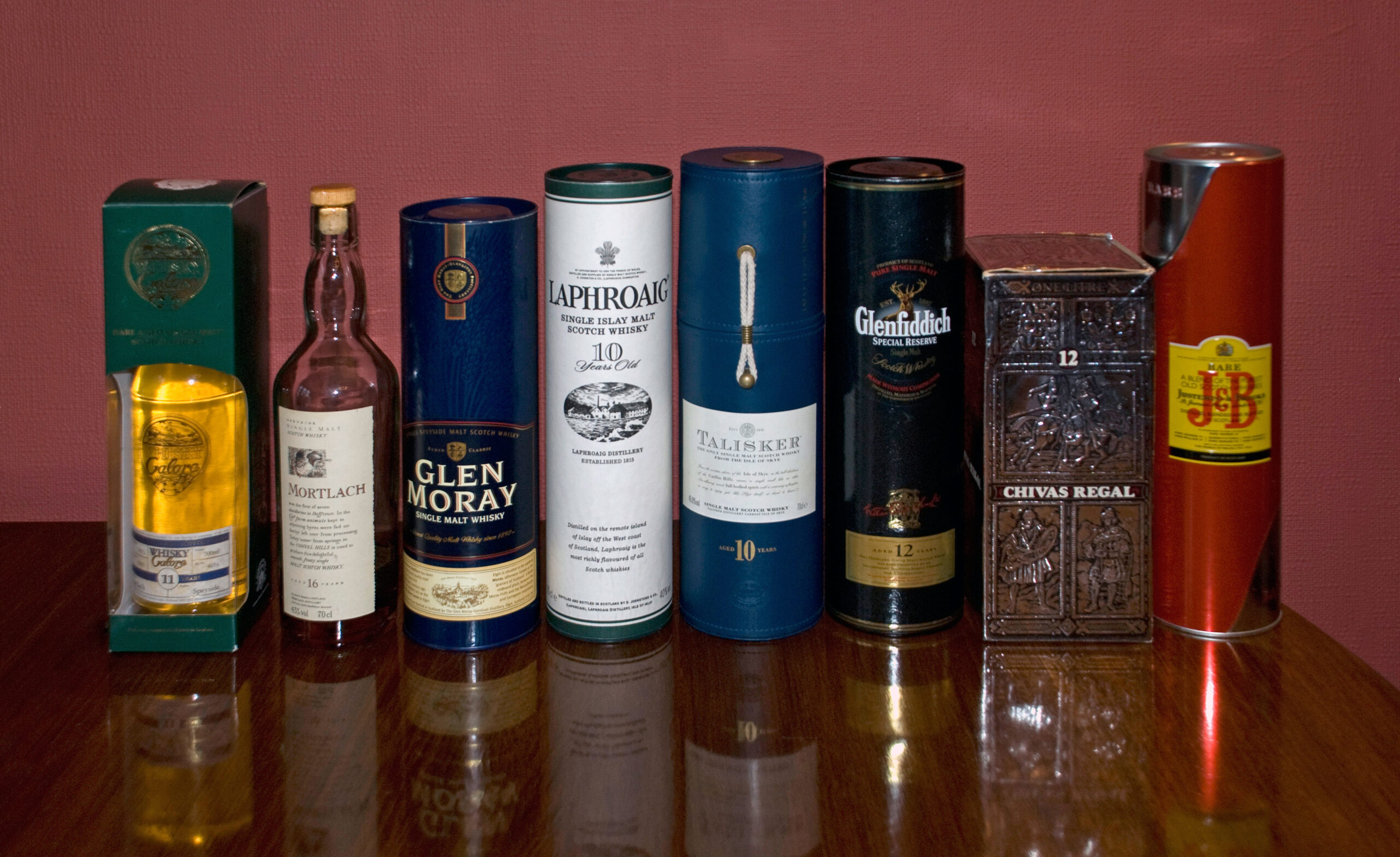
“Scotch whiskies” by Chris huh is licensed under CC BY-SA 4.0 .

In his highly entertaining history of alcohol and the British, Empire of Booze, Henry Jeffreys observed how one effect of the Napoleonic Wars was to make Scotland a popular destination for English holiday makers. What with the continent being isolated and everything, there weren’t many more exotic places for the richer, more adventurous traveller to visit.

The country was until then largely unknown to many people south of the border, something also true of its trademark drink. “Highland and lowland whisky in the early 19th century would have been a mystery to the majority of Englishmen”, Jeffreys writes: “In the literature of the Georgian and early Victorian period it’s apparent that drinking whisky while in Scotland was the modern-day equivalent of licking hallucinogenic toads while in the Amazon or eating rancid whale in Iceland”.

The conflict with revolutionary France proved to be a great boost to Brand Scotland, and not just because of the limits it placed on rival destinations, but also for the dash that the Scots cut on the field. This culminated with a momentous scene in which “the Highland regiments dazzled the French when the Allied armies marched into Paris”.

Here they wowed both friends and enemies alike, and Sergeant Thomas Campbell of the Grenadier Company recalled how the Tsar even personally “examined my hose, gaiters, legs, and pinched my skin, thinking I wore something under my kilt, and had the curiosity to lift my kilt up to my navel, so that he might not be deceived”. Thanks to the likes of the Black Watch and Gordon Highlanders, the Scots had arrived on the global stage, and no one would ever forget Die Damen aus der Hölle (Ladies from Hell) as German troops would later call Highlanders.

This period of upheaval and war – the birth pangs of true modernity — was marked by a growing craze for Highlandism, “a peculiar phenomenon where lowland Scotland, a predominantly settled mercantile society, took on the trappings of the Highlander as a way of differentiating themselves from Englishmen who they were now yoked to in the Union”.

Previously viewed as menacing, the Highlanders had been tamed by the defeat of the Jacobites and the Clearances that followed, making this once-feared Gaelic culture now safe for English speakers to adopt as their own. Much of this was driven by the romantic imagination of Edinburgh’s Walter Scott, who helped shape both Scottish national identity and the 19th century resurgence of medievalism. Perhaps more than literature, however, Highlandism was boosted by the region’s most famous export — whisky. As Jeffreys writes: “The growth of Scotch coincided with the birth of Highlandism”.

The development of Brand Scotland was also helped by a man widely regarded as Britain’s greatest buffoon and waste of space, the former Prince Regent. Historian John Plumb described a hugely influential visit by the now George IV in 1822, where: “He paraded Edinburgh in the kilt, resplendent in the Royal Stuart tartan and flesh-coloured tights, and yet managed to keep his dignity. The Scots loved it! Quaintly enough, George IV had struck the future note of the monarchy … Be kilted! Be sporans! Be tartans! Riding up Princess Street … To the roaring cheers of loyal Scots, he was showing the way that the monarchy would have to go if it were to survive an industrial and democratic society.”

It was the start of a beautifully symbiotic relationship, with the Royal Family immersing themselves in Highlandism ever since, spending much of their summer holidays there and helping to project an ideal of a region famed for its dramatic countryside, castles, distilleries and golf courses. They’re not alone: Donald Trump, whose mother hailed from the Isle of Lewis, has a noted fondness for the old country, even if this is not always reciprocated, and no doubt many more of his compatriots will be making the pilgrimage in the coming year thanks to the country’s newest brand ambassadors. These are, of course, another occupying force of Scots, the fans of the national football team who followed their country’s brief recent appearance at World Cup.

The Scots in Boston marched as proudly as their ancestors. Their bagpipers serenaded the opposition. Some even turned up at a wedding. They came to watch the Boston Red Sox, which one local described as “the best thing that’s happened in years”. They attracted many neutrals, including a duck. Folk songs were written about them. Everyone loved them, even if some struggled to understand them.

The Boston Globe published a full-page letter thanking them. One local reported how Scotland fans leaving Boston was “almost like a day of mourning for the Americans“. After they left, Massachusetts State Senator Paul Feeney made an emotional farewell, thanking them for visiting children’s hospitals and donating money to local charities: “You’ve been great, courteous guests, you’ve been polite and you’ve been fun and I don’t want that to end”. He invited them to return next year, by which time Glasgow will be twinned with Boston. Indeed, Scottish fans so impressed the Bostonians that the city changed its zoning laws, not an easy task in America. They may even have solved the fertility crisis. Indeed, the Tartan Army charm offensive in Boston has been so overwhelming that I half suspect it’s some sort of devious RICU operation.

The Dark Truth Behind America’s National Anthem

The Rest Is History
Published 8 Jun 2026

How did the War of 1812 result in America’s national anthem, The Star Spangled Banner? Who came up with it? And, why does this origin story make the anthem so controversial?

Join Dominic and Tom as they launch into the first episode of their Football World Cup special, with the story behind America’s national anthem, and its secret story.

0:00 – Lloyd’s
01:21 – The Star-Spangled Banner
02:43 – A World Cup Series on National Anthems
04:08 – America’s Most Controversial Anthem
05:00 – The Forgotten War of 1812
09:10 – Britain Strikes Back
11:39 – Francis Scott Key Boards the British Fleet
15:27 – The Bombardment of Fort McHenry
18:14 – The Giant Flag That Inspired the Anthem
20:41 – Francis Scott Key Writes the Poem
23:28 – Why the Anthem Used an Old English Tune
26:13 – The Anacreontic Song
29:07 – How the Song Became a Hit
30:37 – The Times
31:48 – Is The Star-Spangled Banner About Slavery?
36:08 – Escaped Slaves and the British Army
40:55 – The People Who Found Freedom Under the Union Jack
42:29 – Francis Scott Key’s Complicated Legacy
47:06 – The Song Spreads Across America
51:39 – Why America Took So Long to Get a National Anthem
56:42 – How It Finally Became the Anthem
57:06 – Controversial Performances
1:00:17 – Colin Kaepernick and Taking the Knee
1:02:39 – Can You Separate the Anthem from the Author?
1:03:03 – The Abolitionist Version of the Anthem
1:04:13 – Coming Next: God Save the King
1:06:33 – The Rest Is History Club

Video Editors: Jack Meek, Harry Swan + Adam Thornton
Social Producer: Harry Balden
Producers: Tabby Syrett & Aaliyah Akude
Senior Producer: Callum Hill
Executive Producer: Dom Johnson
Chief Digital Officer: Sam Oakley

“The fact that [Canadians] cannot define our values should concern every one of us”

Filed under: Cancon, Government, History, Media, Politics — Tags: , , , — Nicholas @ 03:00

While our American neighbours are busy celebrating their 250th anniversary, Canadians are still left wondering why we can’t seem to define what our own values are except in opposition to those of the United States. Eva Chipiuk discusses this briefly here:

In writing my book, Reconnect to Canada, the most difficult part was not recounting our history or explaining our political and legal systems. It was answering a simple question:

What does it mean to be Canadian?

Over the last few years, I have asked that question repeatedly.

It was clear that something fundamental had shifted, but I could never quite articulate what it was.

The responses to that question were revealing, and most telling was that there was no common answer at all.

Some said hockey. Some said healthcare. Others said diversity or simply that Canadians are “nice”.

The fact that we cannot define our values should concern every one of us.

Then I came across this article, and it put things into perspective:

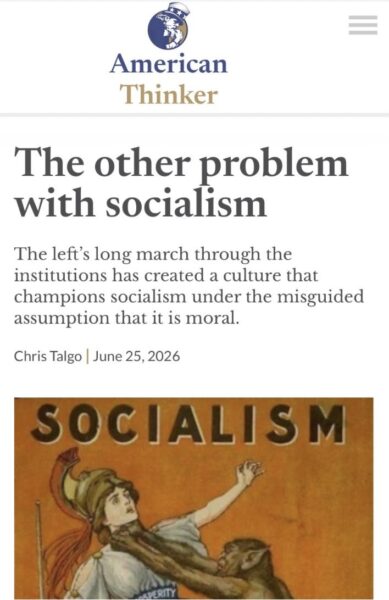
    Socialism, in its depraved but effective way, appeals to people’s worst instincts and impulses. It presents the world as a zero-sum game in which there are winners and losers. It pits groups of people against each other based on arbitrary measures. For the narrow-minded, it makes sense.

    It embodies most of the seven deadly sins.

    Pride: Socialists have zero humility because they reject the fallibility of humanity. They can micromanage an entire society. They can create a centralized, one-size-fits-all, command-and-control utopia. They know all and know best.

    Envy: Taking one’s property because they have too much to give to others who have less is not noble; it is theft. Stealing with state-sanctioned approval is unjust. The sheer resentment that some have more, better, or bigger material possessions is the driving force of socialist ideology.

    Wrath: Socialist doctrine fuels anger, rage, violence, and a desire for vengeance against the so-called oppressors. Instead of mimicking the successful, the people turn their ire toward them.

    Sloth: Because socialism is about passing the buck and the blame, it excuses idleness and promotes laziness. It allows one to shirk personal duties and retards personal growth.

The uncomfortable truth is that Canada increasingly reflects these traits, yet we refuse to acknowledge it.

We insist we are compassionate while shaming and disparaging those who hold different opinions.

We claim to value equality while encouraging envy.

We preach inclusion while dividing Canadians into competing groups.

We speak of unity while constantly finding new reasons to divide ourselves.

We demand accountability from everyone except the government.

We expect government to solve problems that citizens, families, communities, and free people once solved themselves.

Worst of all, we have become experts at pretending none of this is happening.

We congratulate ourselves on being tolerant, generous, and virtuous while our institutions fail, productivity declines, public debt explodes, trust evaporates, and Canadians become more divided than they have been in decades.

That is not something to celebrate.

It is something to confront.

If Canadians can no longer articulate what it means to be Canadian, perhaps it is because we have abandoned the principles that once defined us: freedom, personal responsibility, hard work, accountability, respect for the rule of law, and service to one another rather than dependence on the state.

You do not need to take my word for it.

Just open your eyes. Look around!

A country does not lose its identity overnight. It loses it one abandoned principle at a time.

A nation without shared values eventually becomes little more than a collection of people living within arbitrary borders.

So if we are going to celebrate Canada today, let us celebrate the principles that made this country worth celebrating in the first place and commit ourselves to restoring them where they have been lost.

Flag image candy for the 4th of July

Filed under: Food, History, USA — Tags: — Nicholas @ 02:00

Lofty Pursuits
Published 13 Jun 2018

At Lofty Pursuits we make hard candy using techniques and equipment from the 1800’s. Here we are making Blue Berry and Strawberry shortcake candy in a pattern inspired by the American flag for flag day and the 4th of July. This is one of our most complex designs as it does not have an outer wrap. The video covers some fun bits about the history of the American Flag.

Get our candy here: http://www.pd.net

QotD: “Yankee Doodle”

Filed under: Britain, History, Italy, Media, Quotations, USA — Tags: , , , — Nicholas @ 01:00

Everyone in America knows “Yankee Doodle”. That is a remarkable thing to be able to say about any piece of music, let alone one written in the middle of the eighteenth century by a British army surgeon who meant it as an insult. Most of us learned it before we learned to read. It arrives through some combination of school, parade, ice cream truck, and the ambient cultural air of the American summer, and by the time you can name it you already know it. You know the melody before you know the words, and you know the words before you know what any of them mean. A feather. A pony. Macaroni. A young man coming to town. It is the most familiar song in the American songbook and also, when you actually look at it, one of the strangest.

[…]

Which is how we ended up with a patriotic standard that is also a death threat, a sodomy joke, a farm boy’s account of watching grown men handle their enormous guns with mounting enthusiasm, and the song we teach five year olds at Fourth of July parades. All of this has been inside the song the whole time. I want to walk through what is actually in there, because once you can see it you cannot stop seeing it, and I think we owe the song more than we have been giving it.

Start with the title, because the title is already doing two things at once. “Yankee” is almost certainly from the Dutch Janke, a diminutive Dutch settlers in New York used to mock their English neighbors. The British army picked it up as convenient shorthand for a provincial American. A rube. A man of no consequence. “Doodle” meant fool, from the German dudel, and this is the part that makes it into the elementary school music program. The part that does not is that “doodle” was also eighteenth-century British slang for a penis. Both meanings were in active circulation. Neither was obscure. When the British handed this song to their regulars as a marching tune intended to demoralize the enemy, they were calling the colonists provincial idiots and, on a second pass, Yankee dicks. The American troops heard the title and, in the great tradition of men who have already stopped caring what anyone thinks of them, said yes, that one, put it on the flag.

The first thing the song was is a threat.

    Yankee Doodle’s come to town / For to buy a firelock / We will tar and feather him / And so will we John Hancock.

British soldiers were singing verses like this one in the run-up to Lexington. Tar and feathering was not a prank. It was a ritual. Men were stripped, had boiling pine tar poured directly onto bare skin, rolled in feathers while the tar was still cooling, and paraded through town as public spectacle. The skin came off with the tar. Some victims died in the days that followed from shock and from infections in the raw flesh. The British soldiers are singing about doing this to a specifically named man. John Hancock. The wealthiest man in Boston, already on London’s list for arrest. “So will we John Hancock” uses his name as a verb. We will do this to him. We will use his body to make a point.

The soldiers singing this were on their way to arrest him. They missed. Hancock got through Lexington, made it to Philadelphia, and in the summer of the following year signed the Declaration of Independence in letters so large that his name became, in English, the common noun for a signature. The verb became the noun. We will destroy you publicly became I was here, I did this, come and get me. The song that had been a mob-violence threat against a living dissident was now, a year later, being sung by the men who had saved him as they mustered for the same war. The target of the verse became the architect of the country that kept the verse. This is the first transformation the song undergoes and it is not subtle. It is also not the last.

The second thing the song is is a sodomy panic. He stuck a feather in his cap and called it macaroni. Every American schoolchild has been told this means the colonist was too stupid to know what fashion was. That is the sanitized reading. The full reading requires understanding what the Macaroni Club was. Young English aristocrats came back from the Grand Tour in Italy wearing wigs so tall they required structural adjustment to pass under a doorframe, corseted coats, embroidered slippers, and Continental affectations so pronounced the London press began printing caricatures of them within the year. “Macaroni” meant dandy, in the same dictionary-accurate way “doodle” meant fool. Technically correct. Missing the entire point.

The point is that the Macaroni Club had become, by the 1770s, a convenient public container for British anxieties about male effeminacy, foreign moral contamination, and sodomy. The caricatures drew them in pinched silhouettes and muffs, in poses the London audience was supposed to read as unmistakably queer. The courts were not caricaturing. They were prosecuting. Men were pilloried. Others were executed. The word “macaroni” was carrying the weight of active criminal cases at the exact moment “Yankee Doodle” was being composed. A British army surgeon named Richard Shuckburgh is the likely author of the most famous macaroni verse, and what he wrote was a joke with a second floor. On the ground floor: the colonial rube does not know what high fashion is and mistakes a single feather for an entire wardrobe. On the second floor: the colonial rube has just put on the signifier of a group of men the British state is currently prosecuting for sodomy, and he does not realize what he has announced himself as. He is a joke to the troops singing the song, and the joke is that he is queer and does not know it.

The colonists heard all of this and kept the song anyway. The British were banking on a shame that had already dissolved. You cannot humiliate a people that has stopped needing your approval. The song arrived as an instrument of British contempt, and the colonists adopted it anyway, and from that moment on it stopped being a British song and started being something else. A vessel. Whatever the singer needed it to carry, the song carried. That is the reclamation, and it is also the engine of everything that happens to the song from here.

Emma, “Yankee Doodle, Undressed”, Past Life, Present Cleavage, 2026-04-22.

July 3, 2026

The latest trend in tourism: “grocery tourism”

Filed under: Australia, Food, Japan, USA — Tags: , , , , , — Nicholas @ 05:00

At The Freeman, Nicole James discusses being so far ahead of a trend that it’s only just catching up with her now:

“Piggly Wiggly” by afiler is licensed under CC BY-SA 2.0

Grocery tourism is the hot trend of 2026 according to Condé Nast Traveler. This is all well and good, but also a bit late to the trolley because I have been practicing this trend since my twenties, although without the benefit of a name or a hashtag.

My two worlds met in the supermarket aisle. Before I was a travel writer and sent to places with hotel beds that appeared to have been prepared for minor royalty or a very clean corpse, I was a checkout chick at supermarket chain Coles. This was when prices were typed in by hand, making me feel like I was conducting a low-level NASA launch procedure.

A tin of pineapple rings would trundle towards me, and I would punch in its code. Behind it would come shampoo, fish fingers, instant pudding, 24 cans of Diet Coke, and a packet of aspirin. From these items, I could deduce entire family systems. Marriage trouble. School excursions. Flu. A birthday party. A woman about to murder everyone in her house unless she got a Mint Slice into herself immediately.

I loved the products. Not necessarily the customers who could turn feral over a five-cent discrepancy in canned tomatoes. The conveyor belt was a pageant of human need. It was anthropology in a polyester apron.

When people now declare that they have discovered grocery store tourism, I feel like saying, “We know. We’ve had those for years.”

My first trip to America should have been my grand supermarket awakening. I was a PR manager for Malaysia Airlines in the late ’90s, and we were launching a very long flight to New York from Sydney via KL and Dubai. I arrived bristling with ambition. I wanted to see the cereal aisle. Long had we heard rumors of American supermarkets. They were great glittering cathedrals of corn syrup with aisles devoted just to cereal and marshmallows in the shapes of everything from the moon and stars to presidents. I wanted to stand before them all in awe, like Moses, if Moses had come down from the mountain carrying Pop-Tarts.

[…]

I once stood in a Japanese aisle looking at 15 varieties of bottled tea and felt the kind of reverence other people reserve for stained glass. This is the point of grocery tourism. It’s anthropology with a basket.

Every country gives itself away eventually. This is usually somewhere between the biscuits and the cleaning products. Finland offers Moomins in places no Australian supermarket would dare put a cartoon hippo. Singapore understands the spiritual importance of salted fish skin. Sweden puts things in tubes that should never be in tubes and then offers fermented herring.

And then the Netherlands has licorice. The Dutch have built an entire moral philosophy out of licorice. Sweet, salty, double-salty, hard, soft, shaped like coins, cars, and warnings from your dentist. I’ve always admired the Dutch, but this commitment to black chewy punishment is heroic. Sweden is not to be outdone and has thus flirted with licorice-flavored chips.

Then there are the products that cause the traveler to stop dead and reconsider the whole Enlightenment. In Vietnam, I couldn’t walk past snake wine without dancing an involuntary flamenco of horror. There was a snake in a bottle suspended in alcohol. Sometimes there were scorpions.

South Korea has canned silkworm pupae. Peru has coca tea. Colombia has arequipe. America has cheese in a spray can, which I respect as both a product and a cry for help.

And now, social media has turned all of this into content. Travelers narrate the experience into their phones. A German soccer fan can wander into an American Waffle House at one in the morning and emerge as a folk hero. Erewhon in Los Angeles has become a celebrity shrine where a smoothie can cost more than a small household appliance and one strawberry comes packaged like an engagement ring and with a similar price.

Grocery stores offer the rarest thing in modern travel, the uncurated ordinary. The supermarket is the one place travel cannot fully manicure itself. Hotels can lie. Brochures can lie. Restaurants, especially the ones with menus printed on thick paper, can lie beautifully. But supermarkets are hopeless at lying. They’re too busy. They’re too full of nappies and mince.

Was this workbench a huge mistake?

Filed under: Tools, Woodworking — Tags: , , , — Nicholas @ 04:00

Rex Krueger
Published 1 Jul 2026

Get the plans!
The Big Nick: https://www.rexkrueger.com/store/p/big-nick-bench
The English Joiner’s Bench: https://www.rexkrueger.com/store/p/joiners-bench-bundle-everything-about-the-bench
The Minimum Timber Bench: https://www.rexkrueger.com/store/p/minimum-timber-bench
(more…)

1977 – when the French intelligentsia rallied to protect pedophiles

Filed under: France, Health, History, Law, Media, Politics — Tags: , , , , , — Nicholas @ 03:00

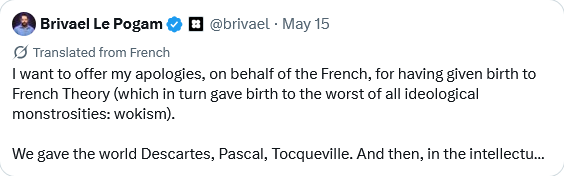
On the social media site formerly known as Twitter, Brivael Le Pogam poinpoints the formal attempt to turn criminal pedophilia into academically supported individuals with “Minor Attraction” (translated from the original French by X):

In 1977, a petition appeared in Le Monde and Libération. It called for the decriminalization of sexual relations between adults and children aged thirteen. Look at the signatures. Foucault. Derrida. Sartre. Beauvoir. Barthes. Deleuze. Guattari. Lyotard. Sollers. The entirety of the French intellectual aristocracy, the very same that would go on to colonize Yale and Berkeley, gathered under a text that pedantically explains that the child is capable of consenting.

This is not an anecdote. It is the proof.

A few days ago, I wrote that French Theory rested on a single thesis: there is no truth, there are only relations of power. I was told I was caricaturing, that these men were too subtle to be reduced to a slogan. Very well. Then let us observe what subtlety produces when pushed to its extreme.

If every norm is merely domination in disguise, then the prohibition protecting childhood is a form of domination like any other. If every truth is a construction, then innocence is a construction. If every desire is worth every other because no law is legitimate, then there is no longer any reason to defend the most elementary boundary that a civilization has ever established. They did not sign this petition despite their philosophy. They signed it because of it. It was the logical conclusion of the system. They simply had the imprudence to write it down in black and white, before their American heirs learned to wrap the same logic in more cautious vocabulary.

This is the man still taught in undergraduate courses. This is the thinker still cited with reverence at conferences. The one who, in 1977, thought the law protected children a little too much.

A thought is judged by what it makes possible. A thought that, when it reaches its term, no longer knows how to say why one does not touch children is not a subtle thought. It is a dead thought. And a civilization that continues to teach it with deference is not subtle either. It is complicit.

One does not deconstruct innocence. One protects it. It is even more or less the only thing one has no right to fail at.

Beef Bourguignon for the French Peasants from 1885

Filed under: Food, France, History — Tags: , , , , — Nicholas @ 02:00

Tasting History with Max Miller
Published 6 Jan 2026

Stewed beef in red wine sauce with onions

City/Region: France
Time Period: 1885

Originally a peasant dish, early beef bourguignon was a sauce for leftover stewed beef. Elevated and popularized by the father of French haute cuisine, Auguste Escoffier, it shortly thereafter made the transition from a sauce to stew, and beef bourguignon was further popularized by cooking icon Julia Child.

This recipe from 1885 is for the sauce version, and it is just as delicious as the modern stew. It’s a little more wine-forward and a little less sweet, the meat is fall-apart tender, and the onions are my favorite part. If you have some leftover cooked beef like a roast or short ribs, this sauce is a great way to jazz it up. Otherwise, make the stewed beef as instructed in the recipe below because the sauce is absolutely worth it.

    Boeuf Bourguignonne
    Brown a piece of pork belly, diced, in butter; add a little flour, salt, and pepper, and add a mixture of half broth and half red wine; add a few small white onions, well peeled; let cook for 20 minutes, then add to this sauce your stewed beef, cut into slices. When the meat is well heated through, serve with the sauce.
    La Bonne Cuisine Pour Tous ou l’Art de Bien Vivre a Bon Marché by Marcel Butler, 1885

(more…)

QotD: Matthew Josephson’s The Robber Barons

Filed under: Books, Economics, History, USA — Tags: , , , , , — Nicholas @ 01:00

The catalyst for this negative view of American entrepreneurs was historian Matthew Josephson, who wrote a landmark book, The Robber Barons. Josephson, the son of a Jewish banker, grew up in New York and graduated from Columbia University, where he was inspired in the classroom by Charles Beard, America’s foremost progressive historian — and a man sympathetic to socialism. “Beard was nothing less than a spellbinder”, Josephson recalled, and Beard’s lectures helped guide him on a path to radical politics.

During the 1920s, after graduation, Josephson became a journalist, an expatriate to France, and, after his return, a part of New York’s literary elite. He and Beard reconnected in 1930, and the mentor urged his student to write a book denouncing the men who had launched America’s industrial power. “Oh! those respectable ones”, Beard said of America’s capitalists, “oh! their temples of respectability — how I detest them, how I would love to pull them all down!” Happily for Beard, Josephson was handy to do the job for him. Josephson dedicated The Robber Barons to Beard, the historian most responsible for the book’s contents.

Josephson began research for his book in 1932, the nadir of the Great Depression. Businessmen were a handy scapegoat for that crisis, and Josephson embraced a Marxist view that the Great Depression was perhaps the last phase in the fall of capitalism and the triumph of communism. In a written interview for Pravda, the Soviet newspaper, Josephson said he enjoyed watching “the breakdown of our cult of business success and optimism”. He added, “The freedom of the U.S.S.R. from our cycles of insanity is the strongest argument in the world for the reconstruction of our society in a new form that is as highly centralized as Russia’s …”

Though not a member of the Communist Party, Josephson co-authored an open letter of support for the Communist Party candidates for President of the United States in 1932. “We believe”, the letter said, “that the only effective way to protest against the chaos, the appalling wastefulness, and the indescribable misery inherent in the present economic system is to vote for the Communist candidates”.

Josephson traced the troubled capitalist system of the 1930s back to the entrepreneurs of the late 1800s. Thus, by explaining what he thought was the wasteful, greedy, and corrupt development of steel, oil, and other industries under capitalism, Josephson was explaining to readers why the Great Depression was occurring. “I am not a complete Marxist”, Josephson insisted, “But what I took to heart for my own project was his theory of the process of industrial concentration, in Vol. 1 of [Marx’s] Capital, which underlay my book”.

Josephson never intended to write an objective view of American economic life in the Gilded Age. He did little research and mainly used secondary sources that supported his Marxist viewpoint. As he had written in the New Republic, “Far from shunning propaganda, we must use it more nobly, more skillfully than our predecessors, and speak through it in the local language and slogans.” Thus he wrote The Robber Barons with dramatic stories, anecdotes, and innuendos that demeaned corporate America and made the case for massive government intervention.

Burton W. Folsum, “How the Myth of the ‘Robber Barons’ Began — and Why It Persists”, Foundation for Economic Education, 2018-09-21.

July 2, 2026

Reining in the administrative state – Humphrey’s Executor overruled by the Supreme Court

Filed under: Bureaucracy, Government, History, Law, USA — Tags: , , , , — Nicholas @ 04:00

One of the two US Supreme Court rulings this week that sparked controversy was the court’s decision to overrule a 1935 precedent that enabled the growth of the administrative state:

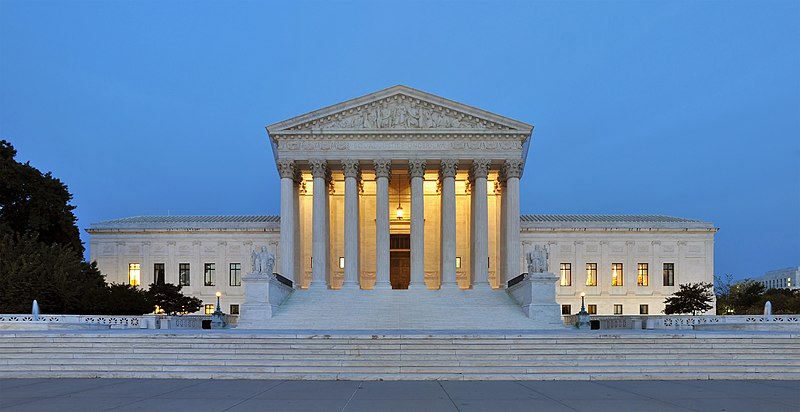
Panorama of the west facade of United States Supreme Court Building at dusk in Washington, D.C., 10 October, 2011.
Photo by Joe Ravi via Wikimedia Commons.

The Supreme Court this week restored an old-fashioned constitutional idea: if a principal federal officer exercises executive power, the president must be able to remove him. The justices’ 6–3 ruling in Trump v. Slaughter, which struck down a law prohibiting the president from firing members of the FTC except for cause, is the logical endpoint of a 15-year series of cases that have steadily chipped away at Humphrey’s Executor, the 1935 decision that blessed for-cause removal protections for the heads of so-called independent agencies.

The Court didn’t mince words. Chief Justice John Roberts wrote that “Humphrey‘s framework, in short, has not withstood the test of time”. Then came the sentence that will launch a thousand administrative-law articles: “If anything more is left of Humphrey‘s, we overrule it”. The New Deal compromise that invented quasi-legislative agencies has finally met Article II of the U.S. Constitution.

That’s good, because the Federal Trade Commission isn’t a debating society. It, along with its alphabet-agency brethren, writes rules with the force of law, investigates private parties, adjudicates violations, and sues in federal court on behalf of the United States. Whatever labels Congress attached to that body in the Progressive Era, the FTC — like the FCC, SEC, NLRB, and so on — today exercises executive power. And the Constitution vests “the executive power” in one president, not in commissioners serving staggered terms, answerable to no one whom voters can fire.

This ruling isn’t a gift to Donald Trump or his successors. It’s a restoration of constitutional accountability. Congress can create executive-branch agencies and specify what they may do, but it cannot create a fourth branch of government and then pretend its officers are independent of the only person the Constitution makes responsible for executing federal law.

Roberts put the point crisply at the end of Slaughter: “Subordinates who exercise the President’s power are subject to removal by him”. That’s a unitary, not an imperial, presidency, and it’s a hallmark of republican government. The president remains constrained by statutes, appropriations, courts, Congress, elections, and the Constitution itself. If the people dislike how the FTC enforces the law, they should be able to blame — and replace — the president, not chase a goulash of insulated mandarins.

Justice Neil Gorsuch’s concurrence adds the important next step. Killing Humphrey’s Executor doesn’t cure every constitutional disease in the administrative state. It simply reallocates the power Congress poured into independent agencies. As Gorsuch warned, “the fourth branch’s powers still exist; they have just been reassigned to the President”. If agencies possess vast legislative and judicial authority, the answer isn’t to hide those powers from presidential control, but to restore legislative powers to Congress. Make Congress great again!

Canada has to stop defining itself as merely “Not-America”

Filed under: Cancon, Food, Media, USA — Tags: , , , , — Nicholas @ 03:00

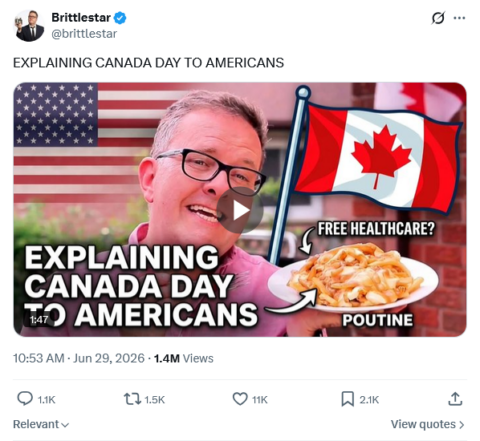
Devon Eriksen responds to a cringey video that claims to explain Canada Day to Americans. The thumbnail image includes some of the usual suspects for this kind of embarrassing nonsense — “free healthcare!” … “poutine!”.

Once again, we see that Canada defines itself as Not-America.

So much so that in the very video where they try to explain their national identity, they require Straw-America as a prop.

But, having embraced multiculturalism and ethnic erasure of White people, they have painted themselves into a corner. Any positive Canadian identity, which identified Canada as what it is, rather than what it is not, would by definition distinguish it from other countries in the world, rather than just America. And this would exclude people of and from those cultures from being Canadian.

Which would be racist, or something.

So what this ends up meaning is that you may talk about what distinguishes Canada from America, and why Canadians are not American and Americans are not Canadian.

But you may NOT talk about what distinguishes Canada from India, and why Canadians are not Indian and Indians are not Canadian.

Or they’ll throw you in jail.

No culture, group, or organization can survive indefinitely by defining itself with a negative, which is why, for example, there are no atheist churches.

Canadians, accordingly, now share no common values, no common ethos, telos, or even logos, have nothing they can agree on, and nothing that binds them together other than physical geolocation and legal jurisdiction.

This is not patriotism, and patriotism, while it is regarded by liberals as a sort of embarrassing social disease, is actually required to get humans to act in concert for mutual good.

Canadians need something to celebrate on Canada Day other than their fear and resentment of Americans who barely think about them at all in any given month.

I honestly don’t know what the average Canadian would say, if he was asked to define a Canadian without referencing America. If he was asked to define a Canadian in a way that didn’t include Brits or Australians. If he was asked to define a Canadian in a way that didn’t include government programs and minor food idiosyncrasies.

You can’t just be the nation of gravy and cheese curds on fries.

You have to stand for something.

“Poutine” by JoePhoto is licensed under CC BY 2.0 .

YourSmartAsianFriend also responds to the video:

Now from a real Canadian:

You better have a snack with you because wait times in Emergency often exceed 10 hours.

Most of us don’t eat poutine — or do so on rare occasion — but eating probably the most unhealthy dish ever conceived not something to boast about.

The entire system is fine but again, bragging about a your measurement standard is absurd, and moreover if you ask most Canadians what their height is, they’ll respond: 5’6, 6’2, etc. … if you say … he was 184 cm … you’ll get mostly blank looks.

Our plastic bag milk is wholly subsidized and controlled by our government dairy cartel — insuring higher prices for all.

What we also have is: emergencies act unlawfully used to crackdown on citizens including seizing their bank accounts, media funded by the government and thus beholden to them. New censorship laws on the way resulting in even more tech companies saying they’ll leave Canada. The highest cellphone rates because again we have regulated our own phone company cartel. We have severe housing shortages (while importing millions of undocumented and temporary visa foreigners) driving housing prices to astronomical levels. We have indigenous peoples now making legally endorsed claims to developed land calling into question much of Canada’s development — the same indigenous groups who have been funded with huge sums and have carved out their own independent country within Canada with the threat of going even farther.

There are many more issues, however, fear not — we have utterly vapid Liberal memes to distract us!

Full disclosure: on Tuesday I actually did order and eat a plate of poutine in a restaurant. In my defence, it was the first poutine I’d eaten in several months … while I enjoy the dish that has been described as “the culinary equivalent of having unprotected sex with a stripper in the parking lot of a truck stop in eastern Quebec”, it’s a very occasional item in my diet.

« Newer PostsOlder Posts »

Powered by WordPress