Quotulatiousness

March 22, 2026

“In 1800, most people worked the land. By 1900, most didn’t. … That’s a psychological earthquake”

Filed under: Education, Europe, Health, History, USA — Tags: , , — Nicholas @ 03:00

On the social media site formerly known as Twitter, L. Wayne Mathison points out just how vast the disruption of normal, traditional lives over less than a century has torn most of us from our historical moorings:
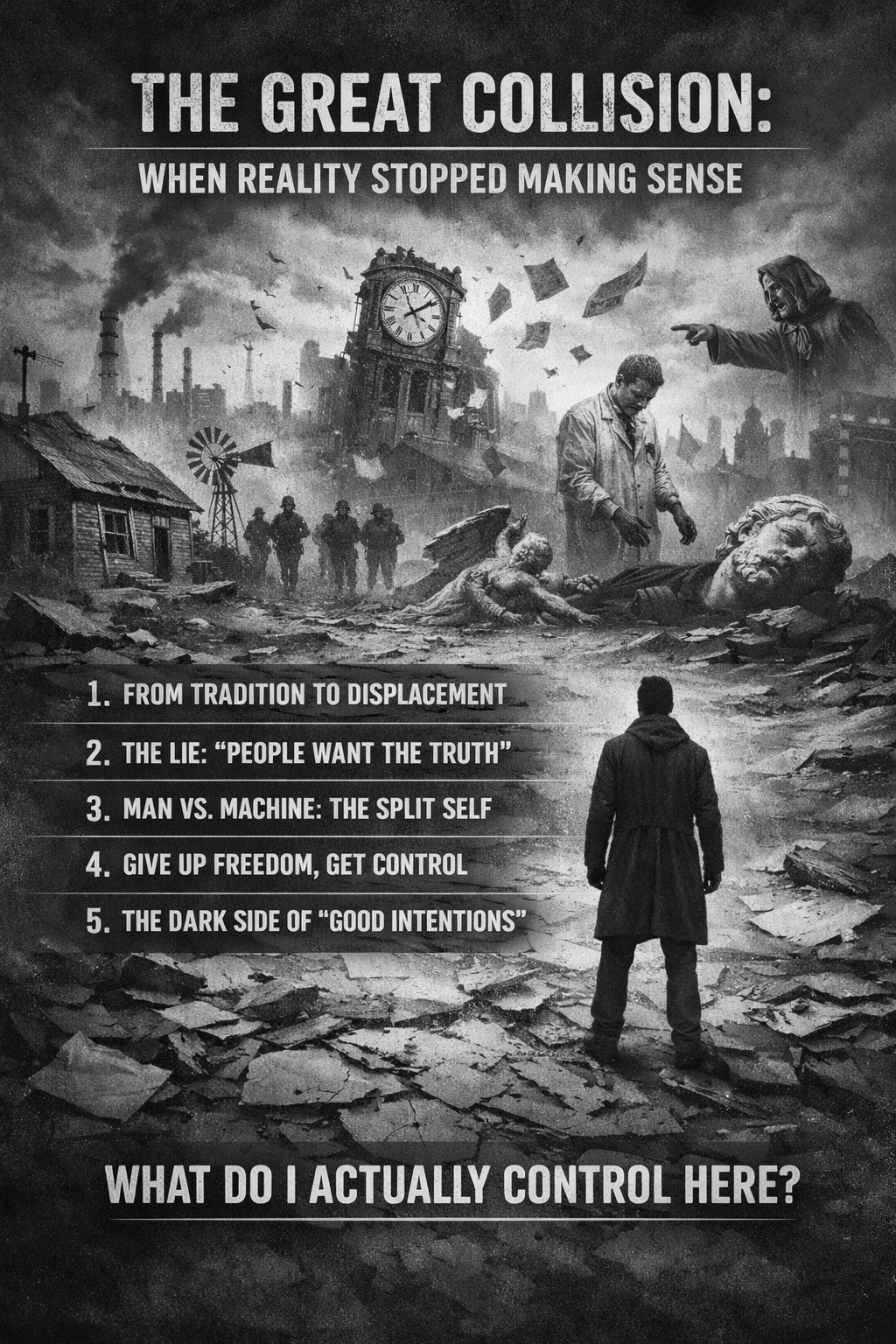
Image generated with AI

The Great Collision: When Reality Stopped Making Sense

For most of human history, life wasn’t confusing. It was hard, yes. Brutal, often. But simple.

You were born into a pattern. You followed it. You died in it.

Then the 20th century showed up like a wrecking ball.

What people call “progress” was really a mass psychological dislocation. We didn’t just move from farms to cities. We lost the structure that told us who we were.

We solved survival. Then immediately created a meaning crisis.

That’s the trade nobody advertises.

1. The Shock: When Life Broke Its Own Pattern

People think industrialization was about better tools. It wasn’t. It was about ripping people out of identity.

In 1800, most people worked the land. By 1900, most didn’t. That’s not a statistic. That’s a psychological earthquake.

Tradition vanished faster than people could adapt. So the state stepped in and did what states always do. Standardize. Educate. Normalize.

Mass schooling didn’t just teach reading. It replaced lost culture with manufactured culture.

Useful? Yes.

Neutral? Not even close.

You don’t remove a thousand-year identity system and expect people to just “figure it out”.

They don’t. They drift.

2. The Lie We Tell Ourselves: “People Want the Truth”

No, they don’t. They want to feel right.

Semmelweis proved it. Doctors were killing women by not washing their hands. When he showed them, they didn’t thank him. They rejected him. Destroyed him.

Why?

Because truth wasn’t the problem. Identity was.

If the facts say “you’re causing harm”, and your identity says “I’m a healer”, most people will reject the facts. Not update the identity.

That’s the Is vs Ought gap in plain terms:

The world is what it is
You believe what should be
When they collide, you protect the belief

Not truth. Belief.

That’s not stupidity. That’s self-preservation.

3. The Split: Are You a Person or a Machine?

Here’s the quiet tension nobody resolves.

You experience yourself as a decision-maker. You choose. You judge. You act.

But science describes you as chemistry and electrical signals.

Both are true. And they don’t fit together cleanly.

The old world said: you are a moral agent.

The modern world says: you are a biological system.

So which one is responsible when something goes wrong?

If you lean too far into “machine”, responsibility disappears.

If you lean too far into “agent”, you ignore constraints.

Most people bounce between the two depending on what excuses them fastest.

4. The Dangerous Shortcut: Let Someone Else Decide

Freedom sounds nice until it demands something from you.

Dostoevsky nailed this. People don’t just want freedom. They want relief from it.

So they trade it. Quietly.

Security, comfort, certainty. Those become the new gods.

And then comes the predictable move. Someone steps in and says:

“I’ll decide what’s good for everyone.”

History has a word for those people. It’s not flattering.

Once you remove any higher standard, the only thing left is preference backed by power.

That’s when things get ugly fast.

5. When “Good Intentions” Go Off the Rails

This is where it usually collapses.

When there’s no fixed standard, people start building their own. Then enforcing it.

George Bernard Shaw is a perfect example. Smart. Influential. Completely untethered.

Once you decide some people are “in the way”, the logic gets dark very quickly.

Not because people are monsters.

Because they think they’re right.

That’s always the justification.

Final Reframe: You Don’t Get Meaning for Free

Here’s the uncomfortable truth.

The old systems that gave people meaning are gone or weakened. They’re not coming back in their original form.

So now you’re left with a choice most people avoid:

Drift and absorb whatever narrative is loudest
Or build your own framework and take responsibility for it

There is no neutral ground.

You’re either shaping your values, or inheriting someone else’s without noticing.

Most people think they’re thinking.

They’re not. They’re echoing.

Simple Stoic Move

Strip it down.

Ask one question:

“What do I actually control here?”

Then act there. Only there.

Everything else is noise.

And right now, there’s a lot of noise.

[NR] – minor formatting added.

The Original AR-15: Serial Number 6 in Original Configuration

Filed under: History, Military, USA, Weapons — Tags: , , , , , — Nicholas @ 02:00

Forgotten Weapons
Published 1 Nov 2025

The very first AR15 rifles submitted to US government trials were extremely lightweight, with an assortment of interesting features that did not last long. They had top-mounted charging handles, one-piece hand guards, very thin barrels with plain muzzles, and a different safety selector configuration than became normal later one. Updates and modifications were made to virtually all of the original rifles, but today we have a chance to look at serial number 6 in the Springfield Armory collection — which is still in completely original configuration.

Thanks to the Springfield Armory National Historic Site for giving me access to this truly unique specimen from their reference collection to film for you! Don’t miss the chance to visit the museum there if you have a day free in Springfield, Massachusetts: https://www.nps.gov/spar/index.htm
(more…)

QotD: The treason of the scientists

Filed under: Media, Politics, Quotations, Science — Tags: , , , — Nicholas @ 01:00

    Luca Barbato @lu_zero_
    Research is not taking money and then creative-write whatever fits the political faction you align with.

    And that’s why there are at least some people, that value science a lot, that consider burning down or starve “institutions” the correct first step to amend course.

One of those people is me.

I can still keenly remember my first feelings of crushing disappointment back in the 1980s when I started reading the “scientific” literature on gun policy and realized how utterly fraudulent much of it was.

I had grown up loving The Science, thinking of research scientists as the best of humanity, carrying us forward into a better future with honesty and courage. Discovering that there were people who would violate this sacred trust to push a political agenda hurt me.

But it only started with the gun policy literature. Sociology, psychology, political “science”, climatology. Learning how far the rot had spread was deeply dispiriting to me.

And the worst of it wasn’t even the hacks and partisans. The worst was noticing the cowardice of the people who failed to oppose them. Because that part isn’t just an indictment of the successful activists and manipulators, it’s an indictment of almost all scientists, everywhere.

Which is why I now contemplate rude, ignorant populists proposing to burn down large swathes of research funding and find myself rooting for the populists, not the scientists.

Because the lesson needs to be learned. It’s not just about driving out the hacks and partisans. Scientists, as a culture, need to learn the hard way that cowardice has a price — that if you don’t call out politicization when it’s happening, you don’t deserve the trust of the rest of our society, or the funding and privileges that come with it.

ESR, The social media site formerly known as Twitter, 2025-12-21.

Update, 23 March: Welcome, Instapundit readers! Have a look around at some of my other posts you may find of interest. I send out a daily summary of posts here through my Substackhttps://substack.com/@nicholasrusson that you can subscribe to if you’d like to be informed of new posts in the future.

March 21, 2026

The second naval battle of Narvik

Filed under: Britain, Germany, History, Military, WW2 — Tags: , , , , — Nicholas @ 05:00

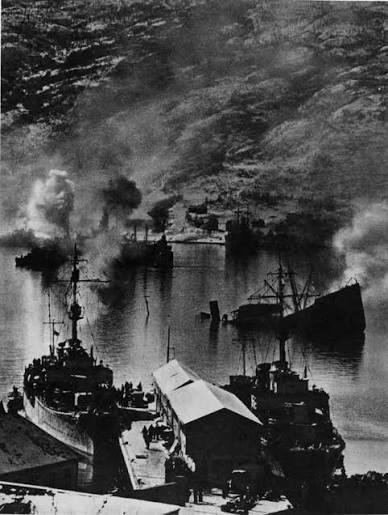
On his Substack, James Holland recounts the events of April, 1940 when British and German ships fought savagely for the port of Narvik in the north of Norway. The first battle had resulted in the loss of several destroyers on each side and the deaths of the commanders as well. A couple of days later, the Royal Navy sent in a more powerful force to eliminate the surviving ships of the Kriegsmarine and secure the port for landing allied troops:

Narvik harbour after the first battle, April 1940.

The next few days were marked by caution and ponderousness by both sides. Now commanding the German flotilla was Kapitän Erich Bey. His remaining ships were trapped unless he moved them swiftly. This meant refuelling as soon as possible from the surviving oiler, making the damaged ships seaworthy, then using bad weather, darkness and supporting U-boats to sneak out past the British in the Vestfjord beyond the Ofotfjord. Although the ships were all refuelled and engines repaired, he then suffered a further calamity when the Zenke damaged her propellers manouevring around the wrecks in Narvik harbour, and the Köllner also caused debilitating damage while refuelling and made herself unseaworthy. Difficult though it was to manoeuvre in the narrow confines of Narvik, these were entirely avoidable and self-inflicted own goals. The British, meanwhile, reeling from the rapid German advances through southern Norway and uncertain what plan to now pursue, dithered from a lack of clear, unified and determined decision-making, so that it was not until the morning of 13th April that they returned, this time with four larger tribal-class destroyers, five further destroyers and the mighty battleship, HMS Warspite, all under the command of Admiral Whitworth.

Kapitän Bey had known the Royal Navy were coming, partly because German cryptanalysts had deciphered British naval codes, but also because it was blindingly obvious they would do. He tried to deploy his ships as well as he might but knew in his heart the situation was hopeless. The crippled Köllner was towed to Taarstadt, an inlet beyond Ballangen, where it was to lie in wait, unseen, for the arrival of the British then fire her torpedoes and guns and hope for the best. She had only reached the inlet at Djupvik, some 20 miles west from Narvik, when she was spotted by the Warspite‘s Swordfish floatplane late in the morning of 13th April. As the leading British ships, Bedouin and Eskimo, turned the headland, their guns and torpedoes were trained and ready. Köllner‘s bow was ripped off by the first torpedo and the rest of her sunk soon after. That was three of the ten now at the bottom of the fjord. The remaining seven had barely begun moving before the rest of the British force were bearing down upon them through the mist, frost and snow. First, though, ten Swordfish, flown from the aircraft carrier, HMS Furious, swooped down. Their orders were to dive-bomb the German ships, a role for which they were not suited; Swordfish, slow, ungainly biplanes, were designed to fly in low and drop torpedoes, a role to which they were, in fact, very well suited. As dive-bombers, however, they hit nothing but lost two of their own in an entirely fruitless attack.

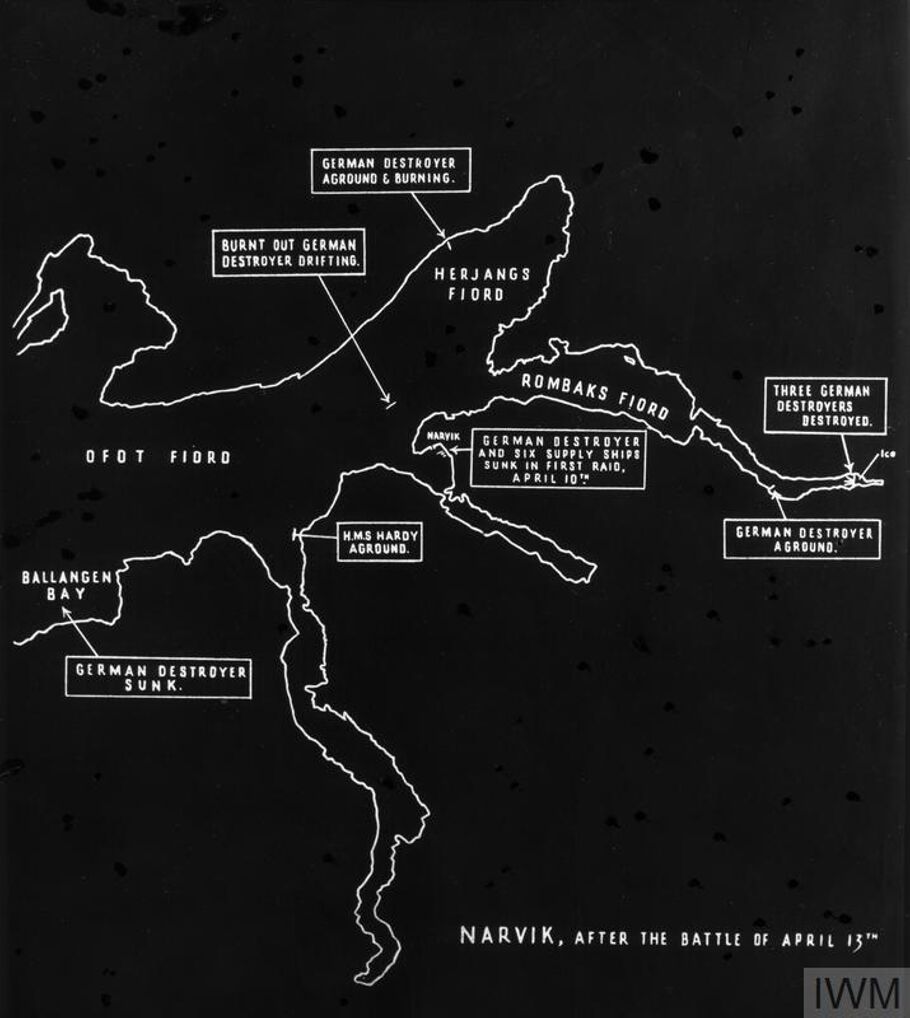
It was also completely unnecessary as Whitworth’s force had the matter firmly in hand. The German destroyers, still nursing the damage of four days earlier, swiftly fired all their remaining ammunition and were now effectively sitting ducks. Bey ordered them into the narrow Rombaksfjord, east and to the north of Narvik, where they were hotly pursued by Eskimo, Bedouin and even Warspite. Here the fjord narrowed to a few hundred yards before widening to half a mile but with the high mountain sides looming over this gloomily dark and slender channel, there was nowhere for the surviving German destroyers to go. The Künne was dispatched by Bedouin, and although the Georg Thiele fired one last torpedo that blew off the bow of Eskimo, her captain then ran her aground like the Hardy, while the surviving three, the Zenke, Von Armin and Lüdemann, steamed to the head of the fjord where they, too, deliberately ran themselves aground. The crews all then made good their escape into the mountains to join the Gebirgsjäger [mountain troops] that had disembarked five days earlier and who were still holding a shallow bridgehead around Narvik.

The second British naval action off Narvik. A diagram of the battle of 13 April 1940.
Imperial War Museum

Amazingly, Eskimo remained afloat, sailing stern-first back out of the fjord and to safety. She was repaired and would fight again, not least against the Bismarck in May 1941. But here in the waters around Narvik, the naval battle was now over, with half the Kriegsmarine‘s destroyer fleet sunk and lost — a disaster from which it could not hope to recover. A golden opportunity to send in decisive numbers of Allied troops to fight and defeat the beleaguered German troops in Narvik was now laid out on a plate. Southern Norway might have already been lost but the north — and, crucially, the iron-ore railway line and port — lay there for the taking — on paper, at any rate. British, French and Polish troops were eventually landed but this was not a part of the world where landing and maintaining supplies was at all straightforward. Britain had only a few basic landing craft at this early stage of the war, there were few beaches and its geographical remoteness and weather made a difficult task even harder. As it happened, by early June, the Allies did have victory there within their grasp, but by then, France was being overrun and facing defeat and the Allies decided the better part of valour was to pull out while they had the chance and consolidate in Britain instead. The Allied expedition to Norway was over.

The ramifications of the naval battle were significant, however. The Kriegsmarine not only lost half their destroyer fleet, but also one of two heavy cruisers, two of six light cruisers and six U-boats, leaving their navy woefully depleted. It also meant their plans for a successful surface fleet marauding in the Atlantic had been left in tatters. The U-boats, withdrawn from the Atlantic for the campaign, hit not a single vessel, largely due to problems with the magnetic ignition pistols on their torpedoes. For the three months they were tied up in the waters around Norway, they were not in the Atlantic, giving Britain a vital free pass as convoys sailed unimpeded. During the critical summer months of 1940, this was to prove a hugely important lifeline. Norway had been clinically subdued by Germany but it would cost Hitler more than half a million troops, all told, as well the costly construction of the Atlantic Wall in the years to come — a series of bunkers, coastal gun batteries and barracks in some of the remotest outposts of Europe and at an untold cost in men, resources and money. Norway would become an albatross around Nazi Germany’s neck, while its value to the Kriegsmarine was negligible.

The grave of Captain Bernard Warburton-Lee, VC, RN, in Narvik.
Photo by James Holland

The Complete Chieftain Tank

Filed under: Britain, History, Military, Weapons — Tags: , , , , , — Nicholas @ 04:00

The Tank Museum
Published 20 Mar 2026

Chieftain. The world’s first main battle tank. An icon of the Cold War, it served the British Army for more than 30 years. Yet, it had something of a Jekyll and Hyde reputation. It was prized for having the best gun in the world but, for the British, it never fired a shot in anger. Loved by gunners. Loathed by mechanics. The Chieftain was often referred to as the best tank in the world as long as it broke down in the right place.

But was the gun truly as good as the stats make it out to be? And was the engine really that bad? It’s time to take a dive into the heart of the Iron Triangle to find out.

00:00 | Introduction
00:36 | Gun
03:44 | Engine
06:19 | Armour
11:07 | Just Deserts
13:53 | A Tragic Hero

In this film, join James Donaldson as he delves into the good, the bad, and the ugly sides of the Chieftain tank. With a great gun, revolutionary armour, and a misunderstood engine, Chieftain’s service with the British ensured the Cold War never turned hot. And hear from Chieftain veterans, Bob and Steve, as they share their experiences with this iconic tank.
(more…)

“None of the artistic -isms lasted very long. Today’s -ism soon becomes yesterday’s was-ism”

Filed under: History — Tags: , — Nicholas @ 03:00

Ted Gioia on “the shock of the old”:

During the 15th century, the leading critics all agreed that the greatest works of art came from an unusual place. No, not a museum or church or palace — they were found, instead, underground and amid ruins, literally covered in dirt.

Before you could see them, you first had to dig them up.

Can we even imagine this attitude today? Our whole hierarchy of aesthetics would need to be reversed. Just consider the shame of admitting that our most cherished cultural legacy had been buried and forgotten by our ancestors. Art appreciation gets turned into some kind of exhumation.

But the reaction to this rediscovered art was just as interesting as the sculptures themselves. How do you feel when you look at these works?

You probably aren’t shocked by the nudity. You’ve seen more salacious stuff on Netflix. In fact, you probably aren’t shocked by anything here — these statues feel very old fashioned and antiquated.

That’s an interesting word, antiquated. It means “old, and no longer useful”. If the plumbing in your house is antiquated, you’re in big trouble. And it’s even worse if you are antiquated.

The word comes from the same root as antiquities — a term applied to arts and artifacts from the past. And most observers today would put the two ideas together, and say that these old statues might be charming to see in a museum, but have little or no relevance to us today.

But that’s not how Michelangelo, Raphael, and other Renaissance artists saw them.

These works were more than a thousand years old, but the leading 16th century artists believed they were worthy of study and imitation. Even more shocking, the great minds of the Renaissance believed that such works represented timeless standards of artistic excellence that could not be erased by the passing centuries.

In other words, evaluating art was like pursuing the good life. After you discovered the pathway to do that, you kept to the course. It didn’t go stale like a loaf of bread. It wasn’t a fad or a trend, but something enduring. The same thing is true of good health or a good marriage — you want them to endure, not get replaced by the next new thing.

Five hundred years later, leading critics believed the exact opposite. Standards were not timeless, but constantly in flux. During the 20th century, art was supposed to disrupt the standards from the past. If a work made you uncomfortable, all the better — you needed a kick in the ass. If the Venus de Milo hadn’t already lost her arms, some witty critic would probably suggest that we cut them off. That would give you a jolt, huh?

This notion of disruption was already prevalent a hundred years ago. And the kicks aimed at your posterior came from all directions. Critic Robert Hughes called this the “Shock of the New”.

The individual asskicks were the -isms.

There’s surrealism, dadaism, cubism, futurism, brutalism, fauvism, abstract expressionism, deconstructionism, postmodernism, serialism, minimalism, and so forth and so on. You could make a patter song from all of them.

Critics placed wagers on them, as if they were horses at the track. If they made a smart bet, they could reap a windfall. Their reputation was enhanced, and also their wallet. I’m reminded of the elite art critic who launched the careers of painters, and sent the market price of their works skyrocketing — but only after he had accumulated some choice specimens for his own collection. In the finance world, this is called insider trading.

The suffix -ism originally denoted a doctrine, theory, or worldview. Or even a religion, such as Judaism or Buddhism. These aesthetic -isms were also a bit like religions, inspiring fervent loyalty.

But there was a big difference. Religions like Judaism or Buddhism last for thousands of years. But aesthetic theories come and go. None of the artistic -isms lasted very long. Today’s -ism soon becomes yesterday’s was-ism.

That’s a little strange, because the advocates of the -isms all promised that they were delivering the blueprint for the future. And then we finally get to the future — and what do we see?

Colt LE-901 Modular Multi-Caliber AR: A Well-Designed Failure

Filed under: History, Military, USA, Weapons — Tags: , , , — Nicholas @ 02:00

Forgotten Weapons
Published 29 Oct 2025

Colt originally developed the 901 as part of the US Army SCAR program, with the intention being to create a 7.62x51mm rifle that could also use unmodified 5.56x45mm upper assemblies. This would allow special operations units to customize a single weapon to a variety of different configurations for different mission profiles. Mechanically, the system Colt devised to do this was quite clever, and very effective. However, the rifle ultimately failed to win a military contract.

Moved to civilian sales, the system was unsuccessful fundamentally because the modular concept is just not very desirable. A single modular rifle like this inevitably sacrifices some capability in every specific configuration in exchange for the modular capability and most people would rather have two dedicated rifles in different configurations than one swappable one. It sounds appealing on paper, but almost always fails economically in practice.
(more…)

QotD: Rejectionism

Filed under: Business, Quotations, USA — Tags: , , , , — Nicholas @ 01:00

… you can, and should, do this little “What is it in itself?” exercise for everything. What is Amazon in itself? Speed. Information velocity. Consumerism. I noticed a funny thing when I moved from the bigger city to a smaller town on the outskirts: All of a sudden I had a lot more money in the bank at the end of the month. I pulled my statements, and found out that I wasn’t spending nearly as much on impulse buys. I had to plan shopping trips to the grocery store, so not only did I save money, I ate better — in the old days, when I was hungry, I’d swing by the drive thru, because it was right there. Or I’d zip down to the store to grab a few things to cook, which ended up grabbing a bunch of other things, because it was right there.

Amazon works the same way. If you have to plan your trips to the grocery store, you have to ask yourself: Do I really need this? There are many fewer chances for impulse buys. When the store’s right there, you just run down and satisfy whatever momentary craving you happen to have. Same with Amazon — if you had to make a special store to get that piece of Chinese junk, you wouldn’t. But Amazon is right there, on the phone …

Haste. Impulsiveness. The instant, unexamined gratification of each and every urge. Those are the things the Left encourages. That’s what all that stuff is fundamentally for — Amazon, Twitter, smartphones, the whole deal.

That, therefore, is what we must reject. Call it “Rejectionism” if you want to make it into a sales pitch (or something better; I suck at titles). The Left’s “morality” is to treat everything — health, beauty, pleasure, the Economy, politics, people — as means to one and only one end: The instant, unthinking gratification of each and every momentary impulse.

We reject it. We reject the Internet. It’s a tool, nothing more, and remember what they say about hammers: When a hammer’s all you’ve got, everything looks like a nail. Reject it. Reject it all, for your soul’s sake.

Severian, “Rejectionism”, Founding Questions, 2022-05-24.

March 20, 2026

When pursuit of knowledge shifts to sharing of feelings instead

Filed under: Education, Media, USA — Tags: , , , , , — Nicholas @ 05:00

Institutes of higher learning were once places where academic careers involved research, analysis, and logical pursuits to advance human knowledge (in theory, at least, and mostly in practice). Today’s groves of academe are apparently much more about “the feels” than the facts:

An expected and obvious consequence of the Great Effeminization of the Academy is that a great deal of academic output is now about the feelings of academics.

From the peer-reviewed paper “What’s Racial About Matter? A Conversation on Race and ‘New’ Materialism Past, Present, and Future” in Catalyst: feminism, theory, technoscience. (They mean matter in the same sense as a physicist, only they are much vaguer.) My emphasis:

    What follows is an informal, at times undisciplined, conversation about Asian American racial matters between interlocutors who have been in generative dialogue for several years now. This roundtable is the constellation of many other discussions from conference panels to shared meals, reflecting the relational nature of our inquiry. We hope this roundtable can open entry points for those exploring intersections of feminist new materialisms, STS, and studies of race — from its genealogies to its animating new directions. How did we get here, and where do we go from here?

The text itself reads like it was produced by one of those postmodern text generators that were passed around as jokes in the late 1990s.

From the Abstract of “After Hybridity: The Biological Life of the Mixed Race Child” (same journal):

    I argue that renderings of the mixed race child as a metaphor for assimilation and multicultural progress obscure how racial science continues to shape the very definition of mixed raceness. Instead, I frame the mixed race Asian American child as hybrid matter to explore the slippages between their figuration and other abnormally reproduced objects: the genetically modified food organism and cancer.

From the Abstract of “Racial Atmospherics: Greenhouses, Terrariums, and Empire’s Pneumatics” (same journal):

    What happens when we understand air as racial matter? This paper takes up this question by tracking the political, architectural, and artistic genealogies of Cold War phytotrons, or computer-controlled climatic laboratories.

From the Abstract of “Disrupting the Whitened Lemur: Reading Black Trans* Considerations in Feminist Primatology” (same journal):

    In this article, I trace the evolution of female dominance studies in lemurs to explore how logics of cis-heterosexuality and whiteness are embedded in the study of the nonhuman … Following recent theories of trans* and the nonhuman, this essay argues that such critiques illustrate the trans* potential of the nonhuman, which was prefigured by decades of critique in feminist primatology. However, by engaging with recent Black trans scholarship, this essay suggests that such trans* critiques of the nonhuman have stopped short by ignoring the racialized nature of the dyad as a social unit. I thus propose a feminist science studies that attends to Black trans* theory to work against colonial taxonomies and the forced assimilation of the nonhuman world into rigid ontologies for material gain — or what I refer to as whitening processes.

The punchline is that not only are these all from the same journal, but they are all from the same issue of that organ. And that this is only one of many such diaries (the proper word) — funded largely by you via our great benevolent government.

It’s okay to hate …

Filed under: Liberty, Media, Politics — Tags: , , , , — Nicholas @ 04:00

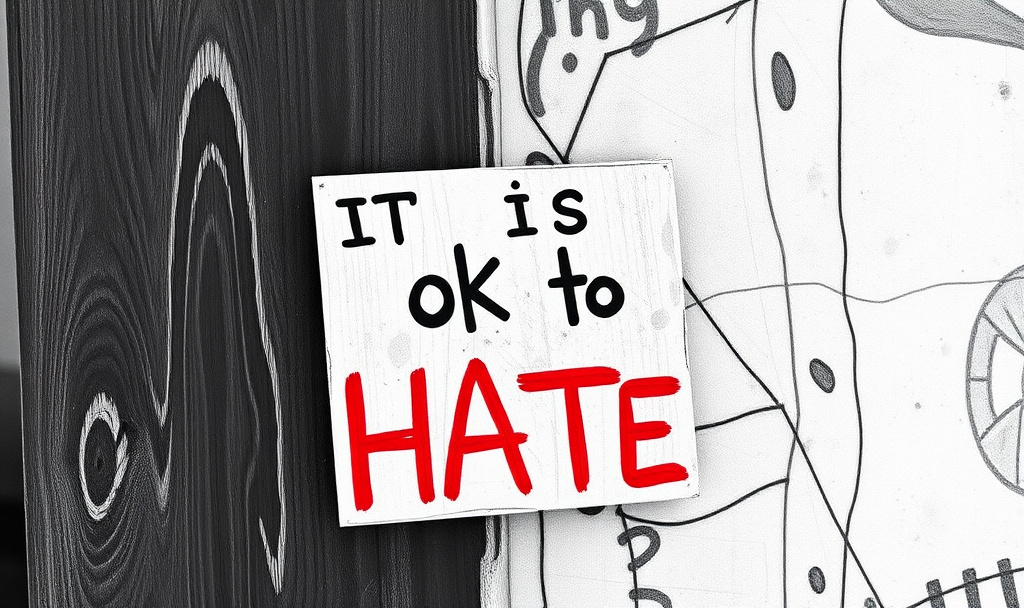
On his Substack, Frank Furedi defends the right to hate:

In recent decades hate has become thoroughly politicised to the point that the mere mention of the word serves as a prelude to discrediting, delegitimating and criminalizing its target. In public life the charge of practising the politics of hate is frequently deployed by leftist promoters of identity ideology against their opponents. The claim promoted by The Guardian that states that “a Tory party that stokes hatred is the real threat to our democracy” is illustrative of the attempt to associate conservatives and other critics of identity ideology with the politics of hate.1

The project of transforming hate into a malevolent ideological standpoint is underpinned by the assumption that all displays of the emotion hate are potentially malevolent. In effect the very human emotion of hate is now frequently demonised as a pathology.

In recent decades hate has been transformed into a stand-alone cultural stigma. According to dominant cultural conventions it is sufficient to use the word hate without any reference to the object of this emotion. It is now common to use the word, Haters. It is not necessary to indicate who the Haters hate. The term Hater serves as a negative identity. As one study acknowledged, “persons branded as ‘haters’ are effectively excommunicated from the polity”.2 The use of the term hater morally contaminates its target.

According to the cultural script that prevails in the West, hate serves as a secular form of moral evil. One expression that captures this evil is that of “The Hate”. By placing a definitive article in front of hate a permanent threat to society is invented. This reified public threat demands vigilance and willingness to mobilise to defeat its manifestations. For example, this is the approach of the campaigning group Stop The Hate.3 The content of The Hate is deliberately left vague so that it can serve as the target of a variety of different campaigns.

The politically motivated designation of hate to describe the behaviour of an individual or a group is not simply an act of description but also a boundary-setting manoeuvre. It basically works as a warning that signals the claim that The Hater cannot be included within the confines of a democratically governed public space. The Hater exists on the wrong sides of the boundary between legitimate and illegitimate politics. This sentiment is frequently communicated by the slogan “Hope Not Hate”, which establishes a moral boundary between legitimate and illegitimate politics. From this perspective hate serves as a diagnostic label for illegitimate public life. Imposing a moral quarantine on those branded as haters is regarded is necessary for the maintenance of a just democratic society.

The frequent use of the slogan “Hope not Hate” smuggles a moralising ethos into public discourse. Through the drawing of a moral contrast between the secular evil of hate, hope emerges as a progressive political virtue. The transformation of hate into a morally toxic antithesis of hope assists the political polarisation that afflicts society. Since haters are regarded as beyond redemption dialogue with them is pointless. The only appropriate response to their words is to criminalise it. Hence the proliferation of rules and laws criminalising Hate Speech.


  1. https://www.theguardian.com/politics/2024/mar/04/a-tory-party-that-stokes-hatred-is-the-real-threat-to-our-democracy
  2. Post, Robert, “Concluding Thoughts: The Legality and Politics of Hatred”, in Thomas Brudholm, and Birgitte Schepelern Johansen (eds), Epilogue, in Thomas Brudholm, and Birgitte Schepelern Johansen (eds), Hate, Politics, Law: Critical Perspectives on Combating Hate, Studies in Penal Theory and Philosophy (New York, 2018; online edn, Oxford Academic, 21 June 2018), https://doi.org/10.1093/oso/9780190465544.003.0013, accessed 12 Mar. 2026.
  3. https://www.stopthehate.uk

Update, 21 March: Welcome, Instapundit readers! Have a look around at some of my other posts you may find of interest. I send out a daily summary of posts here through my Substackhttps://substack.com/@nicholasrusson that you can subscribe to if you’d like to be informed of new posts in the future.

The BBC is cheerleading Britain’s “baby bust”

Filed under: Britain, Media — Tags: , , , , — Nicholas @ 03:00

In The Conservative Woman, Dr. Tony Rucinski reports on a recent BBC programme that clearly takes a dim view of parenting:

ON March 13 – the Friday before Mother’s Day – the Centre for Social Justice published Baby Bust, a report projecting that 600,000 British women alive today may miss out on motherhood they actually wanted. Nine in ten young women still hope to become mothers. The ONS confirms the total fertility rate fell to a record low of 1.41 in 2024. The CSJ calculates a “birth gap” of 30 per cent, with 831,000 people turning 50 in 2024 but only 595,000 babies born.

You probably did not hear about it. No identifiable standalone BBC News website article or feature covering the report has appeared. Our national broadcaster had other priorities. Namely a 1,500-word feature headlined “Like a trap you can’t escape: The women who regret being mothers“. It promoted the piece on social media, where it drew hundreds of critical replies. Instead of covering a demographic crisis, the BBC gave prominent space to a piece whose own evidence undermines its thesis – and thus revealed something important about the role it plays in the very crisis it should be reporting.

Its maternal regret article relies on a 2023 study conducted in Poland which estimates some 5 to 14 per cent of parents regret their decision to have children, a review article which synthesises several methodologically incomparable surveys – different countries, different age groups, different question wordings.

The more important point is its arithmetic. If 5 to 14 per cent of parents experience some regret, then 86 to 95 per cent do not. But the BBC devoted a feature-length article to the minority experience and ignored the majority one entirely. The lead case study featured is of a pseudonymous woman, Carmen, who came from a background of violence and dysfunction. But further data unsurprisingly finds the regret rates to be higher among single parents than married ones: 27.3 per cent versus 9.8 per cent. And that adverse childhood experiences, depression, and anxiety were also strongly associated with parental regret.

The BBC’s article however did not mention marriage once. Even the therapists quoted made the case against the BBC’s framing without apparently realising it. They repeatedly stated that regret often reflects “isolation, exhaustion, or lost identity” – failures of support, not failures of motherhood as a vocation.

The far larger and more painful form of regret that the BBC also ignored is the regret of women who wanted children and never had them, the highest figures among those who experienced fertility treatment failure. Or the similar regret found among couples whose fertility treatment did not result in a child. Or that involuntarily childless women’s regret intensifies with age.

The CSJ’s huge figure of 600,000 “missing mothers” just did not fit the narrative the BBC wants to tell.

Nor is this an isolated editorial misjudgment. Between 2023 and 2026, the BBC published a series of prominent features sympathetic to negative experiences of motherhood or to child-free lifestyles, among them: “I felt like a freak because I didn’t want children” (April 2024). “The adults celebrating child-free lives” (February 2023). “True cost of becoming a mum highlighted in new data on pay” (October 2025).

In the same period, not a single piece of the BBC’s coverage of Miriam Cates – the most prominent parliamentary advocate for pro-natalist policy – featured conversion therapy, smartphones and the trans debate, or substantially addressed her work on demographics or declining birth rates.

The Revenge Plot: Orestes’s Foreshadowing in The Odyssey

Filed under: Books, Europe, History — Tags: , , — Nicholas @ 02:00

MoAn Inc.
Published 4 Dec 2025

This video was filmed in July of 2025. I wasn’t going to upload it due to the weird not-really-focused-but-also-kinda-focused-thing my phone camera was clearly going through, but decided I didn’t care that much because the content itself was fine x
(more…)

QotD: The lameness and sameness of modern science fiction novels

Filed under: Books, Politics, Quotations — Tags: , , , — Nicholas @ 01:00

I’ll confess, though: I almost didn’t read this book. Actually, for several years I didn’t. I was vaguely aware of its existence, but I’d pretty much stopped reading new speculative fiction because I finally admitted to myself that it was pure masochism that kept me beating my head against the wall of newly-published extruded genre product when I had sixty-plus years of Hugo and Nebula nominees to choose from. Sure, every novel will reflect something of its age’s concerns (there’s a lot of nuclear war in those old Hugo winners!), but it’s gotten much worse in the last ten or fifteen years: every book that gets any buzz is so deeply inflected with questions of personal liberation from oppressive structures, so little nuanced and so obsessed with identity and representation, that I find it borderline unreadable. A few books like that, done well — fine, that’s part of life, that’s certainly a kind of story you can tell. But when it’s everything, when it becomes a precondition for publication, you’re left with a tragically denuded sample of the human experience. It’s not that I don’t want to read a book where I disagree with the underlying politics, it’s that an unsubtle obsession with the “correct” politics makes a book boring and cringe. One-dimensionally “right-wing” fiction written in reaction to the contemporary mainstream is just as bad — worse, perhaps, because if done well it’s the sort of thing I would really enjoy.1

Jane Psmith, “REVIEW: The Powers of the Earth, by Travis J.I. Corcoran”, Mr. and Mrs. Psmith’s Bookshelf, 2024-04-29.


  1. There’s nothing worse than poor execution of an incredible idea, because it means no one else will come along and do the incredible idea right. Austin Grossman’s Crooked, for instance, is Richard Nixon vs. Cosmic Horrors, which is a brilliant premise (yes, the Interstate Highway System is definitely an eldritch sigil designed to protect America, I will not accept any argument) but falls apart on the totally ahistorical version of our 37th President designed to justify making him the “good guy”. The real Nixon is such a fascinating and compelling figure — why not keep him as weird and twitchy and striving as he actually was and have him be the good guy anyway?
  2. Or, say, the Napoleon movie.

March 19, 2026

The Two-Handed Chisel Technique You Should Learn

Filed under: Tools, Woodworking — Tags: , , — Nicholas @ 04:00

Rex Krueger
Published 18 Mar 2026

All my plans!: https://www.rexkrueger.com/
Patrons saw this video early: / rexkrueger
Compass Rose Toolworks: https://www.compassrosetools.com/
Join the Mailing List: http://eepurl.com/g3rkmv
Take a course: https://www.rexkrueger.com/courses
Get my woodturning book: http://www.rexkrueger.com/book
Follow me on Instagram: @rexkrueger

Government creates a problem – yet the solution is always “more government!”

Filed under: Bureaucracy, Cancon, Government — Tags: , , , , — Nicholas @ 03:00

On the social media site formerly known as Twitter, L. Wayne Mathison explains the vast drawbacks of asking governments to solve problems:

Government bureaucracy is like a snow machine that keeps blasting, then hires more people to shovel the mess it just made.

We’re told it exists to help. To protect. To serve. Nice story. But in practice, it behaves more like a self-preserving organism. It doesn’t solve problems cleanly. It multiplies them, then offers to manage the mess it helped create.

Here’s the part most people miss. Bureaucracies don’t grow because problems get bigger. They grow because complexity gets rewarded. The more tangled the system, the more valuable the people who run it. That’s not a bug. That’s the incentive structure.

William Niskanen called this decades ago. Bureaucrats maximize budgets, not results. Bigger department, bigger influence. If a problem gets solved too efficiently, the machine loses a reason to exist. So problems don’t disappear. They get “managed”.

Then comes the language game.

Confusion gets dressed up as compassion.
A program no one understands becomes “comprehensive”.
A policy that creates dependency becomes “support”.
Failure becomes “underfunding”.

It’s like hiring a mechanic who loosens parts just to bill you for tightening them later.

Now zoom in on Canada. Then zoom in tighter on Manitoba.

We don’t just have bureaucracy. We have an oversized public sector that’s crowding out the very engine that pays for it. In Manitoba especially, government employment makes up a huge slice of the workforce compared to the private sector that actually generates wealth. More administrators, fewer producers.

And here’s the quiet problem. Public sector growth doesn’t face the same discipline as the private sector. If a business bloats, it dies. If a department bloats, it asks for more funding.

So the balance drifts.

More people administering. Fewer people building, investing, risking.
More rules. Less output.
More spending. Slower growth.

It creates a kind of economic inversion. The part of society that redistributes wealth starts to outweigh the part that creates it. That’s not sustainable. It’s like living off the interest of a bank account you’ve stopped contributing to.

Politicians don’t fix this because growth is easy to sell. Cuts are not. No one gets applause for saying, “We’re going to do less”. So the system expands in one direction only.

Forward. Always forward. Never back.

Meanwhile, taxpayers are handed the bill and told it’s the price of caring.

Here’s the hard reframe. Bureaucracy isn’t malfunctioning. It’s doing exactly what it’s rewarded to do. Expand. Protect itself. Justify its existence.

If you want a different outcome, you need different incentives.

Measure outcomes, not spending.
Reward efficiency, not headcount.
Shrink what doesn’t work, no matter how “important” it sounds.

Because if you don’t trim the machine, it doesn’t stay the same size.

It learns to eat.

« Newer PostsOlder Posts »

Powered by WordPress