Quotulatiousness

March 25, 2026

UNDRIP’s malign power in Canada

Filed under: Cancon, Government, Law — Tags: , , , , , — Nicholas @ 03:00

The United Nations Declaration on the Rights of Indigenous Peoples (UNDRIP) has been adopted into law by the provincial government in British Columbia and the federal government. In BC, voters were assured that this was a purely symbolic act to advance reconciliation with First Nations groups in the province. But that was deliberate misdirection and lies:
During the debate on DRIPA [BC’s Declaration on the Rights of Indigenous Peoples Act] in the legislature in late 2019, government ministers of the day waxed lyrical that DRIPA and UNDRIP created no new rights, had no legal force, did not apply to private land, and did not provide a veto. Those assurances were used to justify passing DRIPA, which resulted in the B.C. Opposition unanimously supporting the legislation. It turns out that the government’s assessment and promises were neither correct in substance nor valid legally.

Much has been written lately about DRIPA, some of it wrong. Prior to the B.C. Court of Appeal decision in Gitxaala, some DRIPA defenders insisted it was merely a “process” piece of legislation that bound the government to an arguably undemocratic joint government and Indigenous leadership arrangement, set out in section 3, to evaluate every B.C. statute for conformity with the 46 Articles of UNDRIP and then amend statutes as deemed necessary to create that conformity.

DRIPA itself, though arguably highly undemocratic and perhaps unconstitutional, is not the real problem in this province. The real problem is that DRIPA has been effectively employed as a “smokescreen” by the B.C. NDP and certain of its allies, while the government, secretly and with no explicit public mandate, imposes the Articles of UNDRIP throughout B.C. as a fundamental matter of policy, as though they have the force of law.

Let’s be clear, this is a devious political manoeuvre, much of which is not underpinned in law by DRIPA or, more importantly, by Supreme Court of Canada jurisprudence at all.

Notwithstanding statements made to the legislature in 2019 to get DRIPA passed, the NDP government immediately chose to implement a policy approach to UNDRIP throughout B.C. under which UNDRIP Articles would be applied by the government and the public service as though they were, in fact, the law in this province, notwithstanding the fact that they are inconsistent in many respects with Canadian constitutional law.

In the wake of recent court decisions, there is no indication that the government’s policy approach has changed or that the Premier is thinking about backing away from it, even though there is now much greater public scrutiny of what the government has really been up to since 2019.

The Eby government claims to be upset that UNDRIP is now being applied by the courts as the law in B.C., which it knows will create utter chaos. What has upset it more, however, is that the courts have usurped the NDP government’s desire to quietly and secretly implement UNDRIP everywhere in the province as a matter of policy, a policy that they would like to be viewed as law but without being legally enforceable by judges.

This amounts to a policy of subterfuge by a government that has shown an inclination towards deception on matters concerning First Nations. It appears that a law is not a law unless the B.C. government says it is a law, but some laws, like DRIPA, can be used as a false “front” to allow the covert implementation of a complex UN-based policy that is clearly unfit for the Canadian context, with no one being the wiser.

In the National Post, Warren Mirko explains the murky theory that allows “indigenous ways of knowing” to be taken more seriously than science, history, and legal procedure:

Canada is rapidly abandoning a principle that has shaped western democracies since the Enlightenment: the idea that no person or group has privileged access to sacred or divine knowledge unavailable to everyone else.

Now, this principle is being threatened by Canada’s increasing embrace of “Indigenous Knowledge” — whereby knowledge is treated as collectively owned and restricted by ancestry rather than something open to examination and shared across society.

The governments of British Columbia and Canada — both of which have formally adopted the United Nations Declaration on the Rights of Indigenous Peoples (UNDRIP) — endorse “Indigenous Knowledge” as inherited, rooted in ancestral relationships to the land, and encompassing spiritual, cultural and metaphysical dimensions passed down through generations.

Remarkably, the defining quality to possess this knowledge is not study, training, time spent on the land, or lived experience by any individual alive today. Instead, it’s lineage itself.

That’s a paradigm shift. When knowledge is said to be possessed by birth rather than learned, its universality is replaced with mysticism and its value diminished.

This comes with real-world consequences: ancestry-based considerations are reshaping how public land and resources are managed on Canadians’ behalf.

In British Columbia, newly proposed changes to hunting and wildlife regulations are described as being informed by “the best available science and Indigenous Knowledge“. In practice, this means “Indigenous Knowledge” is being used to design a regulatory regime that falls almost entirely on non-Indigenous users. That’s because Indigenous harvesting rights are recognized under Section 35 of the Constitution, not bound by the same hunting seasons, bag limits, gear restrictions, or limited-entry systems that apply to the broader public.

The growing influence of this genetically transmitted, ancestry-qualified knowledge extends to matters of public safety and economic security, like nuclear regulation: “Indigenous ways of knowing and the Indigenous cultural context enhance the Canadian Nuclear Safety Commission’s understanding of the potential impacts of nuclear projects and strengthen the rigour of project reviews and regulatory oversight”, says the government of Canada website.

Governments championing the principles of UNDRIP insist that “Indigenous Knowledge” can be combined with “Western” science to produce better public policy. But this is a contradiction. Knowledge cannot at once be exclusive and universal.

Apache Arms Carbine: A Saga of Compliance and Crappy Manufacture

Filed under: History, Law, USA, Weapons — Tags: , , , , , — Nicholas @ 02:00

Forgotten Weapons
Published 3 Nov 2025

The Apache Arms carbine was a Thompson SMG lookalike that was made in small numbers in the late 1960s. It was the successor to the Spitfire carbine made by the same people, after the Spitfire was deemed a machine gun by the IRS. The Apache used M3 Grease Gun magazines and was chambered for .45 ACP. It uses a square receiver tube and many of the same cast parts as the Spitfire. It is a very interesting look at how the design was adapted to be legally considered semiautomatic.
(more…)

QotD: Advice to beginning woodworkers

Filed under: Quotations, Woodworking — Tags: — Nicholas @ 01:00

Are you finding woodworking as easy as you thought? Or is your ardour being cooled by disappointment? If you have not encountered any serious set-back you are indeed fortunate. If you have, don’t worry; take heart — and the advice below.

One thing is certain: that, even though the craft is a lifetime’s study, the application of a few simple principles will assuredly bring success in woodworking. In the first place, never start a job until you know precisely how you are going to do it. Pass its construction step by step through your mind, so that you may hit upon the snags and mentally smooth them out. Making full-size working drawings is part of this thought-before-doing process. It compels you to think out your construction. Besides, full-size drawing is an aid (sometimes an indispensable aid) to setting out, and you need all the aids you can get.

Charles H. Hayward, “Beginner’s Trouble: Some Helpful Advice”, The Woodworker, 1936.

March 24, 2026

More political and philosophical illusions, left and right

Filed under: Media, Politics, USA — Tags: , — Nicholas @ 05:00

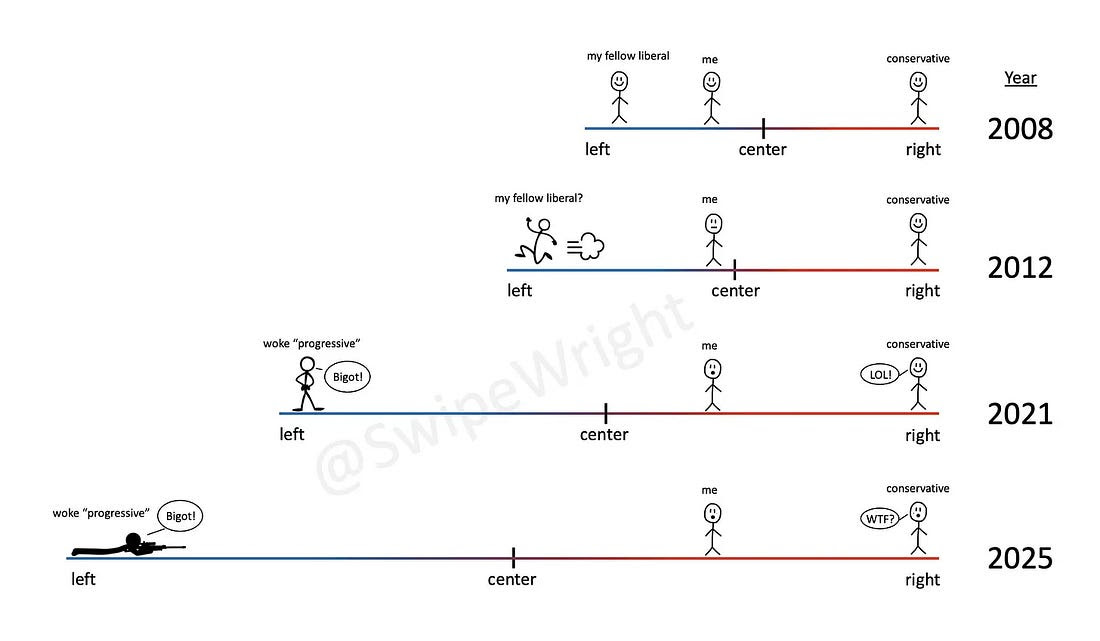
Tom Kratman continues his discussion of the illusions that distort how people on the left and people on the right view reality:

There is an illusion – yes, on both sides – of guilt by association. This is related to, but not exactly the same as, the illusion of indistinguishability. How many nail-bomb-building moral sons of Bill Ayers are over on the modern American left? Can’t be too many, I think, based on the serious dearth of Earth-shattering kabooms we hear, or rather don’t hear, lately. How many hair-shirted and sandwich board clad – with said boards reading, “Repent! The end is near!” – folks are there on the religious right? Based on how the typical Christian lives, and those being by no means a particularly bad set of men and women, there aren’t all that many. How many Christians do you really think, given a button that would make the Westboro Baptist Church and all its members go poof, wouldn’t push that button twice, the first time slowly, for the emotional satisfaction (well, that and to savor the screaming1), and the second time, quickly, to make sure. How many leftists and liberals are dead set against gun control? More than a few.

Then there’s the illusion brought on by willful blindness. For example, “No enemies to the left!” said Alexander Kerenski, Prime Minister of Russia, in 1917. Pity Kerenski wasn’t able to see that the people to his left were largely intellectual idiots and dogmatic homicidal maniacs, and that there may have been people to his right who were considerably more reasonable and sane. He said that not too long before being tossed out on his ear by the Bolsheviks, who, interestingly enough, were to his left.

You don’t see as much of this – the notion that there are no enemies to the right – on the conservative side, by the way, though there is some. Still, the next time I see an actual conservative lining up with the American National Socialist Party,2 the KKK, or Stormfront will be the first.

Part of the problem here, I think, is that we take something – civilization, actually – so much for granted that we forget how hard it is to build or to hold onto, and so forget that we have something important in common with our more moderate political opponents. Thus, taking it for granted, we forget that common ground, see the opposition, and so line up with those more extreme sorts for whom civilization is probably just a burden they’d as soon be done with.


  1. Okay, maybe some would just push it the once.
  2. Which seems to have many trivial manifestations. You can find your own links, but why bother?

“Matt Goodwin’s Suicide of a Nation is a very bad book”

Filed under: Books, Britain, Media, Politics — Tags: , , , , , — Nicholas @ 04:00

In The Critic, Ben Sexsmith reviews a new book by Matt Goodwin, Suicide of a Nation: Immigration, Islam, Identity:

Here is an exceptionally easy argument to make:

  1. Mass migration is ensuring that the historical majority in Britain is becoming a minority.
  2. This is the result of policies that have been pursued regardless of popular opinion.
  3. This has had many kinds of destructive consequences.

The first claim is so obviously true that one might as well deny the greenness of the grass. The second is proven by decades of broken promises (see Anthony Bowles’s article “Immigration and Consent” for more). The third requires argumentation, but I think that it is clear if one considers hideous incidences of terrorism, grooming gangs and violent censoriousness, as well as broader trends of economic dependency and electoral sectarianism.

Again, this is not a difficult argument to make. So why is it made so badly?

Matt Goodwin’s Suicide of a Nation is a very bad book. It reads like the book of a political operator extending his CV. The left-wing commentator Andy Twelves caused a stir on social media by pointing out various factual mistakes and what appear to be non-existent quotes. Twelves speculates that these “quotes” are the result of AI hallucinations, which is plausible, if not proven, in the light of the fact that two of Mr Goodwin’s sparse footnotes contain source information from ChatGPT.

Inasmuch as Suicide of a Nation makes a form of the argument sketched out the beginning of this article, there is truth to it. But it contains a fundamental problem — it assumes that this argument is so true that there is no requirement to make it well.

“Slop” is an overused term but it feels painfully appropriate for a book that is spoon fed to its audience. Goodwin, who had a long academic career before becoming a successful commentator, is not a man who lacks intelligence. But he writes as if he thinks his audience lacks it. “I did not write this book for the ruling class”, writes Goodwin, “I wrote it for the forgotten majority”. Alas, he seems to think that the average member of the “forgotten majority” has the reading level of a dimwitted 12-year-old. As well as being stylistically simple, the book is full of annoying paternal asides. “In the pages ahead I shall walk you through what is happening to the country …” “In the next chapter we will begin our journey …” Thank you, Mr Goodwin. Can we stop for ice cream?

The book is terribly derivative, with a title that reflects Pat Buchanan’s Suicide of a Superpower and a subtitle — “Immigration, Islam, Identity” — that all but repeats that of Douglas Murray’s The Strange Death of Europe — “Immigration, Identity, Islam”. It is written in the humourless and colourless rhetorical style of AI. I’m not saying it was AI-generated. (Indeed, a brief assessment using AI checkers suggests that it was not.) I’m just saying that it might as well have been.

“We will no longer rely on others to defend our Arctic security”

Filed under: Cancon, Government, Military — Tags: , , , — Nicholas @ 03:00

In The Line, Matt Gurney reacts to Prime Minister Mark Carney’s unforced confession that Canada has been freeloading on US military protection for generations and yet is only now making the beginnings of moves to address it:

Rough transit routes to Canada’s Arctic from Esquimalt BC and Halifax NS

There is a fascinating if glum confession buried inside Prime Minister Mark Carney’s recent announcement, given in the company of Canadian Armed Forces personnel in Yellowknife, of how Canada will spend $35 billion to build and upgrade existing military infrastructure. The major spending announcement was augmented by Carney’s promise to submit four northern road, electricity and port projects to the Major Projects Office for expedited (we hope) approval and completion.

The announcements are interesting, even if the bulk of the military spending was actually just re-announcing stuff Justin Trudeau had announced years ago. Nothing new there, alas. Even so, it was the phrasing of the PM’s remarks that jumped out at me. Striking a familiar tone, Carney said, “We will no longer rely on others to defend our Arctic security or to fuel our economy. We are taking full responsibility for defending our sovereignty.”

I like it! I’m glad we’re doing it.

What the hell were we waiting for? How did we ever get to a place where no longer relying on others to defend our security and fuel our economy became a decisive shift in policy worth highlighting in an announcement?

What was wrong with us?

This is not a column aimed at Carney. I’ve been dismayed and discouraged by a lack of progress on some key files so far, but I will grant that we won’t be able to truly judge this announcement for some time, and that he does at least seem more interested than other recent PMs in getting Canada’s military capability back to where it must be. So, for all the Carney fans out there, you can sheath your swords. I get it. I’ll keep watching and waiting, but my impatience is growing.

But I still think the broader question is still worth asking, even if we agree, for now, to leave Carney himself out of it. Why were we relying on others to defend our own territory? Or fuel our economy? Why were we not taking full responsibility for defending our sovereignty? How did that even happen?

There are some admitted historical factors here, including the fact that Canada was spun up as an independent state out of the British Empire, and obviously counted on the support of that empire for much of our early history. That set a tone, clearly. In more recent generations, there was also the obvious reality that the United States’s desire for continental security was always going to involve a lopsidedly large U.S. commitment, just due to the massive disparity between our populations and economies.

Let’s grant that at the outset. Our history and geography have conditioned us to view domestic defence as a collaborative effort where we are a junior partner even in our own territory — maybe not in a legal sense, but in practical one.

The point here isn’t to lament that Canada never had a fleet as large as the Royal Navy in the 1910s, nor an air force as large as the U.S. Air Force in the 1950s. We can all agree and understand that Canada’s contribution was always going to be more modest and given our massive landmass and air and sea approaches, Canadian defence was always going to be made much simpler with the cooperation of a friendly larger ally or benefactor.

But gosh, we really leaned into the helplessness, didn’t we?

Matt is happy that the PM seems more involved in taking Canadian territorial defence seriously, and there’s no dispute that this is a national concern that has been neglected for … well … decades, generations even. I’ve heard some attribute the withering of Canada’s defence establishment to the “peace dividend” after the collapse of the Soviet Union, but it actually began in 1968 with the first Trudeau era. We’re not going to be able to rectify six decades of neglect in a couple of years, no matter how many new programs and purchases are announced.

And not to be a Debbie Downer, but remember that the federal government has been addicted to the sugar high of making announcements and getting tongue-bathed by the tame media enough that the same project would get announced and re-announced for sometimes years before anything tangible resulted. The new Arctic defence announcements were, as Matt noted, already stated government policy before Carney entered politics. How many more dips in the PR bath will it take before anything real is implemented?

Baking the Original Apple Pie from Medieval England

Filed under: Britain, Food, History — Tags: , , , , — Nicholas @ 02:00

Tasting History with Max Miller
Published 16 Sept 2025

Hot water crust pie filled with mashed apples and pears with raisins, figs, and spices

City/Region: England
Time Period: c. 1390

This is the first recorded recipe for apple pie, written in England around 1390 in The Forme of Cury. As many historical recipes are, this one is bare bones and leaves a lot of room for interpretation. The “good spices” in the recipe could mean basically any combination of spices you like. I think this is probably referring to a popular medieval spice mixture called poudre douce, whose exact contents varied from cook to cook. Popular spices included cinnamon, nutmeg, mace, black pepper, long pepper, cardamom, ginger, galangal, and cloves, so feel free to experiment and make up your own.

Whichever spices you use will affect how familiar or exotic the pie tastes, and I really enjoyed the version I made. It’s not too sweet with most of the sweetness coming from the fruit, and I found the spices to be really strong but really pleasant. Unlike modern apple pies, the filling is more of a compote texture, but it holds together nicely. It’s a perfect recipe to try for the fall.

    For to make Tartys in Applis.
    Tak gode Applys and gode Spycis and Figys and reysons and Perys and wan they are wel ybrayed coloured with Safron well and do yt in a cofyn and yt forth to bake wel.
    The Forme of Cury c. 1390

(more…)

QotD: Citizens of a polis

Filed under: Europe, Greece, History, Quotations — Tags: , , , , — Nicholas @ 01:00

A polis is most importantly made up of the citizens, the politai (singular polites (πολίτης), plural politai (πολῖται)); indeed, Aristotle says this too in his Politics (Arist. Pol. 1274b): “for the state [polis] is an assembly of citizens [politai].” Now we are used to the idea that most people in a country are citizens of it, but the idea of the politai is much narrower. In its fundamental meaning a polites is a person engaged in the running of the polis; it is an idea defined by political participation. The politai were adult, citizen men; women, children, the enslaved and free non-citizens were all excluded from this group. A bit of demographic math might suggest that a modest polis with 2000 inhabitants might thus have just 300-400 politai.

Not everyone born in a polis was a member of the politai. Women could be of citizen status (and thus able to bear citizen children in poleis where that was required), but they could not be citizens at all. Being the male child of citizen parents was generally the core requirement of citizenship and in a democratic polis that was generally enough, but oligarchic poleis typically imposed wealth qualifications for political participation so not everyone born to citizens might themselves be a polites if they ended up too poor to meet the requirements. The terms astos and aste (ἀστός and ἀστή), “townsman” and “townswoman” respectively, might be used to make this distinction between the politai and people who were “merely” natives of the polis but barred for whatever reason from political participation. These distinctions become a lot more meaningful when you realize the point Aristotle is making defining the polis this way: if the polis is a community of politai then the residents of a polis (the physical space) who are not citizens are not members of the polis (not merely, we might imagine, non-participatory members).

Now the politai themselves also existed in subdivisions. We’ve mentioned division into demes or neighborhoods; while notionally geographic, demes could become hereditary (and indeed did become so in Athens). In Sparta and some poleis on Crete, citizens were divided into mess groups (syssitia or andreia). But by far the most common and important such division was into “tribes” or phylai (φυλαί, sing. φυλή), inherited kinship groups that often formed the largest subdivision of the politai of a polis, with even very small poleis having attested divisions into phylai in some cases (e.g. Delos as noted by M.H. Hansen in “Civic Subdivisions” in the Inventory). The politai might also be subdivided by other groupings like phratria (brotherhoods) and indeed a polis might have multiple such groupings, either neatly nested (as in Athens’ demes sorted into thirty trittyes sorted into ten phylai to make up the citizen body) or they might confusingly cross-cut each other.

There’s another key distinction between the politai – or at least men who might be politai – which isn’t a legal distinction but nevertheless matters for understanding how the Greeks imagined civic governance: the distinction between the few (hoi oligoi) and the many (hoi polloi). The few were the economic elite of the politai – the wealthy landowners – and the dominant group in oligarchies. A few terms might signify this group: “the few” (οἱ ὀλίγοι – hoi oligoi) or “the best” (οἱ ἄριστοι – hoi aristoi), or “the rich” (οἱ πλούσιοι – hoi plousioi) and can also be part of the meaning of the appellation “beautiful and good” (καλὸς κἀγαθός = καλὸς καὶ ἀγαθός – kalos kagathos) which translates more idiomatically to something like “gentleman” with an implication of both good conduct (especially in war) and high status. At its broadest reach, the few might consist of those politai with enough wealth to serve as hoplites, though it seems in most cases this group is understood much more narrowly and might be defined by heredity in addition to wealth in some cases.

In contrast to the few were, of course, the many. Once again a few terms might signify this group: “the many” (οἱ πολλοί – hoi polloi or οἱ πλῆθος – hoi plethos) or “the poor” (οἱ ἀποροῖ – hoi aporoi) or the people (δῆμος – demos), the last of which gives us the word democracy – rule by the demos. At its narrowest extent, these are all of the people too poor to serve as hoplites but who would otherwise be politai; in fact in a democracy they are politai, but in closed oligarchies they may not be. More broadly the concept of the demos can encompass all of the politai, both wealthy and poor, especially in a democratic context. Nevertheless the Greeks often understand these two groups as oppositional and non-overlapping: the politai composed of “the few”, with money and high status lineages and “the many”, without that, but with far greater raw numbers.

As we’ll see, it is that distinction – between “the few” and “the many” which the Greeks used to define the different forms of polis government, what they called a politeia (πολιτεία), which we might translate as “constitution” with the caveat that these are not written constitutions. And that’s where we’ll go next: now that we have our subdivisions, we’ll discuss next week the different ways they are organized and governed.

Bret Devereaux, “Collections: How to Polis, 101: Component Parts”, A Collection of Unmitigated Pedantry, 2023-03-10.

March 23, 2026

Reject multiculturalism as you would reject fake meat

Filed under: Food, Government, Media, Politics — Tags: , , , , — Nicholas @ 05:00

Spaceman Spiff looks at the technocratic dream that we’d all give up on eating meat and instead switch to lab-grown, VC-funded, and Bill-Gates-approved fake meat. It failed utterly, of course, because despite all of the arguments the corporations and the astroturf activists could marshal, nobody wanted it. Vegetarians wouldn’t switch to eating something vaguely kinda-sorta meat-ish, and meat eaters were happy continuing their carnivorous habits. It had no real market, so it was a dud product.

Our technocratic elites have been pushing multiculturalism for even longer than they were pushing fake meat, but just as with fake meat, the more people encounter it, the less willing they are to accept it:

Multiculturalism is the belief many distinct cultures can live together and flourish rather than devolve into conflict.

This is false. It has never worked anywhere.

The world itself is multicultural. The solution that emerged to manage different groups was national borders. Each culture could segregate and live apart from others because they could not successfully live together.

As the failures of multiculturalism become impossible to hide, social engineers reach for ideas to make it work. The latest is civic nationalism. The fake meat of the social governance world.

For all human history we have relied upon the real thing, but now today’s social engineers believe they have discovered a superior recipe, one that avoids the hassle and expense of tradition.

Anyone can become someone like you as long as they conform to an arbitrary list of beliefs, behaviours, laws and customs. We can ignore ethnicity, heritage and history. We can manufacture instant populations with passports and certificates just as we can create synthetic meat by combining the ingredients ourselves.

Like fake meat it looks workable on paper. Not only that, it is presented as self-evidently reasonable. Why has nobody thought of this before? How convenient governments and corporations can import a new workforce and they magically become British, American or Chinese because they “share values” and observe laws.

America was the first to experiment, a necessity after the introduction of non-European immigration in the 1960s. Needless to say they didn’t need it before that.

The country found itself importing people with no historical connection to the American population through heritage or history. Far fewer of them married into the family than previous waves of immigrants from European nations. While importing the world America was becoming the world with its racial, ethnic and cultural tensions.

They convinced themselves they had always been a nation of immigrants and conveniently forgot how long it took even the Irish to assimilate into America despite their ostensible similarity to the founding stock.

Strenuous efforts to make this seem normal, despite its novelty, included the energetic emphasis on shared values or adopted customs since the newcomers were often strikingly different.

Civic nationalism seems to be based on the same faulty reasoning as synthetic meat. We can circumvent the traditional approach using innovation. Why live through centuries of strife for a nation to emerge when you can just hand out certificates and make everyone instantly like you because they claim to respect the law and promise to adopt new customs?

Initially this can seem to work. If a small number of skilled immigrants come they are typically absorbed. Most cultures can do this if the numbers are modest and especially if the newcomers intermarry, or their children do.

Even more so, in traditional societies, including our own until recently, the pressure to adapt was almost universal; no translators, no welfare, no slack whatsoever.

Large numbers of immigrants over short time scales retard the process of assimilation, and generous welfare programmes can derail it completely.

America is also big unlike European nations, so it has taken a while for the full effects to be felt.

Despite the endless hype, people reveal their preferences in their behaviour. They can move. Pro-immigrationists have complained about white flight for decades, one very obvious example of the failure of civic nationalism.

Image from Spaceman Spiff

Just like those inconveniently full supermarket shelves with their synthetic products no one will buy, people run from diversity when they can.

Civic nationalists, like climate zealots, resort to repeating their tired lines about their great intent, how amazing it is all meant to be if people would just get into the spirit of things.

But it is all fantasy. Literal fictions that exist only inside the heads of those who imagine utopia. Real life has its own ideas.

Update: Added missing URL.

Update the second, 24 March: Welcome, Instapundit readers! Have a look around at some of my other posts you may find of interest. I send out a daily summary of posts here through my Substackhttps://substack.com/@nicholasrusson that you can subscribe to if you’d like to be informed of new posts in the future.

Canada’s NEW Rifle – the CMAR

Filed under: Cancon, Military, Weapons — Tags: , , — Nicholas @ 04:00

The Armourer’s Bench
Published 22 Mar 2026

The Canadian Armed Forces are set to adopt variants of Colt Canada’s MRR as the Canadian Modular Assault Rifle (CMAR). The announcement stated that more than 65,000 rifles will be procured over the next 5 years to replace the Colt Canada C7 rifles and C8 carbines currently in Canadian service.

Be sure to check out our accompanying article for this video here – https://armourersbench.com/2026/03/22/canada-adopts-new-rifle/

Mapping the “Manosphere”

Filed under: Media, Politics — Tags: , , , , — Nicholas @ 03:00

Janice Fiamengo says — and a lot will agree with here — that we can’t hate gender studies enough:

As Leo Kearse posted on Substack Notes – “When’s Louis Theroux doing a documentary on THIS manosphere? When’s he going to expose the idiocy of its leading proponents, such as Stella Creasy and Hannah Spencer?”

Nothing beats a threat narrative for a gender studies academic in search of relevance, and what more urgent than the dark corners of the internet where men (and the women who love them) allegedly spread misogyny and male supremacism.

Many academics now claim expertise in this area of gender studies, probing the volatile fragility and violent anxieties of manosphere men, and calling to repentance all who resist the feminist future. Many of these academics are women, making a sweet living warning about male “hate”, but there are plenty of male feminists as well, crusaders against others’ toxicity.

In “Mapping the Neo-Manosphere(s): New Directions for Research“, four scholars of masculinity survey the latest research on digital media and violent extremism. Vivian Gerrand, Debbie Ging, Joshua Roose, and Michael Flood claim to have read hundreds of studies of the manosphere, which they call an “online ecosystem of anti-women actors”.

According to them, the manosphere is brimming over with grievance-mongering, grift, and gynocidal fantasy. Nothing in it is good or sincere or well-intentioned. Various sub-genres of online content, including fitness advice, stoicism, and the tradwife lifestyle, are presented as outgrowths of misogynistic extremism from which millions of men and boys require rescue, by force if necessary.

A Roll Call of Buzzwords

The researchers make no distinction between manosphere content generally and what they call male supremacy — or, indeed, between those terms and a host of others, all pejorative. Their introductory paragraph alone provides a roll call of buzzwords that link any dissent from Marxist-feminist orthodoxy to misogynistic violence.

The manosphere, we’re told, is “bound by the belief that mainstream society is a misandrist conspiracy that disadvantages men”. Manosphere groups “frame contemporary gender politics as a ‘war against men'”. These groups also “frequently engage in misogynistic abuse as well as inciting violence against women”, thus creating an “online environment of accelerating harms”.

None of these statements is ever supported with evidence, but it is likely too much to expect evidence: the direct equation between male-positive advocacy and murderous misogyny is no longer a subject of academic debate, if it ever was. It is an axiom.

In one short paragraph, then, we move from non-feminist perspectives to “misandrist conspiracies”, and from belief in a “war against men” to “inciting violence” and “accelerating harms”. Anyone with even a passing acquaintance with anti-feminist content will recognize the definitional sleights of hand. Are any of these academics genuinely familiar with the subject they are writing about? It seems more likely that they have taken a shortcut to a politically-approved position.

What about the mass of anti-feminist and male-positive content creators — Rick Bradford at The Illustrated Empathy Gap, Tom Golden at Men Are Good, Alison Tieman and company at Honey Badger Radio, Bettina Arndt at Bettina Arndt, Hannah Spier at Psychobabble, just to name a few — who come nowhere near “inciting violence against women”? On the contrary, they pursue a vision of mutual cooperation and accountability between the sexes by rejecting female privilege and paranoia. Is this manosphere content, or not?

Many men’s rights advocates — researchers like Stephen Baskerville, Paul Nathanson, James Nuzzo, David Shackleton, Gerard Casey, Helen Smith, and Grant Brown, just to name those I’ve been consulting most recently — simply document male disadvantage with evidence. They do not assert conspiracies or stoke grievance.

As for the “war against men”, have our researchers read any of the voluminous feminist writings that celebrate male death and openly advocate a world without them? When feminist leaders — many of them university professors — are not only allowed but actually celebrated for declaring their anti-male hatred and calling for a “decontamination of the earth“, what are sensible people to conclude about anti-male animus?

The REAL History of Worcestershire Sauce (and a few others …)

Filed under: Britain, Food, History — Tags: , , — Nicholas @ 02:00

Tweedy Misc
Published 20 Nov 2025

A look into the history of Worcestershire Sauce, and some other related sauces and condiments originating in the 18th and 19th centuries.

In doing so I try to understand whether Lea and Perrins created something brand new in their Worcestershire Sauce of the 1830s, or whether it was more an evolution of other similar styles of sauce which already existed at that time like Harvey’s Sauce, and Reading Sauce … and in turn do both of those owe something to an even earlier condiment — Quin’s Sauce …?

I also debunk an oft retold (particularly here in YouTube) story about Baron Sandys returning from a post as the Governor of Bengal being the inspiration for Lea and Perrins’ Worcestershire Sauce — it’s almost certainly not true.

0:00 Introduction
0:55 What is Worcestershire Sauce?
1:22 Ingredients and Recipes
3:01 History of Worcestershire Sauce
6:33 Food in Georgian England
7:51 Hare Soup!
8:22 Harvey’s Sauce
11:00 Reading Sauce
13:21 Quin’s Sauce
14:49 Yorkshire Relish
16:04 Henderson’s Relish
17:02 Conclusion

He also posted an addendum to this video.

QotD: Grading coffee

Filed under: Food, Humour, Quotations — Tags: , — Nicholas @ 01:00

Coffee comes in five descending stages: Coffee, Java, Jamoke, Joe, and Carbon Remover. This stuff was no better than grade four.

Robert A. Heinlein, Glory Road, 1963.

March 22, 2026

Four million books published in North America during 2024

Filed under: Books, Business, Cancon, USA — Tags: , , — Nicholas @ 05:00

In the latest SHuSH newsletter, Ken Whyte considers the size of the North American book market at most recent count:

Random photo of books stacked in my office about 15 years ago.

I’m often asked by writers about the prospects of a particular book. I try to be encouraging. If it’s a good book, there’s undoubtedly an audience for it. At the same time, I try to be realistic. It’s a crowded market and it’s often difficult even for a good book to find its audience.

If asked to explain just how crowded the market for books is today, I usually say something like, there are about two million books published in North America every year. I’m not sure where I got that figure from. Probably from some research I read five years ago.

Turns out it’s wrong. “The total number of books published in the US in 2025 with ISBN numbers jumped 32.5% over 2024 to more than four million books,” announced Publishers Weekly on March 17.

I can’t get over that number. Four million books.

An average reader might get through about 2,000 books in a lifetime. A long-lived super-reader churning through 70 or 80 a year may exceed 5,000. Gladstone’s reading logs suggest that he engaged with more than 20,000 books, but it’s not clear he read them all.

A large independent bookstore might carry between 10,000 and 30,000 books. A suburban chain store, 60,000 to 120,000. The Barnes & flagship at Union Square in Manhattan has hundreds of thousands of books on four massive floors. Powell’s City of Books in Portland, occupying an entire city block—you need a map to get from room to room—has at least a half million books, and by some counts a million. New York’s The Strand, which boasts 18 miles of books, new and used, is probably the world’s biggest bricks-and-mortar retailer: it has 2.5 million books on incredibly dense shelving. You’d need a Powell’s, a Strand, and a couple of B&N Union Squares to hold four million titles.

Four million books is equivalent in volume to the holdings of a good-sized university library system, or a large public library system—collections built over a century. And these are published in a single year.

In 1939, the year Margaret Atwood was born, The Library of Congress, widely recognized as the largest library in the world, home to a civilization’s worth of books, boasted about six million titles, including pamphlets. It’s now holding about 25 million, and the US alone is on pace to produce that many titles between now and the end of the decade.

Four million books. That’s 11,000 books a day. Four hundred and fifty books an hour.

A year ago, there were “only” 3.15 million books, traditional and self-published, released. So 2025 represents an increase of 32.5 percent. Self-publishing was up just under 39 percent. Traditional publishing about 6.6 percent. Publishers Weekly doesn’t offer much of an explanation for the explosion of new titles. AI has to be a major factor (see this week’s publishing sensation in The New York Times.)

Of course, most of the four million books are not worth your time. Only 642,242 of the titles were released by traditional publishers. A traditional publisher doesn’t guarantee quality, but it suggests a minimum of vetting. The search for merit among self-published books is easily frustrated.

Bowker, the service that counts the ISBNs (the unique thirteen-digit identifiers attached to each book), does not distinguish among formats. Many of the four million were published only as ebooks. And some books published as print, ebook, and audiobook are triple-counted. There may only be about 2.5 million distinct works in that total.

If one were to take the colouring books, planners, puzzle books, and AI-generated garbage out of the equation, we might be down to 1.5 million meaningfully distinct books. And of all those, maybe 1 to 3 percent, or 20,000 to 50,000, will sell over 1,000 copies. That puts some perspective on the four million.

How To Indoctrinate the Children – Death of Democracy 08 – Q4 1934

Filed under: Germany, History — Tags: , , , , , , — Nicholas @ 04:00

World War Two and Spartacus Olsson
Published 21 Mar 2026

In this episode of Death of Democracy, we examine Germany in the final quarter of 1934, as Adolf Hitler tightens his grip on power after Hindenburg’s death and prepares the Reich for the next stage of Nazi rule. Behind a façade of order, the regime accelerates secret rearmament, deepens propaganda and youth indoctrination, pushes Jews further out of public life, and turns universities, schools, and culture into instruments of ideological control.

This documentary explores Nazi Germany in late 1934 through the looming Saar plebiscite, the growth of the Hitler myth, rising public frustration with local Nazi officials, and the regime’s deeper preparation for dictatorship, expansion, and war. If you are interested in Hitler, Nazi propaganda, rearmament, antisemitism, the Saar vote, and the collapse of democracy in Germany, this episode provides the critical context.
(more…)

« Newer PostsOlder Posts »

Powered by WordPress