
I have been accused of disliking college students. Guilty as charged. I regard them the way I do the Diversity. I like certain individuals just fine, but as a whole, when it comes to interacting with them as a group, I’m Bartleby the Scrivener: “I would prefer not to”.
Which is an odd position for someone who spent as long as I did toiling in the groves of academe to take, I realize. So let me explain: As with the Vibrancy, I dislike their behavior – intensely. But I don’t blame them for acting that way. If you want to know what’s wrong with our entire Postmodern, homo economicus way of looking at the world, there you go. I don’t blame them, because they have every rational incentive to behave that way, and none not to (indeed, acting other than they do comes with a considerable cost).
College kids don’t read, don’t study, don’t do anything other than attempt, insofar as possible, to regurgitate lectures word-for-word on the “exam”, after which they promptly forget everything. Once more, with feeling: I do not blame them for this, since pretty much everything they “learn” is so worthless, it’s antimatter education. I’m not joking when I say it’s all just Social Justice Mad Libs: “The [group] was oppressed by Whitey through [adjective] [adjective] [noun], and that’s why Pale Penis People are evil.”
For example, I taught for a few semesters at a college that tried very hard to run “African-American” versions of core classes as a marketing stunt. There was “US History to 1865”, for example, and, in parallel, “African-American History to 1865.” Leaving aside the fact that you could cover the whole fucking course in about five minutes – “there sure was a lot of slavery back then!” – even the faculty, all of whom were of course raving SJWs, laughed at the sheer pointlessness of it. “US to 1865” was already nothing but “Negroes and Lesbians save the Republic!”, or vice versa, depending on whether or not the prof teaching the course this semester was the Angry Black Feminist Marxist, or the Angry Marxist Feminist Lesbian.
Severian, “College Kids”, Rotten Chestnuts, 2020-12-12.
September 30, 2023
September 28, 2023
QotD: “Tenure Track” positions in an American university
A tenure-track position begins with a national (or international) search and a fairly long hiring process (from job-posting to job-offer usually takes around 6-8 months). A newly hired professor is an assistant professor, which means they are on the tenure track but do not yet have tenure. Instead, after about five to six years, they’ll go up for tenure review, where a committee of faculty in their department along with some external reviewers will look at all of the work the professor has done since their appointment and either recommend them for tenure or not; the university leadership structure typically has a role in confirming a grant of tenure but this is generally a rubber-stamp role. By far the most important part of tenure review at large universities is research; this is the part of the system that is “publish or perish”.1 Untenured tenure-track faculty (so, assistant professors) represent roughly 9% of all faculty members in the United States, according to the AAUP.
A professor that passes tenure review becomes an associate professor, which confers tenure (making it difficult to fire them) as well as a bump in pay. After another few years, they can go up for review again for promotion to the next rank, simply professor (often termed “full professor” for clarity), which comes with another bump in pay. This second transition is different from the first though; whereas the review from assistant to associate professor is an “up or out” moment (you either get tenure and stay or get rejected for tenure and leave the department), some professors can and do remain associate professors forever. Finally, a handful of professors who really distinguish themselves may wind up with an endowed chair and we tend to call these folks distinguished professors, though their actual job title will usually be something like “the so-and-so Professor/Chair of this-and-that” where the ‘so-and-so’ is the name of the donor that endowed the money being used for the distinguished professorship. Tenured professors represent roughly 24% of all university professors according to the AAUP, meaning that the total slice of tenured or tenure-eligable professors in higher education is just 33% – one third.
Let me say that again: only one third of all faculty work the way all of you think all faculty works. Just one third. This is a big part of what I mean when I say that the United States’ university system is being pillaged without the public knowing; if you told most people “only one third of college instructors are actually professors, most of your little Johnny’s classes are taught by non-professors now“, they’d be shocked! But that’s the current situation.2
Tenure-track professors generally teach a fixed course-load, expressed in most cases as a load over semesters, so a “2/2” (pronounced “two-two”) load is four courses a year (two in each semester). Tenure-track faculties at research-focused universities (which are all of the flagship state schools) generally teach a 2/2 load; mixed research/teaching schools (your third-string state schools and less well-funded private schools) often have 3/3 loads. Teaching-focused institutions may have 4/4 or 5/5 teaching loads (or more) and of course fractional loads (like a 2/3, etc.) do exist, but are less common.
In addition to teaching, tenure-track faculty are expected to publish research and do “service”. We’ll talk in another post more about these demands (indeed, we’ve talked about research already), but they deserve a few words here. The amount of research demanded varies by the level of institution; at an R1 the general expectation for a faculty member going for tenure in a humanities department is that their book is out3 and they have a good number of articles and other publications besides. At less research-focused universities, you might see instead that tenure is set at a certain number of articles and the book is instead at the jump to full professor.
Meanwhile “service” refers to all of the non-teaching roles faculty fill in a department. The university is predicated on self-governing departments of academics (“colleges” in the literal sense of an association of colleagues) and so departments are effectively run by committees and faculty appointed to do various key roles: student advising, graduate admissions committees, hiring committees, committees on teaching, and of course department chair (and possibly vice or assistant chairs) who steers the department. Of course faculty are assisted in those roles by the department staff who handle much of the paperwork, compliance and book-keeping. Some, but by no means all, of these service jobs come with a “course release” which is to say the faculty member teaches less in order to do the extra service, but there is an expectation of a certain amount of service work always being part of the workload mix.4
Finally, the more important service positions are often restricted to either associate or full professors – you have to get tenure first before you get a particularly loud voice in the running of the department. Nevertheless, even assistant professors are going to be “in the room” when decisions about courses, resource allocation, scheduling, and so on are made, which matters quite a lot. Moreover, because even assistant professors are expected to become permanent members of the department, their interests tend to be considered because, well, frankly, the tenured professors have to live with them for the next few decades, so you might as well be friends. This fact is really important for understanding why departments can be so callous to anyone not on the tenure-track (and why tenure-track faculty can be so oblivious to how callous they are being), because NTT faculty are usually not in the room when decisions are made.
Bret Devereaux, “Collections: Academic Ranks Explained Or What On Earth Is an Adjunct?”, A Collection of Unmitigated Pedantry, 2023-04-28.
1. A phrase that I am sick to death of hearing, but it seems to be functionally the only thing most people in the public know about academia and also the thing that select members of the public seem to think we need repeated to us at every possible opportunity, as if we’re not aware. It’s useless in any case, in history at least. Which hiring numbers being what they are now, by far the most common career path is in fact, “publish and then perish”.
2. In fact, COVID made these numbers look better than they had in the years previously, not because universities hired more tenure-line professors (they didn’t), but because they fired a lot of non-tenure line professors due to COVID, taking advantage of their lack of job protection.
3. In yesteryear, a book simply forthcoming was good enough. These days, that might not even be good enough to get hired as this entire system breaks down. By the end of 2022, I had actually qualified for tenure at the institutions which did not hire me in 2020; I still do not have a tenure track job.
4. So for instance being department chair often comes with a course release, but being on a committee or serving as an undergraduate or graduate advisor often doesn’t.
September 20, 2023
QotD: The structure of an American university
So let’s start dividing all of those employees down so we know what we’re dealing with. We can start by splitting the university into faculty and staff (with student-workers as a third group we’ll not discuss this week); faculty teach and do research whereas staff are all of the supporting administrators and workers that make the university function. We’re not going to talk much about staff, but briefly we can divide them quickly into four big groups: leadership (chancellors, deans, and assistant deans of various kinds; of old these used to be professors pulled into leadership temporarily but these days these are professional managers),2 department staff (who work within academic departments handling the scheduling, paperwork and other essential support services), university staff (who staff the university-wide bureaucracies like the registrar or bursar) and finally what I’ll call – somewhat imprecisely – facilities staff (a wide category covering all of the folks who do a lot of the physical work that keeps a university running; repair, grounds-keeping, janitorial tasks, running dining areas, etc. etc.). All of these people are important, but this week’s post isn’t about them; I break them up here so that when I do mention them, you understand who I mean.
Faculty are divided as well into two large groups: tenure track and non-tenure track. Tenure-track jobs are what most people are familiar with, at least in a vague way. The tenure track was supposed to be (and pre-aughts, was) the “standard” career path for an academic at a university. That’s the system everyone knows, if they know a system. But another system was made.3 And that brings us to non-tenure track positions, both permanent and temporary, full-time and (fake) part-time (which are often actually full time), which will consume most of this post. We’re going to break these up primarily between full-time non-tenured or teaching track positions and notionally “part time” or adjunct appointments, but there are a few other types thrown in there. Crucially, this other system makes up the majority of university teachers, around 67% and rising.
Bret Devereaux, “Collections: Academic Ranks Explained Or What On Earth Is an Adjunct?”, A Collection of Unmitigated Pedantry, 2023-04-28.
1. R1 is a term from the Carnegie Classification of Institutions of Higher Education, which classifies colleges and universities by the degrees they grant and how research oriented they are. An “R1” classification indicates the highest level of research focus; nearly all of the large flagship state schools are R1 institutions.
2. Whose stewardship of their universities is somehow almost uniformly worse than what was accomplished by amateur professors who’d rather not have been asked.
3. Please read with the voice of Cate Blanchett intoning, “but another ring was made”.
September 17, 2023
QotD: One of the most successful propaganda campaigns in history
Ok, ok, is everyone done laughing yet? Go ahead, get it all out of your system; I’ll wait. Everyone back? Ok, moving on:
What the PTB actually did, of course, was a multi-level propaganda campaign. It was brilliant. It took a few years, of course, but the evidence is all around you. Quick: When’s the last time you saw anyone smoking in a mainstream movie? Even period films about the Forties, say — the ones where they take infinite pains to get just the right period-appropriate shade of Formica on the diner’s countertops — ignore the obvious historical reality of people puffing away like chimneys.
Indeed, it’s all but universal now, and has been for a long time, that characters who smoke are the bad guys.
Here again, look at college kids. I hate to keep beating this dead horse, but it’s really the best example I know of the phenomenon. Any time I taught the Early Modern period, I had to mention the massive economic and cultural effects of tobacco. So I encouraged kids to try it for themselves — everyone here is over 18, I said, so it’s perfectly legal. Want to know what all the hype was about? Just run down to the gas station, buy a pack, and light one up!
Around the turn of the century, I always had a few smokers in class, so I could say “bum one off So-and-So”. Even that would get me a few uneasy chuckles. A few years later, and not only were there no smokers in my classes, but the kids would be actively uncomfortable with the suggestion. By the end of my teaching career, when I couldn’t care less anymore, I was openly taunting them about it. You people have no problem with potheads, I’d say. I bet well over half of you are on Ritalin, Prozac, Xanax, Klonopin, shit that’s bad for you, in ways we don’t even understand yet, but you’re balking at one cigarette? It’s unsafe? Oh, come on, some of you are going to leave here and go light up a completely unfiltered ditch weed, and as for the rest of you, you know all about crazy sex fetishes I’ve never even heard of. You get blackout drunk at the football games every weekend, but oh no, you can’t have one cigarette, it’s so unhealthy.
Such is the power of propaganda, and it’s the only repression that works for the PTB when they’ve truly set their faces against a behavior …
Severian, “The Mob, Faux-tism, and the Ever-Rising Costs of Compliance”, Founding Questions, 2021-02-02.
September 16, 2023
Is Canada knowingly running a massive educational swindle on poor Indian students?
If even half of what Stephen Punwasi reports here is true, then the Canadian government and higher education ministries in the provinces deserve nothing but abuse:
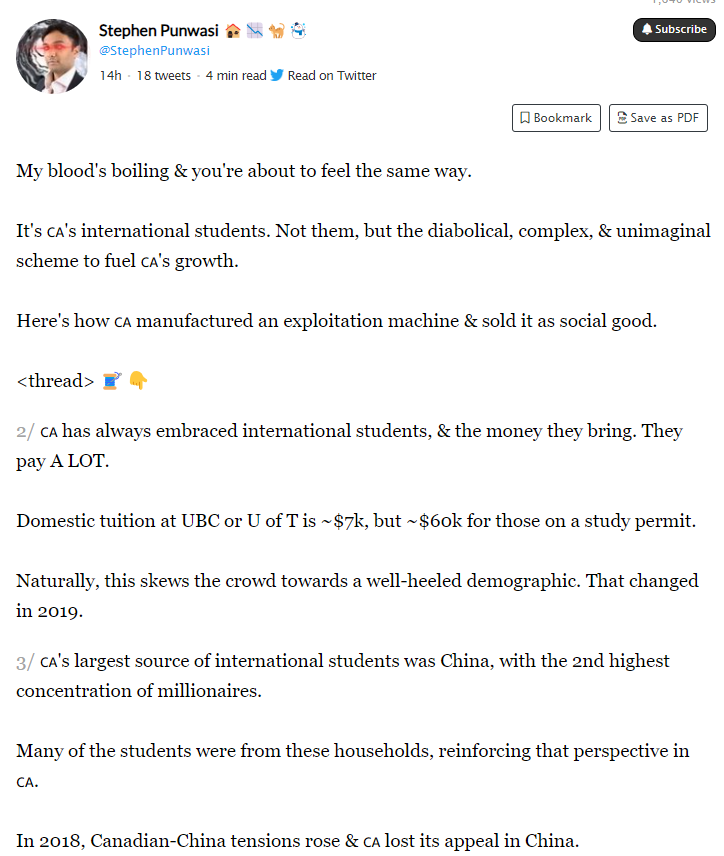
The thread continues:
4/ 🇨🇦, addicted to the cash, cooked up a $148m plan to replace those students with new ones—primarily in developing countries.
Permits to students from India spiked fast… strangely fast. Who are these students? Get a spoon to bite, because this is where it gets f*cked.
5/ India is a FAST growing country, forecast to have the world’s largest middle class soon. It has wealthy families, but they aren’t moving here. An Indian university study found most students looking to study in 🇨🇦 are from low-income farming regions & know little about it.
6/ What they “know” is what the recruiter told them: It’s filled with opportunity, automatic PR, guaranteed gov jobs, etc. Sometimes, the recruiters “get them in” to prestigious schools they could never actually get into. All lies—they’ll say anything for the commission.
7/ Recruiters tell these families their kid is brilliant & just in the wrong country. Find a way to pay their education, & all of the parents’ hard work pays off. Bet the farm, like good parents do. So they round up their savings (& sometimes relatives). They take out loans.
8/ Heck, some literally bet the farm. Oh, some recruiters know people that specialize in high interest loans secured by your farm? Super convenient. Oh, they have a secure stream of capital, a lot of it from investors in 🇨🇦? So lucky, what are the odds‽
9/ So the kids get to 🇨🇦 & don’t arrive at UBC or U of T, but a private career college in a strip mall. Sometimes not even the school they applied to. Some schools popped up almost overnight, others don’t have classes some semesters, & some have no domestic students.
10/ Some are run by swell folks who are strangely close with alleged organized crime groups. Opportunity is everywhere! Anyway, once you’re registered—you can start vouching for visas, there’s no limit. 🇨🇦 wanted this, after all.
11/ So they:
– spent $50k to go to a diploma mill;
– don’t speak english, because of testing fraud;
– have no money;
– often rent mattresses, taking 8/hr shifts w/other students;
– if this doesn’t work, their parents lose everythingA TO funeral home sends 5 dead back per month.
12/ Don’t worry. 🇨🇦 will help, right? In 2022, it lifted the restriction of 20 hours of on-campus work, to “help” 🇨🇦 solve its low-wage labor crisis. Those viral videos of hundreds of people waiting in line for a low-wage job interview? Those are mostly international students.
13/ To reiterate, 🇨🇦 scoured the world for poor families. Promised opportunity if they risked everything. It turns out there was no opportunity, so now they’re stuck paying off debt while most of their income is consumed by shelter costs. It sounds familiar, but why evades me
14/ but here’s the kicker. Other countries where this scam was brewing signed an inter-country agreement to refuse unethical student visa brokering. Did 🇨🇦? Nope, it actively rejected it. Once again, because this is a part of its strategy.

September 15, 2023
The old “war of the sexes” has been won decisively by women … and the aftermath won’t be pretty for any of us
I saw an article earlier today in The Free Press on the plight of young men in the dating scene these days (discussed earlier this month here and in July here). In short, men who don’t meet certain arbitrary minimums will have almost no chance with modern women in their age cohort. If you’re not at least six feet tall (males average 5’9″ worldwide), earn at least six figures (US men average under $60K per year), and have a penis at least six inches long (official estimates say American men average 5.1″ to 5.5″), you might as well give up on the dating scene.
Tom Knighton links all that from the Free Press article with some advice for young men on the off-chance they ever do have a date:

First, let’s look at this from Fox News, where a mother laments some of the issues at college with regard to Title IX and rape accusations.
If my two sons were starting college this Fall I would tell them this: be doubly sure you get consent — for her sake and yours. Maybe even record that consent (how romantic!). Your education and future may depend on it.
Under Biden’s proposed Title IX rules, if a college student is accused of sexual assault or harassment, he will no longer have the right to a live hearing, to cross-examine his accuser and witnesses, or to be represented by an attorney. Instead, a school administrator can decide to forgo a hearing and weigh the “credibility” of each party on his own, acting as investigator, judge, and jury in the case.
The standard for determining guilt will also be weakened from “clear and convincing” to a “preponderance of the evidence” — in other words, that there’s a 50.1 percent or greater chance an assault occurred. Not great odds in what are often “he said, she said” cases.
…
College students — mainly young men — should be worried. Biden’s Title IX changes are a reversal of rules implemented by the Trump administration in 2020, and a return to the “believe all women” attitude laid out in the Obama administration’s 2011 “Dear Colleague” letter.
This suggests a fraught landscape for young men, many of whom might just decide not to risk it.
As it is, our educational system actually favors women in many ways.
The primary, middle, and high school classrooms are constructed in a way that actually favors the way girls typically learn as opposed to how boys do. As a result, girls tend to get better grades and a leg up on getting into college.
Further, as a protected class, even before the recent Supreme Court ruling, women had a bit of an edge at being accepted to college under affirmative action guidelines, though race did tend to play a larger factor.
Now you’re favoring women’s position in a “he said/she said” environment of sexual assault allegation, even when there’s no other evidence. I say this because I’ve covered these stories off and on for years now. That’s how it happens in a surprising number of cases.
It’s a situation where young men are disfavored and operating at a disadvantage from day one, then it gets worse from there.
Schools often have all kinds of support services for female students on top of the support services open to all students. Guys, however, get no such help.
With all that in mind, it’s not surprising that women graduate college at a much higher rate than men.
The relationship between graduating university and earning a higher salary isn’t as robust as it used to be, but it’s still financially advantageous to have a degree in most careers. More and more women do and fewer and fewer men do. That means more higher-income women are competing for fewer high-status men. That tiny proportion of men benefit disproportionally from their increasing rarity in the dating pool.
Men aren’t graduating college at a similar rate to women? Well, who cares? At least women aren’t being kept out of education.
Men can’t find romantic partners and instead, turn to online porn? Well, who cares? At least women are empowered enough to be picky.
I’m not saying we should dictate anything to do with people’s personal choices, but we could at least start to realize that young men are in crisis mode and that we might want to do something about that before we have real problems.
Then we have the potential decrease in the population as fewer and fewer families are starting and I just don’t see good things happening going forward.
Large numbers of angry young men with no chance at forming relationships with women and generally under- or unemployed? This is not a scenario for a happy or stable future.
QotD: Modernism into Post-Modernism
Gertrude Himmelfarb, On Looking into the Abyss, 1994.
September 9, 2023
QotD: Using the Socratic method in today’s university
The problem is, the Socratic method isn’t just “asking a bunch of questions.” The idea of elenchus is to get students to question their own presuppositions. You’re teaching them how to think, not what to think. It’s a neat trick, and I’m far from an expert at it — not least because I was never taught how to do it, except by my teachers in undergrad, who did it to me.
Worse, if you had to put two words on Western Civ’s tombstone, ignoratio elenchii would be strong contenders. That’s “irrelevant conclusion” in English, and it’s not too much of an exaggeration to say that “irrelevant conclusion” basically IS “education”, K-thru-PhD. It’s GIGO, as the computer nerds used to say back in my day — Garbage In, Garbage Out. It’s pretty damn tough, in other words, to have a logical argument with someone who pretends not to believe in logic. By the time you get them in a college classroom, they have twenty years’ experience parroting nonsense … but not the “arguments” for said nonsense, because there aren’t any, and that’s the first thing you have to demonstrate. It’s a tough row to hoe.
Which is why most profs won’t risk it. Because, of course, the other problem with actually arguing with students is the possibility you might lose. The student might be smarter than you — it’s rare, but it happens. They might know something you don’t (which happens all the time; see above). Or they might just refuse to engage. I’ve had a student ask me, to my face, why it is that when I say something it’s a fact, but when xzhey say something it’s an opinion. How do you even respond to that? Seriously — shouting “because it says ‘PhD’ after my name, motherfucker!!” is deeply, viscerally satisfying, but that would teach the kid exactly the wrong lesson, wouldn’t it? All of these are gross insults to egghead amour propre, to be avoided at all costs.
Severian, “How to Teach History”, Rotten Chestnuts, 2020-12-23.
September 6, 2023
Some key planks from Scott Alexander’s presidential platform
I was a bit surprised to find that Scott Alexander has decided to toss his hat into not one, but two party primaries for the 2024 presidential nomination:
The American people deserve a choice. They deserve a candidate who will reject the failed policies of the past and embrace the failed policies of the future. It is my honor to announce I am throwing my hat into both the Democratic and Republican primaries (to double my chances), with the following platform:
Ensure Naval Supremacy And Reduce Wealth Inequality By Bringing Back The Liturgy
The liturgy was a custom of ancient Athens. When the state needed something (usually a new warship) it would ask for volunteers among its richest citizens. Usually one would step up to gain glory or avoid scorn; if nobody did, the courts were allowed to choose the richest person who hadn’t helped out recently. The liturgist would fund the warship and command it as captain for two years, after which his debt to the state was considered discharged and he was given a golden crown. Historians treat the liturgy as a gray area between voluntary service and compulsory taxation; most rich Athenians were eager to serve and gain the relevant honor, but they also knew that if they didn’t, they could be compelled to perform the same service with less benefit to their personal reputation.
Defense analysts warn that America’s naval dominance is declining:
Only 25 per cent of America’s 114 commissioned surface combatants (cruisers, destroyers, and littoral combat ships) are less than a decade old. By comparison more than 80 per cent of China’s 141 destroyers, frigates, and corvettes have been commissioned in the past decade. In the same time period, the United States commissioned 30 surface combatants … The nearly 600-ship Navy of the late 1980s deployed only 15 per cent of the fleet on average. Today, with fewer than 300 ships, the US Navy deploys more than 35 per cent to service its global missions, contributing to a material death spiral.
So America is short on warships. But it is very long on rich people with big egos. An aircraft carrier would cost the richest American billionaires about the same fraction of their wealth as a trireme cost the richest Athenian aristocrats. So I say: bring back the liturgy!
(source)
The American rich already enjoy spending their money on exciting vehicles — yachts for the normies, rockets for the more ambitious, Titanic submersibles for the suicidal. Why not redirect this impulse towards public service? Imagine the fear it would strike into the hearts of the Chinese when the USS Musk enters Ludicrous Mode in the waters off the Taiwan Strait, with Elon himself at the wheel. Imagine how efficiently the USS Jeff Bezos will deliver its payloads! And does anyone doubt that billionaires – usually careful to avoid taxes — will jump at the chance to do this?
The Athenians had a parallel liturgy for rich people who would select and sponsor theater productions, but I think we can skip this one for now.
[…]
Legalize Lying About Your College On Resumes
Colleges trap Americans in a cycle of burdensome loans and act to reinforce class privilege. I have previously advocated making college degree a protected characteristic which it is illegal to ask people about on job applications. But this would be hard to enforce, and people would come up with other ways to communicate their education level.
So let’s think different: let’s make it legal to lie about your college on resumes (it is already not technically illegal to lie on a resume, but companies can ask for slightly different forms of corroboration which it is illegal to lie on). Everyone can just say “Harvard”, and nobody will have any unfair advantage over anyone else.
Start An Internet-Pop-Up Trade War With The European Union
For too long, Americans have groaned under the weight of foreign cookie-related-pop-ups which they and their elected representatives have no control over. It’s time to fight back.
When I am elected, I will mandate that all American websites serve popups to European Union residents explaining why the GDPR is annoying and why it affects even Americans who have no say in it. If the Europeans want to be able to access Google, Facebook, Twitter, or any other US-based site without clicking “I understand” every time they reload it, they’ll have to pressure their government to do something about GDPR.
Appoint Donald Trump Constitutional Monarch
This would require a constitutional amendment, but I’m sure I could convince enough people.
The British experience suggests that the role of a constitutional monarch is to flaunt how rich they are, get 24-7 news coverage regardless of whether or not they do anything interesting, and have scandals. Donald Trump is the best person in the world at all three of these things
Trump wants to be on top, but is not that interested in governing. Meanwhile, American liberals (by revealed preference) want to continue thinking about him every hour of every day forever, but also don’t want him to govern. Constitutional monarchy would satisfy everyone’s preferences. If Trump is destined to destroy democracy — and everyone agrees that he is — let’s make it happen as gently and non-destructively as possible.
Obviously the royal family can’t participate in regular electoral politics, which means no Trump would ever be able to run for office ever again. This is the only way we are ever getting rid of them, you know this is true, please don’t throw away this chance.
I would support reverse primogeniture-based inheritance — ie the youngest son takes the throne — just so we can have a “King Barron”.

August 29, 2023
The Souls of Black Folk by W.E.B. Du Bois “runs so fantastically counter to the entire ideology of ‘decolonise'”
In Spiked, Brendan O’Neill finds himself surprised at the inclusion of a very unusual book on a list demanded by those pushing for “decolonization” of university curricula:
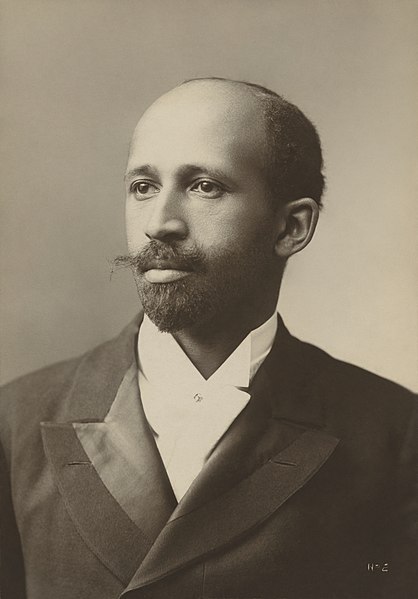
W.E.B. Du Bois by James E. Purdy, 1907, gelatin silver print, from the National Portrait Gallery which has explicitly released this digital image under the CC0 license.
Wikimedia Commons.
“Decolonise the curriculum” is a movement that wants university courses to focus less on dead white European males and more on writers of colour. Its argument is that black students need texts that speak directly to them. They need books by authors who look like them. They need books about experiences and ideas they can more readily relate to than they can the stuff written about in “high white culture”. Black students must be able to recognise themselves in what they study, we’re told, or else they’ll feel cheated and demeaned.
I was surprised to find that one of the leading decolonise movements, at the University of Edinburgh, was arguing for WEB Du Bois’ 1903 book, The Souls of Black Folk, to be included on the English curriculum. The activists said it was unreasonable to expect black students to engage with so many white authors. They also need to engage with people like Du Bois, in whose work they might “recognise themselves”. I was surprised, not because I think The Souls of Black Folk shouldn’t be on more university courses – absolutely it should. No, it’s because The Souls of Black Folk runs so fantastically counter to the entire ideology of “decolonise”. It made me wonder if these activists have even read it. Du Bois’ book contains some of the finest arguments you will ever read against the idea that high culture is a white thing that others cannot connect with.
One of my favourite passages in the book, from the chapter on what kind of education black men are fit for, touches on this very question. Here Du Bois makes his critique of those in his own time who were arguing that blacks only require basic education and industrial training. He describes his own experience of higher learning, writing:
I sit with Shakespeare and he winces not. Across the colour line I move arm in arm with Balzac and Dumas … From out the caves of evening that swing between the strong-limbed earth and the tracery of the stars, I summon Aristotle and Aurelius and they come all graciously with no scorn or condescension.
That passage, Du Bois’ moving belief that Shakespeare does not wince at him, captures a central thread of his writing: universalism. Du Bois agitates against accommodating to segregation or low expectations, and argues for the rights of “black folk” to assimilate into the spoils of civilisation; to become, as he puts it, “co-workers in the kingdom of culture”. To those in the late 1800s and early 1900s who argued that black people needed a targeted form of culture, one specific to their needs and capacities, Du Bois said: “We daily hear that an education that encourages aspiration, that sets the loftiest of ideals and seeks as an end culture and character rather than breadwinning, is the privilege of white men, and the danger and delusion of black men.”
Du Bois insisted that it is only through assimilation into the “kingdom of culture” that self-knowledge and self-improvement can truly occur. As he wrote: “Wed with Truth, I dwell above the veil.” The veil he’s referring to is the veil of colour, the one that separated blacks from whites in post-slavery America. For Du Bois, that veil was best lifted via assimilation into the American republic’s political universe and its realm of culture.
Du Bois’ critique of the notion that high culture was for white men, and would prove mystifying to black men, has sadly been superseded by an “anti-racism” with an entirely different outlook. Now, the supposedly radical stance is to believe that high culture is disorientating for black people, and possibly even damaging to their self-esteem, and therefore they require something more targeted. In short, they need release from the kingdom of culture. That, in essence, is what the decolonise movement desires: the “liberation” of non-white peoples from the cultural gains of Western civilisation. Behold the crisis of universalist belief.
August 28, 2023
QotD: Progressives don’t have collections, but they may have fetish objects
Leftists put their entire lives on display at all times. They might have some knickknacks or mementos (though it’s shocking how few of them have even that), but they’re all for show — if a Leftist ever had a baseball card, it would be framed and displayed in the center [of] xzhyr apartment’s living room, and would have something to do with the player’s politics (the only openly gay player on the Yankees or something). The collector’s joys are unknown to them, because the collector collects for personal reasons. Collectors often can’t wait to show you their collections, of course, and they can be godawful tedious about it, but — pace the Left — they aren’t showing you to brag about it; they’re showing you because you’re their friend, and they assume you’re interested in what interests them.
[…]
SJWs always project, right? They know better than anyone that money can’t buy you happiness, because SJW-ism is strictly an upper-middle-class pursuit. They have all the stuff in the world, and they’re miserable. Look at the ivory tower. I hate to keep beating this dead horse, but it’s really the best example I can think of. Those people are “the 1%” by any measure that makes sense. They have everything. They work 24/7 — that’s “24 hours a week, 7 months a year” — and get comped, on average, nearly $100K for it. You can always tell which one is the faculty parking lot — no make cheaper than Volvo; no model year earlier than 2017. The houses in the faculty ghetto tend to be physically small, it’s true, but that’s because they’re all restored Victorians — go ahead and cost out what it takes to fully restore one of those puppies, and contemplate a lifetime of pauperism.
Commodity fetishism? In spades, kameraden, and we haven’t even gotten to the “lifestyle” stuff yet. Organic food — tiny little bananas from Trader Joe’s that wouldn’t feed a pygmy marmoset, but cost $4 per pound. Hot yoga lessons — $100 per hour. Eat-pray-loving your way across Indonesia — I can’t even begin to calculate it. SJWs live niiiice; way too nice for us deplorables to afford, filthy “capitalists” that we are.
Severian, “Junkies (II)”, Rotten Chestnuts, 2021-01-18.
August 26, 2023
“Email jobs”, as defined by Freddie deBoer
Freddie deBoer offers some notes on what he calls “a book I’ll probably never write”:

When I talk to people about college-educated workers, even informed people, there’s a constant tendency to immediately think of doctors, lawyers, engineers, data scientists … Reflexively, people seem to think of educated labor in terms of college graduates who a) tend to go on to some sort of graduate study, b) work in fields that directly utilize domain-specific knowledge from their majors or graduate education, and c) are generally high-income relative to the economy writ large. These professions, combined, are a healthy slice of our labor force, and there’s nothing wrong with paying an appropriate amount of attention to them. But I think the amount of attention they’re given in the educational and economic discourse is in fact disproportionate. And I also think that there’s a kind of profession that is intuitively very understandable but which (despite considerable effort on my part) remains very difficult to classify and thus to quantify. Though it has many names, I think my preferred term is “email job”.
[…]
To me, prototypical email jobs
- Depend, naturally, on email and other digital communicative tools like video conferencing, online calendars, and networked workspaces for the large majority of their actual productive capability
- Are staffed almost entirely by people with college degrees, but while they do take advantage of time management and organizational skills that can be developed in college, almost never call on domain-specific knowledge related to a particular major
- Dedicate a considerable amount of time not to the named productive goals of the job themselves but to meta-tasks that are meant to facilitate those goals (scheduling, coordinating, assigning responsibility, “touching base”, enhancing productivity, ensuring compliance with various HR-mediated job requirements and odd whims of the boss)
- Have no immediate observable impact on the material world; an email job might involve coordinating or supporting or assessing a project that will eventually move some atoms around, but the email job itself results only in the manipulation of bits
- Cannot be considered creative in any meaningful sense — they do not entail the production of new stories, scripts, code, images, video, blueprints, patents, research papers, etc — but may involve the creation of materials that are subsidiary to larger administrative goals, such as PowerPoint presentations, reports, postmortems, or white papers
- May or may not be partially or fully remote but could likely be performed fully remotely/on a “work from home” basis without issue
- Can involve supervising lower-level workers, even teams, but these positions are not themselves fundamentally supervisory and the holder of an email job is rarely the only “report” for anyone; these positions, in other words, are not executive or executive-track, though some may escape the email job track and gain entry to the executive track
- Tend to top out at middle management, and often have a salary range (with a great deal of wiggle) between $50,000 and $200,000/year.
Doctors do not have email jobs because the human bodies they treat exist in the world of atoms, not the world of bits, and their work involves domain-specific knowledge. There are some lawyers who are effectively in email jobs, as their law credentials are used for hiring purposes but their actual task is handling particular kinds of paperwork that a non-lawyer could complete, but most lawyers are not in email jobs as their work involves various functions at courthouses and otherwise away from the computer, and anyway their work too involves domain-specific knowledge. Most accountants and actuaries are not in email jobs as their jobs require domain-specific knowledge that they acquired in formal education. Architects create new things that will someday exist in the world of atoms and utilize domain-specific knowledge they learned in college. Programmers take advantage of skills gained in college to create new things that exist for their own purpose, rather than to satisfy other administrative functions. Professors don’t have email jobs, even those who work at online colleges, as working with students takes place in the world of atoms and they are constantly accessing domain-specific knowledge they learned in formal education. Screenwriters create something new; engineers move atoms and usually get graduate degrees; CEOs don’t have email jobs because they’re on the executive track and enjoy the ability to delegate most of the email work to subordinates. I could go on.
So who does have an email job? Take someone who works in accreditation at a college in a large public university system. He or she didn’t get a major in accreditation (there is no such major) and is unlikely to have majored in education, and even if they did they would have learned about pedagogy and “theory” and assessment rather than anything having to do with their daily work lives. Essentially everything they do for work takes place within the confines of their laptop screen, and the exception is various in-person meetings that accomplish nothing beyond delegating various tasks, defining roles, critiquing past performance, and otherwise reflecting on how to do a better job of supporting the tasks that other people do. A person in this job might have a secretary or lower-level administrative functionary that reports to them, but they are not on a track that makes advancement likely — becoming a VP somewhere will likely require many years of service and going on the job market to get a job at another school. A person in this position will never interact with students in any real capacity, demonstrating the psychic distance between email jobs and the actual function of their institutions. Though they have a clear and defined set of responsibilities written into their job description, their overall impact on the day-to-day functioning of their college is nebulous, and far more time is spent on administrivia than their “real” duties. They live between the 50th and 75th percentile for individual income in their state.
August 16, 2023
That useful German word, Fremdschämen
At Oxford Sour, Christopher Gage recounts a cringe-worthy example of Fremdschämen from his university days:

Back in university, our English literature professor assigned Jonathan Swift’s A Modest Proposal.
After peeling myself off an undisclosed living room carpet, I trundled into university at the ungodly, semi-torturous hour of 9 a.m. The Geneva Convention still drags its heels in deeming this a cruel and unusual punishment.
The hall filled up in dribs and drabs. One kid, the type who nodded furtively even when there was nothing to nod at, couldn’t wait to tell the world what he thought of The Modest Proposal.
Reader, I cannot directly quote here. One, because memory fails, and two because memory fails. Anyway, he charged into the work.
“Quite frankly,” he said. “I think it is disgusting. To think that even a few hundred years ago someone of apparent letters would propose such a twisted solution to poverty and to hunger is quite frankly abhorrent.”
After relishing his clearly rehearsed diatribe, he sat down and glanced over at the girls. To reward his brilliance, had they disrobed in the hope he sires them with his superior genes right then and there? There was to be no public Genghis Khan moment.
The lecturer, a Clark Kent lookalike with an expressive Roman nose, didn’t know what to say. Neither did anyone else. I admit that in my hungover, hangxiety-ridden, did-I-use-protection state, I briefly pondered whether the joke was on me. Swift was serious?! He meant we should feed poor children to the rich?
The professor said: “Interesting point”.
The lecture hall took on the air of the firing squad. Surely, someone would let fly the first bullet? Aiming neatly above his head, the professor revealed as one would deliver a diagnosis of a terminal illness. Swift’s Modest Proposal was “not given in sincerity” — the bourgeoise version of the proletarian phrase: Are you fucking stupid or something?
The boy crimsoned. His face beat so red he looked like a disgruntled toffee apple. “Oh, no. I knew that” he said. “Of course. I just. It’s just. I think. You know. Of course. I … it’s just shocking to me how … you know… how like … anyone could even print that as a joke?”
(I add the question mark to denote the Millennial tendency to dement declarative sentences into questions for fear of getting things wrong.)
I learned a new word that day. Fremdschämen: The German word for vicarious embarrassment or “cringe”.
August 8, 2023
QotD: The British imperial educational “system”
(At the risk of straying too far afield, let’s briefly note that “senior churchman” was a common, indeed almost traditional, career path for the spare sons of the aristocracy. Well into the 18th century, every titled parent’s goal was “an heir and a spare”, with the heir destined for the title and castle and the spare earmarked for the church … but not, of course, as some humble parish priest. It was pretty common for bishops or abbots, and sometimes even cardinals, to be ordained on the day they took over their bishoprics. See, for example, Cesare Borgia. Meanwhile the illiterate, superstitious, brutish parish priest was a figure of satire throughout the Middle Ages and Renaissance. A guy like Thomas Wolsey was hated, in no small part, precisely because he was a commoner who leveraged his formal education into a senior church gig, taking a bunch of plum positions away from the aristocracy’s spare sons in the process).
That being the case — that schools were for education, universities for training — the fascinating spectacle of some 18 year old fop fresh out of Eton being sent to govern the Punjab makes a lot more sense. His character, formed by his education (in our sense), was considered sufficient; he’d pick up such technical training as he needed on the job … or employ trained technicians to do it for him. So too, of course, with the army, and the more you know about the British Army before the 20th century, the more you’re amazed that they managed to win anything, much less an empire — the heir’s spare’s spare traditionally went into the army, buying his commission outright, which meant that quite senior commands could, and often did, go to snotnosed teenagers who didn’t know their left flank from their right.
Alas, governments back in the days were severely under-bureaucratized, meaning that the aristocracy lacked sufficient spares to fill all the technician roles the heirs required in a rapidly urbanizing, globalizing world… which meant that talented commoners had to be employed to fill the gaps. See e.g. Wolsey, above. The problem with that, though, is that you can’t have some dirty-arsed commoner, however skilled, wiping his nose on his sleeve while in the presence of His Lordship, so universities took on a socializing function. And so (again, grossly oversimplifying for clarity) the “bachelor of arts” was born, meaning “a technician with the social savvy to work closely with his betters”. A good example is Thomas Hobbes, whose official job title in the Earl of Devonshire’s household was “tutor”, but whose function was basically “intellectual technician” — he was a kind of man-of-all-work for anything white collar …
At that point, if there had been a “system” of any kind, what the system’s designers should’ve done is set up finishing schools. The “universities” of Oxford, Cambridge, etc. are made up of various “colleges” anyway, each with their own rules and traditions and house colors and all that Harry Potter shit. Their Lordships should’ve gotten together and endowed another college for the sole purpose of knocking manners into ambitious commoners on the make (Wolsey might actually have had something like this in mind with Cardinal College … alas).
But they didn’t, and so the professors at the traditional colleges were forced into a role for which they were not designed, and unqualified. That tends to happen a lot — have you noticed? It actually happened to them twice, once with the need for technicians-with-manners became apparent, and then again when the realization dawned — as it did by the 1700s, if not earlier — that some subjects, like chemistry, require not just technicians and technician-trainers, but researchers. Hard to blame the “system” for this, since of course there is no “system”, but also because such a thing would be ruinously expensive.
Hence by the time an actual system came into being — in Prussia, around 1800 — the professors awkwardly inhabited the three roles we started with. The Professor of Chemistry, say, was supposed to conduct research while training technicians-with-manners. As with the pre-machinegun British army, the astounding thing is that they managed to pull it off at all, much less to such consistently high quality. They were real men back then …
Severian, “Education Reform”, Rotten Chestnuts, 2020-11-17.
August 4, 2023
QotD: The “knowledge base” problem in teaching history
The point is this: Even if I were an expert in that particular field (I’m not; as with Sovietology, I’m a gentleman amateur), there are zillions of people who know more of the details than I do. It seems like half the Internet can reel off, from memory, the entire command structure of the 6th Volksgrenadier regiment. Teach a “Modern Europe” class, and you’re guaranteed to have at least one of them among the studentry. Knowledge, in that sense, is over-supplied.
It’s over-supplied in another way, too. There have been tremendous recent advances in the study of, say, the Roman Empire. Computer modeling of seed-distribution patterns and asdzlsjdfjkha … sorry, my head hit the keyboard, I can’t stay awake for this stuff, but I’m sure glad someone can, because it’s important. As I understand it, there have been revolutions even in older fields like numismatics and epigraphy — you can learn a lot from coins and inscriptions, and they’re changing our understanding of some fundamental stuff (see e.g. Roman coins in Japan).
But knowledge is also under-supplied, especially from the teachers’ side. Not just “knowledge of human nature”, above, though of course that’s a biggie. Here’s a far from exhaustive list of what I was NOT taught in graduate school:
- economics
- military strategy
- ecology
- agriculture
- logistics
- Western languages
- non-Western languages
and so on. Now, some of these you’re supposed to have supplied yourself (e.g. the languages, provided you don’t need them for your specialty, and at one time I could muddle through a few), but nobody checks. Obviously nobody checks when it comes to economics, because everyone in the Biz is a Marxist, and sentence one of page one of any basic economics textbook should read “Marxism is a comprehensive crock of horseshit”, but it works that way for all the others, too. Considering that “farming” and “fighting” are two of the Three F’s that comprise “what almost all humans did, all the time, for all of recorded history”, those are some pretty goddamn big oversights … you know, if actually knowing how humans do is the point.1
Severian, “How to Teach History”, Rotten Chestnuts, 2020-12-23.
1. the third F, for the record, is “fucking”, and like the languages, you’re supposed to have acquired a working knowledge of that on your own before you arrive. Alas, that obviously didn’t work out as planned. The 40 Year Old Virgin wasn’t supposed to be a documentary, but it’s pretty much cinéma vérité in your average graduate program. Trust me: The persyn with bespoke pronouns has them because xzhey have absolutely no idea what to do with their naughty bits. When I say that a night on the town with a sailor on shore leave would cure most of these … organisms … of the majority of their problems, I mean it. Getting eggheads blued, screwed, and tattooed wouldn’t save America, but it would be a damn good start.


