So why is there such a big disconnect in the media? Why are there headlines about cutting and slashing when government is growing by every possible measure?
For the simple reason that the budget process in Washington is pervasively dishonest, as I’ve explained in interviews with John Stossel and Judge Napolitano. Here are the three things you need to know.
- The politicians created a system that automatically assumes big increases in annual spending, called a baseline.
- When there’s a proposal to have spending grow slower than the baseline, the gap between the proposal and the baseline is called a cut.
- It’s like being on a diet and claiming progress because you’re gaining two pounds each month rather than five pounds.
Defenders of this system argue that programs should get built-in increases because of things such as inflation, or because of more old people, which leads to more spending for programs such as Social Security and Medicare.
It’s certainly reasonable for them to argue that budgets should increase for these reasons.
But they should be honest. Be forthright and assert that “Spending should climb X percent because …”
Needless to say, that won’t happen. The pro-spending politicians and interest groups like the current approach because it allows them to scare voters by warning about “savage” and “draconian” spending cuts.
Daniel J. Mitchell, “The Media’s Pervasively Dishonest Coverage of Trump’s New Budget”, International Liberty, 2020-02-10.
January 25, 2025
QotD: “Big budget cuts!”
January 24, 2025
QotD: Star Trek‘s transporter
It wasn’t supposed to be the catchphrase from the show: that honor was reserved for Gene Roddenberry’s portentous sonorous orotund grandiosity – the space-the-final-frontier-boldly-going-where-no-man’s-gone-before stuff. The beaming was neither here nor there: it was a colloquialism for matter-energy transit, or teleportation – or, more to the point, a way of getting from the inside of the space ship to the set of the planet without having to do a lot of expensive exterior shots in which you’ve got to show the USS Enterprise landing and Kirk, Spock et al disembarking. Instead, the crew positioned themselves in what looked vaguely like a top-of-the-line shower, ordered Scotty to make with the beaming, and next thing you know they were standing next to some polystyrene rocks in front of a backcloth whose colors were the only way of telling this week’s planet from last week’s. “Beaming” was the special effect – the one that saved Star Trek from having to have any others.
Mark Steyn, “Beam Movie Actor”, Steyn Online, 2020-02-15.
January 19, 2025
Mark Carney is a serious man … that doesn’t mean he’d be a good political leader
The Line‘s Jen Gerson likes Mark Carney, but she hastens to add that this isn’t necessarily good news for Mr. Carney as she felt the same way about Jim Prentice who was very briefly Premier of Alberta but “demonstrated the political nous of a chicken nugget” and quickly was out of power:

Then-Governor of the Bank of Canada Mark Carney at the 2012 Annual Meeting of the World Economic Forum in Davos, Switzerland.
WEF photo via Wikimedia Commons.
I learned the most valuable lesson from that period of political reporting, one I try to carry with me unto this very day: Never, never let one’s personal feelings about an individual candidate corrupt one’s political analysis. And if you think about it, this is a very important lesson to learn.
I am not a normal person. That which appeals to me is very unlikely to find purchase with sane, feeling voters who hold ordinary jobs and live lives filled with meaningful human connections and real, not-political conversations.
I was thinking about this as I watched Mark Carney announce his intention to run as Liberal leader in Edmonton on Thursday. Carney is a serious man. He has a real CV and a long list of meaningful accomplishments. He’s a man who seems to understand that the “good old times are over”. He’s a man who has navigated several international crises — as he was keen to point out. He’s a man who despises the excesses of both the right and the left. He’s a man who is is focused on building Canada’s economy.
He’s a man who has correctly identified one of the Conservatives’ core weaknesses, their tendency to channel legitimate anger and grievance into thin slogans that offer few substantive plans toward the kinds of significant changes that this country will be required to make. The fact that Carney is making this critique while coming to the fore without offering any substantive plans of his own is only to be expected considering the timeline’s he’s working with, I suppose.
Regardless, Carney is giving Jim Prentice Energy. Jean Charest Energy. Jeb! Energy.
I like him.
[…]
For that matter, if Carney wants to present himself as a strong supporter of Canada, a defender of our sovereignty in the face of America’s re-articulated expansionist ambitions, why did he preempt his leadership launch with an appearance on The Daily Show? What message are we to take from this: that Carney is well liked and respected by the American political milieu that was roundly trounced by Donald Trump?
It doesn’t signal a lot of faith in Canada as a cohesive cultural concept to soft launch your political leadership campaign through a marshmallow chat with an American comedy host. (As an aside, I realize that foreigners aren’t real to Americans, but I’m begging literally any television journalist on a mainstream U.S. network to stop treating our politicians like kawaii pets [Wiki] on loan from a northern Democrat utopia that exists only in their minds. These people can handle hard questions — even about matters that are important to an American audience; like, for example, Canada’s delinquent NATO spending.)
Did Mark Carney not believe that the CBC that I presume he will be campaigning to preserve was up to the challenge of doing the first interview with him? Look, I wouldn’t turn down a chat at Jon Stewart’s table if I got the call, but if the best possible way to reach potential Liberal leadership voters in 2025 is to pop onto American TV, we might as well pack it in, call ourselves 51 and be done with it.
By the way, in case anyone hasn’t yet pointed it out; the average age of a Daily Show audience member is 63. The audience is in steep decline, and it doesn’t even air on any Canadian TV channels anymore. To watch the Carney clip, Canadians have to seek it out on Apple TV or YouTube. Usually the day after because the target demo is usually in bed by 9 p.m. MST now.
January 13, 2025
Muttering something about “manifest destiny” while glancing north
The Line‘s weekly dispatch is, as usual, mostly behind the paywall but the portion visible to cheapskates contains much of interest:
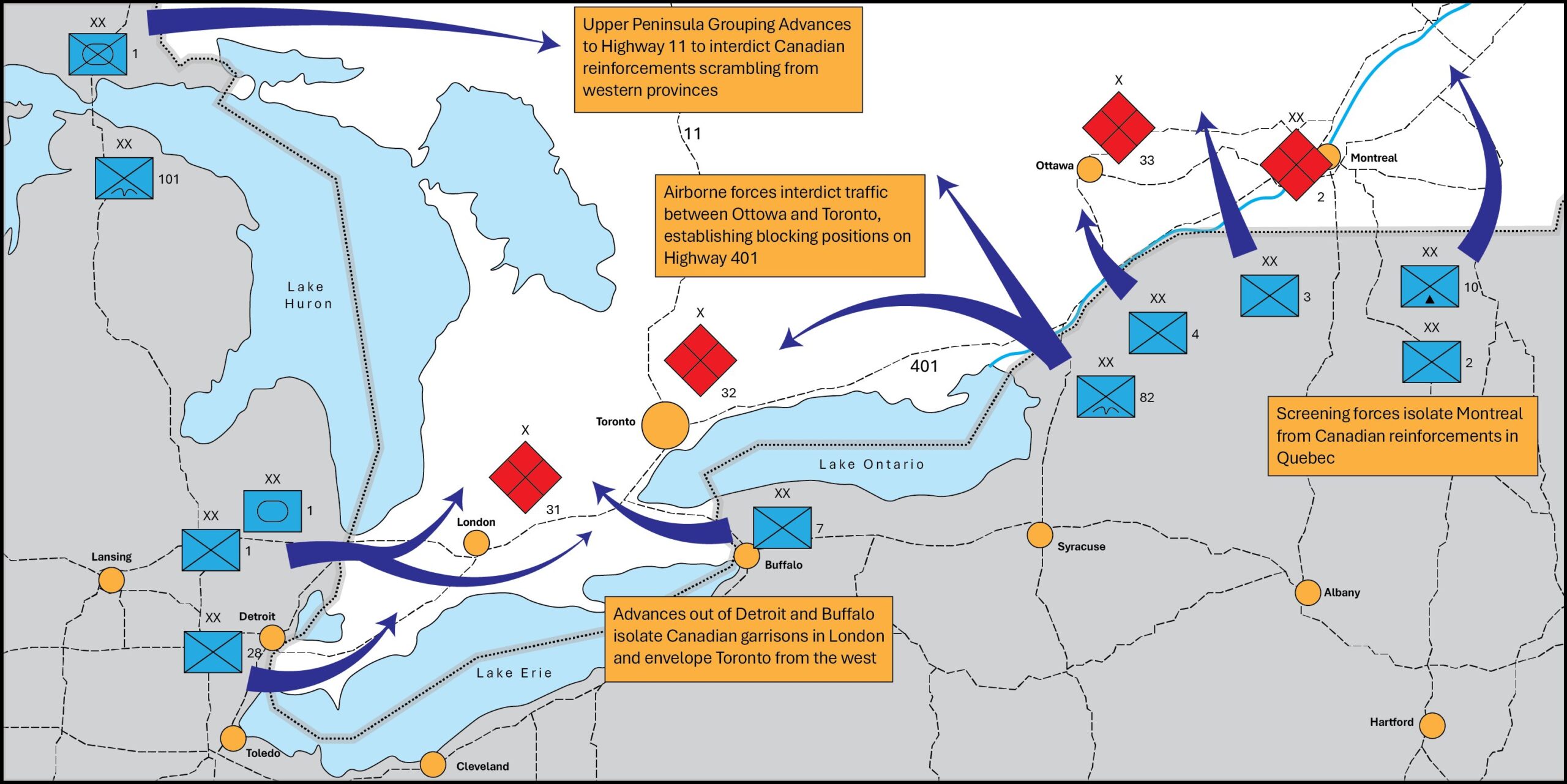
Manifest Destiny, 2025? Big Serge’s updated map for the old US War Plan Red for a military invasion of Canada.
It’s no coincidence that as Canada’s leadership devolved into its own navel, the very-soon-to-be-inaugurated Donald Trump escalated his provocations. This week, Trump threatened to use “economic force” to push Canada to bend the knee. Meanwhile, we cannot help but notice that the idea of a Canadian state is starting to gain significant traction in even moderate and mainstream American conservative circles. Meanwhile, we’ve got Alberta Premier Danielle Smith supping with Kevin O’Leary and Jordan Peterson down in Mar-a-Lago.
Tap tap. May we suggest that you peruse the safety cards tucked into the back of your seat, buckle up, and take note of your nearest emergency exits?
Whether we are talking about some kind of economic union, or a full-blown annexation, the fact that at least some in America are reviving the term “Manifest Destiny” is a possibility that we can no longer afford to dismiss as mere trolling. While we hope that the Trump administration is going to be so bogged down with other policy priorities that “Canada 51” is soon overshadowed, your Line editors have been game theorying out a host of possible scenarios and … none of them look great. If Trump et al get serious about this idea — and, again, we have no way to know if they will get serious about this idea — then we at The Line fear that Canada is in for some serious turmoil in the coming few months.
As I said in an email to Severian the other week, “… Canada will have very little ability to react to whatever Hitler, er, I mean “Trump” will do as soon as he’s inaugurated. It was clear before this that Trudeau cared very little about ordinary Canadians’ lives, but this really is dereliction of duty on a cosmic scale. If Trump does follow through with that huge tariff, the Canadian economy is likely to collapse, as we’re so deeply intertwined with the US on so many levels. Sadly, this might make it even more attractive to Trump, as it would absolutely encourager les autres on a global scale. If the BOM is willing to destroy the economy of his closest trading partner, what might he do to France? Or Germany? Or South Korea?” Back to the dispatch:
To explain our alarm, let’s first look at another news item to cross the desk. This week, Justin Trudeau travelled south to attend the funeral of Jimmy Carter, and stopped at the CNN studios for a quick interview with Jake Tapper on the way through.
On the whole, we think his interview was fine. Look, Trudeau’s been through a lot in the last few days, and considering the circumstances, it’s not reasonable to expect a breakthrough performance. So we’re being a bit unkind to nitpick, but something he said during that interview deserves scrutiny.
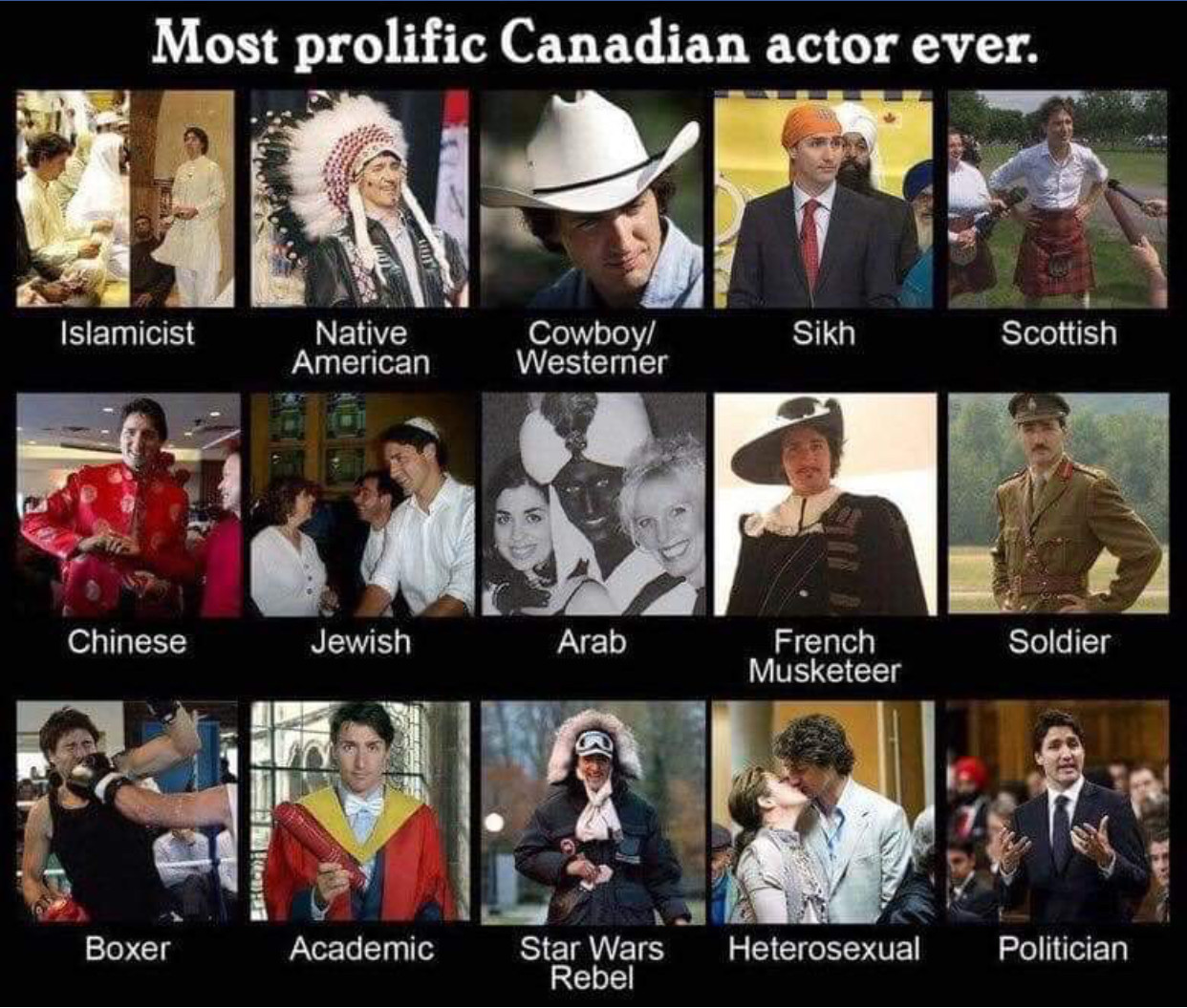
Justin Trudeau got far too comfortable with being treated as a progressive superstar, not only among the sycophants with CBC nametags but even on the international stage … perhaps especially on the international stage. Trudeau was always inclined to the performative in everything he did, and he might well only feel fully alive when cameras are rolling. The evidence certainly seems to point in that direction.
The “most prolific Canadian actor” meme was mildly amusing during Trudeau’s first term in office, as he went out of his way to put on elaborate costumes and to perform for the audience. This sort of thing was understandable if not particularly welcome to those who wanted Canada to be taken seriously by our allies and trading partners. It was clichéd to joke about what novelty socks Trudeau was wearing at any given international event … because it was his trademark. As was the clearly diminished respect he got as his time in office went on.
When asked about Trump’s provocations, Trudeau affirmed Canadians’ pride in their own sovereignty by noting — half jokingly, we presume — that we fundamentally define ourselves as “not American”.
Firstly, this is not a particularly diplomatic jibe to be launched at actual ordinary Americans; it made us wince to consider how it must have landed to CNN’s ordinary watching audience.
Secondly, if the only way in which Canadians can define themselves nowadays is “not-American”, Jeez, that’s an extraordinarily thin peg upon which to hang a hat.
This stuff matters.
It is to wince. However, even that pathetic response was better than launching into yet another diatribe about Trudeau’s firm conviction that Canadians are all genocidal white supremacist morons, I guess.
The ability of a population to withstand neighbourly aggression — “economic force”, if you will — depends on two things. The first is internal social cohesion and identity. The second is what the aggressor is willing to do or offer in order to secure capitulation.
In this case, the second part of that equation is outside our control. So we look to the first: does Canada have a strong sense of self right now? Do its leaders command the moral authority necessary to create the social cohesion required to withstand a period of sustained material sacrifice?
If we are “not Americans”, it rather asks the question why aren’t we Americans? And, more crucially, what are we actually willing to give up in order to preserve that independence?
A people can be rallied to make extraordinary sacrifices for a greater ideal, including the ideal of independent nationhood. Look at the sacrifices of blood and treasure made every day in Ukraine, for example.
If necessary, Canadians can band together and survive on lentils and supply managed dairy and eggs for many months or years. We can pull together through a period of inconceivable material hardship — but only if we’re doing it for something. Canadians, as per usual, can talk a big game, but how many of us are willing to suffer a real collapse of our quality of life to preserve a quasi-ironic, tautological, or negative self-identity?
Before Trudeau’s time in office, I wouldn’t have thought to question Canadians’ pride in their country and willingness to defend it. Nearly ten years later, Trudeau and his minions have done a fantastic job of undermining any kind of patriotic enthusiasms in our “post-national state”, haven’t they?
We at The Line don’t believe there is even a vanishingly small chance of the Americans using martial force to secure Canada — and if they choose to amass a brigade at the border on Monday morning, we’re all taking the Pledge of Allegiance by noon, so let’s not grace this fantasy with a lot of real consideration.
I’d love to refute that, but it’s probably true, at least in the more densely populated areas of southern Canada … the US could send a brigade north to Vancouver, another to Calgary, another to Winnipeg, and one to Montreal. Thanks to the lower lakes, it’d take a bit more to secure Toronto and Ottawa but not a lot more. We literally couldn’t stop them, both because our very limited troops are not positioned to stop an invasion from the south and because they’re not even close to being in a ready-to-move condition. Even our local reserves would have to be notified, travel to their local armouries, be issued weapons and the very limited amount of ammunition kept in local storage and by the time they were ready, there’s a foreign flag waving over Queen’s Park and Parliament hill.
Big Serge’s map at the top of this post vastly overstates the number of US troops necessary to secure the major population areas.
However, it is worthwhile to imagine it as a pure thought experiment: what would you really be willing to give up in order to continue to be “not-American”.
Your investment savings? Your property? Your house? Would you sacrifice the life of your child, or your grandchild, to preserve the legal independence of Canada?
We ask this question not because we think it’s going to come to that, but rather because these questions test the integrity of our national concept. They allow us to examine our resilience, and our willingness to withstand an assault of an economic or moral nature. And, folks, we’re just not convinced that our national resilience is very high at the moment.
Well, I’m sure a lot of new Canadians would want the rest of us to defend the place while they take advantage of all the government and corporate positions that need to be “diversified” … surely us evil white supremacists are willing to lay it all on the line for a more diverse society, right?
It was interesting to us to note, this week, that the most powerful moral appeal for the concept of nationhood was proposed in a Globe and Mail oped by Jean Chrétien. While we salute the old patriot, we can’t help but point out that he’s, well, very old — 91, to be precise.
We at The Line have a sneaking suspicion that Canadian patriotism and, more importantly, a willingness to make serious sacrifices to preserve that patriotism, is going to decline precipitously by age cohort in any well-constructed survey of the topic.
Would the young fight to preserve Canada against the Russians or the Chinese? Yes, we think our fellow Canadians could absolutely be called upon to make serious sacrifices to circumvent the rule of autocrats and dictators. But to prevent being subsumed by the — checks notes — wealthiest and most powerful democratic nation on earth (presuming America stays that way)? A nation that shares almost all of our essential values; one that looks and sounds just like us, and would probably provide a better set of opportunities to our kids? The place an increasing number of us are going to do start business and receive timely medical care?
Why?
Why would we do that? Can someone — anyone — please articulate a vision, here? Is anyone in our leadership class even trying?
It’s been noted many times that people are willing to charge even bare-handed into machine guns and cannons for things like “Liberté, égalité, fraternité“, but nobody is going to man the ramparts for “peace and good government”.
We put a lot of the blame for this on Justin Trudeau, and on the identitarian politics that consciously sought to undermine national legitimacy in the pursuit of progressive ends. But, if we’re being honest, we think this complacency of identity predates these social movements by many decades.
The Liberal Party as an institution owns a lot of it for the ways in which the “Natural Governing Party” has tied national identity to its preferred partisan policy options, at the direct expense of more transcendental and bi-partisan national self concepts. The Liberals have usurped “Canada” into a party brand
The national flag is effectively the Liberal Party flag … thanks Mr. Pearson!
and marshalled the very concept of “patriotism” to build consensus for picayune material entitlements. Trudeau couldn’t even help but do this in his CNN interview with Jake Tapper this week: “We delivered $10-a-day childcare. We’re delivering a dental care program that provides free dental care for people who don’t have coverage. We’re moving forward on a price on pollution that puts more money in the pockets of eight out 10 Canadians.”
We suppose Trudeau found that argument very compelling argument to Americans marvelling at Canada’s inability to meet its basic NATO commitments.
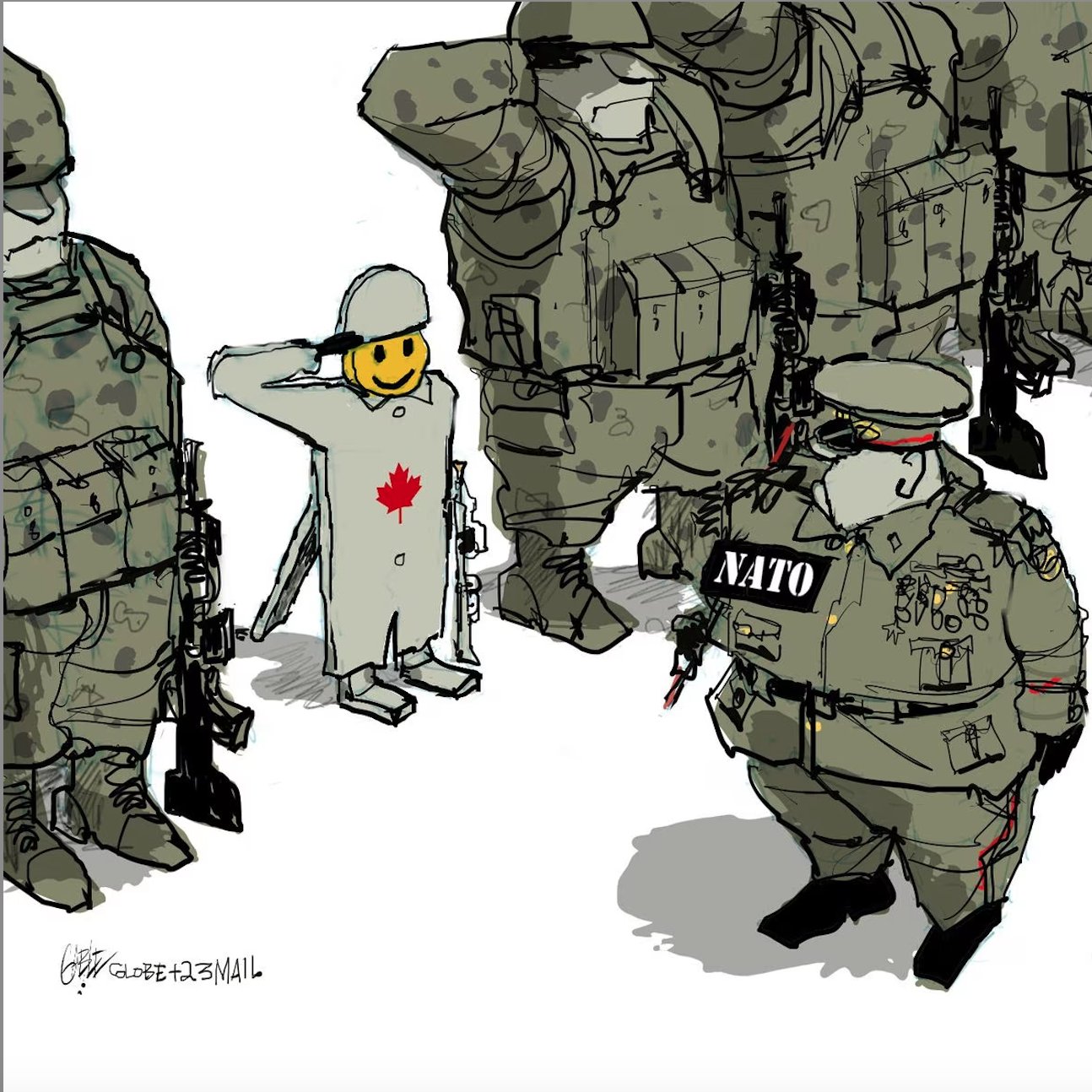
The weird thing is that Trudeau could have deflected a lot of these criticisms by our NATO allies almost painlessly without spending any more money directly on the Canadian Armed Forces — “It’s well known that Justin Trudeau has no time for military issues, but it’s surprising that he hasn’t done a few things that wouldn’t increase the actual spending on the CAF, but would be “bookkeeping” changes that would shift some existing government spending into the military category, like militarizing the Canadian Coast Guard. (That is, moving the CCG from the Fisheries and Oceans portfolio into the National Defence portfolio, not actually putting armaments on CCG vessels. Something similar could be done with the RCMP, switching it from Public Safety to National Defence with no other funding or operational changes.) That Trudeau hasn’t chosen to make even these symbolic changes shows that he actively opposes fulfilling the commitment his government has made twice in the last ten years for reasons of his own.”
This tactic has been very electorally effective for the Liberals, no doubt, but it’s also reduced the idea of “Canada” to a smug transactional exchange. “Canada” as nothing more than what provinces and citizens can wheedle out of the commonweal in transfer payments, equalization cheques, and grandiose but poorly executed national program spending. At least we’re better than America, though, right? We’re “not American!” — we’re so much more thoughtful and compassionate, as evidenced by the entitlements we’ve voted for ourselves, secure in the knowledge that the troglodytes to the south will spend and bleed and die for our coddled asses if Russia lobs a missile from the North.
Canada has become a question of what we, citizens, are able to get, rather than one of what we’re willing to give. And we’re smarmy, preachy assholes about it, to boot. (There’s a very famous political quote we could drop in here about what citizens can do for their countries and vice versa, but you’ll know why we aren’t, if you can guess the quote! It would be a little on the nose.)
A nation that is unwilling to make serious sacrifices of blood and treasure to protect its own sovereignty is a nation that is going to cease to be a nation sooner or later — and if we judge Canada by its commitment to its military, ours is a nation that has regarded itself as a quasi-ironic post-modern punchline for many generations now.
January 9, 2025
Hollywood’s favourite creation … the “hero forgives” scene
I’ve never been much of a moviegoer or TV-watcher, so I hadn’t consciously noticed what kulak is discussing here:
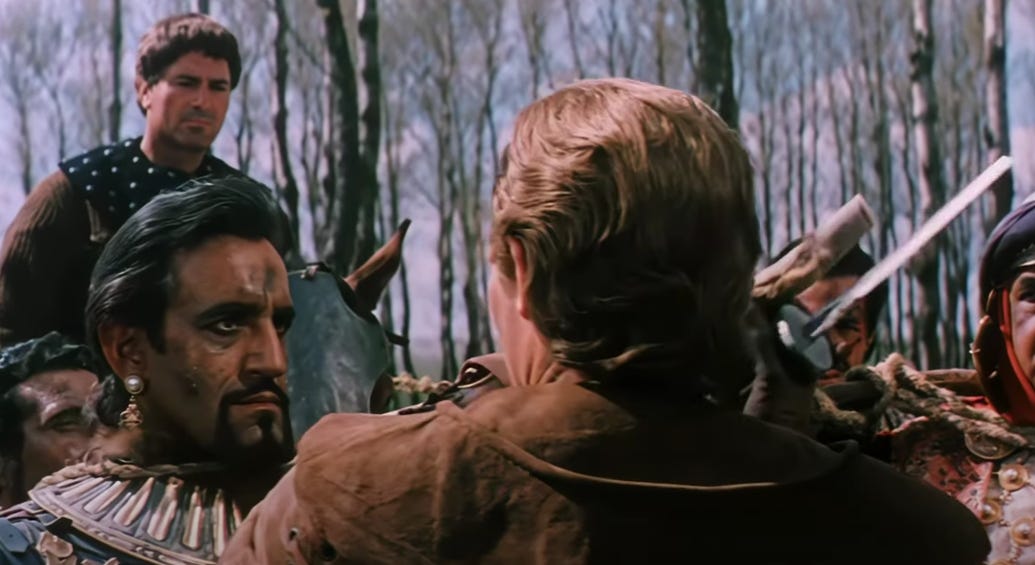
“El Cid” (Charlton Heston) releases enemy raiders who’ve just burnt down a village … for no reason.
“All that it takes for evil to triumph is for good men to do nothing.”
-Edmund BurkeThe reason the boomers are the way they are, and the reason no one in the west fights back against their dispossession and replacement is an 80 year long program to indoctrinate an Ideology I call “Hollywood Anti-justice”.
In almost every piece of media to do with violence, crime, justice, and individual heroism of the past 80 years there is a scene: The “Hero Forgives” scene.
Upon violently defeating, disarming, and capturing the villain, the hero, in spite of his every instinct, in spite of friends screaming at him and reasoning with him with arguments he can’t counter, in spite of the villains mocking unrepentance, dead to rights evidence, gleeful confessions, and even vows to reoffend.
Even if the villain is guilty of hundreds of murders, rapes, and treason, even if the hero himself has killed hundreds of henchmen to capture the villain …
The hero will refuse to kill or punish him.
Sometimes the hero will insist that he must go through the courts … Sometimes the villain will openly mock him that the courts are corrupt and will never convict him, and the hero still will refuse to take matters into his own hands …
Sometimes the hero himself IS the lawful authority. Sometimes the hero is a Military officer, post apocalyptic militia captain, Medieval Knight, Greek Hero, Roman Centurion … etc. And in fact his private judgement IS the official lawful means of passing judgement and executing obviously guilty villains … And he STILL refuses to punish or kill them.
I recently saw El Cid, where the hero, a Knight, refused to hang brigands who had pillaged, raped, burnt a town, confessed and were themselves quite resigned to dying, and even as his fellow knights berated him that the law itself demands he hang them, that it is his sacred duty to hang them, and that it would be treason for him not to…
And the Hero simply cuts their bindings and lets them go … Choosing to be forsworn as a traitor rather than hang the confessed and red-handed guilty. Now this may be a historical, but as far as I’ve been able to find such an event never occurred, it’s been made up for the film, doubly egregious because the historical El Cid almost certainly executed many criminals and brigands, committing and ordering justice … Which is NOT depicted in the film.
Even if the hero has been in this exact position before and spared the villain only for more to die, sometimes even his own family and friends, demonstrating the failure of this unspoken philosophy, the hero will STILL let them go … AGAIN.
Ussually there is some Deus Ex Machina that makes this all workout some ironic or divine punishment will find the Villain through their own folly … but not always. Indeed entire franchises have been perpetuated on THE SAME serial killer villain being forgiven, released, allowed to escape, etc. over and over again.
And audiences consistently hate this, this is always the most cliched, poorly written, out of character, film breaking scene in the entire work … Supposedly great kings, ruthless bounty-hunters, outlaws, veteran knights, military officers, grey and black market criminal anti-heroes, smugglers … All of them transformed into the most inconsistent pacifists for exactly this scene. I’ve seen audiences groan and scream at the TV “Just kill him” and yet the hero, often entirely contrary to their character, will not.
This is not an old literary trope, this is a Hollywood trope.
You can read the original Greek legends, the tales of King Arthur and his Knights, early modern nationalist heroes’ stories, the adventure stories of the Napoleonic officer, the Boys’ Own adventures of empire, and well into contemporary fiction westerns, crime stories, military science fiction, historical fiction, etc.
And in all of them you will see heroes kill their enemies in cold blood, order executions of the guilty, demand deserters, spies, and traitors be shot, seek revenge, order mass hangings … Etc.
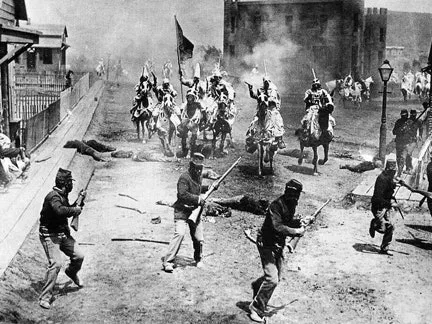
Nor is this some uniquely American madness … As late as the 1950s the vigilantes/terrorists of the original reconstruction era (1864-1877) Ku Klux Klan were treated as folk heroes… Birth of a Nation was played at the White House when it was released. The idea of vengeance, wild justice, and vigilante killings being some unconscionable moral horror was simply not the case in the first half of the 20th century … It was celebrated, much as it had been for the previous 3000 years of the west.
In 1915 the legitimacy of Vigilantism, Vengeance, and Private Justice was so accepted that even arch-progressive, Princeton University Professor, and US President Woodrow Wilson screened Birth of a Nation, a celebration of the Ku Klux Klan’s vigilante-terror campaign, at the White House.
Why did Hollywood invent this trope?
Where Hollywood producers just so attached to an idea of Christian forgiveness and pacifism that they just HAD to include it over the groans and often shouting of their audiences?
Were any of these writers, directors and producers even Christian to begin with!?
Why would the communists, atheists, Jews, and pedophiles that comprise the core of Hollywood writing include such an unusual Christian theme so insistently and often story breakingly?
Well. why do they insist on bullshit girl-bossery, race mixing, and woke theming today over the protests and disinterest of their audience?
Because it benefits them to brainwash the masses that way.
The Hollywood writers never identified with the hero refusing to kill an enemy … they identified with the villain and quite liked for him to get away (indeed many Hollywood writers will openly say as much, that they identify with the villains and much prefer writing them).
December 26, 2024
Historian Reviews the Best and Worst Depictions of the Roman Empire in Film and TV
History Hit
Published 9 Sept 2024Tristan Hughes, host of “The Ancients” podcast, reviews scenes from famous movies and TV shows set in the Roman period.
00:00 Intro
00:58 HBO Rome
12:54 The Last Legion
15:55 Monty Python’s Life of Brian
24:32 Centurion
31:40 Doctor Who
(more…)
December 23, 2024
Mark Steyn – “…the German state’s message to voters is: It’s all your fault and nothing’s gonna change”
At SteynOnline, Mark discusses the media reactions to the terror attack on the Christmas market in Magdeburg:
Say what you like about Germany but their crack police investigators are second to none:
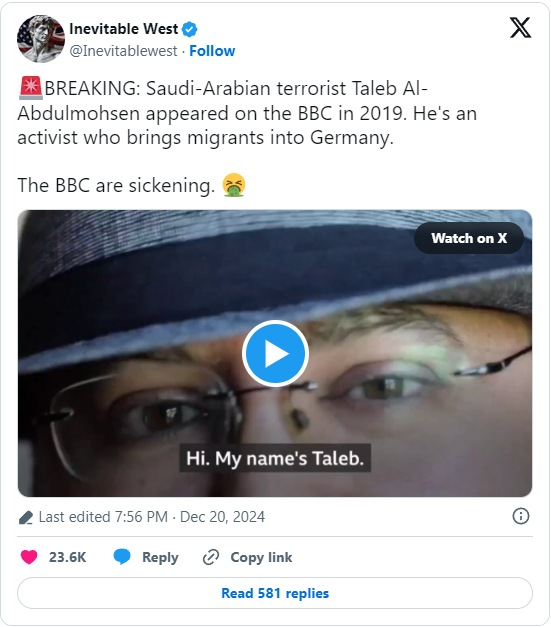
Prosecutor Horst Walter Nopens said on Saturday that the investigation was ongoing but suggested one potential motive for the attack “could have been disgruntlement with the way Saudi Arabian refugees are treated in Germany“.
Gotcha. So, two months before the federal election, the German state’s message to voters is: It’s all your fault and nothing’s gonna change. Nothing against the nine-year-old boy who’s dead or the four ladies – aged 75, 67, 52 and 45 – but that’s just the way it is. There will be a few empty chairs at the Christmas table, but diversity is our strength and a well-integrated psychiatrist driving a BMW is just the kind of high-skilled newcomer Mutti Merkel promised us. He could have gone to Canada or Ireland. To modify George W Bush, we need immigrants to do the jobs that Germans won’t do … like, er, psychiatry.
Are they putting this kind of bollocks in the Covid boosters? Not so long ago the most famous terrorist killer on the planet was a high-value German immigrant. At least a few readers I’ve had occasional email exchanges with over the decades may recall him flying through the window of their office building on a Tuesday morning in September: Mohammed Atta, the man who pulled off what they used to call “the day the world changed” … and a postgraduate student of the Hamburg Institute of Technology.
If you’ve been enjoying the expert class’s bewilderment at the citizenship and professional status of the perp, well, way back when, the grandparents of the current crop of media experts were all over the airwaves explaining why the real threat came from well-travelled middle-class westernised Muslims and that Mr Atta had become “radicalised” when he moved to Hamburg.
It certainly was “the day the world changed” — if by “changed” you mean accelerated Islamic migration to the west: Twenty years ago there were half-a-million Muslims in Canada; now there are two million. As to the “disgruntlement” of Saudis at the way they’re treated in the west, seventeen of Mohammed Atta’s accomplices were Saudi nationals who’d been admitted to flight school in America, where they told their instructors that they didn’t need to do the bit about learning how to land. Which raised not an eyebrow. To channel P G Wodehouse, few people have so much cause to be gruntled.
By the way, how did Mr Atta wind up at the Hamburg University of Technology? Because a nice tourist couple from Germany were visiting Cairo and, at a restaurant one night, struck up a conversation with Mohammed’s dad and said they ran an exchange programme for foreign students back in der Vaterland and would Mo like to come and live with them. Aw, that’s heart-warming. And, despite the three thousand deaths directly arising from that virtue-signalling, I’m sure they’d do it all over again.
In other words, this is where we came in: all the elements the cable experts profess to find “puzzling” we knew back on Day One of the soi-disant “War on Terror”. Even the allegedly newest wrinkle is not new:
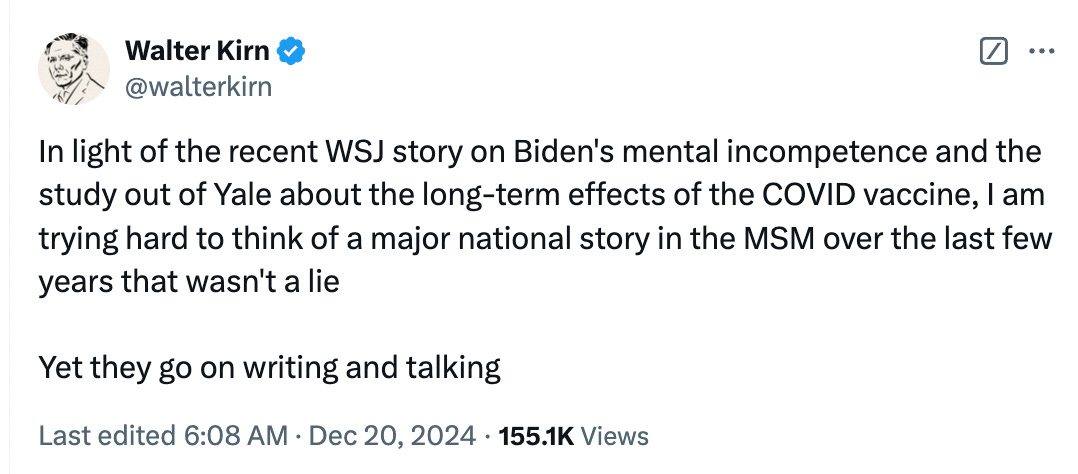
“I am trying hard to think of a major national story in the MSM over the last few years that wasn’t a lie”
Chris Bray with a link-filled post about the modern malaise of western society:
We’re getting there. We can all see it, especially as it gets ready to die.
But a more and more widely shared diagnosis is still producing explanations that don’t quite fit together. Take some time over the holidays, or just over this weekend, to read two remarkable new essays that offer different explanations for the same sickness:
At Tablet, David Samuels describes the creation of a messaging system designed to advance untruth and herd people into compliance — and he discusses “Obama’s role in directing the entire system from above”. In this telling, the system of social manipulation is a party instrument. Democrats did it.
At the same time, on his Substack page, Lorenzo Warby has just posted a deeply argued essay concluding that “we in the West do not live in Party-States. We increasingly live in activist-network states.” In this formulation, our descent into a societal atmosphere of enforced untruth is distributed, not centralized — through “networks and (interactive) signalling”.
What you’ll find striking about these two essays is how much they overlap in description while offering different explanations. We live in an atmosphere of dishonesty and manipulation — an age of psychic warfare — but we’re not quite sure who to blame for it.
However it works, whatever force or system or personality is driving, the social illness caused by the cultural compliance exercise has been obvious for years. Samuels: “The effect of the permission structure machine is to instill and maintain obedience to voices coming from outside yourself, regardless of the obvious gaps in logic and functioning that they create. The clinical term for this state is schizophrenia.”
An argument against Obama did it is that the “it” is global, and more obviously horrible in Australia, New Zealand, Canada, and the UK, and nearing its grotesque apogee in Germany. The pandemic-era narrative enforcement efforts of people like Daniel Andrews, Jacinda Ardern, and Canadian Prime Minister Derek Zoolander surely make American commissars swoon with jealousy. Another argument against the claim that Obama created a new compliance system is the behavior of Václav Havel’s greengrocer, which suggests the use of new media tools for an old job.
An argument against socially guided networks that aren’t top-down party-state systems is the astonishing degree to which the US government is now known to have weaponized the corporate-state coordination of narrative control.
December 20, 2024
The legacy “mainstream” media is not going to be replaced with a new monolithic competitor
Ted Gioia says the transition is almost complete and what used to be the mainstream is rapidly becoming a fringe to the new, much more chaotic mainstream:
Last week, a cable news pundit struggled to understand the new media landscape. So he sought advice from his teenage son.
He asked the youngster to name the most influential people in the world today.
Can you guess the names he picked?
Here’s what happened:
I’m thinking to myself he’s going to say Barack Obama, Oprah Winfrey, Jay-Z.
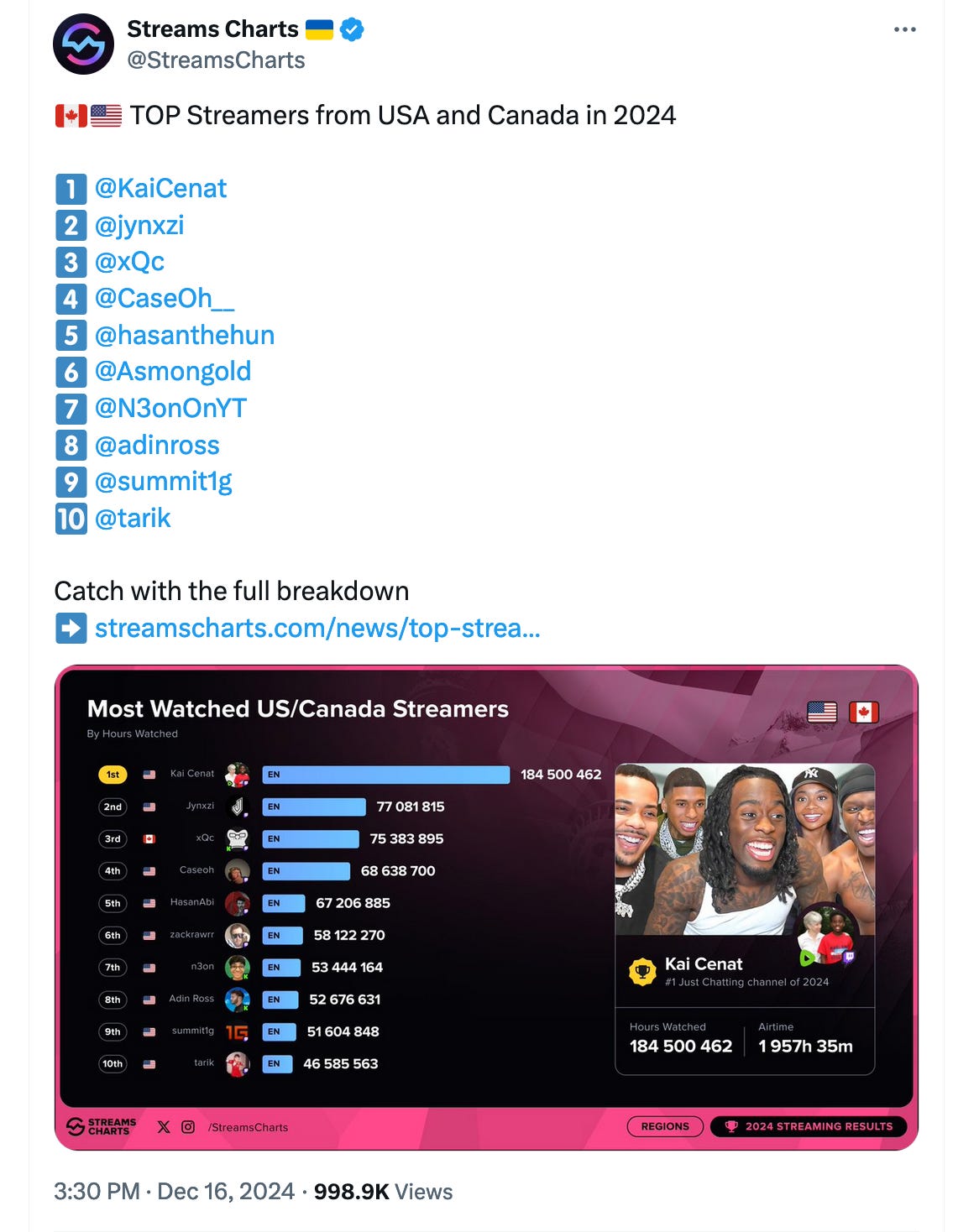
He says Kai Cenat, Adin Ross, Jynxzi, and Sketch. I don’t know who he is talking about.
I said ‘What platforms are you on?’
He said ‘I’m on Twitch, Kick, and Rumble.’
I said ‘That sounds like you need to go to the hospital’.
What are these platforms? I’m telling you guys, the mainstream has become fringe, and the fringe has become mainstream …
There are people out there that are getting 14 million streams. And we are on cable news getting one or two million.
This is the new reality. The future of media has arrived — but people above a certain age won’t even recognize the names.
Check out the list below of the most watched streamers in the US and Canada.
Jynxzi? Zackrawrr? Summit1g?
A few days ago, I’d have told you these are passwords, not people.
Now I know better. I’ve watched videos from each of these individuals—and it’s shocking how different they are from mainstream media fare.
Media empires are getting defeated, but not by their corporate competitors. They’re finding themselves replaced by a ragtag assortment of podcasters, pranksters, pundits, gamers, gadflies, and influencers.
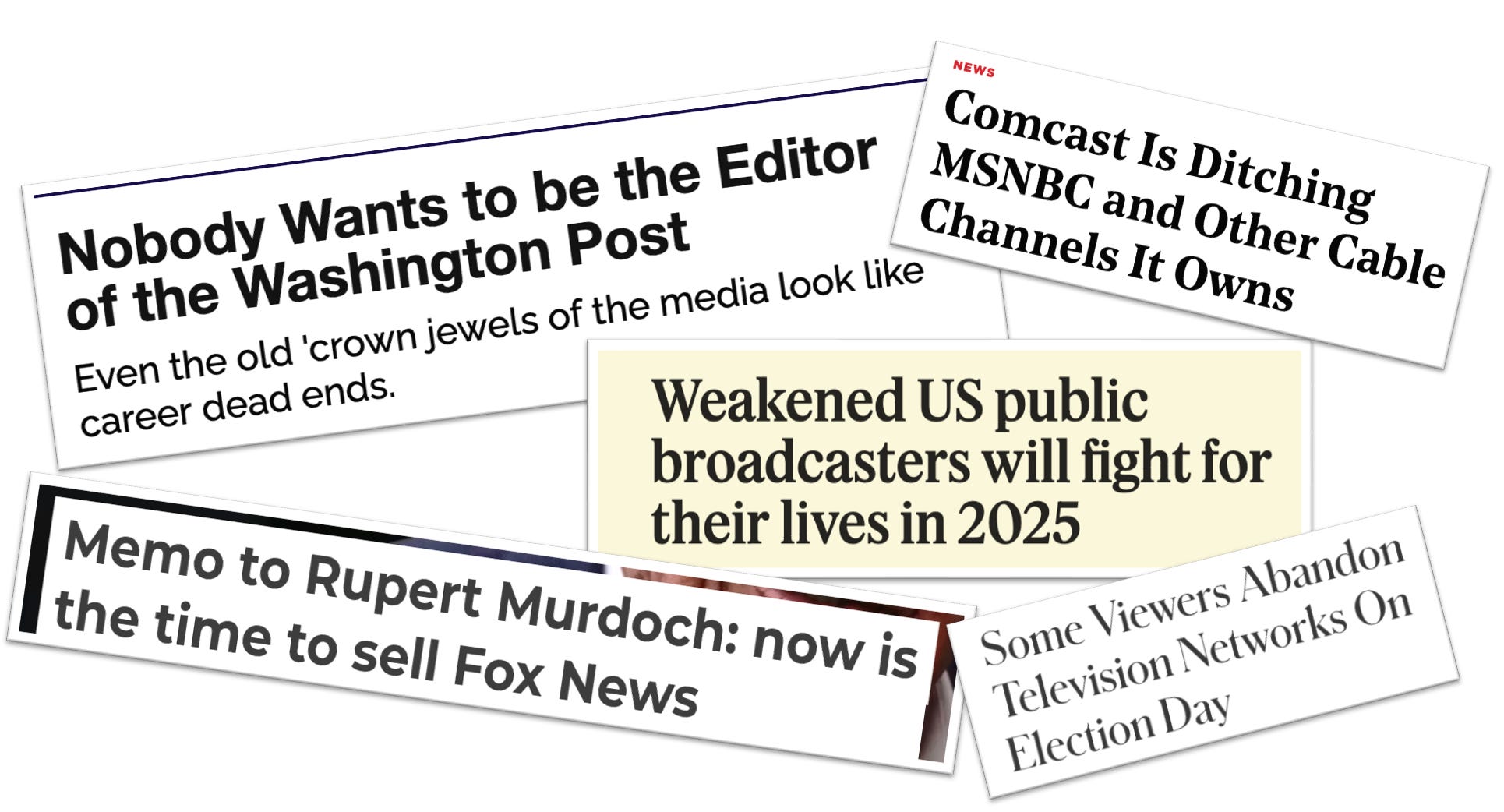
Who would have believed these headlines just a few months ago?
December 7, 2024
QotD: Game of Thrones as PoMo “deconstructionism”
Again, I guess I can forgive my colleagues, under-sexed little closet cases that they are, for being distracted by the boob cornucopia up on screen, but in the books, anyway, this comes through plain as day: Everyone in Westeros is either a psychopathic scumbag, or dead. In the very best PoMo style, the author is rubbing our faces in his belief that, since it’s extremely difficult to be heroic — or, all too often, merely decent — everyone who even thinks about trying is a fool, and deserves all the awful shit that happens to him. I’m told that back in the 18th century, a fun topic of debate at salons is whether a society of atheists could endure. Martin’s entire oeuvre seems dedicated to proving that life — mere, grubby, eating-shitting-sleeping existence — will continue in a society composed entirely of scumbags … but he has no idea why.
I have no idea why this idea (if that’s the right word) is so deeply appealing to academics, but evidently it is … and these are the people who are teaching your children.
Severian, “The One Pop Culture Thing”, Rotten Chestnuts, 2021-09-16.
November 18, 2024
HBO’s Rome Ep. 3 “The owl in a thorn bush” – History and Story
Adrian Goldsworthy. Historian and Novelist
Published Jul 17, 2024Episode Three: Now that Caesar has crossed the Rubicon, the Civil War has begun and the series gathers pace.
Vidcaps taken from the dvd collection and copyright belongs to the respective makers and channels.
Transcript
November 13, 2024
QotD: The 1990s
Consider that if we really do live in a computer simulation, then everything the #wokesters are always going on about is actually true. Everything really IS a “social construction”, because “society” was literally constructed. All that stuff about “systemic racism” is true, too, because again, we’re dealing with a design. Nothing evolves organically inside The Matrix, because there’s nothing organic in there at all. It’s ALL on purpose …
… and you, #wokester, are the only one who can see it. Unlike Karl Marx, who was able to see beyond his class situation enough to say that no one can see beyond his class situation, because reasons, you, #wokester, can do it because you’re Neo. That, too, is built into the system. It’s an endless recursion … but one that entails that you, and you alone, are special, on purpose.
That, kameraden, was the 1990s. Even those movies our author mentioned — Beverly Hills Cop III, Lethal Weapons 3 and 4 — weren’t just copies of copies, they were ironic, snarky commentaries on copies of copies. See also Scream, which was a “deconstruction” of every slasher picture ever made. If you can’t beat ’em, join ’em … but since both beating ’em and joining ’em entail making a sincere effort and sincerity is forbidden, all you can do is mock ’em. That’s what “deconstruction” is, one long polysyllabic mockery of the very idea of excellence. It’s the perfect philosophy for people who know themselves to be mediocre but have been told from day one that they’re special.
See also the tv show Friends, where five ludicrously attractive people and David Schwimmer all pretend to be just normal folks (who happen to live in 3,000 square foot apartments in Manhattan) — each episode is “the one that’s just like The Brady Bunch, but snarky”. Or Seinfeld, which was deliberately designed to be a grating mockery of stuff like The Odd Couple. All snarky mockeries of the very concept of sincerity.
See what I mean? That’s normal now, which is why the 90s must be dragged into an alley and shot, for Western Civ’s sake.
Severian, “Why the 90s Was the Worst Decade Ever”, Rotten Chestnuts, 2021-07-04.
November 12, 2024
QotD: Roger Scruton, terroiriste
>Good wine is a “somewhere”, not an “anywhere”. It is stamped with a place and a year. Rooted, literally. The fancy French word for this is terroir, referring to the way in which environment — soil, geology, even the history of a place — is all responsible for a wine’s character. Terroir is a sense of place in a glass. Roger Scruton often referred to himself as a “terroiriste“. And this could describe his political philosophy as much as his philosophy of wine. From 2001 to 2009, Scruton wrote a wine column in the New Statesman, enabling him to smuggle into that otherwise exclusively Left-wing journal, all sorts of reactionary political ideas: about God, about fox-hunting, about beauty, about his love of the countryside.
Wine, for Scruton, was never just about the taste, never a merely aesthetic sensation. Indeed, he was extremely sniffy about all those “blind tastings” — the ones where we delight when an expert fails to spot the difference between plonk and Premiere Cru. They miss the point, says Scruton. Blind tasting, he explained, is like blind kissing — not a good way to distinguish, for example, between someone who is sexy and someone who is not. Indeed, if the experiment on Love Island is anything to go by, it’s not even a good way to distinguish who your own girlfriend is.
That’s because sexual chemistry, like wine, is a great deal more than some momentary sensation on the lips. It’s a great deal more than a message sent by taste receptors to the brain. It is all about the terroir. And this is not just a comment about wine but about aesthetic experience in general. When we encounter a work of art, we bring a whole hinterland of knowledge that makes sense of that specific experience and gives it its character as art. Music is more than a vibration of the air and its reception by the ear and the brain. So too with wine and taste.
Giles Fraser, “Raise your glass to Roger Scruton, the terroiriste“, UnHerd, 2020-01-15.
November 5, 2024
“… in an effort at harm reduction, I selected the proven authoritarian over the aspiring totalitarian”
In the National Post, J.D. Tuccille explains why he voted for “literally Hitler” instead of “the historic first woman president” in today’s US election:
“Polling Place Vote Here” by Scott Beale is licensed under CC BY-NC-ND 2.0 


 .
.
For me and millions of other Americans, the 2024 U.S. election is already effectively over. Like most Arizonans, I mailed in my ballot and it awaits the count. Now, I suffer through the remaining days of hectoring political ads and finger-waggers nagging me about how I should have voted. This country doesn’t lack strong opinions about two of the worst candidates to ever grace a presidential race. Unfortunately, I felt obliged to vote for one of them, and in an effort at harm reduction, I selected the proven authoritarian over the aspiring totalitarian; I marked my ballot for Donald Trump.
There’s no doubt that Trump is a thin-skinned narcissist. Legendarily intolerant of criticism or even disagreement, he wants broadcast licenses pulled from news networks that he thinks have been mean to him and called for government to crack down on cable operations that aren’t actually subject to government regulation. The man needs perspective as much as he needs a social studies class.
This is, many Democrats and their media supporters will eagerly tell you, evidence of “fascism“. But, as John Bolton, Trump’s former national security adviser, told The New York Times, “Trump isn’t capable of philosophical thought”. Trump’s authoritarianism isn’t an ideology; it’s a personality disorder.
That should be enough to disqualify a candidate for president. You’d think that, in a nation of 330 million people, if one major party chooses to run a profoundly problematic and authoritarian nominee for president, the other could find somebody more qualified. But you’d be wrong. In Kamala Harris, Democrats picked a vacuous sociopath uninterested in policy, but willing to serve as a vehicle for those around her who have tried their hands at totalitarian speech controls, and who are increasingly hostile to Israel, the only majority-Jewish state on the planet, and to Jews as a people.
In 2021, The Washington Post reported that former staffers for Vice President Harris complained she “would refuse to wade into briefing materials prepared by staff members, then berate employees when she appeared unprepared”. That failure to prepare for responsibilities and public appearances feeds her propensity for word salads, leaving the impression she’s reciting the results of a dropped Scrabble board.
In a Biden-Harris administration already lacking for adult supervision — President Joe Biden’s failing mental faculties are now a matter of record, as is his inability to make decisions — that suggests a potential President Harris would have no firmer hand on the wheel. That would leave the relatively faceless minions around her free to continue to exercise their instincts. And their instincts are terrible.
November 3, 2024
The end of the “cheap streaming era” is at hand
Ted Gioia explains why your streaming services are going to be jacking up their prices — if they haven’t already done so:
I got a request to explain why streaming subscription prices are so damned high — and getting higher.
This came in response to a chart I shared two days ago:
And it’s not just Disney.
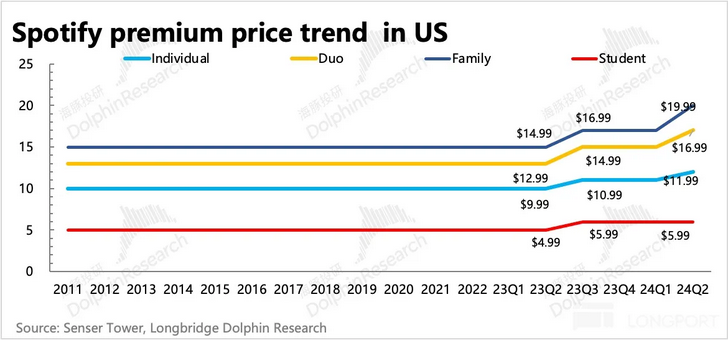
All the streaming platforms are jacking up prices. I still subscribe to five different streaming services—down from six previously. Every one of them raised prices this year, and always by more than the inflation rate.
Here’s what Spotify is doing:
What’s going on? And will it continue?
I recently described this as an “endgame strategy” — but that might be confusing to readers.
Endgame is a term drawn from chess, where it refers to a body of wisdom about the final moves on the board. But business is like chess, so I frequently analyzed endgame situations back in my days at the Boston Consulting Group and McKinsey.
I now see these endgame strategies getting implemented in various media, entertainment, and streaming businesses. But almost nobody inside those businesses wants to talk about it.
So let me lay it out for you.
The Entertainment Industry Is Adopting an Endgame Mindset
You pursue an “endgame” strategy when demand for your business hits a wall, and it’s hard to attract new customers. The most typical endgame strategy is to cut back investment into new products and services, while raising prices sharply.
You’re willing to accept some loss of customers, because you’re now squeezing more profit-per-user out of your remaining consumers — who stick with you out of loyalty or habit or inertia.
These are your sheep, ready to be shorn.
Profit per customer is now the key metric driving your business. It’s more important than innovation or growth or artistry or any of those old fashioned ideas.
That’s why, for example, Netflix won’t share data on the number of subscribers anymore. They claim this is no longer relevant to their business model — and they aren’t lying.
Price increases are now the engine of their business.