
TimeGhost History
Published 1 May 2025In 1948, the Cold War intensifies as Stalin blockades Berlin, triggering a dramatic US-led Airlift to save West Berlin. Meanwhile, the British Empire continues to crumble as Burma, Ceylon, and Palestine gain independence — with Israel’s declaration igniting immediate war. America launches the Marshall Plan, the Soviets tighten their grip in Eastern Europe, and televised anticommunist hearings captivate the US public. The year ends with humanity pushing new frontiers — from launching monkeys into space to relocating beavers by parachute — showing just how rapidly the world is changing.
(more…)
May 2, 2025
Monkey Rockets, beavers with Parachutes, and the Fall of Empires – 1948 Newscast – W2W 26
Comments Off on Monkey Rockets, beavers with Parachutes, and the Fall of Empires – 1948 Newscast – W2W 26
HBO’s Rome – Ep 6 “Egeria” – History and Story
Adrian Goldsworthy. Historian and Novelist
Published 30 Oct 2024This time we come to Episode 6 of Season 1 of ROME. This one is very much based around the City of Rome itself and places Antony centre stage. In the video we look at the actual history and how well the show reflects this. For more detail on the history, have a look at the videos in the Conquered and the Proud playlist.
Comments Off on HBO’s Rome – Ep 6 “Egeria” – History and Story
April 15, 2025
What is it with the progressives’ love for (some) brutal murderers?
I’ve managed to avoid watching any of the interview, but Taylor Lorenz was on CNN, where utter inhumanity is apparently the flavour of the month for all right-thinking progressives:

Former New York Times and Washington Post reporter Taylor Lorenz, speaking about accused killer Luigi Mangione on CNN MisinfoNation with Donnie O’Sullivan:
To see these millionaire media pundits on TV clutching their pearls about someone stanning a murderer when this is the United States of America. As if we don’t lionize criminals … There’s a huge disconnect between the narratives and the angles that mainstream media pushes and what the American public feels … You’re going to see women especially that feel like, “Oh my God”, right? Like, “Here’s this man who’s revolutionary, who’s famous, who’s handsome, who is young, who’s smart”. He’s a person that seems like this morally good man, which is hard to find.
I know Lorenz is a human bug-zapper whose purpose is luring people to doom by drawing them to the glow of the impossibly stupid online utterance, but even by her standards this is nuts. For one thing, Lorenz is a leading advocate for dumbed-all-the-way-down media like her “beloved” Vine, which featured six-second-max videos. If someone handed her a hardcover book, she’d be a serious threat to bite it. Her invoking Flannery O’Connor and A Good Man is Hard to Find in the context of Luigi Mangione is high comedy. Regarding America “stanning” murderers because “we give them Netflix shows,” which does she mean? Americans may be fascinated by O.J. and Bundy and Phil Spector, but we don’t gush cartoon hearts at them over cable, we watch them in lurid docudramas.
As Jim Treacher puts it:
The thing I like most about journalism is the moral authority.
Journos are better human beings than the rest of us — morally, ethically, and intellectually — and they’re not shy about saying so. Their views are the correct views, after all. Their political opinions are the North Star. And if you disagree with anything they know to be true about the world, you’re the enemy and they don’t care what happens to you.
Hell, if you’re on their literal hit list, they’ll openly laugh and swoon over anyone who hurts you. If you don’t believe it, just watch the following clip from a cable news network.
Dramatis Personae:
- Donie O’Sullivan is a “senior correspondent” for CNN.
- Taylor Lorenz is a reporter who has worked for the New York Times and the Washington Post.
- Luigi Mangione, the heir to a wealthy Baltimore family, shot a health insurance executive named Brian Thompson in the back as he was walking to work in Manhattan.
And now, here are O’Sullivan and Lorenz celebrating the murder on national television.
Comments Off on What is it with the progressives’ love for (some) brutal murderers?
April 10, 2025
HBO’s Rome – Ep 5 “The Ram has touched the wall” – History and Story
Adrian Goldsworthy. Historian and Novelist
Published 18 Sept 2024Continuing series looking at the HBO/BBC co production drama series ROME. We will look at how they chose to tell the story, at what they changed and where they stuck closer to the history.
Comments Off on HBO’s Rome – Ep 5 “The Ram has touched the wall” – History and Story
April 6, 2025
“[U]pwards of 86 percent of Americans thought he was too old to serve another term. And no one did anything about it“
Andrew Sullivan reacts to some new books on the Biden administration just hitting the bookstores recently:
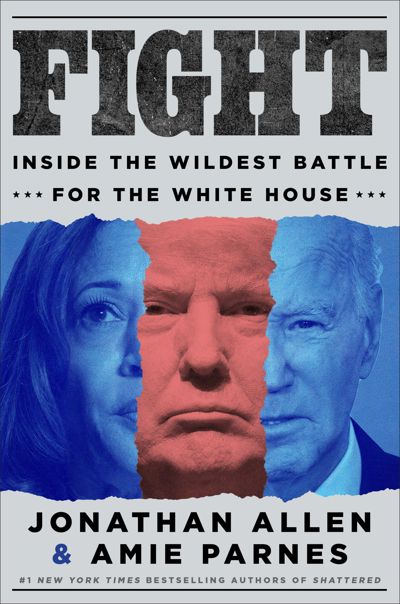
By April of last year, the health of the president had clearly declined. As with many older men in their eighties, this didn’t happen in a slow, predictable glide-path down — but in swift, turbulent declines. Suddenly he took a while to get out of his limo, and then would emerge “with a blank look in his face”, according to the new campaign book, Fight, by Jonathan Allen and Amie Parnes. By early summer, Biden was suddenly freezing up in public, staring motionless into the air. At a fundraiser in Los Angeles, Obama had to jump in to answer some questions, and then had to guide Biden off the stage by hand. We had already seen Joe wander weirdly off the set of MSNBC and during a Medal of Honor ceremony. His memory lapses mounted.
Everyone around him saw this. Everyone close to him had seen it for over a year by then. Everyone in his campaign knew that upwards of 86 percent of Americans thought he was too old to serve another term. And no one did anything about it.
Sometimes human folly is just human folly. Sometimes, even at the pinnacle of the world, you find flawed people struggling with familiar human problems, like how to tell a beloved but fast-aging man that he needs to leave the stage before he falls off it. Just because she was First Lady did not prevent Jill Biden from putting family before country; and just because he was president didn’t mean that Biden reacted to his own decline with denial, anger, pig-headedness, and arrogance.
Do we learn anything new in this book and another one, Uncharted, by Chris Whipple out next week? Not really. We know, in fact, that everything I guessed happened did actually happen. Among the unsurprising confirmations: Obama was so aloof he didn’t even watch the fateful June debate live; he and Pelosi then wanted an open primary and did all they could to get one. (“He goes. She goes” was their mantra.) Hillary Clinton defended Biden — not because she knew his health was fine, but because her health had once been questioned by the press too. Biden’s closest advisers were his wife and, yes, his son Hunter, and they routinely put their clan’s interests well before the country’s. His inner circle — Mike Donilon especially — were so blindly loyal and informationally siloed they couldn’t absorb what was staring them in the face.
The Democrats, even as late as July, could have found a fresh candidate capable of taking on what they said was a vital moment for democracy’s survival. We might have avoided our current abyss:
“It would have been very cheap. It would have been quick. A rocket ship for your career and no loss,” said one Democratic former governor. “If this had been a year earlier, twenty people would have gotten in,” said one governor who had kicked the tires on a 2024 bid.
Why didn’t they? That is a question that will reverberate through history. Wokeness was a factor. The only reason the embarrassingly mid Harris was made veep in the first place was to fill a slot Biden had already marked for a woman, and, in the wake of the Floyd murder, a black woman seemed the only option. Everyone, particularly Pelosi and Obama, knew Harris was a disaster about to happen, and her vice-presidency had the lowest approval ratings in history. Obama told friends directly that he thought she couldn’t win. The night after the epic debate, Pelosi gritted her teeth: “Oh my God. It’s going to be her.”
So yes, identity before merit was a principle the Dems clung to even at the expense of marching off an electoral cliff. “If you want to break the Democratic coalition, try to skip over the first African-American vice president,” Michigan Senator Elissa Slotkin argued at one point. “I watched the black-white stuff start on Thursday night [after the debate],” said another lawmaker. Donna Brazile assembled a team of black women operatives who called themselves “the colored girls” to ensure Harris became the nominee. Jim Clyburn was also a critical supporter: “I’m going all in with Kamala. I don’t want to look back and y’all ain’t there,” he told the DNC.
The open primary therefore never happened. Harris became the nominee for one core reason in the end. Biden, who had previously used the awfulness of Kamala as a way to dissuade anyone from pushing him out, decided to endorse her after she pleaded with him the day he decided to quit. One source “close to both men” explained: “It was a fuck-you to Obama’s plan. At that moment, you have very few things you control, and that’s one thing he had control over, and he chose to stick it to Obama.” So much for putting the survival of democracy first.
And yes, they lied. Jill Biden was one of the worst offenders. She insisted in January 2024, “I see his vigor, I see his energy, I see his passion every single day. I say his age is an asset.” Before the June debate, Joe had been drained by grueling international travel, was catching a cold and couldn’t last more than 45 minutes in the practice debates. But the First Lady went out and told the world: “The president’s feeling great. He’s ready. We’re going to win this thing.” The woman who had covered up her husband’s decline for the previous two years now set expectations that were, of course, utterly ruinous.
Comments Off on “[U]pwards of 86 percent of Americans thought he was too old to serve another term. And no one did anything about it“
March 28, 2025
Mistaking popular fiction for real life
At Postcards from Barsoom, John Carter recounts an odd but revealing experience with a young progressive entity:
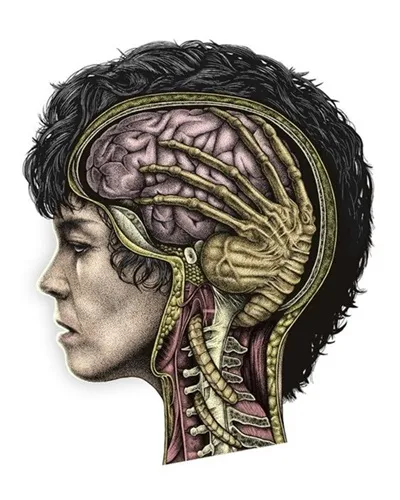
Image by Paul Jackson
Some years ago I was provided a fascinating psychological experience in the form of a young graduate student in the English literature program, whom I encountered because they (you heard me) was (God that’s grammatically awkward) married to a colleague. She (I’m not doing this anymore) specialized in the study of propaganda, by which of course she meant everything her backwards conservative parents in Nowhere, Nebrahoma believed, and not anything she believed. One evening, after enthusiastically explaining the symbolism of the inverted pentagram tattooed on her shoulder, she informed me with invincible confidence that not only was gender an arbitrary social construction, but that even the idea of biological sex was nothing more than convention. Her reasoning, which I presume she’d gleaned from a seminar on radically liberatory queer theory, was that testosterone levels fluctuated during the day, so “males” changed their degree of “maleness” all the time, and how can something that’s constantly changing be used as the basis for a hard binary distinction?
“But that’s not how biological sex is defined,” I replied. “Testosterone is just a hormone. It’s only present in vertebrates. Insects don’t have it, and neither do plants, but they still have biological sex. Sex is defined according to whether an organism produces mobile gametes or sessile gametes, which is basically universal across multicellular life forms.”
“I don’t understand what that means,” she chirped, still thinking we were playing language games. “Like I don’t know what a ‘sessile gamete’ is.”
“Oh,” I responded helpfully, “A gamete is just a reproductive cell. Sessile means it doesn’t move. So –”
The horrible reality of what I was saying dawned upon her. “I just realized that this isn’t a conversation I should be having,” she cut me off, and walked away.
It was remarkable. The mindworm parasitizing her consciousness had detected a threat to its structural integrity, and ordered its host to remove herself from the interaction before she consumed a malinformative infohazard. She didn’t even pretend that this wasn’t what she was doing. I’d never before seen something quite like it.
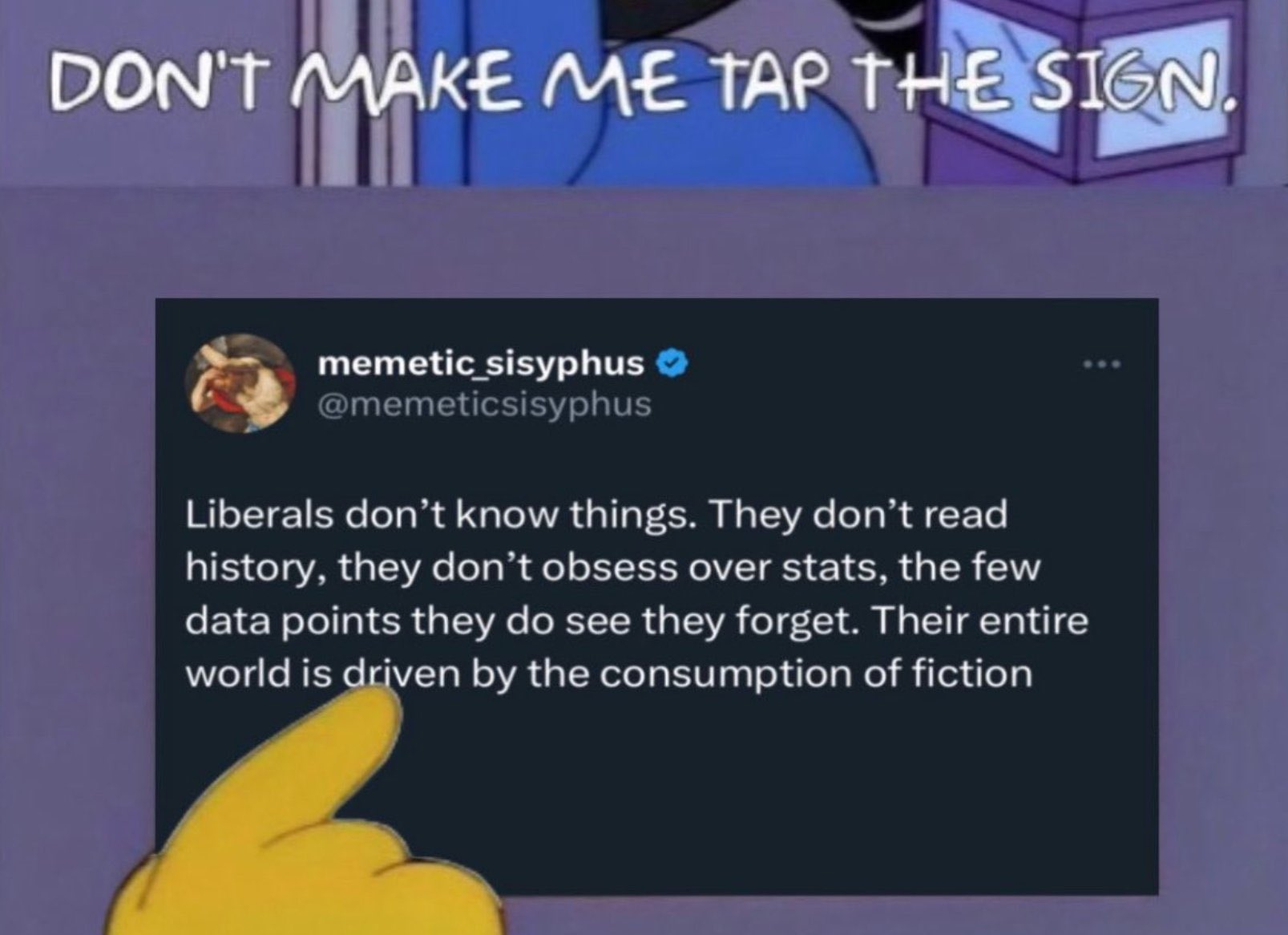
There’s a long-standing joke that liberals don’t know things, that their entire worldview seems to be formed by the ersatz experiences of visual entertainment. When they discuss the war in Ukraine, they express it in terms of Marvel comic book movies or Star Wars; when thinking of President Trump, in terms of Harry Potter. Black people are all wise and benevolent and great dancers because this is what Fresh Prince and Morgan Freeman told them; white men are all inbred stupid Klansmen because of Mississippi Burning and Roots; girls are just as strong as boys (stronger, actually) because Black Widow kicks butt; and so on. Even their favourite point of historical reference – World War Two, the Nazis, Hitler – seems to be almost entirely a palimpsest of Steven Spielberg movies like Saving Private Ryan and Schindler’s List.
It isn’t just that they use fictional references as metaphors or allusions. That’s a very human thing to do, and the right is certainly no stranger to Tolkien analogies. But liberals seem to do this a lot, with only the most tenuous connection back to reality. Their inner world is a series of self-referential fantasies. The right uses fictional references as metaphors to explain facts; the left substitutes fictional metaphors for facts, and then forgets that it does this.
The recent Netflix drama Adolescence is a striking case in point. It portrays the fictional story of a 13-year-old white boy who stabs a female classmate to death because his brain was twisted into a pretzel by exposure to the incel subculture over social media. Following its premier, the British government has been using it to gin up a moral panic, with calls to censor social media to tackle the urgent problem of toxic masculinity.
March 15, 2025
Firefly – We Didn’t Know How Good We Had It
The Critical Drinker
Published 14 Mar 2025It was overlooked in its own time, never finding the audience it deserved, but Firefly has gone on to become a cult classic with the most dedicated on fanbases. And now that I’ve finally arrived to the party 20 years late, I wanted to share my thoughts on Joss Whedon’s Firefly.
Comments Off on Firefly – We Didn’t Know How Good We Had It
March 14, 2025
Firefly and the Lost Cause
Feral Historian
Published 8 Nov 2024I’ve often been questioned for making Civil War comparisons when discussing Firefly. Here I explain why Firefly not only reflects but is based on the Lost Cause mythology of the Confederacy.
For further background on how secession was framed at the start of the American Civil War, battlefields.org has plain text copies of several of the Confederate States’ declarations of causes for secession up at https://www.battlefields.org/learn/pr…. You can see how slavery is mentioned a lot, but often framed in terms of the second-order effects of Northern policy damaging their economy, infringing on sovereignty, etc. It varied by state of course, Virginia kept it vague with references to the Federal government “perverting said powers” granted it, while Mississippi was very clear about slavery being the cause.
00:00 Intro
01:12 The Lost Cause
03:27 Selling the Peace
05:28 Causes
06:59 Firefly as a Lost Cause
Comments Off on Firefly and the Lost Cause
March 10, 2025
Rome (2004): HBO’s Untold 5 Season Story
Little Wars TV
Published 6 Sept 2024HBO’s Rome is one of the greatest television shows ever made, but the premium network infamously cancelled Rome after just two seasons. It is a decision HBO executives later admitted was a mistake. In this video essay, we explore why HBO cancelled Rome and what the showrunners envisioned as the full, five-season story arc. Which characters were meant to survive? What historical storylines would have been explored? And what was the show’s final scene supposed to be at the end of five seasons?
We’ll unearth interviews with Bruno Heller and William J MacDonald, hear from actors like Kevin McKidd, and attempt to piece together a vision of Rome‘s full potential if HBO had not cancelled the show prematurely.
(more…)
Comments Off on Rome (2004): HBO’s Untold 5 Season Story
March 2, 2025
“We’re saying words that we’re told to say. We’re told how to say them. We’re told where to stand. And then we’re telling people how to vote?”
As a natural follow-on to yesterday’s post about Celebrity fatigue, here’s Kat Rosenfield in The Free Press hoping that we can somehow make actors apolitical again:

During the Vietnam War, actress Jane Fonda visited North Vietnam and expressed strong support for the regime’s struggle against the United States and South Vietnam.
If I have to listen to an actor talk about politics, let that actor be Gabriel Basso.
You might know Basso from his breakout role in Netflix’s hit series The Night Agent, in which he stars as an FBI agent who works in a secret basement office beneath the White House. But Basso has another White House connection. In 2020, he played J.D. Vance in the big-screen adaptation of Hillbilly Elegy, which was based on the vice president’s memoir about his childhood in Appalachia — which means we now live in a world where the vice president could be Netflix-and-chilling in the White House, watching the man who once played his own younger self doing espionage in the basement of the building he’s sitting in.
In a recent interview, Basso called his entanglement with Vance’s timeline “kind of weird”, which it is — but what’s weirder is that Basso describes Vance himself as “a cool dude”, as if he’s talking about some guy in his Wednesday night bowling league as opposed to one of the most powerful and polarizing political figures in the United States.
This type of comment is typical for Basso, who doesn’t believe actors should embroil themselves in politics. “We’re saying words that we’re told to say. We’re told how to say them. We’re told where to stand. And then we’re telling people how to vote?” he said on a recent episode of the Great Company podcast. “You should be quiet; you should do your job. You should be a jester, entertain people — then shut the fuck up.”
To hear an actor talk like this is especially remarkable in the middle of awards season, when the great and the good of Hollywood use the red carpet as a pulpit to preach their politics, which are reliably blue. Last Sunday, at the Screen Actors Guild Awards, Jane Fonda used her acceptance speech for the Life Achievement Award to rally the crowd to the right side of history. “Make no mistake, empathy is not weak or woke,” she declared. “And by the way, woke just means you give a damn about other people!”
[…]
The entanglement of Hollywood and Washington only intensified in the final weeks of the 2024 election cycle — which included, among other things, a political ad voiced by Julia Roberts, a Democratic National Committee headlined by Oprah Winfrey, and the Avengers literally assembling to campaign for Kamala Harris. The bitter irony, of course, is that despite the entire Hollywood apparatus coming out in support of Harris, all we got was a Trump landslide and the absolutely dire image of a bunch of our favorite actors wearing “White Dudes for Harris” T-shirts.
It’s enough to make you long for the golden age when it was the norm for actors to, as Basso so artfully put it, “shut the fuck up”.
Comments Off on “We’re saying words that we’re told to say. We’re told how to say them. We’re told where to stand. And then we’re telling people how to vote?”
February 22, 2025
QotD: Modern journalism
We Americans are truly blessed by having a mainstream media full of brilliant renaissance men, women, and gender non-specific entities who are masters of so many varied and intermittently useful skills and who are eager to share their knowledge with us benighted souls. The pandemic has revealed that every urban Twitter blue check scribbler, MSNBCNN panelist, NYT/WaPo doofus, and barely legal “senior editor” of a website you never heard of, is a Nobel Prize-winning epidemiologist, a master logistician, and a diversity consultant to boot.
They may all be lousy journalists, but damn it, they are also lousy at other jobs that they didn’t even pretend to train to do.
It’s awesome to see people with zero life experience in any relevant field weighing in as if we shouldn’t just laugh in their pimply faces. Here’s the typical resume of one of these hacks:
- Went to high school, and never went to parties
- Went to college, majored in journalism, and never went to parties
- Went to journalism grad school, and never went to parties
- Works in the media, and goes to Manhattan/Georgetown cocktail parties
This apparently qualifies them to explain to people like us who have actually done something in our lives how stuff is supposed to work.
Kurt Schlicter, “Our Super Smart Elite Shines During This Pandemic!”, TownHall.com, 2020-04-02.
Comments Off on QotD: Modern journalism
February 21, 2025
Firefly and the End of Serenity
Feral Historian
Published 29 Mar 2023Serenity did an admirable job of wrapping up Firefly after the series was cancelled. But the ending, which depends on the idea that exposing government misdeeds forces change, doesn’t work today. Serenity‘s ending is premised on the idea that “sunshine is the best disinfectant” but the last few years have illustrated that we’re dealing with sunlight-resistant corruption these days.
00:00 Intro
00:24 Backstory
01:27 Chimerica
02:08 Unification
03:37 Secrets
05:12 Serenity‘s Ending
Comments Off on Firefly and the End of Serenity
February 19, 2025
HBO’s Rome – Ep 4 “Stealing from Saturn” – History and Story
Adrian Goldsworthy. Historian and Novelist
Published 28 Aug 2024Vidcaps taken from the dvd collection and copyright belongs to the respective makers and channels.
Transcript
Comments Off on HBO’s Rome – Ep 4 “Stealing from Saturn” – History and Story
February 14, 2025
Trump may start paying attention to Canadian cultural protectionist polices next
Michael Geist points out just how many Canadian federal policies and programs will likely come under scrutiny by the Trump administration for their blatant protectionism against US cultural products:

My Globe and Mail op-ed argues the need for change is particularly true for Canadian digital and cultural policy. Parliamentary prorogation ended efforts at privacy, cybersecurity and AI reforms and U.S. pressure has thrown the future of a series of mandated payments – digital service taxes, streaming payments and news media contributions – into doubt. But the Trump tariff escalation, which now extends to steel and aluminum as well as the prospect of reviving the original tariff plan in a matter of weeks, signals something far bigger that may ultimately render current Canadian digital and cultural policy unrecognizable.
Our cultural frameworks are largely based on decades-old policies premised on marketplace protections and mandated support payments. This included foreign ownership restrictions in the cultural sector and requirements that broadcasters contribute a portion of their revenues to support Canadian content production.
As we moved from an analog to digital world, the government simply extended those policies to the digital realm. But with Mr. Trump appearing to call out what he views to be Canadian protectionist policies in sensitive sectors such as banking ownership, the cultural and digital sectors may be next.
If so, there are no shortage of long-standing policies that tilt the playing field in favour of Canadians that could spark some uncomfortable conversations.
Why do U.S. companies face ownership restrictions in the telecom and broadcast sectors? Why are Canadian broadcasters permitted to block U.S. television signals in order to capture increased advertising revenue? Why do Canadian content rules exclude U.S. companies from owning productions featuring predominantly Canadian talent?
The Canadian response that this is how it has always been is unlikely to persuade Mr. Trump.
Canadian policies premised on “making web giants pay” may also be non-starters under Mr. Trump. For the past five years, the Canadian government seemingly welcomed the opportunity to sabre rattle with U.S. internet companies. This led to mandated payments for streaming services to support Canadian film, television and music production; link taxes that targeted Meta and Google to help Canadian news outlets; and the multibillion-dollar retroactive digital services tax that is primarily aimed at U.S. tech giants.
Not only have those policies raised consumer affordability and marketplace competition concerns, they have also emerged as increasingly contentious trade issues. If the trade battles with the U.S. continue, the pressure to scale back the policies will mount.
Beyond rethinking established cultural and digital policies both new and old, the bigger changes may come from re-evaluating the competitive impact of policies that rely heavily on regulation just as the U.S. prioritizes economic growth through deregulation. Proposed Canadian privacy, online harms and AI rules have all relied heavily on increased regulation, looking to Europe as the model.
For example, consider the Canadian approach to AI regulation in the now-defunct Artificial Intelligence and Data Act. It specifically referenced the European Union’s regulatory system, which establishes extensive regulatory requirements for high-risk AI systems and bans some AI systems altogether.
However, the European approach is not the only game in town. Mr. Trump moved swiftly to cancel the former Biden administration’s executive order on AI regulation, signalling that the U.S. will prioritize deregulation in pursuit of global AI leadership. Further, the arrival of DeepSeek, the Chinese answer to ChatGPT, took the world by storm and served notice that U.S. AI dominance is by no means guaranteed.
The competing approaches – U.S.-style lightweight regulation that favours economic growth against a more robust European regulatory model that emphasizes AI guardrails and public protections – will force difficult policy choices that Canada has thus far avoided.
Comments Off on Trump may start paying attention to Canadian cultural protectionist polices next
January 29, 2025
Canadians – “polite lunatics”
In The Line, Mitch Heimpel talks about a Canadian culture from a time before a Canadian PM could get away with maligning the country as having “no core identity”:
In recent days, The Line has spoken of the need for Canada to go “full psycho”. To “Make ‘Canada’s back’ a threat”. And, specifically, to recapture a Canadian identity that was, not long ago, widely shared — Canadians as scary and even dangerous. My own mind had been on similar topics of late, and I’d been thinking, specifically, about how those representations used to show up not just in our pop culture, but in American pop culture.
And in at least one place, you can find it still: Shoresy, a hilarious comedy show about Canadian hockey hosers that has found success on both sides of the border.
Shoresy is interesting not because it’s new, but almost because it’s retro. Once upon a time, the kind of Canadian identity shown in Shoresy was just … Canadian identity. Here’s a great example of what I mean that I suspect many readers will have seen: 1968’s The Devil’s Brigade, a film about the First Special Service Force, a joint Canadian-American unit that would become the forerunner to the American Green Berets. The film is a remarkable reflection of the attitudes that the two cultures had about each other. In one particular scene, after the Americans (predominantly tough guy actors Claude Akins and James Coburn) have spent days making sport of the Canadians, a new Canadian sergeant — played by Jeremy Slate — is introduced in a mess hall scene. Mild-mannered, lithe, and even bespectacled, the Sergeant sits down next to Akins and begins to insult him. He starts by literally elbowing the American bully for room at the table in the Mess and proceeds to call him a fat tub of lard.
Sgt. Patrick O’Neill (Jeremy Slate) in the mess hall scene in The Devil’s Brigade (1968).
Once Akins has had enough, he attacks the Canadian sergeant, who reveals himself to be the unit’s new hand-to-hand combat instructor, and proceeds to pummel Akins while barely smudging his glasses. After having bruised the American’s body, as well as his ego, he returns to dinner and punctuates it by asking Akins for the salt. Akins hands it over.
This was not a remarkable representation. The Americans used to view us as polite lunatics. This showed up not just in American media, but also our stories about ourselves. Characters like Slate’s sergeant Patrick O’Neill showed up in the songs of Stompin’ Tom, Ian Tyson, and even Gordon Lightfoot. They’re memorialized in the works of Robert Service and Al Purdy. Purdy, in particular, describes this archetype well, both in At the Quinte Hotel and in The Country North of Belleville:
backbreaking days
in the sun and rain
when realization seeps slow in the mind
without grandeur or self-deception in
noble struggle
of being a fool –A country of quiescence and still distance
a lean land
not like the fat south.In those few lines, Purdy captures Canadiana so easily. A people shaped by distance and the harshness of the land. Capable of the toughness needed to endure. With just a little foolishness mixed in for good measure.
Polite lunatics.

Comments Off on Canadians – “polite lunatics”


