Quotulatiousness

December 17, 2025

“The ‘liberal international order’ – a technocratic oligarchy sustained by tightly interlocked institutions”

Last week, Len D. Pozeram wrote about how the real (but mostly unacknowledged) American empire is facing unprecedented challenges and may indeed be in serious decline:

“The Empire’s Mask is Slipping”, The Libertarian Alliance

For generations, Americans were sold a saccharine myth: that our nation’s vast global presence — its military bases on every continent, its endless wars, its economic interventions — was all done in the name of “freedom” and “human rights”. This was the sales pitch. Washington, we were told, was the benevolent policeman of a dangerous world, upholding a Pax Americana designed to uplift humanity.

But for those willing to look beyond the rhetoric, the truth was never hidden — only ignored. This narrative was never more than a sophisticated marketing campaign, engineered to pacify a domestic public and legitimize imperial conquest abroad. From the very beginning, the post-WWII global order was not about freedom, but about power — and who would control it after the collapse of the old European empires.

With the fall of the British Empire, America did not merely “step up” to defend the West — it seized control of the imperial machinery and rebranded it. The British financial aristocracy gave way to a new though related American elite, its nucleus formed around Wall Street banks, the military-industrial complex, Big Oil cartels, and, increasingly, a rising Zionist lobby with ambitions stretching far beyond Tel Aviv.

Under the guise of “containing communism” or “defending democracy”, this new managerial class waged a quiet war against genuine national independence movements across the globe. Countries seeking to control their own resources, chart their own destinies, or resist Western financial domination were systematically targeted for destabilization or outright annihilation.

Guatemala in 1954. Iran in 1953. Indonesia in 1965. The Congo. Chile. Nicaragua. Greece. Even Australia, whose 1975 constitutional crisis remains a textbook case of covert Anglo-American regime change. The public, of course, was kept in the dark. History books were rewritten. Journalists who strayed from the script were destroyed or silenced. CIA fingerprints are now visible in dozens of these cases — operations sanctioned not to spread freedom, but to preserve a system of elite extraction and control.

This system — often referred to in polite company as the “liberal international order” — is, in fact, a technocratic oligarchy. It is sustained by tightly interlocked institutions: the Federal Reserve, the IMF, the World Bank, NATO, and a sprawling Intelligence Community whose true loyalties lie not with the American public, but with transnational networks of finance, energy, and geopolitical strategy. To the extent that ideology plays a role, it is the convergence of evangelical apocalypticism and messianic Zionism — two religious currents that have dangerously informed U.S. foreign policy since the Reagan era.

Yet today, this system is beginning to eat itself. The ideology of endless war, and top-down control has run up against hard limits: financial, and political. The de-dollarization trend in the Global South, the rise of multipolar alliances like BRICS, and the exposure of elite criminality — from Epstein to the endless intelligence scandals — are all symptoms of imperial overstretch and rot.

We are watching the slow collapse of an empire built not on democratic values but on lies, coercion, and institutionalized greed.

From a slightly different viewpoint, Spaceman Spiff maintains that the narratives that have been used to direct and control political thought in the west are in the process of collapsing:

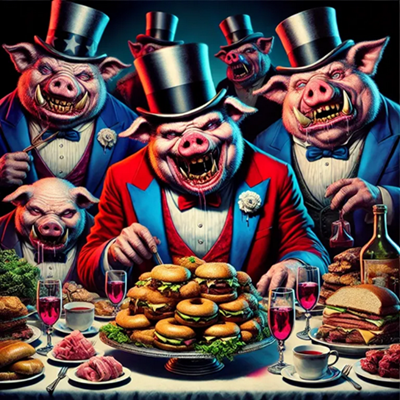
Image from Postcards from the Abyss

As reality intrudes the naivety behind many sacred cows is exposed. The emperor is naked and his supporters look equally naked. The narratives driving their fantasies are failing.

The big three issues common in the West illustrate why people are noticing.

Diversity and immigration

The promotion of diversity as a strength is a consequence of blank slate thinking, a belief disparate populations are substantially the same with most observable differences due to environment only.

This is at odds with what we observe, the significant range in ability and proficiency between distinct groups that becomes apparent when we interact. So artificial variety is sold as a positive in an attempt to downplay the homogeneity that gets better results.

The consequence of this is quotas, where arbitrary rules are enforced to ensure a diverse outcome.

This destroys competency even if we ignore the potential for conflict when foreigners are imported in large numbers.

The main effect of pushing this absurd policy seems to be the rise of ethnic awareness among those who must step aside to accommodate it. How could it not? When people are excluded because of their ethnicity it becomes important to them.

This is not what advocates of diversity intended but is already happening.

Climate

Climate and energy policy is based on anti-scientific magical thinking. With the current emphasis on carbon dioxide we are told a tiny portion of our atmosphere is responsible for most of the future changes that will cause widespread harm. There is no evidence for such claims.

The reality of climate is different from the narrative. It is resilient, as many things are. Our obsession is arrogance. A belief we matter more than we do.

Intellectuals are prone to get lost in their theories of how the world ought to work. Activists then latch on to their utopian ideas to gain some sense of meaning in their lives.

Society also has people lacking conscience who will profit from anything no matter how much damage it causes. Combining these two, dreamers with schemers, is often lethal. Seemingly opposing forces, left-wing activists and capitalist profiteers, can cooperate even if they embrace distinct beliefs.

As many memes remind us, if you have corporate sponsorship you are not the resistance. This is precisely what we see.

Narratives begin to collapse as we witness ruthless corporations promote feelgood nonsense about climate while fleecing taxpayers in the background. Many are noticing.

And the effects of suicidal climate goals are difficult to hide. Every closed factory or power station kills another element of credibility.

Socialism

Socialism is based on the idea an educated elite can make decisions for us all while simultaneously conditioning us to be better versions of ourselves. It ignores all of history and everything we have learned of human psychology to embrace a literal fantasy utopia that no one has even come close to realizing.

Nothing sums up the bankruptcy of our intellectuals more than their inability to reject this failed ideology.

But it also shows us the Anglo-Saxon instinct to restrict others’ control over us is the only way to counter it.

It teaches us of the wisdom of documents like Magna Carta or the Bill of Rights, designed to constrain the powerful regardless of their motives, ambitions or mental state. Rare moments of historical sanity that remind us what effective countermeasures can look like.

It would seem this lesson must be relearned every few generations. But we are learning it. Real life is reminding us why we must limit government and its agents no matter how inconvenient.

Bad ideas are inevitable. It is the ability of activists and the powerful to enact them many are now waking up to as narratives visibly fail.

December 8, 2025

If Britain’s political leadership were trying to destroy the country, what would they have done differently?

My Canadian readers — and possibly the occasional Aussie or Kiwi — can read Spaceman Spiff‘s essay and feel it applies almost 100% to our respective nations as well:

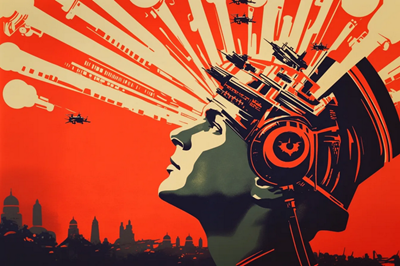
Image from Postcards from the Abyss

Britain is a disaster. The country seems to be in terminal decline.

Not only do we see a lack of ability to turn things around we witness leaders and prominent decision makers evidently clueless about normal life and the hardships many now face.

The political and media classes best reflect this phenomenon. Their views are insular, fictional and at odds with reality. They promote unorthodox ideas that are widely derided yet their enthusiasm is evident as are their hostile responses to being challenged.

Minor comments about immigration are treated as precursors to genocide. Criticism of a biased media unwilling to report events is dismissed as conspiracy. No discussion of climate policy and its unaffordable costs is tolerated. Deviation from the establishment view means excommunication and social exile.

Those in leadership positions drive Britain’s descent into authoritarian governance. Attempts to discuss changes to society leads to extreme overreactions, including jailing noticers, something they now boast about.

Britain has become a madhouse. Our leaders are unable to think like normal people. None of them are facing reality. They seem crazy.

Or, rather, they seem neurotic.

Neurosis is everywhere

Britain has degenerated into a technocratic regime that views the public as its enemy. Normal people disgust the country’s leaders and it shows. They no longer hide their contempt.

But there is a palpable sense of fear emanating from the powerful. Their reactions to normal events paint a troubling picture of who is leading the country, particularly the political and media classes.

If the British establishment were a person we would think them mentally unstable. The qualities we see most are those of a neurotic individual, a type that is well understood.

Here are some features visible in Britain’s ruling class.

Chronic anxiety and worry

A key attribute of neurosis is persistent fear or worry. Rumination is commonplace, circling around and around the same problems. There is also a tendency to overreact, with the response disproportionate to the issue at hand.

The current British regime is wracked with anxiety and worry. This defines them. They are vocal about their concerns.

We are reminded of an endless series of horrors we must attend to; systemic racism, lack of diversity, an imperial past and our cultural dominance along with our impact on the world.

One simple example illustrates the degree to which minds can become distorted by excessive worry.

James Watt perfected the steam engine in 1769 which kickstarted in the industrial revolution, changing the world forever. This would ultimately elevate most nations on earth and led eventually to the establishment of cheap abundant energy for almost everyone.

Until recently these events were viewed as an epoch-defining moment of engineering brilliance. Now this has been recast as a dark stain on Britain’s place in the world, with climate zealots keen to blame the British for all pollution caused by industrialization.

Instead of pride we now see embarrassment and even anxiety about the “damage” Britain has done to the world because it ushered in an era of cheap widespread energy for everyone.

Any rational person would understand this extreme view to be a distortion of reality and excessively negative, yet it permeates everything. Those who rule Britain are ashamed of our past. They worry about it. Only they do this, normal people are proud of our history.

[…]

Welcome to the madhouse

A system of governance driven by neurotics takes on their characteristics. Britain has become a neurotic bureaucracy; a neurocracy.

Neurotics overthink and live inside their heads. They lack the calm, detached strength needed to govern sensibly. Power structures inevitably take on these qualities.

The British government has become paranoid. Digital IDs, internet regulation, censorship. They jail normal people for social media posts. Dissenting views are increasingly punished with custodial sentences.

These are not the actions of the mentally strong. This is an embattled minority fighting reality and becoming desperate.

A gulf is opening between the rulers and the ruled. Increasingly no common ground is even conceivable as the fictions needed to maintain narratives grow. They become overtly false but are needed to feed the neurosis.

One of the things I like about the social media site formerly known as Twitter is how quickly authoritarian bullshit like this can get called out:

Update, 9 December: Welcome, Instapundit readers! Please do have a look around at some of my other posts you may find of interest. I send out a daily summary of posts here through my Substackhttps://substack.com/@nicholasrusson that you can subscribe to if you’d like to be informed of new posts in the future.

November 28, 2025

QotD: Life is not a race to some arbitrary “finish line”

Filed under: Books, Britain, Government, Media, Politics, Quotations — Tags: , , , , — Nicholas @ 01:00

On a friend’s Facebook page I left the following comment about the claim of the writer Abi Wilkinson (in the Guardian!) that inheritance should be confiscated by government to fund the UK’s welfare state. What could possibly go wrong?

I wrote:

    The hostility to inheritance also comes from a mistaken sense of fairness. As Robert Nozick argued in Anarchy, State and Utopia (I quote from memory), people wrongly think life resembles an athletics race, where the racers compete to hit the finishing line. As a result, those “lucky” athletes endowed by nature/god whatever with stronger muscles etc must be handicapped by having weights in their shoes, for example. Just as a child of rich parents must be deliberately held back to give poor kids a more “fair” chance of winning. But as Nozick said, life isn’t like that. It is about people exchanging goods, services and ideas with one another. There’s no fixed end-point to which we are all racing.

    Also, the idea that there is some “prize” that humans compete for implies that someone or some entity has created that “prize” in the first place. But that’s smuggling in a sort of communitarian assumption into the actions of individuals. In an open society, the prizes on offer are varied and multiply constantly.

I should add that the second section of Nozick’s renowned book dissects and ultimately rejects forced redistribution for egalitarian or other forms of “patterned” notions of justice, and he robustly defends what he calls an “entitlement” concept of justice.

One of the approaches that the late Prof. Nozick used was the thought experiment, such as the example referenced above about a fictitious athletics race in which the entrants are hampered/favoured to make the race more “even”, and then assuming that society in general should be like this. A race, held by people who know the rules and seek to abide by them, is not like an open society. “Open” is the key word here: there is no single end to which persons are heading, such as winning the race.

And yet a lot of the metaphors one comes across around discussions around equality, including equality of opportunity as well as outcome, seem to borrow, perhaps unwittingly, from this “race competition” worldview. To give another example, I remember reading some months ago about a university professor (Warwick) who suggested that when parents read stories to their children, this is a form of privilege. This also plays to the idea that life has a fixed end-measure of success, so that anyone giving a value to someone else is giving the latter an unfair “head start” on someone else. It would require a State to exercise totalitarian control of our actions from the moment we wake up to go to sleep lest our actions unfairly advantage/hamper someone in the “race” they are considered, by this worldview, to be on. (It also, by the way, shows that today’s Higher Ed. is full of certifiable fools and worse.)

Johnathan Pearce, “The assault on inheritance and the assumptions that drive it”, Samizdata, 2025-08-21.

November 12, 2025

Bike lanes are only the start

Spaceman Spiff explains how aspirational schemes proposed by our technocratic governments at all levels seem to quickly and effortlessly shift from a nice non-intrusive improvement in life to an overbearing imposition of ever tighter controls on our lives:

Bike lanes on Yonge Street north of Bloor Street in downtown Toronto.
Image from Google Street View

The adoption of cultural novelties follows a predictable path. Some bright idea is proposed and there is nominal support or at least not widespread opposition.

Soon after implementation begins its opposite is condemned. This is the first warning the lunatics have taken over the asylum. We move from a positive, optimistic drive to condemning a perceived negative. By then the intolerant are amassing, attracted to a secular pulpit with which to lecture the rest of us.

More time passes and condemnation of the opposite is not enough. We are commanded to behave in ways more pleasing to our public servants. We learn a key aspect of our future has been decided by a shadowy committee we have never heard of. A well-meaning experiment has become an imperative used to control us.

This absurd sequence is more common than it should be.

A common example in Britain is the creation of bike lanes.

The idea sounds benign. Let’s build cycle lanes to encourage exercise. It is broadly popular, a kind of inoffensive fad to encourage better health despite the weather being an impediment for most.

Few people actively object which is taken to mean they endorse these projects.

It is not long before support for helping cyclists degenerates into discouraging cars since people should be cycling more anyway. The initiative lends moral weight to an otherwise fringe view. The construction of the bike lanes accelerates these ideas as roads are narrowed and traffic slows, frustrating many. There are too many vehicles on the road we are told, all the more reason to get on your bike.

Soon suggestions are made to ban cars completely. The new idea proposed is to shut down the congested roads and replace them with even more bike lanes and pedestrian zones.

Some even openly discuss intentionally making driving awkward and expensive as an explicit goal. The technocratic mind often forgets its charges are people not slaves.

Before long everything shifts, then we wonder how we got to the point our own paid employees can openly gloat we will soon be banned from travelling in ways they dislike as if they are our controllers.

An idea appealing to a minority is imposed on all. Acquiescence to novelties becomes weaponized and subsumed into the ambitions of others. No one ever votes for these things. They seem to just appear.

The end result is often the destruction of goodwill as popular initiatives are rammed down our throats and used to berate us for failing to live up to the standards our public servants impose upon us.

We then tire of the lectures. We wonder where these lunatics come from.

A moment of complacency means unwanted bike lanes but before long it is banned cars, government-controlled IDs and digital currencies. Those who pay attention to the activist world often sense they’d build concentration camps if they could get away with it and all thanks to some benign-sounding scheme we didn’t object to.

November 2, 2025

QotD: The “Blob”, aka the Deep State

The parasitic unholy alliance of Big Corporations, Big Government, Big Bankers and their entire fan club and cheer squad of supporters. Dangerously, this also includes the watchdogs: the Spy Agencies and large parts of the media. The Blob takes money from citizens, pays other parts of the Blob (eg USAID, The UN, The BIS, The World Bank etc), pretends to “help” some token victim group or environmental cause, or even to monitor or audit The Blob, but the outcome benefits The Blob more than the victims. They line their own pockets and increase their own privileges.

The Blob also includes a special category of “useful idiots” who naively assist them in looting Western Civilization. These people are paid in status or an illusory sense of purpose rather than money. They may not realize they are part of the self-serving Blob, and in the long run are not only harming the trees, birds and whales they say they want to save, but are harming their own health, wealth, national security, and worse, that of their children.

Jo Nova, “The Secret Ruling Class – Why the anonymous Blob needs to be invisible”, JoNova, 2025-07-18.

October 19, 2025

Reframing the loss of elite legitimacy as a “loss of faith in democracy”

On his Substack, Frank Furedi illustrates how the public’s declining trust in political elites across the western world is being reframed in the legacy media as declining faith in democracy itself:

No doubt you have come across commentators and legacy politicians whining about the public’s loss of trust in democracy and in the key institutions of society.

“France is not alone in its crisis of political faith – belief in a democratic world is vanishing” commented Simon Tisdall last week in The Guardian.1 He noted that “belief that democracy is the form of governance best suited to the modern world is dwindling, especially among younger people“.

The tendentious claim that the current era of political malaise is an outcome of a loss of commitment to democracy is regularly echoed by mainstream commentators. This was the message of a recent Politico headline that stated that “Europe’s democracies are in danger, warn Merz and Macron”.2 It cited the German Chancellor Friedrich Merz stating that these “threats dwarf anything seen since the Cold War”. He noted that “the radiance of what we in the West call liberal democracy is noticeably diminishing”, adding: “it is no longer a given that the world will orient itself towards us, that it will follow our values of liberal democracy”.

If anything, the French President Macron was even more pessimistic than Merz. He warns that Europe is undergoing a “degeneration of democracy due to attacks from without and from within”. He was particularly concerned about the loss of faith in democracy within France. “On the inside we are turning on ourselves; we doubt our own democracy”, he noted, before adding, “we see everywhere that something is happening to our democratic fabric. Democratic debate is turning into a debate of hatred.” This statement coming from a man, whose presidency lacks a genuine mandate and relies on bureaucratic maneuvering exposes the cynicism of his concern for the “degeneration of democracy”.

[…]

Loss of elite authority

In reality the crisis of democracy narrative serves to mystify the real issues at stake. This narrative offers a misdiagnosis of the very real loss of legitimacy of the ruling elites as a loss of belief in democracy. As far as this dominant narrative is concerned every time people vote against the representatives of the legacy political establishment democracy is in trouble. So long as they win elections and populists aspirations are confined to the margins of society democracy is represented as a big success. But the very minute people vote the “wrong way” the mainstream commentators craft alarmist accounts about democratic backsliding. That is why the Remainer lobby often represents the outcome of the Brexit Referendum as an expression of “democratic backsliding”.

In theory, the term democratic backsliding refers to the declining integrity of democratic values. In practice it means the estrangement of significant sections of the public from their political institutions. The term democratic backsliding serves to mystify a very significant development, which is the legitimacy crisis of the legacy political establishment. Once understood from this perspective it becomes evident that it is not democracy that people no longer trust but the people and the institutions that rule over society.

As it happens the narrative of “democracy is in trouble” smacks of pure hypocrisy. Those who communicate this narrative are not so much interested in the integrity of democracy but in ensuring that people vote the right way. From their perspective if people vote the wrong way than democracy becomes dispensable. That is why more and more we hear the refrain that there is “too much democracy”. “Democracy Works Better when there is less of it” warned Financial Times commentator, Janan Ganesh.3 As far he is concerned, “no global trend is better documented than the crisis of democracy”, by which he means that too often people vote against the advice of the elites.


  1. https://www.theguardian.com/commentisfree/2025/oct/12/france-crisis-political-faith-belief-democratic-world-vanishing
  2. https://www.politico.eu/article/europe-democracies-danger-warn-friedrich-merz-emmanuel-macron/
  3. https://www.ft.com/content/f68c13a4-1130-49d5-b3c6-2270711d819e

October 13, 2025

Communism, Socialism, and Star Trek

Filed under: Economics, Media, Politics — Tags: , , , , , , — Nicholas @ 02:00

Feral Historian
Published 23 May 2025

There’s a long history of Star Trek being equated with communism, both in praise and condemnation. But is it really mappable to modern politics, given that it assumes a different set of socioeconomic conditions? More to the point, is socialism (in the Marxist transitional sense) just a dead-end?

00:00 Intro
00:51 What’s Capitalism?
04:00 Communist, not Socialist
07:14 Theory and Practice
08:51 Goals and Process

🔹 Patreon | patreon.com/FeralHistorian
🔹 Ko-Fi | ko-fi.com/feralhistorian
Obligatory shameless plug for Ninti’s Gate
🔹 https://www.amazon.com/dp/B0CYXH9BWD

October 10, 2025

A POSWID analysis of the contention that “Canada is broken”

It’s my strong opinion that Canada is indeed “broken”, and much but not all the blame for that goes to former Prime Minister Justin Trudeau and increasingly to current PM Mark Carney. It hasn’t all been the direct action or deliberate inaction of the Liberal party and their bureaucratic minions in the civil service, but their fingerprints are on a lot of the damage. Eberhard Englebrecht analyzes Canada using POSWID framing and concludes that “the Purpose Of Canada is What It Does”:

Now, one of the core criticisms made of POSWID by its opponents is that it leans heavily on a consequentialist interpretation of events, completely discarding the roles human intention, error, and agency play in how things transpire.

However, these critiques only hold validity if you take POSWID and make it your singular mode of analysis — something that I don’t encourage, nor intend on doing myself. Rather, POSWID should be understood and used as a specific tool with a specific purpose — that is, to peel back the noxious platitudes, gaslighting, and wishful thinking that envelop our politics, and hinder our ability to view our present situation with clarity and honesty.

And, unfortunately for the citizenry of Canada, Canadian politics is — and has been for some time — a domain chock full of the misguided idealism and obfuscation that POSWID seeks to erase.

It is why many Canadians — despite their country having experienced a precipitous decline in both general prosperity and the integrity of the common social fabric — remain willfully blind to such an absurd degree.

POSWID, as I will be applying it, can tackle many of the polite pleasantries and mindless incantations that have become embedded in Canada’s “consensus” of acceptable political discourse, exposing them as misaligned with reality. This will take one of two forms: the first is to demonstrate that a common belief in the trope in question has led to results contrary to the intentions of those who originally pushed the trope; the second is that the trope was always purely abstract and aspirational, never described reality, and any attempts to align reality with said trope have failed miserably.

Many of these tropes are sacred cows of Canada’s political establishment — ideas that they would insist define “what it means to be Canadian” or are things that “we all believe”. Going against them, or merely questioning their validity or suitability, would be considered “UnCanadian”. These tropes have, in many cases, dictated the direction of Canadian society since the 1960s and created the foundations for the paradigms that currently define Canadian politics. Therefore, the deconstruction of these tropes constitutes the deconstruction of these paradigms — something that would have cascading ramifications for our country.

It is worth noting, however, that my intention in writing this piece is not to make granular policy prescriptions. My job is merely to provide a clear-eyed account of how three of the values and policy programmes of Canada’s chattering class (you could substitute “chattering class” with “professional-managerial class” or “Laurentian Elite”) are out of step with how this country actually exists — a reality felt and experienced at an intuitive level by many, but rarely articulated in public.

October 1, 2025

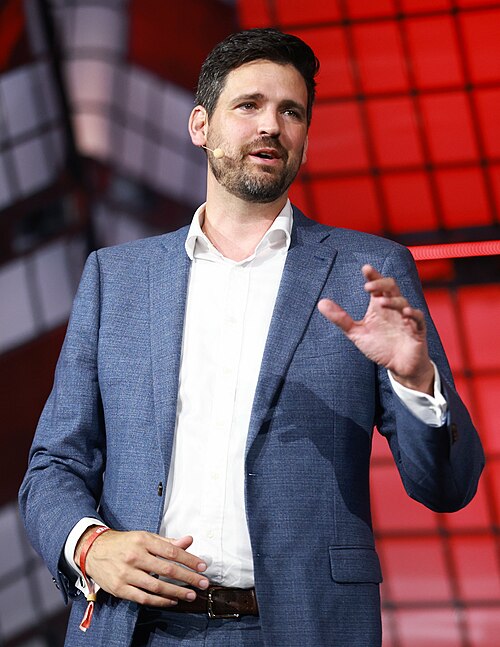
“Sean Fraser, the current minister of justice and attorney general, has made two major mistakes of late”

If you’re at all interested in Canadian affairs, you should subscribe to The Line … even a free subscription will definitely provide you with some excellent non-propagandistic coverage of what is happening in the dysfunctional dominion. For instance, last weekend’s weekly post from the editors included this segment about Sean Fraser, who is perhaps the worst of Mark Carney’s cabinet (and that takes some doing):

Sean Fraser, as Minister of Immigration, Refugees & Citizenship, during day one of Collision 2023 at Enercare Centre in Toronto, Canada.
Photo by Vaughn Ridley via Wikimedia Commons

We at The Line contend that Sean Fraser, the current minister of justice and attorney general, has made two major mistakes of late.

The first was in deciding not to rescind his decision to spend more time with his friends and family when it became clear that Justin Trudeau was no longer an anchor on his electoral chances. After failing to fix Canada’s housing problem and proving himself integral to blowing apart a pan-partisan consensus on immigration that was once the envy of the world, the man had a real opportunity to leave office on a high note. But, no.

Instead, after hitching his bloated baggage to Mark Carney’s trunk, Fraser decided that Canada needed more of him.

And so, as justice minister, instead of addressing petty stuff like, oh, bail reform, or fixing prisons, or getting crime under control, he turned his attention to … Section 33 of the Charter of Rights and Freedoms. The notwithstanding clause.

You may recall that Quebec’s contentious Bill 21 — which prohibits public-service employees in positions of authority, and teachers, from wearing religious symbols while on the job — is currently before the Supreme Court of Canada. Despite numerous mixed rulings on the law, Quebec moved forward with its stance on secularism by invoking Section 33, which allows parliaments to temporarily override judicial rulings.

Section 33 was placed in the Charter for precisely this kind of situation; one in which the courts and parliament disagree about governance. As we still live in a democracy, and are still nominally governed by representatives we elect, the clause was always a bit of a compromise gesture intended to preserve parliamentary supremacy after granting the courts broad powers to basically reinterpret law according to an expansive and ever-expanding understanding of both their jurisdiction, and of the concept of “rights” writ large.

Section 33, nonetheless, has maintained a heavy odour about it, which has generally limited its application, especially outside Quebec. Among the Sean Fraser set, and the largely Liberal collection of lawyers who will insist that the Supreme Court isn’t remotely political, and how dare we entertain the thought, Section 33 was only ever intended as a symbolic right.

But as the definitely-not-political Supreme Court has edged ever deeper into the territory of override and governance, so too have provincial parliaments responded with a very not-symbolic application of the clause.

We do think there’s some blame to be placed at everyone’s door, here. But we also never really took much issue with Section 33. That’s because, at heart, we at The Line believe in, well, democracy. We believe that the people we elect should be able to decide our laws; and we believe that while the Supreme Court of Canada serves as an important check on Parliamentary power, that power doesn’t and should never override the will of the people.

And that’s basically where we part ways with Fraser and many of his — dare we say it? — Laurentian Consensus ilk. Because the unstated critique of the use of Section 33 is basically always the same: these people dislike the application of the clause because they think politics is icky, and that politicians fundamentally cannot be trusted.

In other words, these people don’t actually want a democracy.

They want a technocracy. One in which the smartest and ablest individuals (as defined by them, of course) are the ones who actually get to set the rules and guardrails for society writ large. One in which parliament really is as theatrical, symbolic and pointless as it often regards itself.

There’s an obvious illogical inconsistency here — Fraser and his colleagues are politicians. We aren’t sure if this desire to go out and limit the ability of he and his fellow parliamentarians to do the best jobs they can for the citizens reflects mere self-loathing, or a particular brand of Liberal blindspot, one that leads them to believe that they alone among politicians are exempt from anything as crass political considerations and/or motivations. Those moral failures are apparently for the other guys. But in any case, we have an elected official making the case that unelected courts should have the ability to override legislators, and that the legislators should have no recourse. However Fraser rationalizes this to himself, it’s where we are.

We think the people who have issues with Section 33 are generally not being honest with themselves in that regard; we also think that their instinctual aversion to politics (or their exemption of themselves from it) tends to make them naive. If you vest all the real power of governance in a “non-partisan” Supreme Court, what you’ll get is not a dispassionate government, but rather a heavily politicized Supreme Court. We need only look at what has happened in the U.S. over the past 30 years to see how that pans out in the long run.

Look, we at The Line don’t like Bill 21. It’s a bad law. It needlessly tramples on minority rights. But there’s a very obvious way to get that law repealed that doesn’t involve flirting with a full-blown constitutional crisis in the midst of, you know, all of the other crises going on right now.

Elect a government that will repeal that law.

That’s what democracies do.

To me, one of the most puzzling things about the Carney government’s recent actions is the overall incoherence of them. They are going ahead with one of the worst policies inherited from the Trudeau years with the “gun buyback” program that the minister responsible has openly admitted is almost completely a sop to voters in Quebec. Okay, that makes cynical sense as the Liberal vote is about as “efficient” as it possibly can be so losing just a few seats in Quebec would make it impossible for the Liberals to get re-elected. Fine. Scummy as hell, but fine. Yet the challenge to Section 33 is guaranteed to piss off far more Quebec voters — and stir up controversy across the country to boot — and you’re going to stage a pitched battle against pretty much all the provinces before the Supreme Court? Are you sure about that?

September 24, 2025

Zardoz: A Technocratic Parody

Filed under: Britain, Environment, Media — Tags: , , , , , , , — Nicholas @ 02:00

Feral Historian
Published 30 Jun 2023

After another viewing, I now think of Zardoz as an unintentional parody of the technocratic mindset that was congealing in the 1970s. It’s a strange film, a sometimes tedious film, but it’s worth a look if only because there’s nothing else quite like Zardoz.

I keep saying “Immortals” when I mean “Eternals” and I had to recut this one a bit due to some semi-random copyright issues so I apologize for any perceptible jank.

The tip jar at Ko-Fi helps keep Feral Historians in the woods and off the streets.
🔹 Ko-Fi | ko-fi.com/feralhistorian

September 21, 2025

“What do you remember of the summer when the English awoke?”

Filed under: Britain, History, Media, Politics — Tags: , , , , , , — Nicholas @ 03:00

In The Critic, David Shipley says that the rapid, visible rise in English nationalism is a new and positive thing in Britain:

“Union Jacks and crosses of St George” by Ben Sutherland is licensed under CC BY 2.0 .

What do you remember of the summer when the English awoke? The summer of arguments over what “English” means, hotel protests, and of “flagging”. Overnight the England flag was everywhere. On lampposts, on bridges over motorways, and even painted on roundabouts, the St George’s cross appeared, as a challenge to the old regime, and a threat, or promise, of something new.

For this is new, make no mistake. In my lifetime, England’s flag has only been seen in force during football tournaments and at the rugby. Political figures of the left have seized upon this novelty as they have tried to resist the challenge. The Green Party leadership candidate Ellie Chowns insisted that “it’s traditionally not part of British culture to hang flags”, while Zack Polanski, the party’s new leader, said he wouldn’t fly the flag outside of football tournaments because “of what it represents to people who worry about that problematic history”, before going on to say he’s “worried that we’re importing fascism”. Meanwhile John McTernan, former advisor to Tony Blair insisted that flag flying isn’t an expression of “national pride”, but rather “being used to other people” (my italics).

Notionally sensible centrists, The News Agents suggested that the flag should be redefined as representing “tolerance, liberalism, democracy and Shakespeare” and that would deter “right-wing thugs” from using it. The propagandists of the regime recognise that it is in danger, and seem to believe that “British Values” are enough to hold back the tide.

York Council went ever further, saying that flagging has “coincided with a rise in racist incidents” and have decided to remove hundreds of England and Union flags, to which York’s “Flag Force” responded by announcing they would promptly replace every flag which was removed.

England’s flag was everywhere at the hotel protests too — standing for resistance against a Westminster regime that continues to force migrants upon communities which do not want them.

At the end of the summer, as the Last Night of the Proms coincided with the “Unite the Kingdom” march, the flag divide could not have been wider. On the streets of London that Saturday a sea of Union and St George flags, while at the Albert Hall it seemed one could wave any nation’s flag but England’s.

A Times cartoon from July caught the year’s mood. It depicted a group of unthreatening families protesting, holding signs saying We’re not far right – we’re worried about our kids and Deport Foreign Criminals. Beneath them, buried in the earth lurks a bald, beefy man with H A T E tattooed on his knuckles, and Made in England alongside the red cross of St George tattooed on his shoulder. Here, in the favoured paper of the British establishment, we see their fear that a deeper, more dangerous Englishness threatens to rise up, and threaten, or even destroy their order.

September 20, 2025

QotD: Why modern dishwashers suck

    The current standards for dishwashers took effect in 2013. The standards, which were based on a consensus agreement between manufacturers and efficiency advocates, specify minimum energy and water efficiency levels. The standards require that standard-size dishwashers use no more than 307 kWh per year and 5.0 gallons of water per cycle.

    In 2024, DOE finalized amended standards for dishwashers based on a joint recommendation from manufacturers and efficiency advocates. The new standards for dishwashers will cost-effectively reduce energy consumption by 15% relative to the current standards while also cutting water waste. Dishwashers

It is a general problem, but what started me thinking about it was being told by my dishwasher that it would take three and a half hours to wash the dishes. That seems, judging by a quick search online, to be longer than average but still within the normal range. I have not been able to find figures online for how long dishwashers took twenty or thirty years ago but, by what I remember, it was substantially less — and the dishes ended up dry, which ours don’t.

The explanation is in the final word of the quote above, “waste”. The owners of dishwashers pay for water and power, so if making them more efficient in those dimensions was costless, did not require giving up something else, there would be no need for the Department of Energy to make the manufacturers do it. I conclude that it was not costless, that it either made dishwashers cost more or do their job less well — take longer, not dry the dishes as well, not clean them as well. Using more power or water to do a better job is not waste.

David Friedman, “Optimizing On A Single Variable”, David Friedman’s Substack, 2025-06-02.

September 18, 2025

Broken feedback paths lead to broken organizations … like government

Lorenzo Warby on the ever-increasing dysfunction of most western governments due to the deliberate sabotage of what used to be functional feedback paths:

That institutions within Western democracies have deteriorated in recent decades is clear. That the march of progressivism through the institutions is at the heart of this deterioration is also clear.1

This has been progressives acting like progressives, with all the perverse relationship with information that is at the heart of progressivism. A perverse relationship that leads directly to their degradation of institutions.

Progressives use the imagined future as their benchmark of judgement, but there is no information from the future, so there is no reality-test in their benchmark of judgement. The imagined future can, however, be as glorious as one likes.

Conversely, anything actually created by humans will have downsides and even sins attached. This gives progressives a great rhetorical advantage over anyone who attempts to defend anything humans have actually built. All of the painful history of human achievement is rendered as naught, as mute, in the face of the splendours in their head.

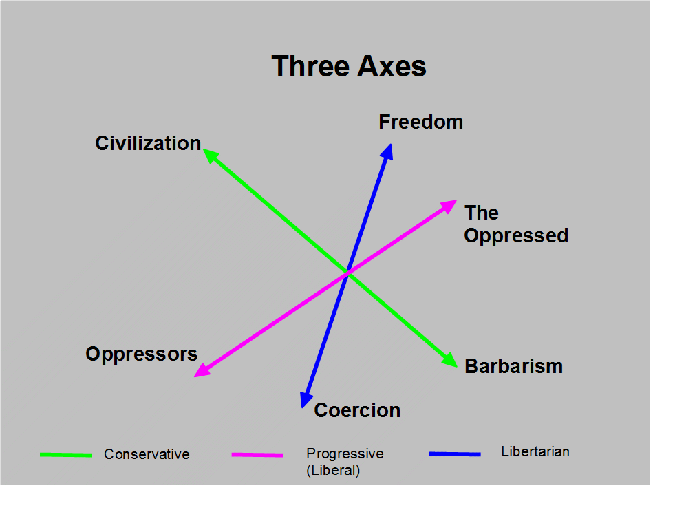
Arnold Kling’s Three Languages of Politics model.

If a group is disproportionately successful, that is not an example to emulate but a sign of their oppressor status. If they are comparatively unsuccessful, that is not a warning about what to avoid, but a sign of their oppressed status. This is an outlook deeply hostile to learning from what does, and does not, work.

For using the glorious imagined future as the benchmark of judgement creates the basis for denigrating anything that comes from the past: which is all the information we have about what works and does not. This includes denigrating the embedded learning in institutions. Even fundamental questions about what is required to sustain a social order get written out of acceptable discourse as not fitting with their imagined-future benchmark of judgement, with the splendours in their heads.

Using the imagined future as one’s benchmark of judgement also naturally leads to concluding that one owns morality, as any opposition to the glorious imagined future is clearly immoral. This leads to, at best, comprehensive disengagement with, and at worse, systematic denigration and delegitimisation of, those who disagree. A systematic denigration and delegitimisation that often involves systematic misrepresentation of those who disagree. The consequence of all this is to block feedback about one’s political projects.

The most extreme instance of this has been the UK, where the BlairBrown Governments of 1997-2010 took power away from elected officials (apart from the PM) and handed it to “experts” in quangoes, to judges via human rights legislation and to the EU. Those with the “correct” understandings could do their thing, insulated from voters. This made the UK a state, a polity, with broken feedbacks.

Modern Western civilisation is a civilisation with broken feedbacks — as I discuss here, here, here, here and here — but the Blair-Brown constitutional vandalism extended that pattern of broken feedbacks systematically to the British state. The consequences have become grimly obvious. Massive waves of unwanted migrants as part of a massively dysfunctional British state.

If you systematically kill feedbacks from voters, you systematically kill accountability. Of course dysfunction will spread across the organs of the state, as it has. (See here for a discussion of aspects of that horrifying dysfunction.)


  1. Feminisation of institutions has also been a corrosive factor, but that is deeply intertwined with the march of progressivism through the institutions.

Update, 19 September: Welcome, Instapundit readers! Please do have a look around at some of my other posts you may find of interest. I send out a daily summary of posts here through my Substackhttps://substack.com/@nicholasrusson that you can subscribe to if you’d like to be informed of new posts in the future.

August 5, 2025

High tech and lust for power are a bad combination

Spaceman Spiff discusses the malign confluence of technocrats and amoral power-seekers (BIRM):

Today’s technocrats, assisted by billionaire tech bros, want to implement a digital surveillance grid that will eradicate any notion of anonymity or privacy forever.

Every major country, including the United States, is working on this with enthusiastic support from governments and their many agents.

The sales pitch is primarily platitudes about protecting people from harm, especially children.

What they seek is the end of the internet as it currently is, which means it will look a lot more like licensed corporate TV than the current free for all. From here their goal is to extend their surveillance operation into every aspect of our lives, from the energy we consume to the food we are permitted to eat.

This will probably cause a lot of damage, but it will ultimately fail.

Tech bro arrogance meets managerial control freakery

We are witnessing a partnership between the technocratic elite, with a limited understanding of technology, and silicone valley titans, who are blinded by the promise of technology.

Each group believes draconian surveillance systems combined with fancy data analysis will solve many societal problems and usher in a new era with them at the helm.

To the technocrats it promises full-spectrum control of all our choices. The food we eat, the material we consume, the ability to travel.

They are salivating at the thought of the ultimate control, the issuing of government-controlled digital currencies they can deactivate on a whim. No steak for the memelords, and no road trips for those without the right carbon profile.

They have been discussing these things for many years with a degree of enthusiasm bordering on mania.

The technologists see a chance to keep in with the powerful, to join the club. If they can be the trusted partner of the visionaries currently wrecking our world they will cash in and perhaps be spared from the concentration camps.

The technologists have powerful tools that promise amazing things. Machine learning, predictive programming, behavioural modelling.

Spotting patterns within trillions of data points is appealing to society’s tinkerers, all the better to predict problematic behaviours and to spot trends. Combined with nudge units and related horrors of social engineering this promises to be the holy grail for a technocratic managerialist regime absolutely convinced it can steer society in enlightened directions, just like they imagine they did during Covid.

It is all very futuristic, and it has clearly impressed our technology gurus as well as those who love control.

But along with the outsized data stores will come outsized cockups they cannot properly plan for.

Climate modelling has promised immense benefits and accuracy for decades and we have yet to see a single successful prediction. Indeed, some of the most famous climate predictions are almost comically wrong but nonetheless trigger endless rounds of funding, chatter, conferences and hubris. Such is the lure of anything that can be adapted to enforce top-down social control.

There have been many attempts to harness technology to predict the stock market, another obvious target. None of them worked either. It doesn’t seem to matter. No one is checking the track record. It is sold on its promise and that works because of who is buying. Or, rather, the type of person who embraces these schemes.

Digital surveillance, digital currencies, digital voting, digital IDs. Everything we do tracked and stored. Such absolute total control would make our superiors into gods as they exploit these powerful tools to direct us towards better versions of ourselves.

There is a delusion at play here. Those closest to this seem lost in their fantasies. They are blind.

August 4, 2025

The EU still dominates in one key area – over-regulation

At the Foundation for Economic Education, Cláudia Ascensão Nunes identifies the one area that the EU has carved out a unique niche for itself … and it’s global in scope:

EU regulations delenda est

In a world where global power is measured by military strength, technological innovation, or cultural influence, it is striking that the European Union, without housing major tech giants or centers of disruptive innovation, has turned bureaucracy into a tool of global power. It shapes the behavior of global companies, including American big tech firms, which adapt their products to comply with European norms. This phenomenon is known as the “Brussels Effect” and has positioned the EU as the world’s regulatory superpower, fueling growing tensions, particularly with the United States following the re-election of Donald Trump.

The European market comprises 450 million consumers with significant purchasing power, making it an essential destination for global companies. However, access to this attractive market comes with detailed regulations based on the precautionary principle, ostensibly prioritizing consumer and environmental protection, and enforced by an efficient bureaucracy capable of implementing and enforcing rules with precision. This combination encourages companies to align their global operations with European standards, as maintaining different product versions for each region is costly and complex. In practice, this exports European standards worldwide.

American big tech companies such as Apple, Google, and Meta exemplify the impact of the “Brussels Effect,” as they face the requirements of legislations like the Digital Markets Act (DMA) and the Digital Services Act (DSA). These laws have forced companies to overhaul their business models, often at high cost and with significant implications. The DMA, for instance, forced Apple to allow alternative app stores and third-party payment systems on iOS, leading the company to announce, in 2024, global changes to its app policy affecting users even outside Europe, with cost estimates in the billions of dollars to restructure its infrastructure and address revenue losses from the App Store.

Google, under the same regulation, was required to offer alternatives to its search engine on Android and to unbundle services such as YouTube, impacting its global strategy and requiring significant investments in new operating systems and interfaces. The company faced potential fines of up to 10% of its global revenue for non-compliance.

Meanwhile, Meta, under the DSA, was required to invest billions in content moderation systems, a serious imposition that openly seeks to control freedom of expression on a global scale. Operational costs increased by around 20%, according to market analysts. These costly adjustments are ultimately coercive due to the weight of the European market, demonstrating how Brussels shapes corporate behavior on a global scale.

These successive impositions and forced adaptations illustrate precisely Friedrich Hayek’s warning about the dangers of central planning. By replacing spontaneous order with top-down, uniform rules imposed by a technocratic authority, the capacity for local adaptation and respect for market complexity is lost. In this scenario, the European Union increasingly takes on the features of a regulatory Leviathan, a body concentrating disproportionate power in the hands of bureaucrats far removed from citizens, reducing freedom of choice and stifling innovation.

« Newer PostsOlder Posts »

Powered by WordPress