Feral Historian
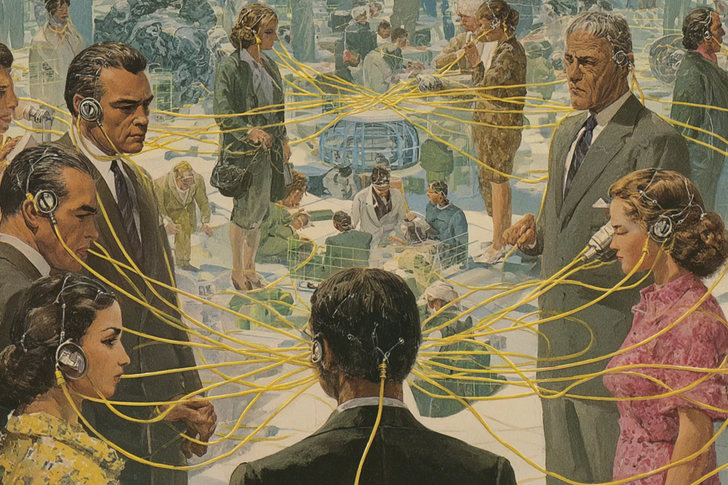
Published 10 Jan 2025H.G. Wells’ Things To Come played much differently in 1936 than it does today. So much so that it offers us an insight into the politics of the period if we can step back from our post-WWII understanding and look at it on its own terms.
Link to the Coupland essay.
http://digamoo.free.fr/coupland2000.pdf00:00 Intro
02:08 Revolution Envy
05:15 The Gulf of Time
06:32 Wells and the BUF
08:02 Empire and Establishment
12:11 The World State
15:18 To Understand the Past …
June 25, 2025
H.G. Wells’ Things To Come: Through The Eyes of its Time
June 8, 2025
Managerialism – threat or menace?
In the New York Times (don’t worry … link is to an archived version), Nathan Levine explains to NYT readers why there is such a push back against the over-mighty technocratic organizations that have been running more and more of our fading civilization:
It is the culmination of a once marginalized, now transformative strand of political thought about who really holds power in the modern American system. Namely, that our democracy has been usurped by a permanent ruling class of wholly unaccountable managers and bureaucrats.
Anti-managerialism is back. Well positioned to answer decades of frustration with mainstream conservatives’ failure to deliver results, this old idea has become the central principle of the new right.
In fact, much of what is commonly called “populist” politics can be more accurately described as part of an anti-managerial revolution attempting to roll back the expansion of overbearing bureaucratic control into more and more areas of life.
Though it has so far met with limited success amid stiff resistance, grasping the nature of this anti-managerialism is essential to understanding the Trump administration’s effort to transform America’s institutional landscape, from government to universities and major corporations.
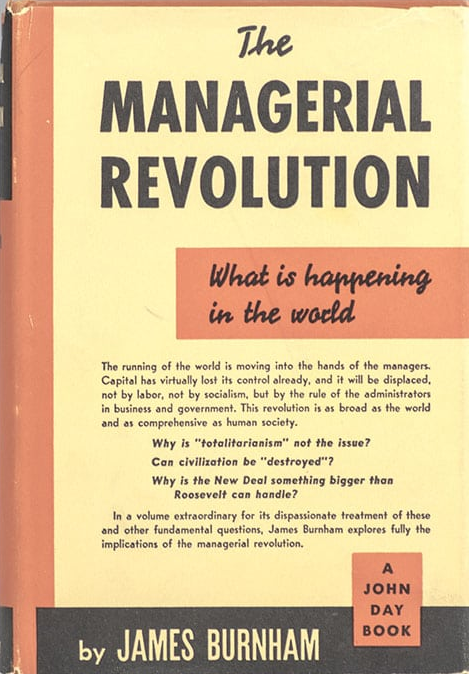
The idea’s intellectual history begins with the political philosopher James Burnham, who argued in his seminal 1941 book, The Managerial Revolution, that the aristocratic capitalist class was in the process of being overthrown by a revolution — just not, as the Marxists predicted, by the working class.
Instead, the exponential growth of mass and scale produced by the Industrial Revolution meant that in both corporation and state it was now those people cleverest at applying techniques of mass organization, procedure and propaganda — what he called the managerial class — who effectively controlled the means of production and would increasingly come to dominate society as a new technocratic oligarchy.
The book made an especially significant impression on George Orwell, who remarked that a managerial class consisting of “scientists, technicians, teachers, journalists, broadcasters, bureaucrats, professional politicians: in general, middling people”, hungry for “more power and more prestige”, would seek to entrench “a system which eliminates the upper class, keeps the working class in its place, and hands unlimited power to people very similar to themselves”.
Orwell was particularly struck by Burnham’s observation that the major political systems of the day — fascism, Communism and New Deal-era social democracy — were fundamentally similar in their turn toward the bureaucratic management of society. He observed that everywhere “laissez-faire capitalism gives way to planning and state interference” and “the mere owner loses power as against the technician and the bureaucrat”. Believing that accelerating managerial control risked dragging every society inexorably into totalitarianism, Orwell made Burnham’s ideas the basis of his novel 1984.
While the Cold War persisted, the view that America’s government might share some traits with the Soviet Union unsurprisingly proved unpopular, especially among Washington’s conservative establishment.
Nonetheless, the managerial class continued to grow, regardless of which political party controlled the government. Cold War defense budgets drove a relentless expansion of security state bureaucracy and the military-industrial complex. The advent of Great Society welfare programs and the Civil Rights Act demanded a re-engineering of social relations, prompting a dramatic proliferation of lawyers, regulatory bureaucrats and corporate compliance officers throughout much of public and private life. An ever-greater proportion of Americans began funneling through the credentialing machinery of higher education, inflating demand for yet more upper-middle-class managerial jobs.
“If the New York Times notices the Buddha, the enlightened one has already left town”
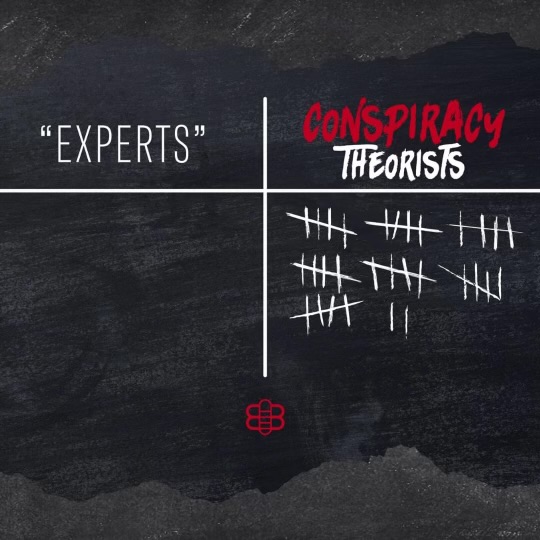
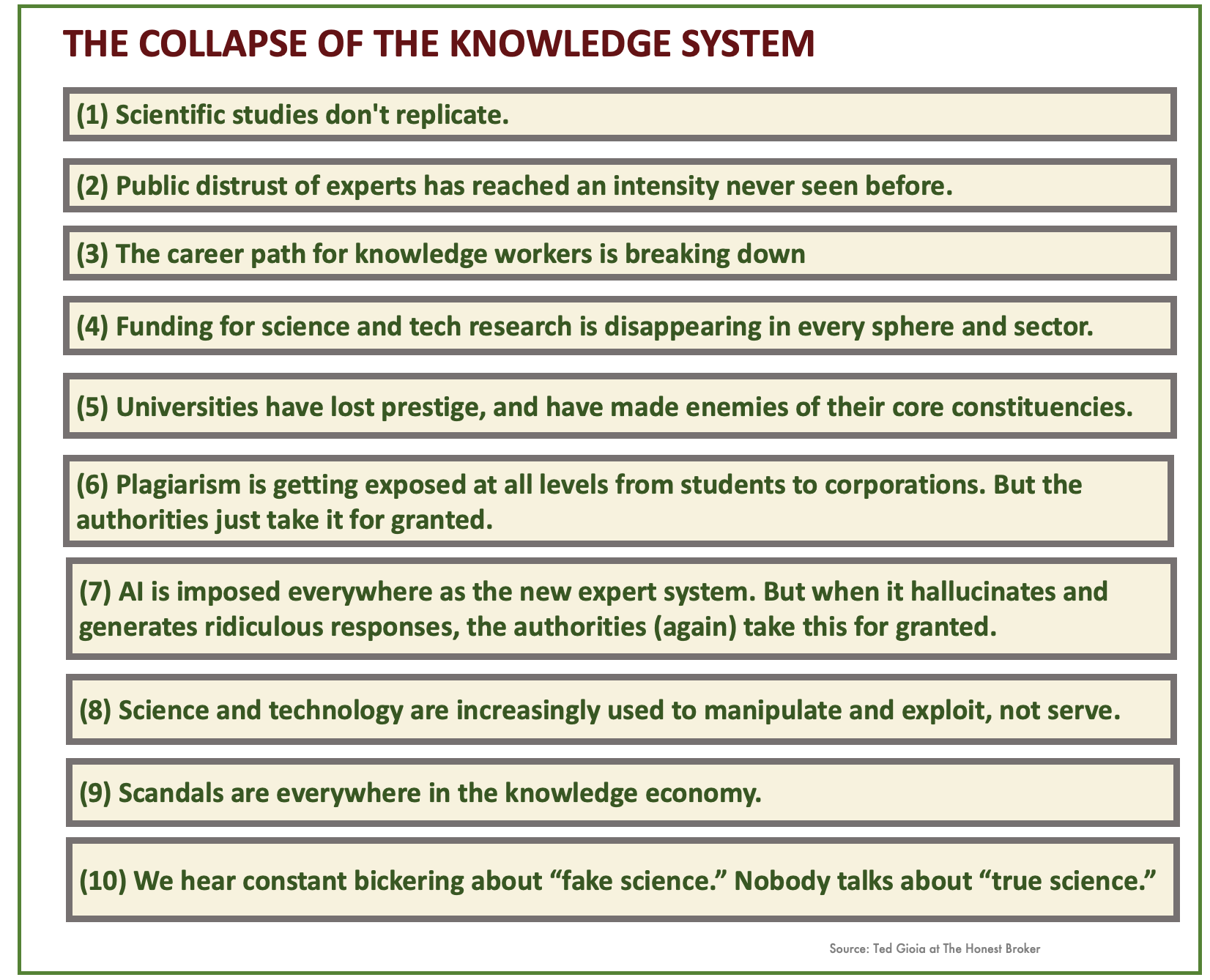
Ted Gioia points out that momentous changes in society are not often noticed until they’ve taken place, and provides ten warning signs of such a change happening right now:
Would you believe me if I told you that the biggest news story of our century is happening right now — but is never mentioned in the press?
That sounds crazy, doesn’t it?
But that is often the case when a bold new worldview appears.
- How long did it take before the Renaissance got mentioned in the town square?
- When did newspapers start covering the Enlightenment?
- Or the collapse in mercantilism?
- Or the rise of globalism?
- Or the birth of Christianity or Islam or some other earthshaking creed?
The biggest changes often happen long before they even get a name. By the time the scribes notice, the world is already reborn.
You can take this to the bank: If the New York Times notices the Buddha, the enlightened one has already left town.
For example, the word Renaissance got introduced two hundred years after the start of the Renaissance. The game was already over.
The same is true of most major cultural movements — they are truly the elephants in the room. And the elites at the epicenter of power are absolutely the last to notice.
Tiberius may run the entire Roman Empire, but he will never hear the Good News.
There’s a general rule here — the bigger the shift, the easier it is to miss.
We are living through a situation like that right now. We are experiencing a total shift — like the magnetic poles reversing. But it doesn’t even have a name — not yet.
So let’s give it one.
Let’s call it: The Collapse of the Knowledge System.
We could also define it as the emergence of a new knowledge system.
In this regard, it resembles other massive shifts in Western history — specifically the rebirth of humanistic thinking in the early Renaissance, or the rise of Romanticism in the nineteenth century.
In these volatile situations, the whole entrenched hierarchy of truth and authority gets totally reversed. The old experts and their systems are discredited, and completely new values take their place. The newcomers bring more than just a new attitude — they turn everything on its head.
That’s happening right now.
The knowledge structure that has dominated everything for our entire lifetime — and for our parents and grandparents — is collapsing. And it’s taking place everywhere, all at once.
If this were just an isolated situation — a problem in universities, or media, or politics — the current hierarchy could possibly survive. But that isn’t the case.
The crisis has spread into every sector of society which relies on clear knowledge and respected authority.
May 17, 2025
QotD: Suburbs and their critics
I respect [sprawl] as people’s choice – the suburbs, highways and byways, strip malls, cookie-cutter houses, whether small semi-detached or McMansions, the whole lot of it.
It gets a lot of bad press, it has got a lot of influential haters, ridiculers and deriders. There are the urbanists, the town planners, the architects, most of whom can’t abide the sprawl. It’s ugly, inefficient, unsustainable, it lacks amenities and it lacks a sense of community, it prioritises – or privileges, as they would say – cars over pedestrians, it wastes space and it wastes resources, it’s barbaric. Those much smarter and more creative than us have offered a lot of alternatives: high-density living, modernist spaces, Le Corbusier’s houses as “machines for living”. They tore down the slums and erected high rise projects, council flats, banlieues and osiedla. They designed and built whole new districts, rich in concrete and wide bare expanses of public space.
Then there are the cultural as opposed to professional haters, and they too are as old as the suburbs themselves. The sprawl is a prison, a conformist hell. It deadens imagination and stifles creativity. It’s full of dumb people leading dumb lives. It’s a triumph of materialism, selfishness and narrow mindedness over selflessness, community and commonweal. From literature through movies and music to TV shows, suburbs don’t get a break; they are the hotbed of reaction, sexism, racism, homophobia, xenophobia, intolerance, prejudice, oppression and kitsch. “Revolutionary Road”, “Stepford Wives”, “American Beauty”, “Weeds”, “Little Boxes”, Stephen King novels, the list is endless, but you get the drift.
There are many differences between the suburbanites and the suburbs haters, but the one big one is this: the suburbanities are the live-and-let-live crowd – they know what they like but they don’t give a shit if you don’t like it. It’s your business and it’s your life – you can do whatever you like. The suburbs haters, on the other hand, not only know what they like but they believe that everyone else should like it to, and if they don’t, tough luck, they should be forced to change for the sake of what’s really good for them and for the whole community. Suburbs are not something that can be tolerated as an option; they should be destroyed, land reclaimed, ideally by nature, their former residents corralled and concentrated.
In many ways it’s yet another example of the old elite versus the masses cultural clash. The masses essentially just want to be left alone. The elites want to remake the whole world so it accords to their vision of what’s good and useful. The masses’ is not to question why …
Arthur Chrenkoff, “In praise of sprawl”, Daily Chrenk, 2020-05-21.
May 9, 2025
March 21, 2025
QotD: Gordon Brown and the “Gillian Duffy affair”
The Gillian Duffy affair, the start of this People’s Decade, was fascinating on many levels. Fundamentally, it revealed the schism in values and language that separated the elites from ordinary people. To the professional middle classes who by that point — after 13 years of New Labour government — had conquered the Labour Party, people like Mrs Duffy were virtually an alien species, and places like Rochdale were almost another planet. Indeed, one small but striking thing that happened in the Duffy / Brown fallout was a correction published in the Guardian. One of that newspaper’s initial reports on the Duffy affair had said that Rochdale was “a few hundred miles” from London. Readers wrote in to point out that it is only 170 miles from London. To the chattering classes, it was clear that Rochdale was as faraway and as foreign as Italy or Germany. More so, in fact.
The linguistic chasm between Duffy and Brown spoke volumes about Labour’s turn away from its traditional working-class base. Yes, there was the word “bigot”, but, strikingly, that wasn’t the word that most offended Mrs Duffy. No, she was most horrified by Brown’s description of her as “that woman”. “The thing that upset me was the way he said ‘that woman'”, she said. “I come from the north and when you say ‘that woman’, it’s really not very nice. Why couldn’t he have just said ‘that lady’?”
One reason Brown probably didn’t say “lady” is because in the starched, aloof, technocratic world New Labour inhabited, and helped to create, the word “lady” had all but been banned as archaic and offensive in the early 2000s. Since the millennium, various public-sector bodies had made moves to prevent people from saying lady to refer to a woman. One college advised against using the word lady, as it is “no longer appropriate in the new century”. An NHS Trust instructed its workers that “lady” is “not universally accepted” and should thus be avoided. In saying “that woman”, Brown was unquestionably being dismissive — “that piece of trash” is what he really meant — but he was also speaking in the clipped, watchful, PC tones of an elite that might have only been 170 miles from Rochdale (take note, Guardian) but which was in another world entirely in terms of values, outlook, culture and language.
“I’m not ‘that woman'”, said Duffy, and in many ways this became the rebellious cry of the People’s Decade. She was pushing back against the elite’s denigration of her. Against its denigration of her identity (as a lady), of her right to express herself publicly (“it’s just ridiculous”, as Brown said of that very public encounter), and most importantly of her concerns, in particular on the issue of immigration and its relationship to the welfare state.
The Brown-Duffy stand-off at the start of the People’s Decade exposed the colossal clash of values that existed between the new political oligarchy represented by Brown, Blair and other New Labour / New Conservative machine politicians and the working-class heartlands of the country. To Duffy and millions of other people, the relationship between welfare and nationhood was of critical importance. That is fundamentally what she collared Brown about. There are “too many people now who are not vulnerable but they can claim [welfare]”, she said, before asking about immigration. Her suggestion, her focus on the issue of health, education and welfare and the question of who has access to these things and why, was a statement about citizenship, and about the role of welfare as a benefit of citizenship. But to Brown, as to virtually the entire political class, it was just bigotry. Concern about community, nationhood and the impact of immigration is just xenophobic Little Englandism in the minds of the new elites. This was the key achievement of 13 years of New Labour’s censorious, technocratic and highly middle-class rule — the reduction of fealty to the nation to a species of bigotry.
Brendan O’Neill, “The People’s Decade”, Spiked, 2019-12-27.
March 11, 2025
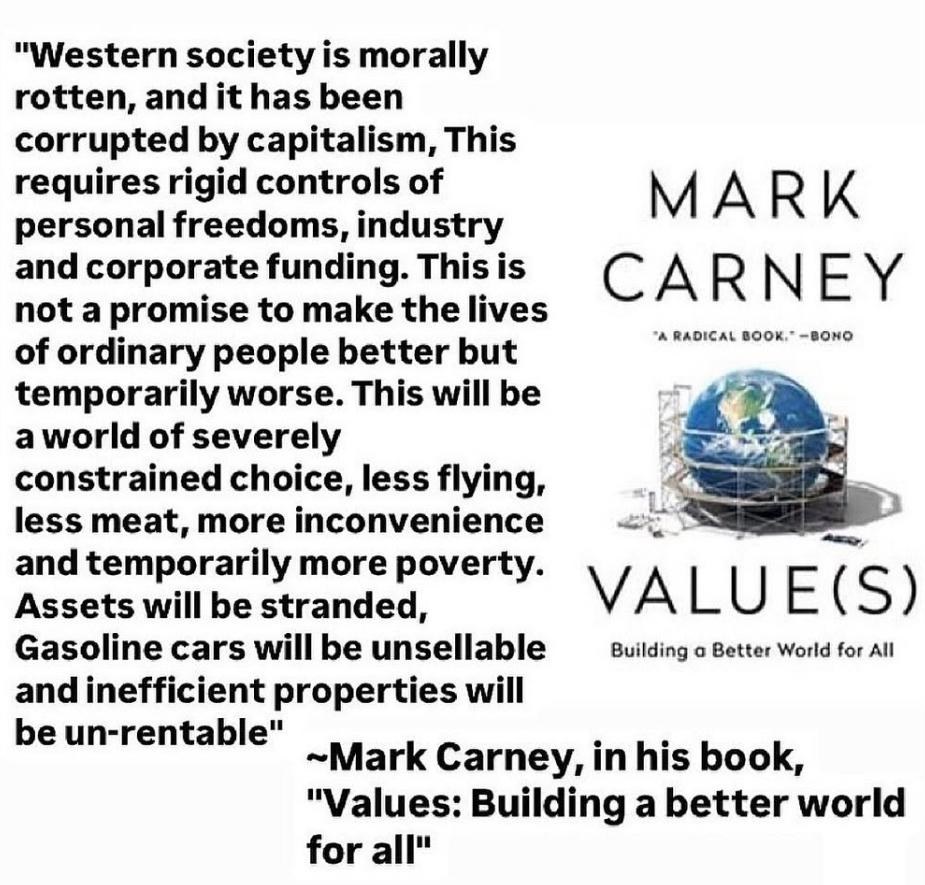
“In many ways, Carney is the technocrat’s technocrat. A bona fide citizen of nowhere”
In spiked, Fraser Myers expresses incredulity that Canadians have “chosen” yet another technocratic globalist as our next Prime Minister to succeed Justin Trudeau:

Then-Governor of the Bank of Canada Mark Carney at the 2012 Annual Meeting of the World Economic Forum in Davos, Switzerland.
WEF photo via Wikimedia Commons.
Canadians have a new prime minister. After a leadership election in the ruling Liberal Party, it’s out with the woke globalist, Justin Trudeau, and in with the woke globalist, Mark Carney.
Extraordinarily, in an age where justified populist rage against an out-of-touch establishment is spreading across the globe, Canadians have ended up with a leader who embodies that very establishment. In many ways, Carney is the technocrat’s technocrat. A bona fide citizen of nowhere.
The new Canadian PM’s CV reads like a parody of an archetypal Davos man. He has been governor of the Bank of Canada, governor of the Bank of England and a United Nations special envoy on climate action and finance. Before he entered the public eye, he worked for Goldman Sachs – in London, Tokyo, New York and Toronto. He has degrees from Harvard and Oxford. Yet he has never once held any form of elected political office. He does not even currently hold a seat in Canada’s House of Commons.
Carney is living, breathing proof that expert credentials are no substitute for sound judgement or political acumen. He has embraced just about every naff and dangerous political trend of our times, never deviating from the Davos script.
Most notoriously, as governor of the Bank of England from 2013 to 2020, Carney became the high priest of Project Fear ahead of the 2016 Brexit vote. He warned before the referendum that a Leave vote would spark an instant recession. It didn’t. He claimed Brexit would make investment in British assets so risky that it could ‘test the kindness of strangers’ should the UK take the leap. Needless to say, this was politically motivated hysteria, not a sober assessment of Britain’s economic prospects outside the EU.
More recently, his endorsement of Labour’s Rachel Reeves as chancellor ahead of the UK General Election also smacked of both dubious judgement and needless political interference. Carney said in autumn 2023 that it was ‘beyond time’ her plans were put into action. Yet since Reeves’s plans were actually put into action, in her first budget in October last year, the UK economy has teetered on the brink of recession, unemployment has risen and government borrowing costs have shot up. Call it the Carney kiss of death.
March 9, 2025
Mark “the human snooze button” Carney
In the National Post, Chris Selley explains the attraction of a Mark Carney-led Liberal Party to mainstream Canadians:

Then-Governor of the Bank of Canada Mark Carney at the 2012 Annual Meeting of the World Economic Forum in Davos, Switzerland.
WEF photo via Wikimedia Commons.
Ironically I suspect what Poilievre is up against is one of the most basic and powerful forces in Canadian politics: conservatism, but in one of its purest forms, namely suspicion of change — especially in a crisis. Recall that Canada saw 10 elections during the pandemic — one federal and nine provincial. The incumbent parties won eight of them, in some cases even as their health-care and long-term care systems collapsed on their heads and their “pandemic preparedness” folders turned out to contain nothing but some old Calvin and Hobbes cartoons.
No question, there are problems here specific to Poilievre and the Conservatives. The Royal Order of Laurentian Elites nearly fainted when Poilievre started saying “Canada is broken”, but people seemed to calm down about it and engage with it once it became clear most Canadians agreed: 70 per cent, according to a Postmedia-Leger poll last year.
Saying “Canada is broken” nowadays is likely to get you branded a traitor by a mob of people who think Beaver Tails, Tim Horton’s, Molson advertisements and a Tragically Hip playlist comprise a national identity. Canada can be broken and Trump can be a lunatic at the same time, but nationalist outbursts have little time for such nuance.
[…]
Change is unavoidable in the forthcoming election, of course. And by rights, Canadians should want it: Like COVID, Trump’s demands on border security and military spending, and his obviously sincere belief in the power of tariffs — as untethered from reality and sense as these demands are — have exposed massive weaknesses on our part that we should want to fix for our own sake. Poilievre should speak more to us about those fixes.
Mark Carney never made any sense to me as a potential saviour for the Liberals. The most obvious recent event they needed to replicate was Kathleen Wynne’s jaw-dropping majority win in 2014 for the Ontario Liberals, after Dalton McGuinty had driven the party into a pond and left it there to drown. Wynne was a proven, veteran campaigner. Carney is … well, certainly not an “outsider”, but this is his first go at politics, and it certainly hasn’t all been smooth sailing.
But Carney seems set to win the party’s leadership race on Sunday, anyway. He’s boring, and he’s a technocrat, and Trudeau is neither. And neither is Poilievre. A boring technocrat might well look like a safe harbour for a lot of Canadians. Poilievre needs to put a more positive spin on the changes we so desperately need.
March 8, 2025
March 7, 2025
Trump marks the overdue end of the Long Twentieth Century, part 2
In The Conservative Woman, N.S. Lyons continues his essay contending that the arrival of Donald Trump, version 2.0, may finally end the era we’ve been living in since immediately after the end of WW2:
The Long Twentieth Century has been characterized by these three interlinked post-war projects: the progressive opening of societies through the deconstruction of norms and borders, the consolidation of the managerial state, and the hegemony of the liberal international order. The hope was that together they could form the foundation for a world that would finally achieve peace on earth and goodwill between all mankind. That this would be a weak, passionless, undemocratic, intricately micromanaged world of technocratic rationalism was a sacrifice the post-war consensus was willing to make.
That dream didn’t work out, though, because the “strong gods” refused to die.
Mary Harrington recently observed that the Trumpian revolution seems as much archetypal as political, noting that the generally “exultant male response to recent work by Elon Musk and his ‘warband’ of young tech-bros” in dismantling the entrenched bureaucracy is a reflection of what can be “understood archetypally as [their] doing battle against a vast, miasmic foe whose aim is the destruction of masculine heroism as such”. This masculine-inflected spirit was suppressed throughout the Long Twentieth Century, but now it’s back. And it wasn’t, she notes, “as though a proceduralist, managerial civilization affords no scope for horrors of its own”. Thus now “we’re watching in real time as figures such as the hero, the king, the warrior, and the pirate; or indeed various types of antihero, all make their return to the public sphere”.
Instead of producing a utopian world of peace and progress, the open society consensus and its soft, weak gods led to civilizational dissolution and despair. As intended, the strong gods of history were banished, religious traditions and moral norms debunked, communal bonds and loyalties weakened, distinctions and borders torn down, and the disciplines of self-governance surrendered to top-down technocratic management. Unsurprisingly, this led to nation-states and a broader civilization that lack the strength to hold themselves together, let alone defend against external threats from non-open, non-delusional societies. In short, the campaign of radical self-negation pursued by the post-war open society consensus functionally became a collective suicide pact by the liberal democracies of the Western world.
But, as reality began to intrude over the past two decades, the share of people still convinced by the hazy promises of the open society steadily diminished. A reaction began to brew, especially among those most divorced from and harmed by its aging obsessions: the young and the working class. The “populism” that is now sweeping the West is best understood as a democratic insistence on the restoration and reintegration of respect for those strong gods capable of grounding, uniting and sustaining societies, including coherent national identities, cohesive natural loyalties, and the recognition of objective and transcendent truths.
Today’s populism is more than just a reaction against decades of elite betrayal and terrible governance (though it is that too); it is a deep, suppressed desire for long-delayed action, to break free from the smothering lethargy imposed by proceduralist managerialism and fight passionately for collective survival and self-interest. It is the return of the political to politics. This demands a restoration of old virtues, including a vital sense of national and civilizational self-worth. And that in turn requires a rejection of the pathological “tyranny of guilt” (as the French philosopher Pascal Bruckner dubbed it) that has gripped the Western mind since 1945. As the power of endless hysterical accusations of “fascism” has gradually faded, we have – for better and worse – begun to witness the end of the Age of Hitler.
February 26, 2025
The more DOGE uncovers, the more we see that western governments are really vast graft machines
Elizabeth Nickson discusses the ramifications of all the wasted money uncovered by DOGE in the first month of investigations and what it almost certainly confirms about the actual value taxpayers are getting for their money:
So essentially the entire town of Washington, D.C. has been stealing. The anomalies are those who are not stealing. $4.7 trillion, almost impossible to trace, represents two-thirds of the annual U.S. budget. And if it’s happening in the U.S., it is happening everywhere: France, Canada, the U.K., Germany, where budgetary processes are probably even more opaque than those of the U.S.
How does the Department of Defence have a $35 trillion black hole?
I used to think of people who worked for the government with a kind of veiled contempt or, in a more benign mood, compassion. I thought of them as pity jobs for those without initiative, as jobs paying off lefty campaigners, as a warehouse for the barely competent. In my own dealings with them, I found them punitive and extractive, papering me with demands to spend more and more money to hire more and more of their pet contractors, to get approval. In my working life, looking at the results of their involvement in America’s rural areas, I hated them for the hell they visited on people unable to fight back. They forced bad science on good people, and refused to see reason. They ruined forests, water courses, fisheries, and township after township turned to dustbowl status. The misery in rural sitting rooms in every state in the U.S. was palpable, long lasting; the green Blob ruined families for generations.
But I did not think of them as being embroiled in a theft so large as to be unparalleled in world history.
The level of the theft has now to be dawning on everyone not living off the public purse which is, what, 60%, 70% of us? The anger setting in is soul-deep, and very very powerful. People who live straightened lives, the poorly pensioned, those living off the laughable social security stipend, those waiting for health care, those whose children can’t even dream of an education, of college, of a six-figure salary which is now subsistence in the ruined cities. Those facing cancer treatment because of the vaccine, and don’t have excess funds. Their families, despairing, hurting, broke.
This isn’t going to go away. It affects everyone. Not addressed down to its deepest level, you are looking at a tax revolt, a national strike. A revolution. A real one, not a papered paid-for color revolution, which is what they have been doing to us.
Those living on social security should have five times the pension they do.
Can you count how many of those there are? Can you?
And meanwhile this:
Is this true? To this date, unknown; the digging continues. Look at this ghastly creature. She apparently has an account in the Cayman Islands. Look at her all compassionate and condescending. She started a war that killed 1.5 million people so far. And apparently got rich from it. A mass murderer celebrated at Upper East Side dinner parties.
Memes like this rocket around, and every one is now suspect. At this point who cares if it’s true, it’s truthy, it makes sense that she made out like a bandit, that Alexandra Ocasio-Cortez and Ilhan Omar have millions hidden somewhere. Ocasio can say “I only have $500,000!” all she wants, but we don’t believe her. If the Wall St Journal says it is false, we don’t believe them. Do you actually think they’d have the money sitting in their savings account? No, it would be buried off-shore. The media is not only complicit, it is the principal actor in this scam. It built the fantasy world we live in, where people read The Guardian, the Times and the Globe and Mail and think they’re informed.
No, they are being propagandized. And as a result, no one sane believes anything any legacy newspaper or television or media says anymore. They hid the theft. They did not report on it. No one trusts a thing they say.
Update: Fixed broken link.
February 2, 2025
Captain Trumpmerica versus the Post-national Maple Protectionists
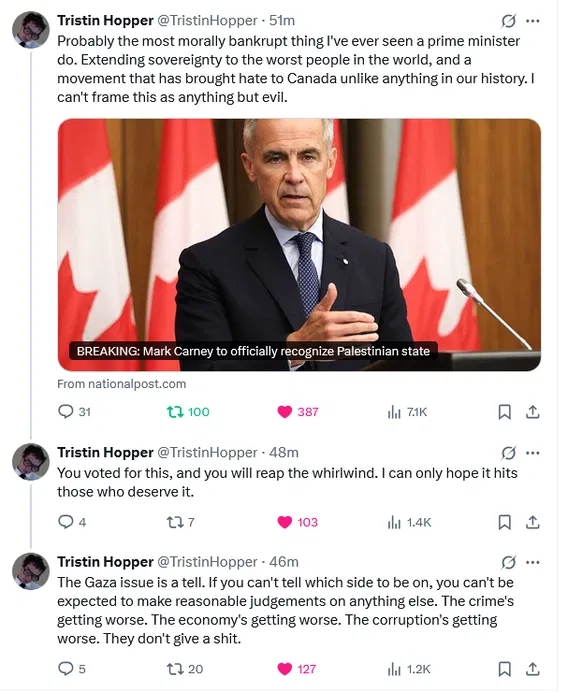
Donald Trump has made picking fights with the corrupt oligarchs of Mexico and Canada a key part of his appeal to American voters. Canada used to be a proud nation, but after years of deliberate mismanagement and stubborn opposition to innovation and growth, we’ve become — as Justin Trudeau so smugly put it — the first “post-national state” that has “no core identity [and] no mainstream”, because we’re a plaything for the WEF and other transnational organizations. Elizabeth Nickson calls us a “failed state” and that swapping in globalist WEF’er Mark Carney for globalist WEF’er Justin Trudeau will make no positive difference:
25% tariffs will ruin us. The tariffs mean one million small businesses — all which sell to the U.S. — will contract and many will close their doors. And then Trump, as he promised the unions, will pull “our” auto industry. Then we’re done.
Who is to blame for this?
The following is going to be crude because Canada is so boring (that’s deliberate) that no one cares. There are a thousand ultra-complex rationales on why Canada is failing and all they do is obfuscate. I’m not pulling punches, softening rhetoric — it is bad. It is urgent. This is the death of something that 75 years ago was shining, sunlit, exciting. That country? That country was killed by the Laurentian elite, weak, cosplaying Marxism to stay in power, themselves outwitted by investment bankers who plan to steal everything not nailed down. In so doing new elements were forcibly injected into the population: envy, resentment of the successful, sloth, the refusal to grow up, be strong and independent. We effectively sit on top of the U.S., seething with envy, in wet diapers.
We are a broken country. Everyone who understands the world knows this. The only people who don’t are deluded Canadian socialists, which is to say our entire elite and all our “knowledge class”. Dissent is ignored. Or jailed.
Central banker Mark Carney, WEFer paramount, is being parachuted into the Liberal party in order to sell us off to the investment banks who will harvest us for our resources. Our people? Future serfs in Special Enterprise Zones. We already have the regulation in place. No taxes, no worker rights, no enviro controls, no self-determination, no agency, no freedom. Time frame? Ten years, twenty at the outside. The inevitable end of hard-core socialism.
That is what Carney did to Canada in the ‘08 crisis, a crisis entirely created by larcenous government and investment bankers: he loaded us up with so much debt that the moment the economy turned, the working class — and Canada is now 75% working class — paid for it through interest rates so high they crippled and broke every middle class family with a mortgage. Then, he moved to England and did it to the English. His name there? Mark Carnage. During the ’08 crisis, he in Canada and the UK and Obama in the US transferred trillions in public wealth to the investment banks to keep them going after the worst crisis since ’29. A crisis they caused. That was the people’s money, not theirs.
However, as Peter Menzies points out, our Laurentian Elite are still 100% protecting us from the baleful influence of American culture … well, the commercial bits anyway:
Next Sunday, the federal agency responsible for the flourishing of national culture and identity will be swamped with complaints. The grumbling will emanate from Canadians enraged they can’t get more American culture. Yes, America may be in the process of humiliating Canada as its lamest of lame duck leaders, Prime Minister Justin Trudeau, waddles into the sunset. And, for sure, most of us are mortified that U.S. President Donald Trump has chosen to make an example of us as he launches his mission to bring the globe to heel and Make America Great Again.
But the bitching directed in the days to come at the Canadian Radio-television and Telecommunications (CRTC) headquarters in Gatineau will originate from Canadians angry they can’t watch American Super Bowl TV ads along with the game. A perennial contender to be the most watched TV event in Canada, the Super Bowl also has traditionally been the most controversial event on the CRTC’s calendar.
The USA can slap us silly with tariffs. It can send hundreds of thousands of us into unemployment and despair. It can mock our disinterest in maintaining the essentials of nationhood and drive us into unsustainable debt. Trump can brutalize our national esteem and taunt us for our cavalier attitudes towards the defence of our sovereignty. And he can lick his big beautiful lips while pondering our potential as the 51st state.
But what will really light us up Feb. 9 will be being unable to watch Meg Ryan and Billy Crystal reinvent their famous restaurant scene from When Harry Met Sally or Michelob Ultra’s production starring Willem Dafoe and Catherine O’Hara as a couple of pickleball hustlers. Or Matthew McConaughey channeling legendary Chicago Bears coach Mike Ditka for Uber Eats. And the Clydesdales. Everyone loves those Budweiser Clydesdales, particularly the cute little foal making a debut.
It doesn’t matter that the ads cost $7 million U.S. (which will convert into heaven only knows how many bazillion loonies in the months ahead) for a 30-second spot. Or that for more than a decade many of the commercials have been available on YouTube. Canadians don’t want to watch a Super Bowl adorned with Government of Ontario and Maple Leaf Foods ads. They want to watch the game like real Americans and relish the full, unfettered American experience.
At the National Post, a sad recounting of just how badly we’ve been let down by our politicians — and not just recently … this is a decades-long list of conscious self-harm for short-term domestic political advantage:
Bold counter-attacks against the U.S. can’t work, because all the ideas Canada could have put into action to make such a response viable are collecting dust on the cellar shelf. Drop interprovincial trade barriers that amount to a $200-billion penalty on the national economy every year? That only became a serious conversation in the last month. It should have been a serious conversation 10 years ago, if not more.
End supply management? Out of the question — think of the Quebec votes such a move would cost. The Big Milk lobby is a strong one.
How about resource development? Because Canada is ultimately a resource-exporting economy? No; we’ve been cancelling energy projects at the slightest objection and building more legislation to stand in their way. Industries like mining and fishing, already mired in growth-choking regulations, are increasingly refashioned by governments into welfare and “reconciliation” initiatives, repelling private investment that would have brought prosperity to the country as a whole.
Diversify away from the Americans? We’ve only done the opposite: since 2017, Canadian trade has become more focused on the U.S.
Canada should be a prosperous, growth-oriented economy, but instead, its government — and the people who continuously vote for economy-stagnating policy — settle for subsistence and redistribution of a shrinking pie of wealth. Their choices for the past decade have left us without enough fat to get through a cold trade winter.
Prompt retaliatory counter-tariffs are hence unwise. Such a move would put Canadians in the path of two separate blows, one from the front, the other from the back. And while immediate counter-tariffs could affect Americans whose support the president depends on — as was the case in the 1930s, when Canadian counter-tariffs prolonged the American Great Depression (while inflicting domestic pain) — those Americans have much bigger economic fat stores. In a trade war of attrition, expect Canada to lose.
That leaves us, unfortunately, with the less-glamourous immediate option: play this by the book. The United States-Canada-Mexico free trade agreement, which will be violated by any across-the-board tariff Trump applies, needs to be challenged with the mechanisms agreed upon by party states. During the process, Canada must remind Trump that it’s just following the agreement that he made.
January 30, 2025
The MAGA movement as “America’s Thermidorian Reaction”
Fortissax lays out the case for Canada remaining separate from the United States, in what he says is the longest single article he’s written. It is indeed a long piece, from which I’ve selected a small portion that helps identify the US MAGA movement as something other than just pro-Trump activism:

“Canada’s national identity is rooted in Order, as expressed in its national motto, Peace, Order, and Good Government, conceived by Sir John A. Macdonald. This stands in contrast to the United States, whose core value is Liberty, reflecting its liberal and individualist foundations in the pursuit of life, liberty, and the pursuit of happiness.”
The MAGA movement, as explored in my colleague and fellow Canadian Endeavour’s article, can be understood not as a counter-revolutionary or genuinely reactionary force, but as America’s Thermidorian Reaction — a movement within the post-WWII liberal order to purge its own radical excesses. Endeavour draws parallels to the French Revolution, where the Thermidorian Reaction was not a restoration of the monarchy but a moderation of the Reign of Terror’s extremism, and to the Soviet Union’s Destalinization, which sought to distance the regime from Stalin’s radical policies without abandoning communism.
Similarly, MAGA does not aim to dismantle the liberal framework established during the cultural revolution of the 1960s, marked by the Civil Rights Act and Hart-Celler Act, but instead seeks to address the instability caused by the radicalization of this framework during the “Great Awokening” of the 2010s. Its faith in “colourblind meritocracy” is rock solid. Just as the Thermidorians and Khrushchev’s regime sought to preserve their respective systems by eliminating destabilizing elements, MAGA represents an attempt to recalibrate the liberal order by challenging excessive ideological commitments like open borders, identity politics, and globalist policies.
While MAGA appeals to traditionalist sentiments, it ultimately operates within the boundaries of the same liberal system it critiques, lacking the philosophical depth to present a true alternative. Trump’s 2016 campaign was fueled by widespread dissatisfaction with the establishment and a sense of cultural alienation among, working-class European-Americans. As an outsider candidate, Trump faced opposition from both political parties and the media but managed to channel populist anger into an unexpected victory. However, his presidency revealed that he posed less of a threat to the system than many anticipated. Trump’s administration implemented some reforms but fell short of disrupting the liberal order, leading many elites to reframe him as a tolerable alternative to the increasing instability caused by radical left-wing movements. The 2024 campaign differs significantly from Trump’s earlier runs because he has garnered support from influential elite factions. Figures in Big Tech, such as Elon Musk and Peter Thiel, and segments of the Zionist lobby, see Trump as a tool to stabilize the system without fundamentally altering it. While Trump continues to appeal to his populist base, his elite backers are likely to exert more influence over his presidency than grassroots supporters.
The Four Agendas of America’s Elite
Endeavour outlines four major agendas driving the U.S. political landscape, which often overlap but also compete for dominance:
- The Anti-White Agenda (Wokeism)
This agenda promotes diversity, equity, and inclusion (DEI) as core principles, advocating for identity politics, demographic transformation, and the demonization of traditional Western cultural norms. Organizations like the NAACP, SPLC, and Open Society Foundations champion this cause.
- Managerialism
Focused on centralized control, managerialism, coined by James Burnham, expands bureaucratic oversight in both public and private sectors. The COVID-19 pandemic epitomized managerial overreach, as policies enforced compliance on an unprecedented scale. Key proponents include BlackRock, the World Economic Forum (WEF), and the Bill & Melinda Gates Foundation.
- The Zionist Lobby
Primarily concerned with ensuring unwavering U.S. support for Israel, the Zionist agenda overlaps with wokeism in promoting leftist social causes but diverges when these causes conflict with Israeli interests. Organizations like AIPAC and the ADL straddle this divide.
- Big Tech
Initially aligned with wokeism, Big Tech has begun to push back against its most radical elements due to its impact on innovation and competence. Elon Musk’s purchase of Twitter (now X) symbolizes this shift, as does growing discontent with DEI mandates within the tech sector.
While these agendas are not inherently unified, they collectively uphold the liberal framework established in the 1960s, even as they compete for dominance within it. I’ve defined these forces in the past as left-liberalism vs right-liberalism, which I covered here: MAGA & Wokism
Parallels to Historical Thermidorian Reactions
MAGA’s role is likened to historical Thermidorian Reactions, where moderates sought to rein in revolutionary excesses to stabilize their regimes. For example:
- The Thermidorians ended Robespierre’s radical Reign of Terror, easing persecution and executions while maintaining the republic.
- Khrushchev’s Destalinization moderated Stalin’s authoritarian rule but preserved the communist system.
Similarly, MAGA seeks to temper the radicalism of woke managerialism without challenging the core tenets of the liberal order. The “Great Awokening,” characterized by intensified DEI policies, identity politics, and cancel culture, parallels the Reign of Terror and Stalinist purges in its ideological zeal. Trump’s 2024 campaign represents an attempt to dial back these excesses and restore a degree of moderation.
Challenges Facing the Thermidorians
Despite its goals, MAGA faces significant hurdles in moderating the system:
- Demographic Shifts: The growing influence of progressive, non-white voting blocs entrenches leftist policies.
- Institutional Entrenchment: Managerial bureaucracies are staffed with ideologues deeply committed to woke principles, making reform difficult.
- Superficial Reforms: Even if MAGA eases censorship and curbs DEI mandates, it is unlikely to reverse structural changes such as demographic transformation or the Civil Rights Act.
Endeavour contends that MAGA’s moderation of woke managerialism may improve short-term conditions but will not address deeper contradictions in the liberal order. For example:
- The Zionist lobby’s support for both Israeli ethno-nationalism and woke policies in the U.S. creates unsustainable contradictions.
- Universalist egalitarianism remains fundamentally flawed, and attempts to reform it, like Gorbachev’s Perestroika in the USSR, may inadvertently accelerate systemic collapse.
While MAGA may temporarily stabilize the United States, it will not fundamentally alter the trajectory set in motion during the cultural revolution of the 1960s. The deeper issues of demographic change, cultural alienation, and institutional decay remain unresolved. Trump’s vision—and likely that of most within the MAGA movement—is rooted in nostalgia for the 1980s and 1990s, a romanticized era cherished by many baby boomers. This idealized vision imagines a time when race was purportedly invisible, the black middle class thrived, and patriotism unified Americans across racial lines. This narrative conveniently ignores the darker realities of that period, including the L.A. race riots and the rise of militant groups like the Black Panther Party. At the same time, this Thermidorian Reaction is being leveraged to solidify control over America’s imperial vassals, with the Anglosphere serving as its primary appendages and European nation-states as key dependencies. Populist movements across Europe echo rhetoric nearly identical to that of MAGA, with many receiving direct or indirect support from individuals and entities affiliated with the movement. Figures like Elon Musk have actively amplified some of these efforts, like promoting the Alternative für Deutschland party and bolstering independent actors aligned with MAGA’s agenda, thereby expanding its influence across the Western world. Not ideal, but a means to an end for sure.
January 27, 2025
Davos is so over, even the high-priced escort girls are giving it a miss this year
Elizabeth Nickson enjoys a nice, rich dish of schadenfreude as the “elite” of the Davos gab-fest dimly begin to realize that their high times are over:
It was a great ride while it lasted, hey, lefties? But it’s over now. You have been left in the screech forward of history. That stink? It’s the burning wreckage of your “ideas”. All you weasely little people like the slender tight-mouthed beta-males at the Biden White House, or the cross-dressing central banker Mark Carney who is laughably trying to be Prime Minister of Canada after bankrupting not one but TWO countries, are history. Like Rory Stewart, the regime apologist in the U.K., who says things like “there’s something really dark and nasty behind the right“. Like Macron, Jacinta Ardern, Trudeau, like the nasty little snake people at Davos right now trying to extract yet more blood and treasure from us. KNEEL and take your SUSTAINABLE DEVELOPMENT GOALS OR YOU ARE RACIST.
You sold your birthright for power. You sold us for power. You sold the future for power. When you get to heaven this is what you should say: I failed, I ruined three generations. I need to be broken down into my component parts and remade into a new being, with a new soul. The old one is stained with the killing of innocents. Like the thousands dead from your obsession with psychopathic primitive Muslims, like the child migrants in cartel sex slavery.
All your projects are in ruins. All your toys lie broken. Your failure is one for the Ages. It will be discussed in heaven and hell for millennia. You have bankrupted the world. Even the freaking oligarchs abandoned you. Even the central bankers decided they badly needed growth or they and their heirs will be living underground for the next five hundred years, hunted like the ghastly little demons they worship. Trump means growth. Big big growth.
You probably don’t know who Rory Stewart is, but he is useful as an example. Not for him, the careful measured sentimental meaningless pap that comes out of every leftie politician’s mouth. Nope, he’s a gabber. He loves attention, in fact, he never ever shuts up, so he is their interlocutor, their dark shrunken snobbish soul.
Stewart is a “writer” and a Westminster gadfly, “much loved” in the British way of saying, “he’s so cute”. He advises, he hangs out with Afghan warlords, he speaks at gatherings of the great and the good. He runs for office, he writes editorials. He is a product of the British elite educational system, and the administrative left, which is to say the outfit that until Monday ran the world. And he has an ego the size of his big stretchy mouth.
This is what he had to say about Trump on Monday. Imagine a rich spoiled debutante drawling this and you’ll get his character.
“He’s so lowering.” By which he means he brings down the tone. Like for instance, the interviewer says Trump tweeted at Gavin Newsom they day after the fires, “Congratulations Gavin New Scum.”
Now, of course, that is how I think of Newscum.
[…]
“We need ideas”
“We need a plan for growth”
“We need to explain how we’re going to sort out the economy”
“and society”.
Buddy, your lot has been in power since Thatcher.
Someone said recently that the reason the English do absolutely NOTHING about those raped, sodomized, beaten little girls is that the upper classes view the lower as less than human, so they don’t care. They don’t care about the freezing old ladies in council houses, the fact that women can’t walk down streets safely, or the farmers not being able to feed people.
For these benevolent rulers protected in their rural retreats and policed neighbourhoods, the multicultural ideal is more important than their fellow citizens.
These are the people who have taken the ideas of Marxism, merged them with predatory capitalism, and from their offices and through countless conferences and meetings a year, try to distribute goods “fairly”, as they determine. Which country shall rise, which shall be invaded, whose resources do we want next? What delicious war shall we start?
That’s what they mean when they say “our democracy”. It’s theirs and nobody else’s.
For more than half a century they have focused on impoverishing middle America. Not the upper middle class, no, they’re fine. Like western Europe, they were broken early and are happy servants, mouthing legacy media propaganda like good little serfs with nice houses and a chance for their children to join the betas taking their orders from the grim oligarchs behind the scenes.
December 23, 2024
Trump’s second term – “The counterrevolution begins now”
A few weeks back in City Journal, Christopher Rufo provided a blueprint for President-elect Donald Trump’s second term with emphasis on “dewokification” of the executive branch:
The second election of Donald Trump, along with Republican victories in both houses of Congress, sets the stage in the United States for a confrontation between democracy, which depends on representative institutions to form a government, and the rule of unelected elites, which relies on claims of expertise to control the state.
Already, internal opposition to Trump is organizing within the federal agencies. CNN reports that Pentagon officials are discussing disobeying official policy. Federal Reserve Chairman Jerome Powell has declared that he would refuse if Trump asked for his resignation. Some would like to see a reprise of the orchestrated counteractions against Trump, from the Russia collusion hoax to the Hunter Biden laptop censorship to the political prosecutions that led to his arrest and felony convictions.
The coming political confrontation is unusual because the specific antagonist is hard to identify. Trump is not contending against Joe Biden or Kamala Harris, or even the Democratic minority in Congress. Instead, the president-elect’s post-electoral opposition comes from inside the executive branch itself, in defiance of Article II of the Constitution, which opens with the unqualified statement: “The executive Power shall be vested in a President of the United States of America”.
In recent years, phrases like “the deep state” have arisen in American political discourse to describe this phenomenon, in which administrators, bureaucrats, and unelected officials seem to wield a kind of power that we still lack appropriate language to describe. Part of the motivation is self-interest — bureaucrats want to protect their positions — but another is ideological: the federal government is steeped in left-wing race and gender ideology, and its adherents see Trump as an existential threat.
By rights, he should be. The incoming president has, under the Constitution, every right to bend the administration to his vision, which is contrary to the tenets of left-wing racialism. But those ideologies, which the Biden administration has entrenched through its “whole-of-government” diversity agenda, have long ruled the agencies that control the details of federal policymaking. Hence, the conflict: the president, who has formal authority, versus the ideological bureaucracy, which has real power.
At the end of his first term, Trump attempted to correct this problem through actions such as an executive order banning critical race theory in the federal government. The second Trump administration must go further and dedicate itself to a process that Vice President–elect J. D. Vance has described as “dewokeification”. This is the most urgent policy problem facing the administration, because without representative institutions and a restoration of constitutional authority, it is not possible to govern America.
The Trump administration has a unique opportunity to take decisive action on Day One, through executive orders that can serve as the opening salvo in a counterrevolution. The basic premise: the U.S. should strip left-wing racialism from the federal government and recommit the country to the principle of color-blind equality. Through an aggressive campaign, Trump and his cabinet can put an end to forms of discrimination disguised under the name of “diversity, equity, and inclusion” (DEI) and make government work again.
The process of ideological capture has taken decades. But the counterrevolution can, and must, quickly retake those institutions in the name of the people and reorient them toward the enduring principles of liberty and equality. Bureaucrats abusing the public trust to advance their own ideologies should be put on notice: they will be shut down, their departments abolished, and their employment terminated. The administration will work to rid America of this ideological corruption before it further rots our institutions, demoralizes our citizens, and renders the government totally incompetent.
The counterrevolution begins now.