Quotulatiousness

July 11, 2020

The “Puritan Moment” of The Current Year

Filed under: Britain, History, Liberty, Politics, Religion — Tags: , , , , — Nicholas @ 05:00

Nigel Jones on the long history of struggle between British puritans and libertarians:

Portrayal of the burning of copies of William Pynchon’s book The Meritous Price of Our Redemption by early colonists of the Massachusetts Bay Colony, who saw his book as heresy; it was the first-ever banned book in the New World and only 4 original copies are known to survive today.
Engraving by F.T. Merrill in The History of Springfield for the Young by Charles Barrows, 1921.

Behind the wave of Wokeism that has swept and is now swamping Anglo-American Culture, is a pattern that has recurred throughout British History since the early 17th century. This is the pendulum that regularly swings between periods of joyful Libertarianism and purse lipped Puritanism.

Puritanism takes its name from the Calvinist religious movement that arose during the Protestant Reformation, partly in reaction to the explosive cultural Renaissance of the Elizabethan era – the age of Shakespeare, Marlowe, Ralegh and John Donne.

The Puritans exported their austere doctrines to America aboard the Mayflower, where they eventually became one of the building blocks of the USA, and briefly achieved political power in England after the Civil War in the forbidding guise of Oliver Cromwell’s Commonwealth.

We all have a mental picture of the Puritans in action. Sombrely dressed in black and grey, smashing the statues of saints, preaching their varied versions of the scriptures, and policing and banning anything when they suspected people of enjoying themselves, from Christmas festivities, to theatres, to fornicating for pleasure rather than reproduction. The Puritans endeavoured to dictate what people could think, speak and write. If this rings any bells with Wokeism, that is surely not coincidental.

There was an inevitable vengeful reaction to this po-faced culture of control and repression, and it soon came with the Restoration of the monarchy in 1660. King Charles II exemplified in his own libidinous person, with his myriad mistresses and tribe of illegitimate children, the loose culture of license that spread out from his court like a stain. This was the easy going Age of Lord Rochester and Nell Gwynn, so disapprovingly, if hypocritically, frowned on in the diaries of Samuel Pepys and John Evelyn. More darkly, the Puritan Regicides who had beheaded Charles’s father were hung, drawn and quartered along with Cromwell’s exhumed corpse.

The Libertarianism ushered in by the Restoration had a much longer run than the initial rule of Puritanism had enjoyed. It lasted through the Georgian Age of the 18th century, culminating in the decadence of the Regency bucks and Queen Victoria’s “wicked uncles”. Puritanism made its comeback with the accession of Victoria herself, with her eponymous reign infamous for its crinolines, covered piano legs, cruel persecution of that supreme Libertarian Oscar Wilde, and its massive hypocrisy – a constant adjunct of Puritanism when it comes up against the incontrovertible facts of life and human nature.

Neatly coinciding with the reign of Victoria’s despised eldest son, Libertarianism returned in the portly shape of Edward VII in the opening decade of the 20th century to which he gave his name. As during the Restoration, the ruling elite again set the tone of the Edwardian era with their shooting and hunting, their discreet adultery at country house weekends, and their lavish clubs and parties.

July 10, 2020

Freedom of speech – a tool to be discarded when your opponents try to use it

Filed under: Liberty, Politics, USA — Tags: , , — Nicholas @ 05:00

Arthur Chrenkoff discusses the recent uproar among progressives over an open letter calling for respect for free speech … when the “wrong kind of people” started signing on:

Godfrey Elfwick’s disturbingly accurate summary of free speech support among the woke.

So how did it come to this on a meta-level – how did the left, which for a long time championed ideas like freedom of speech, come to be the new censors and book burners?

The answer is short and simple: power.

Thanks to its Marxist heritage, the left is all about power. Who has it, who doesn’t (Lenin’s famous ur-question “who whom?”), how to get it. Power and power relationship is the ultimate touchstone and lodestar, the prism through everything else is seen and judged. Everything, including morality – what’s right, what’s wrong – flows from the position in this binary system (and with power it is a zero-sum game: you either have it all or you have none).

Turkish Islamist president Recep Erdogan has once famously said “Democracy is like a streetcar. When you come to your stop, you get off.” The stop – the end – is power; democracy is the mean to the end.

So it is with the left and freedom. The left was pro-freedom when it was on the way up. Being pro-freedom helped them achieve their objectives. Freedom of speech, for example, was important because it guaranteed them the ability to spread their ideas.

Now the left has the power, if not in all respects and in equal measure, certainly as far as culture is concerned, where it enjoys near hegemony. Being on top it doesn’t need freedom of speech anymore. Quite the contrary: freedom of speech now enables its critics to challenge their ideas and their position. Debate is a waste of time and effort, much better and more efficient is to silence any dissenting voices.

It’s never about principle – it’s about the side (yours) and power (yours to gain and keep).

July 7, 2020

L. Neil Smith on the Progressive agenda

Filed under: Economics, Media, Politics, USA — Tags: , , , , , , — Nicholas @ 05:00

His latest article in the Libertarian Enterprise:

For the full length of the last century, Western culture has been commanded by the blind, deaf, but never speechless entities who see things stubbornly as they prefer to see them, and “dream the impossible dream”, rather than see them as they really are. This mental habit has led to various messes that we find ourselves in today. To any extent that it might help us to get out of those messes, it might help to understand how we got into them.

Don’t look to the wrong assistance. Psychology, for example, is nothing at all like a science and those who practice it are nothing at all like scientists. Mostly they’re hyper-opinionated liberals. No two shrinks ever agree on a diagnosis, and official definitions of various mental illnesses are a grammatical and logical laugh riot. The great truth of life is that understanding character is an art, best left to master novelists and story-tellers.

Although they’ll seldom admit it, even to themselves, so-called Progressives know by now that they are wrong, that they have always been wrong. You might say that their wrongness has stood the test of time. So what is it that they really want? Their high-flown theories and values having failed them embarrassingly — a good example of that is the minimum wage, which destroys employment for entry-level and minority youth — rather than seeking new theories and values that might serve them and everybody better, they have turned to a kind of bitter nihilism. They hate and fear the society that has stubbornly refused to bend to their wills, and so it must die. Every single policy recommendation that they make — like the $15 minimum wage, for example, or defunding the police — is directed to that purpose.

Another good example would be “gun control”, which its opponents correctly label “victim disarmament”. As unconstitutional political pressures on private gun ownership increased, and self-defense culture was forced to organize itself (contrary to liberal belief, gun companies and the National Rifle Association were followers in this, not leaders) existing gun laws were gradually weakened. It became easier to obtain and carry a weapon — and necessary, in the view of those of us “delorables” who were constantly being threatened by left-wing political figures. During the Obama-Biden regime, at least 100 million guns were sold. And as they were, violent criminality began to decrease in double digits.

Today, except for many liberal-dominated hell-holes like Chicago, New York, San Francisco, Atlanta, Baltimore, Detroit, and a dozen others, Americans are headed to 19th century crime levels. Did Progressives ever notice or admit that crime had diminished? They did not. The process conflicted with their erroneous belief system, so they still call today for various measures punishing firearms manufacturers and retailers, and disarming individuals who have solved the problem that the politicians and the police have only made much worse for decades.

And so it goes, in all such matters as economics, education, the environment, nutrition, and everything else. Psychologists (who, like a broken clock, are right just this once) call the phenomenon projection: if Progressives can’t run their own lives (and very largely, judging from the kids they raise, they can’t), naturally that makes them and the rest of the bizarre menagerie that was typical of the Obama-Biden Administration qualified to run everybody else’s lives. And because Progressive policies are (at least one hopes) unconsciously suicidal, the rest of us are in for a rough ride.

July 6, 2020

QotD: The special moral insight of children

Filed under: Liberty, Politics, Quotations, USA — Tags: , , , , — Nicholas @ 01:00

The idea that children, in their innocence, have special moral insight goes back a long way in Western culture — perhaps to the biblical injunction that, “Except ye be converted, and become as little children, ye shall not enter into the kingdom of heaven.” It has, of course, always warred with some variant of the belief that “children should be seen and not heard” — that children are not yet ready to hold up their end in adult conversations.

So when does the special moral insight of children manifest itself? When they are telling us that algebra is a stupid waste of time and the drinking age should be 14? No, funnily enough, children are only gifted with these special powers when they agree with the adults around them. Our long-standing cultural dichotomy lets adults use them strategically in political arguments, to push them forward as precious angels speaking words of prophecy to make a point, and then say, “hush, they’re just kids” when the children mar that point by acting like, well, children.

Adult organizations helped organize the walkouts, while casting them as a pure expression of youthful insight. Liberal communities proudly enabled the walkouts; liberal parents posted gushing accounts of their children’s protests on Facebook; liberal elite universities rushed to assure kids that walking out wouldn’t hurt them on college applications. Conservative communities, meanwhile, threatened to enforce the rules against disrupting class time. So the protests often ended up a better reflection of adult priorities than childish wisdom.

[…]

That is not to say that gun-control advocacy is stupid. But if you wouldn’t be swayed by a 17-year-old’s passionate advocacy for a lower drinking age — or for that matter, their ideas about Federal Reserve policy — then you should probably apply those same cautions to their other views, especially when they’re under so much pressure to conform. There’s nothing particularly wrong with Wednesday’s mass walkouts. But there’s nothing especially right about them either.

Megan McArdle, “The student walkout said more about adults than kids”, Washington Post, 2018-03-15.

July 3, 2020

Back to the Future Middle Ages

At Spiked, Dominic Frisby takes us back to a time when today’s progressive temper tantrums would fit in perfectly with accepted behaviours of the age … the Middle Ages:

A social media heretic faces trial

How much of what went on in the Middle Ages and early-modern periods do we look back on with abhorrence and a certain amount of perplexity? Burning witches at the stake, lynch mobs, self-flagellation – what possessed people to do such things, we wonder.

But take a step back, look about and you see many of these practices are still flourishing today, though they go by different names.

Here are just some of them.

Let’s start with excommunication. Excommunication meant so much more than being banned from taking communion. It involved you being shunned, shamed, spiritually condemned, even banished. Only through some kind of heavy penance – often a very public, lengthy and humiliating contrition – could you and your reputation be redeemed.

Excommunication became a powerful political weapon. It was dished out to enemies of the faith to destroy their legitimacy. Often it was used as a punishment for sins as minor as uttering the wrong opinion.

What are No Platforming and cancel culture if not a modern form of excommunication? Qualified, competent professionals are hounded out of their jobs and publicly shamed just for uttering the wrong opinion, often simply for a misjudged choice of words. Even just the wrong pronouns.

As often as not, their employer wants a quiet life, so he bows to activist pressure and sacks the target of the witch hunt. Cancel culture is excommunication.

Today’s religions, however, are not the many sects of Christianity that once perforated Europe, but climate change, education, the NHS, gay rights, trans rights, the European Union and multiculturalism. Even coronavirus and the lockdown have become sacrosanct.

Intellectuals of the right and left, from Polly Toynbee to Nigel Lawson, have described the NHS as Britain’s religion. It has replaced the Virgin Mary as the divine matriarch. Why this worship? I suggest it goes back to the late 19th and early 20th centuries, when the state began to replace the church as the main provider of education, welfare and healthcare. After 1945, it was just a matter of time before the welfare state achieved altar status.

June 26, 2020

Progressive hate for nuclear power

In Quillette, Michael Shellenberger discusses the demands of some climate activists who also reject the best solutions to the problems they foresee:

For the last decade I have been obsessed with a question: Why are the people who are the most alarmist about environmental issues also opposed to all of the obvious solutions?

Those who raise the alarm about food shortages oppose expanding the use of chemical fertilizers, tractors, and GMOs. Those who raise the alarm about Amazon deforestation promote policies that fragment the forest. And those who raise the alarm about climate change oppose nuclear energy, the largest source of zero-emissions energy in developed nations. Why is that?

It is not an academic question for me. I have been a climate activist for 20 years and an energy expert for 10 of them. I was adamantly against nuclear energy until about a decade ago when it became clear renewables couldn’t replace fossil fuels. After educating myself about the facts, I came to support the technology.

Over the last five years, I have campaigned, as founder and president of my small and independent nonprofit research organization, Environmental Progress, to expand the use of nuclear energy. During that time our main opponents have not been climate skeptics or even the fossil fuel industry but rather other climate activists.

This is the case around the world. It is climate alarmist Democrats and Greens who are seeking to shut down nuclear plants in the US and Europe. Greta Thunberg last year condemned the technology as “extremely dangerous, expensive, & time-consuming,” which is false. And Green New Deal architect Rep. Alexandria Ocasio-Cortez (AOC) has advocated closing the Indian Point nuclear plant in New York, which is now being replaced with natural gas.

In nearly every situation around the world, support for nuclear energy from climate activists like Thunberg and AOC would make the difference between nuclear plants staying open or closing, and being built or not being built. Had Thunberg spoken out in defense of nuclear power she likely could have prevented two reactors in her home nation of Sweden from being closed. Had AOC advocated for Indian Point rather than condemned it as dangerous, it could likely keep operating, for at least 40 years longer.

That’s because the main problem facing nuclear energy is that it’s unpopular — and far more among progressives than conservatives, and far more among women than men. There are no good technical or economic reasons that nations from the US and Japan to Sweden and Germany are closing their nuclear plants. Center-left governments are closing them early in response to the demands of progressives and Greens — the very same people who are claiming climate change will kill billions of people.

Darlington Nuclear Generating Station in Clarington, Ontario.
Photo by Óðinn via Wikimedia Commons.

Some prominent environmental groups have a pecuniary interest in replacing existing nuclear generating stations with natural gas and “renewable” energy sources, but money isn’t the only reason for the widespread opposition to nuclear power:

Sierra Club, NRDC, and EDF have worked to shut down nuclear plants and replace them with fossil fuels and a smattering of renewables since the 1970s. They have created detailed reports for policymakers, journalists, and the public purporting to show that neither nuclear plants nor fossil fuels are needed to meet electricity demand, thanks to energy efficiency and renewables. And yet, as we have seen, almost everywhere nuclear plants are closed, or not built, fossil fuels are burned instead.

Thomas Malthus.
Portrait by John Linnell, 1834, via Wikimedia Commons

But it’s not just about money. It’s also about ideology. Anti-nuclear groups have long had a deeply ideological motivation to kill off nuclear energy.

Policymakers, journalists, conservationists, and other educated elites in the ’50s and ’60s knew that nuclear was unlimited energy and that unlimited energy meant unlimited food and water.

We could use desalination to convert ocean water into freshwater. We could create fertilizer without fossil fuels, by harvesting nitrogen from the air, and hydrogen from water, and combining them. We could create transportation fuels without fossil fuels, by taking carbon dioxide out of the atmosphere to make artificial hydrocarbons, or by splitting water to make pure hydrogen gas.

Nuclear energy thus created a serious problem for Malthusians — followers of widely-debunked 18th-century economist, Thomas Robert Malthus — who argued that the world was on the brink of ecological collapse and resource scarcity. Nuclear energy not only meant infinite fertilizer, freshwater, and food but also zero pollution and a radically reduced environmental footprint.

In reaction, Malthusians attacked nuclear energy as dangerous, mostly by suggesting that it would lead to nuclear war, but also by spreading misinformation about nuclear “waste” — the tiny quantity of used fuel rods — and the rapidly decaying radiation that escapes from nuclear plants during their worst accidents.

There is a pattern: Malthusians raise the alarm about resource depletion or environmental problems and then attack the obvious technical solutions. In the late 1700s, Thomas Malthus had to reject birth control to predict overpopulation. In the 1960s, Malthusians had to claim fossil fuels were scarce to oppose the extension of fertilizers and industrial agriculture to poor nations and to raise the alarm over famine. And today, climate activists reject nuclear energy in order to declare a coming climate apocalypse.

June 22, 2020

According to the tenets of Critical Race Theory, it is impossible to be “non-racist”

Filed under: Education, Politics, USA — Tags: , , , , — Nicholas @ 03:00

A fascinating — and depressing — explanation of the core beliefs of those who subscribe to Critical Race Theory:

Haha, yes. “Non-racist” means racist.

You have to understand that one of the primary axioms of this worldview is that everyone with racial privilege of any kind (including light-skinned black people, non-black people of color, etc.) is by definition always and constantly racist.

This is because they have defined “systemic racism” to mean more or less everything that happens, and, so long as there are any differences on average in racial outcomes, the system must be racist (privilege hierarchy noted: Asians and Jews doing well doesn’t count for anything).

You will have noticed that this means “systemic racism” in practice creates a state of perpetual victimhood for the “racially oppressed.” Anything that happens at all that isn’t to some complainer’s liking must have been the result of racism, and it’s their job to find it.

As we hear from Robin DiAngelo and her colleagues: “The question is not ‘did racism take place?’ but ‘how did racism manifest in this situation?'” The racism is absolutely certain to have taken place somewhere, according to this Woke worldview.

This is what “understanding race” and “racism” means when the Woke say it. What you have to understand is that everything contains racism, and a sufficiently skilled complainer can find it and leverage it against you. So, maybe they’re right. You have to understand race/racism.

Thus, more specifically, if you think you are “non-racist” or “less racist,” you’re not just racist, you’re the worst kind of racist. Robin DiAngelo says that in White Fragility explicitly. No exaggeration. That’s her definition for a white progressive or a “good white person.”

A lot of the relevant literature rails on “good white people” (there’s even a completely mental book by this title), “white liberals,” and “white progressives,” who are identified as the worst kinds of racists because they believe they’re not.

Good White: Translations From The Wokish

This entry in ‘Translations from the Wokish’ is an explanation of the term “Good White.” https://newdiscourses.com/tftw-good-white/

So, everyone under this insane rubric has to accept that they are racist and then decide how “anti-racist” they want to be. So, you can be a racist who is a little “anti-racist,” a lot “anti-racist,” or not “anti-racist,” but you cannot be “not racist” or “less racist.”

No matter how “anti-racist” you are, it will not make you not-racist in the end, even if you do it perfectly (impossible, explicitly) for your entire lives (required minimum time commitment, again, explicitly). And these people say their goal is to end racism. Seems odd.

You can’t even become “less racist” in this ideology. There’s no such thing, and to believe you are that is to make yourself more racist because you’re less aware of your need to constantly acknowledge your racism and try to dismantle the system in which it’s embedded.

Robin DiAngelo tells us that the goal is to become “less white,” not “less racist.” I’m not making that up. It’s right there in White Fragility, which millions of people are reading (and being forced to read) right now. Whiteness is the racist system, so that’s the goal.

Of course, all the literature also points out that it’s not possible to avoid benefiting from racial privilege (including white skin or white-passing appearance or light skin or white adjacency), so being “less white” is also impossible. It’s a self-shaming project instead.

Go back and read that like five times. It’s really the theory.

So when you take up “anti-racism,” you’re just signing on to a program they’ve outlined that has absolutely nothing to do with making people less racist, which is impossible. It’s crucial to understand this. “Social Justice” explicitly says it’s only about groups and systems.

Quote: “If democracy is about individual rights (justice for individuals), then social justice is about group rights (justice for groups). And for me there is a fundamental difference between the general notion of justice and the notion of social justice.”

Social Justice
This entry in ‘Translations from the Wokish’ is an explanation of the term “Social Justice.” https://newdiscourses.com/tftw-social-justice/

So, “Social Justice” and thus “anti-racism” in that context is about making *the system* less racist, which is also impossible because the advocates of this Theory only measure by examining outcomes while looking for any and all problems in it.

Since “interest convergence” is one such problem, it’s sure to be found. This is the problem that makes it racist even for a racially privileged person to take up anti-racism. So, even being “anti-racist” increases one’s “racism” and the amount of “systemic racism” in the system.

Interest convergence is core Theory — mainstream Critical Race Theory, not fringe stuff. It says that racially privileged people only “do the right thing” by racially oppressed groups when it is also in their own self-interests. This is cynical in the extreme. Also, useless.

Interest convergence always moves the discussion of racism into hidden, terrible motivations and thus is an impediment to solving any problems of racism. Such impediments, though, are the fault of the racism in the system, not the terrible Theory, according to Theory.

So, even by trying ON THEIR (rather sadistic) TERMS you’re guaranteed not to be able to fix the racist system because fixing it is in the interests of racially dominant people which automatically perpetuates the racism in the system.

You’re also sure to notice that trying to fix a system is always guaranteed to leave out many, sometimes most, of the actual human beings within the system, at least if you still have a bit of your cortex outside of this paranoid way of thinking.

Why? The amount of knowledge and information processing necessary to perfect complex human systems vastly exceeds the processing power of any existing supercomputer, for starters. It just can’t be done.

Of course, our supercomputers vastly exceed the processing power of people who went to college to learn how critical thinking and systematic organization are features of white supremacy and not to be learned. So… there’s that.

So, even “anti-racism” is “racism,” and the whole thing is a giant fraud that’s being used to shake-down our institutions and corporations for the power and grift of the hustlers pushing it. Good people should be livid at this.

Have a nice day.

H/T to Aaron M. on MeWe for the link.

June 18, 2020

The fall of olde timey “liberalism”

Filed under: Books, Britain, Education, History, Liberty, Politics, USA — Tags: , , , , — Nicholas @ 03:00

David Warren on the way “liberalism” was dissected, consumed, digested, and excreted by progressivism:

From different angles, from Tocqueville to Schumpeter to a thousand reporters on the ground, it has been observed that liberalism defeats itself. I mean by this real liberalism, not the poison candy version that is offered to children by our academic Left. The real thing celebrates liberty as the central political good, and equality of opportunity versus equality of result. It frees up economies and societies, by cancelling hidebound rules and regulations. When much younger and under the influence of my father and his war-veteran generation (his was World War II), I considered myself a “liberal,” for views that activist mobs would now consider to be deeply “conservative,” or as they say, “fascist.”

Opposition to totalitarianism was a key to that generation. They weren’t shy about using arms. A true liberal was an enthusiast for the War in Vietnam, and other global initiatives. Liberals were “open society” in an explicitly anti-communist, 1950s way. They loved “civil rights,” and opposed the Nanny State, although incoherently. They wished to accommodate the women’s movement. Their instinctive suspicion of social programmes, and revulsion for “ideology,” were slipping away; or had already slipped, to a longer historical view.

To be tediously economic, they were intoxicated by the view that, “now we are rich we can afford to have some fun.” They had long been bored with the absolute moral judgements that their ancestors (to whom neither divorce nor contraception were thinkable) took for granted — based on a Protestant Christianity that had been abandoned by sophisticated intellectuals a century before. “Church versus State” was no longer an issue, and because it wasn’t, morality became a statist “construct,” even without action from the Marxists.

When Ross Douthat writes a book on “decadence,” he is treating it as a temporal trend: something that comes and goes through the decades. His arguments are themselves decadent: something for the chattering classes to play, in the spirit of badminton. It is a topic for upmarket wit; no horror lurks beneath it. The old Gibbonesque “decline and fall” narrative has evaporated with classical culture, and been replaced by a dry happyface from which the wrinkles of serious history are botoxed. The “whig view of history” survives, but only by cliché.

What isn’t defended, is soon killed off, in nature but also in metaphysics. Leftism flourishes today, not because it has won any argument, but by eating everything on the liberal side. Even the word, “liberal,” went down with a soft burp. It now represents the denial, or reversal, of everything that liberals once stood for. Gentle reader may prove this to himself, by reading old magazines.

June 16, 2020

Andrew Sullivan on Puritanism in the Current Year

Filed under: History, Liberty, Politics, USA — Tags: , , , — Nicholas @ 03:00

Andrew Sullivan wonders if there’s any room for debate any more:

Portrayal of the burning of copies of William Pynchon’s book The Meritous Price of Our Redemption by early colonists of the Massachusetts Bay Colony, who saw his book as heresy; it was the first-ever banned book in the New World and only 4 original copies are known to survive today.
Engraving by F.T. Merrill in The History of Springfield for the Young by Charles Barrows, 1921.

In the last couple of weeks, as the purges of alleged racists have intensified in every sphere, and as so many corporations, associations, and all manner of civic institutions have openly pledged allegiance to anti-racism, with all the workshops, books, and lectures that come with it, I’m reminded of a Václav Havel essay, “The Power of the Powerless.”

It’s about the dilemma of living in a world where adherence to a particular ideology becomes mandatory. In Communist Czechoslovakia, this orthodoxy, with its tired slogans, and abuse of language, had to be enforced brutally by the state, its spies, and its informers. In America, of course, with the First Amendment, this is impossible. But perhaps for that very reason, Americans have always been good at policing uniformity by and among themselves. The puritanical streak of shaming and stigmatizing and threatening runs deep. This is the country of extraordinary political and cultural freedom, but it is also the country of religious fanaticism, moral panics, and crusades against vice. It’s the country of The Scarlet Letter and Prohibition and the Hollywood blacklist and the Lavender Scare. The kind of stifling, suffocating, and nerve-racking atmosphere that Havel evokes is chillingly recognizable in American history and increasingly in the American present.

The new orthodoxy — what the writer Wesley Yang has described as the “successor ideology” to liberalism — seems to be rooted in what journalist Wesley Lowery calls “moral clarity.” He told Times media columnist Ben Smith this week that journalism needs to be rebuilt around that moral clarity, which means ending its attempt to see all sides of a story, when there is only one, and dropping even an attempt at objectivity (however unattainable that ideal might be). And what is the foundational belief of such moral clarity? That America is systemically racist, and a white-supremacist project from the start, that, as Lowery put it in The Atlantic, “the justice system — in fact, the entire American experiment — was from its inception designed to perpetuate racial inequality.” (Wesley Lowery objected to this characterization of his beliefs — read his Twitter thread about it here.)

This is an argument that deserves to be aired openly in a liberal society, especially one with such racial terror and darkness in its past and inequality in the present. But it is an argument that equally deserves to be engaged, challenged, questioned, interrogated. There is truth in it, truth that it’s incumbent on us to understand more deeply and empathize with more thoroughly. But there is also an awful amount of truth it ignores or elides or simply denies.

It sees America as in its essence not about freedom but oppression. It argues, in fact, that all the ideals about individual liberty, religious freedom, limited government, and the equality of all human beings were always a falsehood to cover for and justify and entrench the enslavement of human beings under the fiction of race. It wasn’t that these values competed with the poison of slavery, and eventually overcame it, in an epic, bloody civil war whose casualties were overwhelmingly white. It’s that the liberal system is itself a form of white supremacy — which is why racial inequality endures and why liberalism’s core values and institutions cannot be reformed and can only be dismantled.

This view of the world certainly has “moral clarity.” What it lacks is moral complexity. No country can be so reduced to one single prism and damned because of it. American society has far more complexity and history has far more contingency than can be jammed into this rubric. No racial group is homogeneous, and every individual has agency. No one is entirely a victim or entirely privileged. And we are not defined by black and white any longer; we are home to every race and ethnicity, from Asia through Africa to Europe and South America.

June 15, 2020

Wokepocalypse Now

Filed under: Britain, History, Politics — Tags: , , , , — Nicholas @ 05:00

In Spiked, Andrew Doyle takes a very brief moment to say “I told you so” about Antifa and the other woke entities haunting the headlines these days:

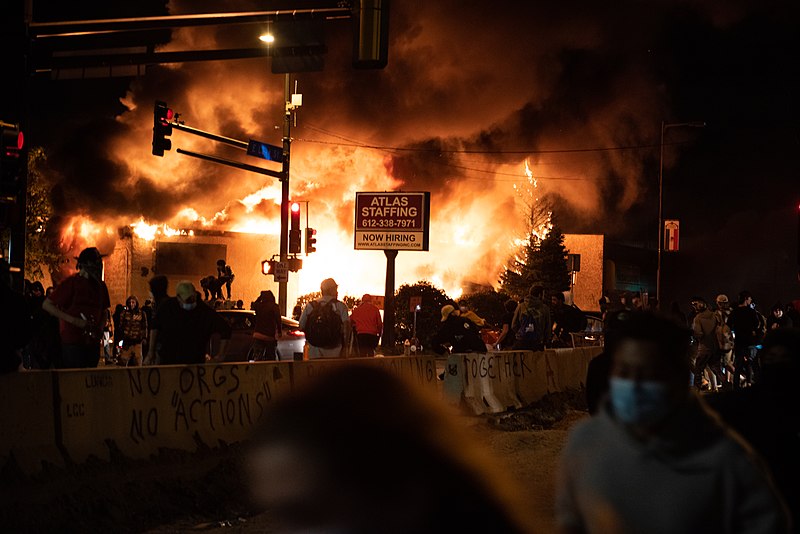
A building burning in Minneapolis following the death of George Floyd.
Photo by Hungryogrephotos via Wikipedia.

Those of us who have urged vigilance when it comes to the rise of identity politics and the cult of Social Justice have now been fully vindicated. For years we have warned about the ways in which the culture war had the potential to infect all public and political discourse. But we were dismissed as railing against niche politics confined to campus common rooms and the dark recesses of the internet. Now the culture war has exploded on to the streets of the UK. If that sounds like a fancy way to say “I told you so”, then so be it.

If we are to have any chance of preserving the liberal values upon which our society depends, we need to find a way to navigate the binary thinking that comes with ideologically driven movements. The first step is to acknowledge common ground. In all my life I have never met a single person who would not agree with the proposition that “black lives matter”, so that seems like a good place to start. It’s been many years since racism has been in any way tolerated by polite society, one of the undeniably positive outcomes of the political-correctness campaigns of the 1980s and 1990s. A further point on which we can surely all agree is that racism exists and should be resisted wherever it occurs. This may seem obvious, but since any opposition to the cult of Social Justice is automatically taken as a denial of the fact of racism, it is worth making the point explicitly.

Those who would deny the existence of racism, or do not agree that black lives matter, or do not accept that racism is an evil that must always be confronted, are already beyond the scope of rational adult conversation. The vast majority of the population believe in our shared values of equality and fairness, although many Social Justice activists prefer to ignore this reality in favour of a fantasy Britain awash with fascists. We saw this in the way that Brexit voters were consistently smeared as xenophobic, even though such a label could only possibly apply to a tiny minority. We saw this in the myth that those who voted Leave were nostalgic for a colonial past, a virtually non-existent mindset that was assumed to be commonplace on the basis of no evidence at all. These kinds of prejudices, largely levelled against working-class people by bourgeois commentators, in turn generated the kind of resentment that almost certainly tipped the scales in favour of Brexit and ultimately led to the collapse of Labour’s “red wall”. These outcomes were in themselves taken as proof of Britain’s inherent racism, and so we find ourselves caught in this perpetual square dance of straw men.

All of which has been a boon for the intersectional, identity-based Social Justice movement, which is sustained on a view of society that bears little resemblance to reality. The latest protests have been infiltrated, and often stoked, by the presence of various groups who unite under the banner of “Antifa”. Like “Black Lives Matter”, these groups rely on the good nature of a public who are likely to interpret their name literally. After all, only a fascist would complain about anti-fascism. Even Mara Liasson, national political correspondent for NPR, fell for this basic rhetorical trick when she described the Normandy landing of more than 150,000 Allied troops as the “biggest Antifa rally in history”. Activist singer Billy Bragg posted an image of Winston Churchill captioned simply with “ANTIFA”. That protesters this week defaced the statue of Churchill in Parliament Square and branded him a “racist” shows the incoherence of much of what is going on.

To return to our common ground: not only is fascism vanishingly rare in the UK, but you would be hard pushed to find anyone who isn’t wholeheartedly opposed to fascism. We are all anti-fascist, which makes Antifa’s claim to be resisting a popular tyrannous force seem about 80 years out of date. The difference is that most of us understand that pepper-spraying a Trump supporter, or striking a UKIP voter over the head with a bike lock, doesn’t put us in the same bracket as those who fought actual fascists at Cable Street in 1936.

As I have argued in Standpoint, our failure to instil critical thinking in our educational systems has led to many of the problems we face in today’s society. To make the case for measured and reasonable discussion of these sensitive issues is to open oneself up to entirely unfounded charges of racism. In such circumstances, most people would rather acquiesce for the sake of an easy life. We have even seen those who have raised questions about the wisdom of permitting mobs to destroy public landmarks being accused of endorsing the slave trade. “How you feel about that statue is how you feel about slavery”, tweeted LBC presenter James O’Brien. “Don’t let anyone pretend otherwise”, he said. But the chances of finding anyone in the UK who would defend slavery are infinitesimal, and it is surely inconceivable that anyone making these allegations sincerely believes otherwise.

June 13, 2020

QotD: The liberal media

Filed under: Humour, Media, Politics, Quotations — Tags: , , , , — Nicholas @ 01:00

As I have pointed out myself, the more one knows about a subject, the more conservative one becomes towards it. Conversely, the less one knows, the more liberal he becomes, and inclined to embrace “progress” and “reforms.” Even a Communist may prove a very conservative stamp collector, once he learns something about philately. It’s only economics he knows nothing about.

This is a universal principle. Everyone knows something about something, and is very backward on that which he knows. The one exception may be journalists, who know nothing about anything, and are therefore liberal all round.

David Warren, “I’ll be a Welshman”, Essays in Idleness, 2018-03-01.

June 12, 2020

An unwelcome return to the 1960s

Filed under: History, Media, Politics, USA — Tags: , , , — Nicholas @ 05:00

David Warren reflects on how many parallels we’re seeing in the current year to the worst aspects of the 1960s:

Young “hippie” standing in front of a row of National Guard soldiers, across the street from the Hilton Hotel at Grant Park, at the Democratic National Convention in Chicago, August 26, 1968. Photo by Warren K. Leffler for US News & World Report via Wikimedia Commons.

As an old Cold Warrior, and once “science kid,” whose childhood developed through the 1960s, there is nothing that ought to surprise me. We have Antifa today; we had the Weather Underground then. We have parallels to every event I witnessed through the idiot box of adolescence, and vice versa. Even the destruction of American cities by riots and crime isn’t new; nor the supine response of our liberal leaders. The obvious left bias of news and entertainment was the same then as now, only less shrieking. The replacement of flatfoot journalists, with malicious ideological clowns from the universities, then a work in progress, was by the end of the last century, complete. The poison spread, through all media of information. We’ve reached an Age of Unreason to match Robespierre’s, and seem now to be waiting for a Napoleon.

Charlatans are the handmaids of paganry. That the charlatans slide into violent insurrection, even against the better pagan customs, is not something historically new.

The alternative is improbable: another Age of Faith. This would necessarily include a subsidiary restoration of faith in science — in the modest belief that if we follow the facts where they lead, as opposed to where we want them to go, a lost perception of cosmological order will also be, willy-nilly, restored. “Modern science” — an unambiguously Christian construct — depends entirely on one assumption. It is, that a universe God created will make sense. Logic, or the principle of non-contradiction, will hold up, and where it doesn’t seem to be doing so, it is not God, but we, who have got it wrong.

By the inversion of “values,” at the present day, the sane views are labelled as “psycho.” The truth is not the true, but what we (or our masters) want to call true. This “truth” is “settled,” from one moment to another; and is not to be discovered, but imposed.

June 9, 2020

It was scientifically inevitable for the Communists to win the Cold War – as foretold in the prophecies

Sarah Hoyt on the “script” that progressives operated under during the Cold War and almost unchanged in detail to the present day, too:

Krushchev, Brezhnev and other Soviet leaders review the Revolution parade in Red Square, 1962.
LIFE magazine photo by Stan Wayman.

… the Cold War had two sides: the USSR and our elites, who had been corrupted and taken over for a long time thanks to the communist agents who had long-marched through our media, our entertainment and our bureaucracy.

Heinlein claimed the Democrats had been taken over by communists, secretly, by the 40s. I have no reason to doubt him. I’m sure most of the bureaucracy and governments in Europe had been taken over that way also.

Even so called conservatives assumed communism would eventually win, because according to the numbers coming out of the USSR and the reporters visiting the USSR — anyone know where Duranty is buried? there should be a line to piss on his grave — they were just so much more efficient. Scientific governance, you know? And anyway, technology was going to be so advanced that most humans would be unemployable, and by the way, there were more and more humans every year, so it was impossible to have all these bourgeois luxuries. So communism, efficient, compassionate, communism was the future, the only way.

The realists who saw it was the only way were willing to do anything to bring it about. Because the people who weren’t as intelligent/well informed would otherwise destroy the world and bring about unimaginable catastrophe.

“Conservatives” were merely those who wanted communism to arrive slower and be a little less violent. Communism with a human face. Socialism on the way to communism. Easing us into our role as cogs in the machinery of the future — where there was no room for personal frills or really emotions — with gentle pneumatic shocks, instead of with the excesses of the Russian and Soviet revolution.

All of this btw is based on three glaring fallacies (phaluscies, since you have to be a dickhead to believe them particularly now.)

1- People are a drain not an asset. They are also a sort of robot incapable of changing behavior in response to changing circumstances.

2- Wealth can’t grow, nor can the carrying capacity of the Earth improve. So since humans can’t respond to reduced infant mortality by having fewer children, the only way to feed everyone is to reduce everyone’s rations. Forever.

3- It is possible for “the best”, properly educated people to be utterly selfless and to administer everyone’s wealth equally and for the common good. They will not revel in power, nor will they avail themselves of any excess. Because, they are absolutely moral and all seeing.

Note the left is still running this script. And some on the right too (Hello, Pierre Delecto!) not to mention all of Europe, left and right. Also note #1 conflicts with the left idea that they can bring about a future in which humans change to be all selfless, etc. But that’s actually complicated and tied in to their myths, which honestly are a Christian heresy, complete with paradise lost.

I know when they started out, the USSR thought it could “engineer” a new human. Homo Sovieticus. But I don’t know enough of Soviet myth to know what underlay that. Maybe it was a behaviorist thing and they thought humans could be trained into being completely selfless automatons. I know by the time I was reading communist theorists (no, I didn’t buy their arguments, but I was required to read them, given when and where I grew up) in the seventies, the philosophy had fallen prey to the agitprop notion that people in madhouses in the US were political prisoners just as in the USSR. (BTW this is part of what underlay the closing of the madhouses.) And that was part of a push in the seventies, as the malfeasance of USSR was starting to be glaring, amid escaped dissidents and escaping information. The push was to “prove” that both systems were equally bad. (The left is still flogging that dead equine, too. So Cubans and Venezuelans are starving? So how many people die of anomie and not being loved enough under capitalism? REEEEE.) So, since Soviets put dissidents in mad houses, so did we. But that necessitated that people who widdled on themselves and/or thought they were a lampshade with a set of dishes thrown in be completely sane “political dissidents”. The only way to do this was to attribute anything communists don’t like to “insanity brought about by capitalism.” This led to crazier byways of thought. For instance, it led to the idea of the pre-historic, pre-agriculture paradise, where everyone was equal, there was no poverty, need, greed, or the heartbreak of psoriasis. A sub-branch of the church believed women were in charge and everyone worshiped the mother goddess. And some of these “scientific, atheist socialists” also believe the goddess actually exists, though G-d doesn’t.

David Friedman had a different formulation for the utopian world many progressives wish for the rest of us:

In the ideal socialist state power will not attract power freaks. People who make decisions will show no slightest bias towards their own interests. There will be no way for a clever man to bend the institutions to serve his own ends. And the rivers will run uphill.

How we are supposed to view the rioting protests in major US cities

Filed under: Media, Politics, USA — Tags: , , , , , — Nicholas @ 03:00

David Thompson shares the essential parts of a Vice article, telling us insufficiently woke dullards how to think about the ongoing civil unrest in many American cities after the death of a man at the hands (well, technically the knees) of Minneapolis police:

A building burning in Minneapolis following the death of George Floyd.
Photo by Hungryogrephotos via Wikipedia.

In the pages of Vice, a moral lecture, delivered from on high:

    How to Talk to Relatives Who Care More About Looting Than Black Lives.

As an exercise in question-begging and dense, self-satisfied presumption, it’s quite a thing, that headline. It’s very now.

Among those of us deemed insufficiently woke and therefore suspect, questions may arise. For instance, in what way will those “black lives” be improved by the destruction of local infrastructure, local businesses, and the subsequent, perhaps dramatic, reduction in trust and goodwill? And what if the stores and homes in question — the ones being smashed, stripped of their contents and set ablaze — are owned by people who happen to be black, as has often been the case? What if the places being looted and vandalised with abandon, indeed exultation, are depended on by people who also happen to be black, whether as customers or employees? Given the levels of material, social and economic destruction, should these people be content, indeed pleased, to be former employees? Unemployed people who now have no local grocer, or garage, or pharmacy?

Alas, such considerations appear to have eluded the keen mental processes of the article’s author, Ms Rachel Miller, a young woman who dutifully declares her pronouns and boasts of being a “Buzzfeed alum.”

    If you’re not Black but want to support BLM, having fraught conversations with your kinda (or definitely) racist loved ones will likely not be fun, but it’s a very worthy undertaking.

Right from the off we’re informed, firmly, that any perceptible reservations about looting and rioting, or reservations about the Black Lives Matter movement — say, regarding its demented far-left agenda, its racial tribalism, and the stated goal of abolishing capitalism, prisons and the police — must be taken as an indicator of being “kinda (or definitely) racist.” Wokeness is not, it seems, a recipe for cognitive subtlety. “Some people,” we’re told, “appear to be far more worried about the fate of a Nordstrom or Target store than that of the actual human lives of protesters.” Again, one might deduce that only those protesting with, shall we say, physical enthusiasm have “actual human lives,” unlike their victims, whose hopes and livelihoods can be gleefully destroyed as an act of righteous liberation. From local amenities.

May 26, 2020

“No more pencils, no more books…”

Filed under: Britain, Education, History — Tags: , , , , , , — Nicholas @ 03:00

In the latest edition of the Libertarian Enterprise, Sean Gabb considers the demands from the British government to quickly re-open the schools over the concerns of the educational unions and administrations:

The latest turn in an increasingly dull coverage of the Coronavirus panic is a proposed reopening of the schools. The Government wants them open as soon as possible for at least some of their students. The teaching unions are bleating that no one should go back until their members can be sure of not catching anything. The headmasters are worried about compliance with the social distancing rules. As a conservative of sorts, I think I am supposed to side with the Government and the pro-Conservative journalists — denouncing the teachers as a pack of idlers where not cowards, and insisting that those factories of essential skills must be set back in full production before the summer holidays. Of course, my settled view as a libertarian is that the teaching unions deserve all the support I have never so far given them. The schools must remain closed until no one is in any danger of so much as an attack of hay fever. The schools have been largely closed since the end of March. The longer they stay largely closed, the better. Best of all if they never reopen — or never reopen as they have been since attendance was made compulsory at the end of the nineteenth century.

I quote John Stuart Mill on compulsory schooling:

    A general State education is a mere contrivance for moulding people to be exactly like one another: and as the mould in which it casts them is that which pleases the predominant power in the government, whether this be a monarch, a priesthood, an aristocracy, or the majority of the existing generation; in proportion as it is efficient and successful, it establishes a despotism over the mind, leading by natural tendency to one over the body.
    (On Liberty, 1859, Chapter 5, “Applications.”)

This has always been the case in some degree. The spread of state schooling in England after 1870, and particularly after it was made compulsory in 1880, and then extended in 1902, is probably inseparable from the nationalist hysteria that drove our participation in the Great War. It also may explain the perverse belief, general until the 1970s, in the unique goodness and honesty of our ruling class. This being said, reasonable patriotism is to be encouraged; and, compared with others, our ruling class was not until recently so bad. A further point is that compulsory state schooling used to be reasonably effective at giving the mass of people a basic education. By 1960, most people were literate and numerate. They could spell and write grammatical prose. They had some exposure to the English classics, and the means of exploring these to greater depth if they wished. They had some understanding of history and the sciences. You can tell much about the quality of a people by examining what is read and watched. Looking at the popular arts in England during much of the twentieth century explains why this passage in On Liberty was less often discussed than his arguments for freedom of speech. Mill was right in the abstract. He could be shown to be right in certain particulars. But the evils of compulsory state schooling were mostly potential.

All this, however, is in the past. Since about 1980, schooling of all kinds has been made into a concerted means of indoctrination. The cultural leftists have captured both the classrooms and the curriculum. I will not elaborate on this claim. Some will argue over terminology, some over the merits of the capture, but hardly anyone denies the broad fact. One of the main functions of modern schooling is to bring about and to protect a radical departure from the old intellectual culture of this country.

Much of this departure has been achieved by preaching in the classroom. But it is supplemented by a growing bureaucracy of surveillance. The teachers themselves are watched, and they can be punished for dissenting from the established discourse. There is, for example, the Government’s Prevent strategy, which applies to the whole state machinery. Its purpose is to identify and root out anyone defined as a “political extremist.” Anyone identified as such is effectively banned from working with children and young people, and probably in the state sector as a whole.

« Newer PostsOlder Posts »

Powered by WordPress