
Let us assume, picking up our discussion of information last time, that our army is formed up into its battle array (pre-planned the night before, recall) and is advancing and our general has just now noticed something that demands a change in the plan. It could be a dangerous enemy attack (perhaps on the flank) or an opportunity to split the enemy line. Whatever it is, our general needs to make some alteration to the battle plan. It is almost certainly a fairly minor alteration, as with a battle line anywhere from a kilometer to several kilometers long, it would, for instance, take far too long to shuffle the right-to-left order of the line just due to the marching time involved. Nevertheless, the general needs to issue an unplanned, on-the-spot command; how does he do it?
The first option, of course, is shouting. The problem here is obvious: how is the commander’s command to be heard? Interestingly, there has been a fair bit of research by ancient historians looking at the question of how many people can possibly hear a short address unaided by modern loudspeakers and the like; figures vary but generally a few thousand if they are reasonably compact and quiet. That might work for a general’s pre-battle speech, delivered before the army advances, but it will not do for an army that is already in motion, much less once the chaos of battle has begun. Thousands of men marching (let alone fighting!) are noisy!
The modern solution to this problem is radio, but of course that’s hardly available to our pre-modern commander. Instead, to judge by films, the mind quickly jumps to signal flags. I am reminded of Braveheart (1995)’s rendition of the Battle of Falkirk, where Edward I uses signal flags to order his archers forward. HBO’s Rome also does this in its version of the Battle of Philippi, with flags being jostled and then pointed forward to signal the advance. Unfortunately, signal flags – as distinct from unit flags (which we’ll come back to in a moment) – have a few key problems, the most notable of which is that no one will be looking at them: after all the army is advancing, the soldiers are looking forward but signal flags (again, as opposed to unit flags) are going to be behind them, not placed out in the middle of No Man’s Land between the armies. As a result, signal flags are useful for sending information long distances (in a chain of stations or operators), for instance from one commander at distance to another, but not in battle; operational, rather than tactical tools. In practice, the use of signal flags like this is confined to the modern era; the first successful “optical telegraphs” (as iterations on things like smoke signals and fire relays) date to the late 18th century.
Unit flags – a banner or other big, obvious symbol (like a statue of an eagle on a stick) – are more useful. These can be positioned at the front of a unit, typically at its center. If it advances, then the soldiers in the unit also know to advance, following the standard they can see (because it is elevated, large and visible) even if they cannot hear the orders. There are two complications here though: first, the unit banner or flag is a relatively late innovation in antiquity, really only coming into its own with the Romans. The Achaemenids may have used some kinds of ensigns or standards, but the Greeks do not seem to have done. Instead our first really good documentation of something like a battle flag comes from the Romans: each legion had a signa (eventually standardized to the legionary eagle, the aquila), which was a shiny metal statue mounted on a pole so it could be easily seen. Units of the legion broken off to do other things might instead follow a less impressive cloth banner, a vexillum, by which such detachments became known as vexillationes. But the broader problem is that of course your general may not be particularly close to your flags (or other standards) which are generally at the front-center of each component unit of your army. The flags may allow a subordinate officer to “drive” the unit over the battlefield – and that’s good – but it doesn’t let the general tell that officer what to do.
A better option is music, but once again development seems to come fairly late in antiquity. Greek hoplites seem to have advanced to the music of the aulos, a double-reeded flute-like instrument; given the limitations of the instrument it is generally assumed it was used to keep time (so everyone marched in step) not transmit orders. Once again, a more complex system of musical signalling seems to come with the Romans, at least as detailed by Vegetius. Vegetius (2.22) notes three different kinds of horn instruments used by a legion: the tubicen was used to sound charge and retreat, the cornicen regulated the movement of the signa (so “advance” or “halt”), while the buccina was used mostly for camp signals: sounding watches or assemblies. It’s a system that is akin to later bugle calls, but note that the orders it can give are limited to a relative handful of prearranged signals: advance, halt, charge, retreat, assemble, change shift and so on.
The attentive reader here may have already noticed how developed Roman command and control is and may suspect that ties in with the Romans having a more “command” oriented culture of generalship; if so you are ahead of the game!
Of course if those instruments are sounding on a per-unit basis (and they are) that means you still have the problem of getting the order from the general to the instruments for the unit in question. And fundamentally here, the technology is – as I tell my students – man-on-horse. The particular fellow on the horse may be a dedicated messenger (if your military organization has those) or a subordinate officer or it may be the general himself.
But it is important to note now the limitations of this sort of system and we can use what we know of the Roman command and control system (as noted, one of the more developed of such systems prior to gunpowder) to get a sense of them. Let’s say the general realizes there is a problem on his flank and he needs a unit (probably here we’re talking a cohort or a maniple, not a legion) to change what it is doing. First off, the order needs to get within shouting range of the unit’s commander (in this case a senior centurion). The general can either go themselves or send a messenger; both options have their downsides. If the general goes himself he is essentially removing himself from observing or commanding the rest of the battle, but a common problem with sending a junior subordinate is that the unit commander may not respect or feel the need to obey that subordinate (written orders can help with this, but now we’re bringing in questions of literacy). Of course both a messenger or a general in transit may also well be killed, which will prevent the order from being received!
In either case, the message is going to move at galloping speed, which is around 40km/h, meaning that it may take several minutes for the general or messenger to navigate to the spot. That doesn’t sound so bad, but battles with contact weapons do not typically go for hours and hours; Pydna (168) was, as noted last week, decided in about an hour total! Of course a battle might be longer (or shorter!) than this, though much of that extra time is likely pre-battle skirmishing – the actual direct press of infantry formations in shock rarely lasts long because of the terror of it (and to a lesser extent its lethality; we’ll return to the balance of terror and lethality next time). Imagine if you were playing a Total War game and your input delay was, say, five minutes long in a battle that might only last an hour or two.
But of course galloping time isn’t the end of it. The message now has to be conveyed to the unit. In the Roman system, that means the messenger needs to find the appropriate centurion, explain the order to him and then ideally that fellow will then signal the instruments and signa to act accordingly – but even then, those instruments and signa only have a handful of prearranged signals available. Anything more complicated will need to be shouted down the line the old fashioned way (as we know, for instance, the Spartans did for lack of almost any of the rest of this apparatus of command, Xen. Lac. 13.9). Needless to say that means that giving any complex order to a unit already engaged or about to be engaged is going to mean starting by signalling retreat and then attempting to regroup the unit; regrouping an already retreating unit is one of the most difficult tasks on a battlefield and is rarely performed successfully in an unplanned fashion (even in a planned fashion it goes wrong as often as it goes right).
(This is, by the by, why reserves are so important. An unengaged unit hanging behind the lines can be given new orders far, far easier than a unit that is already engaged or about to be. And indeed, those familiar with the Roman system of fighting with its three lines of heavy infantry will note that it is a system heavy on reserves. Indeed, the manipular legion essentially assumes it will be necessary to retreat and regroup the first line of heavy infantry (the hastati) behind the second (the principes) and plans and drills for that. Note how the Roman command culture, the Roman fighting method and the actual apparatus of messengers, signa, instruments and junior officers all align here – that’s common because these sort of institutions tend to co-evolve.
By contrast we may compare a Greek hoplite army in the Classical Period. It has no battle flags or ensigns and the general is expected to fight on foot. In the past I’ve described the resulting phalanx as an “unguided missile” and this is a big reason why. That’s not to say hoplite generals never exerted command on the battlefield – better generals might keep a reserve to be rushed to important points (as Pagondas does at the Battle of Delium in 424 BC). But for the most part, once a hoplite general formed up the army and hit “go”, they had very little control over the army.
Bret Devereaux, “Collections: Total Generalship: Commanding Pre-Modern Armies, Part II: Commands”, A Collection of Unmitigated Pedantry, 2022-06-03.
July 5, 2026
QotD: Battlefield communication in the pre-modern world
May 31, 2026
The Battle Of Jutland: How Britain Should Have “ANNIHILATED” Germany’s Fleet & Won EASILY
History Undone with James Hanson
Published 13 Dec 2024James Hanson is joined by Rear Admiral Dr Chris Parry and the YouTuber and naval historian @Drachinifel to discuss the Battle of Jutland. It was the largest naval battle of the First World War and the only time the British and German fleets went head to head.
So just how significant was it and should it have ended differently? This is History Undone.
May 27, 2026
QotD: “Bring your whole self to work”
Organisations and institutions are formalised teams. Due to past ruthless selection — see the Neolithic y-chromosome bottleneck — the male expression of Homo sapien genes is much better at teams than is the female expression of the same. This does turn out to matter.
We have spent centuries, millennia, dealing with the bad traits of men in power. We better start wrestling seriously and quickly with the bad traits of women in power, or we could end up with a cascading collapse of complex systems (see the LA fires for an example). We are already seeing some serious institutional degradation.
But if we remain stuck in “if you criticise men, it’s feminism; if you criticise women, it’s misogyny”, we have a potentially terminal problem.
Lorenzo Warby, Substack Notes, 2026-02-21.
May 25, 2026
George Washington “basically started the world’s first global war”
On his Substack, Ed West talks about a book he had intended to write, but “put it on the back burner” for too long and the moment has passed:
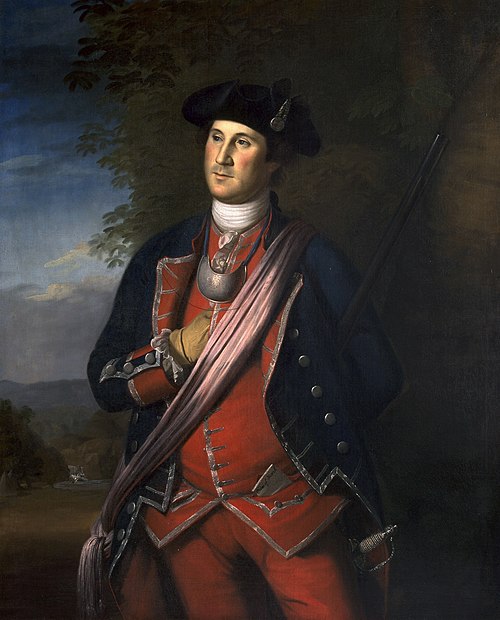
George Washington in the uniform of the Virginia Regiment, 1772.
Portrait by Charles Willson Peale (1741-1827) from the Washington and Lee University collection via Wikimedia Commons.
The story would start in the 1750s. The first truly world war is in full flow, as Britain and France battle for supremacy of the continent and the oceans. In North America, British colonial troops fight side by side with soldiers from the old country, who mock the bumpkin locals with their ditty “Yankee Doodle“. But, rivalries aside, they both know what they’re fighting for: if Louis XV’s absolute monarchy wins, all their liberties will be gone.
In a heroic battle the British regular and colonial forces take the French stronghold of Fort Duquesne and rename it Fort Pitt, after cabinet minister William Pitt “the elder” – it later becomes Pittsburgh. By 1763 the French are driven out of North America altogether. The British colonies are safe. One officer particularly shines during this war, and diarist Horace Walpole writes how “The volley fired by a young Virginian in the backwoods of America set the world on fire”.
That Virginian was George Washington. Born in Wakefield in Westmoreland County, this British hero was the great-grandson of an Essex clergyman thrown out of the church for drunkenness, and who had landed in that colony in 1657. Washington was an impressive man in every way – standing at 6’2″, with enormous hands and feet and a massive nose, he was notably strong and able to throw objects immense distances (although many of these accounts improved in the telling).
Despite having almost no teeth, like any good British patriot, Washington was very proper about his appearance, insisting on bringing a selection of fine linen shirts even into the backwoods. A conservative by nature and with ambitions to serve as an officer in His Majesty’s forces, he didn’t like the new fashion for shaking hands, preferring the more formal bow.
A major at 21, Washington’s first job was to lead his men into the Ohio Valley to warn away any Frenchmen they found there. The following year, 1754, and now a lieutenant-colonel, he went back and built Fort Necessity close to Fort Duquesne, where he stumbled upon a contingent of enemy troops. They ran for their muskets and Washington ordered his company to fire. Ten Frenchmen were killed, including their lieutenant, and the incident would spark a war in North America between the two great powers, which in 1756 linked up with a Europe-wide conflict later known as the Seven Years’ War. It’s strange to think that, as well as being the first president of a future global superpower, Washington basically started the world’s first global war.
But what if France had won that struggle? Would French-controlled colonies in North America have formed constitutions centred on the rights to life, liberty and the pursuit of happiness, not to mention the often-overlooked right to property? Would they have enshrined religious tolerance or the right to free speech? Trial by jury? Innocence until proven guilty? Hell, no! And if it wasn’t for us, my thesis went, you’d be speaking French.
Without England’s history of Parliamentary freedom, habeas corpus, Magna Carta and the jury system, the colonies would never have developed as they did. Neither would they have the same commercial spirit, downstream of their Puritan and Quaker inheritance.
I think I came up with the proposal after reading David Hackett Fischer’s Albion’s Seed, one of the most discussed and popular analyses of American culture. This great work of history and anthropology charts the foundation of the country’s cultural folkways through four migrations – East Anglian Puritans to New England, Cavaliers from England’s south and south-west to Virginia, the mostly northern Quakers to the middle colonies, and Borderers from Ulster to the Appalachians.
I was always very interested in founder effects, whereby colonies come to take on aspects of the mother country which subsequently disappear back home. This is reflected in the fact that many “Americanisms” are actually old English words, like fall, trash and garbage, even “gotten”. It’s also true to some extent of the American accent, developing out of various regional dialects which have since been flattened by the dominance of London. This is especially the case with Ocracoke Island in North Carolina, which apparently is the closest thing to Shakespearean English, although I fear that if I went there this would no longer be true, and they’d all say “like” four times in every sentence and tell you they’re “reaching out”.
May 24, 2026
QotD: Historians, past and present
Meanwhile Xenophon was an Athenian student of Socrates who joined a Greek mercenary group that marched 1000 miles into Persia to overthrow the King of Kings on behalf of the King’s brother. When the King’s brother died and the group’s commanders were all killed by Persian treachery, he led the troops 1000 miles home himself while being constantly harried by hostile armies. He then tried to establish a colony on the Black Sea, survived a mutiny, raided the Thracians, fought for the Spartans, was exiled by Athens, and settled down to manage an estate and write it all up.
Contrast Xenophon with Mary Beard, who studied at Cambridge and now teaches at Cambridge. She holds the same opinions as everyone else at Cambridge. She’s remarked before that, “I actually can’t understand what it would be to be a woman without being a feminist”. This seems like a peculiar failing for an ancient historian. After 9/11, she wrote an article saying that many people thought “the United States had it coming”, and that “world bullies, even if their heart is in the right place, will in the end pay the price”. That caused some controversy on the world stage, but earned her a promotion at Cambridge. I don’t know if she’s ever talked publicly about religion or democracy or climate change or immigration, but I could tell you exactly what she thinks about these things anyway. So why would you bother reading what she thinks about Rome? The answers are just as predictable.
Roman Helmet Guy, “New Books Aren’t Worth Reading”, Atlas Press, 2026-01-13.
May 18, 2026
Isoroku Yamamoto – the admiral and the postwar legend
Big Serge examines the popular memory of Japanese admiral Isoroku Yamamoto, the architect of Japan’s early naval war successes against the United States from 1941 onwards, contrasting the postwar image with the man himself:
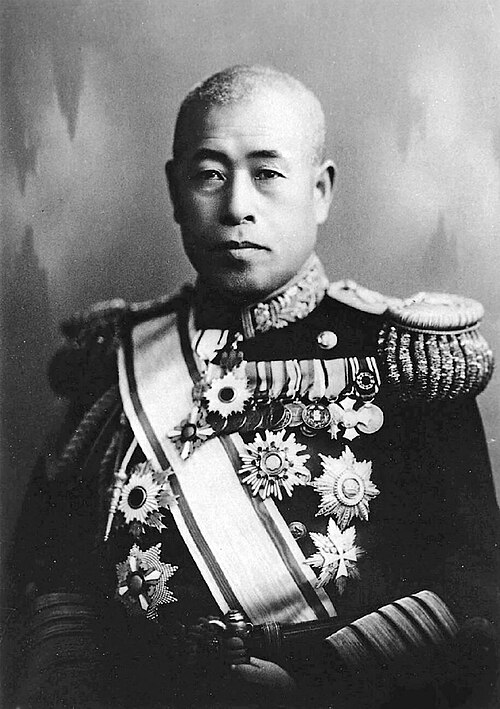
Admiral Isoroku Yamamoto, Commander-in-Chief of the Imperial Japanese Navy’s Combined Fleet.
Photo from the National Diet Library via Wikimedia Commons.
Japanese leadership in the Second World War enjoys noticeably lower name recognition than their German counterparts. Most people with a cursory knowledge of the war know the core German leadership group around Hitler — Himmler, Goering, Goebbels, Speer, and perhaps Heydrich and Bormann — and the all-star lineup of German generals like Rommel, Manstein, and Guderian. In contrast, the only particularly notorious member of Japan’s nebulous leadership group is General Hideki Tojo, who served as Prime Minister for most of the war and became the centerpiece defendant in the postwar trial. As far as Japanese commanders go, the list of name-brand personnel has but a single entry: Isoroku Yamamoto.
Yamamoto’s life and career present a fascinating trajectory that shapes a particular, sympathetic view of the man. A veteran of the Russo-Japanese War, he spent much of his 30’s in the United States, studying at Harvard and serving as naval attache in Japan’s Washington embassy. He therefore had a first hand understanding of America’s industrial depth, and was famously pessimistic about Japan’s prospects in a a war against the United States. “Anyone who has seen the auto factories in Detroit and the oil fields in Texas”, he argued, “knows that Japan lacks the power for a naval race with America”. In one of his more famous and widely recited (though often badly translated) remarks about a war with the United States, he told Prime Minister Fumimaro Konoe in September 1940:
If I was told that I had to do it, then you will certainly observe the Navy going all out for half a year to a year. However, I do not hold conviction about the outcome after 2-3 years.
This quote certainly seems remarkably prescient, in light of Japan’s initial wave of operational successes, which slowly faded away as American combat power ramped up. Far more famous still is his remark, after the attack on Pearl Harbor, that Japan had “awakened a sleeping giant, and filled him with terrible resolve”.
All of this shapes the perception of Yamamoto as a quasi-tragic figure who understood that Japan was unlikely to defeat the United States in the Pacific War, counseled against the conflict, and then dutifully tried to play a losing hand as well as he could once war had been thrust upon him against his own advice. Yamamoto was furthermore a critic of the Japanese Army’s war in China and a particularly vocal opponent of the Tripartite Pact with Germany and Japan, lending credence to the idea that he was war-averse.
This is the Yamamoto of American popular memory, and indeed of a great deal of Japanese postwar writing: a sort of samurai Cassandra, too perceptive and cosmopolitan for the militarist regime he served, a man who fired the opening shot of the Pacific War with a heavy heart and no illusions.
It is certainly true that Yamamoto had an appropriately pessimistic assessment of Japan’s prospects in an extended conflict with the United States. What is less often appreciated is that Yamamoto did not, on the basis of this assessment, conclude that Japan ought not to fight. He concluded instead that, if Japan was going to fight, it had to fight differently — with greater boldness, more risk, and an aggressive search for a decisive stroke. He did not spend the eighteen months before Pearl Harbor advocating for peace. He spent them designing what was, on balance, the single most aggressive operational scheme that was possible — and then only barely — within Japan’s kinetic parameters.
This is the critical distinction between Yamamoto-the-man and the Yamamoto of postwar hagiography. He was not a pacifist, reluctant or otherwise. He was a Japanese naval officer of strong patriotic conviction, deeply committed to his service and his nation, who happened to understand the arithmetic of industrial war better than most of his colleagues. Notwithstanding his appreciation for America’s vast industrial base, he shared a broader Japanese disdain for American martial proclivities, dismissing American naval officers as a club of “golfers and bridge players”. His understanding of the United States did not produce pacifism. It produced, rather, a particular kind of operational philosophy — one which held that Japan’s best hope in a war with the United States was to front-load its risk-taking, to achieve a string of dramatic early victories that would either compel American negotiation or, failing that, push the eventual American counter-offensive as far into the future as possible. In either case, the operational prescription was the same: bold, high-risk operations aimed at decisive results.
May 17, 2026
QotD: Battlefield morale and cohesion in movies/games versus real history
Actual armies have far more than two states of morale and behaved in far more dynamic, unpredictable and interesting ways!
The first problem with this “binary model” of morale is that it assumes just a single factor (“leadership” or “morale”) but in practice we ought to be thinking about at least two different ingredients here: morale and cohesion.
Morale is the commitment the combatants have to their leadership and their cause. To simplify a bit, we might say that soldiers with good morale believe three things: that their cause is a worthy one, that they are on the road to success and that their leaders have a good (enough) plan to achieve final victory. Poor morale can result from a breakdown in any of those three elements: troops might for instance believe both in their goal and its eventual possibility but not in their leaders to produce it (this seems to have been the case, for instance, in the French Mutiny of 1917). On the other hand, regardless of the charisma of leaders, few people come to a war intending to die in it; if the cause appears impossible, morale will sink regardless. And armies that do not believe in the cause at all are extremely difficult to motivate by other means.
On the other hand cohesion is the force that holds a specific unit together through the power of the bonds holding the individual combatants to each other and/or to their (generally junior or non-commissioned) officers. There are a lot of ways to build that cohesion: people are generally unwilling to abandon neighbors, close friends and relatives, for one. They are also reluctant to expose themselves to shame at home for having done so; shame is one of the few things people fear as much, if not more than, death. For armies that can’t rely on that sort of organic cohesion, it can be built by reconstructing the soldier’s unit as his primary social group. Drill can do this: it creates an experience of shared suffering and achievement which bonds the soldiers together creating strong “artificial” cohesion.
These two ingredients have different roots, but they also function differently. The formulation that has always stuck with me is one from James McPherson’s For Cause and Comrades: Why Men Fought in the Civil War (1998): morale (McPherson discusses it under the heading of “the Cause”) will get men into uniform, it will sustain them on large marches and cold nights and it will get them to the battle, but it will not get them through the battle. Instead, cohesion (the “comrades” of the title) gets men through the terror of actual combat, when fear has driven “the cause” far from mind. But of course cohesion isn’t enough on its own either, since it provides no reason to advance or attack or really to do anything at all except stick together.
Adding further complication to this, morale and cohesion are not, as they often exist in games, inherent properties of a unit, but rather emergent properties of the interactions of a whole bunch of individuals. In a strategy game, units exist primarily as extension of the player’s will; in film units typically exist as extensions of their commander’s or the main character’s will (note how common it is that right as the hero begins winning his duel with the villain, so too his army begins winning the battle). But of course actual armies are composed of lots of humans, each with their own individual will and agency.
Those humans are continually making calculations about risks, goals and survival. It’s not hard here to see why, by the by, morale won’t carry troops through high risk conditions: if your only goal is to survive to experience the end-state of the war, then it is always in your interest to let someone else do the dying; it doesn’t serve your end to stay in a high risk position. By contrast, if you are held there by the fear of shame if your close comrades see you run, that still applies. Thus these calculations get progressively more “primal” as the sense of danger rises (fear makes a mess of those higher brain functions), but they do not stop.
Bret Devereaux, “Collections: Total Generalship: Commanding Pre-Modern Armies, Part IIIC: Morale and Cohesion”, A Collection of Unmitigated Pedantry, 2022-07-01.
May 12, 2026
Something something hoist, something something petard
The Liberal party, both federally and provincially, have been massive fans of immigration for decades. Any kind of restriction on foreigners being allowed into the country was seen as tantamount to treason, in Liberal eyes. This resulted in a lot of votes for Liberal candidates in election after election, as most immigrants associated their welcome in Canada with the party most associated with pro-immigration policies. On the weekend, this happy little virtuous circle suddenly broke in the Toronto-area provincial riding of Scarborough Southwest, and the party is left wondering what is going on:
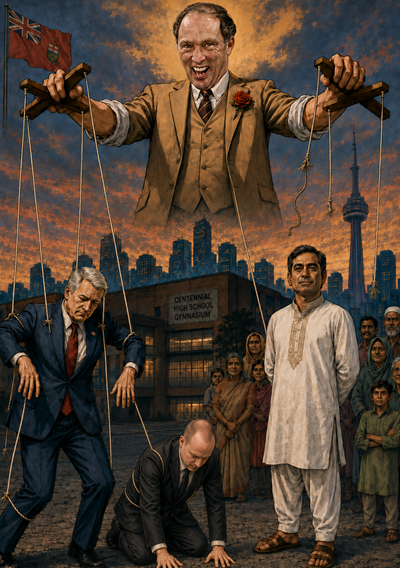
AI-generated image from Upper Canadian Cavalier
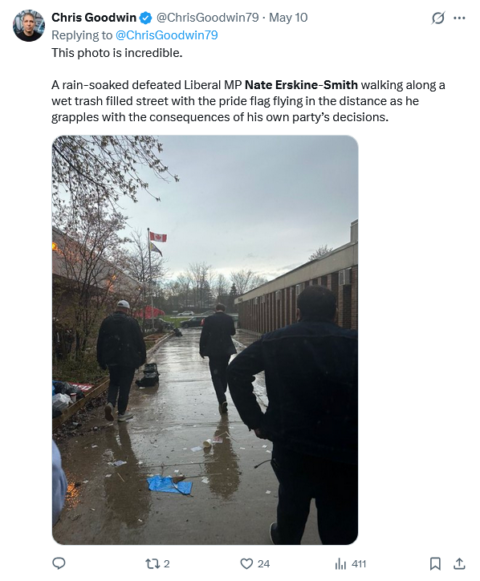
There is a particular flavour of humiliation reserved for the courtier who discovers, too late, that the rules he wrote for everyone else now apply to him. On Saturday afternoon in Scarborough Southwest, Nathaniel Erskine-Smith tasted it. The former federal Minister of Housing, the man Mark Carney himself had blessed to retain his Beaches–East York seat while parachuting into a provincial nomination as a launchpad for the Ontario Liberal leadership, lost. He lost to a man named Ahsanul Hafiz, a Bangladeshi immigrant who had arrived as an international student two decades ago, who had been forced during the campaign to answer for old social media posts of himself posing with firearms and calling for the death penalty of a Bangladeshi politician. Hafiz won not because he was a more accomplished man, not because he had a deeper grasp of public policy, not because he carried the gravitas of a former Crown minister of the Dominion. He won because he could deliver more bodies to a high school gymnasium on a Saturday afternoon than the Oxford-trained lawyer with the cabinet pedigree could.
This is the open secret of Liberal politics in Canada in the year 2026. The white Liberal cannot win his own nomination battles anymore. Not on the merits. Not on the organisation. Not on the strength of his name or the depth of his rolodex. He can only win when the party machinery he himself built bends the rules in his favour, locks the gate behind him, and quietly disqualifies the rivals who would otherwise eat him alive. When the machinery fails, as it failed in Scarborough Southwest, the result is what we saw on the weekend: the dauphin of the Carney court, the heir presumptive, sent home with a participation ribbon and a press release about how concerned he is of the democratic process.
The democratic process. We shall return to that phrase, because it has done a great deal of work for the Liberal Party of Canada these past sixty years, and it deserves the close inspection of an honest mind.
The Scarborough Lesson
Consider the bare arithmetic of what happened. Erskine-Smith is, by every measure the Laurentian establishment recognises, the kind of man the Liberal Party manufactures for leadership. Queen’s University, then Oxford for the BCL. A successful federal MP since 2015. A cabinet minister under both Trudeau and Carney. The blessing of the Prime Minister himself to remain a sitting federal MP while contesting a provincial nomination, an arrangement of breathtaking entitlement that would have been denied to anyone of lesser standing. He had every advantage the system can confer on a chosen son.
And yet the Bangladeshi grocer down the street had more votes.
Three thousand five hundred members were on the final voting list. The Bangladeshi community of Scarborough Southwest, organised through its mosques, its community associations, its weekly newspaper the Weekly Bangla Mail, its television station NRB TV, had decided some time ago that this riding belonged to them. Doly Begum, the former NDP MPP turned federal Liberal, had won the by-election three weeks earlier as the first Bangladeshi-Canadian elected to Parliament. The provincial nomination was the next obvious prize. Three of the four candidates running were of Bangladeshi origin. The fourth was Erskine-Smith.
You can imagine the scene at the high school. The folding tables, the volunteer scrutineers, families arriving in groups of six and eight, elderly grandmothers helped to their seats by grandsons. And against this, the dispersed and atomised liberal professionals of the riding, the kind of people who attend brunches in the Beaches and write earnest letters to the Toronto Star about housing policy. There was no contest. The grandmothers won. They will always win. They were always going to win. Anyone who has spent five minutes thinking honestly about what mass non-European immigration into a Westminster system actually means could have told you so.
This is not a scandal, it is not foreign interference. It is not even when properly understood, a failure of the Liberal Party. It is what democracy looks like when you transplant a foreign communal politics into a parliamentary system that was built for atomised individuals voting their conscience as Englishmen. The system the Liberals constructed across two generations, the system of mass importation without integration, of multiculturalism as official ideology, of the ethnic vote as the quiet hydraulic engine of every Liberal majority, has finally arrived at its terminal stage. The body has now grown larger than the head, and the head has noticed.
At Without Diminishment, Dakota Jeffery-Petts, who once worked as a volunteer on Erskine-Smith’s 2015 campaign, writes:
In Canada, the nomination process remains a glaring national security loophole. These contests are treated as private club matters rather than public democratic exercises. They lack the oversight of a neutral authority. This creates a low-cost, and at times entirely cost-free, environment providing a high-reward entry point for foreign interference.
All you need to do is speak sweet lies to members and constituents. In doing so, you create a motivated interest group that can effectively hand-pick a representative in a safe seat, bypassing the general electorate entirely.
When 3,580 memberships appear overnight in a single riding, we must ask: whose interests are being served? Are they Canadian interests, or diaspora interests?
The primary duty of an elected official, after all, is to the national and public interest. But when a candidate’s mandate is derived from a narrow, diaspora-specific recruitment drive, often centred on grievances or political movements from the old country, that candidate becomes a delegate for a foreign interest rather than a representative of Ontario and the Ontarians in that riding.
The result illustrates the danger of fragmented national and local loyalties.
Multiculturalism, when left without a strong framework of national identity, allows for the importation of foreign conflicts into our legislative halls. We are seeing the rise of a political class that views a seat in a Canadian legislature as a platform for foreign advocacy, rather than a tool for national or provincial governance.
This capture of our nomination process by diaspora activism is the ultimate sign of a hollowed-out democracy. If the gates to our legislatures are guarded by whoever can mobilise the largest bloc of unintegrated interests, then the concept of a Canadian mandate becomes meaningless.
We are effectively outsourcing our leadership selection to the highest bidder, or to the most aggressive foreign-aligned organiser. The decision by the Ontario Liberal Party to allow this surge, and the subsequent defeat of one of the more prominent politicians in the province, shows a party that has lost its way.
By prioritising raw numbers over the quality and loyalty of its candidates, the Ontario Liberals have signalled that they are comfortable being a vessel for proxies acting on behalf of foreign interests, despite the hardships facing so many Ontarians.
April 29, 2026
QotD: The battlefield role of the general in pre-modern battles
So instead of assessing a battle plan – which they cannot observe – soldiers tend to assess battle commanders. And they are going to assess commanders not against abstract first principles (nor can they just check their character sheet to see how many “stars” they have next to “command”), but against their idea of what a “good general” looks like. And that idea is – as we’re about to demonstrate – going to be pretty dependent on their culture because different cultures import very different assumptions about war. As I noted back in the Helm’s Deep series, “an American general who slaughtered a goat in front of his army before battle would not reassure his men; a Greek general who failed to do so might well panic them.” An extreme example to be sure, but not an absurd one. In essence then, a general who does the things his culture expects from him is effectively performing leadership as we’ve defined it above.
But the inverse of this expectation held by the soldiers is that generals are not generally free to command however they’d like, even if they wanted to (though of course most generals are going to have the same culturally embedded sense of what good generalship is as their soldiers). Precisely because a general knows his soldiers are watching him for signs that he is their idea of a “good general”, the general is under pressure to perform generalship, whatever that may look like in this cultural context. That is going to be particularly true because almost all of the common models of generalship demand that the general be conspicuous, be available to be seen and observed by his soldiers. As a result, cultural ideals are going to heavily constrain what the general can do on the battlefield, especially if they demand that the general engage personally in combat.
Different sorts of generals
We can actually get a sense of a good part of the range simply by detailing the different expectations for generalship in ancient Greek, Macedonian and Roman societies and how they evolved (which has the added benefit of sticking within my area of expertise!).
On one end, we have what we might call the “warrior-hero general”. This is, for instance, the style of leadership that shows up in Homer (particularly in the Iliad), but this model is common more broadly. For Homer, the leaders were among the promachoi – “fore-fighters”, who fought in the front ranks or even beyond them, skirmishing with the enemy in the space between their formations (which makes more sense, spatially, if you imagine Homeric armies mostly engaging in longer range missile exchanges in pitched battle like many “first system” armies).
The idea here is not (as with the heroes of Homer) that the warrior-hero general simply defeats the army on his own, but rather that he is motivating his soldiers by his own conspicuous bravery, “leading by example”. This kind of leadership, of course, isn’t limited to just Homer; you may recall Bertran de Born praising it as well:
And I am as well pleased by a lord
when he is first in the attack,
armed, upon his horse, unafraid,
so he makes his men take heart
by his own brave lordliness.On the opposite end of the spectrum, there is the pure “general as commander” ideal, where the commanding general (who may have subordinates, of course, who may even in later armies have “general” in the name of their rank) is expected to stay well clear of the actual fighting and instead be a coordinating figure. This style […] is fairly rare in the pre-gunpowder era, but becomes common afterwards. Because in this model the general’s role is seen primarily in terms of coordinating various independently maneuvering elements of an army; a general that is “stuck in” personally cannot do this effectively. And it may seem strange, but violating these norms with excessive bravery can provoke a negative response in the army; confederate general Robert E. Lee attempted to advance with an attack by the Texas Brigade at the Battle of the Wilderness (May 6, 1864) only to have his own soldiers refuse to advance until he retired to a more protected position. Of course this sort of pure coordination model is common in tactical video games which only infrequently put the player-as-general on the battlefield (or even if the “general” of the army is represented on the battlefield, the survival of that figure is in no way connected to the player’s ability to coordinate the army).
In practice, pre-modern (which is to say, pre-gunpowder) generals almost never adopt this pure coordination model of generalship. The issue here is that effective control of a gunpowder army both demands and allows for a lot more coordination. Because units are not in melee contact, engagements are less decisive (units advance, receive fire, break, fall back and then often reform to advance again; by contrast a formation defeated in a shock engagement tends not to reform because it is chased by the troops that defeated it), giving more space for units to maneuver in substantially longer battles. Moreover, units under fire can maneuver, whereas units in shock generally cannot, which is to say that a formation receiving musket or artillery fire can still be controlled and moved about the field, but a unit receiving sword strikes is largely beyond effective command except for “retreat!”
In between these two extremes sits variations on what Wheeler terms a “battle manager”, which is a bit more complex and we’ll return to it in a moment.
What I want to note here is that these expectations are going to impact where the general is on the battlefield and thus what he can do to exert command. A general in a culture which expects its leaders to be at the front leading the army has the advantage of being seen by at least some of his soldiers (indeed that is the point – they need to see him performing heroic leadership), but once engaged, he cannot go anywhere or command anyone. This is also true, by the by, in cultures where the general is expected to be on foot to show that they share in the difficulties and dangers of the infantry; this is fairly rare but for much of the Archaic and Classical periods, this was expected of Greek generals. Even if a general on foot isn’t in combat directly, their ability to see or move about the battlefield is going to be extremely limited.
On the flipside, a general who is following the “commander” ideal is likely to be in the rear, perhaps in an elevated position for observation. The obvious limitation here is that such a commander is going to struggle to display leadership because no one can see them (everyone is facing towards the enemy, after all). But that also impacts their ability to command – no one is looking at them so if they want to change their plans on the fly they need to send word somehow to subordinate officers who are with or in front of the battle line who can then use their visibility to communicate those orders to the troops.
Bret Devereaux, “Collections: Total Generalship: Commanding Pre-Modern Armies, Part II: Commands”, A Collection of Unmitigated Pedantry, 2022-06-03.
April 23, 2026
Alexander the Great and Julius Caesar
Adrian Goldsworthy. Historian and Novelist
Published 1 Oct 2025The first of this year’s video’s in answer to viewers’ questions — today we think about and compare Alexander and Caesar. This is not new, for in the ancient world the pair were often connected, even though they lived centuries apart. Appian compared and contrasted them, Plutarch paired his biographies of them, while Suetonius and others told stories about Caesar’s admiration for the famous Macedonian.
April 19, 2026
QotD: The (only?) man who didn’t fear Margaret Thatcher
Thatcher reacted with cold fury, but Hoskyns was unabashed. Another story tells of his arriving for a meeting with the PM only to be intercepted by Ian Gow, her personal secretary. “Our girl is tired,” said Gow, trying to bar his path. “I’m tired too,” muttered Hoskyns. “It goes with the bloody job. I’m going in.”
Such irreverence to the “Great She-Elephant”, “She who must be obeyed”, “Attila the Hen” is rare enough, but this isn’t the main thing to remember Hoskyns for. Far more interesting – and relevant to now – is the work he did with fellow conservative Norman Strauss in the mid-1970s to diagnose the exact sources of Britain’s economic malaise, and come up with clear policies about how the country could haul itself out of it.
Robin Ashenden, “Thatcher’s ‘Wiring Diagram’ and why we need it once again”, The Critic, 2020-08-25.
April 6, 2026
QotD: Taylorism
Taylor was unpopular in his own day and is even less popular today, because his particular brand of optimization of the great living machine was all about stripping autonomy (or as Marx would say, “control and conscious direction“) from workers. But the particular kind of optimization he advocated is less important than the conceptual breakthrough that while a nail factory and a car factory might look very different on the surface, they are both governed by the same set of abstract laws: laws of time and motion, concurrency, bottlenecks, worker motivation and so on. A master of those laws could optimize a nail factory, and then go on to optimize a car factory, and could do both without knowing very much at all about nails or cars.
Who could have a problem with that? Even I don’t think it’s entirely wrong — I may have misgivings about the sheer volume of people going into fields like management consulting, but I’ll admit that there remains alpha in asking a smart and incisive outsider to take a look at your operation and tell you what seems crazy. The trouble comes with confusing that sporadic, occasional sanity-check with the actual business of leading a team of people who are working together to achieve an objective. Because, get this, it’s impossible to lead such a team without a deep understanding of the details of every person’s tasks.
It’s surreal to me that this point has to be made, yet somehow it does. If the team you lead makes nails, you need to know everything there is to know about making nails. If the team you lead operates a restaurant, you need to be an expert, not in “management”, but in restaurants. If the team you lead sells mortgage-backed derivatives, you better know a heck of a lot about finance in general, mortgages in particular, the art of sales, and the specific world of selling financial instruments. There are a thousand reasons why this is true, but consider just one: a subordinate is failing at a task, and tells you that it isn’t because he’s lazy or unqualified but because the task is unexpectedly difficult. How on earth can a manager evaluate this claim without being able to do the job himself?
There’s another, very different reason managers need to be experts in whatever it is their team is doing, and it has to do with morale. A subordinate in any sort of hierarchical organization needs to see that his superior can do his own job as well or better than he can. Almost everybody gets this. In a high-pressure commercial kitchen, if a chef or sous-chef doesn’t like the performance of one of their line cooks, they will often leap in, take over that cook’s station, and begin “expediting.” This has a dual purpose: it both relieves a genuine production bottleneck, and also acts as a showy demonstration of prowess, reminding everybody that they got to be the boss through excellence. At the better tech companies, those managing software engineers are always former engineers themselves, and often the very best of the lot. Just like a chef would do, an engineering manager needs to be able to seize a computer and begin expediting under pressure, both to solve a real problem and as a dominance display. But it’s not just about keeping the troops in line, it’s about inspiring them. Nothing motivates a soldier like seeing his commander leading the charge, weapon in hand.1
John Psmith, “REVIEW: Scaling People by Claire Hughes Johnson”, Mr. and Mrs. Psmith’s Bookshelf, 2023-08-28.
- This shows up in places you wouldn’t expect to. I was once cast in a show, and quickly came to understand that our director could (and often did) leap onto the stage, snatch a script out of somebody’s hand, and play their part better than they could. For any part. Before he did this to me, I found him annoying and bossy. Afterwards, I would follow him into the Somme.
Update, 7 April: Welcome, Instapundit readers! Have a look around at some of my other posts you may find of interest. I send out a daily summary of posts here through my Substack – https://substack.com/@nicholasrusson that you can subscribe to if you’d like to be informed of new posts in the future.
March 28, 2026
“Avi Lewis isn’t just left-wing … He’s the Leap Manifesto come to life”
The federal New Democratic Party is having a leadership contest with the voting to be tallied this weekend. Avi Lewis is apparently the overwhelmingly odds-on candidate to take it on the first ballot, and as Fred DeLorey explains, it’s likely to be very bad news indeed … for the NDP’s provincial counterparts:

Maclean’s called it a decade ago. (Cover image: Maclean’s, April 25, 2016)
Pundits love to overcomplicate politics, but the math for this Sunday’s NDP leadership vote is painfully simple. For Avi Lewis to be denied a first-ballot victory, the other four candidates on the ballot need to somehow scrape together 50% plus one of the vote.
Let’s be brutally honest: that ain’t happening.
[…]
So, what does this imminent coronation mean for the NDP?
My gut tells me it’s an unmitigated disaster. Avi Lewis isn’t just left-wing; he’s arguably the most radical, far-left extremist to ever take the helm of a major Canadian political party. We’re talking about a guy who literally wants to nationalize our grocery stores, completely defund the Canadian military, and aggressively shut down our entire energy sector by next Tuesday. He’s the Leap Manifesto [Wiki] come to life.
And here is why this is a catastrophic problem for the broader NDP movement. Unlike the federal Liberals or Conservatives, the NDP is one highly integrated entity. There is no structural separation between their federal and provincial wings. Right now, the federal party is a broke, 6-seat laughingstock without official party status in the House of Commons. But provincially? The NDP is a powerhouse, currently sitting as the government or the Official Opposition in 6 of Canada’s 7 largest provinces.
Those provincial machines weren’t built on Leap Manifesto radicalism. Leaders like John Horgan, Wab Kinew, and Rachel Notley found massive success by dragging their parties to the pragmatic, business-friendly middle. Back in my home province of Nova Scotia, Darrell Dexter famously secured his historic majority by literally branding himself a “conservative progressive”.
Avi Lewis wouldn’t be caught dead anywhere near that kind of pragmatism. As federal leader, his extreme views will instantly infect the brand of the entire integrated party. Every time he attacks the resource sector or champions a fringe socialist policy in Ottawa, Conservative and Liberal premiers are going to gleefully hang those quotes around the necks of every provincial NDP leader in the country. He isn’t just going to sink the federal party; he is going to drag the successful provincial wings down with him.
But then again, the world is changing rapidly, and usually in crazy ways. Maybe Canadians can be convinced that they desperately want Canada Post managing their produce aisles. Maybe the electorate is finally ready for a platform where your weekly ration of locally sourced lentils is delivered by a government-appointed bicycle courier.
I remain deeply unconvinced. But these days? Who knows.
February 27, 2026
Footfall and Cultural Blindspots
Feral Historian
Published 24 Oct 2025Niven and Pournelle’s tale is one of the classics of the alien invasion genre and is deserving of more attention these days than it gets. Space elephants, asteroid strikes, and Orion battleships. Let’s get to it.
This one has been sitting in the WiP folder since early spring. There’s not much Footfall art out there and for whatever reason … I can’t seem to draw elephants.
00:00 Intro
03:25 The Herd(s)
07:13 The Foot and Michael
10:13 Flushing the Story
12:33 Launch and Negotiations
15:50 Takeaways
18:06 Rounding Corners
(more…)
February 21, 2026
The Bomber Mafia by Malcolm Gladwell
Based on the few books of his I’d heard of, I wouldn’t have expected Malcolm Gladwell to dip into military history … and from what Secretary of Defense Rock says, it might have been better if Gladwell had steered clear of this particular topic anyway:
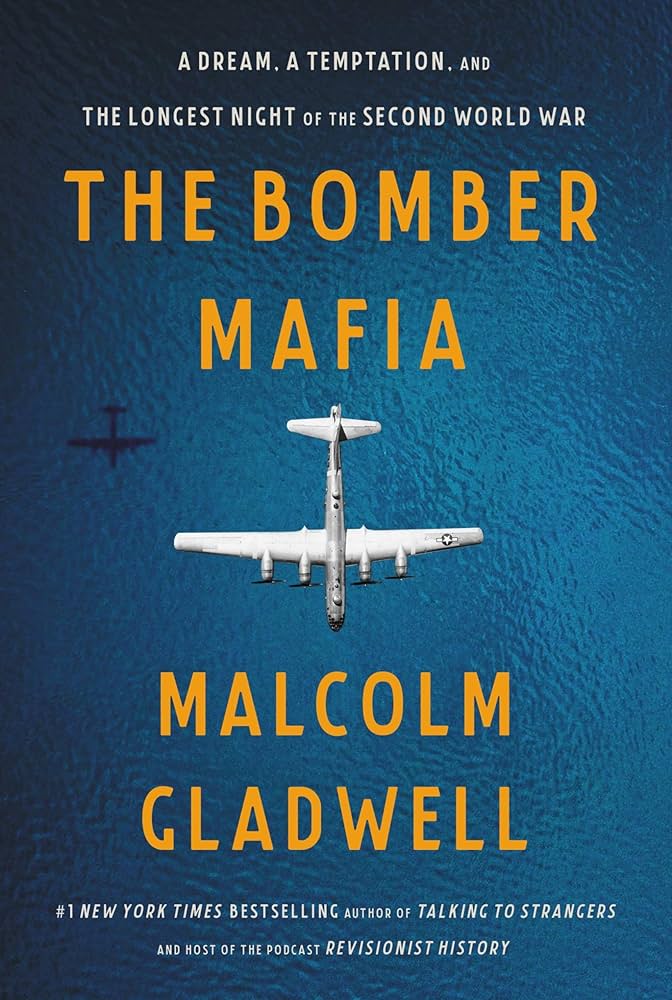
I recently received The Bomber Mafia as a gift for my birthday, and it was bad, so bad that I felt compelled to write this review. In so many ways, the book is everything that is wrong with the “pop history” genre: a bestselling author with a massive built-in audience, with a hit podcast to cross-promote the material, and a framing promise to reveal a supposedly “great untold story” about the strategic and moral struggles of American airmen in World War II. The problem in this case is that Gladwell’s narrative about Curtis LeMay, Haywood Hansell, and the evolution of strategic bombing repeatedly collides with the existing scholarship and often ignores it altogether. From his treatment of the raids of Münster and Schweinfurt–Regensburg to his use of the United States Strategic Bombing Survey and his confident claims about what compelled Japan to surrender, The Bomber Mafia exemplifies the worst tendencies of popular history: sweeping pronouncements built on selective reading, caricatured context, and a startling indifference to both primary sources and a vast secondary literature.1
I was only vaguely familiar with Malcolm Gladwell and his work, but for those who don’t know (like me until recently), he has been a staff writer for The New Yorker since 1996, has written a bunch of New York Times bestselling books on sociology, psychology, and economics, and also hosts a very popular podcast called Revisionist History.2 This is all to say he is widely known and already has a big audience that is generally receptive to his projects. The book was originally based on four episodes he did on this topic in July 2020, and then turned into print, so it isn’t so much an actual book as it is a printed podcast.3
Unsurprisingly, both the audiobook and print editions were widely acclaimed upon release. Writing in the Wall Street Journal, Yale professor Paul Kennedy praised the book as “a wonderful book”.4 The journalist Michael Lewis described it as “a riveting tale”, while the bestselling biographer Walter Isaacson called it “a wonderful narrative”.5 The book was named a Kirkus Reviews Best Book of the Year and selected as an Editors’ Choice by The New York Times Book Review. It also enjoyed significant commercial success, reaching number two on The New York Times Best Sellers list.6 To promote the book, Gladwell made appearances on Jimmy Kimmel, MSNBC, and CBS’s Sunday Morning show. MSNBC even stated in the segment title that this is “A great untold story”, which is hilarious, given that I don’t know how much ink has been spilled on the strategic bombing campaigns.7
But it should be noted that the book has been criticized by virtually anyone who has seriously studied this topic. Much of the criticism of the book has come from the fact that it hardly focuses on the Japanese and German perspectives, misinterprets why members of the air tactical school focused on precision bombing, and the actual role strategic bombing played in the surrender of Japan.8 All of that is valid, but what was initially more startling to me was how little use was made of primary or secondary sources. So many important works are left out makes me wonder how much research Gladwell even put in.9 To write about strategic bombing in World War II and not include Michael Sherry’s The Rise of American Air Power, Richard Overy’s The Bombing War, Donald Miller’s Masters of the Air, Ken Werrell’s Blankets of Fire or Death From the Heavens, Geoffrey Perrett’s Winged Victory, and barely using any of the official histories is borderline negligence.10 Anyone doing research on strategic bombing and Air Power in World War II almost certainly would have come across these.
- Popular history is a form of historical writing aimed at broad audiences that usually prioritizes storytelling over real scholarship. See Gerald Strauss, “The Dilemma of Popular History,” Past & Present, no. 132 (1991): 130–49, and more recently, Ben Alpers, “The Promise and Perils of Popular History,” Society for U.S. Intellectual History, August 17, 2021.
- The show itself isn’t really a conversation with experts and historians (though they do appear) so much as storytelling.
- I would also preface that I generally don’t have a problem with this premise. There is definitely a segment of the historical profession that dislikes pop history for reasons tied as much to credentials as to content. Much “popular history” is produced by journalists, independent writers, or commentators rather than credentialed academic historians, and that fact alone generates suspicion. In some cases, this skepticism is warranted: weak sourcing, thin engagement with the scholarship, and overconfident claims do real damage. But the problem is not who writes history so much as how it is written. Plenty of non-historians have produced outstanding historical works by taking the craft seriously — immersing themselves in primary sources, engaging honestly with existing scholarship, and resisting the temptation to oversimplify for the sake of narrative punch. Conversely, academic credentials have never been a guarantee for insight or even accuracy. If a writer does the work, respects the evidence, and treats complexity as something to be explained rather than avoided, there is no real reason to dismiss the result simply because of the writer’s background.
- Paul Kennedy, “The Bomber Mafia’ Review: Architects of a Firestorm”, The Wall Street Journal, April 30, 2021.
- Summary of reviews in paperback.
- “Hardcover Nonfiction – May 16, 2021”. The New York Times.
- Malcolm Gladwell: ‘Bomber Mafia’ Looks At A Great Untold Story From WWII.
- Some critical reviews include David Fedman and Cary Karacas, “When Pop History Bombs: A Response to Malcolm Gladwell’s Love Letter to American Air Power”, Los Angeles Review of Books, June 12, 2021; Saul David, “Malcolm Gladwell’s The Bomber Mafia is misleading history-lite”, The Daily Telegraph, April 25, 2021, and Steve Agoratus, Air & Space Power History 68, no. 4 (2021): 52–53.
- This is also coming from a guy who famously wrote that achieving world-class expertise in any field is, to a large extent, a function of accumulating roughly 10,000 hours of deliberate practice, as described in his book Outliers: The Story of Success.
- Gladwell doesn’t really deal with British strategic bombing; there’s just a brief chapter on Arthur Harris. If interested, see Noble Frankland, Bomber Offensive, the Devastation of Europe (New York: Ballantine Books, 1971) Max Hastings, Bomber Command: The Myths and Reality of the Strategic Bombing Offensive, 1939-45 (New York: Dial Press/James Wade, 1979), and Norman Longmate, The Bombers: The RAF Air Offensive against Germany, 1939-1945 (London: Hutchinson, 1983).


